I will admit to being afraid of scales—the kind that weigh you, not the ones on a snake. And so my first reaction to the idea I’d be getting a free body-scanning scale with a Factor prepared meal kit subscription was something akin to “Oh no!”
It’s always bad or shameful news, I figured, and maybe nothing I don’t already know. Though, as it turned out, I was wrong on both points.
Factor is, of course, the prepared meal brand from meal kit giant HelloFresh, which I’ve tested while reviewing dozens of meal kits this past year. Think delivery TV dinners, but actually fresh and never frozen. Factor meals are meant to be microwaved, but I found when I reviewed Factor last year that the meals actually tasted much better if you air-fry them (ideally using a Ninja Crispi, the best reheating device I know).
Especially, Factor excels at the low-carb and protein-rich diet that has become equally fashionable among people who want to lose weight and people who like to lift it. Hence, this scale. Factor would like you to be able to track your progress in gaining muscle mass, losing fat, or both. And then presumably keep using Factor to make your fitness or wellness goals.
While your first week of Factor comes at a discount right now, regular-price meals will be $14 to $15 a serving, plus $11 shipping per box. That’s less than most restaurant delivery, but certainly more than if you were whipping up these meals yourself.
If you subscribe between now and the end of March, the third Factor meal box will come with a free Withings Body Comp scale, which generally retails north of $200. The Withings doesn’t just weigh you. It scans your proportions of fat and bone and muscle, and indirectly measures stress levels and the elasticity of your blood vessels. It is, in fact, WIRED’s favorite smart scale, something like a fitness watch for your feet.
Anyway, to get the deal, use the code CONWITHINGS on Factor’s website, or follow the promo code link below.
Is It My Body
The scale that comes with the Factor subscription is about as fancy as it gets: a $200 Body Comp scale from high-tech fitness monitoring company Withings. The scale uses bioelectrical impedance analysis and some other proprietary methods in order to measure not just your weight but your body fat percentage, your lean muscle mass, your visceral fat, and your bone and water mass, your pulse rate, and even the stiffness of your arteries.
To get all this information, all you really need to do is stand on the scale for a few minutes. The scale will recognize you based on your weight (you’ll need to be accurate in describing yourself when you set up your profile for this to work), and then cycle through a series of measurements before giving you a cheery weather report for the day.
Withings
Body Comp Smart Scale
Your electrodermal activity—the “skin response via sweat gland stimulation in your feet”—provides a gauge of stress, or at least excitation. The Withings also purports to measure your arterial age, or stiffness, via the velocity of your blood with each heartbeat. This sounds esoteric, but it has some scientific backing.
Karoline Leavitt concluded her first year as the White House press secretary with a new collection of photos reflecting on the final days of 2025.
The look back at a bustling holiday season included appearances from the 28-year-old’s older husband, Nicholas Riccio, their son Niko, Donald Trump, Santa Claus, relatives, and gussied-up White House guests.
Karoline Leavitt looks back on her merry 2025 holiday season, but fans derail her joy with comments about her 60-year-old husband, Nicholas Riccio. (Photo by Chip Somodevilla/Getty Images)
She captioned the carousel of memories, “A December full of White House Christmas magic, precious time with family, and pure love.”
Also featured, though not prominently shown, is Leavitt’s growing belly. Leavitt announced her second pregnancy on Dec. 26, revealing that she and Riccio, 60, are expecting a baby girl in May 2026. “My husband and I are thrilled to grow our family and can’t wait to watch our son become a big brother,” she gushed in the post.
Leavitt gave birth to her and Ricco’s son in June 2024, and she returned to work under Trump days later. The newlyweds tied the knot in January 2025, just days before Trump’s inauguration. Although the carousel offered 12 photos for followers to comment on, people seemed most interested in the expectant parents. Her most devoted hecklers snarked remarks like, “Is the baby his or Trump’s?”
Defenders tried to shut down the inflammatory assertion to no avail. According to one detractor, the paternity of the unborn child has been a buzzing topic among folks outside of social media.
That individual fueled speculation of a Trump-Leavitt lovechild when they wrote, “It actually might be, have you considered that… I work at the White House and there are whispers about it.”
Others are still struggling to make sense of Leavitt and Riccio’s 32-year age gap. Someone harping over the real estate investor’s senior station in life commented, “When the baby is ten, her father will be SEVENTY! That is absurd.”
Similarly, a critic remarked, “Those poor kids must enjoy it while it lasts …. due to mummy’s greed and ambition they will have a daddy too old to kick a football with them and senile or gone long before they finish college…. Shockingly selfish!! If he was simple middleclass with no connection to Trump would you have married him?? Definitely not.”
i was today years old when i found out that the year karoline leavitt started kindergarten as a tiny little girl her future husband was 37 years old pic.twitter.com/mTJOTZPq3k
The Saint Anselm College alumna described the relationship as “atypical.” In November, Leavitt appeared on the “Pod Force One with Miranda Devine” show, where she bragged, “He’s a self-made man, which I respect… He’s built his career, so he’s in a place where he can support me in mine.”
When asked if she was unable to connect with closer to men her age, Leavitt stated, “Honestly, no, if you want to know the truth.” She also admitted that her family was initially not on board with the relationship.
A deeper dive into the post’s comment section revealed that folks also weren’t done criticizing the former congressional candidate’s appearance. A heckler told her, “With every lie you’re aging a day. Thought you were mid 40s, poor girl.”
And another user typed, “Risking a pregnancy for lip filler is insane. Any practitioner who injected you should lose their license immediately. This is beyond irresponsible. You’re disgusting.”
Leavitt came under fire for what appeared to be injection sites and scabs around the perimeter of her mouth during a Vanity Fair shoot. The untouched images also highlight wrinkles around her eyes. She hit back at the criticims by uploading behind-the-scenes photos from a televised interview proving she still has a youthful glow.
Great Job Angelina & the Team @ Atlanta Black Star Source link for sharing this story.
Copper had its best year since 2009, fueled by near-term supply tightness and bets that demand for the metal key in electrification will outpace production.
The red metal has notched a series of all-time highs in an end-of-year surge, rallying 42% on the London Metal Exchange this year. That makes it the best performer of the six industrial metals on the bourse. Prices dipped 1.1% Wednesday, the last trading day of 2025.
The latest gains also have been driven by traders rushing to ship copper to the US in anticipation of potential tariffs, creating tightness elsewhere. Trump’s plan to revisit the question of tariffs on primary copper in 2026 revived the arbitrage trade that rocked the market earlier in the year, tightening availability elsewhere even as underlying demand in key buyer China has softened. That price spread narrowed recently amid a power December rally on the LME.
“The expectation for future US import tariffs on refined copper has resulted in more than 650,000 tons of metal entering the country, creating tightness ex-US,” wrote Natalie Scott-Gray, senior metals analyst at StoneX Financial Ltd. She noted two-thirds of global visible stocks now are held within COMEX.
Beyond the tariff-driven flows, a deadly accident at the world’s second-largest copper mine in Indonesia, an underground flood in the Democratic Republic of Congo and a fatal rock blast at a mine in Chile have all added more strain to availability of the metal.
The near-term outlook for copper demand growth has been clouded by weakness in China, the world’s top consumer of the red metal. The country’s property market has been stuck in a yearslong downturn that’s dented the need for copper plumbing and wiring, while consumer spending has been sluggish, weighing on appetite for finished goods such as electronic appliances.
Still, robust momentum in global copper demand is expected over the long term. BloombergNEF estimates consumption could increase by more than a third by 2035 in its baseline scenario.
The drivers of this trend include the ongoing shift to cleaner energy sources such as solar panels and wind turbines, growing adoption of electric vehicles and the expansion of power grids.
Copper settled 1.1% lower at $12,558.50 a ton in London. Prices hit a record $12,960 on Monday.
FOXBOROUGH, Mass. – New England Patriots coach Mike Vrabel said he’s confident criminal cases against receiver Stefon Diggs and defensive lineman Christian Barmore won’t be a distraction for his team this week as it chases the AFC’s top seed in the playoffs.
The Patriots are currently 13-3 and have already wrapped up their first AFC East title since 2019. With a victory against the Miami Dolphins on Sunday and a loss or tie by the Denver Broncos against the Chargers, New England would also secure the conference’s top seed in the playoffs and a first-round bye.
“I think these are allegations. … Things that we have to handle,” Vrabel said. “Every day there are distractions, some are smaller than others. I’m confident that we’ll focus on the Dolphins. And those two individuals (Diggs and Barmore) will be able to handle the ongoing legal process.”
Vrabel said Barmore is dealing with an illness and was not with the team for practice on Wednesday. Diggs didn’t speak with reporters Wednesday as he has typically done throughout the season. But he was in the locker room prior to practice and on the practice field with the team.
The NFL said in a statement that both players are eligible to play when the Patriots host the Dolphins. But the league is looking into the alleged incidents, saying they are being reviewed under the NFL’s Personal Conduct Policy.
That policy could make both players subject to placement on the Commissioner Exempt List. If placed on that list, it would prevent them from practicing or playing in games while the NFL investigates.
Diggs and Barmore’s teammates said things were business as usual as the team returned to the practice field.
“They’re our brothers no matter what. And at the end of the day we’re focused on the Dolphins,” right tackle Morgan Moses said.
Diggs in particular has been a vocal leader for the Patriots this season, giving the team energetic pregame speeches, and he has been one of the most visible players on the sideline during games.
“In the role that he’s played in this locker room as a leader is one that no one else can compare to,” Moses said. “He carried this team on the field as a professional and as a player, as an older player showing the younger guys what to do. That’s what we look for. That’s our guy. He has a situation that he’s going to handle. For us in this locker room we’re just going to take take it one day at a time and continue playing.”
News of the charges against Diggs emerged after a court hearing Tuesday in Dedham, Massachusetts. According to police, the chef told investigators that Diggs hit her and tried to choke her during a discussion about money.
The Patriots voiced their support for Diggs in a statement Tuesday after the allegations became public.
“We’ve made a statement and we’ve taken the allegations very seriously,” Vrabel said. “I don’t think we have to jump to any sort of conclusions right now. Let the process take its toll.”
Diggs’ lawyer, David Meier, said in an emailed statement that Diggs “categorically denies these allegations.” Meier described the allegations as unsubstantiated and uncorroborated.
A court arraignment is scheduled for Jan. 23 for Diggs.
Meier also represents Barmore and the attorney issued a statement Wednesday saying the evidence in the Barmore case “will demonstrate that no criminal conduct took place.”
Barmore’s arraignment is scheduled for early February.
Diggs, 32, joined New England before this season after a trade from Houston. He has been a standout player for the Patriots, leading the team with 82 catches and 970 yards receiving. Barmore, 26, has appeared in all 16 games this season with 15 starts. He has 26 total tackles and one sack.
___
AP reporters Mike Casey in Boston, and Mark Scolforo in Harrisburg, Pennsylvania contributed.
Copyright 2025 The Associated Press. All rights reserved. This material may not be published, broadcast, rewritten or redistributed without permission.
Great Job Kyle Hightower, Associated Press & the Team @ KSAT San Antonio Source link for sharing this story.
This is an edition of The Atlantic Daily, a newsletter that guides you through the biggest stories of the day, helps you discover new ideas, and recommends the best in culture. Sign up for it here.
Because every day is Black Friday at Costco, I choose to go on Saturday. I like to get there early. I always park in the same spot (right next to the cart return), and wait with the other die-hards. It has the thrill of a stakeout, absent any crime or danger. When the doors open, we move toward the entrance in an orderly march. There’s a small gasp upon entry—the kind of quiet awe that one feels before the most epic human achievements, as when stepping across the threshold of St. Peter’s or the Chartres Cathedral. But in this place, there is no baroque majesty, no stained glass, just abundance bathed in light. In the sweep of human history generally marked by scarcity and want, here is bounty on an unimaginable scale; here is a year’s supply of mozzarella sticks; here is a hot dog and a drink for $1.50; here is a monument of our civilization, in more than 600 locations across the United States.
I take the ease with which I resort to Costco talk—about produce prices in particular—as a worrying sign that I’ve become a middle-aged bore. But there’s something happening at Costco that I think goes beyond bell peppers (note that my family eats a lot of them, and, boy, are they a bargain). Costco is a marvel not just historically but also in this moment. In an age of broken institutions, insufferable politics, and billionaire businessmen auditioning to be Bond villains, most things feel like they’re getting worse. Costco seems to stay the same. The employees are generally satisfied. The customers are thrilled by the simple act of getting a good deal. All of it makes a unique space in contemporary American life, a space of cooperation, courtesy, and grown-ups mostly acting like grown-ups.
It starts with the thing you’re pushing, the vessel into which you shall receive thy bounty. The cart is improbably large yet easily maneuvered through the warehouse’s aisles. Through some invisible quality control, the sad and broken-down ones you find at the supermarket—unlevel, rear wheel locked, front wheel spinning—seem to be ushered quietly into oblivion at Costco. You’re at the helm of a Peterbilt with the handling of a Porsche.
Traffic is never light, but things generally move along. Pushing something that large requires an awareness of oneself in space. Those who might need to consult a list or message their spouse—should I grab this brick of cheddar cheese?—seem to know to step off to the side. At my store in Granger, Indiana, where elbows are perhaps not as sharp as at some other locations, patrons appear to have an unspoken patience with the person who wants to give a bag of avocados an extra squeeze, or hold a double shell of raspberries up to the light. There are occasional expressions of camaraderie as well: “We can’t get enough of that stuff,” somebody might say as you load two pillow-size bags of Pirate’s Booty into the cart.
You might see the bargain-hunting bonds among Costco shoppers as a function of the chain’s history. To join its ranks costs $65 a year; the store’s membership model originates from a nonprofit wholesale collective for federal employees called Fedco, founded in Los Angeles in the 1940s. The genealogy is complex (a three-hour-long Acquired podcast episode traces it in full), but one trait has endured: the company is animated—even as a for-profit enterprise—by the idea of bringing good value to its members. This has yielded a cultlike loyalty, such that the company can largely rely on happy members to do its advertising and marketing by word of mouth—or perhaps by wearing prized company merch. Kirkland Signature, Costco’s in-house label for hundreds of products, is a kind of anti-brand that happens to be one of the world’s largest for consumer packaged goods. Just buying something under its comically dull logo makes you feel like a smart shopper: You’ve made the wise decision to forgo a better look for a better price.
Costco is a place that encourages, and rewards, just knowing the drill—and the drill isn’t hard to figure out: Move along. Don’t block the way. Unload your cart onto the conveyor belt with dispatch, but leave the heavy stuff. Make the barcodes visible. Violators are never exiled, but transgression, I know from experience, is not without shame. Once, I left the cart in front of the flower display loaded down with 120 pounds of water-softening salt. When I returned, the grandmother who was blocked from the flowers (find me a cheaper dozen roses!)—well, she gave me the finger.
The veneer of civilization is always thin, even at Costco, as one is reminded before major holidays, or in the vicinity of the samples. When there’s a Christmas feast to be provisioned, or half a bite of pizza to be tasted, order breaks down, and with it, spatial awareness, common courtesy, and the Golden Rule. We’re circling like buzzards; we’re blocking the way; we’re shaking our heads at the nerve of the person who took the last three.
But the checkout restores us to our senses. At my Costco, there is usually a line to get in line for the cashier. People can game the system, but most quietly queue up, content to wait their turn to pick a register. The clerks are cheerier than they should be before this endless current of humans and their stuff. Whatever lapses I might have had in the store (did I take a second sample? maybe), here, I’m on my best behavior.
Out of the store, car loaded, cart returned, I tighten up and steel myself for the road. Have you seen the way these people drive nowadays?
Related:
Evening Read
Americans Need to Party More
By Ellen Cushing
(Aleksandra Mihajlovic / Connected Archives)
This much you already know: Many Americans are alone, friendless, isolated, undersexed, sick of online dating, glued to their couches, and transfixed by their phones, their mouths starting to close over from lack of use. Our national loneliness is an “urgent public health issue,” according to the surgeon general. The time we spend socializing in person has plummeted in the past decade, and anxiety and hopelessness have increased. Roughly one in eight Americans reports having no friends; the rest of us, according to my colleague Olga Khazan, never see our friends, stymied by the logistics of scheduling in a world that has become much more frenetic and much less organized around religion and civic clubs. “You can’t,” she writes, “just show up on a Sunday and find a few hundred of your friends in the same building.”
But what if you could, at least on a smaller scale? What if there were a way to smush all your friends together in one place—maybe one with drinks and snacks and chairs? What if you could see your work friends and your childhood friends and the people you’ve chatted amiably with at school drop-off all at once instead of scheduling several different dates? What if you could introduce your pals and set them loose to flirt with one another, no apps required? What if you could create your own Elks Lodge, even for just a night?
I’m being annoying, obviously—there is a way! It’s parties, and we need more of them.
The past year in rhythm and blues music has seen its fair share of high and low notes depending on how you look at things.
We saw Beyoncé finally win the coveted GRAMMY Award for “Album Of The Year,” albeit for a project that’s predominately considered to be a country offering. Granted, the past three-decades-and-counting has seen the superstar diva incorporate soul into pretty much anything she touches sonically, which could arguably put Cowboy Carter in the category of ‘country-soul‘ even as it took home “Best Country Album” at the GRAMMYs in addition to “Favorite Country Album” at the American Music Awards.
Lest we mention that Beyoncé also broke records with each passing show this past summer in the Cowboy Carter Tour, including holding the title of highest-grossing tour at MetLife Stadium, Mercedes-Benz Stadium, Soldier Field and Tottenham Hotspur Stadium in London.
Love Entertainment? Get more! Join the Black America Web Newsletter
SZA was a hit both on the Billboard charts and box office alike, grossing major ticket sales in her film debut with the Keke Palmer-assisted One of Them Days, while simultaneously nabbing “Best R&B Song” at the GRAMMYs for her Lana album lead single, “Saturn.” 2025 also saw her top the Billboard Hot 100 as the prime guest on Kendrick Lamar’s GNX sleeper hit, “Luther,” and ended the year right alongside him a few weeks ago (December 11) by closing out what’s now been officially deemed the highest-grossing co-headlining tour in music history.
Oh, and she’s going into 2026 as the Artistic Director for VANS in a multi-year partnership. We shall for sure see SZA run!
Awards season saw the vets getting their flowers as well, from Alicia Keys receiving the special GRAMMY Global Impact Award and Janet Jackson’s Icon Award at the aforementioned AMAs to Mariah Carey raking them in from the BET Ultimate Icon Award to the VMAs Michael Jackson Video Vanguard Award. Amongst those who received Lifetime Achievement Award GRAMMYs were late soul icons Prince (1958 – 2016) and Frankie Beverly (1946 – 2024).
We saw rising stars continuing to ascend both from the male and female perspective equally, with Warner Records standout Dijon delivering his critically-acclaimed sophomore follow-up, Baby, and Capitol Records’ new Brit-soul babe Olivia Dean having a crossover moment on a level akin to the late Amy Winehouse with her chart-topping breakout sophomore success, The Art of Loving. Nickelodeon-star-turned-genre-breakout Leon Thomas has probably been the most surprising as well as intriguing, spending the year doubling down on the success of his 2024 sophomore magnum opus, MUTT, with a deluxe edition that arrived in spring before closing out the year with a quality EP — more on that later. Although all three have been releasing EPs in their own right since the late 2010s, watching them have respective breakout moments in 2025 is only a testament to trusting where the blues can take you if you simply stick to the rhythm and allow timing to work everything out.
Touring is where R&B stars of past and present alike were truly able to get into their bag. Whether it was pioneering soul divas like Chaka Khan, Patti LaBelle, Gladys Knight and Stephanie Mills teaming up together for The Queens: 4 Legends. 1 Stage Tour, or ’90s teen-queens-turned-titans Brandy & Monica joining forces once again for The Boy Is Mine Tour with Keyshia Cole, Coco Jones, Muni Long, Mya, Jamal Roberts and Kelly Rowland as supporting acts, it really wasn’t hard to see your favorite living soul singer this year. Lionel Richie served the aunties up something proper on his Say Hello to the Hits Tour, as did Trey Songz, Omarion, Ray J, Sammie, Bobby V, Pleasure P and Nivea on The Millennium Tour 2025 for all the ‘millennial mommies’ in the building. Mariah Carey had a grand year all-around, closing it out as she usually does with the number one record in the country while also grossing in millions on her recent Christmastime In Vegas residency in support of her evergreen 1994 holiday hit, “All I Want for Christmas Is You.” Mary J. Blige had similar success on her For My Fans Tour, as did Janet with her Las Vegas residency and special one-off shows from the Cotton Bowl Stadium in Texas to the Yaamava’ Theater in San Bernardino. The fellas of the game were simply cashing in as Usher (Past Present Future Tour), Chris Brown (Breezy Bowl XX) and The Weeknd (After Hours til Dawn Tour) each grossed well over 100 million in sales, respectively.
The aforementioned success did come with tragic moments as well given the unfortunate loss of many R&B greats, from Roberta Flack on February 24 and Angie Stone on March 1 to Roy Ayers just days later on March 4 and the still-jarring death of D’Angelo on October 14 amongst a handful of others. We will miss each and every one of their voices along with their physical presence, while never forgetting the serenading gifts that each fallen icon brought to the world of rhythm and blues.
Float on. Float on…
Take a look below at our official compilation of the top 20 R&B album to release in 2025. We definitely missed a few, so let us know where you agree and who you would’ve added (or taken off). Happy New Year — see you in 2026!
The Weeknd, Hurry Up Tomorrow JANUARY 31
Great Job Keenan Higgins & the Team @ Black America Web Source link for sharing this story.
People walk down the re-opened Bourbon Street after New Orleans Police barricades are moved out of the way. (Halle Parker | WWNO)
NEW ORLEANS (AP) — National Guard members arrived in New Orleans Tuesday to help with safety measures ahead of New Year’s celebrations as city officials are still seeking permanent security solutions nearly a year after a truck attack on Bourbon Street left 14 dead.
The rampage, in which a man from Houston drove around a police blockade in the early hours of Jan. 1, revealed security vulnerabilities surrounding the city’s famous street filled with boisterous bars, brass bands playing on cobblestone corners and a steady stream of partygoers carrying cocktails.
While Louisiana officials say the popular tourist destination is safe and that they’ve implemented additional measures to crack down on potential threats, families of deceased victims say not enough has been done to prevent similar tragedies.
Searching for answers
The attack happened when Shamsud-Din Jabbar drove a pickup truck down Bourbon Street, plowing into crowds celebrating New Year’s Day, killing 14 people and injuring dozens of others. Police shot and killed Jabbar, a U.S. citizen and Army veteran who had proclaimed his support for the Islamic State militant group on social media.
In the wake of the rampage, city officials, state agencies and law firms representing victims’ families launched investigations into whether the attack could have been prevented. The investigations focused on the street’s bollard system of steel columns designed to block cars from entering the thoroughfare. The bollards were being replaced at the time.
Among the victims were Nikyra Dedeaux, an 18-year-old about to start college who was on Bourbon Street with friends. Her mother, Melissa Dedeaux, told The Associated Press on Tuesday that while many will ring in 2026 with fireworks and merriment, she will be grieving. She has been haunted by her daughter’s final moments, captured in graphic video that circulated on social media.
“I’m a parent that had to wake up, log on my Facebook account and see my daughter’s last days — my daughter’s last time. I didn’t get to see her on Bourbon the night it happened. I saw her on a video,” she told the AP.
“I saw no safety,” Dedeaux said. “I saw that my daughter could still be here.”
Proposing permanent solutions
Questions still swirl around the street’s barricade system, which is a patchwork of bollards, strategically parked police vehicles and 32 large steel barriers that officers push into place every night to form pedestrian zones.
“They are not meant to be utilized in the fashion they are,” Samuel Palumbo, the 8th District New Orleans Police Department Captain, said of the barriers that can withstand only low-speed collisions. He stressed to the New Orleans Governmental Affairs Committee this month that the system is a “temporary solution to a permanent problem.”
“We need to learn from what happened,” Morris Bart, whose law firm is representing victims and their families, told reporters Tuesday. “It’s kind of ridiculous … that a year after this tragedy nothing has been done to resolve this situation.”
Palumbo urged the city to install permanent security gates that can withstand crashes up to 50 miles per hour (80 kilometers per hour). The committee opted to hold off on a vote until incoming Mayor Helena Moreno enters office in January.
A consulting firm, hired by the city to conduct a security assessment, made another suggestion: Make Bourbon Street a pedestrian only area.
While much of the street is limited to pedestrians at night, the recommendation — which victims’ families have supported — was largely ignored after French Quarter residents and business owners raised concerns about accessing their homes and businesses.
National Guard’s arrival
As the city prepares for round-the-clock revelry, 350 National Guard members deployed by President Donald Trump’s administration arrived to New Orleans.
A couple dozen members wearing army fatigues, with guns in their holsters, could be seen Tuesday night throughout the city’s historic French Quarter, home to Bourbon Street. They stood near barricades, sipping cups of coffee and even chatting or taking pictures with passersby.
Troops will stay through Carnival season, when tourists descend on the Big Easy to partake in costumed celebrations and parades that snake through city streets before ending with Mardi Gras in mid-February.
Republicans and Democrats have supported the additional resources — which also include state police troopers and Louisiana Wildlife and Fisheries officers. Mayor-elect Moreno said she appreciates the troops’ presence and that it increases the “visibility of security assets during major events.”
Longtime French Quarter worker Miguel Thornton said he’s happy to see armed troops a year after the attack.
“A lot of the service industry professionals that were out here were affected — they saw the carnage, they had to step over bodies — and so people were definitely changed,” Thornton said. “As far as the National Guard, they’ve been here before. Honestly, they’re welcome.”
Remembering 2025
Louisiana has a famous Cajun French phrase, “Laissez les bon temps rouler,” or “Let the good times roll.” In New Orleans, a city that heavily relies on tourism, the show always goes on in the entertainment district — even in the face of tragedy.
After the Bourbon Street attack, the strip was closed down as emergency crews tended to the injured, bodies were removed and blood was washed from the streets. By the next day, before all the victims had even been identified by the coroner, the street was reopened. Within a few months, handwritten tributes at the site of the attack had been painted over.
As the anniversary nears, tourists again flock to Bourbon Street for New Year’s celebrations. This time, suspended above them are hundreds of handcrafted flags honoring the victims.
Buck Harley, who manages a Bourbon Street cigar shop, said he has had to explain the memorial to patrons.
“We seem to as a society forget. And I don’t think it’s because of a lack of empathy but because there’s another big story taking its place,” Harley said. “I have to tell the tourists what the flags are up there for, because it’s forgotten already.” ___ Cline reported from Baton Rouge. ___ Brook is a corps member for The Associated Press/Report for America Statehouse News Initiative. Report for America is a nonprofit national service program that places journalists in local newsrooms to report on undercovered issues.
Great Job & the Team @ Houston Public Media for sharing this story.
The sound that wrenched Lucian Davis awake was a phone notification from the wildfire-tracking app Watch Duty. There was a fire just a few miles downslope from the tent where he had been sleeping.
Davis was the lead bander at the Lucky Peak station, a research site run by Boise State University’s Intermountain Bird Observatory (IBO) near the school’s namesake city. It sits within a small patch of mountaintop scrub and Douglas fir forest, surrounded on nearly all sides by sagebrush steppe. Each fall, the station hosts seasonal field technicians who study the songbirds, raptors and owls that stop at the island of habitat in a sea of open country.
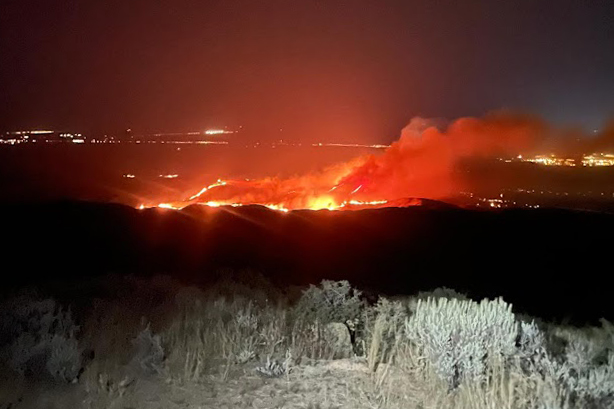
But on October 4, 2024, that open country was burning. At 6:15 that morning, when the alert awakened Davis, the fire was climbing toward the research station, where eight technicians and a class of 6th graders on an overnight school trip were camping.
The teachers woke their kids and got them onto the bus, but as they were driving down the mountain, the fire jumped the main road. Flames licked the sides of the bus, but the students and teachers made it out unharmed.
Meanwhile, the station’s crew grabbed their data sheets and piled into their cars, leaving their tents and gear behind. With fire surrounding the main road, they bounced down an unmaintained back route and made it to safety by 8:30 a.m.
From Boise, the crew watched the blaze creep up the mountain as ash speckled their cars.
The Valley Fire, as seen looking down from the top of Lucky Peak, burns in the early morning before dawn. Credit: Heather Hayes
“For like an hour or two, we couldn’t see the top at all from in town. It was just totally obscured by all the smoke,” Davis said. “Then, when we could actually see it, I was like, ‘Oh shit.’”
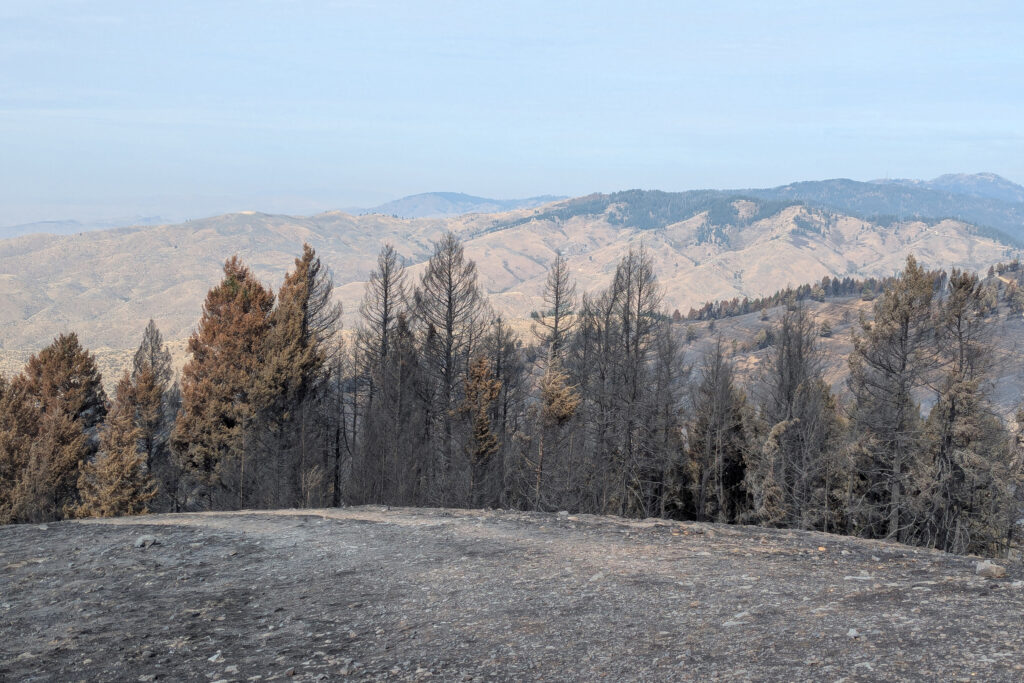
Even from the base of the mountain, the crew could see that the peak’s trees were bare and blackened. It was clear the fire had reached the station.
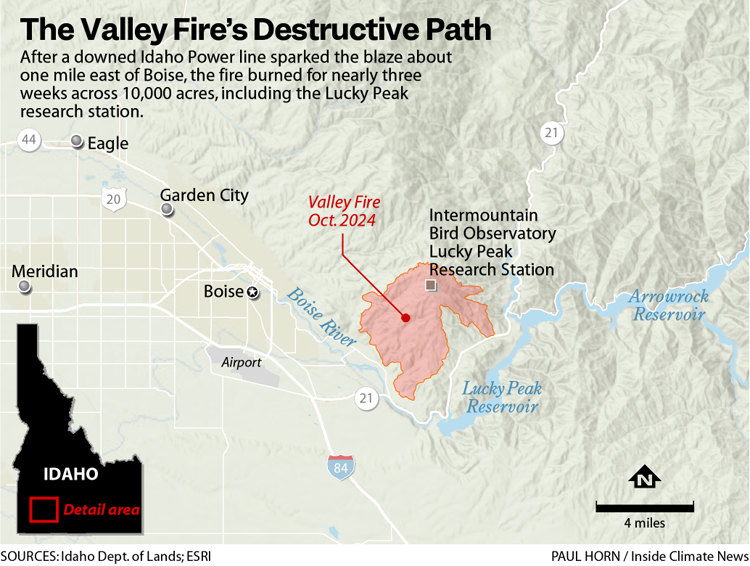
The Valley Fire lasted for three weeks and burned more than 10,000 acres, including about half of the bird research station’s grounds. The fire melted research equipment, destroyed nearly all of the technicians’ camping gear and personal possessions and turned the blind from which the crew studied raptors, which was graffitied with 30 years of researchers’ drawings and signatures, to ash.
But while devastating to the station’s staff, the fire also presented a rare research opportunity.
No bird research station had ever been impacted by a wildfire like this, so detailed studies of how a blaze would impact the animals and their habitats is hard to come by. Lucky Peak, meanwhile, has 30 years of data on its birds from before the fire. By collecting comparable data after the blaze, they could investigate aspects of fire ecology that were nearly impossible to study before.
But while fire is a natural and healthy component of an ecosystem, the Valley Fire didn’t happen in a vacuum. Invasive grasses downslope likely made the fire spread faster, said retired Forest Service and Bureau of Land Management fire ecologist Louisa Evers, who volunteers with IBO, and climate-driven drought may have stoked it. Now, the hotter climate and invasive plants will likely shape the way that the peak regrows. So regardless of how the birds of Lucky Peak respond to the fire, their habitat may never be the same.
Some Birds Rise, and Others Fall
Nearly a year after the fire, the road up Lucky Peak was still lined with charred bitterbrush and the husks of burned trees filled the hillside behind the station. The slope that once hosted the crew’s camp was barren and ashy, the site speckled with hunks of melted plastic from tents and sleeping bags.
But the station’s laboratory, housed in a yurt, and its kitchen tent survived mostly unscathed, as did some areas of thicket and Douglas fir forest.
“I was worried it was going to be totally nuked,” said Heidi Ware Carlisle, education director at IBO. “The views were sort of whiplash. In a single photo, it can look totally fine or totally terrible.”
The view from Lucky Peak one week after the Valley Fire. Credit: Heidi Ware Carlisle
In some ways, it was the best case scenario, she said. The fire created a mixture of old habitat with young shrubs and wildflowers between them, which with time will likely improve the productivity and diversity of the ecosystem.
Mornings on the peak progressed through the fall as they did before the fire. At sunrise, the crew opens up a series of “mist nets”—ultra-fine netting stretched between two aluminum poles. Every half hour, they go and check what birds flew into the nets, extract them and bring them back to the lab.
There, a designated bird bander attaches an aluminum cuff with a unique nine-digit code to each bird’s leg and runs it through a series of measurements: wing length, tail length, age, sex, fat content, muscle size, parasite load. The results are stated as a series of letters and numbers that another researcher transcribes. After a few minutes, the bander releases the befuddled bird with a new anklet.
Before the fire, this data helped illuminate how important this montane forest habitat is for migrating songbirds, said Jay Carlisle, research director at IBO, and Heidi’s husband. Now, it will also provide a point of comparison for data gathered since the fire.
The songbird team sets up a mist net in what used to be a net lane through dense cherry shrubs and Douglas fir trees. Credit: Heidi Ware Carlisle
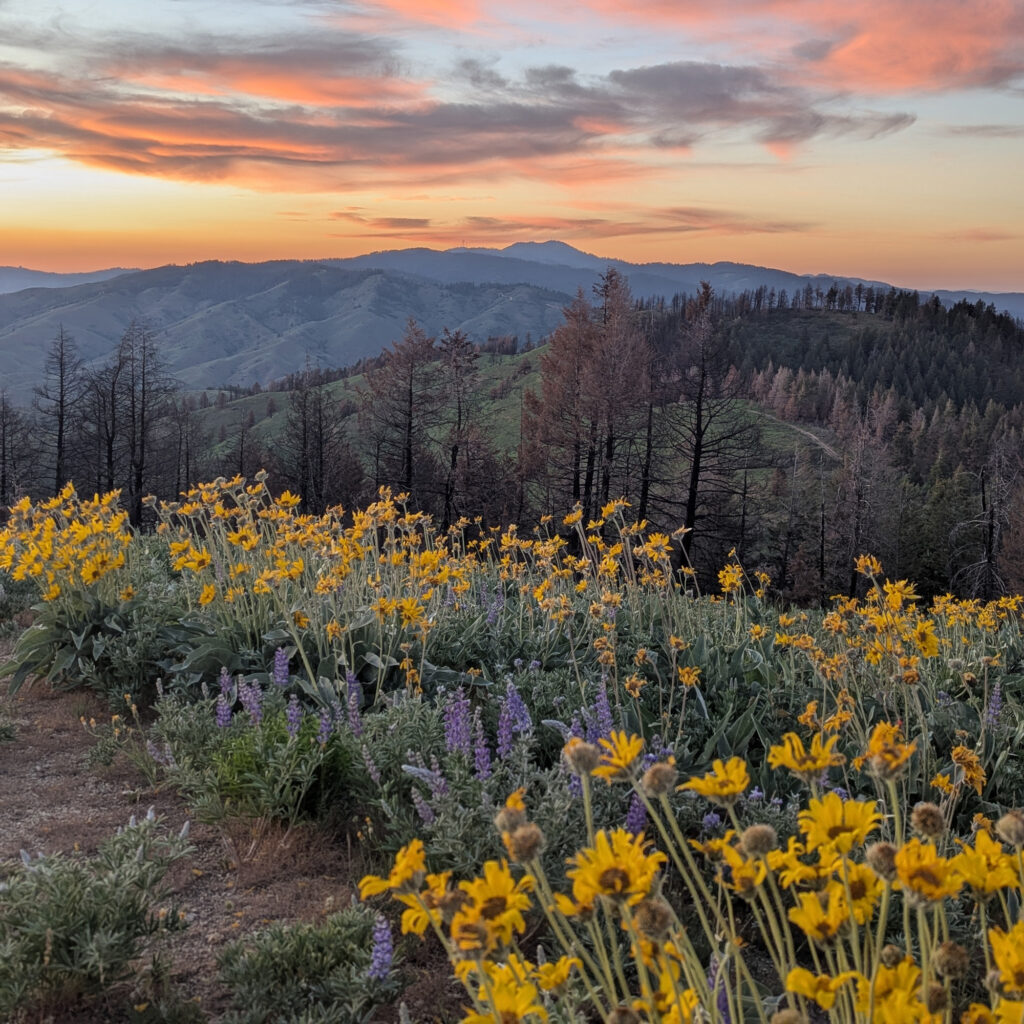
A view of sunset looking north from Lucky Peak. Burned forest is seen in the background with plants resprouting in the foreground. Credit: Heidi Ware Carlisle
Some changes are already obvious. After the blaze, rock wrens and lark sparrows, both open-country birds, nested on the peak for the first time on record. A pair of Lewis’s woodpeckers excavated a nest cavity in a burned tree. Lazuli buntings, which rely on new growth, have boomed in the surge of vegetation that followed the fire.
But for other birds, the fire was a serious hit. During summer banding, the crew caught fewer forest birds like dusky flycatchers and Nashville warblers.
The new sightings and population declines reflect these birds’ well-known habitat preferences, Heidi noted. The most useful insights that Lucky Peak can provide will come from the data the researchers collect while banding—fat stores, age ratios, whether individual birds return after the fire, said Richard Hutto, University of Montana professor emeritus who studies avian fire ecology and is not involved with the bird observatory. “That kind of thing you’d never get out of basic surveys,” Hutto said.
While only preliminary, the data from last summer’s breeding season paints a picture of a struggling bird community. They carried less fat than before. Their wing muscles were weaker. Their bodies carried more blood-sucking flat flies. Jay also noted that, while catching 40-80 birds a day used to be typical in the early autumn, 30-40 birds was considered a good number this fall.
Songbird technician Tyler Jensen also noted that local nesting birds weren’t sticking around to raise their young. “The birds just basically disappear as soon as the fledglings can fly,” he said. Young birds were also scarce in mid-July, when the station’s nets are typically full of just-hatched fledgelings, possibly because the juveniles left with their parents, or, more likely, because most nests on the peak failed to produce any youngsters.
This summer, banding revealed another trend. During 2023 and 2024, about 15 percent of the birds that they captured during the breeding season were at least two years old. This year, that number was around 35 percent.
Heidi hypothesizes that the banding area has some of the peak’s best remaining habitat, so these older adults concentrate there and push the younger birds out. Or the older birds may return because they nested there before the fire while the younger birds don’t find any of the remaining habitat well-suited to them and head elsewhere.
As birds migrate in the fall, research at Lucky Peak can show how they use the freshly burned habitat, a subject that has barely been researched at all, Hutto said. When it comes to fire, “there’s some neat biology that goes on during the nonbreeding season, and very little published on [it].”
Later in the fall, owl banders and hawkwatchers joined the crew to collect data that may help clarify how those birds respond to fire.
Despite these short-term changes, Evers noted that the fire probably benefited the peak’s forests by burning through trees impacted by parasitic dwarf mistletoe and encouraging new growth.
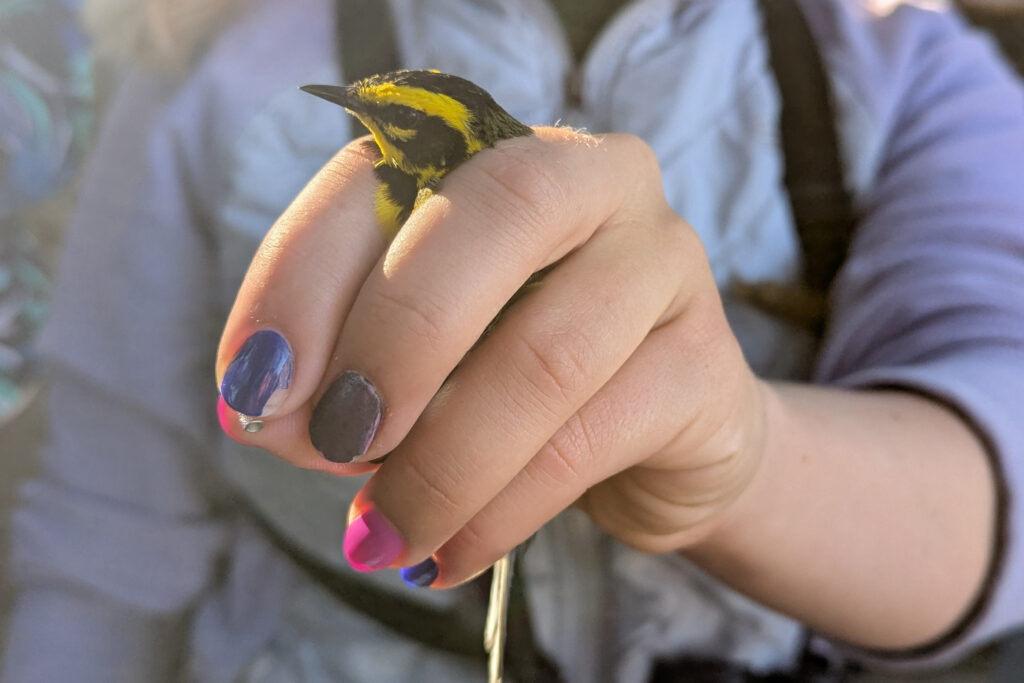
Zoe Bonerbo bands an adult male Townsend’s Warbler at Lucky Peak on June 8. Credit: Heidi Ware Carlisle
Fire is an important and natural component of nearly every ecosystem, Hutto stressed, even when it is a dramatic disturbance or has short-term negative effects. Without a natural fire cycle, he said, there would be no scrub, no fields, no young forests and no habitat for the vast majority of birds.
But climate change and invasive species are disrupting that cycle.
Invasive Grasses Flourish in Fire, Displacing Critical Sagebrush Habitat
“From here, you can see perfectly the problem.”
Ann Moser is standing at the archery range a few miles downslope of the Lucky Peak research station. Nearly all of the landscape here, which was once a sagebrush steppe, was burned.
One small section of the hillside is covered in native yellow bunchgrasses. This, she explains, is what would typically spring up after a fire—their deep roots nourish the soil and preserve its moisture for the bitterbrush and sagebrush that follows.
The rest of the hillside is carpeted in thick green grasses. “Rush skeletonweed,” she said.
Rush skeletonweed is one of two particularly problematic plants for Moser who, as a wildlife biologist for Idaho Fish and Game, is watching over Lucky Peak’s recovery. Cheatgrass is the other. Both plants are invasive species from Eurasia, and both seem primed to change the cycle of fire on the mountain.
Cheatgrass and rush skeletonweed germinate in late fall, when most other plants are dormant, and grow through the winter, their short roots sucking the moisture out of the topsoil. Come spring, they die, shedding their seeds and creating a thick layer of what firefighters call “fine fuel” that ignites easily and burns fast. If a fire comes, the grasses’ seeds have evolved to survive it and germinate quickly, so the invasives can absorb all the fresh nutrients in the soil before other plants have a chance to grow.
The grasses have been present at the base of Lucky Peak for a while, but the Valley Fire supercharged their growth.
“The whole front range facing the town of Boise is all south facing,” Moser said, noting the invasive grasses do best on slopes with that aspect. “It’s hot and dry, and it’s going to be the hardest part to recover.”
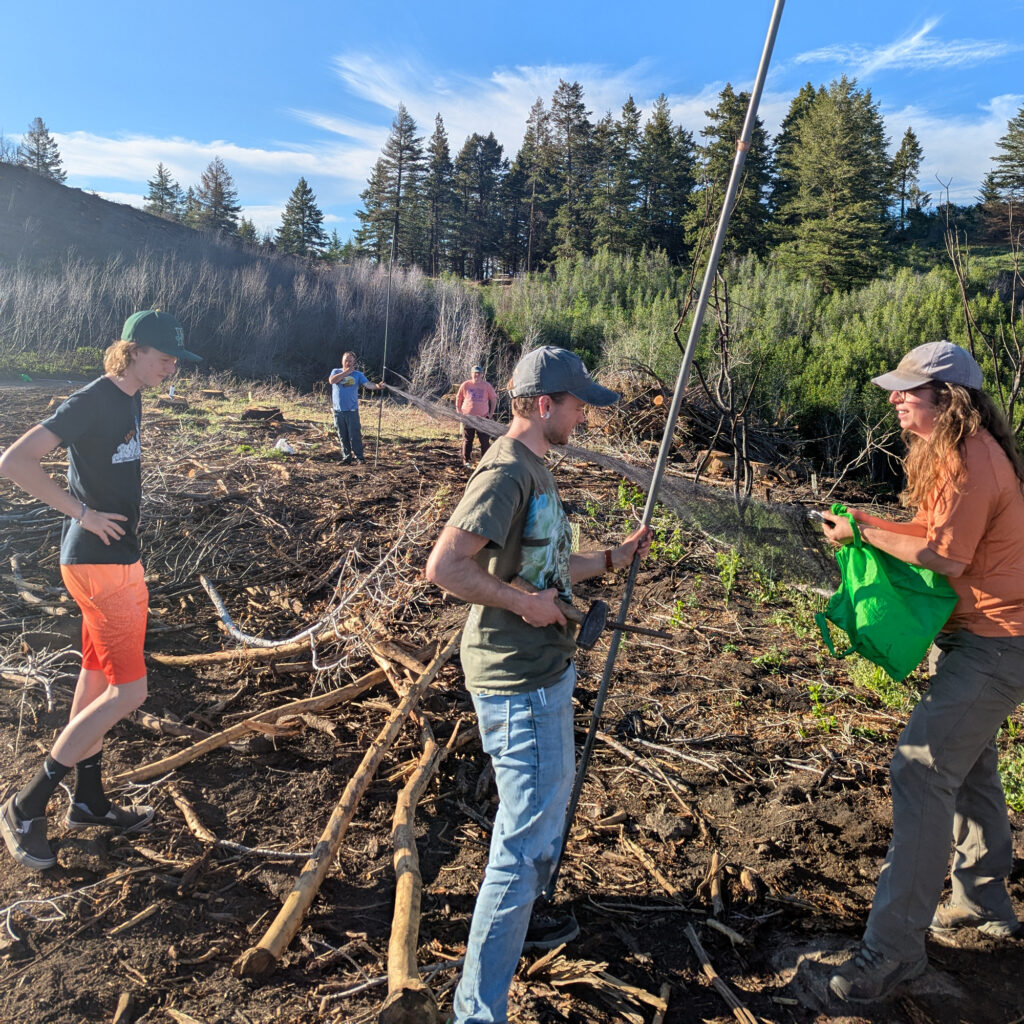
Moser’s team from Idaho Fish and Game and the federal Bureau of Land Management began recovery work soon after the fire. They dropped thousands of sagebrush seeds from a helicopter and planted 52,000 seedlings of native trees on the slope. Later in the fall, they planted another 60,000 plants. “We’re trying to get as much stuff on the landscape as soon as we can to give it a chance to outcompete the cheatgrass,” she said.
To control the invasives themselves, the only option is herbicide, she said. That’s an extreme option, she acknowledged, even though the teams use carefully chosen products, spray minimally and restrict their spraying to the fall when most native plants are dormant. “I don’t know what its effect is going to [have] on the lupin, for example,” she said.
It’s hard to know how successful this restoration will be. High-altitude sagebrush should only burn every 10-300 years, and these burns should be patchy, Moser said, to allow neighboring sagebrush plants to reseed the burned patches. But the invasive grasses carpet landscapes in what firefighters call a “continuous fuel bed,” which after a fire can build up and burn again in as little as one or two years, Moser said. Any subsequent fire driven by the invasives could undo all of Moser’s work.
“I can argue to some extent the fire was beneficial in the trees,” she said of the nearby forests, which can show improved health after wildfires. “I don’t think I could argue that it was beneficial here.”
This story is funded by readers like you.
Our nonprofit newsroom provides award-winning climate coverage free of charge and advertising. We rely on donations from readers like you to keep going. Please donate now to support our work.
For the forest around the research station, cheatgrass and rush skeletonweed could pose an existential threat. Cooler temperatures and heavier winter snowpack have kept the invasives rare at the peak, but with climate change making winters milder and weather growing hotter and drier, that may soon change. Though there is scholarly disagreement on how often and intensely these forests should burn, the historic frequency was certainly less than that of cheatgrass and rush skeletonweed. If these grasses colonize the peak, they could establish a new fire cycle of more frequent, faster, higher severity fires that would slowly but surely burn away the forest.
Climate change could impede Lucky Peak’s recovery more directly, too. Previous research has found that Douglas fir and ponderosa pine forests struggle to regrow after burns in today’s climate-altered world. Without the shade from these trees, invasive grasses have another advantage in their march up the peak.
“We’re on a sinking island, basically,” Heidi said of the steady rise of warmth and aridity up the mountain. “When is it going to flood?”
“It’s Never Gonna Be the Same”
For Davis and Jensen, the biggest loss was the slope above the bird banding station where technicians camped each fall. When it was covered with Douglas firs, Jensen found it homey, cozy and full of birds.
The fire killed every fir on that slope, and Idaho Fish and Game cut down their skeletons, leaving stumps and ashy earth behind.
“I really miss it,” Jensen said. “It’s never gonna be the same without constant nuthatch babble above the tents.”
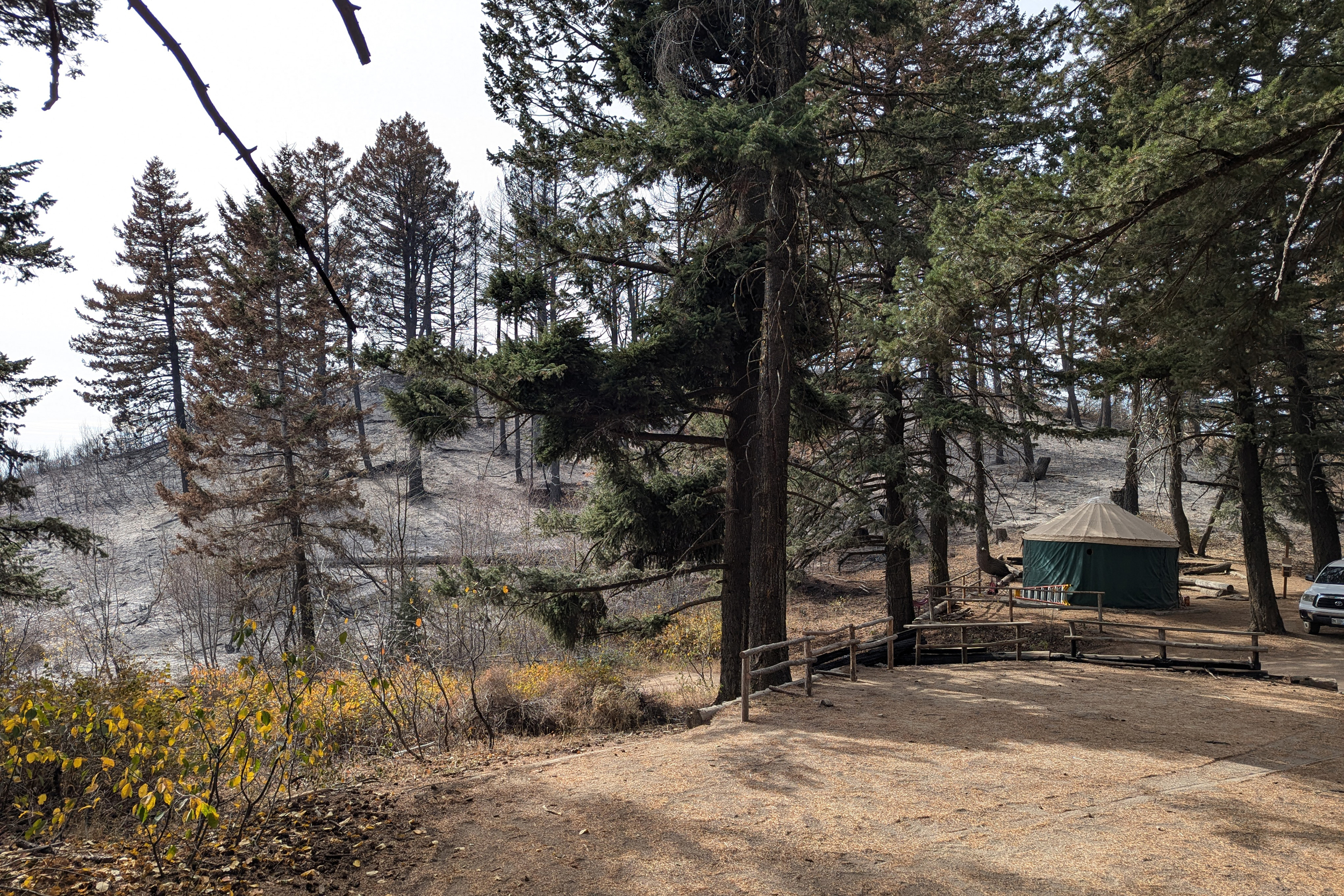
A view of the Lucky Peak main camp surrounded by charred trees. Credit: Heidi Ware Carlisle
The technicians whose equipment burned suffered a real loss, Heidi said, while she and Jay live in Boise and didn’t lose anything tangible in the fire. But she still feels grief for the mountain.
“A lot of my sadness comes from the personal part of it,” she said.
The couple met there in 2005, when Heidi was a volunteer for the songbird banding project that Jay started, and they both did their graduate thesis research at the observatory. In 2017, Jay proposed to Heidi there. They regularly take day trips with their kids to the peak. Their eldest son is named Felix—Latin for lucky.
Heidi knows that the burnt Douglas fir groves won’t regrow in her lifetime, and she laments that her children won’t remember the peak the way she and Jay do. She tears up remembering the days of uncertainty right after the fire, when no one knew if the station had survived.
“What’s keeping me going is the science stuff,” she said.
Heidi sees two possible futures for Lucky Peak. In one, the Valley Fire is only the first of many blazes as climate change and invasives crank up the frequency of fire in the forest, which helps the grasses take over. A temporary disturbance becomes a permanent change.
But there’s another future, a narrow path in which well-timed rains, effective invasive species management and a bit of luck keep fires at bay while native vegetation regrows. In this scenario, Heidi suspects much of the burn would turn into lush thickets of deciduous shrubs. If humanity can curb climate change, the coniferous forests that the staff remember would eventually return, too, perhaps with the slightly more climate-tolerant ponderosa pines as the dominant species. One day, many years from now, it would burn again, as it naturally should.
And for as long as they possibly can, observatory staff will be there, studying how birds are responding to whatever change comes.
About This Story
Perhaps you noticed: This story, like all the news we publish, is free to read. That’s because Inside Climate News is a 501c3 nonprofit organization. We do not charge a subscription fee, lock our news behind a paywall, or clutter our website with ads. We make our news on climate and the environment freely available to you and anyone who wants it.
That’s not all. We also share our news for free with scores of other media organizations around the country. Many of them can’t afford to do environmental journalism of their own. We’ve built bureaus from coast to coast to report local stories, collaborate with local newsrooms and co-publish articles so that this vital work is shared as widely as possible.
Two of us launched ICN in 2007. Six years later we earned a Pulitzer Prize for National Reporting, and now we run the oldest and largest dedicated climate newsroom in the nation. We tell the story in all its complexity. We hold polluters accountable. We expose environmental injustice. We debunk misinformation. We scrutinize solutions and inspire action.
Donations from readers like you fund every aspect of what we do. If you don’t already, will you support our ongoing work, our reporting on the biggest crisis facing our planet, and help us reach even more readers in more places?
Please take a moment to make a tax-deductible donation. Every one of them makes a difference.
If you check the archives, you’ll find I’ve already written two scathingreviews of the previous Avatar films, so it hardly seems worthwhile to type out a third one for Avatar: Fire and Ash.
They’re all the same film anyway, with minor changes. Writer-director-egomaniac James Cameron seems to feel that if it ain’t broke, financially speaking, don’t fix it, so he spends sickening amounts of money ($400 million for this installment) realizing his insipid sci-fi CGI visions, knowing they’ll make even more sickening amounts of money and guarantee further bloated sequels. As it stands today, Fire and Ash has already made more than $800 million worldwide.
Every time audiences turn out for these movies, it’s always the same: We arrive on the planet Pandora, a natural paradise rendered in slick pastels and populated by tall, trite-adage-spewing noble savages who are under attack by human colonizers seeking resources to exploit, the hyper-militarized “sky people.” Though the noble savages are always hopelessly outgunned, they inevitably channel their warrior skills and oneness with nature just in time for the big battle, when the sky people are defeated. Until the next sequel comes out, in which we’ll do it all over again.
And the usual suspects return for their big paydays: Sam Worthington, Zoe Saldaña, Sigourney Weaver, Stephen Lang, Kate Winslet, and the gang.
This has been going on since 2009, when the first Avatar was released. The twenty-first century has been so harrowing, sixteen years feels like five lifetimes, at the very least. Even Cameron seems to acknowledge we’re now all in hell together, so this time he adds a bit of spice to this second sequel in the form of what we might call the “ash people.” Unlike the bland blue-skinned Na’vi “forest people” and the bland aqua-skinned Metkayina “water people,” the volcano-dwelling Mangkwan are a fierce offshoot of the Na’vi who have been literally burned by nature, their main settlements going up in flames. As their badass chief Varang (Oona Chaplin) tells it, their prayers to the usual nice nature gods went unanswered as they faced incineration, so the survivors decided to worship the fire itself as the more obviously powerful force in the world.
Well, okay then! This is almost a little bit interesting. And for once, we’re not dealing with pastels — the ash people go for gray, black, and red as their signature color scheme, and it’s wonderfully enlivening to the eye to get away from all those babyish hues that define life on Pandora. But the Varang character doesn’t really go anywhere. She’s cooler to look at than the other characters, but beyond snarls and swaggering, she doesn’t do much, especially once she hooks up with war-loving jarhead Colonel Miles Quaritch (Stephen Lang), who’s offering to sell her clan guns. He was killed in the first Avatar, but was of course resurrected as a Na’vi “Recombinant,” which seems to make very little difference to his stupidly aggressive anti-Na’vi soldiering.
In Avatar: Fire and Ash, Quaritch “goes native” with Varang, but again, it doesn’t actually go anywhere. All the plotting tends to be strangely curtailed in these Avatar films, presumably because of the fan commitment to seeing the same movie again next time. One consequence is that characters have to be resurrected in some form or other, with nobody ever truly dying, to the point that death seems like a wonderfully elusive goal we never fully appreciated before.
Cameron borrows liberally from the old 1950s Westerns that clearly inform his conception of native peoples — and I defy you to find a more dubious source. So the ash people are after guns, just like the stereotypical “bad Indians” always were in old-time movies. Stereotypical “good Indians” in old Westerns, on the other hand, tend to befriend genocidal white settlers — embracing peace and cutting deals. The “good Indian” philosophy is expressed in Avatar: Fire and Ash by a wise old whale, who argues against fighting the sky people because violence always begets more violence.
Which brings us back to James Cameron, who recently gave an interview quoting a version of that line from his own film, partly in order to demonstrate that his Avatar movies are designed to parallel real-world conflicts: “It’s a fine line…. killing only leads to more killing, an endless expanding spiral…. That’s what we’ve seen. We’ve seen it in Gaza. We’ve seen it in Sudan. We’ve seen it in Ukraine.”
But he adds, referring to the Palestinian struggle against Israeli genocide, “There are some fights that are righteous. And total annihilation is a reason to fight. It’s existential.”
That might not sound like much — the bare-minimum acknowledgment of the reality in Gaza. But placed in the context of insistent pro-Israeli sentiments and, beyond that, mostly deafening silence from influential figures in the world of arts and entertainment, Cameron’s statement is more impressive.
It’s vintage Cameron, who’s obnoxious as hell and generally makes rotten but super-successful movies. But on the other hand, he periodically takes a public stand that you wish would be more typical of people who are rich and famous and can afford to take risks. Cameron has been one of the most vocal filmmakers when it comes to trying to save the medium from the powerful creeps who are eager to make money off cinema’s demise. Cameron has particularly blasted Netflix for its increasingly aggressive moves to kill off the theatrical exhibition of films in favor of in-home streaming:
Cameron criticized [Netflix co-CEO Ted] Sarandos’ publicly expressed belief that going to the theater to watch films is “an outmoded idea” for the majority of people — as well as Netflix’s habit of releasing its top-tier features, like Alfonso Cuarón’s Roma and Jane Campion’s Power of the Dog, for very limited runs in order to qualify them for Oscars consideration.
Cameron also addressed Sarandos’ claim that if Netflix acquired Warner Bros., the streamer would continue to release the studio’s films in theaters. “It’s sucker bait,” Cameron said. “‘We’ll put the movie out for a week, we’ll put it out for 10 days, we’ll qualify it for Academy Awards consideration.’ See, I think that’s fundamentally rotten at the core. A movie should be made as a movie for theatrical. And the Academy Awards to me mean nothing if they don’t mean theatrical, and I think they’ve been co-opted, and I think it’s horrific.”
Again, not the strongest sauce, except by comparison to the silence of most of Hollywood’s heavy hitters. Cameron at least makes it clear he wants to preserve some vestige of the theatrical film experience, even if he mostly wants to save it for the kind of films he makes, humdrum sagas full of obsolete notions done in same-old, same-old CGI.
Is it worth wrestling with the uncomfortable fact that, when so much else is bombing in theaters, Cameron can still draw enormous crowds with another Avatar movie? Even a sixteen-year absence from the screen between the first and second Avatar movies couldn’t kill the franchise. And it’s not just the reliable lure of big IP movies — even the Marvel films aren’t the reliable draw they once were. With a budget of $593.7 million, the last Star Wars movie way underperformed and the trailer for the new one, The Mandalorian & Grogu, has been widely mocked for looking like little more than Disney+ TV show.
Is there some secret sauce for getting people in theaters these days? Currently, people tend to leave their homes for lowish-budget horror, or the occasional auteur version, such as Sinners and Weapons. They go for large-scale kids’ movies like Zootopia 2, which is still doing booming business in its fifth week. They go for Christopher Nolan movies — look at the impact of the Odyssey marketing already starting for a movie not due in theaters until July. And, finally, they go for Big Jim’s Avatar movies.
I’d say horror and kid movies have perpetual appeal. Beyond that, people will leave the house to see giant action-oriented spectacles that justify a trip to the theater for the sake of the big-screen experience — if they seem likely to hit some sweet spot of kinetic thrills and feel-good sentiments. That’s a big if. But Cameron’s created a trusted brand when it comes to that combination, with two supremely successful franchises to boast of — Terminator and Avatar — along with a legendary entry in another franchise (Aliens) and, of course, the immensely profitable Titanic on top of the heap.
It could also be argued that Avatar hits a kind of ultimate sweet spot, fostering the illusion for audiences worldwide that we’re all on the side of those bravely fighting to save Mother Earth, even while most of us are actually standing by, letting our environment go straight to hell, and even siding eagerly with the top destroyers of the planet.
And happy New Year to you, too.
Great Job Eileen Jones & the Team @ Jacobin Source link for sharing this story.
As the global population grows, the pressure to produce nutritious food more efficiently continues to increase. At the same time, food manufacturing generates large amounts of leftover material that often goes unused. Scientists reporting in the American Chemical Society’s Journal of Agricultural and Food Chemistry investigated whether waste from carrot processing could serve a new purpose. By feeding carrot side streams to edible fungi, the researchers created a sustainable protein source.
They then used this fungal protein in experimental vegan patties and sausages. When these foods were tested, volunteers rated them as more enjoyable than comparable products made with traditional plant-based proteins.
“This study is a significant step towards a circular economy by transforming valuable food side streams into a high-quality protein source, highlighting the potential of fungal mycelium in addressing global food security and sustainability challenges,” says Martin Gand, the corresponding author of the study.
The Global Need for New Food Solutions
The urgency for alternative protein sources is clear. According to the United Nations, about one in 11 people worldwide experienced hunger in 2023, and more than three billion people could not afford a healthy diet. These challenges point to the need for food systems that deliver more nutrition while using fewer resources.
Edible fungi offer one possible solution. Previous research has shown that fungi can grow on food industry leftovers such as apple pomace and whey from apple juice and cheese manufacturing, respectively. Building on this work, Gand and his colleagues set out to recover nutrients from carrot side streams and reuse them as a growing medium for fungi.
Instead of harvesting mushroom caps, the team focused on fungal mycelia. These root-like structures grow faster and take up less space, while still producing nutrients that are beneficial for human diets.
Selecting the Best Fungus for Protein Production
To identify the most promising option, the researchers tested 106 different fungal strains grown on side streams from orange and black carrots used in natural color production. Each strain was evaluated for growth performance and protein output. One fungus emerged as the top candidate: Pleurotus djamor (pink oyster mushroom).
After selecting this species, the researchers adjusted growth conditions to increase protein yield. The resulting protein showed biological values similar to those of animal and plant proteins, meaning it could be efficiently used by the human body. The P. djamor mycelia were also low in fat and contained fiber levels comparable to other edible fungi.
Taste Tests With Vegan Foods
To see how the fungal protein worked in real foods, the team prepared vegan patties that replaced soy protein with different amounts of mycelia. The patties contained 0%, 25%, 50%, 75% and 100% fungal protein. Volunteers evaluated the patties based on texture, flavor, and aroma. A key finding was that participants preferred the patties made entirely with mycelium over those made entirely with soy.
The researchers also produced vegan sausages using either soaked chickpeas or fresh mycelia. In these tests, volunteers generally favored both the smell and taste of the sausages that included fungal mycelium.
A Low-Waste Path to Future Protein
Overall, the findings suggest that fungal mycelia could serve as a sustainable and appealing protein source. The process makes use of food production materials that would otherwise be discarded, without requiring additional farmland, and offers nutritional benefits similar to existing plant-based proteins. Gand adds, “utilizing side streams as substrate for mycelium production reduces environmental impact while adding value and supports food security by enabling an efficient and sustainable protein production.”
The authors also note that the research was supported by institutional resources and GNT Europa GmbH, a company that produces natural food colors.
Great Job & the Team @ Public Health News — ScienceDaily Source link for sharing this story.