Home News Page 167

Scientists turn carrot waste into protein people prefer

Scientists turn carrot waste into protein people prefer

As the global population grows, the pressure to produce nutritious food more efficiently continues to increase. At the same time, food manufacturing generates large amounts of leftover material that often goes unused. Scientists reporting in the American Chemical Society’s Journal of Agricultural and Food Chemistry investigated whether waste from carrot processing could serve a new purpose. By feeding carrot side streams to edible fungi, the researchers created a sustainable protein source.

They then used this fungal protein in experimental vegan patties and sausages. When these foods were tested, volunteers rated them as more enjoyable than comparable products made with traditional plant-based proteins.

“This study is a significant step towards a circular economy by transforming valuable food side streams into a high-quality protein source, highlighting the potential of fungal mycelium in addressing global food security and sustainability challenges,” says Martin Gand, the corresponding author of the study.

The Global Need for New Food Solutions

The urgency for alternative protein sources is clear. According to the United Nations, about one in 11 people worldwide experienced hunger in 2023, and more than three billion people could not afford a healthy diet. These challenges point to the need for food systems that deliver more nutrition while using fewer resources.

Edible fungi offer one possible solution. Previous research has shown that fungi can grow on food industry leftovers such as apple pomace and whey from apple juice and cheese manufacturing, respectively. Building on this work, Gand and his colleagues set out to recover nutrients from carrot side streams and reuse them as a growing medium for fungi.

Instead of harvesting mushroom caps, the team focused on fungal mycelia. These root-like structures grow faster and take up less space, while still producing nutrients that are beneficial for human diets.

Selecting the Best Fungus for Protein Production

To identify the most promising option, the researchers tested 106 different fungal strains grown on side streams from orange and black carrots used in natural color production. Each strain was evaluated for growth performance and protein output. One fungus emerged as the top candidate: Pleurotus djamor (pink oyster mushroom).

After selecting this species, the researchers adjusted growth conditions to increase protein yield. The resulting protein showed biological values similar to those of animal and plant proteins, meaning it could be efficiently used by the human body. The P. djamor mycelia were also low in fat and contained fiber levels comparable to other edible fungi.

Taste Tests With Vegan Foods

To see how the fungal protein worked in real foods, the team prepared vegan patties that replaced soy protein with different amounts of mycelia. The patties contained 0%, 25%, 50%, 75% and 100% fungal protein. Volunteers evaluated the patties based on texture, flavor, and aroma. A key finding was that participants preferred the patties made entirely with mycelium over those made entirely with soy.

The researchers also produced vegan sausages using either soaked chickpeas or fresh mycelia. In these tests, volunteers generally favored both the smell and taste of the sausages that included fungal mycelium.

A Low-Waste Path to Future Protein

Overall, the findings suggest that fungal mycelia could serve as a sustainable and appealing protein source. The process makes use of food production materials that would otherwise be discarded, without requiring additional farmland, and offers nutritional benefits similar to existing plant-based proteins. Gand adds, “utilizing side streams as substrate for mycelium production reduces environmental impact while adding value and supports food security by enabling an efficient and sustainable protein production.”

The authors also note that the research was supported by institutional resources and GNT Europa GmbH, a company that produces natural food colors.

Great Job & the Team @ Public Health News — ScienceDaily Source link for sharing this story.

Austin weather: Bundle up if heading out for New Year’s Eve

Austin weather: Bundle up if heading out for New Year’s Eve

It’s a cold start to the day before temperatures warm up and then take a dive, so make sure to bundle up if you’re heading out for New Year’s Eve events.

The backstory:

Austin weather: Bundle up if heading out for New Year’s Eve

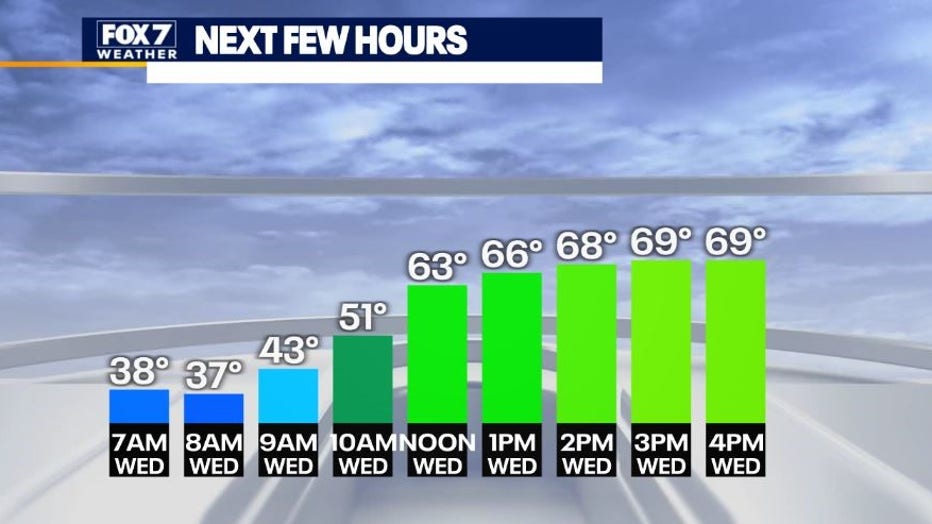
This afternoon the highs will reach the upper 60s. 

It will be mostly sunny, and the winds will stay around 5 mph. 

Once again, we will see temperatures take a dive as we head into the overnight hours. 

So, you’ll still want to bundle up if you’re headed out for any New Year’s Eve events. 

Timeline:

By the evening, we will be dropping back into the 50s. 

Once we reach midnight, and strike into the New Year, we will have dipped back into the upper 40s. 

The skies will be mostly clear, and winds will stay around 5 mph. 

The temperatures will drop from there, with the morning low in the mid 40s. 

So, it is a cold start to the New Year, but that changes quickly as we move into the afternoon. 

The high will reach the mid 70s and the sunshine continues, but there will be wind gusts around 20 mph. 

What you can do:

Track your local forecast for the Austin area quickly with the free FOX 7 WAPP

The design gives you radar, hourly, and 7-day weather information just by scrolling. 

Our weather alerts will warn you early and help you stay safe.

The Source: Information from FOX 7 Austin meteorologist Leslie London.

WeatherAustin

Great Job & the Team @ Latest & Breaking News | FOX 7 Austin for sharing this story.

Investors predict AI is coming for labor in 2026  | TechCrunch

Investors predict AI is coming for labor in 2026  | TechCrunch

Concerns about how AI will affect workers continue to rise in lockstep with the pace of advancements and new products promising automation and efficiency.

Evidence suggests that fear is warranted.

A November MIT study found an estimated 11.7% of jobs could already be automated using AI. Surveys have shown employers are already eliminating entry-level jobs because of the technology. Companies are also already pointing to AI as the reason for layoffs.

As enterprises more meaningfully adopt AI, some may take a closer look at how many employees they really need.

In a recent TechCrunch survey, multiple enterprise VCs said AI will have a big impact on the enterprise workforce in 2026. This was particularly interesting because the survey didn’t specifically ask about it.

Eric Bahn, a co-founder and general partner at Hustle Fund, expects to see affects on labor in 2026. He’s just not sure exactly what that will look like.

“I want to see what roles that have been known for more repetition get automated, or even more complicated roles with more logic become more automated,” Bahn said. “Is it going to lead to more layoffs? Is there going to be higher productivity? Or will AI just be an augmentation for the existing labor market to be even more productive in the future? All of this seems pretty unanswered, but it seems like something big is going to happen in 2026.”

Techcrunch event

San Francisco
|
October 13-15, 2026

Marell Evans, founder and managing partner at Exceptional Capital, predicted companies looking to increase AI spending, will pull money from their pool for labor and hiring.

“I think on the flip side of seeing an incremental increase in AI budgets, we’ll see more human labor get cut and layoffs will continue to aggressively impact the U.S. employment rate,” Evans said.

Rajeev Dham, managing director at Sapphire, agreed that 2026 budgets will start to shift resources from labor to AI. Jason Mendel, a venture investor at Battery Ventures, added that AI will start to surpass just being a tool to make existing workers more efficient in 2026.

“2026 will be the year of agents as software expands from making humans more productive to automating work itself, delivering on the human-labor displacement value proposition in some areas,” Mendel said.

Antonia Dean, a partner at Black Operator Ventures, said even if companies aren’t shifting labor budgets toward AI projects, they will likely still say AI is the reason for layoffs or a reduction in labor costs anyway.

“The complexity here is that many enterprises, despite how ready or not they are to successfully use AI solutions, will say that they are increasing their investments in AI to explain why they are cutting back spending in other areas or trimming workforces,” Dean said. “In reality, AI will become the scapegoat for executives looking to cover for past mistakes.”

Many AI companies argue their technology doesn’t eliminate jobs but rather helps shift workers to “deep work” or to higher-skilled jobs while AI just automates repetitive “busy work.”

But not everyone buys that argument, and people are worried that their jobs will be automated. According to VCs who invest in that area, it doesn’t sound like those fears will be quelled in 2026.

Great Job Rebecca Szkutak & the Team @ TechCrunch Source link for sharing this story.

Body found during search for missing 19-year-old Camila Mendoza Olmos | Houston Public Media

Body found during search for missing 19-year-old Camila Mendoza Olmos | Houston Public Media

(Courtesy Bexar County Sheriff’s Office)

Sign up for TPR Today, Texas Public Radio’s newsletter that brings our top stories to your inbox each morning.

This story was updated on Wednesday, Dec. 31, 2025, at 8:40 a.m.

During the search for 19-year-old Camila Mendoza Olmos on Tuesday, authorities discovered a body that could be the missing woman.

As of Wednesday morning, the Bexar County Medical Examiner’s Office told TPR that the identification of the body as being that of Mendoza Olmos is “pending.”

Mendoza Olmos was last seen on the morning of Christmas Eve, prompting an extensive search in northwest Bexar County.

Bexar County Sheriff Javier Salazar said deputies found the body around 4 p.m. on Tuesday in a wooded area a few hundred yards from Mendoza Olmos’ home, where she was last seen on Wednesday.

“At this point, it’s too early to tell if the body that we found is that of Camila,” Salazar said. “We don’t suspect foul play.”

Salazar said the Bexar County Medical Examiner’s Office will need to confirm the identity of the body and determine a cause of death, a process that could take several days.

Investigators said evidence suggests Mendoza Olmos may have been experiencing a mental health crisis before she disappeared.

“During the course of the investigation, we developed some information that there may have been some suicidal ideations on Camila’s part,” Salazar said. “It sounds like a young person going through a very tough time in their life.”

Salazar also said a firearm was found near the body and matched the description of a gun reported missing from Mendoza Olmos’ home.

The FBI and the Department of Homeland Security are assisting the Bexar County Sheriff’s Office in the investigation.

This is a developing story that will be updated.

Great Job & the Team @ Houston Public Media for sharing this story.

Sybil Wilkes Breaks Down What We Need to Know: December 31, 2025

Sybil Wilkes Breaks Down What We Need to Know: December 31, 2025

Source: Reach Media / Radio One

Sybil Wilkes delivers the essential stories impacting our community in the latest “What We Need to Know” segment. From major political shifts and cultural losses to the challenging job market and uplifting community stories, here’s a recap of the news shaping our world.

Donald Trump’s Second Term: 1 Year In

A year into President Donald Trump’s second term, a significant transformation is underway at the Department of Health and Human Services. Secretary Robert F. Kennedy Jr. has aggressively pursued a “Make America Healthy Again” agenda. This overhaul has involved cutting thousands of jobs and halting billions in research funding. While these moves have been polarizing, some initiatives, such as those promoting healthier lifestyles and aiming to lower prescription drug prices, have found support across the political aisle.

Two Talent’s Lost

This week, the community is also taking a moment to honor the legacies of two immense talents we lost in 2025. Gospel legend Richard Smallwood, the Grammy-nominated singer and Howard University-trained composer, passed away on December 30th due to complications from kidney failure. His music has been a cornerstone of the gospel world. We also mourn the passing of esteemed actor Isaiah Whitlock Jr., who died at 71. Best known for his unforgettable role as Senator Clay Davis on “The Wire,” Whitlock’s career left a lasting mark on American culture, inspiring many who followed in his footsteps.

Economics in 2025

On the economic front, job seekers have navigated a difficult landscape over the past year. Even highly experienced professionals are facing challenges like automated hiring systems, being ghosted by recruiters, and frequent rejections. This tough market is influenced by companies adopting generative AI to reduce roles and a rise in unemployment figures. These factors have combined to create a more competitive and uncertain environment for those searching for work.

The Good News File

In a dose of good news, creators are making the world of tabletop gaming more inclusive. Joseph Johnson, a Black content creator, founded Tabletop Jocks to create a space that centers Black and queer players. Through events, content, and mentorship programs, Johnson and other creators like Keonte Williams are actively working to dismantle barriers in a hobby that has historically been exclusive. Their efforts are building a more welcoming community for everyone. Be informed, be empowered.

Great Job Nia Noelle & the Team @ Black America Web Source link for sharing this story.

Trump Mobile says it’s delaying its first-ever smartphone, and the government shutdown is to blame | Fortune

Trump Mobile says it’s delaying its first-ever smartphone, and the government shutdown is to blame | Fortune

Trump Mobile, the wireless venture backed by the Trump Organization, has postponed delivery of its long-promised gold-colored T1 smartphone beyond the end of the year, blaming the latest U.S. government shutdown for the delay. The move extends a months-long slide in its launch timeline and underscores the operational challenges of turning a political brand into a mass-market hardware business.​

Customer service representatives for Trump Mobile told Fortune the shutdown had disrupted shipments of the $499 device, and said while the device would not be shipped this month, “we’ve been told mid to late January.” The company has not publicly provided a revised delivery date.

​​”The T1 has been delayed due to the government shutdown. They had to pause everything on the FCC side of things,” the customer service rep said, adding the $499 price has not changed.

Trump Mobile was unveiled in June as a licensing venture that uses the Trump name to sell mobile service and a branded Android handset, the T1 Phone. The device is marketed as a gold-colored smartphone priced at $499, available via preorder with a $100 down payment. It is designed to run on “The 47 Plan,” a $47.45-per-month offering that bundles 5G service with unlimited talk, text, and data, the pricing a nod to Donald Trump’s status as the 45th and 47th U.S. president.

Trump Mobile tells Fortune the T1 smartphone is now expected to arrive in January.

Trump Mobile

At launch, the Trump Organization and Trump Mobile framed the project as both a business opportunity and a statement about domestic manufacturing. Early marketing materials promised a handset “built in the United States,” aligning with Trump’s public criticism of Apple and his threats of 25% tariffs on Apple and Samsung devices made in China. Supply chain experts quickly questioned whether a fully U.S.-made smartphone at that price point was realistic, noting less than 5% of the components in an iPhone are currently manufactured in the U.S., according to IDC estimates.​​

The shipping schedule has slipped repeatedly. Initial materials indicated the T1 Phone would be available in August, before the date was pushed to October and then to a vague commitment to deliver units by year-end. In recent weeks, Trump Mobile’s website has removed specific release dates and “Made in USA” language, according to NBC News and People, which have been tracking changes to the website. As the flagship device remains unavailable, the company has begun selling refurbished phones like Apple’s iPhone 15 and Samsung’s Galaxy S24, positioning them as lower-cost alternatives to buying directly from the manufacturers.​​

The business itself operates as a virtual mobile network rather than building its own infrastructure. Trump Mobile’s plan is delivered over existing U.S. carriers via Liberty Mobile Wireless, a Florida-based mobile virtual network operator, while customer service is handled by Ensurety Ventures, an insurance company in Missouri. The Trump-branded service is run out of Trump Tower in Miami, and key executives introduced at launch came from real estate, insurance, and pager businesses rather than from major smartphone manufacturers.​​

Trump Mobile has not explained exactly how the federal shutdown is affecting its production or logistics beyond citing it as the reason for the latest slip. Industry groups have previously noted shutdowns can slow regulatory approvals and customs processing for electronics, adding friction to certification and import timelines. Analysts also point out most shutdowns leave private-sector manufacturing and many core supply chains operating, which can limit how much disruption they cause to commercial product launches.​​

As for the customers who have already put down $100 to reserve the gold T1 Phone, some preorder buyers have reported receiving only receipts and generic assurances, with no firm shipping date and difficulty getting detailed updates from support channels.

Great Job Dave Smith & the Team @ Fortune | FORTUNE Source link for sharing this story.

2026 MLB Free Agent Signings, Trades: White Sox Sign Former Mets Top Prospect

2026 MLB Free Agent Signings, Trades: White Sox Sign Former Mets Top Prospect

It’s never too early to look toward the 2026 MLB season, and that starts with keeping tabs on all the deals.

Here are all the notable free agency signings, trades, and extensions throughout the offseason: 

Dec. 31

White Sox sign OF Jarred Kelenic
Reported terms: Non-roster invite

Dec. 30

Angels buyout 3B Anthony Rendon
Details: Rendon will make $38 million over the next three-to-five years

Angels sign RHP Kirby Yates
Reported terms: One year, $5 million

Dec. 27

Cincinnati, Miami make trade

Reds receive: OF Dane Myers
Marlins receive: OF Ethan O’Donnell

Reds sign OF JJ Bleday
Reported terms: One year

Dec. 24

Marlins sign RP Pete Fairbanks
Reported terms: One year, $13 million

Dec. 23

Pirates sign 1B Ryan O’Hearn
Reported terms: Two years, $29 million

White Sox sign LHP Sean Newcomb
Reported terms: One year, $4.5 million

Dec. 21

Red Sox trade for Cardinals 1B Willson Contreras
Trade details: Red Sox receive Contreras and $8 million to cover $41 million remaining on his contract; Cardinals receive RHP Hunter Dobbins, RHP Yhoiker Fajardo and RHP Blake Aita

White Sox sign INF Munetaka Murakami
Details: Two years, $34 million
Stats: Hit 246 home runs in eight seasons for NPB’s Tokyo Yakult Swallows, breaking the league record for most home runs in a season in 2022 (56). 

Dec. 19

Giants agree to two-year deal with P Adrian Houser
Stats: 8-5 record and 3.31 ERA (in 2025)

Orioles acquire RHP Shane Baz
Rays receive: LHP Slater de Brun, C Caden Bodine, RHP Michael Forret, OF Austin Overn, Compeitive Balance Round A pick

3-Team Trade

Pirates receive: 2B Brandon Lowe, OF Jake Magnum, LHP Mason Montgomery
Rays receive: OF Jacob Melton, RHP Anderson Brito
Astros receive: RHP Mike Burrows

Kansas City, Philadelphia make trade

Royals receive: LHP Matt Strahm
Phillies receive: RHP Jonathan Bowlan

Padres sign IF Sung-Mun Song
Reported terms: TBD
2025 Stats (KBO): 26 home runs, 90 RBIs, 25 stolen bases, .315/.387/.530 slash line (574 at-bats)

Dec. 18

Padres agree to three-year deal with SP Michael King
Stats: 5-3 record with a 3.44 earned run average

Dec. 17

Guardians designate OF Jhonkesny Noel for assignment
Stats: Hit 13 home runs in 67 regular-season games in 2024

Mets sign RHP Luke Weaver
Reported terms: Two years, $22 million

Phillies sign RHP Brad Keller
Reported terms: Two years, $22 million

Dec. 16

Reds sign LHP Caleb Ferguson
Reported terms: TBD

Giants sign RHP Adrian Houser
Reported terms: Two years, $22 million

Giants sign RHP Jason Foley
Reported terms: One year, $2 million

Nationals sign LHP Foster Griffin
Reported terms: One year, $5.5 million

Cubs re-sign LHP Caleb Thielbar
Reported terms: One year

Dec. 15

Blue Jays finalize deal with RHP Tyler Rogers
Reported terms: Three years, $37 million

Phillies sign OF Adolis García
Reported terms: One year, $10 million

Twins sign 1B Josh Bell
Reported terms: One year with a mutual option

Dec. 13

Cardinals sign RHP Dustin May
Reported terms: One year

Tigers sign RHP Kenley Jansen
Reported terms: One year

Yankees re-sign IF Amed Rosario
Reported terms: One year, $2.5 million

Mets sign IF Jorge Polanco
Reported terms: Two years, $40 million

Dec. 12

Marlins sign OF Christopher Morel
Reported terms: One year

Royals extend 3B Maikel Garcia
Reported terms: Five years, $57.5 million (maximum $85 million)

Dec. 11

Braves sign RHP Robert Suarez
Reported terms: Three years, $45 million

Athletics sign RHP Mark Leiter Jr.
Reported terms: One year, $3 million

Dec. 10

Braves sign OF Mike Yastrzemski
Reported terms: Two years, $23 million

Orioles sign 1B Pete Alonso
Reported terms: Five years, $155 million

Dec. 9

Pirates sign LHP Gregory Soto
Reported terms: One year, $7.75 million

Tigers re-sign RHP Kyle Finnegan
Reported terms: Two years, $19 million

Angels acquire IF Vaughn Grissom
Reported terms: Grissom to Angels; Red Sox received OF Isaiah Jackson


Phillies re-sign DH Kyle Schwarber
Reported terms: Five years, $150 million

Dodgers sign RHP Edwin Diaz
Reported terms: Three years, $69 million

Dec. 6

Seattle, Washington make swap

Mariners receive: LHP Jose A. Ferrer
Nationals receive: C Harry Ford, RHP Isaac Lyon

Dec. 3

Reds re-sign RHP Emilio Pagan
Reported terms: Two years, $20 million

Dodgers re-sign C Miguel Rojas
Reported terms: One year, $5.5 million

Rays sign OF Cedric Mullins
Reported terms: One year

Dec. 2

Blue Jays sign RHP Cody Ponce
Reported terms: Three years, $30 million

Astros sign RHP Ryan Weiss
Reported terms: One year, $2.6 million (option that could exceed $10 million over two years)

Angeles sign HP Alek Manoah
Reported terms: One year, $1.95 million

Dec. 1

Mets sign RHP Devin Williams
Reported terms: Three years, $45 million

Nov. 29

Orioles sign RHP Ryan Helsley
Reported terms: Two years, $28 million

Nov. 26

Blue Jays sign RHP Dylan Cease
Reported terms: Seven years, $210 million

Nov. 25

Red Sox land RHP Sonny Gray from Cardinals
Reported terms: Gray reworking contract, will receive $31 million in 2026 and a $10 million mutual buyout for 2027

Cubs sign RHP Phil Maton
Reported details: Two years, $14.5 million with a club option for 2028

Nov. 24

Semien to Mets; Nimmo to Rangers
Reported terms: Mets acquire INF Marcus Semien; Rangers acquire OF Brandon Nimmo
 

November 19

Braves, Astros trade infielders
Reported terms: Braves acquire INF Mauricio Dubón, Astros acquire INF Nick Allen

Braves re-sign RHP Raisel Iglesias
Reported terms: One year, $16 million

November 18

Angels trade Taylor Ward
Reported terms: Orioles receive OF Taylor Ward; Angels receive RHP Grayson Rodriguez.

Four players accept qualifying offer (one-year, $22.025 million deal):

November 17

Padres re-sign LHP Hart
Reported Terms: Padres sign LHP Kyle Hart to a one-year, $1.2 million contract that includes a club option for 2027

November 16

Dodgers, Mariners trade pitchers
Reported Terms: Dodgers acquire RHP Tyler Gough; Mariners acquire LHP Robinson Ortiz

November 11 

Rays trade CF Kameron Misner to Royals
Reported Terms: Rays acquire Misner; Royals acquire player to be named later

November 5

Rays trade RHP Cole Wilcox to Mariners
Reported Terms: Mariners acquire Wilcox; Rays get cash considerations

November 4

Cubs trade RHP Andrew Kittredge to Orioles
Reported Terms: Orioles acquire Kittredge; Cubs get cash considerations

Want great stories delivered right to your inbox? Create or log in to your FOX Sports account and follow leagues, teams and players to receive a personalized newsletter daily!

FOLLOW Follow your favorites to personalize your FOX Sports experience

Great Job & the Team @ FOX Sports Digital Source link for sharing this story.

The Holiday Traditions of a Nation Long Dead

The Holiday Traditions of a Nation Long Dead

Every year in late December, my childhood home transformed into a vision of American bliss. We’d gather to ornament a tree, drape string lights around the house, and sit down to an elaborate feast. Not long after dawn the next day, while our little sister still slept, my brother and I would impatiently sneak downstairs to see our gifts, which we understood to have been delivered by a kindly old man. It could have been a scene out of A Christmas Story. Except we weren’t celebrating Christmas. My family was celebrating the Soviet version of New Year’s, a holiday that resembles Christmas in nearly every way, except that it takes place almost a week later and excludes Jesus, God, or any other signifier of religion. We were keeping the national tradition alive in suburban America, years after the country that invented it had dissolved.

Soviet New Year’s began as a ritual in a country where all the religious rituals were gone. Long before the 1917 revolution that brought them to power, the leaders of the Soviet Union had decried religion as, in Karl Marx’s phrase, the opium of the masses. Their officially atheist government suppressed many kinds of spiritual observance, including Christmas. But by the mid-1930s, Soviet leaders sensed that people needed something to take the edge off in the dead of winter, a carnivalesque custom of the sort that Christmas once provided. So they took the most fun parts of the Christian holiday and plopped them on New Year’s.

It became arguably the most important holiday on the country’s calendar. Other celebrations tended to come with historical significance, such as the anniversary of the revolution and of the Soviets’ victory in World War II. But New Year’s, at its core, was about nothing more and nothing less than family: a chance to come together and take stock. That may be a big reason it survived the Union’s dissolution. Even after religious institutions were allowed to conduct their services without government interference and their holidays were acknowledged, New Year’s remained important for both the people who had left the region and those who still lived there.

But today, Soviet New Year’s customs are in danger of slipping away or evolving beyond recognition. Some people still celebrate the holiday the old way, with their families and gifts. Many, though, are establishing new practices that reflect new values and new political circumstances: Wars between former Soviet republics, for instance, and the ways that political leaders have used the momentous nature of the night for their own gains, have changed how people celebrate. A holiday that once felt embedded in the identity and culture of the Soviet people may soon become untethered from its history.


Soviet New Year’s began at a time when morale in the country was, in general, low. It was the 1930s, and Ukraine had suffered one of the worst man-made famines in world history. The idea to bring joy to the winter came from a Communist Party leader named Pavel Postyshev, who had been one of the famine’s administrators. During an intimate car ride around Moscow with General Secretary Joseph Stalin and a future successor, Nikita Khrushchev, Postyshev proposed reviving the tradition of trees, but tied to a secular holiday. Stalin enthusiastically endorsed the idea, and in 1935, a letter from Postyshev appeared in Pravda, the official newspaper of the party’s central committee, arguing that all Soviet children should get to experience the cheer that the bourgeoisie’s children once had: “Let’s organize a fun New Year’s Eve party for the kids.”

Postyshev’s idea spread like a wildfire in reverse—trees sprang up across the Soviet Union. The first year, delegates from the local party leadership and schoolteachers gathered parents and instructed them in how to decorate a tree. In some schools, Grandfather Frost, a Santa Claus equivalent, distributed gifts to kids. Soon, families adopted the new practice as their own. But Postyshev never got to see the extent of it. In the ’30s, Stalin consolidated power, punishing anyone he suspected of opposing him, including Postyshev—who was executed in 1939. The holiday soon became another tool for Stalin to reinforce his power and centrality in Soviet life. “The cheerful, happy children sang, danced, recited poems, praising in the songs and poems of their beloved Stalin, who gave them a joyful and happy life,” one 1938 newspaper report read.

After Stalin died, in 1953, the holiday’s focus turned away from politics. In 1956, Khrushchev delivered a speech criticizing Stalin’s “cult of personality” and his purges, signaling to people that they could drop the anxieties about political correctness that had constricted their lives in the Stalin era. The film Carnival Night, released that same year, captured the iconoclastic mood. In it, workers resist the efforts of their company director to organize a New Year’s celebration in which everything is acceptable to the people above him and no fun for those below. He plans to deliver a speech, but a worker persuades a magician to make the text disappear; when the director later goes to grab it, he instead finds a string of scarves and other knickknacks. The company director, representing a self-aggrandizing political blowhard, is humiliatingly sidelined, and the workers have a grand time.

By the time my dad started celebrating New Year’s in Moscow, in the ’60s, most of the elements of the holiday I would come to know as a kid were present: family dinner, gifts, and a decorated tree. It had become an unquestioned fulcrum of Soviet life. If there was a custom of reading poems or singing songs in Khrushchev’s honor, it wasn’t ubiquitous. Once the country’s leaders began giving an annual New Year’s address, in 1970, these speeches weren’t taken seriously. They were filled with empty platitudes, “void of meaning,” according to The Invention of Russia, by the journalist Arkady Ostrovsky. “These addresses were merely a prompt for popping the corks from bottles.”

That cork-popping continued even as the Soviet Union dissolved and many people left the region. I was born in Moscow in 1996, five years after the fall of the Union, and we moved to upstate New York five years after that. For a long time, the New Year’s my family celebrated was stuck in amber, the old tree-and-gifts version. In the former Soviet republics, people still considered the day significant but changed some of the customs. In Armenia, for instance, once religious holidays were again allowed, religious institutions attached themselves to New Year’s. From the early 1990s until 2023, the head of the national Church would deliver a midnight address right before the country’s president or prime minister. Tigran Simyan, a professor at Yerevan State University who studies the evolution of New Year’s in Armenia and the post-Soviet world, told me, “Our happy New Year, for us, is more important than Christmas.”

Politics also returned to the holiday after the Soviet Union’s fall. In Russia, the seeming end of single-party rule and a brief moment of political competition revived the status of the New Year’s address. It was a rare time when all eyes were focused on the same speaker. The Russian Federation’s first president, Boris Yeltsin, strategically resigned on December 31, 1999, giving his handpicked successor, Vladimir Putin, the opportunity to introduce himself during a midnight address as the millennium turned. “The ritual was unmistakably staged,” Ostrovsky writes in The Invention of Russia. “The New Year’s address had greater symbolic value than any election.”

In more recent times, young Russians have tended to focus on partying on New Year’s Eve. But the many people who maintain the Soviet way of celebrating at home with family might still put on Putin’s address. Once again, a popular film captures the mood. The plot of 2010’s Yolki is almost the exact opposite of Carnival Night’s. Whereas the 1956 film is about a collaborative effort to prevent a speech, Yolki features people across the country working together to help a girl on her quixotic quest to insert a phrase into the president’s midnight address, granting the address central importance. Yolki was the first in what became Russia’s most financially successful non-animated film franchise, despite the series’ declining artistic and entertainment value. Its 12th sequel, set as ever on New Year’s Eve, came out this December.


Eventually, politics’ creep back into the New Year’s holiday began to affect the way my family celebrated in the United States. Although for years, none of us took what Putin said in his address too seriously, my grandparents still put it on out of habit. But as his regime grew more repressive and violent, we let that go. The way I remember it, we stopped after Russia’s initial invasion of Ukraine, in 2014, deciding that we didn’t need to support Putin’s rule on our holiday. But my dad dates our move away from the midnight address to earlier, in 2012. That year, Putin stepped through a loophole in constitutional term limits and returned to the presidency, then brutally suppressed the protests that followed. “I didn’t want to hear him anymore,” my dad told me recently.

After Russia’s full-scale invasion of Ukraine, in February 2022, some Ukrainians’ New Year’s celebrations stopped. “What is there to celebrate when there is a war?” a Ukrainian soldier serving on the front line asked Euronews last New Year’s. Meanwhile, I spent last New Year’s in Tbilisi, the capital of Georgia, where clubs had just been closed for weeks in deference to protests over the government pausing its European Union accession bid. Though some young people I talked with were spending the night with their family, many spilled out onto Rustaveli Avenue in the city center for a combination party, protest, and celebration. Without a single state to hold it together, and so many interstate conflicts, the Soviet New Year’s tradition is splintering across the Soviet diaspora.

Perhaps soon the holiday will become unrecognizable from its former iteration, especially as the people who remember its origins adapt to new cultures or pass away. My own family no longer makes a point of gathering on the holiday. In part, that’s because my siblings and I have gotten older, scattered, and given in to assimilationist pressure—the fear of missing out on the American custom of partying with our friends on New Year’s. But we’ve also lost the center of gravity that held us to the Soviet tradition. Early in November, my last surviving grandmother suffered a stroke, which paralyzed most of her body, leaving only her eyes and one arm fully mobile. Her grandfather, my great-great-grandfather, became a Bolshevik in 1905 and participated in the three revolutions that led to the establishment of the Soviet Union. His son, her father, wrote and disseminated anti-religious propaganda. Much of my family’s adherence to the holiday might very well be because of this history. On Thanksgiving, days before my grandmother died, I told her I was researching our holiday tradition. She squeezed my hand and blinked knowingly.

Watching the tradition slip away feels like losing part of the Soviet and post-Soviet identity that’s defined my family for more than a century. I feel a grief that’s hard to disentangle from my grief for the people who passed the tradition on to me. But looking back on how my family has acted in decisive moments, I’m also aware of an opportunity. My forefathers helped form the Soviet identity and its rituals, even before there was a country to promote them. Likewise, during and after the Soviet Union’s existence, although politicians repeatedly imposed a tone that fit their priorities, my family chose how to spend the day. Ultimately, the common people reshaped the holiday to suit their needs and values. Their examples prove that people can make their own traditions, with whatever ideals they inherit.


​​When you buy a book using a link on this page, we receive a commission. Thank you for supporting The Atlantic.


Great Job Andrew Fedorov & the Team @ The Atlantic Source link for sharing this story.

Buddhist Monks March Through Georgia During ‘Walk For Peace’

Buddhist Monks March Through Georgia During ‘Walk For Peace’

Source: aire images / Getty

In a world where chaos and uncertainty appear to be on the rise with no end in sight, we long to see headlines that bring us peace and some semblance of tranquility, and what better news could provide us with such a state than Buddhist monks participating in a 2,300-mile Walk for Peace, and that walk making its way down to Georgia?

According to Fox 5 Atlanta, the journey of 19 monks, led by Bhikkhu Pannakara, began Oct. 26 at the Huong Dao Vipassana Bhavana Center in Fort Worth, Texas, and is scheduled to end on Feb. 13, 2026, at the U.S. Capitol in Washington, D.C. On Monday, the monks continued their journey through Georgia, beginning in Sharpsburg and making their way through Peachtree City to Fayetteville and Morrow in the Atlanta area.

“We are grateful for the continued support and warm welcome we receive along the way,” the monks said on their Facebook Page, according to WSB-TV 2.

On Tuesday, day 66 of the journey, the monks were at Rainbow Park at the Porter Sanford III Performing Arts & Community Center in Decatur for lunch, welcoming visitors to meet and greet with them between 10:30 a.m. and 1 p.m., before moving on to the Beacon Municipal Complex, where a “peace gathering” is scheduled for 2:30 p.m., USA Today reported.

From USA Today:

Support personnel for the monks provide food and water, but the monks also accept food, water, prayers, flowers and other items as donations as they pass through towns in America. The monks will also accept offerings for lodging for their lunch or overnight stops.

Crowds have gathered along the path to welcome, pray, and celebrate with the monks as they pass through the South.

It’s a rare thing in the U.S., currently, when crowds have a positive reason to gather in the streets. No protests. No political squabbles. No injustice to stand against. No kings. This march brings people together to celebrate life, peace, and the beauty in this world that is easy to forget.

This is why we embrace — or should embrace — and celebrate various cultures in America. This is what the nation needs more of, arguably now more than ever.

The march is expected to last an estimated 120 days. May its impact last much longer.

Peace, y’all!

SEE ALSO:

The Bison ONE Newsroom in Conversation with Cathy Hughes

8 Barack Obama Quotes That Still Inspire Us Today


19 Buddhist Monks Move Through Georgia During ‘Walk For Peace’ From Texas To DC
was originally published on
newsone.com

Great Job Zack Linly & the Team @ Black America Web Source link for sharing this story.

Tips for making climate-related resolutions that stick » Yale Climate Connections

Tips for making climate-related resolutions that stick » Yale Climate Connections

Transcript:

New Year’s can be a great time to set climate-friendly goals – like driving less, eating less meat, or saving energy at home.

But even if you’re excited about your resolutions on January first, following through for the rest of the year can be hard.

Ballard: “Things come in that challenge our motivation, so stress, difficult emotional situations, tiredness – all those things cause our motivation to weaken.”

Ian Ballard, an assistant professor at the University of California, Riverside, studies how people make decisions and pursue goals.

He says to make resolutions stick, break them into manageable steps. And reward yourself for hitting milestones – for example, if you bike to work for a week, buy yourself a treat.

He also suggests teaming up with a friend to work toward a shared goal, which can provide an extra boost of motivation and accountability.

And he recommends making a plan for what to do if you’re struggling to stay on track.

Ballard: “So it can be as simple as, if I fail to keep this resolution, then I’m going to set aside some time on a Sunday evening to think about how I can change the resolution and set a new goal going forward.”

So instead of giving up, you can keep your commitment to climate action all year long.

Reporting credit: Sarah Kennedy / ChavoBart Digital Media

Great Job YCC Team & the Team @ Yale Climate Connections Source link for sharing this story.

Secret Link