Home News Page 171

TCU pulls out overtime win against USC in Valero Alamo Bowl

TCU pulls out overtime win against USC in Valero Alamo Bowl

SAN ANTONIO, TX – DECEMBER 30: Texas Christian University Horned Frogs running back Jon Denman (13) and Texas Christian University Horned Frogs wide receiver Eric McAlister (1) celebrate after Denman scores a touchdown against the Southern California

TCU (9-4) managed an overtime win against the University of Southern California (9-4) at the Valero Alamo Bowl in San Antonio on Tuesday night, with the Horned Frogs handing out a 30-27 win against the Trojans.

Valero Alamo Bowl 2025

TCU quarterback Ken Seals got his very first start as a Horned Frog as TCU appeared in their third straight bowl game against the No. 16 ranked USC Trojans in the Alamo Bowl. 

TCU Tight Ends Coach Mitch Kirsch handled the play-calling duties for the offense, after former offensive coordinator Kendal Briles left to take a job at South Carolina. 

For USC, their fourth straight bowl game under head coach Lincoln Riley ended with them breaking a potential three-win streak for such games.

TCU player highlights

TCU pulls out overtime win against USC in Valero Alamo Bowl

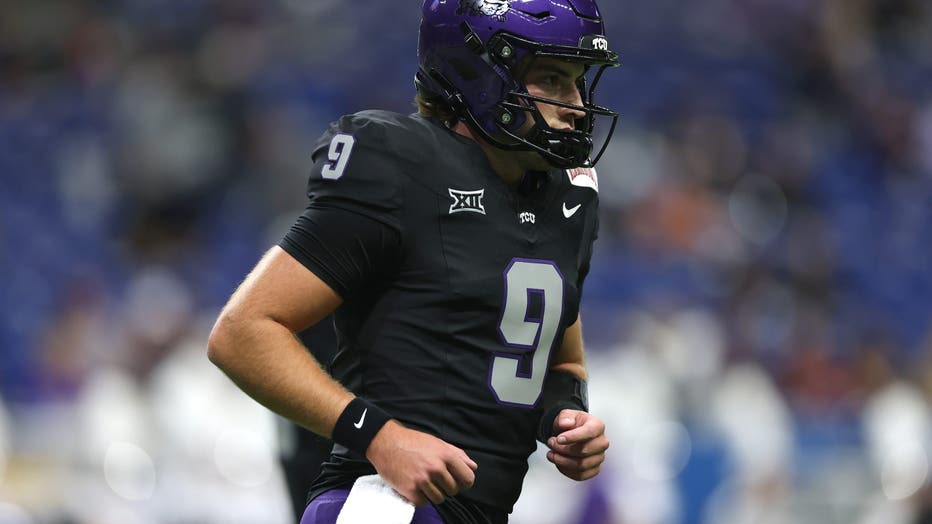
SAN ANTONIO, TEXAS – DECEMBER 30: Ken Seals #9 of the TCU Horned Frogs warms up prior to the game against the USC Trojans at Alamodome on December 30, 2025 in San Antonio, Texas. (Photo by Kenneth Richmond/Getty Images)

Seals led the team in passing yards with 288 to score a single touchdown. Seals completed 29/40 passes, and had one interception. 

Jeremy Payne led TCU in rushing with 72 yards, making 13 carries and scoring a touchdown. 

Payne also led in receiving with 80 yards. He received six times in total.

USC player highlights

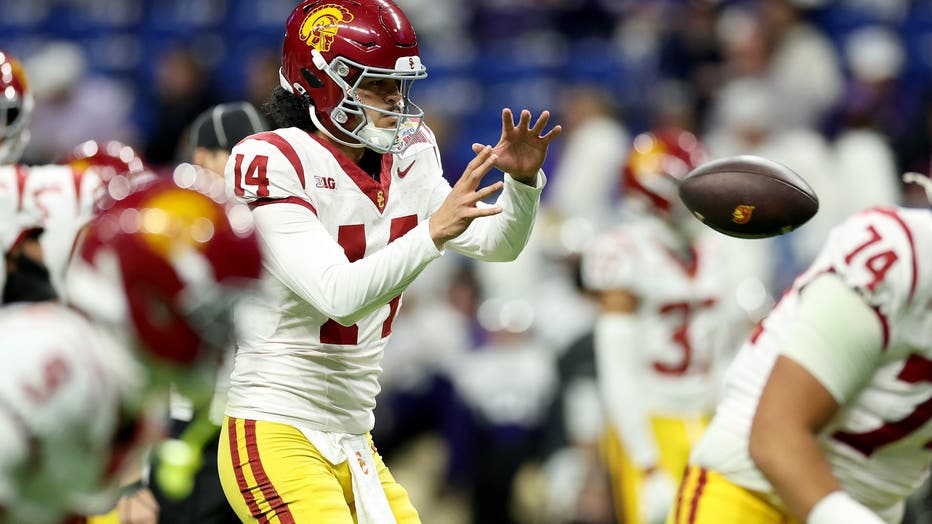
SAN ANTONIO, TEXAS – DECEMBER 30: Jayden Maiava #14 of the USC Trojans warms up prior to the game against the TCU Horned Frogs at Alamodome on December 30, 2025 in San Antonio, Texas. (Photo by Kenneth Richmond/Getty Images)

Jayden Maiava led the team in passing yards with 18/29 completions. He had 280 passing yards in total, one TD and two interceptions.

King Miller led for rushing with 99 yards, and made 25 carries. He scored a single touchdown.

Tanook Hines led for receiving with 163 yards, receiving six times in total.

The Source: Information in this article comes from the NCAA.

College Football

Great Job & the Team @ Latest & Breaking News | FOX 7 Austin for sharing this story.

Community Based Disease Surveillance Guideline, 2082

Community Based Disease Surveillance Guideline, 2082

Overview The Ministry of Health and Population (MoHP), Nepal, has officially endorsed a new Guideline for Community-Based Disease Surveillance 2082. The guideline has been developed in line with the provisions…

The post Community Based Disease Surveillance Guideline, 2082 appeared first on Public Health Update.

Great Job Public Health Update & the Team @ Public Health Update Source link for sharing this story.

Inside a third-grade typing class: How HEB ISD students build skills one keystroke at a time

Inside a third-grade typing class: How HEB ISD students build skills one keystroke at a time

by Matthew Sgroi, Fort Worth Report
December 30, 2025

The rhythm of learning sounds a lot like keys clicking across Salote Faasoo’s classroom at North Euless Elementary.

Third graders sit at rows of Chromebooks, fingers hovering above home keys as Faasoo moves between desks, glancing at screens and offering reminders. 

One student beams after a perfect round. He’s the fastest typist in the class, students shouted. Another groans after earning zero stars. 

“It’s hard,” admits third grader Ronan Reid, who earned five stars on his lessons. “But it challenges you.”

The brief morning lesson is part of Hurst-Euless-Bedford ISD’s growing focus on digital literacy. Each day, third graders spend about 10 minutes in Typing Club, an online platform that teaches accuracy, finger placement and rhythm — all skills the district says prepare students for reading, writing and online testing. 

“Typing builds letter recognition, especially with our lower reading students,” Faasoo said. “They have to spell the words correctly, no autocorrect like on a phone or tablet. It forces them to pay attention.”

The district’s formal keyboarding program, now in its third year, follows national guidance on how students learn typing — including proper hand placement and accuracy — as well as state standards that require students to correctly use a keyboard as part of technology instruction. Third graders are expected to reach 10 to 15 words per minute with at least 90% accuracy, according to district benchmarks. 

HEB ISD began integrating Typing Club into elementary classrooms after STAAR moved fully online in 2023. The lessons are built into the part of the day focused on reading and writing — a shift that officials and Faasoo say connects digital fluency to literacy. 

“It shows in their writing,” Faasoo said. “From the beginning of the year to now, you can see the growth.”

For many students, though, progress means patience. Most are far more familiar with tapping on touch screens than navigating a full keyboard, Faasoo said — especially when it comes to using both hands and keeping their eyes on the screen instead of the keys.

Student Arianna Cabrera said she tries her best to be accurate but sometimes still gets zero stars for falling short. When that happens, she keeps practicing and pushes herself to improve.

“Then I’ll try to do it a little faster next time,” she said.

Arianna hopes to become a doctor one day. Ronan wants to be a soccer player. For now, both are simply working through each level, adjusting to the feel of real keys under their fingers as they learn to balance accuracy, speed and focus.

It’s the consistency of those small gains that Faasoo builds on. She uses Typing Club as a warm-up before essay writing and encourages students to log in from home through the district’s online portal as developing the skills are incorporated into lessons.

“They look forward to it,” she said.

District leaders say that excitement — and steady improvement — show the effort is paying off.

“Two years’ worth of data tells us we’re moving in the right direction,” Holly Norgaard, HEB ISD’s executive director of curriculum and instruction, said at a recent board meeting. 

Students are typing at or above the district’s accuracy and words-per-minute goals, she said. 

“But we need to find that balance between the number of minutes they spend in the program and the outcomes we’re seeing,” she said.

For Faasoo’s class, the balance looks like a morning full of focus — and a few proud smiles. 

Matthew Sgroi is an education reporter for the Fort Worth Report. Contact him at matthew.sgroi@fortworthreport.org or @matthewsgroi1

At the Fort Worth Report, news decisions are made independently of our board members and financial supporters. Read more about our editorial independence policy here.

This <a target=”_blank” href=”https://fortworthreport.org/2025/12/30/inside-a-third-grade-typing-class-how-heb-isd-students-build-skills-one-keystroke-at-a-time/”>article</a> first appeared on <a target=”_blank” href=”https://fortworthreport.org”>Fort Worth Report</a> and is republished here under a <a target=”_blank” href=”https://creativecommons.org/licenses/by-nd/4.0/”>Creative Commons Attribution-NoDerivatives 4.0 International License</a>.<img src=”https://i0.wp.com/fortworthreport.org/wp-content/uploads/2021/04/cropped-favicon.png?resize=150%2C150&amp;quality=80&amp;ssl=1″ style=”width:1em;height:1em;margin-left:10px;”>

<img id=”republication-tracker-tool-source” src=”https://fortworthreport.org/?republication-pixel=true&post=329871&amp;ga4=2820184429″ style=”width:1px;height:1px;”><script> PARSELY = { autotrack: false, onload: function() { PARSELY.beacon.trackPageView({ url: “https://fortworthreport.org/2025/12/30/inside-a-third-grade-typing-class-how-heb-isd-students-build-skills-one-keystroke-at-a-time/”, urlref: window.location.href }); } } </script> <script id=”parsely-cfg” src=”//cdn.parsely.com/keys/fortworthreport.org/p.js”></script>

Great Job Matthew Sgroi & the Team @ Fort Worth Report for sharing this story.

The phone is dead. Long live . . . what exactly? | TechCrunch

The phone is dead. Long live . . . what exactly? | TechCrunch

True Ventures co-founder Jon Callaghan doesn’t think we’ll be using smartphones the way we do now in five years — and maybe not at all in 10.

For a venture capitalist whose firm has had some big winners over its two decades – from consumer brands like Fitbit, Ring, and Peloton, to enterprise software makers HashiCorp and Duo Security – that’s more than armchair theorizing; it’s a thesis on which True Ventures is actively betting.

True hasn’t gotten this far by following the crowd. The Bay Area firm has largely operated under the radar despite managing roughly $6 billion across 12 core seed funds and four “select,” opportunity-style funds that it has used to pour more capital into portfolio companies that are gaining momentum. While other VCs have grown more promotional – building personal brands on social media and podcasts to attract founders and deal flow – True has gone in the opposite direction, quietly cultivating a tight network of repeat founders. The strategy seems to be working: according to Callaghan, the firm boasts 63 exits with gains and seven IPOs amid a portfolio of some 300 companies assembled over its 20-year history.

Three of True’s four recent exits in the fourth quarter of 2025 involved repeat founders who came back to work with the firm again after previous successes, says Callaghan. Still, it’s Callaghan’s thinking about the future of human-computer interaction that really stands out in a sea of AI hype and mega-rounds.

“We’re not going to be using iPhones in 10 years,” Callaghan says flatly. “I kind of don’t think we’ll be using them in five years – or let’s say something different that’s a little safer – we’re going to be using them in very different ways.”

His argument is simple: our phones are lousy at being the interface between humans and intelligence. “The way we take them out right now to send a text to confirm this or send you some message or write an email – [that’s] super inefficient, [and] not a great interface,” he explains. “[They’re] prone to error, prone to disruption [of] our normal lives.”

So sure is he of this that True has been spending years exploring alternative interfaces – software-based, hardware-based, everything in between. It’s the same instinct that led True to bet early on Fitbit before wearables were obvious, to invest in Peloton after hundreds of other VCs said ‘no thanks,’ and to back Ring when founder Jamie Siminoff kept running out of money and even the judges on “Shark Tank” turned him away. Each time, the bet looked questionable, says Callaghan. Each time, the bet was on a new way for humans to interact with technology that felt more natural than what came before.

Techcrunch event

San Francisco
|
October 13-15, 2026

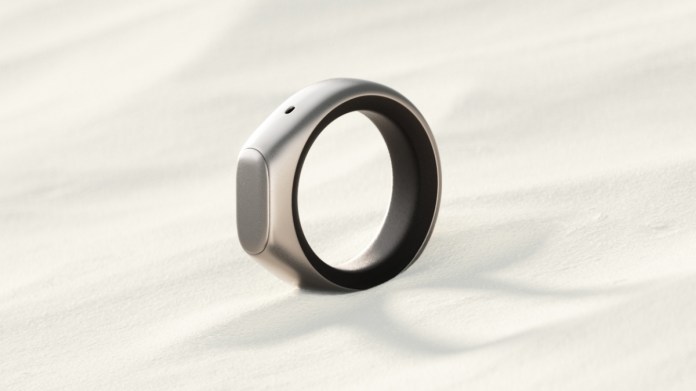
The latest manifestation of this thesis is Sandbar, a hardware device that Callaghan describes as a “thought companion” — or, in more mundane terms, a voice-activated ring worn on the index finger. Its singular purpose: capturing and organizing your thoughts through voice notes. It’s not trying to be another Humane AI Pin or compete with Oura’s health tracking. “It does one thing really well,” Callaghan says. “But that one thing is a fundamental human behavioral need that is missing from technology today.”

The idea isn’t to passively record ambient audio but to be there when an idea strikes, serving as a kind of thought partner. It’s attached to an app, leverages AI, and, according to Callaghan, represents a very different philosophy about how we should interact with intelligence.

What drew True to Sandbar founders Mina Fahmi and Kirak Hong wasn’t just the product, though. “When we met Mina, we were just absolutely aligned on vision,” Callaghan recalls. True’s team had already been thinking for years about alternative interfaces, making targeted investments around that possibility. They’d met with dozens of founders, as a result. But the approach of Fahmi and Hong – who previously worked together on neural interfaces at CTRL-Labs, a startup acquired by Meta in 2019 – stood out. “It’s about what [the ring] enables. It’s about the behavior it enables that we will very soon realize we can’t live without.”

There’s an echo here of Callaghan’s old line about Peloton: “It’s not about the bike.” To some, the bike – even its earliest iteration – was compelling. But Peloton was really about the behavior it enabled and the community it created; the bike was just the vessel.

This philosophy of betting on new behaviors — not just new gadgets — also explains how True has managed to stay disciplined about capital. Even as AI startups raise hundreds of millions at billion-dollar valuations out of the gate, True insists that it’s able to stick to what it does best, which is to write seed checks of $3 million to $6 million for 15% to 20% ownership in startups that it often gets to see first.

Callaghan says True will raise more money to fund what’s working, but he’s not interested in raising billions of dollars. “Like, why? You don’t need that to build something amazing today.”

That same measured approach colors his view of the broader AI boom. While he says (when asked) that he believes OpenAI could soon be worth a trillion dollars, and while he calls this the most powerful compute wave we’ve seen, Callaghan sees warning signs in the circular financing deals backing hyperscalers and their $5 trillion in projected CapEx spending on data centers and chips. “We’re in a very capital intense part of the cycle, and that is worrisome,” he notes.

That said, he’s optimistic about where the real opportunities lie. Callaghan thinks the greatest value creation is ahead of us – not in the infrastructure layer but in the application layer, where new interfaces will enable entirely new behaviors.

It all comes back to his core investing philosophy, which sounds almost romantic — the kind of pitch-perfect VC wisdom that would ring hollow from most people: “It should be scary and lonely and you should be called crazy,” Callaghan says about early-stage investing done right. “And it should be really blurry and ambiguous, but you should be with a team that you really believe in.” Five to ten years later, he says, you’ll know if you were on to something.

Either way, based on True’s track record of betting on hardware that many others missed – fitness trackers, connected bikes, smart doorbells, and now thought-capturing rings – it’s worth paying attention when Callaghan says the phone’s days are numbered. Being early is the whole point — and the trend lines support his thesis: the smartphone market is effectively saturated, growing at barely 2% annually, while wearables — smartwatches, rings, and voice-enabled devices — are expanding at double-digit rates.

Something’s shifting in how we want to interact with technology, and True is placing its bets accordingly.

Pictured above, Sandbar’s Stream ring. For much more from our conversation with Callaghan, tune in to the StrictlyVC Download podcast next week; new episodes drop every Tuesday.


Great Job Connie Loizos & the Team @ TechCrunch Source link for sharing this story.

Trump issues first vetoes of his second term

Trump issues first vetoes of his second term

President Donald Trump this week issued the first vetoes of his second term in office, rejecting two bills that passed Congress with bipartisan support.

Trump on Monday vetoed a pipeline measure and legislation that would include more land for the Miccosukee Tribe in Florida, the White House said on X.

The pipeline bill, known as the Finish the Arkansas Valley Conduit Act, passed both the House and the Senate by voice vote, indicating overwhelming bipartisan support. The legislation aims to facilitate completing a pipeline project to bring clean water to southeastern Colorado.

In a letter to the House announcing the veto, Trump pointed to the history of the pipeline construction, arguing it had dragged on for too long and had cost too much money.

“Enough is enough,” Trump wrote. “My administration is committed to preventing American taxpayers from funding expensive and unreliable policies. Ending the massive cost of taxpayer handouts and restoring fiscal sanity is vital to economic growth and the fiscal health of the Nation.”

The bill’s sponsor, Rep. Lauren Boebert, R-Colo., responded on social media, writing, “This isn’t over.”

Colorado’s two senators, both Democrats, blasted Trump on social media. Sen. Michael Bennet called Trump’s veto a “revenge tour,” and Sen. John Hickenlooper accused him of “playing partisan games and punishing Colorado by making rural communities suffer without clean drinking water.”

Hickenlooper encouraged Congress to overturn the veto, which would require two-thirds majority votes in both chambers.

The other bill Trump vetoed, known as the Miccosukee Reserved Area Amendments Act, would expand the Miccosukee Reserved Area in Florida to include part of the Everglades National Park known as Osceola Camp. It also passed Congress by voice vote.

The legislation was sponsored by Rep. Carlos Gimenez, R-Fla., whose office did not immediately respond to a request for comment on Trump’s veto.

In his letter explaining the veto, Trump accused the Miccosukee Tribe of seeking “to obstruct reasonable immigration policies that the American people decisively voted for when I was elected.”

Trump vetoed 10 bills during his first term; only one of the vetoes was overridden by Congress. The first veto came two years into his term, on a Senate joint resolution that sought to terminate a national emergency he had declared on the Southern border.

What’s behind the MAHA movement? Backed by RFK Jr. and the Trump administration, it’s reshaping food policy across the U.S.

Great Job Sarah Dean and Raquel Coronell Uribe | NBC News & the Team @ NBC 5 Dallas-Fort Worth for sharing this story.

‘Such a Childish Man’: Trump Dangles Lunch for a Second Day, But His Offhand Insult Turns the Gesture Into an Awkward Power Play

‘Such a Childish Man’: Trump Dangles Lunch for a Second Day, But His Offhand Insult Turns the Gesture Into an Awkward Power Play

President Donald Trump, for the second day in a row, offered reporters lunch while throwing in an insult during a public appearance.

Ahead of Trump’s closed-door meeting with Israeli Prime Minister Benjamin Netanyahu at his Palm Beach home, he paused to take questions from the press before heading in. The free-flowing exchange led to Trump narrating who could stay, who could go, and what role food might play in the process.

‘Such a Childish Man’: Trump Dangles Lunch for a Second Day, But His Offhand Insult Turns the Gesture Into an Awkward Power Play
President Donald Trump sparked online chatter after again offering reporters lunch while reminding them they were “not nice,” highlighting his ongoing tension with the press. (Photo by Joe Raedle/Getty Images)

‘Who’s That?’: Trump’s Private, Roped-Off Dinner Sparks Online Frenzy — One Seat in Particular Has the Internet Guessing

The invitation came with a familiar edge, mixing humor, irritation, and control in equal measure.

“We’ll see you. We’re going to have a big meeting, and we’ll see you in a couple of hours, if you’d like. And if you’d like, you can come up and have lunch, like you did yesterday. Would you like that or not? Do you want that? Because some of them think it’s terrible — it’s a bribe,” Trump said on Monday, Dec. 29, before joking, “But, you know, a bribe for $25? I don’t know.”

He continued, “If you’d like, you can go, and if you don’t, you can stand in a driveway and melt.”

“All right. But if you want, will you work on that? Margo — is Margo doing a good job? She’s a star. She’s too nice,” he stated, extolling his special assistant and communications adviser Margo Martin. “Her only problem? She’s too nice to you, and you’re not nice to us.”

The comments mirrored remarks Trump made just a day earlier during a meeting with Ukrainian President Volodymyr Zelenskyy, when he also joked about feeding reporters while questioning how it might be perceived. The back-to-back appearances made the lunch offer feel less spontaneous and more like a running theme.

“President Trump is ‘bribing’ the fake news with lunch again!” one person posted on X, framing the exchange as part of Trump’s long-running friction with reporters.

On Threads, the jokes leaned sharper, as one person asked, “Did they spit in the lunch for the media?” Another added, “He thinks because he can be bought with a compliment, the press can be bought with some rancid food.”

“Still thinks he on the apprentice show,” joked a fourth person.

A few pointed out that Trump and Netanyahu were “twinning” by both wearing navy blue suits and red ties around their necks. One person noted, “The way they are dressed alike. It would be funny if it wasn’t so pathetic. He is such a childish man.”

Another wrote, “Dressed like twins. Trump always wears the same suit. Netanyahu kissing up to Trump by imitating [him]. Why has no one mentioned it on the news media??”

The online reaction highlighted how quickly Trump’s smallest gestures balloon into broader commentary. His relationship with the press has long been defined by tension, selective access, and public sparring. He has called journalists names and made enemies with those who dare to call him out.

Even moments framed as light or generous often circle back to complaints about fairness and tone from the “fake news.”

The timing of this invitation only reinforced that dynamic, signaling to people in the corps that he knows that was a headline-grabbing act that got many talking about him. Because of the remarks from the day before, the second lunch invitation felt like a premeditated action to distract people from the controversial politician he was meeting with.

By the time reporters were ushered away, the meeting itself had already taken a back seat. Online, the lunch became shorthand for Trump’s complicated dance with the press — an offer extended, questioned, and debated all at once.

Great Job Nicole Duncan-Smith & the Team @ Atlanta Black Star Source link for sharing this story.

‘I opened her door and the wind caught me, and I went flying’: The U.S. Arctic air surge is sweeping northerners off their feet | Fortune

‘I opened her door and the wind caught me, and I went flying’: The U.S. Arctic air surge is sweeping northerners off their feet | Fortune

A surge of Arctic air brought strong winds, heavy snow and frigid temperatures to the Great Lakes and Northeast on Tuesday, a day after a bomb cyclone barreling across the Midwest left tens of thousands of customers without power.

Blustery winds were expected to add to the chill, with low temperatures dipping below freezing as far south as the Florida panhandle, the National Weather Service said.

The wild storm hit parts of the Plains and Great Lakes this week with sharply colder air, strong winds and a mix of snow, ice and rain, leading to treacherous travel. Forecasters said it intensified quickly enough to meet the criteria of a bomb cyclone, a system that strengthens rapidly as pressure drops.

Kristen Schultz, who was heading home to Alaska, said it took her four hours to get to the Minneapolis airport on Tuesday.

“Just give yourself plenty of extra time and that way, even if things go smoothly, you don’t have to be stressed out,” she said, “and you’re ready in case things don’t go so smoothly.”

Nationwide, more than 115,000 customers were without power Tuesday morning, around a third of them in Michigan, according to Poweroutage.us.

As the storm moves into Canada, the frigid air trailing behind it will spread across much of the eastern two-thirds of the country, the National Weather Service said, powering the lake-effect “snow machine” in areas downwind of the Great Lakes.

Some areas in western and upstate New York saw a foot or more of snow Monday and their totals could reach up to 3 feet (91 centimeters) this week, forecasters said. Strong winds on Monday, including an 81 mph (130 kph) gust in Buffalo, New York, knocked down trees and wires across the region, the weather service said.

“At this point, the worst does seem to be over, and we are expecting conditions to improve especially by later today,” said Andrew Orrison, a weather service meteorologist.

Videos on social media show people struggling to walk in the windy conditions and a waterway in downtown Buffalo clogged with tree branches and other debris stemming from a windblown surge from Lake Erie.

Just south of Buffalo in Lackawanna, Diane Miller was caught on video being blown off the front steps of her daughter’s house and landing in some bushes. She wasn’t seriously hurt.

“I opened her door and the wind caught me, and I went flying,” Miller told WKBW-TV.

Whiteout conditions were still possible in some areas, forecasters said, and New York Gov. Kathy Hochul warned people in impacted areas to avoid unnecessary travel.

The fierce winds on Lake Erie had sent water surging toward the basin’s eastern end near Buffalo while lowering water on the western side in Michigan to expose normally submerged lakebed — even the wreck of a car and a snowmobile.

Kevin Aldrich, 33, a maintenance worker from Monroe, Michigan, said he has never seen the lake recede so much and was surprised Monday to spot remnants of piers dating back to the 1830s. He posted photos on social media of wooden pilings sticking up several feet from the muck.

“Where those are at would typically be probably 12 feet deep,” or 3.6 meters, he said. “We can usually drive our boat over them.”

Dangerous wind chills across parts of North Dakota and Minnesota plunged as low as minus 30 F (minus 34 C) on Monday. And in northeast West Virginia, rare nearly hurricane-force winds were recorded on a mountain near Dolly Sods, according to the National Weather Service.

On the West Coast, strong Santa Ana winds with isolated gusts topping 70 mph (112 kph) brought down trees in parts of Southern California where recent storms had saturated the soil. Downed powerlines forced the shutdown of a freeway north of Los Angeles for several hours on Monday. Wind advisories had expired by evening, but blustery conditions were expected through Saturday, along with thunderstorms.

Rain on New Year’s Day could potentially soak the Rose Parade in Pasadena for the first time in about two decades.

___

Associated Press writers Julie Walker in New York; Leah Willingham in Concord, New Hampshire; Jeff Martin in Kennesaw, Georgia; and Susan Haigh in Norwich, Connecticut, contributed.

Great Job Holly Ramer, The Associated Press & the Team @ Fortune | FORTUNE Source link for sharing this story.

Arsenal will end the year top of the Premier League after 4-1 statement win over Villa

Arsenal will end the year top of the Premier League after 4-1 statement win over Villa

Arsenal ensured it will end the year top of the Premier League after beating Aston Villa 4-1 at home in a powerful statement win on Tuesday with all goals scored in the second half.

The fourth goal, scored by substitute Gabriel Jesus one minute after coming on, highlighted the depth of Arsenal’s bench this season and coach Mikel Arteta jubilantly high-fived his assistants at the final whistle.

Victory moved Arsenal five points ahead of Manchester City, which plays at Sunderland on New Year’s Day, and six points clear of third-place Villa.

“It is a beautiful evening. That was a very tough match, as we knew it would be, because they are a top opponent to play against,” Arteta told broadcaster Sky Sports. “The way we started the second half was amazing, we really turned things up and were efficient in everything that we did.”

Arsenal has not won the Premier League since 2004 and the pressure is on Arteta to deliver.

“In 2026, we know what we want,” Arteta said.

Villa manager Unai Emery later defended his decision not to shake Arteta’s hand at the end of the game by saying it was “cold” at the Emirates.

“Always my routine is go to the opposition coach, shake hands and go inside,” the former Arsenal manager told Sky Sports. “If he is not doing the same rule, I can’t wait … it was cold.”

Elsewhere, Chelsea drew 2-2 at home to Bournemouth; Newcastle won 3-1 at lowly Burnley; and Manchester United was held 1-1 at home to rock-bottom Wolverhampton.

Struggling West Ham drew 2-2 with visiting Brighton, and Everton won 2-0 at Nottingham Forest.

Sharing the goals

No Arsenal player is near the top of the scorers’ charts this season, yet sharing the goals around might just be the team’s strength.

Defender Gabriel Magalhães headed home early in the second half following a corner for set-piece specialist Arsenal, and midfielder Martín Zubimendi netted in the 52nd minute.

Winger Leandro Trossard curled in a fine third from the edge of the penalty area in the 69th and was involved in the fourth goal, curled into the same corner from almost the same spot in the 78th minute by Jesus after Arsenal had launched a superb counterattack from deep.

The win was even more impressive considering Arsenal was missing key midfielder Declan Rice with a knee injury and Villa was playing on the back of 11 straight victories in all competitions.

Gabriel nodded in from close range and was deemed not to have impeded Villa goalkeeper Emiliano Martínez with his elbow.

Zubimendi finished confidently after captain Martin Ødegaard expertly won the ball in midfield and advanced before threading a perfect ball behind Villa’s defense.

Ollie Watkins grabbed an injury-time consolation for Villa.

Poor defending costs Chelsea

Bournemouth’s David Brooks netted early from close range after Chelsea failed to deal with a throw-in from the right.

Cole Palmer equalized in the 15th with a penalty awarded after a video review ruled that Antoine Semenyo’s knee had gone into the back of forward Estevão’s leg.

Midfielder Enzo Fernández gave Chelsea the lead midway through the first half, but Chelsea gifted Bournemouth an equalizer when a defender headed on a throw-in from the left and Justin Kluivert scored at the back post for 2-2.

Chelsea is fifth and level on 30 points with United in sixth.

United held by Wolves

Manchester United led through Joshua Zirkzee’s deflected strike in the 27th but Ladislav Krejčí equalized close to halftime for Wolves with a powerful downward header.

It was Wolves manager Rob Edwards’ first point since taking charge in November.

Patrick Dorgu’s injury-time goal for United was ruled out for offside by VAR.

Boos at the final whistle by United fans contrasted with Wolves supporters’ chants of “We’ve won a point.”

Wissa scores for Newcastle

Yoane Wissa grabbed his first league goal since joining from Brentford as Newcastle moved into 10th spot.

Newcastle was 2-0 up inside seven minutes with Joelinton being set up from the left wing by Anthony Gordon and Wissa bundling in from close range following a goalmouth scramble.

Josh Laurent pulled a goal back for Burnley midway through the first half. Newcastle survived nervy moments before Bruno Guimarães sealed the win with an expert lob in stoppage time.

Next-to-last Burnley is two points behind West Ham in 18th.

Garner and Paquetá shine

Everton netted in the 19th when James Garner drilled in a low finish after being set up down the right by Dwight McNeil.

Garner then turned neatly in midfield before feeding Thierno Barry with a defense-splitting pass to make it 2-0 against Forest in the 79th.

West Ham took an early lead against Brighton when striker Jarrod Bowen latched onto Lucas Paquetá’s exquisite through ball from halfway and struck a low shot into the bottom corner.

Veteran forward Danny Welbeck equalized for Brighton from the penalty spot for his eighth goal of the season, and then hit the crossbar with a Panenka-style chipped penalty later in the first half.

Paquetá converted his spot kick with a staggered run-up in first-half injury time, but Joël Veltman equalized for Brighton in the 61st following a corner.

Defending champion Liverpool hosts Leeds on Thursday.

___

AP soccer: https://apnews.com/hub/soccer

Copyright 2025 The Associated Press. All rights reserved. This material may not be published, broadcast, rewritten or redistributed without permission.

Great Job Jerome Pugmire, Associated Press & the Team @ KSAT San Antonio Source link for sharing this story.

31 Atlantic Stories You Might Have Missed

31 Atlantic Stories You Might Have Missed

In case you’re settling into winter and lamenting not having read everything The Atlantic has published this year, you’re in luck. I’ve created a list of stories you may have missed that are very much worth your time. The assortment ranges widely: eating an organ feast in Mark Twain’s Paris, experiencing a comedy-show adventure in Riyadh, drifting after a shipwreck in the Pacific, and diving into the secrets of the Inca empire. “What Parents of Boys Should Know” sparked many conversations in my group chats, as did this photo of Abraham Lincoln’s ear being cleaned. There are stories that contextualized a chaotic moment for the American experiment, drawing deeply on history.

I hope you’ll spend time with this selection, and I would love to hear what you think. Send me a note: [email protected].


I Watched Stand-Up in Saudi Arabia

By Helen Lewis

What the surreal Riyadh Comedy Festival foretold about the kingdom’s future

The New Rasputins

By Anne Applebaum

Anti-science mysticism is enabling autocracy around the globe.

America and Its Universities Need a New Social Contract

By Danielle Allen

Fifty dollars for STEM, five cents for citizenship—that’s how America apportions its education dollars. Our beleaguered universities must redress the balance—helping the country and themselves.

What Parents of Boys Should Know

By Joshua Coleman

Daughters tend to receive higher levels of affection and patience at home than sons. But the sons might need it more.

Is This the Worst-Ever Era of American Pop Culture?

By Spencer Kornhaber

An emerging critical consensus argues that we’ve entered a cultural dark age. I’m not so sure.

My Shipwreck Story

By Alec Frydman

On my first time out as a commercial fisherman, my boat sank, my captain died, and I was left adrift and alone in the Pacific.

An Innocent Abroad in Mark Twain’s Paris

By Caity Weaver

My quest for a true literary experience resulted in choucroute, a surprise organ feast, an epiphany at the Louvre, existential dread, and a rowboat.

A PTSD Therapy “Seemed Too Good to Be True”

By Yasmin Tayag

What if overcoming trauma can be painless?

They might be surprised that the republic exists at all.

Invisible Habits Are Driving Your Life

By Shayla Love

The science of habits reveals that they can be hidden to us and unresponsive to our desires.

The Rise of John Ratcliffe

A partisan loyalist with a history of politicizing intelligence will soon be running the CIA.

A perfect suit, made by an expert tailor out of superlative fabric, would do nothing less than transform me.

This isn’t single-party rule, but it’s not democracy either.

A profane blogger believes an innocent woman is being framed for murder. He’ll do anything to prove he’s right—and terrorize anyone who says he’s wrong.

Why some mainstream Black intellectuals are giving up on the landmark decision

How Aella went from selling sex to studying it

The Telepathy Trap

By Daniel Engber

A podcast shows how love divides us.

The People Who Clean the Ears of Lincoln (And Other Statues)

By Alan Taylor

A collection of images of the varied workers and techniques used to maintain some of the world’s largest and most prominent statues and monuments.

Accommodation Nation

By Rose Horowitch

America’s colleges have an extra-time-on-tests problem.

Do You Actually Know What Classical Music Is? Does Anyone?

By Matthew Aucoin

The term is applied to radically different compositions across more than 1,000 years of history. We need a better definition.

What having a baby taught me about the illusion of control

A century-old book foresaw Trump’s most basic strategy.

In 1965, the two intellectual giants squared off in a debate at Cambridge. It didn’t go quite as Buckley hoped.

Would you raise kids with your best pals?

For hundreds of years, Andean people recorded information by tying knots into long cords. Will we ever be able to read them?

Inside the world of extreme-privacy consultants, who, for the right fee, will make you and your personal information very hard to find

Instead of cutting services to cut costs, one rural hospital plans to thrive by offering more.

A radical legal philosophy has undermined the process of constitutional evolution.

He was denounced by rebel propagandists as a tyrant and remembered by Americans as a reactionary dolt. Who was he really?

Its trappings remain, but authoritarianism and AI are hollowing out our humanity.

Many birth mothers hope to maintain contact with their child. But their agreements with adoptive parents can be fragile.


Evening Read

Jan Buchczik

New Year’s Resolutions That Will Actually Lead to Happiness

By Arthur C. Brooks

If you are someone who follows a traditional religion, you most likely have a day such as Yom Kippur, Ashura, or Ash Wednesday, dedicated to atoning for your sins and vowing to make improvements to your life. But if you are not religious, you might still practice a day of devotion and ritualistic vows of self-improvement each year on January 1. New Year’s Day rings in the month of January, dedicated by the ancient Romans to their god Janus. Religious Romans promised the two-faced god that they would be better in the new year than they had been in the past.

According to the Pew Research Center, historically between one-third and one-half of Americans observe this pagan rite every year by making their own New Year’s resolutions. The most common resolutions are fairly predictable: financial resolutions, like saving more money or paying down debt (51 percent in 2019); eating healthier (51 percent); exercising more (50 percent); and losing weight (42 percent).

Old Janus is pretty annoyed at this point, I imagine, because our resolutions overwhelmingly fail.

Read the full article.


Culture Break

31 Atlantic Stories You Might Have Missed
(Illustration by Shawna X)

Watch. Here are the 10 best movies of 2025, according to our critic David Sims.

Explore. What’s the point of school photos anymore? The portraits are kitschy and expensive—but parents can’t seem to stop buying them, Annie Midori Atherton writes.

Play our daily crossword.


Explore all of our newsletters.

Rafaela Jinich contributed to this newsletter.

When you buy a book using a link in this newsletter, we receive a commission. Thank you for supporting The Atlantic.

Great Job Bhumika Tharoor & the Team @ The Atlantic Source link for sharing this story.

“The Wire” Actor Isiah Whitlock Jr. Dead At 71

“The Wire” Actor Isiah Whitlock Jr. Dead At 71

Source: Santiago Felipe / Getty

Isiah Whitlock Jr., the veteran character actor beloved for his role as state Sen. Clay Davis on HBO’s “The Wire,” has died, leaving fans and fellow artists reflecting on the joy he brought to the screen. Known for his distinctive gravelly voice and that unforgettable catchphrase, Whitlock built a career filled with memorable performances in film, television, and theater.

Born in South Bend, Indiana, Whitlock found his love of acting at the American Conservatory Theater in San Francisco. He became a frequent collaborator with director Spike Lee, appearing in acclaimed films like “25th Hour,” “She Hate Me,” “BlacKkKlansman,” and “Da 5 Bloods.” Lee praised his longtime colleague, saying, “When you have an actor like Isiah, you know he’s going to deliver something special. He just had that gift.”

While Whitlock took on many roles throughout his career, his performance as Clay Davis in “The Wire” truly resonated. Audiences everywhere remember the way he stretched a certain four-letter expletive, turning it into a cultural moment that made so many smile. Even so, those who worked with Whitlock say his impact went far beyond any catchphrase.

“He had a gravity to him. He was a kind soul with an incredible wit. Working with him was an honor because he made everyone around him better,” recalled Wendell Pierce, his co-star on “The Wire.” Fans embraced Whitlock, often approaching him on the street to quote his famous line, something he always returned with warmth and good humor.

Throughout his decades in the business, Whitlock earned praise as a true professional and a generous scene partner. He moved easily among genres and was often lauded for bringing humanity and depth to every character, no matter the size of the role. Critics and peers noted that his presence elevated every project he joined.

SOURCE: Deadline

RELATED: What I’ve Learned From Season 4 of “The Wire”: Systems Can Be Destructive
RELATED: Remembering Michael K Williams


“The Wire” Actor Isiah Whitlock Jr. Dead At 71
was originally published on
92q.com

Great Job 92Q STAFF & the Team @ Black America Web Source link for sharing this story.

Secret Link