This is an edition of The Atlantic Daily, a newsletter that guides you through the biggest stories of the day, helps you discover new ideas, and recommends the best in culture. Sign up for it here.
A year ago, no one knew for sure whether Project 2025 would prove to be influential or if it would fall by the wayside, like so many plans in President Donald Trump’s first term. Today, it stands as the single most successful policy initiative of the entire Trump era.
Project 2025, which was convened by the Heritage Foundation during the Trump interregnum, was not just one thing: It was a policy white paper, an implementation plan, a recruitment database, and a worldview, all rolled into one. As I wrote in my book this past spring, the authors sought to create an agenda for the next right-wing president that would allow him to empower the executive branch, sideline Congress, and attack the civil service. The resulting politicized, quasi-monarchical government would enact policies that would move the United States toward a traditionalist Christian society.
In the roughly 11 months since he took office, Trump has closely followed many parts of Project 2025, finally embracing it by name in October. Both Trump and the plan’s architects have benefited: His second administration has been far more effective at achieving its goals than his first, and the thinkers behind Project 2025 have achieved what Paul Dans, one of its leaders, described as “way beyond” his “wildest dreams.”
Project 2025’s biggest victory has been an extraordinary presidential power grab, which has allowed Trump to act in ways that previous presidents have only fantasized about, and to act with fewer restraints. He has laid off tens of thousands of federal employees, sometimes in defiance of laws. More than 315,000 federal employees had left the government by mid-November, according to the Office of Personnel Management. Entire agencies, such as USAID, have been effectively shut down, and the Education Department may be next.
Elsewhere, the administration has slashed environmental regulations, withdrawn from a major international climate agreement, undermined renewable energy, and worked to encourage oil and gas drilling on public land. It has discarded key civil-rights-enforcement methods, dismantled anything that might be construed as DEI, and set the agenda for aggressive immigration policies, not just closing the border to many foreign nationals and deporting unauthorized immigrants but also cracking down on valid-visa holders and seeking to denaturalize citizens.
This is not small-government conservatism—it’s an effort to concentrate federal power and turn it into a political weapon. Long-standing guardrails against presidential interference in the Justice Department have been demolished. The White House has fired line prosecutors, and Trump has illegally appointed his own former personal attorneys to lead U.S. Attorney’s Offices. These prosecutors have brought charges against many of Trump’s political foes, including former FBI Director James Comey, New York Attorney General Letitia James, and Representative LaMonica McIver; others have been placed under investigation. (Judges have thrown out indictments against Comey and James, though the DOJ is appealing those dismissals. McIver, who was indicted in June for allegedly impeding federal agents and interfering with an arrest, denies wrongdoing and has pleaded not guilty.)
The administration has dabbled in impounding funds appropriated by Congress, despite a law barring this. It has also mounted a major assault on the independence of regulatory agencies, as established by Congress; Trump has fired multiple appointees, sometimes in apparent violation of law, but the Supreme Court has allowed him to proceed. Earlier this month, the justices heard arguments in a case that could overturn or severely narrow the 1935 precedent that safeguards agency independence. We already have a glimpse of what a fully politicized regulatory environment might look like: Chairman Brendan Carr, a Project 2025 author, has used his position at the Federal Communications Commission to pressure CBS News and ABC, even trying to get the late-night host Jimmy Kimmel fired earlier this year.
Trump’s presidential power grab will allow his administration to achieve more of Project 2025’s ambitions in the coming year and beyond. All of this has been enabled by a Republican-dominated Congress, which has with few exceptions allowed the president to seize legislative prerogatives, and by the Supreme Court, which has repeatedly allowed Trump to move forward on his expansion of power using the so-called shadow docket.
But Project 2025 has not been a complete success. One key belief of the authors was that Trump’s first administration was undercut by bad appointments and by failures to fill other roles. To that end, Project 2025 created a huge database of potential appointees and offered training courses. Although Trump has managed to find more aides loyal to him than in his first term, his pace of confirmation for top jobs trails the pace of most recent presidents. He has also seen a historic high in nominations withdrawn in the first year of a presidency.
More fundamentally, the Christian nationalism that courses through Project 2025 has been somewhat eclipsed by other priorities. The Trump administration has made few major moves to restrict access to abortion or to enact pronatalist policies, and the conservative Catholic writer Ross Douthat recently argued that Christianity seems to be window dressing in the administration’s policy rather than a real ideological driver of decision making. Big Tech was a notable boogeyman for the authors, who view smartphones and social media as a danger to traditional religious values, but major Silicon Valley figures have become hugely influential in the White House.
For the Heritage Foundation, Project 2025 has been a somewhat Pyrrhic victory. Although its policy ideas are steering the administration, the think tank finds itself on the outside—a product, it seems, of Trump’s displeasure that coverage of Project 2025 complicated his campaign last year. Heritage is also fighting an intramural battle over how to handle the racist and anti-Semitic strains of the right.
Another, larger question looms. For decades, American conservatives have argued for restraints on government, in part out of fear of how progressives have used power to enact their policies. Project 2025 threw that out, embracing right-wing big government. Its unpopular ideas are one reason that Republicans are facing a daunting election environment in 2026 and perhaps 2028. If Project 2025’s authors felt, as Russell Vought once said, that America was “in the late stages of a complete Marxist takeover” before Trump returned to office, they may find the situation even more apocalyptic if a Democrat wins the presidency in 2028—and inherits the sweeping powers they have handed to the White House.
Related:
Evening Read
The Atlantic
All Hail Dead Week, the Best Week of the Year
By Helena Fitzgerald
Christmas is over and we have arrived at the most wonderful time of the year—nominally still the holidays, but also the opposite of a holiday, a blank space stretching between Christmas and New Year’s Eve when nothing makes sense and time loses its meaning …
In between the end of the old year and the beginning of the new one is this weird little stretch of unmarked time. For most people, this week isn’t even a week off from work, but at the same time it also isn’t a return to the normal rhythm of regular life. Nobody knows what to do with this leftover week, awkwardly stuck to the bottom of the year. I call it “Dead Week,” a time when nothing counts, and when nothing is quite real.
Nestled in the Texas Hill Country just north of Austin, a new 55+ community is redefining what it means to live well. Regency at Santa Rita Ranch, a Toll Brothers active-adult community, offers more than beautiful new homes—it delivers an experience thoughtfully designed around connection, wellness, and choice.
At Regency, residents are invited to live life on their own terms. Whether that means starting the day with a yoga class, meeting friends for coffee at the clubhouse, or heading out for an afternoon hike along Santa Rita Ranch’s miles of trails, every day unfolds with intention. This is a community where being decisively adventurous or decidedly relaxed is entirely up to you.
The heart of Regency at Santa Rita Ranch is its resort-style amenity center, created to encourage both social connection and personal well-being. A luxury clubhouse serves as a central gathering place, complemented by spaces for fitness, relaxation, and socializing. A thoughtfully curated calendar of events, clubs, and activities makes it easy to pursue passions, try something new, and form meaningful friendships within a welcoming 55+ community.
Regency at Santa Rita Ranch homes reflect Toll Brothers’ signature approach to thoughtful design and quality craftsmanship. Open-concept floor plans, modern finishes, and flexible spaces are designed to support today’s active adult lifestyle—whether hosting family, working on personal pursuits, or simply enjoying a home that lives comfortably and efficiently. The emphasis is on intentional design that enhances everyday living.
Equally compelling is the community’s location within Santa Rita Ranch, one of the area’s most sought-after master-planned communities. Residents enjoy access to world-class amenities, natural open spaces, and a setting that balances Hill Country tranquility with everyday convenience. Nearby Georgetown’s historic downtown, local dining and shopping, golf courses, and Austin’s cultural energy are all within easy reach.
Regency at Santa Rita Ranch reflects Toll Brothers’ commitment to delivering not just luxury homes, but complete lifestyle experiences. Here, luxury is found in the freedom to choose how you spend your time, the ease of low-maintenance living, and the energy of a community built around shared interests and active living.
For those ready to embrace what’s next—with confidence, comfort, and connection—Regency at Santa Rita Ranch offers a place where every day feels thoughtfully curated and distinctly your own.
Starting Monday, December 29, at 5:30 p.m., OurCalling will open an Inclement Weather Shelter and begin check-in at their Navigation Center, located at 1702 S. Cesar Chavez Boulevard, Dallas, TX 75215.
The shelter can accommodate 300 people and provides a safe place to sleep, hot meals, restroom facilities, and on-site support from OurCalling staff. At the moment, OurCalling is the only facility opening this evening, according to the organization.
OurCalling’s Street Outreach Teams are activelysearching for neighbors living outside, including those in wooded areas, underpasses and other high-risk locations, according to OurCalling spokesperson. Residents in danger can also be identified through the OurCalling app, allowing the team to reach them quickly and bring them to safety.
Wired for Profit: Third in a series about Alabama Power’s influence over electric rates, renewable energy, pollution and politics in the Yellowhammer State.
BUCKS, Ala.—South Alabama is where it all washes out.
Here, in the nation’s second-largest delta, the waters of the Deep South wind through the pines and cypresses of the Yellowhammer State, snaking their way into Mobile Bay and on to the Gulf. Among the most biodiverse regions in the country, the Mobile-Tensaw Delta drains 44,000 square miles of Alabama, Georgia and Mississippi. It’s where the rivers—the Mobile, Tensaw, Blakely, Apalachee, Middle and Spanish Rivers—meet in land dubbed the “American Amazon” by E.O. Wilson, a renowned naturalist born in the state.
The Delta’s history is America’s. At its heart are the island mounds of Bottle Creek, the “principal political and religious center” for the Indigenous Pensacola culture for 300 years before European contact.
About a dozen miles south, beneath the surface of the Mobile River’s muddy waters, lies the wreckage of the Clotilda, widely regarded as the last slave ship to enter the United States. And farther south, still, the Mobile River empties into Mobile Bay, itself a veritable biodiversity hotspot and the cornerstone of a vibrant coastal culture and ecosystem.
But all of that, many residents, experts and environmentalists say, is at risk, because of Alabama Power’s coal ash waste, a toxic leftover from decades of burning coal for electricity.
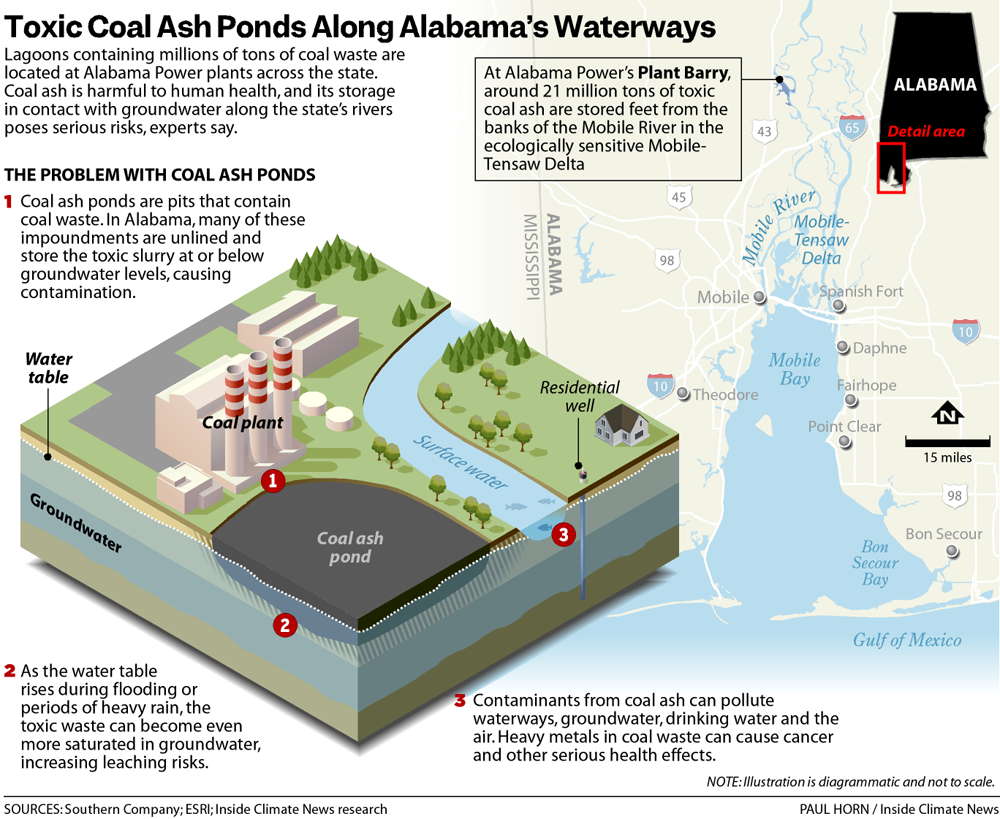
One 600-acre pit of the toxic coal ash lies along the banks of the Mobile River in the Upper Delta, about 25 miles north of Mobile Bay. There, smokestacks from the James M. Barry Electric Generating Plant rise like a sore thumb from a horizon of green, towering over an unlined pond filled with more than 21 million tons of the toxic residue. Holding back the toxic waste from the Mobile River? Earthen dikes.
Alyson Tucker, media relations manager for Alabama Power, one of the nation’s most profitable electric utilities and one of the state’s most powerful companies, said in an email that the company “remains committed to operating in full compliance with environmental regulations. Our plans for closure and groundwater protection fully comply with current state and federal law, are approved by [the Alabama Department of Environmental Management] and are certified by professional engineers.”
“Due to ongoing litigation related to Plant Barry coal ash, we are unable to comment further at this time,” Tucker said.
Leaving coal waste in place under engineered caps, company representatives have long argued, is safe and protective of groundwater—claims that state regulators have accepted but both environmental groups and federal regulators dispute.
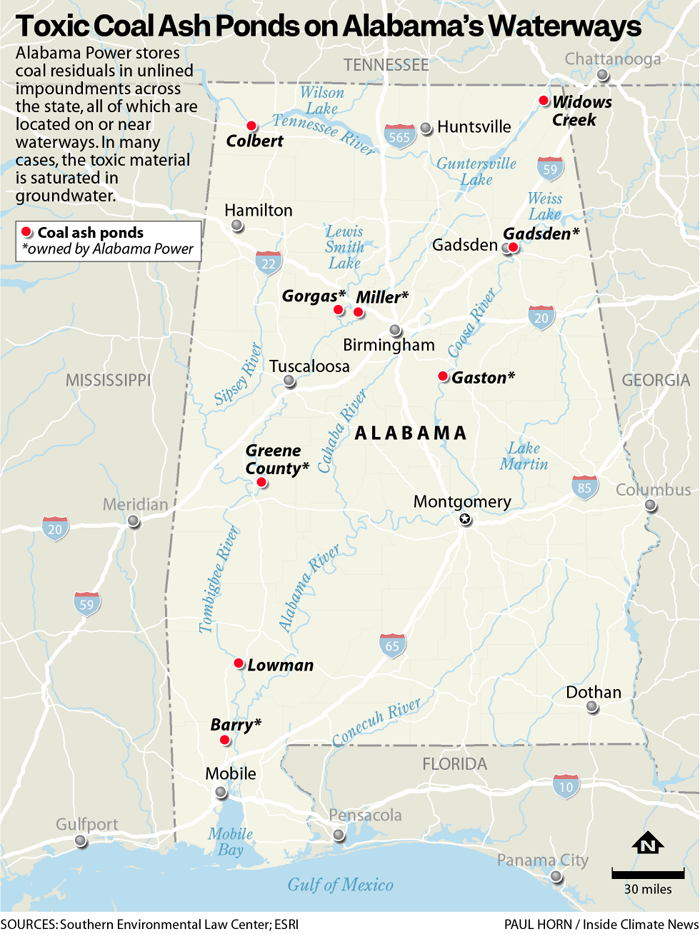
Alabama’s American Amazon isn’t the only area placed at risk by Alabama Power’s ghosts of energy past. An Inside Climate News review of the utility’s legally mandated emergency action plans shows that hundreds of square miles of land and waterways would be at risk of inundation in the event of a breach of the barriers holding back toxic waste at its six coal ash pond sites across the state. In total, more than 117 million tons of coal sludge are at issue, stored along Alabama’s waterways.
“Under federal regulations, coal ash units cannot be closed in a way that allows coal ash to continue to spread contamination in groundwater after closure. In contrast, Alabama’s permit program does not require that groundwater contamination be adequately addressed during the closure of these coal ash units,” the decision said.
“The delta is an elegant labyrinth, full of bayous and sloughs and backwaters. If it is flooded with ash, it would be polluting forever.”
— Cade Kistler, Mobile Baykeeper
More than a year after the EPA denied Alabama’s coal ash plan, with the Trump administration now running the federal environmental agency, it’s unclear what comes next for the toxic ponds and the government’s now decade-old effort to safely close them.
But one thing is certain, according to Cade Kistler, who leads Mobile Baykeeper, an environmental nonprofit currently in litigation with Alabama Power over the coal ash lagoon at Plant Barry. Until the toxic leftovers of the company’s fossil fuel commitments are moved out of groundwater and away from waterways, the delta and Mobile Bay are an Eden on the edge of disaster.
“The delta is an elegant labyrinth, full of bayous and sloughs and backwaters. If it is flooded with ash, it would be polluting forever,” Kistler said. “There would be no way to effectively clean it up.”
The Costs of Kingston
The failure of a dirt dike at a coal ash pond isn’t theoretical. In 2008, a coal ash impoundment in Kingston, Tennessee, breached, spilling more than a billion gallons of toxic sludge across 300 acres of land and into the Emory River channel. The result was one of the largest environmental disasters in U.S. history. The spill cost the Tennessee Valley Authority (TVA), which owned the coal impoundment, over $1 billion to clean up. Ten years after the spill, dozens of the roughly 900 workers employed during the cleanup were already dead. More than 250 were chronically ill. According to the EPA, coal ash contains heavy metal contaminants like mercury, cadmium and arsenic known to cause cancer and other serious effects on the nervous system, heart, kidneys and development.
Both Alabama Power’s own groundwater monitoring reports and measurements taken by researchers from the Mobile River adjacent to Plant Barry confirm heavy metal contamination at the site.
“We identified a significant contribution of toxic metals linked to coal ash near Sister’s Creek, the man-made cooling discharge channel of Plant Barry, particularly during the dry season,” one 2025 study by scientists at the University of Alabama and Texas A&M Universities concluded. The peer-reviewed paper also pointed to the impacts of climate change as another reason to be wary of Alabama Power’s storage of coal ash on waterways.
“There is a plausible concern for acute and chronic toxic metals environmental pollution from the Alabama ash pond, considering rising seawater levels and more frequent severe storm surges in the region since its initial construction,” the study said.
Alabama Power’s coal ash storage lagoon at its Greene County plant sits next to the Black Warrior River. Credit: Lee Hedgepeth/Inside Climate News
The volume of coal ash material stored at Plant Barry alone is more than four times that of the sludge that spilled in Kingston in 2008, according to company figures. That fact alone should worry anyone concerned about Alabama’s environment, said Diane Thomas, one of three self-proclaimed “coal ash grannies” featured in a new documentary about Plant Barry’s coal lagoons, Sallie’s Ashes.
Thomas spent three decades living on the eastern shore of Mobile Bay.
“I have kayaked and sailed,” she said. “I swam. I crabbed. I fished. My love for the bay and what you can do on the bay runs deep.”
It was an easy “yes,” then, when her decades-long friend Sallie Smith asked Thomas and another friend, Savan Wilson, to help her fight against Alabama Power’s plans to leave coal ash beside the Mobile River. Smith had been diagnosed with terminal cancer and felt she needed to spend her remaining time advocating to protect the bay she’d grown to adore. The trio founded the Coal Ash Action Group, a grassroots organization committed to educating Alabamians about an issue unknown to many.
Thomas, a retired clinical psychologist, said it’s easy to fight for something so dear to so many. For decades, the delta and the bay have been an integral part of her family’s lives.
Diane Thomas shows community members a hand-colored map of Plant Barry’s inundation zone. Credit: Courtesy of Sallie’s Ashes
She smiled as she recalled her first jubilee, a naturally occurring event where low oxygen levels in Mobile Bay cause marine life to flee toward shore.
“There is nothing like catching your own crabs,” Thomas said. “Have you ever cleaned 200 crabs? Your thumbs are just raw.”
After her husband was diagnosed with stage four lung cancer, no longer able to work, he began to fish almost daily. With aggressive treatment, he survived the disease.
“We ate fresh fish for about eight years—four times a week,” Thomas said.
That type of close connection with the water is something Thomas feels shouldn’t be put at risk unnecessarily by an electric utility.
“A Knife to Your Throat”
Alabama Power’s legally-mandated emergency action plan for Plant Barry shows that if earthen dikes separating the coal ash from the Mobile River were to breach, around 25 square miles of the Mobile-Tensaw Delta would be inundated with coal slurry, covering dozens of miles of the Mobile, Middle and Tensaw Rivers, just upstream of Mobile Bay. From there, the toxic sludge would diffuse throughout the region, with the state’s rivers acting as a heart, pumping the liquid farther and farther from Plant Barry.
“But instead of lifeblood, it’s pumping coal waste that would kill the environment,” Thomas said.
David Bronner, the prominent CEO of the Retirement Systems of Alabama, recently called Plant Barry’s coal ash pond “a huge environmental bomb” in a newsletter sent to state retirees.
“We need your cooperation again for South Alabama,” Bronner wrote in an open appeal to Alabama’s congressional delegation. “Not for new jobs, but for solving an old problem that still exists. That problem hangs over all of Alabama, like a knife to your throat: the coal ash dump that sits next to Mobile Bay. No one should forget what the Tennessee coal ash dump did to that state. A breach of the Mobile site would clearly damage Mobile Bay for decades.”
Thomas believes Bronner’s assessment is on target.
Cade Kistler serves as Baykeeper for Mobile Baykeeper, an environmental nonprofit. Credit: Courtesy of Mobile Baykeeper
Cade Kistler, Mobile’s Baykeeper, said it’s important to remember that environmental harm can lead to economic pain, too, for individuals and businesses alike.
“There would be a huge impact on the people that want to fish in Mobile Bay and use it for their livelihoods,” he said. “And there are also those people that live on its shores—a lot of beautiful homes and properties. Those Zillow listings won’t look quite so good if a coal ash breach occurs.”
Kistler also pointed out that BP’s 2010 Deepwater Horizon oil spill, which crippled the Gulf Coast environmentally and economically, involved about 134 million gallons of oil, 20 times less than the volume of coal slurry disposed of at Plant Barry. Those who lived through the aftermath of the oil spill on the Gulf Coast remember the deep impact it had on coastal communities.
A coal ash breach could be even worse, Thomas said.
“If a breach occurred, we would be the most industrially polluted site in the nation, and we know that pollution wouldn’t just go away,” she said.
That’s why she and Wilson have committed themselves to informing others across the state about the dangers of the waste, something they now do in memory of Smith, who died of cancer in October 2023.
“Sallie’s focus was on connecting people in search of our common humanity, and in seeking to deepen our understanding and compassion for one another,” her obituary read. “This ardent effort was an outgrowth and demonstration of her deep faith. She loved her family, Mobile Bay, country music, her many friends, including her hiking group of intrepid college friends, and all God’s people.”
“Pray We Don’t Have a Hurricane”
While there’s still much to be done to contain the coal ash threat, Thomas said, there have been at least some glimmers of hope. In early 2024, Alabama Power confirmed a plan to contract a company called Eco Materials to remove and recycle some of the coal waste stored at Plant Barry.
Since then, however, there has been little in the way of substantive public updates about the project, which company officials previously said would begin recycling coal ash into construction materials like concrete in January 2026. In response to an inquiry from Inside Climate News, a representative for Alabama Power said the recycling facility is “expected to be in service by early 2026.”
Eco Materials was acquired by materials company CRH in July 2025, according to an announcement. Neither Eco Materials nor CRH responded to a request for a detailed update on the recycling plans.
Eco Materials was contracted to recycle some coal waste from Plant Barry, but updates on the project have been rare. Credit: Lee Hedgepeth/Inside Climate NewsThe smokestacks of Plant Barry rise above the Mobile-Tensaw Delta. Credit: Lee Hedgepeth/Inside Climate News
Still, Thomas said that even the conception of a plan is a step in the right direction.
“We need to recycle as much as possible and just pray we don’t have a hurricane,” she said.
Kistler said he fears just that. An extreme weather event or other emergency could leave a world-renowned environmental gem drowned in polluted sludge.
Alabama Power’s emergency action plans, bare-bones documents required by federal law, provide only limited information about what could occur if a breach happened at its coal ash sites across the state. The documents also provide little real-world information about how the company would approach mitigation, clean up and remediation.
Regarding extreme weather, the 39-page emergency plan for Plant Barry mentions only that if severe weather causes road closures during an emergency dam breach, company response times may be delayed. Despite Plant Barry’s location in south Alabama, the word “hurricane” does not appear in the emergency action plan.
“It’s foolhardy,” Kistler said. “There needs to be more detail.”
Regulators have agreed. In January 2023, the EPA issued Alabama Power a notice of potential violation informing the company that, in the agency’s view, it had violated federal regulations because its groundwater monitoring program and emergency action plan were not adequate.
The agency settled that dispute with Alabama Power in 2024 when the company agreed to “evaluate and expand its groundwater monitoring program at Plant Barry, to review and upgrade its Emergency Action Plan, and to pay a civil penalty of $278,000,” according to the EPA.
More than a year later, a representative of the utility told members of Alabama’s Public Service Commission that an updated emergency action plan is still in the works.
“The emergency action plan will be modified to include additional wording and descriptions to clarify the company’s preparedness for extreme weather conditions,” Dustin Brooks, land compliance manager for Alabama Power, told commissioners on Dec. 9.
“I just hope that outside this public document, they’ve got better plans somewhere,” Kistler said.
A previously available copy of the EPA’s settlement agreement with Alabama Power has been removed from the agency’s website, though the press release announcing the agreement remains. “This Initiative is needed given the breadth and scope of observed noncompliance with the federal coal ash regulations,” the agency said.
An executive of Alabama Power, which owns most of the state’s coal ash units, claimed at a September 2023 EPA hearing that the utility’s storage ponds are “structurally sound.” Susan Comensky, Alabama Power’s then-vice president of environmental affairs, told EPA officials that allowing the company to “cap” coal ash waste in place, even in unlined pits, will not present significant risks to human or environmental health.
“Even today, before closure is complete, we know of no impact to any source of drinking water at or around any Alabama Power ash pond,” Comensky said at the time.
A protestor confronts EPA officials at a public hearing on coal ash in Montgomery, Ala. Credit: Lee Hedgepeth/Inside Climate News
Coal ash is the primary waste product of burning coal to produce electricity at facilities like this one in Jefferson County, Alabama. Credit: Lee Hedgepeth/Inside Climate News
However, Alabama Power has been repeatedly fined for leaking coal ash waste into groundwater.
In 2019, the Alabama Department of Environmental Management (ADEM) fined the utility $250,000 after groundwater monitoring at a disposal site on the Coosa River in Gadsden showed elevated levels of arsenic and radium, according to regulatory documents.
In 2018, ADEM fined Alabama Power a total of $1.25 million for groundwater contamination, records show. In its order issuing the fine, the agency cited the utility’s own groundwater testing data, which showed elevated levels of arsenic, lead, selenium and beryllium.
Plant Barry is just one of Alabama Power’s six plant sites across the state that store coal ash. In all, the slurry lagoons cover a footprint of around 2,000 acres and pose unique risks to groundwater and waterways around them.
A now capped-in-place coal ash impoundment at Plant Gadsden, for example, is still contaminating groundwater more than seven years after its closure, according to Alabama Power’s groundwater monitoring reports and a lawsuit filed against the utility by Coosa Riverkeeper, an environmental nonprofit.
“The citizens of Gadsden and folks who depend on Neely Henry Lake deserve so much better than Alabama Power’s legacy of pollution,” Justinn Overton, executive director and riverkeeper at Coosa Riverkeeper, said in a news release after the lawsuit was filed. “Drinking water supply, booming ecotourism, and hard-working Alabamians are all threatened by Alabama Power’s recklessness.”
In a motion to dismiss the lawsuit over groundwater contamination at Plant Gadsden, lawyers for Alabama Power emphasized that state regulators approved the company’s plans for coal ash waste at the site.
When groundwater monitoring identified elevated levels of contaminants, the lawyers wrote, “Alabama Power worked with professional engineers and the public to design and implement a corrective action program to address those exceedances—a program certified as compliant with the federal CCR rule and that will continue as part of ‘post-closure care.’”
While the suit should be dismissed due to an expired statute of limitations, Alabama Power’s attorneys argued, the court should also decline to second guess the decision of state regulators to approve the company’s actions.
“[Coosa Riverkeeper] asks the Court to turn back the clock, to before 2020, to second-guess the groundwater monitoring system and closure decisions—work completed long ago, approved by state regulators, and certified by professional engineers as compliant,” the motion said.
This story is funded by readers like you.
Our nonprofit newsroom provides award-winning climate coverage free of charge and advertising. We rely on donations from readers like you to keep going. Please donate now to support our work.
Plants Barry, Gorgas, Greene County and Miller have been designated as having “significant hazard potential” under federal law. Plant Gaston, located near the town of Wilsonville in Shelby County, has been designated as having “high hazard potential.”
Following an emergency dam break at that site, which the company deems “unlikely,” Alabama Power’s initial hazard potential assessment concluded that “water and [coal ash] could potentially impact the residential neighborhood to the west, and the Coosa River to the south…failure or misoperation of the [coal ash] unit could potentially result in a loss of human life.”
Kistler said that it’s notable that Alabama Power is unique among southern utilities in leaving all of its coal waste in unlined pits along waterways. Georgia Power, another subsidiary of Southern Company, has already shifted toward more appropriate disposal of at least some of its coal ash in lined landfills. It’s not a question then, Kistler said, of whether Alabama Power can do the same. It’s only a question of if it will.
Barry Brock, with the Southern Environmental Law Center, is part of the team of lawyers suing Alabama Power over its coal ash impoundment at Plant Barry. Initially dismissed by a Trump-appointed U.S. district court judge on technical grounds, the case is now pending before the Eleventh Circuit Court of Appeals, where Brock said he is hopeful the team will secure a victory.
Oral arguments in the case were held in Atlanta in November, and some of Alabama Power’s arguments were unusually revealing, Brock said.
“Alabama Power admits that a lot of the coal ash is going to be left in contact with groundwater under their closure plan,” he said. “That’s particularly galling.”
Coal ash isn’t SELC’s first legal tussle with Alabama Power, however. Lawyers for the environmental nonprofit are also representing customers suing Alabama Power over residential solar fees they argue violate the law and discourage the use of renewable energy. In response, the company has said that it “support[s] customers interested in using onsite generation, such as solar” but that its rate structure for those customers must avoid “unfairly shifting” costs to other ratepayers.
Meanwhile, the company has doubled down on its fossil fuel investments, purchasing a natural gas plant in Autauga County for around $622 million, effectively locking the company into the continued use of fossil fuels for years to come, though the company said in an email that its investments are data-driven, forward-looking and “are not based on a preference for any one fuel source.”
All of these developments are individually concerning, Brock said, and together, they demonstrate a pattern.
“It sends a pretty clear message that Alabama Power is really concerned about their financial well-being and the rate of return they get on fossil fuel infrastructure,” he said. “It says they have a pretty compliant regulatory environment that is not going to scrutinize them when they want to raise rates for customers to do it.”
While the company clearly has the resources to line its coal ash ponds and recycle much of the waste, there’s also little doubt that the state can count on much more sympathetic federal regulators under the Trump EPA than it did under Democratic leadership. At present, the state and federal governments seem closely aligned: Twinkle Cavanaugh recently resigned after 13 years as president of the state’s Public Service Commission, the agency charged with regulating Alabama Power. Her new position: a job as the Trump administration’s top Department of Agriculture official in Yellowhammer State.
About This Story
Perhaps you noticed: This story, like all the news we publish, is free to read. That’s because Inside Climate News is a 501c3 nonprofit organization. We do not charge a subscription fee, lock our news behind a paywall, or clutter our website with ads. We make our news on climate and the environment freely available to you and anyone who wants it.
That’s not all. We also share our news for free with scores of other media organizations around the country. Many of them can’t afford to do environmental journalism of their own. We’ve built bureaus from coast to coast to report local stories, collaborate with local newsrooms and co-publish articles so that this vital work is shared as widely as possible.
Two of us launched ICN in 2007. Six years later we earned a Pulitzer Prize for National Reporting, and now we run the oldest and largest dedicated climate newsroom in the nation. We tell the story in all its complexity. We hold polluters accountable. We expose environmental injustice. We debunk misinformation. We scrutinize solutions and inspire action.
Donations from readers like you fund every aspect of what we do. If you don’t already, will you support our ongoing work, our reporting on the biggest crisis facing our planet, and help us reach even more readers in more places?
Please take a moment to make a tax-deductible donation. Every one of them makes a difference.
Lee Hedgepeth is Inside Climate News’ Alabama reporter. Raised in Grand Bay, Alabama, a small town on the Gulf Coast, Lee holds master’s degrees in community journalism and political development from the University of Alabama and Tulane University. Lee is the founder of Tread, a newsletter of Southern journalism, and has also worked for news outlets across Alabama, including CBS 42, Alabama Political Reporter and the Anniston Star. His reporting has focused on issues impacting members of marginalized groups, including homelessness, poverty, and the death penalty. His award-winning journalism has appeared in publications across the country and has been cited by the New York Times, the Wall Street Journal and the Washington Post, among others.
Great Job By Lee Hedgepeth & the Team @ Inside Climate News Source link for sharing this story.
All over the country, Americans are struggling to pay their utility bills. In the Hudson Valley, the situation is particularly dire, with some ratepayers coping with surprise monthly bills of thousands of dollars. It doesn’t have to be that way, according to the region’s democratic socialists, who are leading a fight to lower prices.
A bill introduced by Sarahana Shrestha, a democratic socialist assemblywoman in Assembly District 103 in the Mid-Hudson Valley, and her state senate colleague, Michelle Hinchey, calls for a state takeover of the utility company serving the area. A feasibility study by NewGen Strategies and Solutions, commissioned by Shrestha’s office, says a public takeover would provide millions in savings to New York State and its ratepayers.
According to the study’s projections, a publicly owned utility — unlike a private company — would no longer have to pay state and local taxes or make profit for its shareholders, allowing it to save $15.2 million in its first year alone. After that, the savings keep growing: $34.4 million by year five, $56.2 million by year ten, $116.8 million by year twenty, and $210.5 million by year thirty. These savings would allow the utility to lower costs to ratepayers. It would also allow for more stability, making billing more predictable for consumers and fund much-needed repairs to infrastructure.
Energy affordability is a matter of serious urgency in the area. In 2024, Central Hudson had to settle a $60 million class action lawsuit over a billing fiasco. One of Shrestha’s constituents, who lives in a recreational vehicle, didn’t get a bill for more than a year. When they did, it was for $6,000.
Shrestha, who was a climate organizer and active in Mid-Hudson Valley Democratic Socialists of America before her election in 2022, ran for office on energy affordability, finding that, when she talked with neighbors, it was one of their top concerns. Some ratepayers were finding thousands of dollars incorrectly overdrawn from their bank accounts. Shrestha has held some eighteen town halls on the idea of a takeover of the utility.
“There are certain things that are just not designed for the private sector,” Shrestha says, and energy delivery “is, for me, at the top of that list.” (She notes that health care is another example.) While the model has always depended on fleecing the ratepayer, she points out some recent developments that make it especially untenable.
One is aging infrastructure, which a for-profit company doesn’t have the incentive to fix, like “leak-prone pipes, things that are very expensive to fix when you are using that capital investment to also increase your profits,” Shrestha describes. That model, she says, “is spiraling the rates out of control at a time when we do have real supply chain issues.” In addition to the aging infrastructure, she continues, utilities also need to build resiliency against new threats bombarding contemporary life like cyberterrorism and extreme weather. They also need to create grids that can deliver renewable energy, reduce emissions, and avoid worsening the climate crisis. All of that, Sreshtha says, can be done better outside a for-profit model.
The utilities depend on consumers’ revenues for the whole system to function, but this model is extremely expensive, unpredictable, and burdensome for the very consumers on which it depends. “That’s an insane catch-22 for somebody who’s just trying to have the lights or fridge on,” Shrestha exclaims. “We don’t need investors to be owners here. We can own this ourselves.”
In 1932, Franklin D. Roosevelt gave a speech on precisely this issue, in Portland, Oregon, declaring,
I therefore lay down the following principle: That where a community — a city or county or a district is not satisfied with the service rendered or the rates charged by the private utility, it has the undeniable basic right, as one of its functions of Government, one of its functions of home rule, to set up, after a fair referendum to its voters has been had, its own governmentally owned and operated service.
Shreshtha, working within the tradition of community-driven energy democracy that FDR championed, has been less focused on the Albany side of the legislative process than on building local support. “I don’t think anybody in the campaign really believes the top-down approach makes sense or is even feasible,” she says, explaining that the campaign has focused on local elected officials like town supervisors as well as city councils and county legislatures — and, most of all, the public. Mid-Hudson Valley DSA and its partners in the Hudson Valley Public Power Coalition have been tabling, phone banking, and holding town halls. The next town hall is in Poughkeepsie, which just elected a democratic socialist town councilor, on January 22.
One finding from the feasibility study affirms Sreshtha’s (and FDR’s) emphasis on public support. Shreshta points to “delightful lessons” from Massena, a tiny conservative North Country town of about ten thousand, whose public utility takeover Shrestha calls “one of the great success stories of recent times.” For years, Massena fought a privately owned utility company that, in her telling, “kept screwing them over.” The town repeatedly voted to spend the money to acquire the utility. They quickly made that money back. In its feasibility study, NewGen says, “the one fundamental lesson” from Massena is that “a high level of enduring public commitment to the formation of a municipal utility is probably the single most indispensable ingredient in that process.”
Legislative momentum is building. In a recent New York Times article, Democrats in Albany sounded ready to introduce her bill, which the assemblywoman notes with some surprise. She remarks, too, that Antonio Delgado, New York’s current lieutenant governor, who is launching a primary challenge to Governor Kathy Hochul, also recently tweeted his support of the idea.
All that is encouraging, but Shrestha says there is much work to do on the local level. The utility will put out extensive misinformation and will fight hard. Before the legislative fight begins in earnest, she says, “we want our information to be familiar to people before they start getting the utility’s information.”
The stakes are high for the ratepayers of the Hudson Valley, but they’re also bigger than that: Shrestha is hoping that if a public takeover works in Central Hudson, it will lend support to the fight for public energy elsewhere. Rochester, New York, has been fighting for energy municipalization for a long time, while in Tucson, Arizona, the idea is just taking root. There’s also an effort brewing on Long Island, where there is little left-wing political leadership. But as the Massena experience shows, experiments of this kind can succeed in politically unexpected places.
Shrestha and I discuss the issue in the context of the cost-of-living crisis that’s hitting many Americans so hard. “The rate increases being requested at a time of affordability crisis are scary,” says Shrestha. And other than a public takeover, “there seems to be no solution. We can’t say, ‘Do not replace the leak because it’s too expensive.’ We can’t say, ‘Don’t hook up renewables because it’s too expensive.’ So nobody has a solution, I believe, outside of our proposal.”
Great Job Liza Featherstone & the Team @ Jacobin Source link for sharing this story.
Richard Reeves and Michelle Harrison discuss shifting attitudes toward leadership, young men and the future of gender equality.
The Reykjavik Global Forum in Iceland. (United Nations Foundation)
At this year’s Reykjavík Global Forum in November, where 500 global leaders from public and private sectors convened in Iceland, the mood around gender equality was both urgent and reflective. Progress that once felt inevitable now looks fragile. The Reykjavík Index for Leadership reveals concerning declines in how women are perceived for leadership roles across major economies, while conversations about young men and boys have become more heated, polarized and emotionally charged.
While at the forum, I spoke with Richard Reeves, an author and researcher focused on boys and men, and Michelle Harrison, the founding force behind the Reykjavík Index for Leadership, about what’s really going on—and what comes next. Their insights help clarify the current backlash, the urgency of centering young people, and why gender equality must remain a shared project—one that includes all of us.
Katie Usalis: We’re seeing backlash across democracies and worrying data on attitudes toward women’s leadership. What are you seeing in the Reykjavík Index this year?
Michelle Harrison: When we first started tracking the Reykjavík Index for Leadership—which measures how suitable women and men are perceived to be for leadership positions—we saw two fairly stable groups within the G7.
In the higher performing group were the U.K., Canada, France and the U.S. The lower performers were Japan, Italy and Germany. That basic structure held for a while. But now, the picture is shifting—and not in a good way.
Nothing is getting better across the G7, with two exceptions: Italy and Japan have actually improved and moved up in the rankings. That’s important good news. But elsewhere:
The U.S. has fallen from the top three to sixth, and the drop is significant.
The U.K. only remains near the top because it started so high; it has also seen a major decline.
France and Canada stay near the top, but their scores are also falling.
Germany, which was already near the bottom, has now dropped to the bottom and deteriorated further.
Overall, we’re looking at a significant regression.
What’s truly new is what we see among young people. Across the G7, we’re witnessing something we haven’t seen before in social history since we started tracking: young people pushing back culturally against the progressive values of their parents. That backlash is strongest among young men—but we see it among young women too.
And it’s polarized. There are very progressive young people who believe in equality wholeheartedly, and there are young people moving in the opposite direction. That split, and how fast it is widening, is deeply alarming.
Usalis:When you look at the backlash against progressive values and a growing generational split—especially from young men—what do you think is driving it?
Harrison: I think we have to see it in context. There’s a wider story here about economic stagnation, lack of growth and lack of opportunity.
The post-war generations—especially the Boomers—experienced rising living standards as almost a given. That’s starting to look like the exception instead of the rule. For many young people now, the path ahead is unclear. What does it mean to be young when you can’t see a route to security, let alone prosperity? That’s a huge part of this.
We also see strong links with loneliness, which we used to associate with older people. Now it’s increasingly a young person’s problem. When you combine economic insecurity, loneliness, and rapid technological and cultural change, you create a kind of vulnerability. And in that space, other voices stepped in—especially online.
Technology has enabled entire alternative narratives about gender and power to flourish. Many of us were slow to see just how powerful those messages were for young people. So we have to understand this backlash not just as ideological, but as a symptom of deeper distress.
Richard Reeves speaks onstage during attend the Common Sense Summit on Kids and Families 2025 on March 25, 2025, in San Francisco. (Kimberly White / Getty Images for Common Sense Media)
Usalis:Richard, when we talk about reaching young men and boys, especially in the context of women’s representation, a lot of women feel wary—like, “Really? We’re talking about men again?” How do you think we should talk about women’s representation with men and boys?
Richard Reeves: I’d start by saying: Make it personal, not abstract.
If you ask young men in the abstract about “gender representation in leadership” or “women on AI boards,” you’re likely to get confusion, defensiveness or just a sense of distance. It feels very elite, very remote. Most people aren’t thinking about who sits on the global AI governance council.
But if you ask:
“Do you think your sister should have the same chance to be the boss as you?”
“Do you think your mom should get passed over for promotion at the DMV just because she’s a woman?”
“Should your local school board or council be all men?”
Almost no young men will say, “Yes, I think my sister should have worse opportunities.” Framed at the level of their mom, their sister, their local school, it’s very difficult to be against fairness. That’s the lived reality.
The second piece is: assume they’re on-side, instead of treating them as the enemy to be converted. If we speak as if every man is a latent misogynist, they will hear that. Many men actually do care about equality—and many are struggling themselves in other ways.
This leads to the third point, which I know is controversial: if we say we care about gender representation, we have to show that we care when it goes the other way too.
Do we care that:
The share of male teachers has dropped by about 10 percentage points?
The share of men in mental health professions has roughly halved over the last couple of decades?
Some professions and institutions have become almost entirely female?
If we only use the phrase “gender representation” when we’re talking about women’s underrepresentation, many men will reasonably conclude that we actually just mean women’s advancement, full stop. That doesn’t make them anti-woman—but it makes them feel that this conversation is not about them, or even allowed to include them.
Usalis: That can feel uncomfortable for some activists who’ve spent their lives fighting for women and girls. Why is it so important, in your view, to recognize representation “both ways”?
Reeves: Because either we believe balance matters, or we don’t.
Take a national youth-serving organization that historically worked with boys and young men. Its executive team is now six women—no men at all, and all white women at that. When I publicly called that out, they were furious with me. And I had this moment of doubt—should I have said anything?
But if that leadership team were all men, we would absolutely call that out. We’d say: How can an organization historically serving boys and young men now claim to speak for all youth with this leadership profile?
If representation matters when women are missing, it has to matter when men are missing too. Otherwise we’re not arguing for a principle—we’re arguing for a side.
This isn’t because women make “bad” decisions without men or vice versa. It’s because, on average, men and women bring different experiences and emphases. That’s the whole argument for balance.
A simple example:
Women legislators are more likely to foreground issues like street lighting and childcare, because their embodied experience of walking home at night or trying to juggle work and caregiving is different.
In an all-female leadership team of a youth mental health organization, you might miss some of the subtle ways that young men externalize distress as “bad behavior,” and end up punishing symptoms rather than recognizing a gendered pattern of mental health.
None of that is a moral failing. It just reflects lived experience. So if we say these differences are meaningful—and that’s the core of the case for women’s representation—then men’s experience matters too where they’re underrepresented.
Usalis: Michelle, given the data you’re seeing, if you could ask our readers to take just one step, what would it be?
Harrison: I would ask readers to focus on the conditions our young people are living in—not just their attitudes.
When we see young people pulling away from equality, I think we should read that as a signal of distress before we read it as an ideological statement. That means:
Taking seriously the economic reality: many young people see no obvious path to a secure, dignified adulthood.
Recognizing the emotional reality: loneliness is rising, especially among the young.
Understanding the informational reality: many of the messages shaping their view of gender and power are coming from corners of the internet we’ve barely engaged with.
So one step is: Become more intentional about how we nurture boys and young men, alongside girls and young women. Make sure they feel genuinely seen, cared for and included in the story of progress—not cast as the obstacle to it.
That doesn’t mean diverting resources away from women; it means designing a future in which young men also see themselves as having a stake in equality.
Usalis: If you had one closing message for women readers who care deeply about equality, what would it be?
Reeves: If you are a woman who is fighting every day for women’s representation and equality—and at the same time you are looking at the boys and men in your life and worrying about them—you are not confused. You are right.
You are allowed to care about both. In fact, we need you to care about both.
My ask is: Don’t let anger close the door on empathy. Keep your anger at injustice. But also keep your compassion and your willingness to think structurally about the challenges facing boys and men.
We will not get to a healthy, equal society by having men and women in a permanent emotional standoff. We have to emotionally de-escalate, even when it feels hardest, and find ways to make progress together.
Harrison: And I would add: don’t lose sight of what’s possible. We’ve already changed the world once. We can do it again—this time with a clearer understanding that our daughters and our sons need to see themselves in the story of equality.
Great Job Katie Usalis & the Team @ Ms. Magazine Source link for sharing this story.
McALLEN — Alix Flores, 62, has jumped from different careers over the years, working with nonprofits, in corporate America, as a teacher at a Brownsville school and with the regional office of the Texas Department of State Health Services.
He wanted to make sure he was always employed so he would be covered by employer-provided health insurance.
“I always made sure that if I quit a job, I better have another one waiting already so I can continue being insured,” Flores said.
That changed with the rollout of the Affordable Care Act and he was able to take breaks between work. Now, he works part-time as a home health aide for his aging mother.
For the past two years, the Brownsville resident has paid $12 a month for health coverage. He doesn’t pay anything to visit his primary care provider and pays $10 to visit a specialist.
He also pays nothing for medication to treat his chronic condition, even though it can cost approximately $900 without insurance.
But next year, Flores’ monthly premium is jumping to $275, 23 times higher than what he’s paying now.
That’s because enhanced premium tax credits that had made it much cheaper for many more people to buy health insurance through the federal marketplace are slated to expire by the end of the year. The Rio Grande Valley, where Flores lives, stands to be disproportionately affected by the expiration of these subsidies.
“’I’m going to go ahead and pick a plan, and I’m just going to hope for the best,” Flores said, adding that he hopes that Congress will at least extend the subsidies for one more year. “Take that one year, look at what works and what doesn’t, and come up with something better.”
The Rio Grande Valley saw some of the fastest growth in ACA enrollment in Texas between 2020 and 2025.
During that time, enrollment quadrupled in the Valley, where 20% of the population has ACA coverage. The highest enrollment was in Starr County which saw about 27% of its population enrolled in the ACA.
One factor for the enrollment boom is a 2021 federal law that expanded the value of and eligibility for tax credits that reduce ACA enrollees’ premium payments — the enhanced premium tax credits that are expiring at the end of the year.
“It was like gangbusters,” said Ryan Kennelly, a licensed insurance consultant who assists clients all over the country, including in Texas. “All of a sudden, instead of one application a day, we had 10 per broker. Everyone wanted insurance, because it was dirt cheap.”
The bill made two major changes. It ended the income cliff — 400% of the federal poverty level — allowing people earning more money, typically pre-retirees or small business owners, to qualify. And it lowered the maximum amount that people qualifying for the subsidies could pay towards their premium as a percentage of income. People earning between 100% and 150% of the federal poverty level — $32,150 to $48,225 for a family of four — qualified for tax credits that drove silver plan premiums to be free.
In the Valley, 98% of ACA enrollees received an advanced premium tax credit that lowered their monthly payments, with 70% of consumers paying $10 or less per month for their plans in 2025.
But with the enhancements to those premium tax credits set to expire by January, health care providers are worried that health plans will become unaffordable to many or that healthy enrollees will simply drop their coverage, not wanting to pay for something that previously came at no cost to them.
Those insured are expected to forgo visits to their doctor for regular checkups. It could cause serious health conditions, especially those that could have been treated, to go undetected and worsen.
More sick people
Throughout the Rio Grande Valley — which includes Hidalgo, Cameron, Starr and Willacy counties — a handful of resources offer health care services at a low cost to provide some relief to this undeserved area.
Among those resources is Nuestra Clinica Del Valle, a federally qualified health center. Such centers are funded by the federal government to provide primary care services to low-income communities. Nuestra Clinica does so by offering their services on a sliding fee scale.
But even with a resource like Nuestra Clinica, residents will often delay seeking care until their health problems have already become severe.
“I’ve seen a bunch of patients who come in and the first time they see a primary care doctor is after they’ve been to the hospital after they had a heart attack or a stroke,” said Dr. Carlos Medina, the chief medical officer for Nuestra Clinica.
About 3.1 million adults in Texas, or about 13% of the adult population, have diagnosed diabetes. That prevalence skews much higher in border counties including those in the Rio Grande Valley.
In addition to diabetes, Valley residents are at high risk for hypertension and high cholesterol, Medina pointed out, so screening is critical to prevent worsening health conditions.
Health care providers like Medina see the expanded tax credits as an encouragement for residents to visit their doctor regularly.
“That, at the time, has been translating into more outpatient care for patients with chronic conditions and also for more screening of preventive measures for those now-insured patients,” said Dr. Eduardo Candanosa, a family medicine physician.
If people decide to not renew their insurance because of the higher cost, Candanosa predicts that will translate into difficulty in obtaining needed medication for chronic health conditions and a heavier reliance on emergency rooms for acute care.
In Hidalgo County, 20% of their population benefit from ACA tax credits, said Dairen Sarmiento Rangel, director of Hidalgo County’s health and human services department.
In 2025, Hidalgo County had a total of 200,636 ACA enrollees, the fifth-most of any Texas county despite ranking ninth in total population.
Without the expanded tax credits, previous ACA policy holders could go without insurance, either because it is too expensive or because they simply don’t want to pay more, and drive up the region’s uninsured rate, which sits at about 28%, more than double the national rate.
“That could result in unmanaged chronic illnesses, more uncompensated visits to the ER,” Sarmiento Rangel said. “We’re gonna have a sicker community.”
Since county officials became aware that the enhanced tax credits could expire, they’ve been preparing to take on more clients through existing programs like their indigent health care program, which provides coverage for low-income people.
The county health clinic is also available to residents for immunizations, family planning, prenatal care and, just this year, it began offering testing for hypertension, cholesterol and diabetes.
In September, the county also debuted an OnMed CareStation, a virtual care station that connects patients to a health care provider for primary care consultations, regardless of whether they are insured. In 2026, the county will also begin offering low cost lab services.
“We’re in a good place, to be able to pick up some of these people that will be losing their tax credit funds, but only time will tell,” Sarmiento Rangel said.
“Just cancel everything”
Sarah Loredo, an insurance broker in McAllen, has spent the last several weeks reaching out to patients to help them renew their insurance plans during the open enrollment period. But with the expected price hike, many who aren’t dealing with an existing health condition are questioning the worth of having insurance at all.
About 70% of ACA consumers in the Valley paid $10 or less per month for their plans this year but even a modest price hike is prompting enrollees to allow their insurance coverage to lapse.
“I do see people saying, ‘Just cancel everything,’” Loredo said.
“I had a lady today, like, okay, it’s going from $0 to $20, and she’s like, ‘Yeah, but I wasn’t paying anything,’” she said. “It’s a big, large group of people telling me, ‘Um, no, I’m just gonna go ahead and leave it for this year.’”
People earning under 150% of the federal poverty level currently have a maximum monthly premium payment of $0 under the current credit structure. A study of the tax credits undertaken by the Episcopal Health Foundation and Texas A&M University calculated that that payment would rise to a maximum of $33 per month for a single 45-year old adult earning under 138% of the federal poverty level, and $68 per month for those between 138% and 150%.
The rise is even more dramatic for middle-class people; a single adult earning between 200% and 250% of the federal poverty level, or $31,300 to $39,125, would see their maximum monthly premium rise from $85 to $221.
Indeed, those steep price hikes are expected for many of her clients, said Sarah Guerrero, an insurance agent trainer with Healthcare Educators, an agency in Harlingen.
“When I take a look at all my clients as a whole, those are the increases that I’m seeing for those with middle income — going from that $90, $100 up to $300, $400. And that’s just their responsibility, that’s not the actual premium.”
Guerrero’s own premium for her ACA plan is also expected to rise from $90 per month to $300.
Bracing for impact
The window to extend the enhanced tax credits before they expire is quickly closing and lawmakers in D.C. remain far from any deal to extend them.
The House recessed for the holidays, leaving little hope that the tax credits will be extended before they lapse on Dec. 31. However, House Democrats and four defecting Republicans voted to force a floor vote on the subsidies in January.
There is also a concern that there will be fewer insurers offering health plans through the ACA marketplace. Already, Aetna announced it would no longer offer ACA plans across the country come 2026. Molina Healthcare and Guardian, which offers dental plans, also stopped offering ACA plans in the four counties that make up the Valley, but there are still more insurers in the marketplace than in 2021 when the enhanced subsidies went into effect.
Fewer enrollees means less generous subsidies and that would decrease the amount of federal money flowing to insurers. That could lead more to follow Aetna’s lead and get out of the ACA business.
But the transition is not expected to be as volatile as it was during the early days of the ACA, said Benjamin Ukert, a professor at the Texas A&M School of Public Health who has researched the state’s ACA marketplace.
Ukert said insurers are already pricing in a smaller, sicker risk pool with their premium increases. But some say they see echoes of the chaos.
“Everyone was just over utilizing the plans [in the first few years],” said Kennelly, a licensed insurance consultant. “So there’s going to be another correction like that. They’re already increasing the deductibles, increasing out of pocket, watering down networks. I mean, there’s only so much you can do before the plans just don’t cover anything, as far as network or drugs.”
In the meantime, enrollees, insurers and experts are planning for higher premiums and the first instance of large-scale enrollment decline in the marketplace’s 12-year history.
Fewer people enrolled in health insurance will only further drive up costs, Guerrero said.
“If we just look at the Rio Grande Valley, there are so many underlying conditions, so many conditions that are starting younger and younger that, if treated at an early stage, could potentially save money on the back end as we start to age,” she said.
Reporting in the Rio Grande Valley is supported in part by the Methodist Healthcare Ministries of South Texas, Inc.
Great Job Texas Tribune, By Berenice Garcia And Gabby Birenbaum, Data Reporting By Dan Keemahill & the Team @ KSAT San Antonio for sharing this story.
There has been a flurry of AI voice recording gadgets like Omi, Bee, and Friend that want to capture your voice and let you converse with an AI chatbot. While Bee was acquired by Amazon, and devices like the Stream ring by Sandbar and a new AI ring from former Pebble founder Eric Migicovsky are set to enter the market next year, the jury is still out on the success of wearable AI devices.
Amid all this, Plaud is thriving by targeting professional users with a different approach: a credit card-sized recording device that slips into your wallet. The company says it has shipped more than a million units and that more than 50% of its customers have converted to pro subscriptions.
The company’s latest iteration, the Plaud Note Pro, launched for pre-order in August two years after the original Note, priced at $179. After using the device for over a month, it has become an essential part of my daily carry – and its ultra-thin design makes that easy.
At just 0.12 inches thick – about the width of three stacked credit cards – it’s the thinnest AI recording device on the market and easily fits in a wallet or attaches magnetically to the back of your phone.
The company provides a wallet-like pouch and a magnetic ring accessory that attaches to MagSafe-enabled phones, allowing you to mount the Note Pro on the back of your iPhone or compatible Android device. The device is also very light at 30 grams, and you won’t feel the weight if you keep the Note Pro in your wallet.
One of the key differences between Plaud and other AI wearables is that the Note Pro doesn’t need to be connected to your phone to record audio. The device has 64GB of onboard memory, so it can store a large volume of recordings without transferring them to your phone or uploading them to the cloud.
Pluad Note Pro is as thick as a coaster Image Credits: Ivan Mehta
Plaud Note Pro has four MEMS (Micro-Electro-Mechanical Systems) microphones to pick up audio from all directions. While the company advertises that the effective audio range is 16.4 feet, I have recorded talks at conferences while sitting far from the stage and gotten satisfactory results. The device also has one voice processing unit for noise suppression, voice isolation, and echo cancellation.
Techcrunch event
San Francisco | October 13-15, 2026
The recording device has impressive battery life. I went to a conference earlier this month with a fully charged device and recorded a few interviews and talks there. After that, I used the device for some phone call recording and personal note-taking. Despite all that use, the device still had 55% charge after 15 days. The company says you can wring 30 hours of continuous recording and 60 days of standby from a single charge.
Plaud’s new device comes with a proprietary charger with a USB-C cable on the other end. The device takes two hours to charge from 0%, and then you are set for at least a couple of weeks unless you are recording hours of content.
Image Credits: PlaudImage Credits:Plaud.ai
One problem with wearable AI devices is that you have to ensure, through an indicator, that the device is recording (or has stopped recording). Thankfully, Plaud Note Pro has a tiny screen that displays your recording status. You can also press a button while recording to highlight a point a speaker is making, and it will show up in the AI-powered summary prominently. The screen also shows you the remaining battery level.
There is intentionality behind recording with this device. You also get haptic feedback for starting and stopping the recording. The visual indication and your action of pressing the button also make it easier to signal to a others in the meeting that you are recording the session.
Image Credits: Ivan Mehta
You can choose to just record sessions and export them to another AI transcription service you are subscribed to. Plaud natively provides 300 minutes of free transcription every month. The company also lets you customize AI-generated notes through templates suited for different profiles and tasks. You can create your own template as well. The transcription is accurate in most instances, and now you can also access the recording, transcript, and notes through a website. The company has also addressed the problem my former colleague Brian Heater had of tapping on the word and not being played the corresponding recording.
While a pendant or pin-like form factor is possibly easier to carry, the card-sized recorder offers better microphones and more versatile placement options. It’s worth buying the $179 gadget if you take a lot of in-person meetings.
Great Job Ivan Mehta & the Team @ TechCrunch Source link for sharing this story.
While gift-giving is a big part of the Christmas holiday, so too is gift returning, but before you head to the store to bring back your unwanted gifts, there are some things experts say you should know.
Store policies and exchanges aren’t what they used to be, according to the Better Business Bureau, which notes that the previous idea of “the customer is always right” may no longer be the case.
According to the National Retail Federation, almost 20% of gifts will be returned or exchanged after the holidays.
So how can you avoid some of the common pitfalls?
Here are some tips suggested by the BBB:
Know the policies
The BBB suggests customers check return policies for various stores and recognize that holiday return policies may differ from a store’s regular policy. There are things like restocking fees that could apply. Some may offer exchanges only or store credit only.
“The fact is – now it’s a matter of goodwill and customer service. However, stores are not legally required to accept exchanges or give refunds unless the merchandise was defective or misrepresented,” Steve J. Bernas, president and CEO of the Better Business Bureau, said in a statement. “While most retailers offer refund and exchange programs, how and when they do is strictly up to them. Be sure to double-check policies this holiday season, even if you are familiar with the brand, as stores can change their policies whenever they want.”
Check online policies
“If you are shopping online, search for the seller’s return policy and read it through before clicking ‘buy,'” the group says. “Find out if they accept returns or exchanges and who pays for the shipping when an item is returned. In some cases, you can save on shipping fees by returning an online purchase to the local brick-and-mortar store.”
Find the warranty
For those who may have received electronics or appliances, many come with a warranty, but those likely won’t come from the retailer where the item was purchased. Instead, they come from the manufacturer.
“Find out how returns and repairs are handled if an item stops working or needs replacement parts. Will the retailer ship the item to the manufacturer for you? Or will you need to deal with the manufacturer directly? Knowing the answers will leave you well-prepared for any future issues,” the BBB said.
Keep receipts
Some stores will only accept returns and exchanges with an item’s receipt and original packaging, according to the BBB.
“Always include a gift receipt with items you give and hold on to any gift receipts you receive,” the group said.
Bring your ID
In some cases, stores will ask to see a customer’s ID as they return an item, or the original form of payment.
“If this is the policy of the store where your gift is from, you may need the assistance of the gift giver in order to be reimbursed,” the BBB said.
Do it sooner than later
The BBB advises shoppers to “make returns in a timely fashion.”
“Almost all return policies are valid during a specific time period,” the group said. “Some stores modify their return period during the holidays, so don’t risk missing your chance to make your return. Take the item back to the store without delay.”
Great Job NBC Staff & the Team @ NBC 5 Dallas-Fort Worth for sharing this story.
President Donald Trump opened a high-stakes meeting by trying to project command and confidence, but quickly drifted into familiar grievances, personal score-settling, and a rambling detour that left onlookers stunned by how little he seemed to grasp the weight of the moment.
Trump and Ukrainian President Volodymyr Zelensky spent more than three hours in talks Sunday on ending the war with Russia — before veering off script to relitigate the 2020 election, praise his relationship with President Vladimir Putin, and undercut the seriousness of the discussion in real time.
U.S. President Donald Trump speaks during the meeting with Ukrainian President Volodymyr Zelensky at his Mar-a-Lago club on December 28, 2025 in Palm Beach, Florida. (Photo by Joe Raedle/Getty Images)
“We went through the Russia, Russia, Russia hoax together,” Trump said of Putin, referring to investigations into Russian interference in the 2016 election.
“Russia wants to see Ukraine succeed,” Trump said, as Zelensky raised an eyebrow. Trump then added, “It sounds a little strange,” to which Zelensky smiled, nodded, and replied dryly, “Yeah.”
Trump told reporters that he had already made similar comments privately. “I was explaining to the president [Zelensky], President Putin was very generous in his feeling toward Ukraine succeeding,” Trump said, glossing over the fact that Putin launched a full-scale invasion of Ukraine in 2022.
At several points, Zelensky appeared to struggle to conceal his disbelief. As Trump continued revisiting his claims about election interference and his rapport with Putin, Zelensky twiddled his thumbs, rolled his eyes, and shifted his feet behind the podium. When Trump repeated his suggestion that Putin’s intentions were misunderstood, Zelensky let out an incredulous laugh.
The meeting at Trump’s Mar-a-Lago resort came amid renewed U.S.-led diplomatic efforts and just a day after Russia struck Kyiv with ballistic missiles and drones, killing at least one person in Ukraine’s capital and injuring 27 others.
Both leaders said progress had been made, but Trump repeatedly stressed the complexity of negotiations while attributing the war itself to his false claim that the 2020 U.S. election had been “rigged and stolen.”
“If the election weren’t rigged and stolen, 2020, you wouldn’t’ve had this war, would’ve never happened. And it didn’t happen for four years, never was even thought to happen,” Trump said, suggesting the 4-year gap between his first and second terms had caused the conflict. “And I spoke with President Putin, I got along with him very well, despite the Russia, Russia, Russia hoax, which was a total hoax.”
On social media, critics seized on the contrast between Trump’s remarks Sunday and his repeated campaign promises to end the war within 24 hours. Influencers urged followers to “watch Zelenskyy’s face” as Trump launched into what they described as his typical dog-and-pony show.
“This man has absolutely no brains no class. Always living in the past always about him,” fumed one viewer.
Another added, “He just cannot help playing his greatest hits of bs at every opportunity to plump up his self gratifying fragile ego. Absolutely everything has to be about him.”
Despite describing himself as “on the side of peace,” Trump said he understood Putin’s resistance to a ceasefire sought by Ukraine.
“He feels that look, you know, they’re fighting and to stop, and if they have to start again, which is a possibility, he doesn’t want to be in that position—I understand that position,” Trump said.
Asked whether he had set a deadline, Trump demurred.
“I don’t have deadlines,” he said. “You know what my deadline is? Getting the war ended.”
BREAKING: A video montage of all the times Trump promised to end the Ukraine war in 24-hours is going viral after Trump said he has “no deadlines” to end the war.
On X, a viral montage posted by Call to Activism highlighted Trump’s past pledges, including: “Before I even arrive at the Oval Office, shortly after I win the presidency, I will have the horrible war between Russia and Ukraine settled … And we’ll do it quickly… I will fix that within 24 hours … 100 percent sure.”
Back at Sunday’s press conference, a reporter pressed Trump on what would happen if negotiations collapsed, asking “what happens in a few weeks if things sputter, what are you prepared to do?”
Trump raised both his hands in a palms-up shrug. “They keep fighting, and they keep dying. No good. But if things don’t happen, they keep fighting, and they keep dying. And we don’t want that to happen. He doesn’t want it to happen,” Trump said, pointing toward Zelensky. “President Putin doesn’t want it to happen either.”
The lack of decorum sent viewers over the edge.
“Decorum level negative 5 billion,” said one viewer. Another added, “Zelenskyy’s reaction is in his body language.”
“The President of the United States sounds like an idiot,” said JK while another keenly observed, “Putin doesn’t care if people keep dying. He wants the territories, so he will kill as many as possible to get it.”
Both leaders acknowledged that major obstacles remain, particularly over territory. Russia currently controls about 20% of Ukraine, including most of the Donbas region.
“You know our position,” Zelensky said. “We have to respect our law and our people. We respect the territory which we control.”
Trump acknowledged the difficulty. “Some of that land has been taken,” he said. “Some of that land is maybe up for grabs, but it may be taken over the next period of a number of months.”
Zelensky later said U.S. and Ukrainian teams would meet again next week. European leaders echoed cautious optimism, with European Commission President Ursula von der Leyen praising “good progress” while calling for “ironclad security guarantees from day one,” and French President Emmanuel Macron announcing a meeting in Paris next month to finalize commitments.
Great Job A.L. Lee & the Team @ Atlanta Black Star Source link for sharing this story.