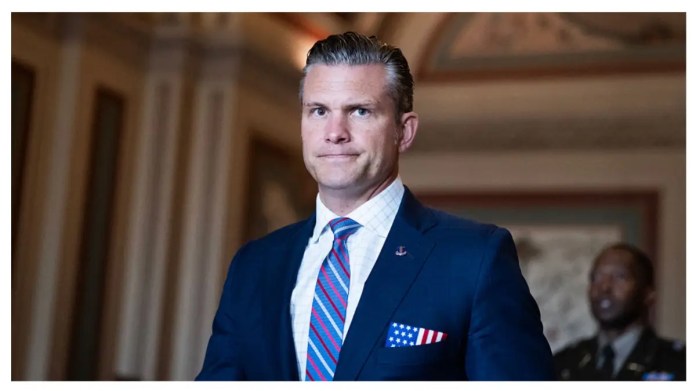
Defense Secretary Pete Hegseth is facing renewed scrutiny this week as a tense exchange with Sen. Mark Kelly starts circulating again — landing just as Hegseth moves to escalate an investigation targeting the same lawmaker who once put him on the spot under oath.
The video, now going viral on social media, shows Kelly methodically pressing Hegseth during a Senate Armed Services Committee hearing with a series of true-or-false questions about alleged episodes of public intoxication back when Hegseth led Concerned Veterans for America.
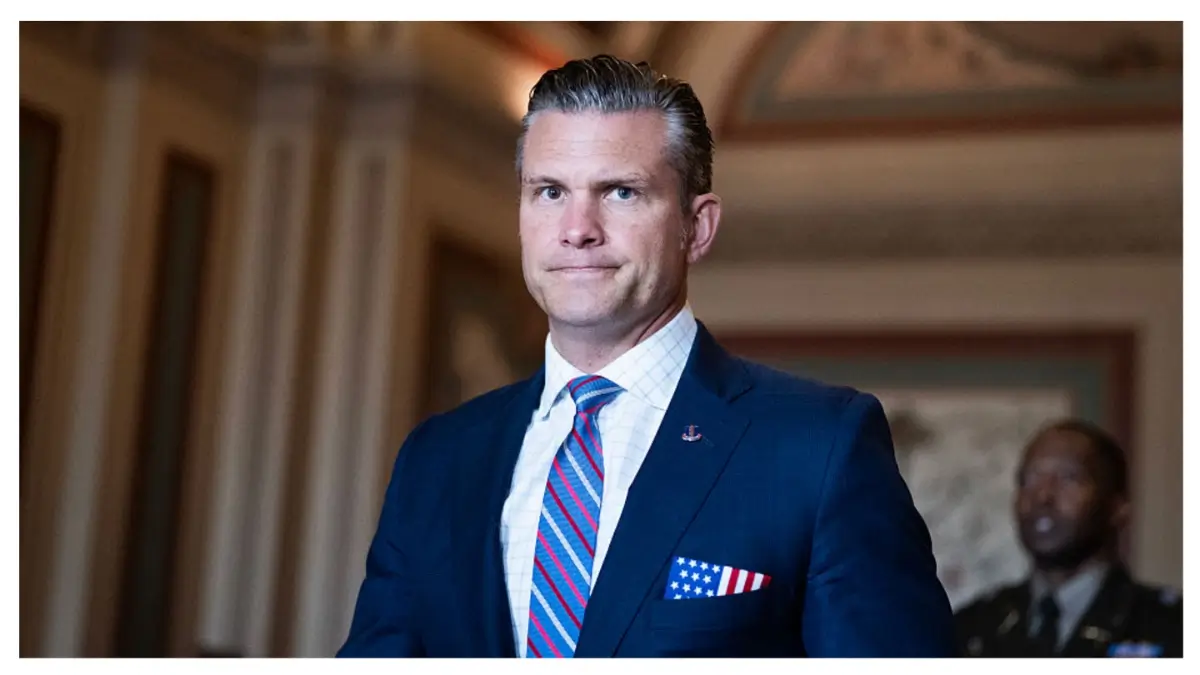
Defense Secretary Pete Hegseth arrives for a briefing in the U.S. Capitol with Congressional leaders and Secretary of State Marco Rubio on military strikes against alleged drug trafficking boats in the Caribbean, on Wednesday, November 5, 2025. (Tom Williams/CQ-Roll Call, Inc via Getty Images)
The exchange devolved into repeated deflections that critics now say look even worse in hindsight.
At the time, Hegseth was President-elect Donald Trump’s nominee for defense secretary, seeking control of a department with roughly 3 million military and civilian employees. Kelly, a retired Navy captain and former astronaut, said he was unconvinced Hegseth had the discipline, credibility or experience required for the role.
“And there were very specific cases cited by individuals about your conduct. I’m going to go through a few of them, and I just want you to tell me if these are true or false. Very simple,” Kelly said before listing incident after incident.
“On Memorial Day 2014, at a CVA event in Virginia, you needed to be carried out of the event for being intoxicated.”
“Senator, anonymous smears,” Hegseth replied — a phrase he would repeat to nearly every allegation, without directly denying them.
Kelly pressed on: “Just true or false. Very simple. Summer of 2014 in Cleveland, drunk in public with the CVA team.”
“Anonymous smears.”
Pete Hegseth has admitted to personal issues in his past. Yet when asked about those same issues yesterday, he blames an “anonymous smear campaign” against him.
Kelly continued, citing an event in North Carolina where Hegseth was allegedly drunk in front of three young female staff members after reversing a no-alcohol policy.
“Anonymous smears.”
The questioning culminated with allegations involving a strip club visit with staff while on official business in Louisiana, and whether the organization later reached a financial settlement with a female staffer connected to the incident.
“Absolutely not. Anonymous smears,” Hegseth said, later adding, “Senator, I was not involved in that. I don’t know the nature of how that played out.”
Near the end of his allotted time, Kelly delivered a blunt assessment. “It’s clear to me that you’re not being honest with us or the American people because you know the truth would disqualify you from getting the job,” he said.
Social media critics suggested Hegseth might have been aware of the legal risk if he refuted the accusations, with one person saying, “A denial would likely be lying to congress so….”
Other voices called out Hegseth’s reliance on a single phrase to deflect every allegation, which many compared to invoking legal privilege.
“‘Anonymous smears’ must be the new ‘I plead the fifth.’” Another observed, “Absolutley not! Anonymous smears”….you KNOW that one was fuckin true.”
“He just admitted that he was at a strip club with the young female and male soldiers,” added Brenda.
Critics across several platforms mocked Hegseth for apparently refusing to deal with his reality.
“He’s an alcoholic and can’t admit it,” another person riffed on Threads with another asking bluntly, “Is he drunk now….that’s a weird way to say false.”
“As a former alcoholic, I promise you that this man has a drinking problem,” another critic observed. “He tells himself the same lies all alcoholics do.”
Some observers cut straight to Hegseth’s fitness for office, “Unqualified! Disgusting! Resign Party Pete!”
The renewed attention to the clip comes amid an extraordinary escalation by Trump and Hegseth against Kelly and his colleagues.
Hegseth, now nearly a year into the job, has threatened disciplinary action over a separate controversy involving Kelly and five other Democratic lawmakers — all military or intelligence veterans — who appeared in a video last month, urging active service members to refuse unlawful orders.
Tonight, we learned the Pentagon is escalating its review of me into “an official command investigation.”
If Donald Trump or Pete Hegseth think they can stop me from doing my job and serving the American people, they’ve got the wrong guy. pic.twitter.com/wjKVr37vby
Trump reacted with a series of incendiary Truth Social posts, accusing Kelly and the others of “seditious behavior, punishable by death.”
The move by Democrats left Trump fuming for days. The White House later denied Trump was calling for executions.
Hegseth soon amplified the president’s stance. “The video made by the ‘Seditious Six’ was despicable, reckless, and false,” he wrote. “Encouraging our warriors to ignore the orders of their Commanders undermines every aspect of ‘good order and discipline.’”
The Pentagon confirmed it had escalated its review of Kelly from a preliminary assessment to a formal command investigation, according to ABC News. Hegseth has said the video risked confusing troops and encouraging insubordination, and has floated the possibility of recalling Kelly, who retired in 2011, to active duty for court-martial or administrative punishment.
Kelly has dismissed the effort outright. “This is very performative for him,” he told reporters, later calling the investigation “a bunch of bull****.”
“This is just about sending a message to retired service members, active duty service members, government employees — do not speak out against this president, or there will be consequences,” Kelly said.
Weeks later, a 2016 video emerged of Hegseth saying the U.S. military “won’t follow unlawful orders,” prompting accusations of hypocrisy.
Great Job A.L. Lee & the Team @ Atlanta Black Star Source link for sharing this story.
Local police said they have charged an Illinois driver who struck and killed a pedestrian while she was livestreaming on TikTok.
The New York Times reports that Tynesha McCarty-Wroten, who posts to TikTok under the name Tea Tyme, has been charged by the Zion Police Department with two felonies — reckless homicide and aggravated use of a communications device resulting in death.
In a video that has been reshared by other accounts on TikTok, woman posting as Tea Tyme can reportedly be seen speaking into her phone when there’s a loud thud. An offscreen child asks, “What was that?” then the woman replies, “I hit somebody.”
Surveillance videos reportedly showed McCarty-Wroten’s vehicle entering the intersection while the traffic light was still red, with investigators determining that she did not seem to slow down or change course before striking Darren Lucas, who was later pronounced dead at the hospital.
McCarty-Wroten’s lawyer told the NYT that evidence will show that “what happened was an accident, was a negligent act, but was not an intentional or reckless act.”
Great Job Anthony Ha & the Team @ TechCrunch Source link for sharing this story.
AUSTIN – A fatal crash shut down northbound U.S. Highway 183 in Southeast Austin on Sunday morning.
US Hwy. 183 shut down near airport
What we know:
The collision happened in the northbound lanes of the highway near McCall Lane, not far from the Austin-Bergstrom International Airport. Austin Police and emergency crews arrived on the scene shortly before 9:45 a.m.
Police said that at least one person died in the crash. To allow investigators and cleanup crews to work, officials closed all northbound lanes of Highway 183.
As of about 1 p.m., the highway was reopened and Austin Police say an adult female driver involved in the crash is now facing charges of intoxication manslaughter.
What we don’t know:
Authorities have not yet said how many vehicles were involved in the crash.
The identities of those involved have not been released.
The Source: Information in this article is from the Austin Police Department.
Louis Gerstner, who took over International Business Machines Corp. when it was on its deathbed and resuscitated it as a technology industry leader, died Saturday. He was 83.
IBM chairman and CEO Arvind Krishna announced Gerstner’s death in an email sent Sunday to its employees, but didn’t provide a cause of death.
Gerstner’s nine-year tenure as chairman and CEO of the company known as “Big Blue” is often used as a case study in corporate leadership.
On April Fool’s Day, 1993, he became the first outsider to run IBM, which was facing a choice of bankruptcy or dismemberment after a period when it had been the undisputed leader in personal computers and mainframes. He pivoted the Armonk, New York-based company toward business services and away from hardware production, reversing a move to break up the company into a dozen or more semi-autonomous units — “Baby Blues” — in pursuit of greater profits.
Gerstner slashed costs and sold off unproductive assets, including real estate and IBM’s collection of fine art. He fired 35,000 of the 300,000 employees, who had become accustomed to a culture of lifetime tenure based on principles established by former CEO Thomas Watson Sr. in the early 20th century.
He stressed company-wide teamwork to replace the tradition of loyalty to various divisions, and he pegged compensation to corporate performance rather than individual results. To meet performance goals, he emphasized regular accountability rather than waiting for yearly performance reviews.
“People do what you inspect, not what you expect,” he said.
Gerstner’s key change was to scrap IBM’s culture of selling bundled products that only worked with other IBM goods, from PCs to operating systems to software. Products he considered losers were jettisoned. He pulled the plug on OS/2, an operating system intended to challenge Microsoft’s Windows that hadn’t proved popular with customers.
“His leadership during that period reshaped the company,” Krishna wrote. “Not by looking backward, but by focusing relentlessly on what our clients would need next.”
Focus on Middleware
IBM put its focus on so-called middleware — software for databases, systems management and transaction management. The company became the impartial integrator for companies’ networks and systems, happy to help whether the hardware used had the IBM name on it or not.
Gerstner made an early bet on the internet and e-business, which he guessed correctly would put less emphasis on personal computers and more on servers, routers and other more sophisticated equipment that would benefit from IBM’s service know-how and involve buyers familiar to IBM’s sales force, such as chief technology officers.
Later in his tenure, he also made some strategic acquisitions such as the $2.2 billion paid for Lotus Development Corp., whose Notes product was vital for helping IBM customers collaborate on an enterprise-wide basis.
The switch in focus from hardware to services resulted in an increase in services revenue from $7.4 billion in 1992 to $30 billion in 2001. IBM’s share price went from $13 to $80 in his nine years as CEO, adjusted for splits,.and IBM’s market value rose from $29 billion to about $168 billion in that period.
“If I had a vote, the most significant legacy of my tenure at IBM would be the truly integrated entity that has been created,” he wrote in Who Says Elephants Can’t Dance? Leading a Great Enterprise through Dramatic Change (2002). “It certainly was the most difficult and risky change I made.”
Louis Vincent Gerstner Jr. was born on March 1, 1941, in Mineola, New York, to Louis Gerstner Sr., a milk truck driver, and Marjorie Rutan, a secretary and college administrator. He was one of four brothers.
He graduated from Mineola’s Chaminade High School, a competitive Catholic institution. He got an engineering degree from Dartmouth College and an MBA from Harvard University.
After Harvard he joined McKinsey & Co. as a consultant. He made partner in four years and spent 12 years there before taking a job with American Express.
He worked for the credit-card division there, then took over travel-related services. Under his leadership, Amex, which offered primarily a travel card at that point, increased its presence in retail stores and created premium cards that permitted customers to carry unpaid balances.
With his way to the top of management at Amex blocked by CEO James D. Robinson III, Gerstner agreed to run RJR Nabisco Inc., where he stayed four years before joining IBM. His primary focus at RJR Nabisco was to reduce the $25 billion in debt produced by the leveraged buyout that created the tobacco and consumer products firm.
IBM’s board began its search for a new CEO after it forced out John Akers in January 1993, just as the company was reporting its largest annual loss. In selecting Gerstner, the board chose managerial experience over computer expertise. (Gerstner’s brother Richard had worked for IBM for 30 years and headed the division that included personal computers.)
From Gerstner’s first day in April 1993 until the January 2002 announcement that he was stepping down, IBM’s shares rose ninefold while the Standard & Poor’s 500 Index gained 154%. Sam Palmisano succeeded him, first as CEO, then as chairman when Gerstner retired at the end of 2002.
In 2003, Gerstner became chairman of the Carlyle Group, the Washington-based private-equity firm. He oversaw the firm’s expansion into Asia and Latin America and early preparations for going public, which it did in 2012. He retired in 2008, remaining as a senior adviser.
With his wife, Robin, he had two children. Their son, Louis III, died in 2013 after a choking accident in a restaurant.
Through Gerstner Philanthropies, the family has supported biomedical research, environmental and education programs, and social services in New York City, Boston and Florida’s Palm Beach County. The family has been a longtime supporter of the Mayo Clinic.
Great Job Patrick Oster, Bloomberg & the Team @ Fortune | FORTUNE Source link for sharing this story.
CHARLOTTE, N.C. – Zach Charbonnet ran for 110 yards and two touchdowns, and the Seattle Seahawks turned two third-quarter Carolina turnovers into TDs to beat the Panthers 27-10 on Sunday and close in on the No. 1 seed in the NFC playoffs.
Sam Darnold threw an interception in the end zone but finished 18 of 27 for 147 yards with a touchdown for the Seahawks, who can wrap up the NFC West title and the top seed if the San Francisco 49ers and Los Angeles Rams both lose or tie.
Jaxson Smith-Njigba added nine catches for 72 yards as Seattle (13-3) won its sixth straight.
The Panthers (8-8) had a chance to win the NFC South because the Tampa Bay Buccaneers lost 20-17 at Miami on Sunday. Now the Panthers will likely need to win at Tampa Bay next weekend to win their first division title since 2015 and snap a seven-year playoff drought. Carolina could still claim the division with a loss to the Bucs if the Atlanta Falcons (6-9) win their final two games.
Bryce Young was limited to 54 yards on 14-of-24 passing and threw an interception for the inconsistent Panthers, who followed up a win with a loss for the fifth straight time. Young ran for 30 yards and accounted for Carolina’s only touchdown with a 10-yard scamper.
Carolina was limited to 139 yards of offense.
After an ugly first half that ended in a 3-3 tie, the Seahawks took control in the third quarter thanks to their defense.
DeMarcus Lawrence recovered a fumble by Chuba Hubbard deep in Carolina territory and Charbonnet cashed in with a 2-yard touchdown run. On the ensuing possession, Young’s pass to a Tetairoa McMillan was intercepted by Julian Love, leading to Darnold’s 17-yard touchdown pass to tight end AJ Barner.
The Panthers, who were held to 72 yards in the first three quarters, responded with a 13-play, 69-yard drive. Young scored on a 10-yard run to cut Seattle’s lead to 17-10.
The Panthers’ defense appeared ready to get off the field on Seattle’s next possession, but two-time Pro Bowl cornerback Jaycee Horn was flagged for grabbing Smith-Njigba’s facemask on a third-down reception on third-and-21, more than 15 yards behind the first-down marker.
That gave Seattle a first down and the Seahawks cashed in with Jason Myers’ 30-yard field goal to make it a two-possession game with eight minutes remaining.
Seattle sacked Young twice on the ensuing possession to get the ball back, and Charbonnet sealed it with his second TD run.
Injuries
Seahawks: WRs Rashid Shaheed (concussion) and Cody White (groin) left in the first half and did not return.
Panthers: TE Ja’Tavion Sanders (ankle) was carted to the locker room after getting injured on the game’s first play and did not return. CB Robert Rochell (concussion) left a short while later. LB Claudin Cherelus left with a calf injury in the third quarter.
Copyright 2025 The Associated Press. All rights reserved. This material may not be published, broadcast, rewritten or redistributed without permission.
Great Job Steve Reed, Associated Press & the Team @ KSAT San Antonio Source link for sharing this story.
Bill Kristol sits down with Ryan Goodman to discuss new and upcoming Epstein document releases. They’ll cover which records to watch for next, what the disclosures do—and don’t—tell us so far, and whether the U.S. Department of Justice is dragging its feet, playing procedural games, or protecting powerful interests.
As always: Watch, listen, and leave a comment. Bulwark+ Takes is home to short videos, livestreams, and event archives exclusively for Bulwark+ members.
Don’t care for video? Use the controls on the left side of the player to toggle to audio.
Add Bulwark+ Takes feed to your player of choice, here.
Great Job The Bulwark & the Team @ The Bulwark Source link for sharing this story.
While it is true that some U.S.-based electricians can make $100,000 per year, it is not the standard for all electricians and will rarely occur in the early stages of the career. That’s why knowing best electrical courses in New York is important.
The average compensation for an electrician is generally better than many other trades and, as it relates to many trades, there is a greater amount of predictability in terms of how one progresses through a career as an electrician. However, to reach six figures as an electrician, a few factors need to align (e.g., where one lives, how long he/she has worked, what type of electrical specialty one works in, etc.) as well as how much work one wants to take on.
U.S. Average Compensation for Electricians
The Bureau of Labor Statistics reports that the average electrician in the United States typically makes between $60,000-$65,000 each year. Electricians just starting out may begin closer to $40,000 while experienced electricians may make significantly more. That’s why understanding your salary is important.
This average is important because it demonstrates that making $100,000 per year is not the rule rather the exception; it is located near the top of the pay scale.
Factors Which Contribute to Reaching Six Figures as an Electrician
Typically, electricians who earn six figures are either in one of the following situations, or both.
High Paying Locations
In locations such as California, New York, Washington, and Massachusetts, electricians are paid higher hourly wage rates. As well, in large metropolitan areas with consistent construction and infrastructure development projects, electricians are able to command even higher hourly wage rates. In many union roles, electricians can earn over $50 an hour based on their hourly rate.
Long Hours/Overtime
One of the quickest ways that electricians increase their earnings is by way of overtime. Typically, electricians work nights, weekends, and during emergencies, which pay time-and-a-half or double time. Electricians who work in hospitals, factories, or data centers regularly incur these types of hours.
Industrial/Commercial Work
Residential electricians typically earn less than electricians employed in commercial or industrial environments. Electricians who work with heavy machinery, automation systems, or high voltage equipment are typically compensated at a higher level due to the risks associated with working with such complex systems. In addition, electricians typically need to undergo additional training to perform such functions; however, the increased compensation also correlates to the risks involved.
Operating One’s Own Business
Electrical Contractors/Business Owners tend to have the greatest earning potential. Many self-employed electricians earn well above $100,000; this is particularly true after they establish a crew and focus on larger-scale projects. While the trade-off is responsibility, paperwork, and business risk, the earnings potential for electrical contractors/business owners are among the highest.
Time Frame
Most electricians do not earn six figures quickly according to Electrical Path. A general progression is as follows:
Many times, it takes seven to ten years to attain the upper end of the compensation range, depending upon local licensing requirements and individual career choices.
Commonality of Earning Six Figures Among Electricians
No. While it is possible for an electrician to earn six figures, it is not the norm. Owning a company, or being highly experienced in niche matters can help.
Most electricians earn a stable middle class income, with good job security and a steady demand for services. For those who plan their careers accordingly, choose high paying geographic areas, and accept more challenging or specialized assignments, they are the individuals most likely to surpass the six-figure threshold.
Overall, becoming an electrician is still a wise choice for individuals looking for stability, hands-on work, and long term earning potential, especially in the age of AI.
Great Job Sebastian Bickley & the Team @ Our Culture Source link for sharing this story.
Willy Gonzalez and other members of UNITE HERE Local 23, which represents workers at the George R. Brown Convention Center and Hilton Americas-Houston, stand in front of Houston City Hall on Wednesday, Sept. 24, 2025.
In the final months of 2025, about 700 unionized hospitality workers across four workplaces in Houston won approximately 25% raises in hourly wages — gains that came after an unprecedented 40-day strike at the Hilton Americas-Houston hotel.
“It does reach these historic proportions when you look at the history of labor in Texas,” labor historian Tom Alter said.
UNITE HERE Local 23 union leaders approached the end of 2025 with ambition. Multiple contracts were set to expire, opening the door to wage gains as inflation outstripped income levels across the region.
Sign up for the Hello, Houston! daily newsletter to get local reports like this delivered directly to your inbox.
“We made it a point in 2025 that this was the year that we were going to change the standards across Houston,” UNITE HERE Local 23 Texas chapter president Franchesca Caraballo said. “Starting with the Hilton, we knew that that was going to be pretty much the first domino, and we knew that that was going to set the stage for the rest of the contracts.”
Nearly 1,000 more unionized workers across two additional workplaces are awaiting new contracts in 2026. They stand to benefit from the wins so far — which could interest more workers in collective organizing.
Timeline
Sep. 1, Labor Day — About 400 workers with UNITE HERE Local 23 begin a 10-day strike at the Hilton Americas-Houston, demanding a $23 hourly wage, up from a base rate of $16.50.
Sep. 9 — After union officials say Hilton management counteroffered with a $1 raise to a $17.50 hourly wage, the union extends the strike by 11 days.
Sep. 11 through Sep. 17 — Officials announce postponements of multiple events, including Houston Mayor John Whitmire’s “State of the City” address, the Harris County Democratic Party’s annual fundraiser gala and City Controller Chris Hollins’ annual investor conference.
Sep. 19 — With no reported concessions, the union announces another extension, this time by three weeks.
Oct. 8 — About 100 food and beverage workers at the nearby George R. Brown Convention Center pass a strike authorization vote before heading to the negotiating table. They also demand a $23 hourly wage, up from a base rate of $16.
Oct. 10 — After 40 days on the picket line, the hotel workers and Hilton announce a new agreement. It raises base hourly pay to $20 followed by $2 in incremental increases over the next three years.
Nov. 7 — In a nearly identical agreement, convention center workers win a wage hike to $20 followed by $2 in raises over the three-year contract.
Dec. 5 — About 200 workers across two airline lounges at the George Bush Intercontinental Airport reach an agreement also raising hourly wages by $4, placing the base rate at $20 followed by $2 in raises over the next three years.
“I think we could call it a ripple effect,” said Aimee Chin, economics department chair and labor economist at the University of Houston. “I think the initial lengthened strike was the basis for coming more quickly to an agreement for the later ones. … I think it brought people ready to negotiate and ready to make a deal sooner.”
The wage gains were life-changing for workers who shared stories of stretched paychecks with Houston Public Media.
“Mortgage, insurance, food — everything has gone up over the years,” said Damian Salcedo, a bartender employed by Flik Hospitality Group in the United Club lounge at the airport. “Actually I’m going to have a little bit of money left over with this new wage. … It’s not just that, but I’m actually going to be able to help my family with that, too.”
Negotiations are pending for about 350 unionized workers at the Marriott Marquis hotel in downtown Houston, along with another 600 food workers at Bush Intercontinental Airport. Caraballo with UNITE HERE Local 23 told Houston Public Media negotiations with Marriott and airport food company OTG were set to begin in December.
“With the doors that the Hilton strike opened for setting this new standard, we see the other companies kind of following suit as it pertains to wages,” Caraballo said. “We’re getting the workers ready for that fight as well. So we’ll be having hopefully some good news soon.”
If the wage gains continue next year, more than 1,650 hospitality workers in Houston will have seen raises in the aftermath of the Hilton workers’ strike.
What does it mean for organized labor in Texas?
The strike in Houston flew under the radar compared to national actions — like the 50,000-worker strong strike by the United Auto Workers against Ford, General Motors and Stellantis in 2023, including at facilities in North Texas; or the ongoing strike of more than 4,000 Starbucks workers across more than 150 unionized stores, including in Austin, San Antonio, Dallas, Denton, Farmers Branch and Crossroads.
“It’s an important thing that happened in Houston,” said Alter, the labor historian. “Houston is an important city, but it often nationally doesn’t get the attention that it deserves.”
Kyle McClenagan/Houston Public Media
Workers picket outside of the Hilton Americas-Houston to demand higher wages on Sept. 2, 2025.
In some ways, Alter argued, the Hilton strike is especially notable because of who participated — one of the most “oppressed sections of the working class … who’s kind of in a much weaker position” compared to the Starbucks Workers United and UAW members.
While precise demographic data wasn’t readily available, Houston Public Media interviewed multiple Spanish-speaking women represented by UNITE HERE Local 23.
“The ethnicity and gender aspect of it is an important component as well that needs to be acknowledged,” Alter said.
He drew parallels to labor actions by garment workers in 1950s Texas, which included a strike led by Chicana women in San Antonio from 1959-63. The militant strike failed to achieve wage gains, with the plant ultimately closing and relocating, but it bolstered the labor movement in Texas.
The hotel and convention center agreements were also unusual because of the dynamic between employees, employers and owners. While the workers were directly employed by and negotiated with private companies, the facilities were operated by a public entity — Houston First, the city’s local government corporation for conventions and tourism. As Houston Public Media first reported, the structure of the financial arrangements meant that the labor agreements only affected Houston First’s bottom line.
That dynamic bolstered pressure from public officials to settle the dispute (though Houston First downplayed the importance of outside pressure, emphasizing the role of Hilton as the primary negotiator at the hotel and the Levy food services company at the convention center).
Dominic Anthony Walsh/Houston Public Media
UNITE HERE Local 23 union members stand up during a Houston City Council meeting on Wednesday, Sept. 24, 2025.
Houston City Council member Joaquin Martinez represents the area where the buildings are located and holds a non-voting seat on the Houston First board.
“The overall intent was to lift up working families — specifically in the conventions and visitors section, specifically in the hotels and then, of course, the airports — so it’s honestly probably one of the biggest wins that I’ve been able to participate in,” Martinez said.
Looking ahead, the labor economist Chin was hesitant to predict continued wage concessions as a result of the Hilton strike — but she said it’s likely to deepen interest in collective action.
“I think people are dissatisfied in the one-to-one negotiations,” she said. “It feels like you are powerless versus the firm, and so I can see why workers have an appetite to try this. In that sense, I’m predicting more interest in being part of unions and what they do, but I am unsure how much they’ll be able to get and negotiate.”
Great Job & the Team @ Houston Public Media for sharing this story.
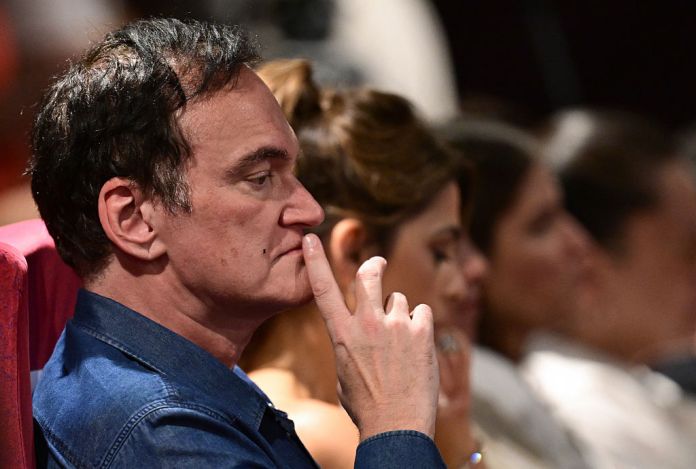
All the glowing reviews for the four-hour-and-forty-one minute version of Quentin Tarantino’s Kill Bill — originally released as two separate films in 2003 and 2004 — are a sickening read if you actually go and see the damn thing, now titled Kill Bill: The Whole Bloody Affair. So little is changed, it’s shocking. It’s essentially the first two installments stuck together with a fifteen-minute intermission in between, an effect you could achieve at home by simply watching both films with a long bathroom break in between.
In case you need a reminder, Kill Bill is the saga of a top assassin named Beatrix Kiddo (Uma Thurman) who emerges from a four-year coma and seeks protracted, gory revenge on her former mentor-lover Bill (David Carradine) and the hit squad who nearly killed her.
When Beatrix finally awakens, it seems she’s also lost the baby she had been carrying. This is yet another vital reason that, in the list of revenge killings she plans to do, written down neatly in a notebook, she puts the death of the baby’s actual father last after the planned murders of hit squad members Vernita Green (Vivica A. Fox), O-Ren Ishii (Lucy Liu), Elle Driver (Daryl Hannah), and Bill’s brother Budd (Michael Madsen). Then finally, she declares, “I am going to kill Bill.”
There are really only four primary changes in this new cut. First, Tarantino has doubled the length of the anime sequence, laying out the backstory of formidable yakuza boss O-Ren Ishii. Second, the black-and-white gore in the extraordinarily bloody Tokyo nightclub sequence has been restored to full, crimson color. Third, some “segue” material from the opening of Kill Bill: Vol. 2, shot in black-and-white in imitation of certain French New Wave films, now plays behind the end credits. Fourth, the brief coda at the end of Kill Bill: Vol. 1, which featured Bill’s voice-over revealing that Beatrix’s baby did not die in the wedding party massacre after all, is now gone.
In the glowing reviews, you’ll read about how Kill Bill: The Whole Bloody Affair can only now be fully appreciated as the masterpiece it is. This is the familiar auteur-worshipping take that sells every “director’s cut” as revelatory, once it’s freed from the vile influences of interfering, money-grubbing producers and studio executives. And sometimes, director’s cuts are revelatory. But sometimes, they’re overlong and clotted with unnecessary material that obscures the impact of the films you already love. Or, as in this case, they make very little difference.
The original decision to split Kill Bill into two separate releases, over Tarantino’s objections, was made by producer Harvey Weinstein of the then-thriving studio Miramax Films. And given what’s happened in the years since, with Weinstein convicted of rape and sexual assault and serving a sixteen-year prison sentence, nobody wants to side with Weinstein about anything. But it must be acknowledged that almost any producer would’ve opted for exactly the same two-part release, purely for practical reasons. More standard-length screenings mean more audience members and greater profits. Even for a “special event” film like Kill Bill: The Whole Bloody Affair, it’s tough to get people who aren’t ardent cinephiles to commit to an almost five-hour running time.
Tarantino’s own legacy has been considerably tainted since his Kill Bill heyday — and it’s worth noting that even then he was an obnoxious personality who just happened to have undeniable filmmaking skills. But since the original release of Kill Bill, more unsavory aspects of Tarantino’s career have come to light. In his long association with Harvey Weinstein, he admitted he “knew enough to do more than I did” about Weinstein’s vile predatory habits. This is especially striking considering his intense creative friendship with Uma Thurman during the making of Kill Bill. She was one of the many women in Hollywood struggling to fend off Weinstein’s aggressive sexual advances.
Thurman went public with her charges against Weinstein in 2018, and in the same interviews, she also had serious complaints to make about Tarantino’s behavior during the making of Kill Bill. Though Tarantino included a credit on Kill Bill indicating their creative “Q and U” collaboration, he also indulged in sadistic acts aimed at Thurman that were designed to make it into the film. During the Crazy 88s fight sequence, for example, when teen assassin Gogo (Chiaki Kuriyama) is strangling Beatrix with a chain, causing her face to redden and her eyes to protrude, it was actually Tarantino pulling on the chain just out of camera frame. When Budd appears to spit tobacco juice in Beatrix’s face, it was Tarantino doing the spitting off camera. And most seriously, Tarantino insisted that Thurman drive a rickety car herself, ignoring her request that a stuntwoman do it:
“Quentin came in my trailer and didn’t like to hear no, like any director,” she says. “He was furious because I’d cost them a lot of time. But I was scared. He said: ‘I promise you the car is fine. It’s a straight piece of road.’” He persuaded her to do it, and instructed: “ ‘Hit forty miles per hour or your hair won’t blow the right way and I’ll make you do it again.’ But that was a deathbox that I was in. The seat wasn’t screwed down properly. It was a sand road and it was not a straight road.”
The resultant car crash gave Thurman a serious concussion as well as neck and knee injuries. Tarantino refused to allow Thurman access to the footage of the car crash until fifteen years later, in what he considered an act of atonement for an incident he regretted. Noted Thurman, “Not that it matters now, with my permanently damaged neck and my screwed-up knees.”
Recently, during the theatrical rerelease Kill Bill: The Whole Bloody Affair, Tarantino has been back in the news with a sudden burst of unsolicited commentary attacking actors he dislikes. In a widely quoted interview, Tarantino claimed that Paul Thomas Anderson’s There Will Be Blood would be even better if it weren’t for Paul Dano, who was “the weakest actor in SAG,” not strong enough to play opposite Daniel Day-Lewis and make the film the “two-hander” it should have been: “He is weak sauce, man. He’s a weak sister.”
Tarantino added to the list of actors he scorns Owen Wilson and Matthew Lillard. Lillard cogently pointed out that Tarantino was singling out actors lacking power in the current star rankings: “You wouldn’t say that to Tom Cruise. You wouldn’t say that to somebody who’s a top-line actor in Hollywood.”
But Tarantino seems to court controversy recently as he evinces less and less interest in actually making movies. His strong support for Israel since marrying his Israeli wife Daniella Pick and moving to Tel Aviv with their two children, has reportedly included touring a military base “to boost IDF morale,” supporting the troops currently waging war and committing genocide in Palestine.
Pick has proudly declared in a recent interview that Tarantino never considered leaving Israel for safety as bombs fell. He’s even quoted as saying, “Well, whatever. Like if something happens, I’ll die as a Zionist.”
Meanwhile, he’s aborted his tenth and possibly last film because of a realization he had after writing the script that he had no particular interest in actually filming it. “Every Tarantino title promises so much, except The Movie Critic,” he explained. “Who wants to see a movie called The Movie Critic?” There are still rumors that Tarantino will make a different and perhaps final film, just not immediately. Instead, Tarantino claims to be “really juiced about live theater now.”
Increasingly, the shine is off Quentin Tarantino among many film fans who admire his undeniable cinematic talents but are fed up with his tiresome, would-be macho acting out in his public conduct. But he maintains his reliable following among the dudebro contingent who worship his geeky loudmouth aggressivity and defend him against all social media backlash.
And Tarantino’s legacy of high-octane hits makes him bulletproof in Hollywood, where it’s clear he’d always be welcome to make a splashy comeback, no matter how long he stays away. But now semiretired from the film industry, Tarantino’s got nothing good to say about its current state of operations, which is fair enough. As he argues in a recent interview, talking about why he’s deserted filmmaking for the stage:
That’s a big f—ing deal, pulling [a play] off. . . . But making movies? Well, what the f— is a movie now? . . . What? Something that plays in theaters for a token release for four f—ing weeks? All right, and by the second week you can watch it on television. I didn’t get into all this for diminishing returns.
He’s right about the state of Hollywood. But it’s a further irritant that such an aggressive bigmouth is talking smack from the sidelines when what we really need from our top directors — especially the ones, like Tarantino, with the most leverage — is to join the front lines in the existential battle for American cinema.
Steven Spielberg, who is nearly twenty years older than Tarantino, is jumping right back into the fray with a big original sci-fi film, Disclosure Day. Martin Scorsese, at age eighty-three, is about to start filming What Happens at Night. Earlier this year, Tarantino’s friend Paul Thomas Anderson made a huge push to revive big non-IP theatrical movies for adults with One Battle After Another. Christopher Nolan not only just wrapped principal photography on the enormously ambitious The Odyssey, but — as the newly elected president of the Directors Guild — was the genesis behind the DGA’s unprecedented but very welcome public statement of “concerns” about the prospective Netflix purchase of Warner Bros.:
We believe that a vibrant, competitive industry — one that fosters creativity and encourages genuine competition for talent — is essential to safeguarding the careers and creative rights of directors and their teams. We will be meeting with Netflix to outline our concerns. . . .
And then there’s Tarantino — one of the last filmmakers in Hollywood who can snap his fingers and mobilize talent and financing for non-IP projects — reclining in the back row and shooting spit-wads, refusing to get back to work. Instead, he’s recycling his twenty-plus year-old movie with minimal additions or edits and calling it something new. If I had to guess, I’d say this is perhaps the overarching reason that Tarantino is vastly more grating than usual these days.
Because right now, the American movie is in a fight for its life. Tarantino’s peers have all taken up arms — challenging themselves like never before with hugely ambitious projects specifically for the big screen (and, hopefully, big audiences).
It’s time Tarantino once again joins the front lines and makes a last-ditch effort to save this medium we all love. Do that, Quentin, and you can talk all the smack you want, I promise.
Great Job Eileen Jones & the Team @ Jacobin Source link for sharing this story.
Nalden, who co-founded the file transfer service WeTransfer in 2009 along with Rinke Visser and Bas Beerens, is not pleased with the company’s direction after the service was acquired by Bending Spoon last year — and he doesn’t mince his words about it.
“Bending Spoons doesn’t really care about people, and even though I get that it is their private equity strategy, I notice that since I left [WeTransfer] in 2019, there were a lot of updates that were basically killing the product, in my point of view,” he told TechCrunch.
Post-acquisition, WeTransfer made a confusing move related to transfer link experiences and laid off 75% of its staff. This year, the company was caught in a controversy around using its users’ content to train AI models and had to backtrack on changes to its terms.
Around this time, Nalden had creatives reaching out to share their frustration with WeTransfer. He realized that he wanted to build an alternative to WeTransfer with the original ethos of the service around simplicity. The service is called Boomerang, and you can use it to transfer files without logging in.
“Why do tech companies always make things so complicated? I’ve always struggled with this, and I just wanted to offer another tool that is just, it’s all about user experience, it’s ease of use, it’s the simplicity of sharing something quickly, and that just saves time. You don’t need to sign up, you don’t need to verify via email,” Nalden told TechCrunch about the ethos of the service.
Image Credits: Boomerang
For casual users, the non-login experience would be sufficient, but it has its limits. You can have 1GB of total space, and upload files of up to 1GB in size with a seven-day expiration. If you want a bit more, you can choose to create a free account. That will get you 3GB of total space with a file upload limit of 3GB per file. You’ll asl get access to your upload history, the ability to add and delete files anytime, and the ability to customize emojis on the page while sending the file.
If you want even more, there is a €6.99 per month paid tier, which will give you 200GB per space (folders) and 500GB total storage with a file upload limit of 5GB per file. Plus, you’ll get custom covers for spaces, password protection for files, up to 90 days of expiry, and the ability to invite unlimited users to access files in a space.
Techcrunch event
San Francisco | October 13-15, 2026
Image Credits: boomerang
Nalden is clear that with this new service, he doesn’t want to offer advertising to users and keep a simple structure for payment. He feels that there is a lot of complexity in the advertising business, and with Boomerang, he wants to get the least amount of data he can from users.
“I just want to offer a tool that works for users. It’s like buying a hammer. You possibly don’t want to buy a fancy hammer, but a hammer that just works,” he noted.
Boomerang’s site and interface are barebones, and that is by design. Nalden noted that a lot of design is to please investors, and he feels that stripping down the experience is a refreshing change. While companies are looking to add more and more AI features, Nalden said that he is largely using AI to build the product, but he doesn’t want to use it around user-facing features.
Boomerang is available on the web, but the company said it is planning to release a dedicated Mac app soon.
Great Job Ivan Mehta & the Team @ TechCrunch Source link for sharing this story.