
Home News Page 2524

UP orchestra blends symphony, tradition, cultural memory in meaningful intersection

UP orchestra blends symphony, tradition, cultural memory in meaningful intersection

UP orchestra blends symphony, tradition, cultural memory in meaningful intersection

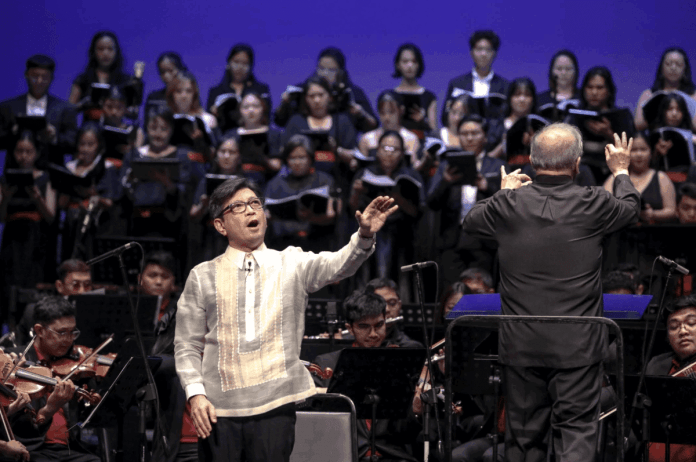
UP president Angelo A. Jimenez, as narrator of Aaron Copland’s “Lincoln Portraits” with the UP Symphony Orchestra, performed excerpts from memorable speeches and writings of US president Abraham Lincoln.

The concert on June 18 led by the University of the Philippines Symphony Orchestra (UPSO) dubbed “Alay sa Pamantasan ng Sambayanan” was unlike a standard symphonic concert. The program seemed more of a curated cultural ceremony—part musical showcase, part institutional homage.

The program nonetheless was ambitious in both performance and message, threading themes of patriotism, freedom, and identity into a cohesive musical narrative. Notably, six of the nine compositions performed were by Filipino composers—an effort underscoring the UPSO’s consistent push to prioritize local symphonic repertoire in their programming.

Article continues after this advertisement

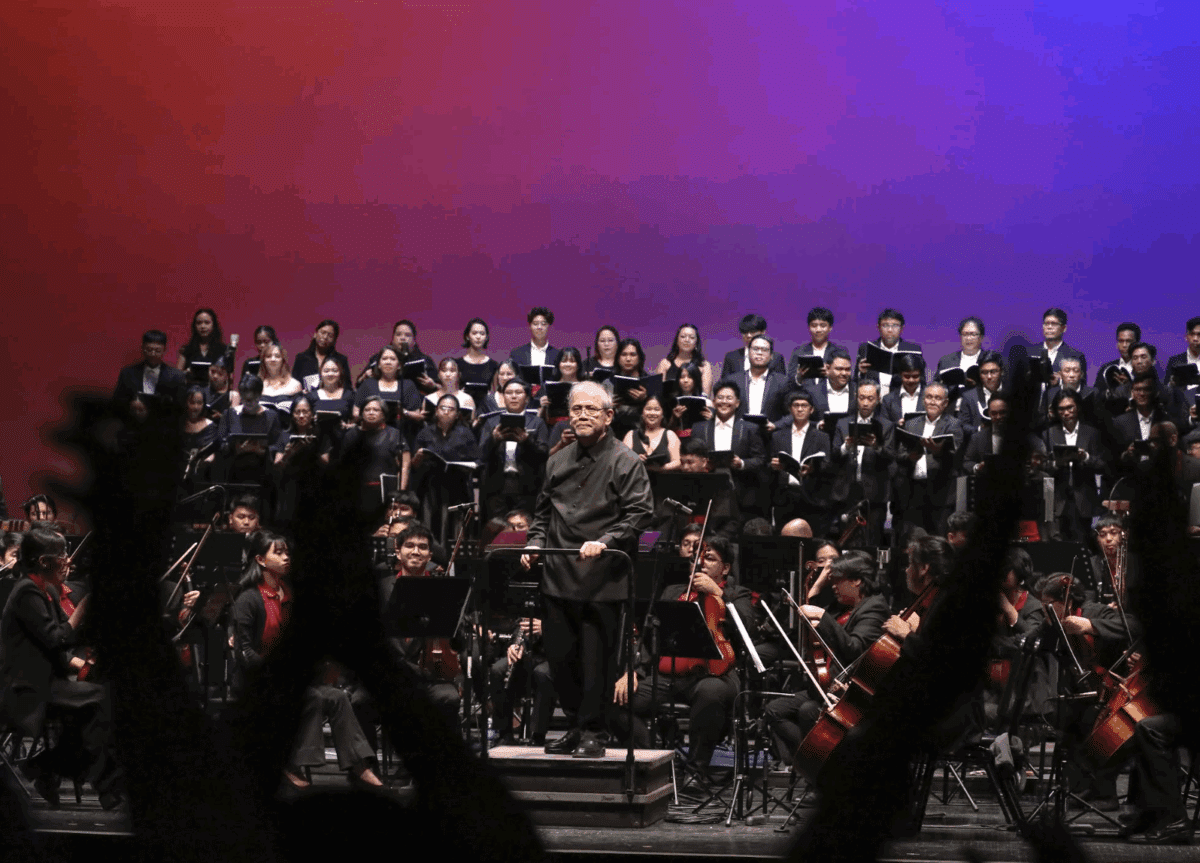
Under the baton of eminent music professor Josefino Chino Toledo since Day 1, the UPSO has come a long way since suddenly appearing in the cultural radar in December 2018 through a free holiday concert. It was met with surprise even in the university, as another prominent orchestra was booked much earlier in the same open-air venue that very same week. But for the new orchestra, the post-concert verdict was swift. They were not a ragtag team of 65 hastily assembled members—these Maroons were ready to play! UPSO has since been serenading UP campuses year around, holding mostly free events for the past six-and-a-half years. It’s been invited elsewhere, too, including a 2023 visit to Taipei.

Just two weeks ago, the orchestra collaborated with five pianists, five solo singers, and a new sister team—the UPSO Symphonic Chorus—to mark UP’s 117 th founding anniversary and the Philippines’ 127 th Independence Day at the University Theater in UP Diliman.

Opening with a new arrangement of Nicanor Abelardo’s UP Beloved (or UP Naming Mahal), conductor-arranger Toledo chose to pair its familiar melody with orchestral grandeur and bilingual lyrics. The effect was emotionally powerful, particularly for alumni in the audience. As someone who remembers singing this hymn during university events, hearing the English stanza felt both curious and thoughtful—perhaps a subtle nod to UP’s global identity.
UP orchestra blends symphony, tradition, cultural memory in meaningful intersectionUP orchestra blends symphony, tradition, cultural memory in meaningful intersection

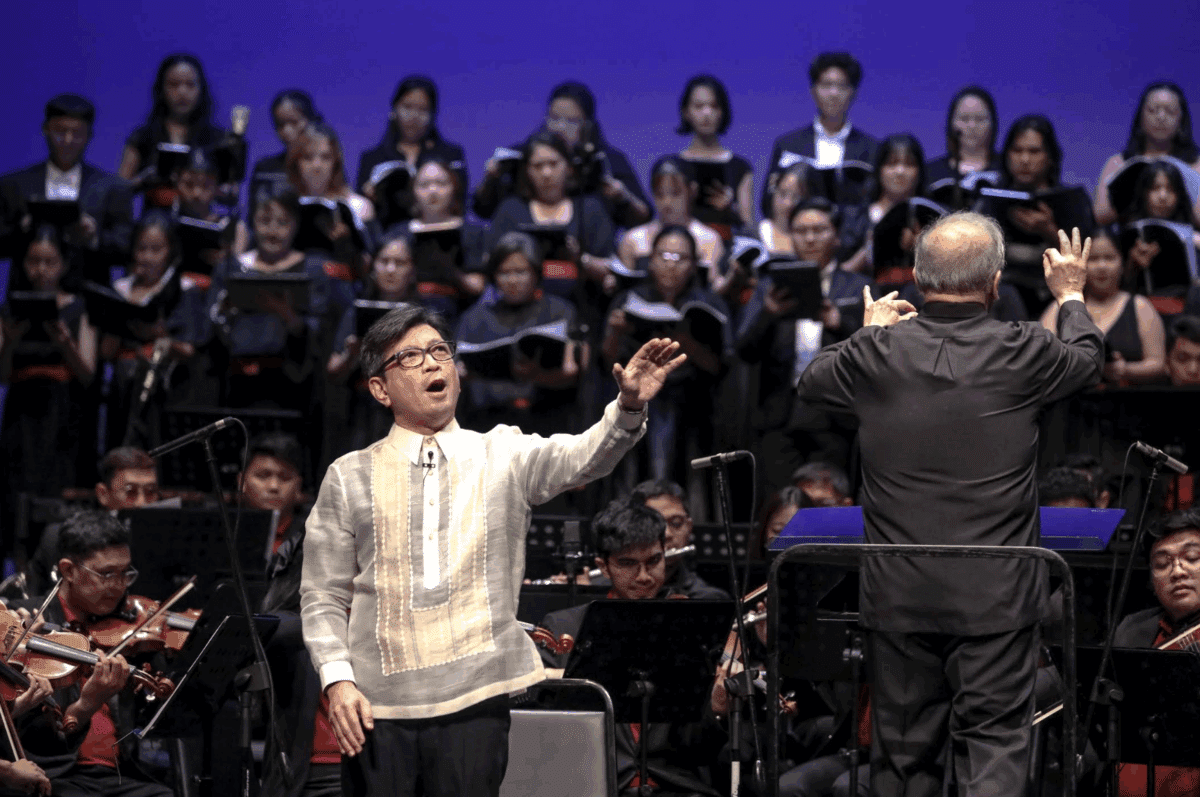
Musical director and conductor Josefino Chino Toledo with the UPSO Symphony Chorus

The selection of Beethoven’s Egmont Overture and Copland’s Lincoln Portrait provided moments for cross-cultural resonance. Beethoven’s score carries historical weight in its depiction of resistance and sacrifice, while Copland framed his piece around excerpts from Abraham Lincoln’s writings, gaining local significance through its narrator. UP President Angelo Jimenez delivered the text with solemnity and poise, invoking a statesman-like presence that reinforced the concert’s civic undertones. It was a choice that risked feeling ceremonial but instead offered sincerity.

Among the most memorable segments was Toledo’s Tikladong Hirang, a texturally rich piece for five pianos and orchestra. The staging itself was technically seamless—the appearance of five grand pianos via a hydraulic lift drew audible murmurs of delight. But what stood out was the work’s collage-like structure, referencing compositions by notable Filipino composers and blending them into a tapestry of distinct musical gestures. While the coordination among pianists occasionally felt less than organic, the concept paid off in scale and symbolism.

Article continues after this advertisement

Lucio San Pedro’s Panata sa Bayan and Toledo’s Tagpi-tagping Kundimang Hibik ng Bayan were the emotional linchpins of the program. The former, written for a UP presidential inauguration in 1988, carried a tone of solemn promise. Baritone Lionel Guico’s performance was commanding without overpowering the choral texture. The latter piece, with its use of kundiman idioms and fragmented nationalist texts, was perhaps the most intimate work on the program, its melancholy understated yet persistent.

UP orchestra blends symphony, tradition, cultural memory in meaningful intersectionUP orchestra blends symphony, tradition, cultural memory in meaningful intersection

Baritone Lionel Guico rendered “Panata Sa Bayan” by National Artist for Music Lucio SanPedro with the UP Symphony Orchestra Chorus

The finale—Tchaikovsky’s 1812 Overture—was executed with flair: the live carillon, cannon fire, and dramatic crescendos were intentionally theatrical. While one could debate the alignment of this particular piece with the concert’s Filipino-centric identity, its placement felt like a celebratory release. The audience’s reaction—raucous applause and a standing ovation—made clear how well it landed.

Article continues after this advertisement

Two encores followed: a medley of protest songs and Kayumangging Malaya by San Pedro. The conclusion brought the focus squarely back to Filipino music and its role in social commentary.

As I walked out of the theater that evening, I felt a quiet admiration for the musical risks taken—not everything was perfectly balanced, but the conviction was unmistakable.


Your subscription could not be saved. Please try again.


Your subscription has been successful.

Joining Toledo and Jimenez were artists who performed works by seven National Artists for Music, including featured sopranos Mary Michael Boragay and Maria Charezka Dawal-Granda, tenors Kelbert Sinfuego and Johann Niccolo Uy, baritone Lionel Guico, pianists Ena Maria Aldecoa, Geraldine Marie Gonzales, Luci Magalit, Michelle Nicolasora, and Albert Napoleon Roldan; and the UPSO Symphonic Chorus led by chorus director Noemi Binag.

Great Job & the Team @ INQUIRER.net Source link for sharing this story.

24 Dead In Texas Floods And More Than 20 Children Missing From A Girls Summer Camp

24 Dead In Texas Floods And More Than 20 Children Missing From A Girls Summer Camp

Posted on July 4, 2025

KERRVILLE, TEXAS – JULY 04: Trees emerge from flood waters along the Guadalupe River on July 4, 2025 in Kerrville, Texas. Heavy rainfall caused flooding along the Guadalupe River in central Texas with multiple fatalities reported. (Photo by Eric Vryn/Getty Images)

KERRVILLE, Texas (AP) — Heavy rains have caused devastating flash floods in Texas Hill Country, killing at least 24 people and leaving many others missing. At a news conference late Friday Kerr County Sheriff Larry Leitha said two dozen people were dead after least 10 inches (25 centimeters) of rain poured down overnight, causing flash flooding of the Guadalupe River. Authorities said 237 people had been recued so far, including 167 by helicopter. Among the missing are more than 20girls from a summer camp. Officials say the death toll may rise as rescue operations continue. The area, known as “flash flood alley,” is prone to sudden flooding due to its thin soil.

(Copyright 2025 The Associated Press. All Rights Reserved.)

Great Job & the Team @ News Talk WBAP-AM Source link for sharing this story.

Watch Oasis Reunite for Their First Show in 16 Years in Cardiff – Our Culture

Watch Oasis Reunite for Their First Show in 16 Years in Cardiff – Our Culture

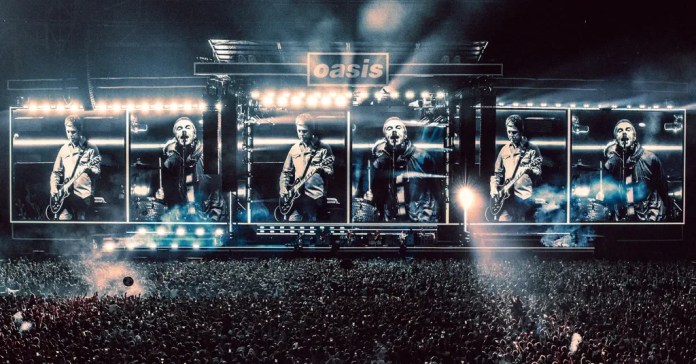
Oasis managed to get through their first show in 16 years on Friday at Principality Stadium in Cardiff, Wales, the first date of their highly anticipated reunion tour. Kicking off with (What’s the Story) Morning Glory?’s ‘Hello’, Liam and Noel Gallagher ran through a string of hits and deep cuts from across their discography before closing their four-song encore with ‘Wonderwall’ and ‘Champagne Supernova’. Check out the full setlist and clips from the show below.

Joining the brothers onstage were Andy Bell on bass, Paul “Bonehead” Arthurs and Gem Archer on guitar, and Joey Waronker on drums, plus Joe Auckland on trumpet, Steve Hamilton on saxophone, Christian Madden on keyboards, and Alastair White on trombone. Opening the show were Cast and Richard Ashcroft, who dedicated ‘Bittersweet Symphony’ to Liam and Noel.

After playing the Principality Stadium again on Saturday, Oasis are scheduled to play shows in Manchester, London, Edinburgh, and Dublin before heading out to North America, Asia, Australia, and South America.

Setlist: 

Hello
Acquiesce
Morning Glory
Some Might Say
Bring It on Down
Cigarettes & Alcohol
Fade Away
Supersonic
Roll With It
Talk Tonight
Half the World Away
Little by Little
D’You Know What I Mean?
Stand by Me
Cast No Shadow
Slide Away
Whatever
Live Forever
Rock ‘n’ Roll Star
The Masterplan
Don’t Look Back in Anger
Wonderwall
Champagne Supernova

Great Job Konstantinos Pappis & the Team @ Our Culture Source link for sharing this story.

Drake – “What Did I Miss?”

Drake – “What Did I Miss?”

Drake surprises his fans with the release of a brand new single. The song is titled “What Did I Miss?”.

Earlier on Friday, Drake debuted the song during a stream, where he was surrounded by guns in the backyard and also in a warehouse where he was wearing all kind of “Iceman” branding. It looks like the album is coming soon.

Listen below:


Great Job Rick & the Team @ Fresh: Hip-Hop & R&B Source link for sharing this story.

We’ve Witnessed U.S. Money Supply Make History on Both Ends of the Spectrum — Including a First Since the Great Depression — and It Foreshadows a Big-Time Move in Stocks | The Motley Fool

We’ve Witnessed U.S. Money Supply Make History on Both Ends of the Spectrum — Including a First Since the Great Depression — and It Foreshadows a Big-Time Move in Stocks | The Motley Fool

M2 money supply has pushed boundaries in multiple respects this decade.

For more than a century, Wall Street has been a stomping ground for wealth creation. No other asset class has come particularly close to matching the annualized return of stocks spanning 100 years.

However, this doesn’t mean stocks move higher in a straight line. Volatility is the price investors pay for admission to the world’s greatest wealth creator — and 2025 has been chock-full of volatility.

During a one-week stretch in April, the ageless Dow Jones Industrial Average (^DJI 0.77%) and broad-based S&P 500 (^GSPC 0.83%) dipped into correction territory, while the Nasdaq Composite (^IXIC 1.02%) entered a bear market for the first time in three years. This was followed days later by all three indexes recording their largest single-day point gains since their respective inceptions.

Image source: Getty Images.

When the market vacillates wildly, it’s common for investors to seek out clues that might tell them which direction stocks will head next. These clues come in the form of events and data points that have previously correlated with sizable moves higher or lower in one or more of Wall Street’s major stock indexes. Though no event or data point can guarantee what’s to come, some of these tools have remarkably strong track records of forecasting future returns.

One metric, which has made history on both ends of the spectrum over the last couple of years, is currently foreshadowing a big-time move in stocks.

U.S. money supply has endured two extremes this decade

While there are a number of telling metrics, events, and indicators, such as the stock market entering 2025 at one of its priciest valuations dating back 154 years, perhaps the most eyebrow-raising of them all is U.S. money supply.

Among the numerous measures of money supply, M1 and M2 tend to garner the most attention. The former measures all cash and coins in circulation, as well as demand deposits in a checking account. In other words, it’s capital that can be spent immediately.

Meanwhile, M2 takes everything in M1 and adds in savings accounts, money market accounts, and certificates of deposit (CDs) below $100,000. This is still money that can be spent, but it requires more effort to do so. It’s this money supply measure that’s been all over the map and made history at opposite ends of the spectrum this decade.

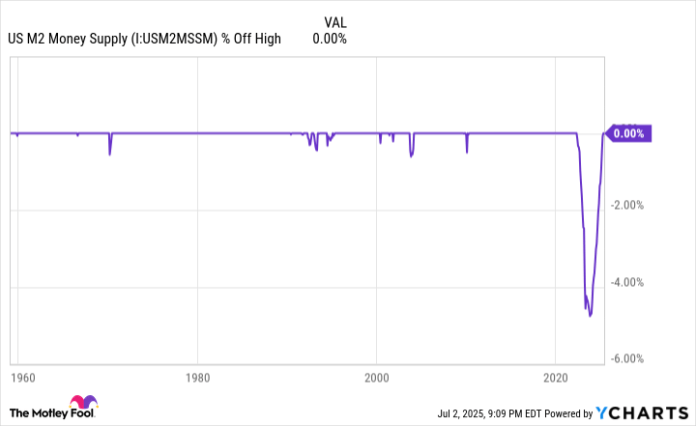
Normally, M2 money supply moves up and to the right. This is to say that, with very few exceptions, money supply has been steadily increasing over time. However, these rare exceptions have been doozies.

The post you see above on X (formerly Twitter) comes from Reventure App CEO Nick Gerli. Even though it’s more than two years old and the right side of the chart is now outdated — I’ll touch on this in greater detail in a moment — it demonstrates one of the more intriguing correlations we’ve witnessed over the last 155 years.

Prior to this decade, there had only been four instances where M2 money supply declined by at least 2% on a year-over-year basis: 1878, 1893, 1921, and 1931-1933. All four of these periods respectively correlate with economic depressions for the U.S. economy, as well as double-digit unemployment rates.

Between April 2022 and October 2023, U.S. M2 money supply contracted by more than $1 trillion, equating to a 4.76% peak-to-trough decline. It represented the first time since the Great Depression that M2 fell by at least 2% year over year, as well as more than 2% on a peak-to-trough basis.

Admittedly, things are quite different today than they were during the prior four occurrences where M2 declined by more than 2% on a year-over-year basis. For instance, the Federal Reserve didn’t exist in 1878 and 1893. Further, monetary policy and fiscal policy know-how are far greater today than they were in the 1920s or during the Great Depression.

But we’ve also witnessed money supply make history in the other direction.

We’ve Witnessed U.S. Money Supply Make History on Both Ends of the Spectrum — Including a First Since the Great Depression — and It Foreshadows a Big-Time Move in Stocks | The Motley Fool

US M2 Money Supply data by YCharts.

For starters, the latest update from the Board of Governors of the Federal Reserve System shows M2 hit an all-time high of $21.942 trillion in May 2025. It’s erased the 4.76% peak-to-trough decline from April 2022 to October 2023 in its entirety (and then some!). Steadily climbing money supply is typically something that’s observed when the U.S. economy is healthy and expanding, which is often good news for the stock market.

Furthermore, M2 expanded by more than 26% on a year-over-year basis during the height of the COVID-19 pandemic due to fiscal stimulus. When back-tested to 1870, this is, by far, the quickest expansion of money supply in America’s history.

Thus, the outsized drop in M2 from April 2022 to October 2023 might have been nothing more than a benign mean reversion following a never-before-seen jump in money supply.

Regardless of which historical M2 money supply moment shines brightest, all point to heightened volatility for the Dow Jones Industrial Average, S&P 500, and Nasdaq Composite.

A smiling person reading a financial newspaper while seated at a table in their home.

Image source: Getty Images.

History has a knack for rewarding patience and optimism on Wall Street

Though wild gyrations in Wall Street’s major stock indexes can, at times, be scary or tug on the heartstrings of investors, history has demonstrated a knack for rewarding those who exercise patience and perspective, and have an optimistic view on the U.S. economy and stock market.

A perfect example of history rewarding optimists can be seen when examining U.S. economic cycles.

On one hand, recessions are perfectly normal, healthy, and inevitable. No amount of fiscal or monetary policy maneuvering can stop economic slowdowns or downturns from taking shape sometimes. But the one prevailing theme of recessions is their rapid resolution. The average U.S. recession since the end of World War II has resolved in 10 months, and none have lasted longer than 18 months.

In comparison, the average period of economic growth over the last eight decades clocks in at around five years and includes two periods of expansion that surpassed the 10-year mark. With corporate America enjoying far more time in the sun than under the gray clouds of a recession, it’s no surprise that stocks have performed so well over extended periods.

This leads to the next point: the disproportionate nature of bull and bear market cycles on Wall Street.

In June 2023, shortly after the S&P 500 had entered its current bull market, Bespoke Investment Group published a data set on X (formerly Twitter) comparing the calendar-day length of every S&P 500 bull and bear market dating back to the start of the Great Depression.

The 27 S&P 500 bear markets that occurred over the nearly 94 years examined stuck around for an average of just 286 calendar days, with the longest bear market enduring only 630 calendar days.

Meanwhile, the typical S&P 500 bull market from September 1929 through June 2023 lasted 1,011 calendar days. Also, if the current bull market is extrapolated to present day, more than half of the 27 S&P 500 bull markets (14 out of 27) have stuck around longer than the lengthiest bear market.

Regardless of the near-term volatility that (presumably) awaits Wall Street, history has shown time and again that investors who exercise patience and allow time to work its magic are handsomely rewarded.

Great Job newsfeedback@fool.com (Sean Williams) & the Team @ The Motley Fool Source link for sharing this story.

Construction underway for Fort Worth Latter-day Saints temple, expected to open in 2026 | FROUSA Media | FROUSA Media

Construction underway for Fort Worth Latter-day Saints temple, expected to open in 2026 | FROUSA Media | FROUSA Media

When Janae Baird wanted to go to the temple, there was a laundry list of arrangements she had to make as a mother of five young children. 
Baird’s pilgrimage from Fort Worth to The Church of Jesus Christ of Latter-day Saints’ Dallas temple, the only one in the metroplex, involved a one-hour commute to the location, the two hours she would spend inside and the hour it would take her to get back home

Making the four-hour trip would only be possible after successfully scheduling an appointment to visit the temple, which can be a challenge in itself considering the membership growth the denomination has seen in Baird’s three decades of living in the metroplex, she said. 

While Baird’s children are grown up now, the thought of having a sacred place to practice her faith closer to home would be “such a blessing in my life,” she said. 

For the past two years, that thought has come closer to becoming a reality. 

In October 2023, members of the church broke ground in Burleson on the second temple to be built in the Dallas-Fort Worth area. The Fort Worth Texas Temple will be about 30,000 square feet with an estimated completion date in mid-2026.

“Having the temple in Dallas is wonderful,” Baird said. “But having the temple in Fort Worth will provide an opportunity for people to attend more frequently and to have it be a more peaceful and calm experience overall.”

About the Fort Worth Texas Temple

Temples within the denomination, also called “house of the Lord,” are considered places of holiness and peace separate from the preoccupations of the world. 

Temples are not placed for regular Sunday worship but rather serve as the only place where ceremonies such as baptism and eternal marriage can be performed on behalf of those who have died — a practice that Latter-day Saints believe was followed in the New Testament but later lost, according to The Church of Jesus Christ of Latter-day Saints. They are also a place where the highest sacraments of the faith take place, including marriages and the “sealing” of families for eternity. 

The interior of Latter-day Saints temples consist of a number of rooms designed to accommodate certain functions such as marriages, baptisms and religious instructional sessions. 

Inside the temples, church members change into simple, modest white clothing before taking part in temple ceremonies. The white clothing symbolizes purity and equality before God, according to the church

A meetinghouse, or chapel, is a building where members gather for Sunday worship services, weekly activities or community events. A new meetinghouse is also being built in addition to the construction of the Fort Worth Texas Temple.

Anyone, regardless of religion, may enter a Latter-day Saints meetinghouse and attend services. 

However, because of the sacredness of temples as “houses of the Lord,” only members of the church who are in good standing are allowed to enter, according to the church

The exterior of the meetinghouse June 30, 2025, in Burleson. (Mary Abby Goss | Fort Worth Report)

Membership growth

The new temple comes as membership growth in Texas has been rapid in recent decades, growing from 132,000 Latter-day Saints in 1985 to just over 210,000 in 2000, according to the church. Today, Texas is home to more than 378,000 members in nearly 750 congregations.

North Texas is home to about 100,000 members of The Church of Jesus Christ of Latter-day Saints, according to a spokesperson for the Fort Worth Temple Groundbreaking Committee. Fort Worth has about 33,000 members and 30 meetinghouses, according to the Dallas Morning News.

The groundbreaking for a new temple symbolized a new beginning “and an invitation for all to come and partake of the blessings of the gospel of Jesus Christ,” Elder Jose L. Alonso, member of the General Authority Seventies of The Church of Jesus Christ of Latter-day Saints, said during the October 2023 groundbreaking. 

“Those who will build this beautiful temple of stone and mortar, and we as a community, can also build a kind of temple full of unity, love and understanding in our hearts,” Alonso said. 

A welcome message is displayed on the meetinghouse June 30, 2025, in Burleson. (Mary Abby Goss | Fort Worth Report)

Construction milestones

Stone cladding panels are being fastened to the retaining walls that surround the temple grounds, according to a June 22 update posted to the project’s website. The new meetinghouse’s parking lot is also being paved, sod has been laid, and soft landscaping is being established.

A gold domed cupola was set in place on the Fort Worth Texas Temple in late May, with its finial soon to follow. The construction milestone brings the temple to its full height. 

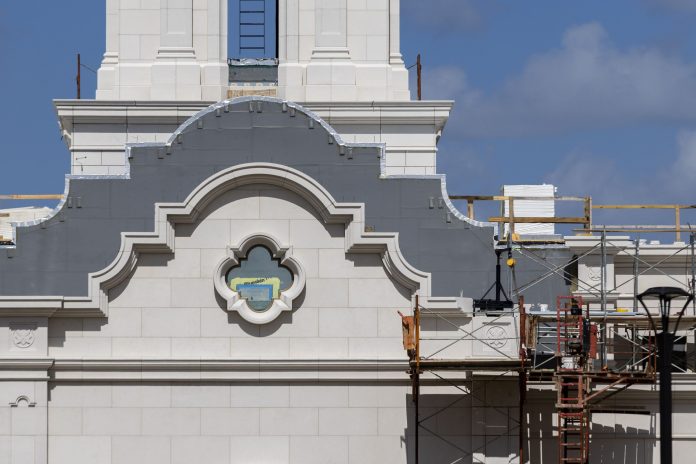
The quatrefoil window is displayed on the facade of the Fort Worth Texas Temple on June 30, 2025, in Burleson. (Mary Abby Goss | Fort Worth Report)

After the temple is built, it will be open to the public for tours — typically scheduled for a period of two weeks or more — before being dedicated for ordinance work.

It is Baird’s hope, she says, that by visiting the temple people will understand “what makes it feel like a special place” and continue to enjoy the outdoor temple grounds after its dedication. 

“The exterior of the temple, we really hope, can be a place where as the community passes by to enjoy the grounds that they can feel that calm and that peace,” Baird said. “And that the temple becomes a beloved place for them as well.”

Marissa Greene is a Report for America corps member, covering faith for the Fort Worth Report. Contact her at marissa.greene@fortworthreport.org

News decisions are made independently of our board members and financial supporters. Read more about our editorial independence policy here.

Fort Worth Report is certified by the Journalism Trust Initiative for adhering to standards for ethical journalism.

Republishing is free for noncommercial entities. Commercial entities are prohibited without a licensing agreement. Contact us for details.

Great Job Felicia Ray Owens & the Team @ FROUSA Media Source link for sharing this story.

#FeliciaRayOwens #TheFeliciaFiles #FROUSA #LocalVoices #IndependentMedia #HerSheSquad

Great Job Felicia Ray Owens & the Team @ Felicia Ray Owens Source link for sharing this story.

#FROUSA #HillCountryNews #NewBraunfels #ComalCounty #LocalVoices #IndependentMedia

Great Job Felicia Ray Owens & the Team @ FROUSA Media Source link for sharing this story.

#FeliciaRayOwens #TheFeliciaFiles #FROUSA #LocalVoices #IndependentMedia #HerSheSquad

Great Job Felicia Ray Owens & the Team @ Felicia Ray Owens Source link for sharing this story.

Construction underway for Fort Worth Latter-day Saints temple, expected to open in 2026 | FROUSA Media

Construction underway for Fort Worth Latter-day Saints temple, expected to open in 2026 | FROUSA Media

When Janae Baird wanted to go to the temple, there was a laundry list of arrangements she had to make as a mother of five young children. 

Baird’s pilgrimage from Fort Worth to The Church of Jesus Christ of Latter-day Saints’ Dallas temple, the only one in the metroplex, involved a one-hour commute to the location, the two hours she would spend inside and the hour it would take her to get back home

Making the four-hour trip would only be possible after successfully scheduling an appointment to visit the temple, which can be a challenge in itself considering the membership growth the denomination has seen in Baird’s three decades of living in the metroplex, she said. 

While Baird’s children are grown up now, the thought of having a sacred place to practice her faith closer to home would be “such a blessing in my life,” she said. 

For the past two years, that thought has come closer to becoming a reality. 

In October 2023, members of the church broke ground in Burleson on the second temple to be built in the Dallas-Fort Worth area. The Fort Worth Texas Temple will be about 30,000 square feet with an estimated completion date in mid-2026.

“Having the temple in Dallas is wonderful,” Baird said. “But having the temple in Fort Worth will provide an opportunity for people to attend more frequently and to have it be a more peaceful and calm experience overall.”

About the Fort Worth Texas Temple

Temples within the denomination, also called “house of the Lord,” are considered places of holiness and peace separate from the preoccupations of the world. 

Temples are not placed for regular Sunday worship but rather serve as the only place where ceremonies such as baptism and eternal marriage can be performed on behalf of those who have died — a practice that Latter-day Saints believe was followed in the New Testament but later lost, according to The Church of Jesus Christ of Latter-day Saints. They are also a place where the highest sacraments of the faith take place, including marriages and the “sealing” of families for eternity. 

The interior of Latter-day Saints temples consist of a number of rooms designed to accommodate certain functions such as marriages, baptisms and religious instructional sessions. 

Inside the temples, church members change into simple, modest white clothing before taking part in temple ceremonies. The white clothing symbolizes purity and equality before God, according to the church

A meetinghouse, or chapel, is a building where members gather for Sunday worship services, weekly activities or community events. A new meetinghouse is also being built in addition to the construction of the Fort Worth Texas Temple.

Anyone, regardless of religion, may enter a Latter-day Saints meetinghouse and attend services. 

However, because of the sacredness of temples as “houses of the Lord,” only members of the church who are in good standing are allowed to enter, according to the church

The exterior of the meetinghouse June 30, 2025, in Burleson. (Mary Abby Goss | Fort Worth Report)

Membership growth

The new temple comes as membership growth in Texas has been rapid in recent decades, growing from 132,000 Latter-day Saints in 1985 to just over 210,000 in 2000, according to the church. Today, Texas is home to more than 378,000 members in nearly 750 congregations.

North Texas is home to about 100,000 members of The Church of Jesus Christ of Latter-day Saints, according to a spokesperson for the Fort Worth Temple Groundbreaking Committee. Fort Worth has about 33,000 members and 30 meetinghouses, according to the Dallas Morning News.

The groundbreaking for a new temple symbolized a new beginning “and an invitation for all to come and partake of the blessings of the gospel of Jesus Christ,” Elder Jose L. Alonso, member of the General Authority Seventies of The Church of Jesus Christ of Latter-day Saints, said during the October 2023 groundbreaking. 

“Those who will build this beautiful temple of stone and mortar, and we as a community, can also build a kind of temple full of unity, love and understanding in our hearts,” Alonso said. 

A welcome message is displayed on the meetinghouse June 30, 2025, in Burleson. (Mary Abby Goss | Fort Worth Report)

Construction milestones

Stone cladding panels are being fastened to the retaining walls that surround the temple grounds, according to a June 22 update posted to the project’s website. The new meetinghouse’s parking lot is also being paved, sod has been laid, and soft landscaping is being established.

A gold domed cupola was set in place on the Fort Worth Texas Temple in late May, with its finial soon to follow. The construction milestone brings the temple to its full height. 

Construction underway for Fort Worth Latter-day Saints temple, expected to open in 2026 | FROUSA Media
The quatrefoil window is displayed on the facade of the Fort Worth Texas Temple on June 30, 2025, in Burleson. (Mary Abby Goss | Fort Worth Report)

After the temple is built, it will be open to the public for tours — typically scheduled for a period of two weeks or more — before being dedicated for ordinance work.

It is Baird’s hope, she says, that by visiting the temple people will understand “what makes it feel like a special place” and continue to enjoy the outdoor temple grounds after its dedication. 

“The exterior of the temple, we really hope, can be a place where as the community passes by to enjoy the grounds that they can feel that calm and that peace,” Baird said. “And that the temple becomes a beloved place for them as well.”

Marissa Greene is a Report for America corps member, covering faith for the Fort Worth Report. Contact her at marissa.greene@fortworthreport.org

News decisions are made independently of our board members and financial supporters. Read more about our editorial independence policy here.

Fort Worth Report is certified by the Journalism Trust Initiative for adhering to standards for ethical journalism.

Construction underway for Fort Worth Latter-day Saints temple, expected to open in 2026 | FROUSA Media | FROUSA Media

Republishing is free for noncommercial entities. Commercial entities are prohibited without a licensing agreement. Contact us for details.

#FROUSA #HillCountryNews #NewBraunfels #ComalCounty #LocalVoices #IndependentMedia

Great Job Felicia Ray Owens & the Team @ FROUSA Media Source link for sharing this story.

#FeliciaRayOwens #TheFeliciaFiles #FROUSA #LocalVoices #IndependentMedia #HerSheSquad

Great Job Felicia Ray Owens & the Team @ Felicia Ray Owens Source link for sharing this story.

Deadspin | Phillies’ Ranger Suarez looks for another strong outing vs. Reds

Deadspin | Phillies’ Ranger Suarez looks for another strong outing vs. Reds

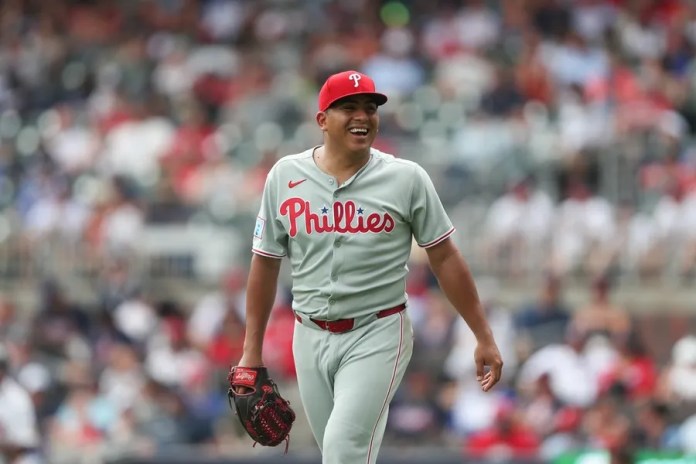
Jun 29, 2025; Cumberland, Georgia, Philadelphia Phillies starting pitcher Ranger Suarez (55) reacts to his strikeout during a game against the Atlanta Braves during the sixth inning at Truist Park. Mandatory Credit: Mady Mertens-Imagn Images

The Cincinnati Reds are becoming known for their resilience.

Fresh off an impressive offensive display, the Reds hope to author a similar performance Saturday when they continue their road series against the Philadelphia Phillies.

Philadelphia took an early 3-0 lead in the Friday matinee before Cincinnati scored in four consecutive innings — highlighted by a five-run third — en route to a 9-6 victory.

“I think they know now that if we keep playing, we’ve got a chance,” Reds manager Terry Francona said after his team’s second straight win following a stretch of four losses in six games. “When you’ve got something to show for it, it really helps.”

Spencer Steer, who sat out Wednesday night in Boston after getting hit by a pitch on his hand during the completion of a suspended game earlier in the day, led the Reds’ charge on Friday with two hits, two walks, two RBIs and two runs.

“You have to find every way possible to play,” Steer said. “(My hand) was good to go.”

As for the Phillies, they lost despite racking up 14 hits. They had a chance to tilt the scoreboard in their favor in the eighth inning, but Alec Bohm struck out with the bases loaded.

Philadelphia starter Jesus Luzardo allowed six runs (five earned) in two-plus innings as the hosts squandered the early lead and never fully recovered.

“I still have all the confidence in the world in Luzardo,” Phillies manager Rob Thomson said. “He’s going to have — everybody is going to have — bad outings here and there. I think we’re still fine.”

Of course, Thomson has the luxury of a rotation that features several outstanding pitchers. One of those talented hurlers will start Saturday as the red-hot Ranger Suarez (7-2, 2.00 ERA) takes the mound.

The left-hander has allowed only six earned runs in his past eight starts, good for a 0.99 ERA over that stretch. He gave up one run in seven innings against the Atlanta Braves on Sunday, prompting Thomson to say, “I think he’s pitching better than I’ve ever seen him pitch. I really do.”

Suarez has made eight career appearances (four starts) against Cincinnati, posting a 2-0 record with a 2.17 ERA.

The Reds will give the nod to Nick Lodolo (5-5, 3.52 ERA), who also has good career numbers against his Saturday opponent. The lefty has started against the Phillies five times previously, going 1-0 with a 2.76 ERA.

Lodolo is coming off a Sunday matchup against the San Diego Padres in which he yielded one run over 5 1/3 innings. However, he didn’t have his best control (57 strikes and 38 balls), as he walked two batters and hit another.

“I wasn’t putting myself in great spots over and over,” Lodolo said, “but I battled and kept us there and we won the game.”

If the Saturday contest is close at the end, the Reds certainly will feel confident handing the ball to Emilio Pagan, who worked the ninth on Friday for his 19th save. It was Pagan’s 11th scoreless outing in his past 12 appearances.

Pagan needs one more save to match his career high, set with the Tampa Bay Rays in 2019.

–Field Level Media

Great Job & the Team @ Deadspin > Sports News Without Fear, Favor or Compromise Source link for sharing this story.

Construction underway for Fort Worth Latter-day Saints temple, expected to open in 2026

Construction underway for Fort Worth Latter-day Saints temple, expected to open in 2026

When Janae Baird wanted to go to the temple, there was a laundry list of arrangements she had to make as a mother of five young children. 

Baird’s pilgrimage from Fort Worth to The Church of Jesus Christ of Latter-day Saints’ Dallas temple, the only one in the metroplex, involved a one-hour commute to the location, the two hours she would spend inside and the hour it would take her to get back home. 

Making the four-hour trip would only be possible after successfully scheduling an appointment to visit the temple, which can be a challenge in itself considering the membership growth the denomination has seen in Baird’s three decades of living in the metroplex, she said. 

While Baird’s children are grown up now, the thought of having a sacred place to practice her faith closer to home would be “such a blessing in my life,” she said. 

For the past two years, that thought has come closer to becoming a reality. 

In October 2023, members of the church broke ground in Burleson on the second temple to be built in the Dallas-Fort Worth area. The Fort Worth Texas Temple will be about 30,000 square feet with an estimated completion date in mid-2026.

“Having the temple in Dallas is wonderful,” Baird said. “But having the temple in Fort Worth will provide an opportunity for people to attend more frequently and to have it be a more peaceful and calm experience overall.”

About the Fort Worth Texas Temple

Temples within the denomination, also called “house of the Lord,” are considered places of holiness and peace separate from the preoccupations of the world. 

Temples are not placed for regular Sunday worship but rather serve as the only place where ceremonies such as baptism and eternal marriage can be performed on behalf of those who have died — a practice that Latter-day Saints believe was followed in the New Testament but later lost, according to The Church of Jesus Christ of Latter-day Saints. They are also a place where the highest sacraments of the faith take place, including marriages and the “sealing” of families for eternity. 

The crane provides a sense of scale at the Fort Worth Texas Temple on June 30, 2025, in Burleson. (Mary Abby Goss | Fort Worth Report)

The interior of Latter-day Saints temples consist of a number of rooms designed to accommodate certain functions such as marriages, baptisms and religious instructional sessions. 

Inside the temples, church members change into simple, modest white clothing before taking part in temple ceremonies. The white clothing symbolizes purity and equality before God, according to the church

A meetinghouse, or chapel, is a building where members gather for Sunday worship services, weekly activities or community events. A new meetinghouse is also being built in addition to the construction of the Fort Worth Texas Temple.

Anyone, regardless of religion, may enter a Latter-day Saints meetinghouse and attend services. 

However, because of the sacredness of temples as “houses of the Lord,” only members of the church who are in good standing are allowed to enter, according to the church

The exterior of the meetinghouse June 30, 2025, in Burleson. (Mary Abby Goss | Fort Worth Report)

Membership growth

The new temple comes as membership growth in Texas has been rapid in recent decades, growing from 132,000 Latter-day Saints in 1985 to just over 210,000 in 2000, according to the church. Today, Texas is home to more than 378,000 members in nearly 750 congregations.

North Texas is home to about 100,000 members of The Church of Jesus Christ of Latter-day Saints, according to a spokesperson for the Fort Worth Temple Groundbreaking Committee. Fort Worth has about 33,000 members and 30 meetinghouses, according to the Dallas Morning News.

The groundbreaking for a new temple symbolized a new beginning “and an invitation for all to come and partake of the blessings of the gospel of Jesus Christ,” Elder Jose L. Alonso, member of the General Authority Seventies of The Church of Jesus Christ of Latter-day Saints, said during the October 2023 groundbreaking. 

“Those who will build this beautiful temple of stone and mortar, and we as a community, can also build a kind of temple full of unity, love and understanding in our hearts,” Alonso said. 

A welcome message is displayed on the meetinghouse June 30, 2025, in Burleson. (Mary Abby Goss | Fort Worth Report)

Construction milestones

Stone cladding panels are being fastened to the retaining walls that surround the temple grounds, according to a June 22 update posted to the project’s website. The new meetinghouse’s parking lot is also being paved, sod has been laid, and soft landscaping is being established.

A gold domed cupola was set in place on the Fort Worth Texas Temple in late May, with its finial soon to follow. The construction milestone brings the temple to its full height. 

The quatrefoil window is displayed on the facade of the Fort Worth Texas Temple on June 30, 2025, in Burleson. (Mary Abby Goss | Fort Worth Report)

After the temple is built, it will be open to the public for tours — typically scheduled for a period of two weeks or more — before being dedicated for ordinance work.

It is Baird’s hope, she says, that by visiting the temple people will understand “what makes it feel like a special place” and continue to enjoy the outdoor temple grounds after its dedication. 

“The exterior of the temple, we really hope, can be a place where as the community passes by to enjoy the grounds that they can feel that calm and that peace,” Baird said. “And that the temple becomes a beloved place for them as well.”

Marissa Greene is a Report for America corps member, covering faith for the Fort Worth Report. Contact her at marissa.greene@fortworthreport.org

News decisions are made independently of our board members and financial supporters. Read more about our editorial independence policy here.

Fort Worth Report is certified by the Journalism Trust Initiative for adhering to standards for ethical journalism.

Construction underway for Fort Worth Latter-day Saints temple, expected to open in 2026 | FROUSA Media | FROUSA Media

Republishing is free for noncommercial entities. Commercial entities are prohibited without a licensing agreement. Contact us for details.

Great Job Marissa Greene & the Team @ Fort Worth Report Source link for sharing this story.

The Biggest Coverup of the American Revolution

The Biggest Coverup of the American Revolution

WE ALL KNOW THAT THE DECLARATION OF INDEPENDENCE, adopted 249 years ago today, proclaims that “all men are created equal,” and that the brave members of the Second Continental Congress pledged “our Lives, our Fortunes and our sacred Honor” to the cause of separation from Britain.

But largely forgotten amid the Declaration’s historically consequential opening and its stirring conclusion is the true heart of the document: its laundry list of twenty-seven grievances against King George III. The representatives in Philadelphia sought to explain to Britain and the world why Americans demanded independence. This catalogue assembled by the Declaration’s drafter, 33-year-old Virginia delegate Thomas Jefferson, was designed to clinch the case.

Most of the points detail the monarch’s interference with the colonists’ courts and assemblies, but perhaps the most serious charge was that he “ravaged our Coasts, burnt our towns, and destroyed the lives of our people.” Within these short phrases lies the biggest patriot coverup of the war, one in which Jefferson was intimately involved—and one perpetuated long after the Revolutionary War was won.

THERE IS NO DISPUTING that King George III’s military forces treated New England’s coastal towns harshly at the start of the conflict. At the Battle of Bunker Hill in June 1775, redcoats torched the Boston suburb of Charlestown to prevent patriot snipers from targeting their troops during the bloody fight.

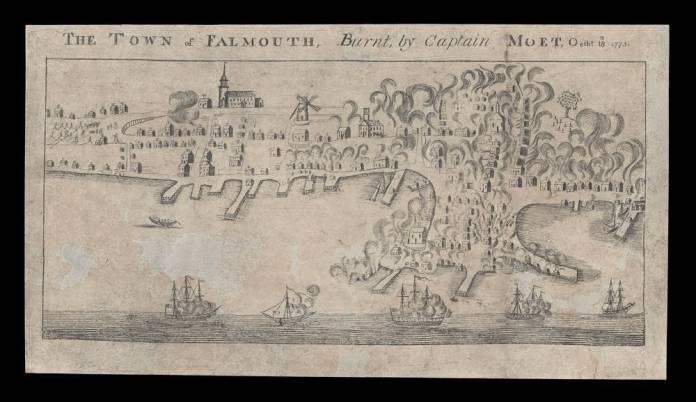
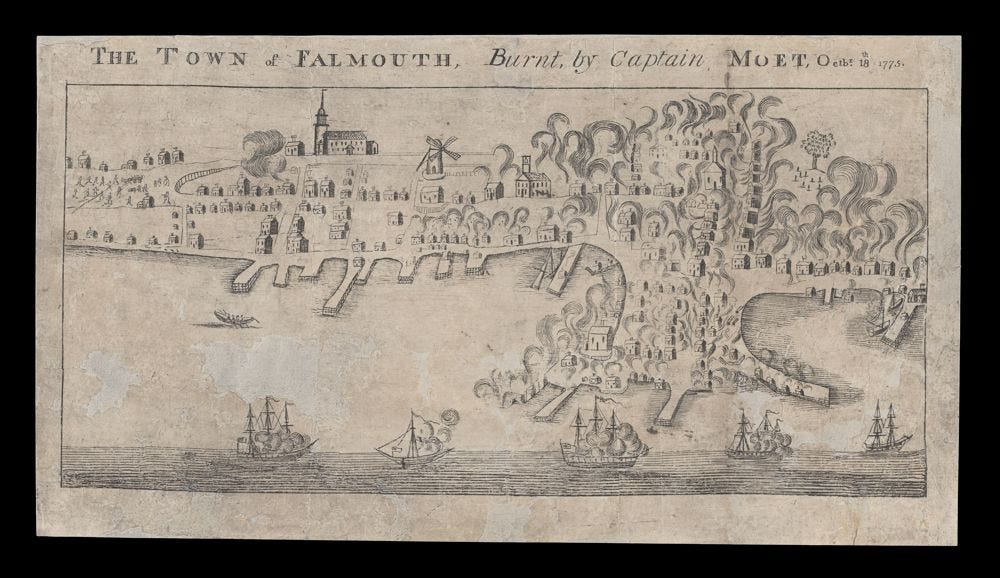
That fall, in retaliation for a deadly patriot attack on a Royal Navy ship in Maine, Admiral Samuel Graves, writing from Boston Harbor on July 6, ordered a fleet under Captain Henry Mowat “to lay waste burn and destroy such Sea Port towns as are accessible to His Majesty’s ships” in the northern province. On October 17, Mowat gave the residents of Falmouth—today’s Portland—two hours to evacuate. The subsequent bombardment and landing parties left most of its four hundred buildings in ruin and nearly half the population of 2,500 homeless.

The Biggest Coverup of the American Revolution

Topographical view of the burning of Portland (then Falmouth), Maine by Lieutenant Henry Mowat on October 18, 1775. (Courtesy of the Osher Map Library and Smith Center for Cartographic Education, University of Southern Maine.)

But the fates of Charlestown and Falmouth paled in comparison with the annihilation of the port of Norfolk—Virginia’s largest city and the eighth-largest settlement in the thirteen colonies—which lay five hundred miles to the south. With its fine harbor and recent influx of Scottish merchants, the port had burgeoned from a regional trading center into an important node in the expanding Atlantic trade. As the largest port between Philadelphia and Charleston, it boasted a population triple that of the capital of Williamsburg. Half were enslaved people, many of whom were highly skilled laborers in the Scottish-owned factories, at the shipyards, on the docks, and aboard the many vessels plying the waters.

Virginia’s royal governor, Lord Dunmore, had fled Williamsburg in the summer of 1775 and made a Norfolk shipyard his base of operations to defeat the rebels. By year’s end, however, the patriots had seized the town, pushing his troops and civilian loyalists onto ships in the harbor. On New Year’s Day 1776, after a bombardment by four Royal Navy warships to destroy sniper posts, an enormous fire swept the port that burned for three days. Soon not a single building was left standing. Dunmore was immediately fingered as the villain.

The news shocked and outraged Americans. John Hancock, presiding over the Second Continental Congress in Philadelphia, called the act “contrary to the rules of war . . . by all civilized nations.” George Washington, commander of the young Continental Army, decried British leaders who behaved like “the most barbarous Savages,” and predicted “the destruction of Norfolk, & threatned devastation of other places, will have no other effect than to unite the whole Country.”

By the spring of 1776, moderates found themselves hard put to argue for accommodation with Britain as ships of war laid waste to defenseless American cities. What had long been a radical notion—independence—quickly found favor among colonists. Even members of Parliament were appalled by the actions. Speaking in the House of Lords on March 5, 1776, the Duke of Richmond lambasted “devastation hitherto unprecedented in the annals of mankind” that “would render us despised and abhorred.” He predicted the disaster in Virginia would “turn the whole continent . . . into the most implacable and inveterate enemies.” In response, the Duke of Manchester suggested that the colonists, despite their own wishes, might be “forced into independency.” That is precisely what happened.

WHAT NEITHER THE AMERICAN PUBLIC nor Parliament knew was that the man who would go on to draft the Declaration had secretly encouraged Norfolk’s ruin shortly before it happened. Nor did they know that the colony’s patriots perpetrated the deed themselves and successfully blamed it on the enemy. Later historians continued to consider Dunmore the culprit in what was arguably the greatest war crime of the American Revolution.

The truth only came out sixty years later, when a 1777 report on Norfolk’s destruction, long hidden, came to light. The careful study of the blaze by a committee of Virginia patriots determined that 96 percent of the destruction was caused—on purpose—by the patriots themselves. They had used Dunmore’s bombardment, which by itself had caused limited damage, as an opportunity to set fire to and loot the town. They did not even spare the Anglican church, Masonic Hall, or homes of fervent patriots.

This was not, however, the result of raw troops running amok. According to eyewitnesses deposed by the committee, officers urged them on. Letters from patriot leaders also reveal that there was a secret plan to destroy the town, despite their public insistence that they would protect all property. Just weeks before the blaze, a pseudonymous newspaper writer urged the patriotic residents of Norfolk to take action for “the general good,” even if it “cost the lives of a few” and resulted in “either the partial or total destruction” of the town. A few days after that, Jefferson wrote a letter to John Page, a senior Virginia patriot, that concluded on an intriguing line, rendered in capital letters: “DELENDA EST NORFOLK”—Latin for “Norfolk must be destroyed,” an allusion to the famous declamation about Carthage with which Cato the Elder ended all his speeches while calling for war.

THE PERPLEXING QUESTION IS WHY Virginia’s patriot leaders would want to burn the leading city in their own colony. Other ports like Philadelphia and New York had large loyalist factions, but no one proposed demolition as a solution. Some have argued that Norfolk’s destruction was a simple move to deny the British a strategic harbor. Yet after the Royal Navy abandoned Boston in the spring of 1776, no one seriously proposed leveling that town.

A major reason has little to do with tea or taxes and a lot to do with immigrants and race. The rich tobacco planters of English descent who led Virginia’s rebellion had long viewed Norfolk’s prosperous Scottish merchants with suspicion. Many also owed them a good deal of money. As Jews were (and often still are), these savvy Scots were viewed as wealthy and untrustworthy cosmopolitans.

The port posed another threat to tobacco planters, since it had long been a magnet for the enslaved people who made their lives easy. In the crowded alleys and dark taverns along the waterfront, those who had fled plantations could hide, forge papers, and even find a measure of liberty in servitude rare in Virginia’s plantations, which were tightly controlled forced-labor camps. Then, in November 1775, Lord Dunmore freed those in bondage if they would fight for the king. This emancipation proclamation, and the resulting black regiment, terrified the patriots. Norfolk’s destruction promised to snuff out this dual threat to their wealth and power.

By the end of 1776, Virginia’s patriot assembly ordered deportation of all Scottish merchants, crippling the young state’s economy. New restrictions were placed on those in bondage to prevent them from seeking liberty. Their freedom only came ninety years later, after an even bloodier war. Meanwhile, the myth of Dunmore’s villainy can still be found in textbooks.

We still struggle with Jefferson’s challenging call in the Declaration to treat all people as equals under the law. But we can at least face up to the often-ugly facts of our founding, whether the senseless demolition of a city, the tragic deportation of valuable residents, or the inhumanity of lifetime servitude. Surely, we are old enough now—nearly a quarter of millennium—to handle the self-evident truths of our beginnings.

Share this article with someone with whom you have also shared a Fourth of July hotdog.

Share

Great Job Andrew Lawler & the Team @ The Bulwark Source link for sharing this story.
Secret Link