
Check out the best moments between the Kansas City Royals and the Seattle Mariners.
Great Job & the Team @ FOX Sports Digital Source link for sharing this story.

Check out the best moments between the Kansas City Royals and the Seattle Mariners.
Great Job & the Team @ FOX Sports Digital Source link for sharing this story.
AUSTIN, Texas – The Fourth of July is Friday, and first responders are prepared for heavy rainfall and the possibility of flooding leading into the holiday weekend.
The Texas Division of Emergency Management has activated state emergency response resources in parts of Central Texas.
What they’re saying:
“We are concerned about excessive rainfall that could lead to flash flooding with so many people out and about traveling for the holiday weekend,” says TDEM Chief of Media Communications Wes Rapaport.
An abundance of rainfall across Central Texas sends the state emergency operations center into an escalated response.
“Essentially, what that means is that it brings certain state agencies to the table to ensure that the coordination remains streamlined, and that we are best equipped to support any requests for assistance from the state that come from local officials in impacted areas,” says Rapaport.

Level four is the lowest response level and level one is the highest. TDEM activated level two on Wednesday, July 2.
“We have responders, we have boats, and we have aircraft staged and ready to support any requests from local officials to the state of Texas for assistance, should that be needed,” says Rapaport.
According to the National Weather Service, heavy rainfall and flash flooding poses a threat to parts of West Texas, Central Texas, and the Hill Country over the next few days.
Emergency management officials recommend taking proactive measures.
“Packing an emergency supply kit that’s got, you know, first aid supplies, food and water and clothes and a weather radio, batteries and chargers and things like that. But also to be prepared to follow instructions from local officials should there be a need to seek higher ground or leave the area that you’re currently in,” says Rapaport.
The weather is also a threat to upcoming Fourth of July events. For a full list of events in Central Texas, click here.
TDEM says there are hundreds of staff members working around the clock to assure the safety of the public.
“We know it’s a holiday weekend, and we want Texans to go out and enjoy what our great state has to offer and spend time with their loved ones and, enjoy the holiday weekend. That said, we really need to make sure that Texans stay weather-aware and pay attention. So, the state of Texas has done our part, we need Texans to do their part,” says Rapaport.
TDEM says level 2 will remain active until there is no longer a possibility of flooding.
The Source: Information from interviews conducted by FOX 7 Austin’s Tan Radford
Great Job Tan.Radford@fox.com (Tan Radford) & the Team @ Latest News | FOX 7 Source link for sharing this story.
NEW YORK – Alarmed by the policies of President Donald Trump, millions turned out last month for protests around the United States and overseas. Mindful of next year’s 250th anniversary of American independence, organizers called the movement “No Kings.”
Had the same kind of rallies been called for in the summer of 1775, the response likely would have been more cautious.
“It (‘No Kings’) was probably a minority opinion in July 1775,” says H.W. Brands, a prize-winning scholar and chair of the history department at the University of Texas at Austin.
“There was a lot of passion for revolution in New England, but that was different from the rest of the country,” says Pulitzer Prize-winning historian Joseph Ellis. “There were still people who don’t want to drawn into what they feared was an unnecessary war.”
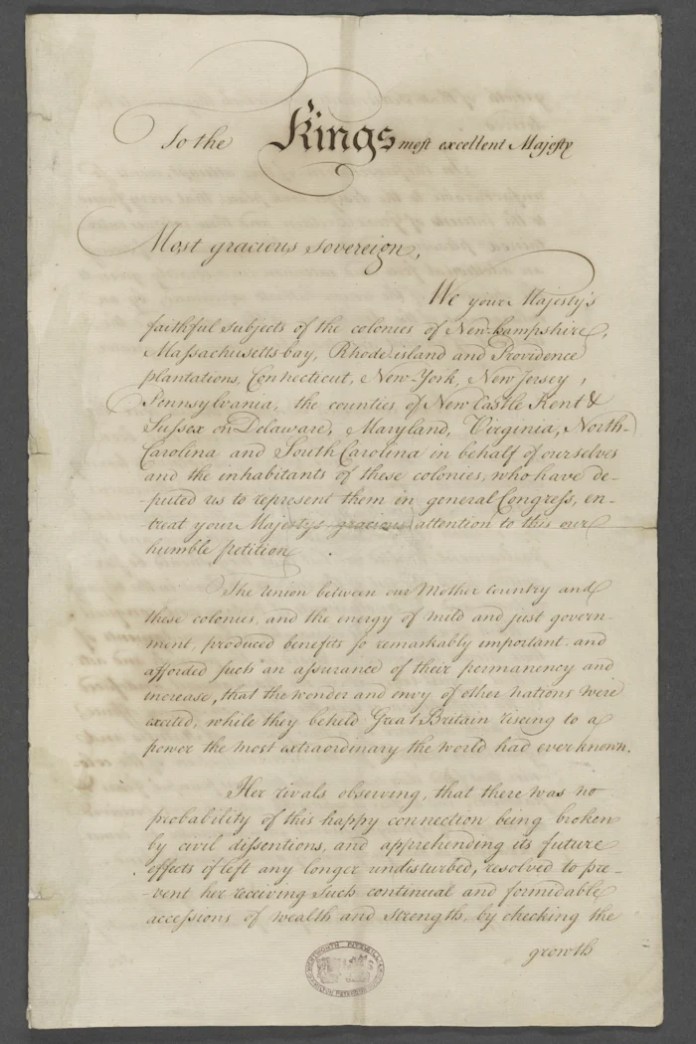
This month marks the 250th anniversary — the semiquincentennial — of a document enacted almost exactly a year before the Declaration of Independence: “The Olive Branch Petition,” ratified July 5, 1775 by the Continental Congress. Its primary author was John Dickinson, a Pennsylvanian whose writing skills led some to call him the “Penman of the Revolution,” and would stand as a final, desperate plea to reconcile with Britain.
They put forth a pre-revolutionary argument
The notion of “No Kings” is a foundation of democracy. But over the first half of 1775 Dickinson and others still hoped that King George III could be reasoned with and would undo the tax hikes and other alleged abuses they blamed on the British Parliament and other officials. Ellis calls it the “Awkward Interval,” when Americans had fought the British in Lexington and Concord and around Bunker Hill, while holding off from a full separation.
“Public opinion is changing during this time, but it still would have been premature to issue a declaration of independence,” says Ellis, whose books include “Founding Brothers,” “The Cause” and the upcoming “The Great Contradiction.”
The Continental Congress projected unity in its official statements. But privately, like the colonies overall, members differed. Jack Rakove, a professor of history at Stanford University and author of the Pulitzer Prize-winning “Original Meanings,” noted that delegates to Congress ranged from “radicals” such as Samuel Adams who were avid for independence to such “moderates” as Dickinson and New York’s John Jay.
The Olive Branch resolution balanced references to “the delusive pretences, fruitless terrors, and unavailing severities” administered by British officials with dutiful tributes to shared ties and to the king’s “royal magnanimity and benevolence.”
“(N)otwithstanding the sufferings of your loyal Colonists during the course of this present controversy, our Breasts retain too tender a regard for the Kingdom from which we derive our Origin to request such a Reconciliation as might in any manner be inconsistent with her Dignity or her welfare,” the sometimes obsequious petition reads in part.
The American Revolution didn’t arise at a single moment but through years of anguished steps away from the “mother” country — a kind of weaning that at times suggested a coming of age, a young person’s final departure from home. In letters and diaries written in the months before July 1775, American leaders often referred to themselves as children, the British as parents and the conflict a family argument.
Edmund Pendleton, a Virginia delegate to the Continental Congress, urged “a reconciliation with Our mother Country.” Jay, who would later help negotiate the treaty formally ending the Revolutionary War, proposed informing King George that “your majesty’s American subjects” are “bound to your majesty by the strongest ties of allegiance and affection and attached to their parent country by every bond that can unite societies.”
In the Olive Branch paper, Dickinson would offer tribute to “the union between our Mother country and these colonies.”
An early example of ‘peace through strength’
The Congress, which had been formed the year before, relied in the first half of 1775 on a dual strategy that now might be called “peace through strength,” a blend of resolve and compromise. John Adams defined it as “to hold the sword in one hand, the olive branch in the other.” Dickinson’s petition was a gesture of peace. A companion document, “The Declaration of the Causes and Necessity of Taking Up Arms,” was a statement of resolve.
The 1775 declaration was drafted by Thomas Jefferson, who a year later would be the principal writer of the Declaration of Independence, revised by Dickinson and approved by the Congress on July 6. The language anticipated the Declaration of Independence with its condemnation of the British for “their intemperate Rage for unlimited Domination” and its vows to “make known the Justice of our Cause.”
But while the Declaration of Independence ends with the 13 colonies “absolved from all Allegiance to the British Crown,” the authors in 1775 assured a nervous public “that we mean not to dissolve that Union which has so long and so happily subsisted between us, and which we sincerely wish to see restored.”
“Necessity has not yet driven us into that desperate Measure, or induced us to excite any other Nation to war against them,” they wrote.
John Adams and Benjamin Franklin were among the peers of Dickinson who thought him naive about the British, and were unfazed when the king refused even to look at the Olive Branch petition and ruled that the colonies were in a state of rebellion. Around the same time Dickinson was working on his draft, the Continental Congress readied for further conflict. It appointed a commander of the newly-formed Continental Army, a renowned Virginian whom Adams praised as “modest and virtuous … amiable, generous and brave.”
His name: George Washington. His ascension, Adams wrote, “will have a great effect, in cementing and securing the Union of these Colonies.”
Copyright 2025 The Associated Press. All rights reserved. This material may not be published, broadcast, rewritten or redistributed without permission.
Great Job Hillel Italie, Associated Press & the Team @ KSAT San Antonio Source link for sharing this story.

LONDON – Oasis is due to take to the stage in Cardiff, Wales on Friday, kicking off a hotly, and somewhat anxiously, anticipated reunion tour.
The return of the Britpop-era rockers after a 16-year hiatus is a major moment for fans. Will it be a storming success? Definitely maybe.
Predictions are tricky when it comes to Noel and Liam Gallagher, the sparring siblings who give Oasis its charisma, and its volatile chemistry.
“That’s one of the attractions about Oasis — they bring this element of risk,” said author and music journalist John Aizlewood. He said the “alternative aura that they have cultivated with the age-old pop story of fractious brothers” is part of the band’s appeal.
Unless the brothers’ combustible relationship derails proceedings, two nights at Cardiff’s 70,000-capacity Principality Stadium on Friday and Saturday raise the curtain on a 19-date Live ’25 tour in the U.K. and Ireland. Then come stops in North America, South America, Asia and Australia, ending in Sao Paulo, Brazil on Nov. 23.
Founded in the working-class streets of Manchester in 1991, Oasis released its debut album, “Definitely Maybe,” in 1994 and became one of the dominant British acts of the 1990s, releasing eight U.K. No. 1 albums and producing hits including “Wonderwall,” “Champagne Supernova,” “Roll With It” and “Don’t Look Back in Anger.”
The band’s sound was fueled by singalong rock choruses and the combustible chemistry between guitarist-songwriter Noel Gallagher — a Beatles and glam rock-loving musician with a knack for memorable tunes — and younger brother Liam, a frontman of compelling swagger and style.
Then and since, the brothers have often traded barbs — onstage, in the studio and in interviews. Liam once called Noel “tofu boy,” while Noel branded his brother “the angriest man you’ll ever meet. He’s like a man with a fork in a world of soup.”
Oasis finally split in 2009, with Noel Gallagher quitting the band after a backstage dustup with Liam at a festival near Paris.
The Gallagher brothers, now aged 58 and 52, haven’t performed together since, though both regularly play Oasis songs at their solo gigs.
They long resisted pressure to reunite, even with the promise of a multimillion-dollar payday — though Liam sounded more open to the idea. The singer told the Associated Press in 2019 that Noel “thinks I’m desperate to get the band back together for money. But I didn’t join the band to make money. I joined the band to have fun and to see the world.”
Now they have agreed on a tour that will see them joined — if reports are right — by former Oasis members Paul “Bonehead” Arthurs and Gem Archer on guitars, bassist Andy Bell and drummer Joey Waronker.
The announcement of the U.K. tour in August sparked a ticket-buying frenzy, complete with error messages, hours-long online queues, dashed hopes and anger at prices that surged at the last minute. Some fans who waited online for hours at the Ticketmaster site complained that they ended up paying 355 pounds ($485) for regular standing tickets instead of the expected 148 pounds ($202).
The ticketing troubles sparked questions in Britain’s Parliament, where Arts Minister Chris Bryant criticized “practices that see fans of live events blindsided by price hikes.” Britain’s competition regulator has since threatened Ticketmaster — which sold some 900,000 Oasis tickets — with legal action.
Tickets for the U.K. shows sold out in hours, with some soon offered on resale websites for as much as 6,000 pounds ($7,800). That suggests major pent-up demand, both from the original fans — a male-dominated cohort now well into middle age — and from a younger generation.
No plans have been announced for Oasis to record any new music, and the tour is being presented as a one-off.
Aizlewood said it’s an opportunity for Oasis to “tend the legacy” of the band, and remind people of the power of the Oasis brand.
“There should be a sense of huge joy and life affirmation about these shows. And I think if they can just play it right, then that can be a massive burnishing of their legacy,” he said.
“(There is) this enduring love for Oasis — and love means money.”
Copyright 2025 The Associated Press. All rights reserved. This material may not be published, broadcast, rewritten or redistributed without permission.
Great Job Jill Lawless, Associated Press & the Team @ KSAT San Antonio Source link for sharing this story.

Led Zeppelin frontman Robert Plant has paid tribute to Liverpool footballer Diogo Jota, who tragically died in a car accident in northern Spain on July 3. The Portuguese international was 28.
Explore
Explore
See latest videos, charts and news
See latest videos, charts and news
Plant, a lifelong Wolverhampton Wanderers supporter and Vice President of the club, expressed his grief on X (formerly Twitter), writing: “What a tragic loss. The dimming of a bright, shining light. Thank you for your magic, Diogo.”
The accident reportedly occurred in the early hours of Thursday morning as Jota was traveling from Portugal to Santander, where he planned to take a ferry back to England for pre-season training. He had been advised not to fly following minor surgery.
His younger brother, Andre Silva, also a professional footballer in Portugal, was killed in the crash at age 25. According to CNN, Spain’s Guardia Civil said the accident was likely caused by a “burst tire while overtaking.”
Plant’s connection to Jota goes beyond music fandom. The rock icon has been a vice president at Wolves since 2009 and has attended countless matches at Molineux over the years. Jota’s time at Wolves was a pivotal chapter in his career; after arriving on loan in 2017, he helped secure the club’s promotion to the Premier League and stayed on to establish himself as a standout forward.
Tributes poured in from across the football and entertainment worlds following the news. Cristiano Ronaldo shared an emotional message: “It doesn’t make sense. Just now we were together in the national team, you had just got married. Rest in peace, Diogo e Andre. We will miss you.” Former Liverpool manager Jürgen Klopp described Jota as “not only a fantastic player, but also a great friend, a loving and caring husband and father.”
Jota’s sudden passing comes just 11 days after he married his long-time partner, Rute Cardoso. He is survived by Cardoso and their three young children.
Great Job Jessica Lynch & the Team @ Billboard Source link for sharing this story.

Within the space of two weeks in June, the Ukrainian and Israeli armed forces executed two of the most audacious operations in recent military history. On June 1, using hundreds of short-range one-way attack drones smuggled deep into Russian territory, Ukraine was able to significantly damage or destroy at least 11 Russian strategic bombers as part of its Operation Spider’s Web. Then, starting on June 13, in Operation Rising Lion, Israel used one-way attack drones that had been smuggled into Iran piece by piece to destroy Iranian air defenses, helping Israel gain full control of Iranian airspace. In each case, drones that cost no more than a few thousand dollars each were able to wipe out tens or even hundreds of millions of dollars’ worth of advanced weapons systems that cannot be easily replaced.
These two stunning tactical successes herald a broader shift in the conduct of warfare. Both Ukraine and Israel also continue to rely on traditional, expensive weapons systems, and Israel’s success in Iran in particular required the extensive use of crewed fighter jets. But for modern militaries, uncrewed weapons systems—increasingly enabled by artificial intelligence—are becoming critical for success on the battlefield. This should be no surprise: according to Ukrainian officials, one-way attack drones are now responsible for 70 percent of the frontline casualties in the war between Russia and Ukraine. In 2024, Eric Schmidt, the chair of the U.S. National Security Commission on Artificial Intelligence and Google’s former CEO, argued that the rise of cheap drones has rendered older technologies such as tanks “useless” and advised the United States to “give them away” and buy drones instead. In posts on X in 2024, Elon Musk suggested that “idiots are still building manned fighter jets like the F-35” and said that “future wars are all about drones.”
Despite this growing consensus, the U.S. Department of Defense still devotes most of its funding to expensive legacy weapons systems. Operation Midnight Hammer—the June 22 U.S. attack on Iranian nuclear sites involving more than 125 U.S. aircraft, including seven B-2 bombers—showed that high-cost, crewed weapons systems still have an important role on the battlefield. But as modern warfare evolves, so must the world’s most powerful military. The Pentagon spends tens of billions of dollars annually sustaining and upgrading aircraft carriers, F-35s, and tanks. But it invested just $500 million in low-cost drones through the first round of its signature Replicator Initiative in 2023. Although the Replicator Initiative represents a good start, U.S. investment in the low-cost drones necessary to fight a high-intensity, modern war is still at least an order of magnitude too small.
Making the shift to a high-low mix of forces—larger numbers of inexpensive assets paired with lower numbers of expensive platforms and weapons—will not be easy. After decades of focusing nearly exclusively on building a military made up of small numbers of advanced systems, the United States must recoup lost time and invest in and develop the capacity to deploy large numbers of cheap but accurate uncrewed systems, or what could be called “precise mass” capabilities. It must also integrate this new generation of capabilities with its existing legacy systems so it can operate more effectively in creative ways. If the Pentagon does not adjust to the new realities of warfare, it will lose the ability to deter adversaries’ aggression before it occurs—and perhaps the ability to win wars.
The Ukrainian and Israeli operations show that precise mass attacks can be devastatingly effective, even against sophisticated adversaries. In Operation Spider’s Web, Ukraine made use of several emerging technologies. One was an open-source autopilot system that enables its drones to operate autonomously when the signal between human pilot and drone is jammed or weak. Another was an AI-enabled targeting system trained to identify Russian bombers based on three-dimensional scans of Russian and Soviet aircraft housed in Ukrainian aviation museum collections. Spider’s Web’s success—and Ukraine’s ability to smuggle more than a hundred drones over 2,000 miles into Russian territory in preparation for the operation—reinforces a pattern evident from the outset of the conflict: expensive military platforms are more susceptible than ever to attacks by precise mass weapons, especially when they are parked out in the open in airfields or seaports.
Israel’s Operation Rising Lion demonstrates the vulnerability of other expensive systems, such as air defense, to cheap, precise mass capabilities, no matter how deep into a country’s territory they are. Well before the mid-June attack began, Israeli agents had smuggled drone parts into Iran, then reassembled them so that they could strike Iranian air defense systems quickly and without detection.
By using cheap uncrewed weapons systems to carry out their attacks, Ukraine and Israel also imposed asymmetric costs on their adversaries. Although the full scope of Russia’s losses from Operation Spider’s Web is not yet clear, Ukraine claims to have destroyed over 40 aircraft. The 11 Russian bombers that commercial satellite imagery has verified were destroyed or severely damaged were alone hundreds of times more valuable than the drones used in the attack. If Russia lost even one of each kind of the advanced aircraft Ukraine supposedly destroyed, it would have incurred serious costs: a single Russian airborne early warning and control system aircraft has an estimated price tag of $330 million, and Russia’s long-range bombers cost up to $270 million. By contrast, Ukraine’s quadcopters cost between $600 and $1,000 each, meaning that the total capabilities used in Spider’s Web likely cost Ukraine no more than $117,000, a fraction of the cost of a single Kh-101 missile carried by one of the destroyed Russian bombers, and less than the $200,000 per-unit Javelin antitank missiles the United States has provided to Ukraine.
U.S. investment in low-cost drones is still at least an order of magnitude too small.
Although they took place in vastly different contexts, Spider’s Web and Rising Lion underscore an emerging dynamic in modern warfare: militaries that rely too heavily on expensive legacy systems may struggle in longer wars of attrition, and if wealthy countries do not adapt, they will be able to afford to lose only so many of these systems before the costs become financially or politically unsustainable.
Precise mass weapons are not just cheaper than their legacy counterparts, affording even underresourced militaries the ability to compete with stronger foes. They can also be produced much faster. Ukraine is now producing millions of drones each year, whereas it will take many years for Russia to rebuild its degraded bomber fleet. Such a gap in replacement times could help level the playing field or even determine the outcome of a protracted conflict between a state that overinvests in expensive, difficult-to-replace legacy weapons systems and one that can rapidly scale production of precise mass systems.
Ukraine and Israel are not the only countries that are exploiting these advantages. Their adversaries are, too. Moscow retaliated against Spider’s Web with some of the largest drone attacks of the war, nearly overwhelming Kyiv’s already overstretched air defenses. Iran responded to Israel’s initial attacks by launching its own waves of relatively cheap drones and missiles against Israeli targets. Although Israeli air defenses intercepted most of these attacks, the Iranian response was effective enough to prompt concerns from Israeli and U.S. officials that the Israel Defense Forces could run out of interceptors. The counterattack also forced Israel to use its fighter jets to further target Iranian launch sites over the course of a 12-day war that cost Israel hundreds of millions of dollars a day.
Even as low-cost drones become increasingly important on the battlefield, legacy capabilities, such as stealthy submarines and fighter and bomber aircraft, remain useful, especially in combination with cheap systems. For example, Israel’s June 13 strikes on Iranian air defenses with one-way attack drones allowed advanced Israeli and (subsequently U.S.) aircraft and pilots to enter Iranian airspace to bomb the country’s most sensitive nuclear sites and other strategic targets virtually unimpeded. Notably, Iran did not fire a single surface-to-air missile at any U.S. aircraft, and the Israeli government claims that none of its crewed aircraft were shot down.
Israel’s early use of uncrewed weapons systems to weaken Iran’s air defense reduced the monetary and human risks in the event that the initial attack failed and the drones were shot down. Then, once the skies were cleared, Israel used its crewed aircraft to strike targets such as the Natanz nuclear facility with an accuracy and payload beyond drones’ capability. Russia has similarly combined cheap systems such as Shahed-136 drones with advanced missiles to exhaust or destroy air defenses and then strike high-value targets.
Stealthy legacy weapons systems are expensive and take a long time to produce. But they can be extremely effective. To successfully degrade the deeply buried Fordow and Natanz enrichment facilities, the United States not only had to use 14 30,000-pound massive ordnance penetrator bombs that only it possesses; it also had to dispatch seven $2 billion stealth B-2 bombers, the only aircraft in the world equipped to carry and deliver such bombs. For all their advantages, one-way attack drones simply cannot carry over 400,000 pounds of firepower.
Investing exclusively in precise mass systems would limit the targets a military is capable of destroying. In fact, Iran’s military exemplifies the pitfalls of such an overreliance on low-cost weapons systems. Tehran has one of the most extensive drone programs in the world, but because it lacks a modern air force, it couldn’t successfully strike well-protected Israeli military and civilian targets and force Israel to rethink its war plans.
The Allies’ victory on D-Day in 1944 required the integration of air, naval, and artillery fire to soften Nazi defenses and clear the way for ground forces to seize and hold territory in Normandy. That victory required mastering the cutting edge of combined arms warfare at the time. Today, operating with a mix of low-cost and high-end systems is the new combined arms warfare.
Taken together, Spider’s Web, Rising Lion, and Midnight Hammer suggest that well-resourced militaries need to invest in both types of capabilities to strengthen their deterrence. As China rapidly modernizes its military in every domain, including precise mass, the United States has invested too little in “low end” systems that can be easily acquired at scale and updated as needed. The Replicator Initiative’s initial $500 million expenditure amounted to just 0.05 percent of the U.S. defense budget in fiscal year 2024.
The United States could comfortably spend ten times as much on precise mass capabilities—including on one-way attack drones and surveillance platforms—than it does by reprogramming money invested elsewhere in the Pentagon’s vast budget. The Pentagon could also easily draw on the vision of uncrewed and crewed aircraft flying alongside one another and acquire large numbers of inexpensive, uncrewed, autonomous surface naval craft to add firepower and surveillance capabilities at sea. But even in this new era of precise mass, the Pentagon should continue investing in stealthy bombers and submarines that are hard to locate and destroy.
Historically, countries that fail to adapt effectively to changes in the character of war are less capable of deterring their adversaries and more likely to lose future wars. Japanese airpower destroyed supposedly impregnable British battle cruisers in the Pacific at the outset of World War II. In the Hundred Years’ War, England used the longbow to end the era of the mounted knight by defeating France at the Battle of Crécy. If the United States continues to underinvest in precise mass to complement its legacy investments, it may not face such a dramatic fate. But its deterrence may deteriorate at the hands of adversaries who believe they can bleed U.S. resolve. At the same time, however, Washington should not lose sight of the high-end, stealthy platforms and weapons that are cornerstones of U.S. military power and simply chase the newest, shiniest technologies in the hopes that they represent a magic bullet. Preparing for the future of warfare has never meant abandoning the past. But it does require a nimbleness the United States has not yet shown.
Loading…
Great Job Michael C. Horowitz, Lauren A. Kahn, Joshua A. Schwartz & the Team @ FA RSS Source link for sharing this story.

Cryptocurrency markets rallied on Thursday as President Donald Trump secured his first major legislative victory of his second term, with the House passing his sweeping $3.3 trillion domestic agenda package just ahead of the July 4 holiday.
| Cryptocurrency | Gains +/- | Price (Recorded at 11.26 p.m. ET) |
| Bitcoin BTC/USD | +0.47% | $109,230 |
| Ethereum ETH/USD | +0.51% | $2,579 |
| Dogecoin DOGE/USD | -1.12% | $0.1708 |
The crypto market capitalization reached $3.37 trillion, gaining 0.42% in 24 hours, with Bitcoin maintaining 64.5% dominance and Ethereum holding 9.2% market share.
The surge followed House Republicans’ approval of Trump’s “One Big, Beautiful Bill,” which includes tax cuts, military and border security funding, and significant federal safety net reductions.
Market volatility remained elevated, with 87,335 traders liquidated in the past 24 hours, totaling $217.42 million in liquidations.
Open Interest in crypto derivatives climbed to $151.69 billion, up 0.95%, while the U.S. Dollar Index declined 0.14% to $96.682. The CMC Crypto Fear and Greed Index registered 55, maintaining neutral territory.
Broader equity markets posted gains, with the S&P 500 rising 0.83% to 6,279.35, the Nasdaq-100 advancing 0.99% to 22,866.97, and the Dow Jones Industrial Average climbing 0.77% to 44,828.53.
Top Gainers (24-Hours)
| Cryptocurrency | Gains +/- | Price (Recorded at 11.26 p.m. ET) |
| Zcash (ZEC) | +6.12% | $41.05 |
| Walrus (WAL) | +5.85% | $0.4374 |
| Fartcoin (FARTCOIN) | +5.28% | $1.20 |
Gold prices edged up to around $3,330 per ounce, heading for a weekly advance as concerns over the U.S. fiscal deficit and tariff uncertainty boosted the metal’s safe-haven appeal.
In a significant development for the crypto industry, House Committee on Financial Services Chairman French Hill and House Committee on Agriculture Chairman GT Thompson announced that the week of July 14th will be designated as “Crypto Week.”
The House plans to consider the CLARITY Act, the Anti-CBDC Surveillance State Act, and the Senate’s GENIUS Act as part of Congress’ efforts to establish America as the crypto capital of the world.
Analyst Take: Cryptocurrency Analyst Rekt Capital noted that Bitcoin needs to maintain levels above $108,890 for the remainder of the week to position itself for a bullish weekly close above final major resistance levels, suggesting continued upward momentum potential.
Read Next:
Photo Courtesy: PeopleImages.com – Yuri A on Shutterstock.com
Disclaimer: This content was partially produced with the help of AI tools and was reviewed and published by Benzinga editors.
Great Job Kaustubh Bagalkote & the Team @ Benzinga – Stock Market Quotes, Business News, Financial News, Trading Ideas, and Stock Research by Professionals Source link for sharing this story.

LONDON – Oasis is due to take to the stage in Cardiff, Wales on Friday, kicking off a hotly, and somewhat anxiously, anticipated reunion tour.
The return of the Britpop-era rockers after a 16-year hiatus is a major moment for fans. Will it be a storming success? Definitely maybe.
Predictions are tricky when it comes to Noel and Liam Gallagher, the sparring siblings who give Oasis its charisma, and its volatile chemistry.
“That’s one of the attractions about Oasis — they bring this element of risk,” said author and music journalist John Aizlewood. He said the “alternative aura that they have cultivated with the age-old pop story of fractious brothers” is part of the band’s appeal.
Unless the brothers’ combustible relationship derails proceedings, two nights at Cardiff’s 70,000-capacity Principality Stadium on Friday and Saturday raise the curtain on a 19-date Live ’25 tour in the U.K. and Ireland. Then come stops in North America, South America, Asia and Australia, ending in Sao Paulo, Brazil on Nov. 23.
Founded in the working-class streets of Manchester in 1991, Oasis released its debut album, “Definitely Maybe,” in 1994 and became one of the dominant British acts of the 1990s, releasing eight U.K. No. 1 albums and producing hits including “Wonderwall,” “Champagne Supernova,” “Roll With It” and “Don’t Look Back in Anger.”
The band’s sound was fueled by singalong rock choruses and the combustible chemistry between guitarist-songwriter Noel Gallagher — a Beatles and glam rock-loving musician with a knack for memorable tunes — and younger brother Liam, a frontman of compelling swagger and style.
Then and since, the brothers have often traded barbs — onstage, in the studio and in interviews. Liam once called Noel “tofu boy,” while Noel branded his brother “the angriest man you’ll ever meet. He’s like a man with a fork in a world of soup.”
Oasis finally split in 2009, with Noel Gallagher quitting the band after a backstage dustup with Liam at a festival near Paris.
The Gallagher brothers, now aged 58 and 52, haven’t performed together since, though both regularly play Oasis songs at their solo gigs.
They long resisted pressure to reunite, even with the promise of a multimillion-dollar payday — though Liam sounded more open to the idea. The singer told the Associated Press in 2019 that Noel “thinks I’m desperate to get the band back together for money. But I didn’t join the band to make money. I joined the band to have fun and to see the world.”
Now they have agreed on a tour that will see them joined — if reports are right — by former Oasis members Paul “Bonehead” Arthurs and Gem Archer on guitars, bassist Andy Bell and drummer Joey Waronker.
The announcement of the U.K. tour in August sparked a ticket-buying frenzy, complete with error messages, hours-long online queues, dashed hopes and anger at prices that surged at the last minute. Some fans who waited online for hours at the Ticketmaster site complained that they ended up paying 355 pounds ($485) for regular standing tickets instead of the expected 148 pounds ($202).
The ticketing troubles sparked questions in Britain’s Parliament, where Arts Minister Chris Bryant criticized “practices that see fans of live events blindsided by price hikes.” Britain’s competition regulator has since threatened Ticketmaster — which sold some 900,000 Oasis tickets — with legal action.
Tickets for the U.K. shows sold out in hours, with some soon offered on resale websites for as much as 6,000 pounds ($7,800). That suggests major pent-up demand, both from the original fans — a male-dominated cohort now well into middle age — and from a younger generation.
No plans have been announced for Oasis to record any new music, and the tour is being presented as a one-off.
Aizlewood said it’s an opportunity for Oasis to “tend the legacy” of the band, and remind people of the power of the Oasis brand.
“There should be a sense of huge joy and life affirmation about these shows. And I think if they can just play it right, then that can be a massive burnishing of their legacy,” he said.
“(There is) this enduring love for Oasis — and love means money.”
Copyright 2025 The Associated Press. All rights reserved. This material may not be published, broadcast, rewritten or redistributed without permission.
Great Job Jill Lawless, Associated Press & the Team @ KSAT San Antonio Source link for sharing this story.
#FeliciaRayOwens #TheFeliciaFiles #FROUSA #LocalVoices #IndependentMedia #HerSheSquad
Great Job Felicia Ray Owens & the Team @ Felicia Ray Owens Source link for sharing this story.

Tensions flared between Remy Ma and the daughter of a man that the “Lean Back” rapper’s son is accused of killing. The altercation happened outside of a courthouse last month, with the two women having an intense verbal exchange. The confrontation took place outside of the Queens County Courthouse as Jayson “Jace” Scott was being arraigned for his role in the 2021 murder of Darius Guillebeaux.
According to reports, Guillebeaux’ daughter, Jazmin Dior, posted a video on social media capturing the exchange she had with the Bronx artist. Dior is heard calling Remy Ma out, accusing her of “trying to act tough” and telling her to “go around the corner,” suggesting that she wanted to fight her.
Remy Ma is seen heading down the courtroom steps to set her belongings down, responding, “Come on, beat me up,” before the video ends. Another clip shows Remy Ma being handcuffed by officers outside, but it is unclear what led to that happening.
RELATED CONTENT: Remy Ma Professes ‘Love’ For Eazy The Block Captain Amidst Papoose Split During Rap Battle
In a follow-up post, Dior accused the “Conceited” rapper of being antagonistic. “You would have thought I did something to you,” she said in the clip to Remy Ma, remarking that she seemed to lack remorse over what Scott did. “Realistically, I can never speak to my father again. You can see your son.”
Scott, 23, was allegedly hired to kill Guillebeaux, and the shooting occurred in broad daylight at the intersection of 148th Street and Rockaway Boulevard on June 7, 2021. He was arrested by the New York Police Department for first- and second-degree murder as well as reckless endangerment in the first degree and two counts of criminal possession of a weapon in the second degree. An accomplice, Richard Swygert, was also accused of conspiring with Scott in the murder-for-hire and was also charged. He is currently in prison for a separate murder that took place in 2021.
“Remy Ma wished to address this situation personally, but has been strongly advised by our office not to say anything publicly, as most people in this situation are, as the case is still active,” a statement released by the rapper’s representative said. “To be clear, Jayson Scott is innocent and Remy Ma is committed to proving his innocence and fully supporting her child during this time.” Scott faces life in prison if convicted of the charges.
for money RELATED CONTENT: Remy Ma Reveals She Had Breast Reduction
Great Job Christopher Smith & the Team @ MadameNoire Source link for sharing this story.

Mookie Betts hit a solo HR that extended the Los Angeles Dodgers’ lead to 6-0 against the Chicago White Sox.
Great Job & the Team @ FOX Sports Digital Source link for sharing this story.
Stay Connected to Independent News in Hill Country

Get the latest stories, events, and updates from FROUSA.org delivered straight to your inbox.