Lorde has extended her perfect streak on the ARIA Albums Chart, as Virgin debuts at No. 1 this week (chart dated July 4).
The Auckland-born singer-songwriter now boasts four chart-topping albums in Australia, following her breakout 2013 debut Pure Heroine, 2017’s Melodrama and 2021’s Solar Power.
“This album broke me apart and forged a new creature out of me,” Lorde wrote in a recent social media post. “I am so proud to stand before you today as her, grateful for this beautiful life spent singing to myself and to you, for as long as you’ll have me. Thank you so much, from the bottom of my heart, down to my cells.”
Explore
Explore
See latest videos, charts and news
See latest videos, charts and news
The ARIA triumph comes on the heels of Lorde’s surprise set at Glastonbury last weekend, where she warmed up for her Ultrasound World Tour kicking off in November in the United States. She also teased a forthcoming Virgin B-sides release, revealing that several tracks didn’t make the final cut for the album.
Trailing close behind Virgin is Kpop Demon Hunters, up 5-2 in its second chart week, making it the highest-charting soundtrack since Wicked hit No. 3 last year. Morgan Wallen’s former leader I’m The Problem holds steady at No. 3.
Teddy Swims’ I’ve Tried Everything But Therapy (Complete Edition) arrives at No. 11, while Bruce Springsteen’s The Lost Albums starts at No. 21. Australian representation on the albums chart comes courtesy of The Kid LAROI’s The First Time, rebounding to No. 47 following the release of his Thundercat collaboration, “How Does It Feel.”
On the ARIA Singles Chart, Alex Warren’s “Ordinary” claims a 15th consecutive week at No. 1, tying Ed Sheeran’s “Shape of You” as the third-longest reign in ARIA history. Only The Kid LAROI & Justin Bieber’s “Stay” (17 weeks) and Tones And I’s “Dance Monkey” (24 weeks) have spent longer at the summit.
Great Job Jessica Lynch & the Team @ Billboard Source link for sharing this story.
A woman has been left in critical condition after suffering injuries in a residential fire involving active fireworks that more than 100 firefighters responded to, officials said.
The incident occurred just after 9 p.m. in the Pacoima neighborhood of Los Angeles, California, when authorities say that three one-story homes were showing fire when the Los Angeles Fire Department responded to “active fireworks inside a detached garage are exposing more homes and brush in the area,” according to information obtained from the LAFD by ABC News’ Los Angeles station KABC.
“I felt almost like the impact, you feel it. And as soon as I heard that, I turned the street to see if anyone needed help and more fireworks started going off,” one area resident told KABC. “It felt like an explosion … the fireworks started going off and sooner or later all these fires started coming.”
A 33-year-old woman was taken to the hospital in critical but stable condition, a 68-year-old woman suffered smoke inhalation but declined transport to the hospital and several animals were injured, according to the LAFD.
A woman has been left in critical condition after suffering injuries in a residential fire involving active fireworks that more than 100 firefighters responded to, officials said.
KABC
It took more than 100 firefighters to battle the blaze and contain it in just under an hour, according to the LAFD.
A fourth home and a car were also damaged in the fire and LAFD HazMat and arson investigators, along with the LAPD Bomb Squad and the Mayor’s Crisis Team, responded to the scene.
The investigation into the incident is currently ongoing.
Great Job & the Team @ ABC News: Top Stories Source link for sharing this story.
Tyler Sherman, a nurse at a rural Nebraska hospital, is used to the area’s aging farmers delaying care until they end up in his emergency room.
Now, with Congress planning around $1 trillion in Medicaid cuts over 10 years, he fears those farmers and the more than 3,000 residents of Webster County could lose not just the ER, but also the clinic and nursing home tied to the hospital.
“Our budget is pretty heavily reliant on the Medicaid reimbursement, so if we do see a cut of that, it’ll be difficult to keep the doors open,” said Sherman, who works at Webster County Community Hospital in the small Nebraska town of Red Cloud just north of the Kansas border.
If those facilities close, many locals would see their five-minute trip to Webster County hospital turn into a nearly hour-long ride to the nearest hospital offering the same services.
“That’s a long way for an emergency,” Sherman said. “Some won’t make it.”
Already struggling hospitals would be hit particularly hard
States and rural health advocacy groups warn that cutting Medicaid — a program serving millions of low-income and disabled Americans — would hit already fragile rural hospitals hard and could force hundreds to close, stranding some people in remote areas without nearby emergency care.
More than 300 hospitals could be at risk for closure under the Republican bill, according to an analysis by the Cecil G. Sheps Center at the University of North Carolina at Chapel Hill, which tracks rural hospital closures. Even as Congress haggled over the controversial bill, a health clinic in the southwest Nebraska town of Curtis announced Wednesday it will close in the coming months, in part blaming the anticipated Medicaid cuts.
Bruce Shay, of Pomfret, Connecticut, fears he and his wife could be among those left in the lurch. At 70, they’re both in good health, he said. But that likely means that if either needs to go to a hospital, “it’s going to be an emergency.”
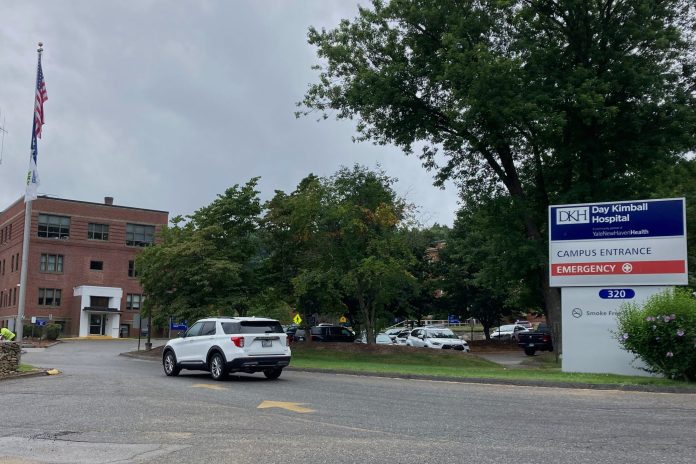
Day Kimball Hospital is nearby in Putnam, but it has faced recent financial challenges. Day Kimball’s CEO R. Kyle Kramer acknowledged that a Senate bill passed Tuesday — estimated to cut federal Medicaid spending in rural areas by $155 billion over 10 years — would further hurt his rural hospital’s bottom line. Roughly 30% of Day Kimball’s current patients receive Medicaid benefits, a figure that’s even higher for specific, critical services like obstetrics and behavioral health.
“An emergency means I’m 45 minutes to an hour away from the nearest hospital, and that’s a problem,” Shay said. And he and his wife wouldn’t be the only ones having to make that trip.
“You’ve got, I’m sure, thousands of people who rely on Day Kimball Hospital. If it closed, thousands of people would have to go to another hospital,” he said. “That’s a huge load to suddenly impose on a hospital system that’s probably already stretched thin.”
Experts say the bill’s $50 billion fund for rural hospitals isn’t enough
Rural hospitals have long operated on the financial edge, especially in recent years as Medicaid payments have continuously fallen below the actual cost to provide health care. More than 20% of Americans live in rural areas, where Medicaid covers 1 in 4 adults, according to the nonprofit KFF, which studies health care issues.
President Donald Trump’s $4.5 trillion tax breaks and spending cuts bill, which passed Thursday, would worsen rural hospitals’ struggles by cutting a key federal program that helps states fund Medicaid payments to health care providers. To help offset the lost tax revenue, the package includes $1.2 trillion in cuts to Medicaid and other social safety net programs — cuts they insist only root out fraud and waste in the system.
But public outcry over Medicaid cuts led Republicans to include a provision that will provide $10 billion annually to buttress rural hospitals over the next five years, or $50 billion in total. Many rural hospital advocates are wary that it won’t be enough to cover the shortfall.
Carrie Cochran-McClain, chief policy officer with the National Rural Health Association, said rural hospitals already struggle to break even, citing a recent American Hospital Association report that found that hospitals in 2023 got nearly $28 billion less from Medicaid than the actual cost of treating Medicaid patients.
“We see rural hospitals throughout the country really operating on either negative or very small operating margins,” Cochran-McClain said. “Meaning that any amount of cut to a payer — especially a payer like Medicaid that makes up a significant portion of rural provider funding — is going to be consequential to the rural hospitals’ ability to provide certain services or maybe even keep their doors open at the end of the day.”
Kentucky is expected to be hit especially hard
A KFF report shows 36 states losing $1 billion or more over 10 years in Medicaid funding for rural areas under the Republican bill, even with the $50 billion rural fund. No state stands to lose more than Kentucky.
The report estimates the Bluegrass State would lose a whopping $12.3 billion — nearly $5 billion more than the next state on the list. That’s because the bill ends Kentucky’s unique Medicaid reimbursement system and reduces it to Medicare reimbursement levels.
Kentucky currently has one of the lowest Medicare reimbursement rates in the country. It also has one of the highest poverty rates, leading to a third of its population being covered by Medicaid.
Kentucky Gov. Andy Beshear, a two-term Democrat widely seen as a potential candidate for president in 2028, said the bill would close 35 hospitals in his state and pull health care coverage for 200,000 residents.
“Half of Kentucky’s kids are covered under Medicaid. They lose their coverage and you are scrambling over that next prescription,” Beshear said during an appearance on MSNBC. “This is going to impact the life of every single American negatively. It is going to hammer our economy.”
Great Job Margery A. Beck, Susan Haigh, The Associated Press & the Team @ Fortune | FORTUNE Source link for sharing this story.
Canadian voters rejected MAGA-style culture wars and anti-LGBTQ+ panic, showing that when economic crises hit, scapegoating doesn’t sell.
Prime Minister of Canada Mark Carney talks to media at the end of an E.U.-Canada Summit on June 23, 2025, in Brussels, Belgium. (Thierry Monasse / Getty Images)
As Pride Month came to a close against a backdrop of globalbacklash to LGBTQ+ rights, Canada’s spring election delivered a rare counterpoint: Voters refused to take the bait.
Despite leading the polls, Conservative leader Pierre Poilievre not only lost the federal election, he failed to hold his seat. The message was unmistakable: When faced with real economic strain and imported culture war theatrics, Canadians chose practical policy over manufactured outrage.
This wasn’t just a political upset—it was a referendum on how voters respond to moral panic when cost-of-living crises dominate headlines.
In 2025, the Conservative campaign leaned hard into Make America Great Again (MAGA)-style rhetoric: Defund “woke” programs, attack trans rights, and promise a crackdown on diversity, equity and inclusion (DEI) initiatives. Poilievre’s allies included Elon Musk, Ben Shapiro and Jordan Peterson. He talked tough on cultural grievances. But he offered little on grocery bills, rent hikes or inflation.
Why does this matter? Because it punctures the illusion that scapegoating wins elections. Anti-LGBTQ+ panic has become a go-to strategy in conservative playbooks—not because gender issues threaten public order, but because they offer distraction. As gender theorist Judith Butler writes, panic around gender doesn’t reflect actual threats, but symbolically rallies voters around an imagined return to “traditional” norms. In moments of instability, targeting queer and transgender people allow political leaders to redirect attention from their own inability to materially improving people’s lives.
Moral panic, in other words, is a well-worn political smokescreen. But in Canada this year, voters didn’t fall for it.
Economic credibility—not imported outrage—decided the election. The political tide turned after Donald Trump’s second-term inauguration in January. His chaotic first 100 days unleashed a wave of instability. Tariffs on Canadian exports and energy triggered immediate price shocks. Trump mocked Canada as the “51st state,” dismissing sovereignty and ridiculing the former prime minister as “Governor Trudeau.” The impact was swift: By March, Trump ranked second only to affordability as a top concern among Canadian voters.
The Conservative campaign never adjusted. Instead, Poilievre doubled down. He pledged to defund public universities over “wokeness,” gut DEI programs and pass legislation targeting trans healthcare and school curricula. The platform was loud, polarizing and vague—and it left the center ground wide open.
Liberal competitor Mark Carney outpaced Poilievre on affordability and competence, winning over moderate voters unconvinced that culture wars could solve their daily economic struggles.
Carney’s recent unveiling of a housing and affordability plan—focusing on supply expansion, rental incentives and intergovernmental transfers—underscored what Poilievre’s campaign lacked: a concrete, material strategy to ease economic pressure. The contrast was decisive.
Canada wasn’t alone. Just five days later, Australians dealt a similar blow to right-wing leader Peter Dutton. Like Poilievre, Dutton leaned into imported U.S.-style culture war rhetoric, and he lost on it. The parallel underscores a broader pattern: When voters are economically squeezed, spectacle politics lose its grip.
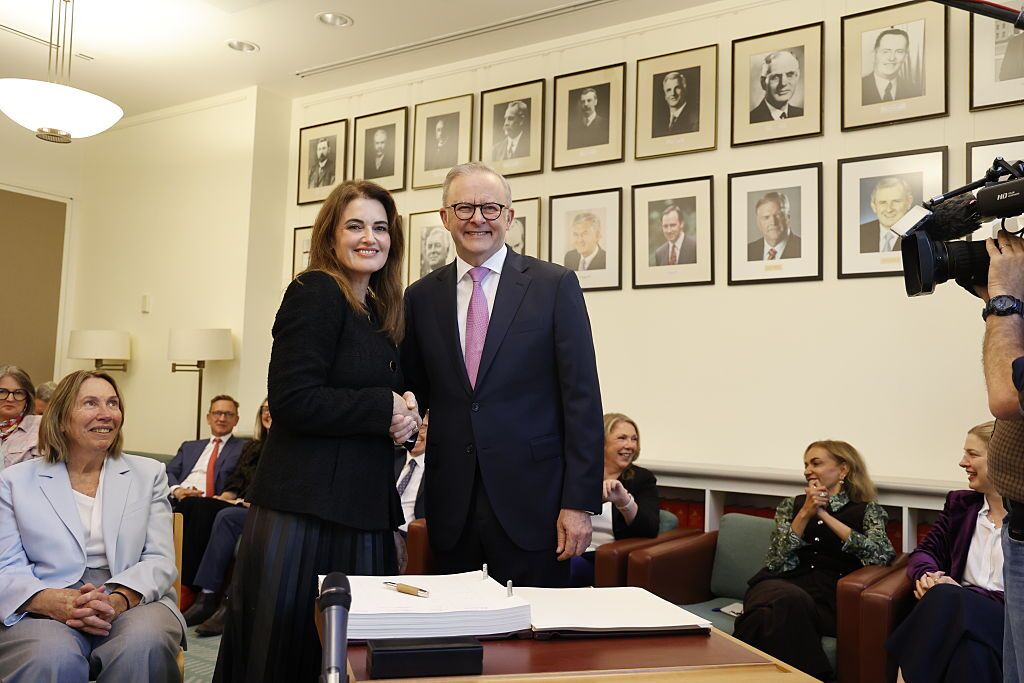
Peter Dutton, the leader of the Liberal Party and the Opposition, was defeated in his own seat of Dickson by the Labor challenger, Ali France—pictured here shaking hands with Anthony Albanese after signing the Labor Caucus book on May 9, 2025, in Canberra, Australia. (Hilary Wardhaugh / Getty Images)
In Canada, the rejection of gender panic during this election cycle offers more than symbolic reassurance—it signals that public tolerance is a ballot-winning move. Pride Month often amplifies the noise of anti-trans disinformation, yet Canadian voters cut through it. This wasn’t just a refusal to engage in imported outrage—it was a democratic reaffirmation that rights aren’t up for debate, even when fear is politically convenient.
Poilievre’s campaign, dubbed a “Maple MAGA” version of Trumpism, alienated moderates. It was grievance-driven, thin on substance and heavy on imported outrage. His fixation on divisive social issues made it harder to convince voters he could govern effectively. In the end, Canadian voters sent a clear signal—they’ll take affordability over fear politics.
At a time when liberal democracies from the U.K. to South Korea are seeing renewed assaults on LGBTQ+ rights, Canada’s election offers rare evidence that backlash isn’t inevitable. When cost-of-living pressures intensify, the politics of distraction lose their potency. The gender panic playbook didn’t just fail—it boomeranged.
As Argentina, Ireland and Norway head into national elections in the second half of 2025, Canada’s vote offers an early signal: Voters still care more about rent than rhetoric. And after Pride Month, that message matters more than ever—not just symbolically, but politically. It’s proof that inclusive democracy can win, even in anxious times.
Nationwide — Luis Alvarez, a 31-year-old man who helped a 9-year-old girl who was bitten by a shark, is now in ICE custody after being arrested for allegedly driving without a license. He now faces possible deportation.
On June 11, Leah Lendel, a 9-year-old girl, was bitten by a shark while on vacation in Boca Grande, Florida. Alvarez was one of three men who rushed to help her. Despite the danger, Alvarez jumped into the water and helped get Leah to safety before emergency crews arrived. The girl was airlifted to a hospital and had emergency surgery to save her hand, according to People.
Just days after the rescue, Alvarez was stopped by police in Immokalee, Florida. He was pulled over at night for driving without headlights. When asked for a driver’s license, he showed a work authorization document on his phone instead. Police found out Alvarez never had a valid U.S. driver’s license. He was arrested for driving without a license and taken to Collier County Jail.
Alvarez, born in Nicaragua, has been in the U.S. for about two and a half years. ICE later took custody of him because he entered the country illegally in December 2022. His arrest came through a local police partnership with Homeland Security. Bail is set at $150, and he is scheduled to appear in court on July 9.
Before this, Alvarez had several past arrests for driving without a license, mainly in Lee County, Florida. Despite the legal issues, people who helped at the shark attack praised his bravery. One witness said Alvarez dove deep underwater, not caring about the shark, to rescue Leah. Others called him a “real decent guy” for risking himself in the rescue.
Great Job Nina Deleon & the Team @ BlackNews.com Source link for sharing this story.
President Donald Trump speaks during the American 250 kickoff event on July 3, 2025, at the Iowa State Fairgrouds.
The Octagon likely is coming to the White House next year.
President Donald Trump plans to have the UFC hold a fight card at 1600 Pennsylvania Avenue in 2026 as part of the United States’ 250th birthday celebration.
The Republican president, who is close with UFC president Dana White, made the announcement on Thursday during an appearance at the Iowa State Fairgrounds in Des Moines.
Trump said, “Does anybody watch UFC? The great Dana White? We’re going to have a UFC fight. We’re going to have a UFC fight — think of this — on the grounds of the White House. We have a lot of land there.
“We’re going to build a little — we’re not, Dana is going to do it. Dana is great, one of a kind — going to be UFC fight, championship fight, full fight, like 20,000 to 25,000 people, and we’re going to do that as part of ‘250’ also.”
Trump has attended numerous UFC events, including UFC 314 at Miami in April, when he sat with White.
On the last night of the 2024 Republican National Convention, White made the introduction when the once and future president accepted his party’s nomination.
Trump said Thursday, “Every one of our national parks, battlefields and historic sites are going to have special events in honor of ‘America250.'”
–Field Level Media
Great Job & the Team @ Deadspin > Sports News Without Fear, Favor or Compromise Source link for sharing this story.
The Texas housing market continues to challenge sellers as inventory reaches its highest level in 14 years, according to new research from the Texas Real Estate Research Center.
High interest rates and economic uncertainty are keeping many buyers away, but some buyers are finding opportunities to lock in mortgage rates as low as 2.5%.
Several real estate agents say more people are exploring assumable mortgages. That’s when a buyer takes on the seller’s existing loan balance and the lower rate.
Homes for sale with low rates can be found through Roam. The company’s online description shows it helps manage the assumption process for a fee. It also allows you to search for homes in your desired area.
Dallas realtor Ben Wilson explained how he helped one Plano family buy a home with an assumable loan.
“So my buyer was able to secure a 2.8% loan just this year,” Wilson said. “Given that FHA loans are 6.5% right now, they save about $1,200 in their mortgage payment every month.”
Wilson says that it is a huge amount of savings.
Only government-backed loans are assumable, such as FHA, VA or USDA loans. Buyers still have to qualify and cover the gap between the loan balance and the sales price. Wilson’s clients had cash, but realtor Terry Hendricks said specialized lending is another option.
He said buyers are still just coming to the table with their loan payment and closing costs
“I have a list of about 400 homes here in the Dallas market that’s actively on the market right now with a government-backed loan,” Hendricks said.
FINDING ASSUMABLE MORTGAGES
If you want to find homes with assumable mortgages, you can ask your real estate agent to help you research. Some seller’s agents will advertise homes for sale by putting the assumable loan and rate in the listing. You can also search the website withroam.com.
You can put in your ZIP Code or city, and it will show you homes that are on the market, the assumable loan rates, and the difference in the mortgage amounts with the assumable rate versus the current rate. If you have questions about the process, experts recommend you discuss your unique situation with a real estate agent, mortgage lender, or another trusted advisor.
In May, Brazil’s Finance Minister Fernando Haddad flew to the U.S. to meet with executives from Amazon, Google, Nvidia, and Meta. His agenda: to pitch his country as the newest, most attractive data center hub in the region.
Haddad’s biggest selling point was sustainability. “We want the digital economy in Brazil to be simultaneously digital and green,” he said during a presentation at the Milken Institute Global Conference in Los Angeles.
The timing of Haddad’s tour was no coincidence: The country had just introduced its national data center policy, intended to lure Big Tech with tax breaks and renewable energy alternatives. Even before Haddad’s U.S. trip, tech giants like Microsoft and Amazon Web Services had signed multimillion-dollar contracts to build data centers in Brazil to meet the growing demand for artificial intelligence and cloud computing in Latin America’s biggest economy.
But with the new policy expected to draw more interest from global tech companies, environmental regulators and experts are raising the alarm about their potential impact, especially in fragile areas, including a city that was hit by record floods last year.
Data centers are “putting significant pressure on our energy system and could have a major environmental impact, especially considering the locations where they’re being installed,” Andréa Santos, an engineering professor at the Federal University of Rio de Janeiro, told Rest of World.
Brazil is home to more than 180 data centers, putting it ahead of other large economies in the region: There are nearly 60 data centers in Mexico and fewer than 40 in Argentina. About one-third of Brazil’s data centers are located in São Paulo, the biggest city, which suffered an acute water crisis about a decade ago. At least 41 of the data centers are considered either large or hyperscale, meaning they occupy enough space to house thousands of servers and other equipment.
Brazil’s data center market is expected to be worth nearly $6 billion by 2030, according to a recent study from Arizton Advisory & Intelligence, a market research and consulting firm. The country’s geography lends itself to the particular demands of data centers, Luis Tossi, vice president of the Brazilian Data Center Association, an industry body, told Rest of World.
“We have available land, abundant electric and renewable energy, and a skilled workforce,” he said. “We are in a condition as a country to attract this kind of investment.”
Fernando Haddad, Brazil’s finance minister, speaks during an interview at the Finance Ministry in Brasilia, Brazil, March 27, 2025. Arthur Menescal/Bloomberg/Getty Images
Since 2024, the federal government has intensified its efforts to attract tech infrastructure, introducing the Brazilian Artificial Intelligence Plan, which outlines $4.2 billion in targeted investments. Also last year, the national development bank, BNDES, rolled out a $367 million credit line to support the expansion of data centers.
The efforts have paid off. Last year, AWS announced an investment of $1.8 billion to expand its data center infrastructure in Brazil through 2034. In September, Microsoft pledged to invest $2.7 billion in Brazil over three years to boost its cloud and artificial intelligence infrastructure.
The tax break proposed in the new national data center plan could attract around $356 billion in investment over the next decade, according to some estimates, with the country’s installed capacity rising to 8 gigawatts from around 1 gigawatt currently.
“We came to understand that Brazil’s greatest potential lies in positioning itself as a hub for clean data centers,” Igor Marchesini, special adviser to the Ministry of Finance, which is involved in the drafting of the national data center policy, told Rest of World. “No other country in the world has the conditions to compete at scale on this front.”
But environmental advocates say the plan to turn Brazil into a data center hub does not consider the long-term impacts on the country’s ecosystem.
We have to take into account that we’re living in the midst of a climate crisis.
While the draft legislation for the national data center plan has not yet been submitted to Congress, over 80 meetings involving at least 200 federal officials have already taken place, according to an investigation by The Intercept Brazil. No officials from the environment ministry were present at any of these gatherings.
The Ministry of Environment is “taking part in the ongoing discussions within the federal government regarding the forthcoming national data center policy,” a spokesperson told Rest of World. Asked about environmental safeguards, the spokesperson said data centers “are subject to the current environmental regulatory framework, including the National Environmental Policy, which requires environmental licensing for activities that are potentially polluting or that use natural resources.”
Industries considered to be polluting, such as oil, energy, and metal, have a special licensing regulation. Data centers are currently not on this list.
In May, the nongovernmental group Brazilian Institute for Consumer Protection requested a copy of the data center policy that Haddad presented to U.S. investors, from both the Ministry of Finance and the Ministry of Development, Industry, Trade and Services. Both ministries refused, saying the document wasn’t finalized yet.
“We’ve been watching with great concern how this process has been unfolding, how it often masks greenwashing practices, and how these narratives are being used in the name of a so-called energy transition,” Julia Catão, coordinator of the sustainable consumption program at the Brazilian Institute for Consumer Protection, told Rest of World.
The Ministry of Finance will make the plan public once it is final, Marchesini said. The Ministry of Development, Industry, Trade and Services did not respond to queries from Rest of World.
Meanwhile, Brazilian company Scala Data Centers has set its sights on Eldorado do Sul, in the south of the country — a region that suffered widespread destruction last year from unusually powerful floods. With an initial investment of $550 million, the project is expected to become the largest digital infrastructure complex in South America.
Scala Data Centers and the local government have framed the project as an example of resilience and innovation. But environmentalists are concerned it will exacerbate the environmental devastation of the region, which has yet to fully recover.
“We have to take into account that we’re living in the midst of a climate crisis, which leaves us with very little room for error,” Heverton Lacerda, president of the Gaúcha Association for the Protection of the Natural Environment, told Rest of World. Data centers could strain the fragile power grid in Eldorado do Sul, he said.
The Scala Data Centers infrastructure is expected to operate at a capacity of 4.75 gigawatts initially — equivalent to the energy requirements of around 40 million people. The state of Rio Grande do Sul, where it is slated to be built, has a population of around 11.2 million.
Scala Data Centers did not respond to an interview request from Rest of World.
Worldwide, there is growing pushback against the large quantities of water needed to cool data centers, as well as their broader environmental impact. The International Energy Agency estimates that electricity consumption from global data operations — including storage facilities and machine learning clusters — could more than double by 2026.
About 89% of Brazil’s electricity now comes from renewable sources — primarily hydropower — though recent droughts in the southeast region have stretched the system. The cooling systems in large data centers, especially those relying on older air-liquid hybrid technologies, can consume millions of liters of water per day, particularly in hot climates.
The national data center policy is set to be submitted to Congress in the coming weeks. Meanwhile, uneasiness over the lack of transparency around it is growing.
“Many of the debates are taking place behind closed doors,” said Catão. “We had hoped that civil society would be heard, but that’s not what’s happening.”
Great Job Jorge C. Carrasco & the Team @ Rest of World – Source link for sharing this story.
The Velvet Sundown, a psychedelic rock band that has amassed over 850,000 monthly listeners on Spotify, has been making headlines this week because it doesn’t actually exist. None of the group’s four named musicians have given any interviews, and all photos posted on their social media accounts appear to have been made with AI, prompting accusations that their totally boilerplate music, too, is the product of generative AI.
On Wednesday, Rolling Stone published an interview with Andrew Frelon, who presented himself as a spokesperson and “adjunct” member of the band and claimed that the whole project was a deliberate hoax. “It’s trolling. People before, they didn’t care about what we did, and now suddenly, we’re talking to Rolling Stone, so it’s like, ‘Is that wrong?’” he explained. Turns out Frelon isn’t affiliated with the Velvet Sundown at all, according to the band’s Spotify bio.
In a message to Rolling Stone, the X account that’s linked to the “real” Velvet Sundown’s Spotify, wrote: “We understand the intrigue our project inspires — and we’re not here to dispel mystery. But we are here to correct the record….The Velvet Sundown is a multidisciplinary artistic project blending music, analog aesthetics, and speculative storytelling. While we embrace ambiguity as part of our narrative design, we ask that reporting on us be based on verifiable sources — not fabricated accounts or synthetic media.”
Frelon, who’s using a pseudonym, went on to write a Medium post about the situation. He explained that he specializes in generative AI systems “to uncover vulnerabilities in order to fix them” and further described himself as “an artist who has gained recognition for using generative AI for creative projects, some of which included using generative AI to generate and seed fake historical artifacts online in support of multiple interlocking art hoaxes.” Seeing all the stories TVS generated, he said, “Suddenly, I had the crazy idea, what if I inserted an extra layer of weird into this story? What if I re-purposed an old Twitter account I’d barely used for another project, and made that into an ‘official’ looking account for TVS?”
Frelon turned his idea into an opportunity for trolling and harassing music writers. In his post, he concluded: “I see what I have done as a kind of red-teaming of the media & platform ecosystems at large. I write this with the intent not of shaming anyone named in it, but in the hopes of inspiring a more careful approach to prevent the publication of blatantly false information by people with worse or more dangerous agendas than my own foolish experiment.” Feeling inspired, anyone?
Great Job Konstantinos Pappis & the Team @ Our Culture Source link for sharing this story.