On a sweltering June day, an artificial intelligence-powered humanoid robot built by Chinese firm Ubtech entertained a crowd of hundreds waiting to enter the China pavilion at the Osaka World Expo.
Robotics is just one of several industries where Chinese companies are challenging their Western rivals — Ubtech’s latest model can speed-walk, scan barcodes, and handle receptionist tasks. But rather than presenting a cold futuristic ambience, the design of the 3,500-square-meter pavilion embraced traditional materials and culture: bamboo panels etched with poetry, wooden displays, and augmented reality experiences where visitors can toss virtual snowballs and rake autumn leaves.
The serene setting highlighted Chinese prowess and masked any potential tension regarding tech firms entangled in U.S. sanctions and the broader geopolitical rivalry over AI.
Staff throughout the pavilion used handheld radios from Hytera, a Chinese walkie-talkie maker that has admitted conspiring to steal trade secrets from Motorola and faces a potential injunction restricting global sales. Hytera proudly demonstrated its products at the expo, emphasizing that their durability and extended battery life can play a role in protecting public safety.
An interactive AI display, featuring the Monkey King from the classic tale Journey to the West, showcased technology from iFlytek, a partly state-owned company making voice recognition software and AI translation tools. The U.S. had sanctioned iFlytek in 2019 and 2021 for “actively cooperating” in Beijing’s repression of ethnic and religious minority groups and working against U.S. foreign policy interests. A senior executive said the sanctions have hurt global partnerships, and that iFlytek is seeking business in Japan. In 2019, China’s foreign ministry called the sanctions interference and denied human rights abuses.
More broadly, Chinese tech companies face mounting barriers from tariffs and expanded export controls on microchips, aimed at curbing their ability to advance in AI and high-performance computing. In recent years, Chinese firms have rapidly scaled their businesses in non-Western markets, according to an Atlantic Council study.
Rest of World visited the Osaka World Expo to understand how Chinese technology companies are marketing themselves to a global audience.
There are long lines for the China pavilion at the 2025 Osaka World Expo.
A replica bronze mask from China’s Sanxingdui Museum and wooden reliefs on Japan-China friendship are among the pavilion’s highlights — though the timeline omits key conflicts from the late 19th to mid-20th century.
Ubtech’s Walker C advanced robot entertains crowds waiting to enter the China pavilion. The robot can run, maneuver around obstacles, and interact in multiple languages.
Inside, laser video projections display Chinese artwork, calligraphy, digital scrolls, and landscapes, using technology from Chinese firm Appotronics.
Participants at the China pavilion include Hytera and iFlytek.
Visitors interacted with astronauts on China’s Tiangong space station.
One of the most popular exhibits was a deep-sea exhibition projection by Appotronics, where visitors could tap the wall to interact with virtual Chinese coastal sea life.
On the second floor, an AI avatar of Sun Wukong, the Monkey King from Journey to the West, responded to questions in several languages.
Visitors queue up to view soil samples collected from the near and far sides of the moon by China’s Chang’e 5 and Chang’e 6 lunar missions.
In the pavilion theater, visitors watch a film featuring scenes of Chinese food delivery workers navigating city streets and scientists working late into the night.
The China pavilion occupies a prime spot near the center of the expo. It draws about 8,000 visitors a day on weekends and 6,000 on weekdays, organizers say.
Corridors in the pavilion are lined with large bamboo panels engraved with ancient Chinese poetry and classical literature.
A private group chat of Democratic Party operatives and crypto industry advocates has been secretly coordinating to push Democratic senators to support major cryptocurrency-friendly legislation up for a vote on Tuesday. In the chat, they admitted that while “Trump’s corruption is manifesting dramatically in crypto,” it would be “political suicide” for Democrats to reject doing the industry’s bidding, even if they have reservations about the impacts on consumers and the financial system.
In the Signal chat, the contents of which were viewed by the Lever, influential Democratic figures noted they “need to win the next election, which means we can not afford to alienate a very vocal and wealthy group of donors.”
To provide political cover for supporting the crypto industry’s legislative giveaway, group chat members suggested pro-crypto allies in the Democratic caucus could introduce symbolic anti-corruption amendments to the final bill prohibiting President Donald Trump and elected officials from profiting from cryptocurrencies knowing the effort would be “DOA,” or dead on arrival, since the language would likely be voted down by Republicans.
According to a new financial disclosure, Trump has so far netted nearly $60 million from the launch of various crypto coins through his company World Liberty Financial. He has also launched his own stablecoin that an Abu Dhabi investment firm plans to invest $2 billion in.
The internal text messages in the chat, named “Dem Crypto Policy Roundtable,” offer a behind-the-scenes look at how crypto interests are working closely with top Democratic Party insiders just three years after the crypto industry was in a free fall amid multiple criminal investigations and popular cryptocurrencies collapsing.
These hidden group chats, whose messages are usually set to disappear after a short time frame, are increasingly becoming a key communication channel between Washington and Silicon Valley, where influence peddling or even undisclosed lobbying may take place outside the confines of mandatory public disclosures.
The main bill that the chat members are pushing for, dubbed the GENIUS Act, is set for a final vote on Tuesday afternoon, and appears poised to pass.
According to critics and Democrats on the Senate Banking Committee, the legislation would inundate the banking system with volatile digital assets that have experienced significant upheaval in recent years.
The GENIUS Act aims to establish a light-touch legal framework for stablecoins, a cryptocurrency designed to hold a stable one-to-one value with the US dollar. However, those assets have collapsed in the recent past after their shaky financial backing led to multiple bank failures.
The bill could even allow social media companies and major brands to create their own currencies, which would force users to pay for online goods and services in a billionaire’s Monopoly money. The bill also includes a special carve-out requiring stablecoin owners to be made whole before other customers in the event of a bank’s insolvency.
But if Senate Democrats oppose the legislation, tech industry representatives in the chat were blunt about the repercussions.
“If Dems bail on this [bill], they will get 0 dollars going forward,” said Avichal Garg, a managing partner at the venture capital firm Electric Capital, which focuses on digital asset technology like cryptocurrency. “It would be political suicide for them not to support it.”
The Dem Crypto Policy Roundtable group chat includes over a hundred members on both sides of Washington, DC’s revolving door, ranging from venture capitalists, lobbyists, and lawyers for major crypto companies to former Capitol Hill staffers and members of the Democratic National Committee.
Among the more active members of the group is Justin Slaughter, the current vice president of regulatory affairs at crypto investment firm Paradigm, which recently hired a former staffer for Senate Minority Leader Chuck Schumer (D-NY).
Before entering the private sector, Slaughter worked as a staffer at the Securities and Exchange Commission and the Commodity Futures Trading Commission, and on Capitol Hill as general counsel to Sen. Ed Markey (D- MA).
Another member is Sheila Warren, senior global policy adviser at the trade association Crypto Council for Innovation, which has close ties to Schumer’s office. In January 2024, the trade association hired Ryan Eagan, a ten-year veteran from Schumer’s office. Eagan is the council’s top lobbyist for crypto issues so far this year.
In August of last year, Warren hosted a pro-crypto event with Schumer to raise money for former Vice President Kamala Harris’s presidential campaign. At that event, Schumer vowed to pass legislation aiding the crypto industry, which could be accomplished with the passage of the GENIUS Act.
Another active member of the chat is Austin Campbell, a professor at New York University’s Stern School of Business who testified before Congress in February advocating for a more lenient regulatory framework for cryptocurrencies and stablecoins.
The GENIUS Act wasn’t the only legislative priority brought up in the Signal chat. Members also discussed a companion “market structure” bill known as the Clarity Act, which would ensure that crypto is regulated by the Commodity Futures Trading Commission, a fairly weak and understaffed regulatory body, instead of by the far more robust Securities and Exchange Commission, which oversees financial regulation across the economy.
Last month, sixteen Democrats joined with Republicans to advance the GENIUS Act to a full Senate vote now scheduled for Tuesday. But in the past several weeks, the bill’s passage has been held up by backroom negotiations over whether to allow for votes on amendments to the final bill.
One potential amendment would be an anti-corruption measure that would add guardrails prohibiting the president, vice president, members of Congress, and other federal employees from profiting off stablecoins and other cryptocurrencies.
One member of the chat admitted the current bill was rife with loopholes. “I’d rather we stop the actual corruption,” said Will Schweitzer, a pro-crypto Democrat who ran against Sen. Kirsten Gillibrand (D-NY) in the 2024 Democratic primary election.
Jason Gottlieb, a defense lawyer at the New York law firm Morrison Cohen representing crypto companies, responded that regardless of such concerns, Democrats needed to back the legislation to protect their political coffers.
Democrats “need to win the next election, which means we can not afford to alienate a very vocal and wealthy group of donors,” noted Gottlieb.
“The time to do this is now and make fixes later,” said another member of the chat.
Slaughter added that if Democrats tried to kill the bill, it would likely be seen as “[Sen. Elizabeth] Warren and her merry band successfully stopped crypto and showed Dems are against crypto.” A leader of the progressive wing of the Democratic Party, Warren (D-MA) has been a staunch critic of the cryptocurrency industry’s practices and opposes the GENIUS Act.
“It’ll be the end of any efforts to get Dems to be open to crypto,” wrote Slaughter. “What a lot of Dems in the Senate realize is this is their best chance to break away from [Sen. Warren] setting [financial regulation] policy for the rest of the party.”
In the chat, Sheila Warren from the Crypto Council for Innovation acknowledged that corruption and crypto go hand-in-hand.
“The point is that Trump’s corruption is manifesting dramatically in crypto, so if you’re going to campaign on crypto, you can’t ignore that,” she wrote to the group. “If I were an ordinary Dem running in the midterms, I personally would stay away from crypto apart from being vaguely supportive — unless I were on a committee of jurisdiction and have to have a [point of view]. And if the latter, I would flag the corruption and be a pro-crypto anti-corruption candidate.”
One compromise solution some members in the group suggested was for Democratic Senators to offer up anti- corruption amendments to the GENIUS Act, knowing they would likely be for show.
“Anti-corruption language that targets Trump interest[s] will be doa,” said Gottlieb, the defense lawyer for digital asset and blockchain technology companies. “This is what it’s like to be in the minority party across the board, sadly.”
“Nobody is going to get primaried because they voted for GENIUS,” added Warren. “With or without the anti- corruption amendment.”
Others in the chat wrote that corruption didn’t matter to them, outside of how Democrats could use it as a political tool.
“I disagree that the corruption thing matters at all. Everyone knows Trump is corrupt . . . corruption is a red herring,” said Garg, the venture capitalist at Electric Capital.
“Agree,” Warren responded. “But as in any crypto group chat, we love to pretend there is no broader context.”
Some members of the chat grappled with the optics of supporting legislation so clearly aligned with Trump’s crypto allies. “There is a massive group who wants to stand up to Trump in any way, shape, or form,” wrote Schweitzer. “The industry did the wrong thing by aligning with him and you probably know as well as I that many want to bail on him.”
Campbell, the NYU professor, disagreed, saying Democrats who vote against the bill would be seen by voters as “being pro-bank” and that “the idea that you can tie this explicitly to Trump corruption is simply wrong.” Being reflexively anti-Trump, in his view, makes the President’s political position “stronger, not weaker.”
Campbell told the Lever that his thoughts on the matter “are pretty public on Twitter/X,” Elon Musk’s social media site.
Other members of the group chat did not respond to a request for comment before publication, but wrote on the chat that they had been contacted by a reporter.
After that, the tone of some of the chat’s messages shifted. “For the record, Trump is a grifter and so are his sons,” wrote one member. “Print that.”
Great Job Freddy Brewster & the Team @ Jacobin Source link for sharing this story.
ProPublica is a nonprofit newsroom that investigates abuses of power. Sign up to receive our biggest stories as soon as they’re published.
What Happened: A monitor appointed by a federal court has found that a New York City Police Department unit has been unjustly stopping and searching New Yorkers, almost all of them Black and Hispanic men. The report on the NYPD’s Community Response Team echoes a recent ProPublica investigation that found the unit, championed by Mayor Eric Adams, has been ridden with abuses.
The federal monitor found that while the CRT was initially created in the early days of the Adams’ administration to focus on so-called quality-of-life issues such as illegal motorbikes, its officers have more recently been “stopping, frisking, and searching unconstitutionally.”
What They Said: In a sample of body-worn camera footage, the monitor found that 41% of stops, searches, and frisks by CRT officers were unlawful, a far higher percentage than with other NYPD units. What’s more, while officers are required to document such stops, which the department then releases as public data, the report found that officers often failed to do so, and even when they did there was a “lack of meaningful review” by supervisors.
As ProPublica previously reported, that behavior goes back to at least 2023, when an NYPD audit found officers were wrongfully stopping New Yorkers and failing to log the incidents. Soon after the audit, the mayor took to Instagram. “Turning out with the team,” he wrote, showing a photo of him wearing the CRT’s signature khaki pants.
The federal monitor had other striking findings. For instance, it found that “97% of the individuals stopped, frisked, and searched were Black or Hispanic men.”
It also found, as ProPublica previously reported, that the NYPD had not been straightforward about the CRT with the monitor itself. Department officials had initially told the monitor that the CRT was just a “pilot program” that already ended, only for the monitor to later learn the team was here to stay and actually expanding.
Background: Our March investigation detailed a wide range of troubling behavior by CRT officers that alarmed NYPD leaders. In the fall of 2022, department lawyers and others warned that highlight videos of the CRT that the team posted on social media showed problematic conduct. Other incidents included a CRT commander who punched a driver, another commander who shoved a pedestrian into a car window and a third officer who drove into a motorbiker, ultimately killing him.
Over the past two years, New Yorkers have filed at least 200 complaints alleging improper use of force by CRT members, according to Civilian Complaint Review Board records. Another NYPD team with a similar size and mandate has had about half as many complaints.
Adams’ connection to CRT has been so close, former officials said, that the mayor was given private access to a live feed of the unit’s body-worn cameras. This year, he chose one of the team’s leaders, Kaz Daughtry, to be deputy mayor of public safety.
Why It Matters: The federal monitor for the NYPD was created a dozen years ago after a court found that the department had been engaging in widespread unconstitutional stop-and-frisks, a practice overwhelmingly focused on Black and Hispanic men. The seminal ruling imposed court oversight — the creation of the monitor’s office — of the country’s largest police department. The monitor in turn files regular progress reports.
The monitor’s latest report was filed with Judge Analisa Torres, who oversees the case and has the power to impose fixes. But whatever Torres does, the monitor’s findings make clear that the problems identified by the court all those years ago still persist.
Former NYPD Chief Matthew Pontillo, who wrote the 2023 audit of the CRT, said that the conduct of the team may actually be worse than what’s described in the monitor’s report, noting that the recent investigation relied on body-worn camera footage to examine officers’ conduct. In his own review, Pontillo had found that CRT officers were often not turning on their cameras to fully capture incidents.
Response: The mayor’s office declined to answer ProPublica’s questions and instead suggested contacting the NYPD. The department has not replied to our questions.
Adams has previously defended the CRT. Asked about the unit at a mayoral press conference this spring, Adams said: “CRT is here. I support all my units. And if they don’t all stand up and do the job the way they’re supposed to do, those who don’t will be held accountable.”
The NYPD has also defended the CRT’s work and touted the unit’s confiscation of illegal motorbikes and ATVs.
Great Job by Eric Umansky & the Team @ ProPublica Source link for sharing this story.
This story was part of a special Juneteenth project originally published in 2022 with Vox that explored the ongoing struggle for freedom for Black Americans.
As the Juneteenth holiday approaches, you’ll start to see various symbols of Blackness across the country. Front lawns, apartment balconies, and clothing with the pan-African flag, “Black Power” fist, and other celebratory symbols will be everywhere. But did you know there’s a specific flag for Juneteenth?
In fact, it has a backstory that goes back to the late 1990s. Capital B spoke with Ben Haith, the flag’s creator, and others to learn more about its history and impact.
The history
Haith, a community organizer and activist known better as “Boston Ben,” created the flag in 1997. In an interview with Capital B Atlanta, Haith said once he learned about Juneteenth, he felt passionately it needed representation.
“I was just doing what God told me,” Haith said. “I have somewhat of a marketing background, and I thought Juneteenth, what it represented, needed to have a symbol.”
Haith wasn’t impressed with the initial concept, but every Juneteenth holiday he would raise the flag near his son’s middle school in Roxbury, a majority Black community in Boston.
After getting his inspiration for the flag, he knew which colors and symbols he wanted in the flag — he just needed to finalize it. That’s when he met illustrator Lisa Jeanne-Graf, who responded to an ad in a local newspaper and finalized the flag in 2000.
The design elements
The colors
Juneteenth is often associated with red, green, and black: the colors of the pan-African flag. However, those aren’t the colors of the Juneteenth flag. The banner shares the colors of the American flag: red, white, and blue. In the past, Haith has said it was a purposeful choice — a reminder that Black Americans descended from slaves are exactly that: American.
“For so long, our ancestors weren’t considered citizens of this country,” Haith said. “But realistically, and technically, they were citizens. They just were deprived of being recognized as citizens. So I thought it was important that the colors portray red, white, and blue, which we see in the American flag.”
Steven Williams, the president of the National Juneteenth Observance Foundation, agreed with the sentiment.
“We’re Americans of African descent,” Williams said. “[The National Juneteenth Observance Foundation’s] mission statement is to bring all Americans together to join our common bond of freedom.”
There’s been some debate about whether the Juneteenth flag is the most appropriate symbol for the holiday. Haith said he understood why people could have some hesitancy around commemorating the freedom of slaves by using a red, white, and blue flag, which some see as a tribute to the oppressors of Black Americans.
“Some of us were raised to recognize the American flag, we salute the American flag, we pledged allegiance to the American flag,” Haith said when asked of the skepticism around the flag he created. “We had relatives who went to war to fight for this country. We put a lot into this country, even when our ancestors were enslaved. They worked to help make this country an economic power in the world.”
The star
The star in the middle of the flag has a dual meaning. On June 19, 1865, Black slaves in Galveston, Texas, were informed of the Emancipation Proclamation, President Abraham Lincoln’s declaration of the freedom of enslaved people. The star on the Juneteenth flag is meant to represent Texas as the Lone Star state, but also the freedom of enslaved citizens.
Williams also spoke of the use of stars in helping slaves escape to freedom.
“When people were escaping down the Underground Railroad …they used stars to navigate where they were at, when they were going up and down,” he said.
With its dual meaning, it’s meant to represent the role that Texas plays in the history of Juneteenth, but also as another reminder that Black people are free.
The outline around the star and the arch
The outline was inspired by a nova, which is an explosion in space that creates the appearance of a new star. In this instance, it represents both slaves being free and a new beginning for Black Americans, Haith said.
The bottom half of the flag is red and shaped in an arch, which has similar meaning to the white outline around the star. The curve is meant to represent a “new horizon.”
Williams hopes the design reminds people to keep in mind that new beginnings take effort.
“I tell young people, ‘You are free,’” he said. “You might have obstacles, you might have hurdles, but you are free. … And you need to exercise that freedom, which is liberty.”
The timing
Juneteenth is now a federal holiday, nearly 200 years after slaves in Texas were informed of their freedom. The change, signed into law by President Joe Biden in 2021, came at the behest of demands for racial progress following the police murder of George Floyd in Minneapolis. Cities across the country were forced to reckon with calls to remove and rename monuments and institutions honoring Confederate leaders of the past.
In Richmond, Virginia, a capital of the former Confederacy, monuments of Confederate generals that were centuries old were dismantled after protester demands across the country. In metro Atlanta, there is an ongoing debate around the removal of Confederate leaders etched on the side of Stone Mountain. It is said to be the largest monument to the Confederacy in the world.
In America, the Southern Poverty Law Center estimates that at least 160 Confederate symbols were dismantled in 2020.
Individual states started to recognize Juneteenth as an official holiday prior to Biden’s declaration. The first was Texas in 1980, and more states followed suit in 2020.
Theo Foster, a professor of African American History at the University of Louisiana at Lafayette, noted that symbols celebrating Black pride are important, but they’re not enough.
“We tend to just hold on to symbols and let the material go,” he said. “That’s where I’m hypercritical of progress narratives, and flags, and 1619 projects, because we don’t get to that point of where the rubber meets the road where the symbols meet the experience of Black boy joy or Black girl magic.”
The banner’s impact
Williams recognizes the flag as a larger part of his organization’s decades-long campaign to make Juneteenth a national holiday. The National Juneteenth Observance Foundation has been on the front lines of the fight to have Juneteenth nationally recognized since its founding in 1997. Haith himself is a member.
Foster says he sees the Juneteenth flag as an attempt to honor Black Americans’ enslaved ancestors.
“Racism exists, anti-Blackness exists. How do we respond to that problem?” he said. “I think the Juneteenth flag is an attempt to respond to that harm that is ongoing. I think people are right to be critical of it, but also to be in conversation of what’s useful about it.”
Haith said he’s been overwhelmed by the fact that Juneteenth is now a federal holiday, and feels honored when people use the flag.
“I believe we represent our ancestors,” Haith said. “When we celebrate, we’re celebrating for them, and we’re celebrating for the future of our people. The flag represents the people of the past, it represents us, and it will represent the people in the future.”
Great Job Kenya Hunter & the Team @ Capital B News Source link for sharing this story.
From coast to coast, millions gathered for the No Kings protests—dwarfing Trump’s birthday parade with signs that mocked authoritarianism and championed democracy.
Thousands of No Kings protests swept across the United States on Saturday, June 14. The protests intentionally coincided with a lavish, Trump-ordered U.S. Army 250th anniversary parade, Flag Day and the president’s 79th birthday.
From big cities, to small rural towns, representing every corner of the country, between 4 and 6 million people in more than 2,000 locations attended No Kings protests across the country, making it one of the largest national protests in U.S. history.
Meanwhile, in Washington, D.C., Trump’s military parade was “underwhelming,” according to reporters at The New York Times. According to the Associated Press, attendance fell far short of the expected 200,000.
At the No Kings protests, signs criticized many of Trump’s policies, including mass deportations of immigrants without due process; ongoing efforts to dismantle the civil service and weaken government agencies; attacks on academia and more.
“Today what I saw was a boisterous, peaceful display of First Amendment rights,” Ezra Levin, co-founder and co-executive director of the nonprofit Indivisible, told NPR.
Here are some of our favorite signs from those “boisterous” protesters.
West Coast
A reference to the right-wing rallying cry against Black Lives Matter, this important sign draws attention to the devaluation of immigrants and other groups by the current administration. Laid over a Mexican flag, it reminds viewers of the attacks immigrants face, which are often life-threatening. (Jay L Clendenin / Getty Images)
Since Musk accused Trump of affiliation with notorious child sex offender and sex-trafficker Jeffrey Epstein, there has been renewed focus on the files and Trump’s history of alleged sexual assault. (Emersen Panigrahi)
Ms. research editor Tory Davis (far left) in the Los Feliz neighborhood of Los Angeles. (Instagram)
Downtown Los Angeles. (Jay L Clendenin / Getty Images)Los Angeles. (Ali Matin / Middle East Images and AFP via Getty Images)Downtown Los Angeles. (Jay L Clendenin / Getty Images)Los Angeles. (Ali Matin / Middle East Images via AFP)Los Angeles. (Jason Armond / Los Angeles Times via Getty Images)
South
Midwest
Opinion: Trump hates it but Americans are very much united. No King protests proof. | Opinion https://t.co/Bm6eRHwNKG
New York City. (Selcuk Acar / Anadolu via Getty Images)New York City. (Michael M. Santiago / Getty Images)New York City. (Pablo Monsalve / VIEWpress via Getty Images)
Roxana Behdad is an editorial intern for Ms. and a rising senior at Cornell University, majoring in political science and minoring in creative writing. Her specific interests include political and feminist theory.
Ava Blando is a guest writer and Editorial Intern with Ms. She is currently majoring in Government at Smith College with a Concentration in Community Engagement and Social Change and a Certificate in Reproductive Health, Rights, and Justice. Ava is an aspiring impact litigator with experience in state and federal policy and government, nonprofit administration, environmental organizing, and journalism. In her free time, she enjoys songwriting and playing guitar.
Welcome back to World Brief, where we’re looking at deadly strikes between Israel and Iran, day one of meetings at the G-7 summit, and a U.S. immigration crackdown.
Sign up to receive World Brief in your inbox every weekday.
Sign up to receive World Brief in your inbox every weekday.
By submitting your email, you agree to the Privacy Policy and Terms of Use and to receive email correspondence from us. You may opt out at any time.
Attacks on Tehran
Airstrikes lit up the Israeli and Iranian skies on Monday, marking the fourth straight day of heavy bombardments between the two adversaries. Although foreign leaders are demanding that both sides de-escalate immediately to avoid an all-out war, Israel and Iran refuse to come to the negotiating table. Israel is “changing the face of the Middle East,” Israeli Prime Minister Benjamin Netanyahu said during a Monday press conference.
Israel has continued to target Iran’s nuclear and military infrastructure, including major uranium enrichment facilities as well as top Iranian leadership. According to Israeli military spokesperson Brig. Gen. Effie Defrin, Israel has destroyed more than 120 surface-to-surface missile launchers in central Iran since airstrikes began on Friday as well as 10 command centers in Tehran allegedly belonging to the country’s elite Quds Force.
Israeli Defense Minister Israel Katz said on Monday that Israel is also attacking “regime targets and security infrastructures in Tehran,” signaling a potential regime-change focus. Israel issued its first evacuation warning for part of the Iranian capital on Monday, affecting some 330,000 people. Among Monday’s targets, Israel confirmed that it had hit the Tehran headquarters of Iran’s state media broadcaster. The attack occurred while a news anchor was live on air and briefly halted the broadcast, though programming resumed shortly after. Israeli forces claimed the facility was a “communication center” being used by the Iranian military “under the guise of civilian activity,” but they did not provide evidence for the claim. Before the strike, Katz had warned that the “mouthpiece of Iranian propaganda and incitement is about to disappear,” adding that “we will strike the Iranian dictator everywhere.” A spokesperson for Iran’s foreign minister called the attack a “war crime.”
In retaliation for the Israeli campaign, Iran has fired around 370 ballistic missiles and hundreds of drones at Israel over the past four days, including another wave of strikes on Monday, killing at least eight people and bringing the total death toll in Israel since last Friday to at least 24, with nearly 600 others injured, according to the Israeli prime minister’s office. Israeli attacks on Iran have killed more than 220 people since the strikes began, according to Iranian state media.
Iran reportedly told mediators Qatar and Oman on Sunday that it will not begin cease-fire negotiations with Israel or return to nuclear negotiations with the United States while Israeli attacks continue.
“It takes one phone call from Washington to muzzle someone like Netanyahu,” Iranian Foreign Minister Abbas Araghchi wrote on X on Monday. He warned the United States against getting involved in the conflict, saying it will destroy any prospect of a nuclear deal and could have dangerous consequences for regional security. And he vowed to continue to “pummel” Israel until all military actions stop.
Israeli Strategic Affairs Minister Ron Dermer said on Monday that Israel will pursue its military offensive against Iran regardless of whether Washington holds nuclear negotiations with Tehran.
European leaders who are in Canada on Monday for the G-7 summit are reportedly drafting a statement calling for both Israel and Iran to cease their assaults. The draft acknowledges that Israel has the right to defend itself and that Iran cannot be allowed to obtain a nuclear weapon. However, CNN reported that, according to a source familiar with the process, U.S. President Donald Trump is not expected to sign the joint declaration.
Asked by a reporter at the summit on Monday about whether he has seen any messages from intermediaries suggesting that Iran wants to de-escalate the conflict, Trump replied that he had, and that Iran “would like to talk.”
“Iran is not winning this war,” Trump said, adding that the country “should talk immediately before it’s too late.”
Today’s Most Read
The World This Week
Tuesday, June 17: Jordanian King Abdullah II addresses the European Parliament.
New Zealand Prime Minister Christopher Luxon begins a four-day visit to China.
Wednesday, June 18: Russia begins hosting the four-day St. Petersburg International Economic Forum.
Guernsey holds a general election.
Thursday, June 19: Russian President Vladimir Putin hosts Indonesian President Prabowo Subianto.
The deadline for Chinese company ByteDance to divest TikTok or else face a U.S. ban expires. Trump is expected to extend the deadline but has not formally done so yet.
Friday, June 20: Istanbul hosts a two-day Organization of Islamic Cooperation foreign ministers’ meeting.
Monday, June 23: European Union sanctions against Russia following its annexation of Crimea expire.
What We’re Following
A rocky start to the G-7. Disunity overshadowed the start of the working sessions of the annual G-7 summit in Canada on Monday, as leaders fear that traditional alliances will not be enough to ensure consensus on key global issues. Already, Ottawa has abandoned drafting the usual joint communique issued at the end of the two-day conference for fear of repeating the results of the 2018 summit in Quebec, when Trump ordered the United States to withdraw from the document over a spat with then-Canadian Prime Minister Justin Trudeau.
Day one of the G-7 meeting was supposed to focus on tariff deals and China amid Washington’s trade war and the resulting economic fallout. However, wars in Europe and the Middle East took center stage at the summit, as Trump suggested following a phone call with Putin on Saturday that Moscow should mediate negotiations between Israel and Iran.
Speaking to reporters in Canada on Monday, Trump also suggested that Russia be brought back into the group, arguing that ejecting Moscow had been a “mistake” and that he thinks Russia would not have invaded Ukraine in 2022 if that hadn’t happened. Russia was kicked out of what was then the G-8 in 2014 after it annexed the Ukrainian territory of Crimea. Ukrainian President Volodymyr Zelensky will attend the G-7 talks on Tuesday alongside NATO chief Mark Rutte.
U.S. immigration crackdowns. Trump ordered federal authorities on Sunday to prioritize deportations in Democratic-run cities, including Chicago, New York, and Los Angeles. In a Truth Social post, the U.S. president heralded the actions of U.S. Immigration and Customs Enforcement, whose raids against undocumented migrants have sparked mass protests across the country this month and led to the contested deployment of National Guard troops and Marines to California.
“You have my unwavering support. Now go, get the job done!” Trump wrote.
The White House has pushed an aggressive immigration agenda in recent weeks, ramping up domestic deportation efforts as well as imposing a sweeping travel ban on 12 countries. According to an internal State Department cable seen by the Washington Post, the Trump administration is considering expanding initial travel restrictions to 36 additional nations if they do not meet State Department benchmarks and requirements within 60 days. Countries must submit an initial action plan by Wednesday at 8 a.m.
The new nations facing visa bans are Angola, Antigua and Barbuda, Benin, Bhutan, Burkina Faso, Cape Verde, Cambodia, Cameroon, the Democratic Republic of the Congo, Djibouti, Dominica, Ethiopia, Egypt, Gabon, Gambia, Ghana, Ivory Coast, Kyrgyzstan, Liberia, Malawi, Mauritania, Niger, Nigeria, St. Kitts and Nevis, St. Lucia, Sao Tome and Principe, Senegal, South Sudan, Syria, Tanzania, Tonga, Tuvalu, Uganda, Vanuatu, Zambia, and Zimbabwe.
The memo listed “widespread government fraud,” the lack of a central authority to produce reliable identity documents, large numbers of citizens who overstay their tourist visas, and populations that exhibit “antisemitic and anti-American activity in the United States” as some of the rationale for restrictions. However, countries that agree to accept third-country nationals removed from the United States could be exempt.
“Your holidays, my misery.” Thousands of people took to the streets across Southern Europe on Sunday to protest overtourism. In Barcelona, where the main march took place, demonstrators chanted “your holidays, my misery” while carrying signs reading “mass tourism kills the city” and firing water pistols at tourists standing outside of cafes, hostels, and public squares. Similar demonstrations were held across Portugal, Italy, and smaller Spanish towns.
European authorities argue that short-term rentals, largely used by tourists, drive up housing costs for locals. Barcelona’s city government vowed last year to ban apartment rentals for tourists by 2028 in an effort to make the city more livable. And last month, Spain ordered Airbnb to block more than 65,000 listings from its platform for allegedly violating government rules. Barcelona recorded around 26 million tourists last year alone.
Odds and Ends
In the fictional on-screen world of James Bond, Britain’s MI6 has had a female spy chief since 1995. Now, the real MI6 is finally catching up. On Sunday, British Prime Minister Keir Starmer announced that Blaise Metreweli, currently the organization’s director of technology and innovation, will become the first woman in charge of the country’s foreign intelligence service. The “historic appointment” comes “when the work of our intelligence services has never been more vital,” Starmer said. MI6 is the last of Britain’s three main spy agencies to shatter the glass ceiling.
#Israel #Vows #Strike #Iranian #Regime
Thanks to the Team @ World Brief – Foreign Policy Source link & Great Job Alexandra Sharp
Marc Andreessen has found a clever justification for dismissing democratic oversight of technology. Over the past year, the billionaire venture capitalist has repeatedly invoked a century-old idea from the German sociologist Robert Michels: the “Iron Law of Oligarchy.” Michels’s theory holds that complex organizations such as a government — even those founded on democratic ideals — inevitably become dominated by a small elite.
Andreessen doesn’t cite this theory to critique power or warn against it. Rather, he distorts it to justify why his class of Silicon Valley “builders” should be in charge. “The Iron Law of Oligarchy basically says democracy is fake,” he concludes from his simplistic reading of Michels’s argument. Andreessen’s understanding echoes the logic Benito Mussolini used to justify fascism in Italy.
If rule by elites is inevitable, Andreessen’s argument goes, we should stop pretending otherwise and get out of their way. Let the builders build. Let the engineers and investors lead. Let public institutions fall in line.
But Andreessen seems unaware — or uninterested — in the deeper points made by Michels’s 1911 book, Political Parties. Michels wasn’t offering a license for elite rule; he was warning about the dangers posed to democracy when leaders claim a monopoly on insight and legitimacy while dismissing the public as too ignorant or irrational to participate. The German Social Democratic Party, which Michels studied, prided itself on mass participation, but in his view, it evolved into a top-down organization with power increasingly concentrated at the top. That wasn’t a sign that democracy was irredeemable. It was a sign that its principles can been eroded from within.
While Michels’s work is not without critique, its insights are prescient. For instance, Donald Trump’s populist rejection of “the swamp” of entrenched elites gave way to a consolidation of power around an inner circle loyal to him. In the 2016 presidential primary, Democratic insiders, not voters, tipped the scales to Hilary Clinton. And during Joe Biden’s term, a small circle of aides, family members, and top Democratic officials shielded the public from concerns about Biden’s health and cognitive decline.
Andreessen is himself a case study in this very dynamic. His writings, political organizing, and even communications strategy — closed-door Signal threads and curated media channels — suggest not a desire to guard against oligarchy, but, like Mussolini, to embody it himself.
In Andreessen’s 2023 “Techno-Optimist Manifesto,” he presents a sweeping argument: technological innovation is the ultimate solution to social problems — from poverty to stagnation to inequality. Builders and investors like himself, he insists, should be left to work without interference from regulators, ethicists, or journalists. Democratic constraints are framed not as necessary checks on power but as symptoms of a culture infected by fear and demoralization.
In this worldview, the enemies are many: sustainability, stakeholder capitalism, social responsibility, “trust and safety” — even the “ivory tower” of academics and experts. Any attempts to balance innovation with public accountability are portrayed as tools of suppression. To Andreessen, they are not contributions to democratic debate but roadblocks to be cleared away.
Andreessen’s disdain for the “ivory tower” — which he derides as the domain of “know-it-all credentialed experts” indulging in “luxury beliefs” — is especially ironic given his own efforts to dress up political preferences as grand theory. To be sure, many academic institutions, over the last decade or so, have struggled with ideological conformity, censorship, and the narrowing of debate. But Andreessen isn’t calling for a renewal of intellectual pluralism — he’s trying to delegitimize one class of expertise while enthroning another. His “manifesto” is full of sweeping, pseudo-intellectual declarations about history, economics, and human nature, invoking figures like Friedrich Nietzsche and Friedrich Hayek to lend philosophical weight to what is essentially a deregulatory agenda.
He also justifies his authoritarian turn with an argument called the “The Deal,” a supposed bargain society struck with an earlier generation of tech innovators: allow them to build and profit, and in return, they will be generous philanthropists. He also refers to this process as the “Silicon Valley Circle of Life.”
But as a result of growing scrutiny of Silicon Valley — around monopoly power, labor practices, and misinformation — Andreessen claims that society has broken its side of the deal. Rather than engaging with these critiques, he suggests that innovators are no longer bound by any expectations of responsibility or oversight. This supposed dealbreaker is what led him to shift his support from Biden to Trump.
Michels developed the Iron Law to describe the drift of power into smaller and smaller circles, which is well-demonstrated by Andreessen’s — and several other prominent tech figures’ — use of private, encrypted group chats as tools of political coordination. These aren’t casual discussions. As reporting in Semafor shows, they are used to align messaging and shape campaigns — out of view from the public, media, or even political parties. It’s the smoke-filled backroom, digitized and rebranded.
To be clear, no one is denying the value of technology and innovation. Technological progress has driven extraordinary gains in health, mobility, knowledge, and more. But innovation happens within a social and political context. At a moment when AI tools are reshaping employment, information, and education — and when the legitimacy of public institutions is already under strain — we can’t afford to let those who profit most from disruption write the rules behind closed doors.
The lesson of Michels is not that we must accept elite domination. Andreessen’s ideas and actions illustrate exactly why we still need fight for it.
Great Job Christopher Marquis & the Team @ Jacobin Source link for sharing this story.
On The National Report, Newsmax host Jon Glasgow said, “We’ve had millions of people pour in over the borders. Is there a possibility of some sleeper cells here in the United States that Iran might try to activate?” Newsmax host Rob Astorino replied, “There’s no question. I mean, that’s been their plan the whole time.”
Appearing on Newsmax’s Rob Schmitt Tonight, retired Army Lt. Col. Tony Shaffer claimed that Israel “could well have essentially limited all options that the Iranians have, except for potentially some sleeper cells, which we are definitely still worried about here in the United States.” Newsmax host Bianca de la Garza responded, “As we have to be. Joe Biden opened borders for four years.”
Great Job Media Matters for America & the Team @ Media Matters for America Source link for sharing this story.
Yesterday, the American public witnessed one of the most extravagant and unusual displays of patriotic pageantry in recent memory: an Army festival and military parade in the nation’s capital. Nearly 7,000 soldiers, 28 Abrams tanks, 50 helicopters, 34 horses, two mules, and a single dog marched through a cloudy and drizzling Washington, D.C. The event, a celebration of the Army’s 250th anniversary, also fell on President Donald Trump’s 79th birthday—and took place against a backdrop of fierce immigration crackdowns and nationwide protests against the administration. While millions demonstrated across the country, crowds in the capital appeared lower than expected as thunderstorms threatened in the forecast.
Children climb inside a tactical vehicle (left) and a Black Hawk (right), part of a display of military equipment parked on the National Mall.
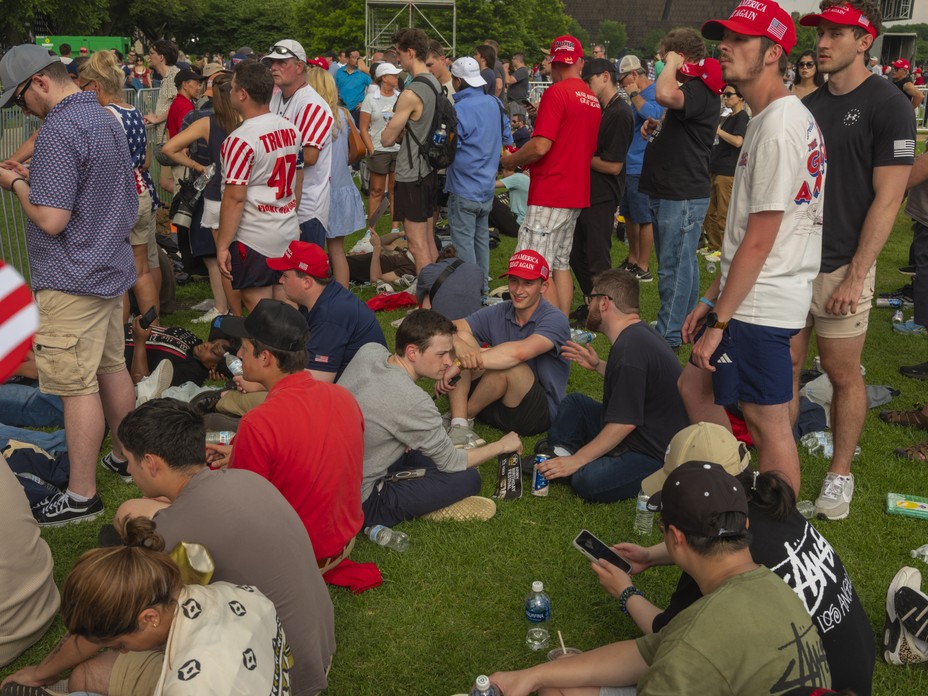
Parade-goers in patriotic ensembles stand near a screen showing a video about the Army’s history.
Onlookers along the parade route
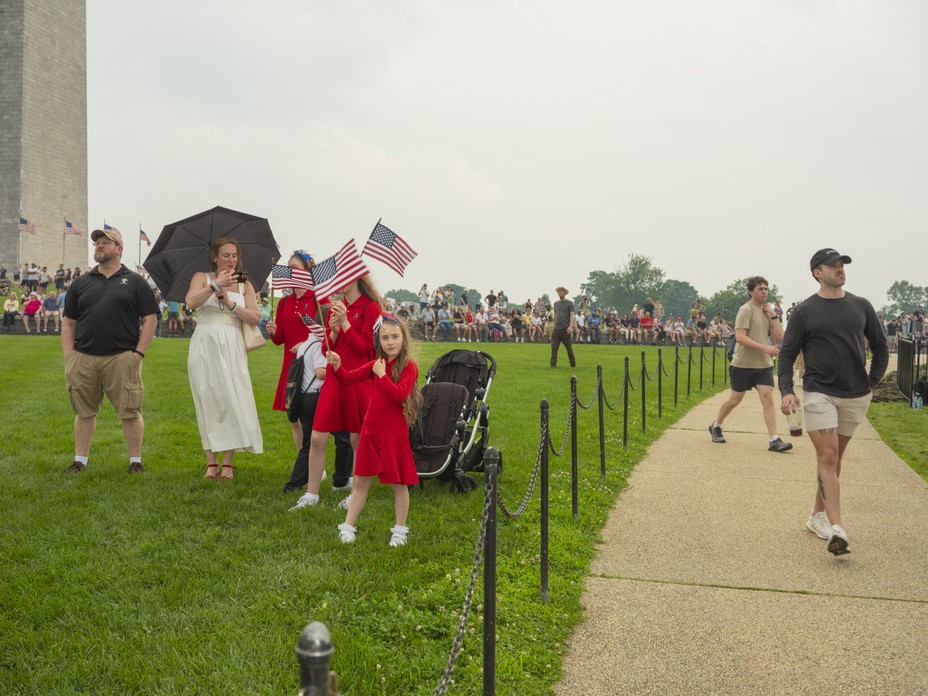
Parade-goers wave flags beneath the Washington Monument.
A group of onlookers waits for a glimpse of President Trump, who watched the parade from a stage south of the White House.
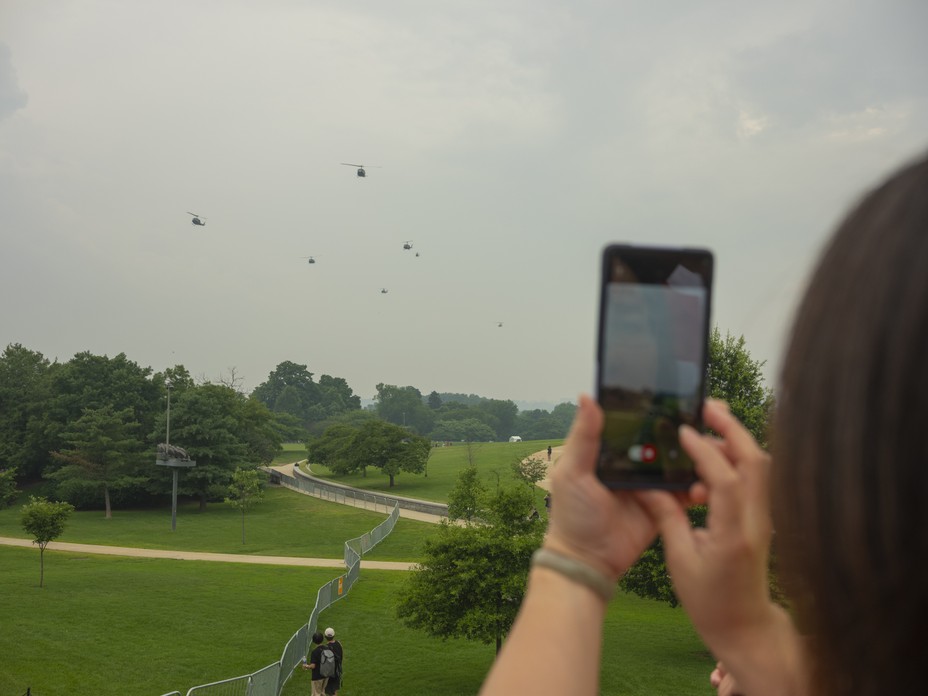
An observer photographs military helicopters flying in formation through cloudy skies. The aerial displays also featured World War II–era planes and drones, showcasing military equipment of the past and future.
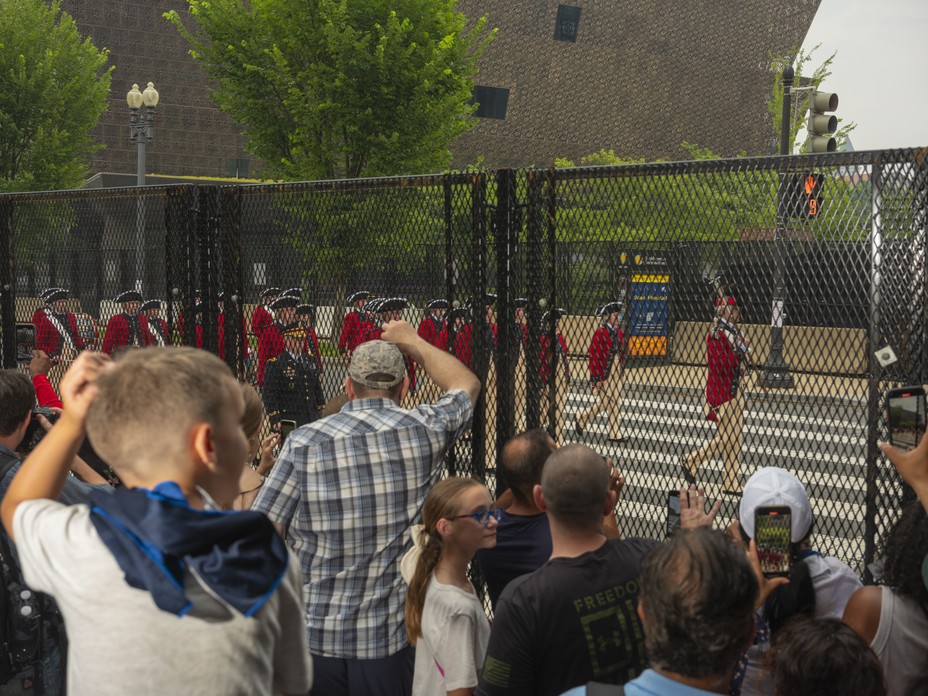
Crowds watch the Old Guard Fife and Drum Corps from behind barricades near the National Museum of African American History. The corps’ uniforms recall those worn by Continental Army musicians during the Revolutionary War.
As the parade proceeds along the National Mall, parachuters from the Army Golden Knights descend onto the White House Ellipse to present President Trump with a folded American flag.
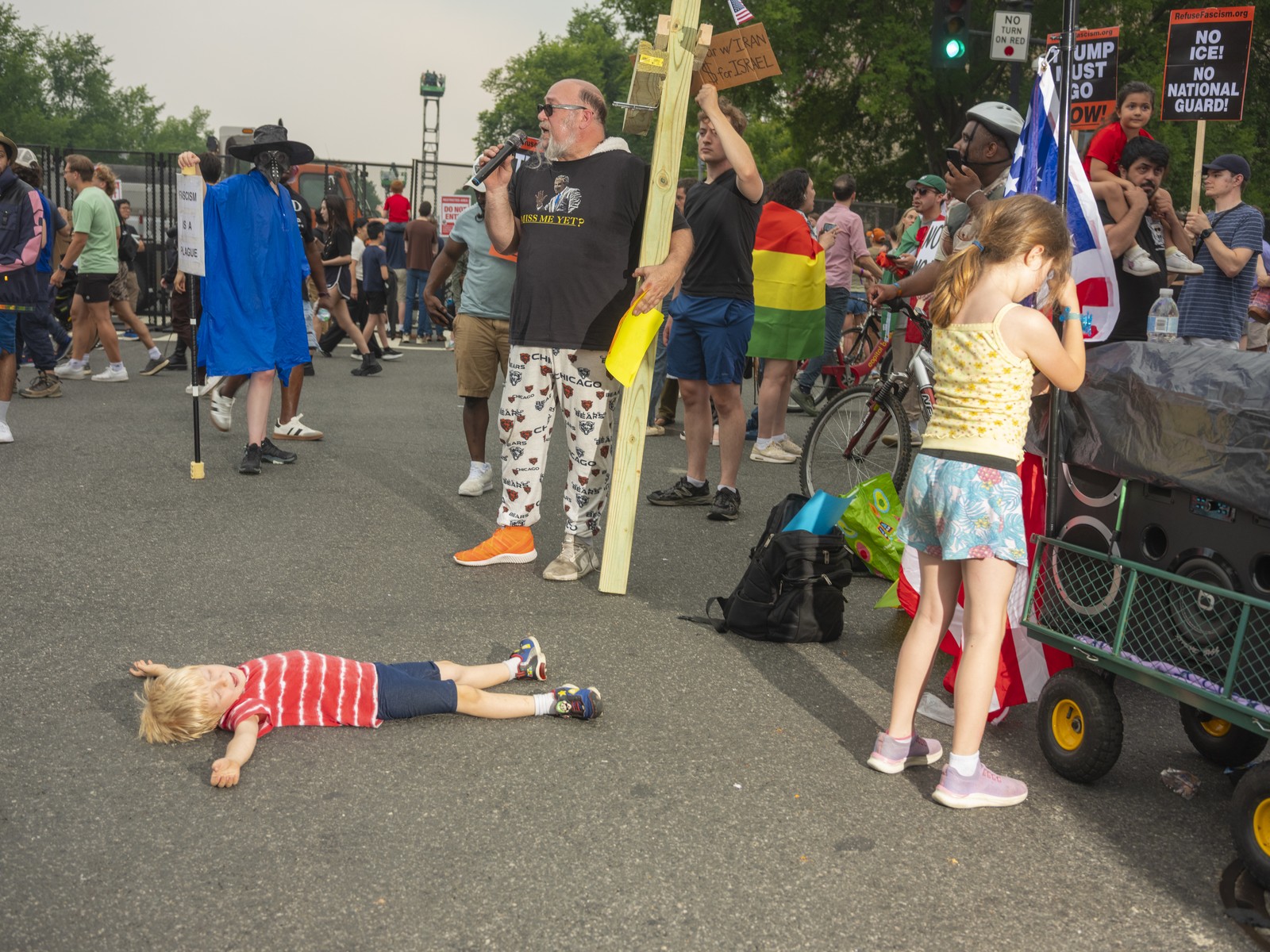
A child takes a moment of respite as protesters demonstrate near the parade route.
#Photos #Military #Parade #D.C
Thanks to the Team @ The Atlantic Source link & Great Job Matt Eich