
Home News Page 2603

Hospitals Are Drug Testing Mothers Without Consent, Fueling Family Separations

By junior year of high school, Desseray Wright was already a mother and didn’t expect to become pregnant again so soon. 

The Bronx, New York, teen was juggling raising a toddler and dreaming about becoming a lawyer. Sometimes, she would hang out with her friends and occasionally smoked weed. Then one day, despite still getting her period, she found out she was pregnant. She was more than 24 weeks along — too late to consider an abortion. Because Wright smoked weed for several months into her pregnancy, she told a health care provider during a routine prenatal visit. It would be an admission she’d later regret. 

After giving birth at a Bronx hospital in 1995, she noticed a bag on her baby’s scrotum, and demanded answers. Hospital staff told her her son had been drug tested, but didn’t explain why. Then a social worker entered her room, questioning her about marijuana use. Within the first hour of her newborn son Trayquan’s life, she had lost custody.

“I was honest and truthful with this lady,” recalled Wright, now 47 and a family defense practice policy advocate for the Bronx Defenders. She explained that back then she believed child protective services were only called when there were allegations of abuse.

While some policies have changed since Wright’s case nearly 30 years ago, health care advocates and legal experts Capital B interviewed said across the country these types of interventions and drug testing without consent still disproportionately target Black and brown mothers. 

At the center of the disparities, they say, are gaps in federal privacy laws — including the Health Insurance Portability and Accountability Act (HIPAA) — which do not require hospitals to inform patients when they are tested for drugs.

Civil rights organizations, including those led by justice-impacted Black women like Wright, argue that these covert tests have fueled a long-standing pattern of criminalizing Black and brown women in family courts and separating families under the guise of child protection. These women turned their personal pain into advocacy, calling for legislation to close HIPAA loopholes to prevent other mothers from being swept into both the criminal and family court systems instead of parenthood.

There has been legislation introduced in recent years in states like California, New York, and Tennessee — where women have been prosecuted for using drugs while pregnant — to inform expectant mothers that they and their newborn are being tested for drugs. They also have the choice to opt out of those tests.  

“Disproportionate drug screening of Black mothers and newborns, without consent, adds to the excessive surveillance of Black families, and leads to an increase in foster care placements,” according to a May 2024 report released by New York State’s Advisory Committee to the U.S. Commission on Civil Rights, “Examining the New York Child Welfare System and Its Impact on Black Children and Families.”

Last month, the New York state Senate Health Committee passed the Maternal Health, Dignity, and Consent Act on an 11-2 vote. 

This bill “is a clear statement that pregnant people do not deserve to be surveilled or criminalized,” Jamila Perritt, who is an OB-GYN and president & CEO of Physicians for Reproductive Health, said in a statement after the bill’s advancement on May 13. 

Desseray Wright is a family defense practice policy advocate for Bronx Defender. (Courtesy of Eliza McCurdy Colon)

In Wright’s case, child protective services required her to attend family court compliance hearings for parenting classes and a drug treatment program — even though, she said, in the 1990s those services weren’t designed for adolescents or applicable to marijuana use. After months of juggling two children and long commutes on public transportation from the Bronx to mostly unhelpful referrals across most of the five boroughs, Wright made the difficult decision to drop out of high school to focus on getting her son back.

Capital B has reached out to New York’s Office of Child and Family Services via email for comment about its policies. A spokesperson responded on June 10 to say that they do not comment on pending legislation.

“I remember the feeling that I felt of losing my child.”

Advocates and survivors interviewed by Capital B often refer to the combined family, child welfare, and criminal legal systems as “family-policing systems.”

Pregnant people go into labor inside a hospital almost every day. Between contractions, they, or their partner, may be handed a flood of documents. Included may be a form with legal language that could authorize a nurse practitioner or physician to drug test both the birthing person and their newborn, without clear consent or probable cause.

“The hospitals that are participating in this, it’s people of color who are more impacted, and at more disproportionate rates,” said Stephanie Jeffcoat, founder of Families Inspiring Reentry & Reunification 4 Everyone. The organization helps impacted parents navigate multiple interlocking systems such as the family and criminal justice systems, and is part of the steering committee working on establishing informed consent in California. 

Jeffcoat and Wright say the system is broken due to social workers and other professionals with mandated reporting credentials. Jasmine Sankofa, executive director of the nonprofit organization Movement for Family Power, which is dedicated to abolishing the family policing system, agrees with them.

Jasmine Sankofa is the executive director at Movement for Family Power. (Courtesy of Jasmine Sankofa)

“There really isn’t any research that justifies the use of mandated reporting, the use of test and report,” Sankofa said, adding, “It’s bias based. It’s not research based.” 

She added that “studies have found that even if a pregnant person was using substances while they were pregnant — even if a child is born and is experiencing neonatal abstinence syndrome, for example — the recommended treatment is the approach is called, ‘eat, sleep, and console.’” 

The best health care for a newborn isn’t separation, nor is it to test and report their birthing parent to a family-policing system, Sankofa added.

In cases where mom or baby test positive, child protective services are contacted. 

As the parent goes back and forth to court, the baby is first placed in a foster home, and because of the Adoption and Safe Families Act enacted by former President Bill Clinton in 1997, within 15 months “states must initiate termination of parental rights proceedings, except in specified circumstances.” 

Despite her specific circumstances, the California child welfare system still took Jeffcoat’s daughter, Harmony Faith Chase, from her nine years ago.

Jeffcoat survived being raped, and found out she was pregnant too late for an abortion. At the time she was 28, unhoused, and struggled with substance use. She didn’t have health insurance, couldn’t afford an abortion, and had an estranged relationship with her mother, who had custody of her two older children. 

One day, she went to a hospital in Orange County for an eye infection. That’s when she later learned she was tested for drugs. 

Jeffcoat’s next visit to the hospital was when she delivered her daughter via C-section. The first hour of Harmony’s life was interrupted when a social worker took her away from her mom’s arms and was placed into the foster care system — never to be in the care of her mother again. 

“I remember the feeling that I felt of losing my child,” said Jeffcoat, now 37. 

In 2023, a bill was introduced in California that would, in part, prohibit medical personnel from performing a drug or alcohol test or screen on a pregnant person or a newborn without prior written and verbal informed consent, and would require the test or screen to be medically necessary to provide care. That bill failed to advance from the state’s Senate health committee in March 2023. 

Jeffcoat is currently studying law to become an attorney in dependency law.

“I feel like my own attorney failed me,” she said. “I want to really be up in there [court] making sure that parents aren’t losing their kids to the system. Especially in the timeframe of the adoption, it should not have been able to take place in six months. It takes longer for people to be sentenced to jail or prison.”

Jeffcoat said she lost custody of Harmony in 2017 while incarcerated for 6½ months for a probation violation. Family court proceedings went on without her being present. 

Once released, she spiraled deeper into her addiction. In 2019, she had a fight with another unhoused person about her bike. After waking up nearby a dumpster, it was the moment she said she decided to turn her life around. She contested the adoption. In 2021, she found the adopting parents. For three years, Jeffcoat said she reached out to them with hopes to create a post-adoption agreement to at least regain visitation rights, to no avail. 

“I needed to make sure that I get into a position to ensure that they do not continue to do this to other people,” said Jeffcoat, who launched her nonprofit in 2023.

“The police, to me, are not simply somebody in a police uniform.”

Perritt, the doctor who is also a fellow of the American College of Obstetricians and Gynecologists and the Society of Family Planning, said people “universally enter” health care professions “because they want to change social justice issues, but during the course of medical education and training you are taught to conform to a system that exists already in order to survive it.”

The history of the medical field being white and male, increases Perritt’s beliefs that health care professionals teaming up with police goes back to the country’s Founding Fathers. 

“The police, to me, are not simply somebody in a police uniform. It’s also the doctors, it’s also the nurses, it’s also the social workers. It’s any and everybody who’s a mandatory reporter.”

Hospitals and health care providers often set their own drug testing and reporting policies — ones that can conflict with the ethical standards taught in medical training, particularly around informed consent and patient trust. In a notable shift, Mass General Brigham, a major hospital system in Boston, stopped automatically filing child neglect reports solely based on a newborn testing positive for drugs, citing a need to reduce unnecessary family separations.

Drug testing shouldn’t be considered a family testing system, advocates said.

In 1996, after Wright lost custody of Trayquan, who was placed in her father’s care, her troubles with the family-policing systems continued when she got pregnant with her third child and second son, Hassan. With an ongoing family court case, the newborn was immediately taken away and placed into a foster home in Brooklyn, New York. Hassan was there for nearly four years.

Child protective services continued to return to Wright’s life twice: when she went to federal prison for 10 years for a weapons and drug conviction, and survived a domestic violence incident by calling 911.

After Wright was released from federal prison in 2013, she earned a criminal justice degree from John Jay College of Criminal Justice. She mourned the loss of her oldest daughter to gun violence in 2018, and in 2021 held on tight to Hassan, now 28, when he survived being shot.

“I graduated at the top of my class,” Wright said. 

Great Job Christina Carrega & the Team @ Capital B News Source link for sharing this story.
Philanthropy Can ‘Unlock Profound Change’ for Women and Girls in this Moment—and Women-Led Orgs Are Rising to the Occasion

Although marginally increasing over the years, reports show that less than 2 percent of philanthropic giving in the U S. directly benefits women and girls, a percentage that is likely even lower on a global scale. Amidst rollbacks on women’s rights, cuts to federal funding, economic uncertainty—and so many other issues and inequities that inevitably hit women and girls the hardest—philanthropy‘s role is more important than ever.  

“This is precisely when philanthropy must step forward with courage, doubling down on long-term, flexible funding that sustains organizations through uncertainty,” says Ana Marie Argilagos, president and CEO of Hispanics in Philanthropy.

Women funders and donors, along with an increasing number of women-led philanthropic organizations, are rising to meet the moment, knowing that the benefits of centering women and girls are far reaching and profound.

“From removing barriers to women entering tech to ending violence against women, there are so many areas where philanthropy is making both problems and solutions visible and leading to real improvements in the lives of women and girls,” says Brooke D. Anderson, president of Pivotal Ventures, founded by Melinda French Gates.

I had the opportunity to ask Anderson, Argilagos and several other women leaders in philanthropy—Sarah Haacke Byrd, CEO of Women Moving Millions; Cecilia A. Conrad, Ph.D., CEO and founder of Lever for Change; Asha Curran, CEO of GivingTuesday; and Valerie Jarrett, CEO of the Obama Foundation—to share their perspectives on the potential for philanthropic dollars to make meaningful change for women and girls worldwide and what critical issues need support.

I asked them all the same question:

How can philanthropy be used to improve the lives of women and girls globally? And what are some of the critical issues facing women and girls that need support?

Here’s what they had to say.

Their answers have been lightly edited for length and clarity. Read extended versions of the interviews here.


Brooke D. Anderson, president of Pivotal Ventures

Women make up half of the U.S. population, yet we are in the minority in every major position of power in our society. Ten percent of Fortune 500 CEOs. Seventeen percent of check writers in venture capital. Twenty-six percent of U.S. senators. I know from personal experience that we are a small percentage of leaders in the national security space.

When Pivotal set out to advance women’s power and influence, it was because we knew that when you have more women making decisions, it’s better for society as a whole. But the barriers to women’s power are frustratingly high.

Consider women’s health. Women spend 25 percent more of their lives in poor health than men, with severe consequences for their families and communities. Pivotal launched a global open call to support an array of organizations—of diverse geographies, sizes, perspectives and approaches—united by their goal to improve the mental and physical health of women.

I also think about our work on caregiving. I know firsthand from taking care of my mom and dad that there is nothing more universal than care. At some point we will all be a caregiver, or need a caregiver, or both. But caregiving falls disproportionately to women. To showcase the opportunity to update the caregiving system, we supported a report that highlighted for entrepreneurs and investors how big the care market actually is: $648 billion! And that helped them understand why they should be working toward new solutions that meet more families’ needs. 

From removing barriers to women entering tech to ending violence against women, there are so many areas where philanthropy is making both problems and solutions visible and leading to real improvements in the lives of women and girls.


U.S. federal cuts are creating a dangerous domino effect, with many foundations pulling back rather than stepping forward. Philanthropy cannot afford to mirror the government’s retreat. This is precisely when philanthropy must step forward with courage, doubling down on long-term, flexible funding that sustains organizations through uncertainty. We need to respond with solidarity and a strategic vision that recognizes women’s organizations as essential infrastructure for democracy and human rights. 

Philanthropy can unlock profound change when it centers and trusts women and girls.

One example is our Fondo LILAS. HIP is investing in survivor-led organizations across Latin America—groups that are tackling child sexual violence with courage, creativity and care. These leaders aren’t just advocating for change—they are the change. From legal and psychological support to national and regional advocacy strategies, they are building networks of healing and resilience.

We are backing these efforts, not as charity, but as strategy. The urgent issues—violence, displacement, systemic inequity—require us to shift from funding services to fueling movements that are already in place. 

We think philanthropy must evolve beyond traditional donor-recipient dynamics to become a true co-creator, designing funding strategies that shift power back to our communities. Our role isn’t to dictate solutions but to transform the realities of people in the way they believe it needs to be. This means relinquishing control, embracing community wisdom and funding with the understanding that those closest to the pain already hold the vision for healing. When philanthropy truly honors the leadership of women, trans and nonbinary people, we don’t just address symptoms—we create the conditions for generational transformation grounded in dignity and justice.


Gender equality is not only a moral imperative—it is central to building more just, prosperous and resilient societies.

Philanthropy plays a vital role in transforming the lives of women and girls globally by providing the catalytic capital needed to dismantle systemic barriers and drive bold, lasting change. At a time when democratic institutions are declining and civic spaces are shrinking, the very foundations that support gender equality are under threat. Nearly 40 percent of countries—home to over 1.1 billion women and girls—are stagnating or backsliding on key gender equality indicators. The rise in economic inequality, political polarization and restrictions on fundamental freedoms are compounding these challenges.

Gender equality is not only a moral imperative—it is central to building more just, prosperous and resilient societies. Yet traditional funding streams often fall short of addressing the root causes or responding with the speed and scale required. This is where philanthropy can lead. The moment calls upon us to continue to work relentlessly, unapologetically and collaboratively to move capital and challenge the status quo to remove barriers based on gender.

Philanthropic capital is uniquely positioned to fuel innovation, take risks and invest in long-term, systemic solutions. It can be the first to fund new ideas, amplify underrepresented voices, and support movements before other forms of capital are willing or able to engage. 

At Women Moving Millions, we understand that accelerating gender equality will require many things, but most critically, it will require strategic capital and stakeholder collaboration. We are at the forefront of this effort, mobilizing resources and leadership to unlock the full potential of women and girls worldwide. We know that together, we can power a world where all women have full autonomy, freedom and agency over every aspect of their lives.


Cecilia A. Conrad, Ph.D., CEO and founder of Lever for Change

The ability of women to exercise their full power in society is directly connected to the quality of their health. Yet, today, women experience inequities across all aspects of their health. These inequities can negatively impact their daily lives, as well as their economic prospects and prosperity, their ability to engage in their communities and their opportunities to achieve their goals. 

More than one billion women and girls around the world suffer from malnutrition. Reproductive healthcare is being denied in the U.S. and other countries. And globally, a woman dies in childbirth every two minutes. These are urgent issues that need to be addressed. 

Women and girls’ health is one area where philanthropy can make a big difference. We are partnering with Pivotal, a Melinda French Gates organization, on a $250 million global open call, Action for Women’s Health, that will fund organizations around the world improving women’s mental and physical health. We’ve witnessed an incredible global response to Action for Women’s Health and have received thousands of applications from teams working on various aspects to support women’s health. We’re seeing lots of great teams take innovative approaches to address these challenges, and this open call is about getting them the resources they need to scale up and reach as many people as possible. 


Throughout the GivingTuesday movement, we see grassroots women leaders around the world who generously give time, skills and financial resources to catalyze positive change in their communities. The critical issues facing women and girls—health and education access, underrepresentation in leadership, conflict—globally remain persistent and interconnected, and many crisis moments often affect women and girls first and most severely.

We have to shift from treating women as the receivers of help and instead as the problem solvers and leaders of change. When resources flow to women leading, we consistently see approaches that are more collaborative, empathetic and attuned to local contexts. This isn’t just good for women and girls—it strengthens entire communities.


The Obama Foundation is doing its part to ensure that women and girls around the world are provided with the tools and resources to reach their full potential. Through our program Girls Opportunity Alliance, we are empowering and educating adolescent girls. 

To date, the Girls Opportunity Alliance has supported more than 150 grassroots organizations in more than 35 countries. This funding has impacted more than 120,000 girls around the world—from providing scholarships and mentorship to funding new learning centers and school dormitories.

When girls are given the resources to overcome obstacles, amazing things start to happen: Poverty goes down, economies grow, families get stronger, babies are born healthier and the world, by all accounts, gets better. By addressing critical systemic issues, we will see broader, more transformative changes across our communities, driving local economies and creating a more equitable future for girls around the world. 

!function(f,b,e,v,n,t,s)
{if(f.fbq)return;n=f.fbq=function(){n.callMethod?
n.callMethod.apply(n,arguments):n.queue.push(arguments)};
if(!f._fbq)f._fbq=n;n.push=n;n.loaded=!0;n.version=’2.0′;
n.queue=[];t=b.createElement(e);t.async=!0;
t.src=v;s=b.getElementsByTagName(e)[0];
s.parentNode.insertBefore(t,s)}(window,document,’script’,

fbq(‘init’, ‘200522034604820’);
fbq(‘track’, ‘PageView’);

Great Job Marianne Schnall & the Team @ Ms. Magazine Source link for sharing this story.

Daily Show for June 12, 2025

Democracy Now! 2025-06-12 Thursday

  • Headlines for June 12, 2025
  • Ex-U.S. Diplomat Joins March to Gaza, Says Biden Official Matthew Miller Has "Blood on His Hands"
  • Block the Bombs: Rep. Delia Ramirez Pushes Bill to Halt U.S. Weapons Sales to Israel over Gaza
  • "The Beginning of Fascism": Rep. Delia Ramirez Says Trump's Immigrant Crackdown Is Crushing Democracy
  • The U.S. Accepts "Fruits of Migrant Labor" But Not Immigrants' Humanity: Day Laborer Organizer in L.A.

Download this show

Great Job Democracy Now! & the Team @ Democracy Now! Audio Source link for sharing this story.

Trump Braces for Expanded Anti-ICE Protests Across the U.S.

Welcome back to World Brief, where we’re looking at anti-ICE protests spreading across the United States, votes of confidence in the Polish and Israeli parliaments, and rioting in Northern Ireland.


‘Brazen Abuse of Power’

What started as small, mostly peaceful protests against U.S. Immigration and Customs Enforcement (ICE) raids in Los Angeles have become nationwide demonstrations against U.S. President Donald Trump’s alleged abuse of executive power.

This week, the Trump administration deployed around 4,000 National Guards and about 700 Marines to Los Angeles without first consulting California Gov. Gavin Newsom. The White House maintains that its actions were vital to weaken the demonstrations, but local officials argue that they only fueled tensions and endangered residents.

“This brazen abuse of power by a sitting president inflamed a combustible situation, putting our people, our officers, and even our National Guard at risk,” Newsom said late Tuesday after imposing a nighttime curfew on roughly 1 square mile of Los Angeles’s downtown area. That curfew has since been lifted.

Even as protests appeared to dwindle in Los Angeles on Wednesday, anti-ICE marches have risen across the country. Authorities have recorded or anticipate protests in Atlanta; Austin, Texas; Chicago; Eugene, Oregon; Mission Viejo, California; New York City; Raleigh, North Carolina; Seattle; St. Louis; and Washington, D.C.; among others. On Wednesday, Texas Republican Greg Abbott became the first state governor to deploy the National Guard ahead of planned demonstrations in San Antonio and other parts of the state.

The Pentagon will deploy federal troops to other cities “if there are riots in places where law enforcement officers are threatened,” Defense Secretary Pete Hegseth told Senate lawmakers on Wednesday.

U.S. Army Maj. Gen. Scott Sherman said on Wednesday that the 700 Marines ordered to Los Angeles will enter the city in the coming days. However, a federal judge in California is expected to hear a state request on Thursday to limit federal troops to just guarding Los Angeles’s federal buildings and prevent them from participating in immigration raids.

The anti-ICE protests come just days before Trump is set to hold a military parade in Washington on Saturday to mark the U.S. Army’s 250th anniversary. The massive demonstration, coinciding with Trump’s 79th birthday, has raised alarms among democracy activists who fear that Trump is politicizing the military for his personal agenda.

To counter Saturday’s parade, a coalition group called No Kings is planning more than 1,800 peaceful demonstrations and events across the country. This is a “mass, nationwide protest rejecting authoritarianism, billionaire-first politics, and the militarization of our democracy,” according to an event description for the organization.

Although No Kings has not scheduled any marches in Washington, Trump warned on Tuesday that “for those people that want to protest, they’re going to be met with very big force.” Thousands of officers and other law enforcement officials are planning to be deployed to the capital and other cities across the United States for the military parade.


Today’s Most Read


What We’re Following

Votes of confidence. Polish Prime Minister Donald Tusk won a vote of confidence in parliament on Wednesday, allowing the pro-European leader to solidify his fragile coalition after suffering a major defeat in the country’s recent presidential election. “I needed this vote because we were seeing … speculation that this government will not make it,” Tusk said, adding that he needed to regain voters’ confidence. In the 460-member lower house, 243 lawmakers voted in favor of Tusk, giving him a majority in parliament.

On June 1, nationalist candidate Karol Nawrocki defeated Tusk-backed rival Rafal Trzaskowski in a runoff vote. Tusk admitted on Wednesday that Nawrocki’s win will create challenges “greater than we expected” but vowed to continue his efforts to repeal judicial reforms passed by the right-wing Law and Justice party.

Meanwhile, the Israeli Knesset faced a major challenge on Wednesday when opposition lawmakers submitted a bill to dissolve parliament. In a rare move, Israeli Prime Minister Benjamin Netanyahu’s far-right backers threatened to support the bill to protest the government’s failure to exempt ultra-Orthodox Jewish communities from having to serve in the Israeli military.

After its first reading, the bill must pass three additional readings before the Knesset can be dissolved. That process could take days, if not weeks, to conclude. If that occurs, Israel will be forced to hold early elections that could potentially unseat Netanyahu and his Likud party from power. Parliamentarians engaged in intense, last-minute talks on Wednesday to avoid such an outcome, though no agreement on enlistment has reportedly been reached yet.

Xenophobic attacks. Rioting in the Northern Ireland town of Ballymena and the surrounding area stretched into early Wednesday, as police used water cannons and plastic baton rounds to counter violent protests. Assistant Chief Constable Ryan Henderson characterized the riots as “racially motivated” and said authorities were working to identify those responsible and bring them to justice. Such violence should be “loudly condemned by all right-thinking people,” he added.

Chaos first erupted on Monday after a peaceful march supporting the family of an alleged sexual assault victim turned violent. Earlier that day, a local court charged two 14-year-old boys who spoke Romanian with attempting to rape a teenage girl on Saturday night; the suspects denied the allegations. A planned demonstration over the case became disruptive when masked demonstrators broke away from the group to throw bricks, Molotov cocktails, and fireworks at several homes and businesses, injuring at least 15 officers in the process. Many of the attacks appeared to target the property of immigrants.

British Prime Minister Keir Starmer said he “utterly condemns” the violence, and Northern Ireland First Minister Michelle O’Neill called the attacks “pure racism,” adding, “There’s no other way to dress it up.”

Conditions for statehood. Palestinian Authority President Mahmoud Abbas called on Tuesday for Hamas to cease ruling Gaza, according to a letter addressed to French President Emmanuel Macron and Saudi Crown Prince Mohammed bin Salman. Abbas denounced Hamas’s Oct. 7, 2023, attack on Israel; demanded that the militant group “hand over its weapons”; and ordered the immediate release of all remaining hostages, echoing three key Israeli demands.

However, Abbas added that the Palestinian security forces, which the Palestinian Authority controls, should oversee Hamas’s removal with Arab and international support—a suggestion that is expected to ruffle feathers in Israel. Hamas controls Gaza, whereas the Palestinian Authority administers parts of the West Bank, and the two groups have been bitter rivals for years. Netanyahu has repeatedly said he opposes the Palestinian Authority having any role in Gaza’s postwar governance.

Macron and Mohammed bin Salman will jointly chair a United Nations conference in New York next week to discuss the creation of a Palestinian state. Macron has listed several conditions to secure this, including disarming Hamas and reforming the Palestinian Authority. Abbas committed to such reforms in his letter on Tuesday, promising to also hold general elections to combat institutional corruption.

However, the United States is already trying to derail next week’s talks. In a cable sent on Tuesday, the Trump administration discouraged countries from attending the conference, saying that the United States views it as “counterproductive to ongoing, life-saving efforts to end the war in Gaza and free hostages.” The cable, which was seen by Reuters, also said the White House opposes any steps to unilaterally recognize a Palestinian state.


Odds and Ends

Hong Kong’s national security police have a new target: video games. On Tuesday, the government effectively banned the Taiwanese war strategy game Reversed Front: Bonfire, accusing it of “advocating armed revolution.” The game allows players to “pledge allegiance” to Taiwan, Mongolia, Hong Kong, Tibet, Kazakhstan, Xinjiang, or other locations in order to overthrow the Chinese Communist Party. Apple removed the game from its App Store for Hong Kongers on Wednesday, and local authorities have warned that anyone who downloads or recommends Reversed Front: Bonfire could face legal charges.

#Trump #Braces #Expanded #AntiICE #Protests #U.S

Thanks to the Team @ World Brief – Foreign Policy Source link & Great Job Alexandra Sharp

Designing a Wealth Tax for Today’s Robber Barons

Under threat from a volatile United States, Canada needs to chart its own path to build a more self-reliant, just, and equitable economy.

A time like this calls for nation-building: the country can’t afford austerity or cutbacks, nor can it afford to let the superrich call the shots in its economy and public policy.

Canada urgently needs robust public investment in physical and social infrastructure: new homes, schools, hospitals, transit, and green energy. It also needs to reduce the extreme concentration of wealth at the top, which distorts democracy and frays the social fabric much.

A wealth tax focused on those at the very top — less than 1 percent of Canadians — could help achieve both these goals. Such a wealth tax could raise huge amounts of public revenue to put toward building infrastructure and critical social investments, while blunting the growing power of the wealthiest few and creating a more level playing field on which working-class Canadians can thrive.

This report first lays out the context, examining the extent and effects of wealth inequality today and the strong public support and growing international momentum for a wealth tax.

Central to its analysis, the report then assesses the significant revenue potential of a 1 percent tax on net wealth above $10 million — with higher brackets and rates on wealth above $50 million and $100 million — projecting it could raise nearly half a trillion dollars for Canada over ten years. Key counterarguments to such a tax are addressed and shown to be largely off base.

In its conclusion, the report outlines some of the transformative public investments that the revenue generated by a wealth tax could fund to build a stronger and more equitable Canada.

Wealth inequality in Canada is sky high.

Analysis from the Parliamentary Budget Office (PBO) shows the richest 1 percent control 24 percent of the country’s wealth, amounting to $3.5 trillion in 2021. Research from academic economists puts that figure even higher, finding that the top 1 percent control 29 percent of net wealth.

Research published by the Canadian Centre for Policy Alternatives in 2018 found that the eighty-seven richest families in Canada held as much wealth as the bottom 12 million Canadians combined. The 2025 Forbes Real-Time Billionaires list finds that seventy-eight Canadian billionaires hold $520 billion in wealth.

Canada is not alone experiencing extreme wealth concentration. In the United States, wealth inequality is even higher, with the top 1 percent holding approximately 35 percent of total wealth. At a global level, a recent Oxfam report estimates that the richest 1 percent now “own more wealth than 95 percent of humanity.”

This extreme inequality is corrosive, damaging economies, societies, and democracy.

A wide range of research, including from economists at conservative institutions like the International Monetary Fund and the Organisation for Economic Co-operation and Development (OECD), finds that inequality lowers economic growth and productivity. Inequality can lead to less investment in areas like education, meaning poorer people are unable to flourish and realize their productive potential. As one report puts it, “When those at the bottom of the income distribution are at high risk of not living up to their potential, the economy pays a price.” Inequality can also reduce economic growth by making it more volatile and less enduring and by lowering aggregate demand since poorer households are more likely than richer ones to spend most of their income.

In turn, failing to tax the rich means governments are forgoing revenue that could be put toward badly needed, highly productive public investments in infrastructure, housing, and childcare.

Investment in infrastructure like public transit boosts growth, productivity, and incomes. Investment in affordable housing, which eases housing shortages and contributes to lower rents, is not only good for renters but also for businesses that struggle to recruit workers who can’t find affordable homes close to work. The benefits of universal public childcare to women’s labor force participation are widely recognized.

Epidemiological evidence from across rich societies also shows that higher inequality worsens a wide range of health and social outcomes, including life expectancy, infant mortality, rates of mental illness, and social trust. The effects of high inequality on health appear to extend even to the affluent within a country, such that “living in a more equal place benefit[s] everybody, not just the poor.” Extreme inequality is also corrosive to democracy, with a growing body of political science research showing that income and wealth concentration has a distorting influence on politics and policy outcomes.

Despite this evidence, both federal and provincial governments are signaling their intention to squeeze social spending in the face of deficits, which would be devastating to Canadian society and economy.

Strengthening the public sector is essential to rebuilding Canada’s social fabric and withstanding external threats, including US protectionism and annexation rhetoric. A wealth tax could help create the fiscal space for urgently needed public investment.

A striking fact about a wealth tax is that 80 to 90 percent of Canadians across party lines back the idea in public opinion polling. Even many socially minded wealthy Canadians are on board, with groups such as Patriotic Millionaires and Resource Movement advocating for higher taxes on the wealthy — i.e., themselves. The same is true internationally, with polling showing strong global public support for taxing the rich across a wide range of countries, including in polling of millionaires in G20 countries.

Last year, the Brazilian presidency of the G20 commissioned a report from University of California, Berkeley, economist Gabriel Zucman, which lays out a proposal for a minimum tax on billionaires’ wealth. The G20 report is part of a rapidly growing body of economic research showing that wealth taxes on the superrich are technically feasible and can be economically beneficial.

Brazil, Germany, Spain, and South Africa have been at the forefront of the push for a wealth tax within the G20, with their finance ministers penning a joint statement of support last year. While there is momentum, there are holdouts such as the United States — despite strong public support in polling and with prominent wealth tax proposals from senators Elizabeth Warren and Bernie Sanders.

The good news is that individual countries can take effective action both unilaterally and as part of an emerging coalition of the willing. Canada should join the effort to push the G20 wealth tax agenda forward and help lead that coalition of the willing by implementing a robust, modern wealth tax.

Consider an annual tax on the net wealth of families with rates of 1 percent above $10 million, 2 percent above $50 million, and 3 percent above $100 million. This means the first $10 million of any family’s wealth is entirely unaffected by the wealth tax. Based on modeling of the first year of this wealth tax, the bottom 99.4 percent of Canadians would pay nothing, while only the richest 0.6 percent would pay any amount. This means that only roughly one hundred thousand families across the country would pay any amount under the wealth tax, with ten thousand wealthy enough to fall into the second-highest bracket and 3,700 in the highest bracket.

This narrow tax on the wealthiest few would raise an estimated $39 billion in its first year, $62 billion by its tenth year, and $495 billion cumulatively over a ten-year window. These are net revenue estimates after deducting a generous $795 million in the first year (and rising) for enforcement, while accounting for levels of tax avoidance and evasion at the high end of estimates from recent economic research on wealth taxes. Revenue estimates use the Parliamentary Budget Officer’s High-net-worth Family Database model of the wealth distribution, along with Statistics Canada and PBO data to project for future years.

Notably, these tax rates would be expected to only slow the accumulation of the fortunes of the superrich, rather than erode them. Indeed, the estimated revenues continue to rise over the ten-year window. But given the threat that extreme concentrations of wealth pose to our democracy and economy, additional brackets and higher rates — capable of putting a lasting dent in those fortunes — should also be considered. For example, the US wealth tax proposals of senators Elizabeth Warren and Bernie Sanders included rates as high as 6 percent and 8 percent on billionaires. Still, the more modest rates proposed here may be a sensible place to start for Canada, particularly if acting as a first mover.

Note: Tax on the net wealth of families of 1% above $10 million, 2% above $50 million, and 3% above $100 million.

A key question that arises when considering a wealth tax is whether it can be effectively enforced. There is no doubt that corporations and the wealthy have proved adept at avoiding and evading their tax obligations in recent decades. But leading experts on tax havens emphasize that this is “not a law of nature but results from policy choices” — and better policy choices can be made if there is political will.

Key design features for an effective wealth tax:

The growing body of economic research on wealth taxes finds that they can be effective and enforceable if they are well-designed. Unlike some older experiments with wealth taxes, modern wealth tax proposals have a few key and well-understood design features that minimize avoidance and evasion.

First, a well-designed wealth tax must have a comprehensive base, applying to all types of assets equally (rather than exempting certain types of assets such as real estate, which would make tax avoidance by shifting between asset classes easy and likely). Second, a wealth tax should be narrowly targeted on the superrich, excluding upper-middle-class households that may find it more onerous to make payments if their largest assets are illiquid. This also ensures that enforcement efforts and resources can be focused on the richest few. Some older European wealth taxes had poorer designs on both of these fronts, with too many exemptions for certain asset types and applying too broadly into the upper-middle class.

Third, an effective wealth tax must make use of extensive third-party reporting of assets particularly from financial institutions, rather than relying too heavily on self-reporting as in the case of some older wealth taxes. Fortunately in Canada, the key infrastructure for third-party reporting is in place because financial institutions must already report to the Canada Revenue Agency (CRA) about their account holders’ incomes, including capital gains income generated from assets. Employers, businesses, and other institutions similarly have obligations to report key information to the CRA. The recent expansion of beneficial ownership registries at the federal and provincial level will also help track asset ownership.

Third-party reporting should be complemented by the credible threat to the superrich of a lifestyle audit by the CRA. Those found to be engaging in tax evasion, as well as financial services providers that facilitate that evasion, should be subject to significant penalties. My modeling of wealth tax revenues already deducts a generous $10 billion over ten years for use in enforcement and administration.

But will the wealthy move their investments — or themselves — abroad?

One concern is that a wealth tax might lead to people shifting investments abroad, but the design of the tax avoids this concern. For Canadian residents, the tax applies to their total net worth above the threshold, regardless of where those assets are invested, so shifting investment abroad offers no tax advantage. For foreign investors not in the jurisdiction of the tax, incentives to invest in Canada remain unchanged (though the incentive of the very wealthy to move to Canada would be affected). Moreover, because it targets (very large) existing stocks of wealth, rather than the flow of income or the act of investment, a wealth tax avoids disincentive effects associated with taxes on productive activities.

What about (illegal) attempts to hide assets abroad specifically to evade the tax? Fortunately, international tax cooperation and information sharing have taken major strides in recent years. Under the Common Reporting Standard developed by the OECD and enacted in 2017, “more than 100 countries have agreed to automatically exchange financial account information,” including jurisdictions long recognized as tax havens such as Switzerland, Luxembourg, the Cayman Islands, and Bermuda. And it’s working. The Global Tax Evasion Report 2024 finds that “offshore tax evasion has declined by a factor of about three in less than 10 years.” The Common Reporting Standard continues to evolve and improve each year, and though the United States remains outside this system — while having its own reporting requirements — the ability to track offshore assets has become significantly stronger.

Another concern is that the wealthy themselves may move abroad in response to a wealth tax. Even if some do, that does not mean they can avoid the wealth tax. To reduce the incentive, either a substantial exit tax can be imposed (e.g., at 40 percent as in Elizabeth Warren’s proposal) or annual wealth tax obligations can continue to be applied after expatriation for a set number of years, as proposed in analysis for the UK Wealth Tax Commission. This would be a fair recognition of the broader society’s contribution to creating and enabling these fortunes.

Research suggests that this type of flight of the superrich is less common than one might expect and modest in its economic effects. After all, a household’s connection to a country is driven by many factors other than tax policy such as family, social ties, and even patriotism. As mentioned above, there are now many wealthy households in Canada and around the world publicly campaigning for taxing the rich. As for those among the extremely wealthy who remain intensely resistant to chipping in to build a stronger and more just society, we might be better off if they choose to leave. We can focus instead on unleashing the talents and productive potential of Canadians who care about building the country.

If there is progress among a coalition of the willing of the G20 countries toward creating an internationally coordinated wealth tax, the prospects for effective enforcement will be even stronger. Last year, G20 finance ministers pledged to “engage cooperatively to ensure that ultra-high-net-worth individuals are effectively taxed,” and there is a push to make further progress this year. The progress to date in reducing tax evasion through the Common Reporting Standard shows that international cooperation is not only possible but can yield results quite rapidly.

Nevertheless, to add a layer of conservatism to my revenue estimates, I reduce the wealth tax base by 16 percent to account for any behavioral responses to the introduction of the tax including avoidance and evasion. This behavioral response factor is on the high end of the estimates in the economic literature, aligning with estimates by economists Gabriel Zucman and Emmanuel Saez for Warren and Sanders’s wealth tax proposals. These economists observe that avoidance and evasion levels could be even lower with a well-designed wealth tax and effective enforcement measures, noting that “evasion depends on the design of the wealth tax and the strength of enforcement.” Other research suggests a lower range for behavioral responses, such as the estimate of 7 to 17 percent in analysis for the UK Wealth Tax Commission. A proposal by economists for a Europe-wide wealth tax also suggests a lower behavioral response rate.

A wealth tax on the superrich would be a strong step toward reinvesting in Canada. It could both raise funds to help reverse decades of underinvestment in our physical and social infrastructure and begin to tackle the extreme concentration of wealth that’s fraying the country’s social fabric and distorting its democracy.

At nearly half a trillion dollars over ten years — the revenue from a wealth tax alone could fund a suite of transformative national projects, including:

These types of investments would not only help create a stronger society where far more Canadians have a decent, secure life, but also have significant long-term benefits for growth and productivity.

Creating affordable homes for hundreds of thousands of workers would allow them to access higher-wage jobs in cities that have long excluded them, helping workers and businesses alike. Transit investment would reduce costly traffic congestion and increase mobility and job matching between workers and employers. Public childcare investment would help ensure parents of young children are free to stay in the labor force if they choose. Universal public pharmacare would be far more efficient than fragmented privatized drug insurance with its huge administrative duplication across corporate insurers. Ensuring Canadians enjoy a basic standard of security and income would help unleash the potential of millions of people to make the contributions they want to their communities and economies.

Of course, a wealth tax is not a panacea.

To reduce inequality and create a fairer tax system, more policy action is needed to make large corporations pay their share, as well as to end the preferential treatment of capital gains income, which is taxed at half the rate of the wages and salaries earned by most Canadians. A more just and resilient economy would require strengthening workers’ ability to organize in unions and expanding opportunities to create democratic employee-owned firms. Solving the housing crisis would require ending the apartment ban imposed by big cities on most of their land so that we can actually build nonmarket homes at scale and end the overall shortage of housing supply.

A wealth tax can help Canada set its own course distinct from the colossus to the south.

It provides the opportunity to ensure that working-class people who create this country’s wealth actually share in it. Given its popularity across party lines, a wealth tax also has the potential to bring the vast majority of Canadians together at a time when our society is at risk of falling into the type of deep polarization that exists in the United States.

If Canada instead pursues austerity and underinvestment in the public good — and there are worrying signs of this from federal and provincial governments — the result will be a diminished society and a weakened ability to withstand external threats.

A wealth tax makes it clear: the country is not facing a bare cupboard. Canada possesses the resources and the choice to collectively invest in this country’s future. It also has the opportunity to lead — by designing a modern, best-in-class wealth tax and joining the growing international coalition committed to taxing the ultrarich. It is a moment worth seizing.

Great Job Alex Hemingway & the Team @ Jacobin Source link for sharing this story.

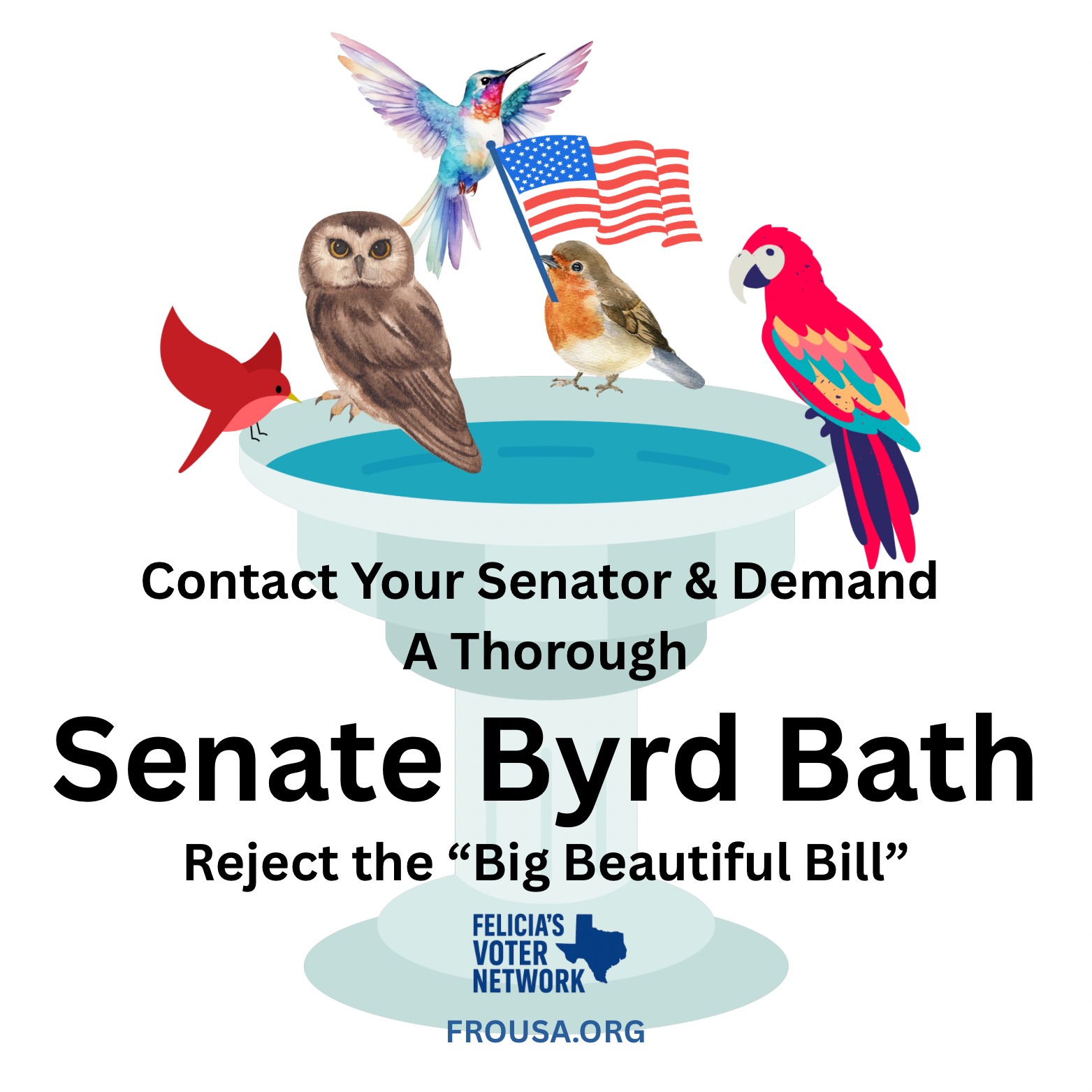
Why We’re Demanding a Byrd Bath—And Why You Should Too

Let’s be clear: the so-called “One Big Beautiful Bill” is anything but.

This sweeping piece of legislation—officially known as H.R. 1—was rushed through the House and is now in the hands of the Senate. It’s being pushed as a win for American families, but beneath the surface, it threatens vital programs like Medicaid, balloons the national debt, and quietly undercuts protections many of us rely on.

And here’s the catch: instead of facing a full debate, lawmakers are trying to push this bill through using a process called budget reconciliation—a shortcut that allows them to bypass the usual 60-vote threshold in the Senate.

That’s where the Byrd Rule comes in.

The Byrd Rule exists to prevent unrelated, non-budgetary items from being snuck into reconciliation bills. It’s named after the late Senator Robert Byrd, and it’s one of the few tools we have to keep massive legislation like this accountable to the American people.

How it works:
  • Points of Order: Any senator can raise a point of order if they believe a provision in a reconciliation bill violates the Byrd Rule.
  • The Parliamentarian’s Role: The Senate Parliamentarian advises the presiding officer on whether the provision is indeed a violation.
  • “Byrd Bath”: The process of reviewing reconciliation bills for potential Byrd Rule violations is often referred to as a “Byrd Bath”.
  • Removal of Extraneous Matter: If the point of order is sustained, the extraneous provision is removed from the bill, but the rest of the bill can still be considered.
  • Waiver: It’s possible to waive the Byrd Rule with a three-fifths vote (60 votes) of the Senate.

We’re calling on voters—especially those in states with Republican Senators—to demand a real and rigorous Byrd Bath. That means holding the bill up to scrutiny, stripping out anything that doesn’t belong, and refusing to let this become another bloated handout to the wealthy at the expense of working families.

Several GOP Senators—like Lisa Murkowski, Susan Collins, and Josh Hawley—are already signaling concern. They need to hear from you. Loudly.

Take Action:

Call your Senator. Email. Tag them. Ask one question:

“Will you demand a Byrd Bath before H.R. 1 moves forward?”

Because democracy isn’t just about voting every two or four years. It’s about showing up when it counts—and this counts.

Want to understand the Byrd Rule in full? Read the full Senate document here.


ProPublica Opens Application for Five New Local Partners to Join Its 50 State Initiative

ProPublica announced on Wednesday a new call for proposals to select the next five partners in its Local Reporting Network. These newsrooms will be chosen to be part of the organization’s 50 State Initiative, a commitment to partnering with one newsroom from each state by 2029. The deadline for applications is July 21 at 5 p.m. Eastern. Reporters selected for the one-year program will begin work on Oct. 1, 2025.

Through this partnership, ProPublica will reimburse news organizations for the salary of the selected reporter (up to $75,000 plus a benefits stipend) so they can spend a year working full time on an accountability journalism project of importance to their communities. Additionally, ProPublica provides editing support, along with our data, research, visual storytelling, graphics, design, audience and engagement expertise.

More information about how to apply and the application for prospective newsrooms have just been posted. Newsrooms from 35 states are eligible to apply for this round. Please see our eligibility map for details.

As part of the 50 State Initiative, ProPublica is currently working with newsrooms from the first 10 states; another five newsrooms will start in July. Reporting with The Connecticut Mirror on car towing in the state sparked legislative reforms to overhaul century-old towing laws that favored tow companies at the expense of drivers. In Georgia, we have documented how the state’s Medicaid work requirement, which is being heralded as a model for the rest of the country, has fallen short and cost millions. And in Tennessee, we’ve shown how one company has vastly expanded the use of a unique high-interest loan — and then gone on to sue more than 100,000 borrowers.

“It’s thrilling to see ProPublica’s Local Reporting Network reach newsrooms in all regions of the country,” said Sarah Blustain, an assistant managing editor at ProPublica. “With each additional state, we are able to bring urgent local issues to readers nationwide.”

The 50 State Initiative expands the scope of ProPublica’s work at the local and regional level, which includes a growing team of journalists reporting from communities across the country and groundbreaking partnerships with local news organizations through the LRN program.

The initiative broadens our support for local journalism, which now includes the LRN alongside dedicated reporting hubs in the Midwest, South, Southwest and Northwest, as well as an investigative unit in Texas in partnership with The Texas Tribune. ProPublica has more than 25 staff reporters and more than 20 reporting partnerships around the country contributing to regional and local accountability reporting, ensuring people can benefit from world-class journalism that can drive measurable change in their communities.

The LRN began in January 2018 in an effort to help remedy the lack of investigative reporting at the local level. It has since led to partnerships with some 80 news organizations across the country.

Great Job by ProPublica & the Team @ ProPublica Source link for sharing this story.

Daily Show for June 11, 2025

Democracy Now! 2025-06-11 Wednesday

  • Headlines for June 11, 2025
  • "No Kings": 1,800+ Rallies Planned as Trump Threatens "Very Heavy Force" on Army Parade Protesters
  • From Travel Ban to Troops in Streets, Advocates Blast Trump's Targeting of Immigrant Communities
  • "They Kidnapped Us": Deported Gaza Flotilla Activist Describes Israeli Interception in Int'l Waters

Download this show

Great Job Democracy Now! & the Team @ Democracy Now! Audio Source link for sharing this story.

Trump Doubles Down on Federal Troop Deployments to Los Angeles

Welcome back to World Brief, where we’re looking at U.S. troops in Los Angeles, Israel’s seaborne attack on Yemen’s Houthis, and a school shooting in Austria.


‘Inflammatory and Unnecessary Provocation’

U.S. President Donald Trump deployed an additional 2,000 National Guard troops and 700 Marines to Los Angeles on Tuesday to help quell protests against U.S. Immigration and Customs Enforcement (ICE) raids. The White House claims that its controversial decision to send federal forces has weakened the demonstrations. But state officials maintain that doing so without first consulting California Gov. Gavin Newsom was illegal and unnecessary, as the protests were already calming before Washington got involved.

Welcome back to World Brief, where we’re looking at U.S. troops in Los Angeles, Israel’s seaborne attack on Yemen’s Houthis, and a school shooting in Austria.


‘Inflammatory and Unnecessary Provocation’

U.S. President Donald Trump deployed an additional 2,000 National Guard troops and 700 Marines to Los Angeles on Tuesday to help quell protests against U.S. Immigration and Customs Enforcement (ICE) raids. The White House claims that its controversial decision to send federal forces has weakened the demonstrations. But state officials maintain that doing so without first consulting California Gov. Gavin Newsom was illegal and unnecessary, as the protests were already calming before Washington got involved.

Small, largely peaceful demonstrations began last Friday, only to grow over the weekend across parts of Los Angeles and the surrounding area, in some cases becoming violent. Local police responded to reports of burned cars and graffitied public property with force, using tear gas, flash grenades, and rubber bullets on protesters. One nonlethal round hit an Australian journalist covering the crisis; Australian Prime Minister Anthony Albanese issued a formal complaint to the Trump administration on Tuesday over what he called the “horrific” incident.

Much of Los Angeles, home to 4 million people within city limits, has not been affected. Los Angeles Police Chief Jim McDonnell said he was confident in his department’s ability to handle the demonstrations, adding that the Marines’ arrival would create a “significant logistical and operational challenge.” And Newsom filed an emergency motion in federal court on Tuesday to block Trump and Defense Secretary Pete Hegseth’s deployment of the National Guard and Marines.

“These unlawful deployments have already proven to be a deeply inflammatory and unnecessary provocation, anathema to our laws limiting the use federal forces for law enforcement, rather than a means of restoring calm,” California state officials wrote in the court motion. “Federal antagonization, through the presence of soldiers in the streets, has already caused real and irreparable damage to the City of Los Angeles.”

While testifying before the House Appropriations Committee on Tuesday, Hegseth defended Trump’s deployments, saying they were vital to “ensure that those rioters, looters, and thugs on the other side assaulting our police officers know that we’re not going anywhere.” The Marines’ sole purpose while in Los Angeles is to protect federal personnel and property, not arrest protesters, Marine Corps Gen. Eric Smith said.

According to a Defense Department official, the deployment of National Guard and Marine troops will likely last 60 days and cost around $134 million.

The use of military force on domestic soil is extremely rare in the United States. On Tuesday, Trump said he would not rule out invoking the Insurrection Act against the protesters, just one day after implying that Newsom could be arrested for his actions. U.S. House Speaker Mike Johnson went a step further when asked if Newsom should face legal repercussions for trying to block the deployment orders. “I’m not going to give you legal analysis on whether Gavin Newsom should be arrested,” Johnson said. “But he ought to be tarred and feathered—I’ll say that.”


Today’s Most Read


What We’re Following

Naval assault. The Israeli military launched its first seaborne attack against Yemen’s Houthis on Tuesday. Israeli navy vessels targeted the port city of Hodeidah, damaging facilities believed to be used for aid shipments into the country as well as weapons smuggling. “We warned the Houthi terror organization that if they continue to fire at Israel, they will face a powerful response and enter a naval and air blockade,” Israeli Defense Minister Israel Katz wrote on X.

The Houthis did not offer an immediate damage assessment or casualty report, and it maintained that Israel’s actions will not hinder the group’s support for Palestinians in Gaza. Israel and the United States have both carried out military operations against Houthi targets in recent months, with one U.S. attack in April killing at least 74 people.

Meanwhile, foreign anger toward Israel’s actions closer to home continues to grow. On Tuesday, Australia, Canada, New Zealand, Norway, and the United Kingdom announced that they will impose sanctions on far-right Israeli ministers Itamar Ben-Gvir and Bezalel Smotrich for what the countries described as the two men’s “repeated incitements of violence against Palestinian communities” in the West Bank and Gaza.

National mourning. A school shooter killed 10 people and wounded at least 12 others in the Austrian city of Graz on Tuesday before taking his own life. The 21-year-old perpetrator was not previously known to local authorities, and police say it is still unclear what his motive was. The individual was a former student at BORG Dreierschützengasse, the high school where the attack occurred.

Austrian Chancellor Christian Stocker declared three days of national mourning on Tuesday alongside a countrywide minute of mourning, scheduled for 10 a.m. local time on Wednesday. This is “a dark day in the history of our country,” Stocker said. Mass shootings are rare in Austria. According to the Regional Gun Violence Research Consortium, only two have occurred in Austria between 2000 and 2022.

Heavy drone barrage. Russia launched a massive aerial strike against Ukraine on Tuesday, hitting a maternity ward in the city of Odesa and killing at least four people across the country. More than 300 drones and seven missiles were fired; Ukrainian President Volodymyr Zelensky has claimed that two of these were North Korean-made ballistic missiles. The assault also damaged Saint Sophia Cathedral, a UNESCO World Heritage Site located in Kyiv.

“It is vital that the response to this and other similar Russian attacks is not silence from the world, but concrete action,” Zelensky wrote on X. Tuesday’s offensive follows several heavy Russian bombardments, including an overnight offensive on Sunday into Monday that—with nearly 500 drones and 20 missiles launched—was the largest barrage against Ukraine since Moscow’s full-scale invasion began in February 2022.

Meanwhile, NATO chief Mark Rutte warned on Monday that Russia could be ready to attack the alliance within the next five years. During a speech in London, Rutte called for a substantial increase in military spending to bolster air and missile defenses by 400 percent. “The fact is: We need a quantum leap in our collective defense,” Rutte said. “The fact is: Danger will not disappear even when the war in Ukraine ends.”


Odds and Ends

After years waiting for BTS’s next dynamite single to be released, fans of the South Korean K-pop group are finally a step closer to hearing new music. Members RM and V were discharged from the country’s military on Tuesday after serving their mandatory service, becoming the third and fourth singers in the seven-member boy band to finish their conscription. “Please wait just a little longer, and we will return with a really cool performance,” V told the group’s followers.

#Trump #Doubles #Federal #Troop #Deployments #Los #Angeles

Thanks to the Team @ World Brief – Foreign Policy Source link & Great Job Alexandra Sharp

Secret Link