Ryan Goodman and Sam Stein walk through the little-noticed memo that could allow military force on American streets, even without a governor’s request. They unpack the legal implications, the use of federal troops against civilians, and what it signals about 2025.
Leave a comment
As always: Watch, listen, and leave a comment. Bulwark+ Takes is home to short videos, livestreams, and event archives exclusively for Bulwark+ members.
Don’t care for video? Use the controls on the left side of the player to toggle to audio.
Add Bulwark+ Takes feed to your player of choice, here.
Great Job Sam Stein & the Team @ The Bulwark Source link for sharing this story.
Before we start:Great conversation yesterday on protests. I’m grateful to everyone who participated. And I’m sure this will be ongoing. But I do have one additional response to some thoughts I saw expressed elsewhere.
There is a strain of thinking which maintains that all of these protests are beyond reproach. I’ve seen people say, for instance, that it’s perfectly fine for protesters to be waving Mexican flags. That this is their God-given right, etc.
A lot of the uncritical support of the protests is based on moral judgments about what should be true.
It should be fine for people to wave Mexican flags. But I don’t think should is a very useful frame right now. I’m much more interested in will.
Will the rest of America—rightly or wrongly—become more sympathetic to the people opposing Trump after seeing Mexican flags?
We can expand the frame of will for the entire scene—the people in the streets, the torching of cars, the throwing of bricks. Protests are a tool for leveraging public opinion. It does not really matter what the public should think. It matters what it will think.
For whatever it’s worth, I’d argue that we should view these protests through a utilitarian and not a moral lens. Maybe the best evaluation I’ve seen about the nature of protest is from Peter Coyote (yes, that Peter Coyote):
A protest is an invitation to a better world. It’s a ceremony. No one accepts a ceremonial invitation when they’re being screamed at. More important you have to know who the real audience of the protest is. The audience is NEVER the police, the politicians, the Board of supervisors, the Congress, etc. The audience is always the American people, who are trying to decide who they can trust; who will not embarrass them.
Coyote goes on to make a number of practical suggestions which strike me as sensible—but require organization and leadership:
Number 1 let women organize the event. They’re more collaborative. They’re more inclusive, and they don’t generally bring the undertones of violence men do. 2 appoint monitors, give them yellow vests and whistles. At the first sign of violence, they blow the whistles and the real protesters sit down. Let the police take out their aggression on the anarchists and the provocateurs trying to discredit the movement. Number 3 dress like you’re going to church. It’s hard to be painted as a hoodlum when you’re dressed in clean presentable clothes. They don’t have to be fancy they just signal the respect for the occasion that you want to transmit to the audience. Number 4, make your protest silent. Demonstrate your discipline to the American people. Let signs do the talking. Number 5 go home at night. In the dark, you can’t tell the cops from the killers. Come back at Dawn fresh and rested.
We will see what this weekend’s decentralized protests look like.
One last thought: At the moment the various anti-Trump protests are logistically, thematically, and organizationally decentralized. This is helpful in some ways and unhelpful in others. At some point the movement could benefit from having a leader.
Okay. So let’s talk about something else: Dirty Jersey and the problem with Bulwark Democrats.
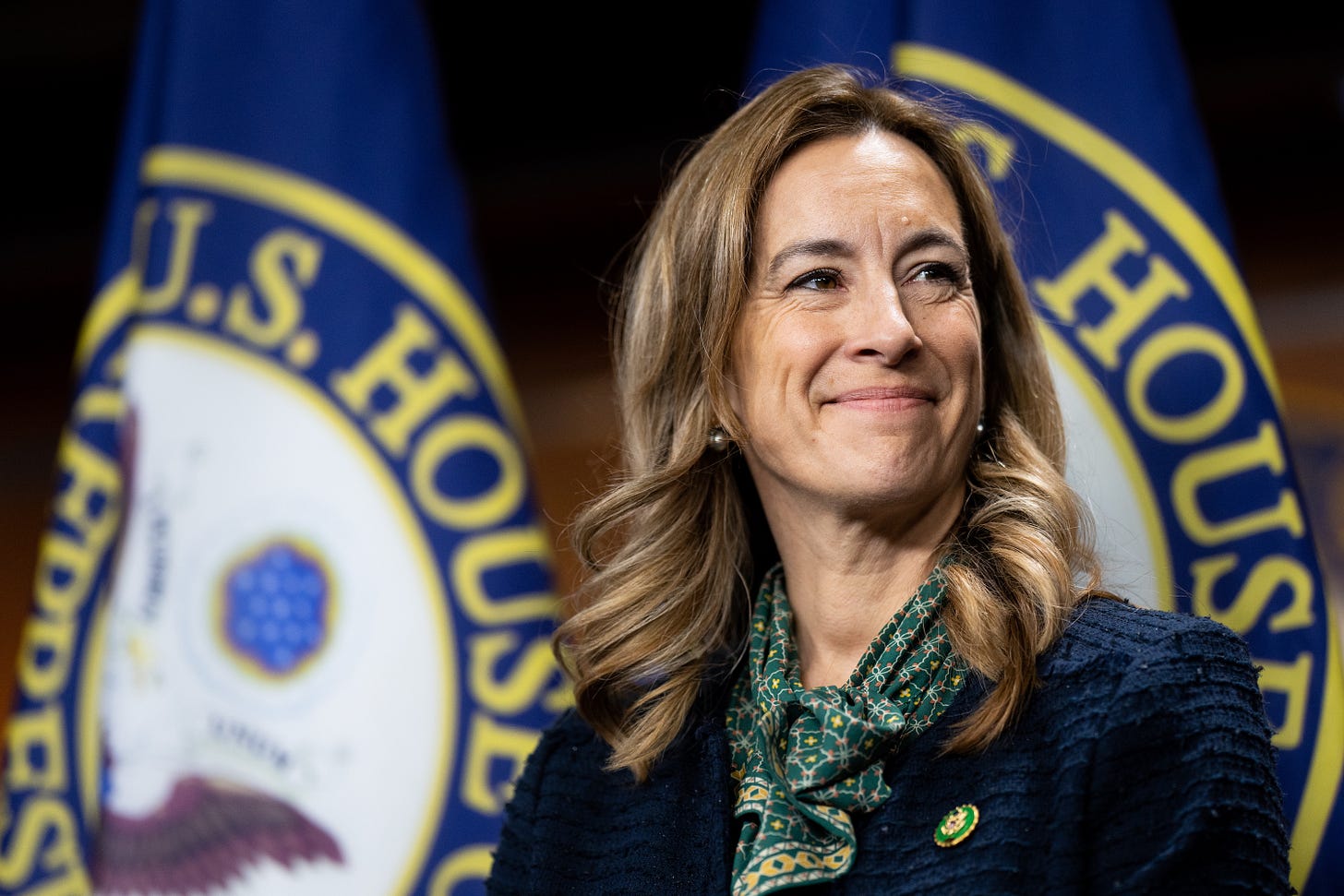
Rep. Mikie Sherrill (D-N.J.) participates in a Democratic press conference in the Capitol on November 7, 2023. (Bill Clark/CQ-Roll Call, Inc via Getty Images)
If you haven’t listened to Sarah’s Focus Group on Democrats and the New Jersey governor’s race, you absolutely should. Today.
It’s the best episode of the show, maybe ever.
I know that you don’t care about the Democratic primary in this race. But I want to talk about it in some detail because it gets at one of the Dems’ big strategic mistakes: They sometimes promise things they can’t possibly deliver. Which is a recipe for disillusionment and apathy from their voters.
Let me explain.
I am one of Mikie Sherrill’s constituents. If you grew a Bulwark Democrat in a lab, it would look like her. She had a cool job in the military. She’s an upper-middle-class professional. She’s so moderate that you could mistake her for a McCain-era Republican. By all accounts she has been a hard worker and a diligent policy person in Congress. She’s great. Seriously.
She also seems to be leading the Democratic field, though not by much. She has polled in the 30s after it had been widely assumed that her race would be a coronation.
On The Focus Group the N.J. Dems Sarah spoke with were lukewarm about Sherrill. They liked her fine but didn’t love her. This mirrors the sense I have on the ground in Manhattan.
Sherrill’s campaign focuses on exactly three things:
Housing costs
Electability
Being a helicopter pilot
Most of the Democrats running talk about housing costs as their primary issue. I understand that. New Jersey is a high-cost state and voters rank the cost of housing as their top issue.
But I want to be very clear about this: No governor can make New Jersey real estate cheaper. It’s impossible.
Why?
Great Job Jonathan V. Last & the Team @ The Bulwark Source link for sharing this story.
A wave of bills in state legislatures across the country aim to classify climate-heating methane gas as a source of “green” or “clean” energy to prevent communities from transitioning away from fossil fuels — and secretive dark money groups connected to the gas industry are behind the effort.
The legislation could threaten the enforcement of climate policies across the country, allowing gas to stand in for clean energy in states’ renewable energy portfolios or otherwise thwarting local efforts to phase out reliance on fossil fuels. As methane emissions increasingly drive climate change, the bills would disguise the devastating environmental impacts of the powerful greenhouse gas — while the Trump administration caters to fossil fuel-backed donors on federal gas policy.
State officials say the bills are necessary to protect local economic development tied to a major local source of energy. But the legislators didn’t come up with the idea on their own: the rebrand originated from model legislation introduced by the American Legislative Exchange Council (ALEC), a conservative lobbying network funded by large corporations. And in at least one case, the effort is being pushed by the gas industry itself to further entrench states’ dependence on gas.
ALEC has a reputation for providing pro-corporate model legislation to legislators, including many bills designed to obstruct climate action. In recent years, the group has drafted bills to blacklist companies that boycott the fossil fuel industry and criminalize protests of fossil fuel infrastructure.
While the group’s donors have largely been hidden from the public, its second-largest known donor is fossil fuel mogul Charles Koch, an investigation by the Center for Media and Democracy found.
A version of the methane gas rebranding bill first passed in Ohio in 2023 after it was floated by the Empowerment Alliance, a dark money gas advocacy group helmed by Trump megadonor and former gas industry executive couple Tom Rastin and Karen Buchwald Wright. According to documents obtained by the watchdog Energy and Policy Institute and first reported by the Washington Post, the Empowerment Alliance worked with Ohio state legislators on the idea, while ALEC provided a model bill and talking points for officials.
ALEC denied its involvement in Ohio’s law after the Washington Post published its story. But last summer, ALEC posted a markedly similar model bill on its website.
The model bill, titled “The Affordable, Reliable, and Clean Energy Security Act,” states that “‘Green energy’ will be redefined as meaning any energy generated by using an energy resource in which the emissions are equivalent to the standard set by pipeline-quality natural gas, (e.g. those emitted by residential gas stoves).”
Since that model bill was published, a new swath of states — including Indiana, Tennessee, Mississippi, and Louisiana — have introduced similar legislation declaring gas a “clean” or “green” source of energy. Indiana and Tennessee’s bills passed into law in April. Mississippi’s bill died in committee in February. But Louisiana’s bill — whose first iteration included exact language from the ALEC model legislation — passed in the state’s House of Representatives on June 2 and is now being considered by its Senate.
The Empowerment Alliance promotes the proliferation of ALEC’s model bill on its website. “We define American natural gas as green and clean energy,” the site reads. “We encourage all 50 states to pass legislation using the ARC Energy Security model as a starting point to unleash energy prosperity for every household and business.” Other allied fossil fuel-funded think tanks, like the Heartland Institute and the Institute for Energy Research, have also backed the model legislation.
Screenshot from the Empowerment Alliance website.
But clean energy advocates and experts say the bills are a clear attempt by the fossil fuel industry to preempt any local transition away from their products, which pose severe threats to local air quality and the climate.
“It’s simply a grand effort at greenwashing a dirty energy source,” said Gabe Filippelli, executive director of the Environmental Resilience Institute and professor of earth sciences at Indiana University.
Methane, the main component in “natural” gas, is more than twenty-eight times as potent as carbon dioxide at trapping heat in the atmosphere, and more than eighty times as potent over the first two decades of its release. Methane emissions are rising faster than ever, even as technologies for documenting and monitoring leaks have advanced.
Yet despite knowing the risks it poses to the climate, major fossil fuel producers have campaigned to promote gas as a cleaner alternative to other fossil fuels, according to internal documents made public by Congress last year.
The legislation moving through statehouses across the country would take those industry campaigns a step further, using the rebranding of gas to facilitate the continued buildout and use of fossil fuels, even if new climate and clean energy requirements are introduced.
Twenty-nine states and DC have passed renewable portfolio standards, which require a certain portion of the state’s electricity to be met with renewable energy sources like wind and solar. Some states have clean electricity standards that allow state utilities to include nuclear and other forms of energy not typically defined as renewable as “clean” energy sources. Even in states without such standards, some municipal governments have passed or considered clean energy standards at the local level.
The new bills could drastically weaken those standards by forcing state and municipal governments to include methane gas — a fossil fuel — as a source of “clean” or “renewable” energy.
Tennessee, for example, passed a law clarifying that “a political subdivision that imposes requirements or expectations related to the type of clean or green, or renewable, energy used by a public utility in an ordinance, resolution, or other regulation must include certain sources of energy” — including gas. Effectively, the law could prevent municipalities in the state with renewable energy requirements — like Nashville, which has committed to using 100 percent renewable energy by 2041 — from excluding gas in its efforts.
Tennessee initially passed a less specific law defining gas as “clean energy” in 2023, shortly after Ohio’s. According to a leaked presentation and audio, the Tennessee Gas Association — the state’s industry trade association and lobbying group — took credit for passing that bill.
“We were able to pass a bill that classified natural gas as a clean energy,” said Jim Spears, then a lobbyist for the Tennessee Gas Association at the group’s annual meeting in Orlando that summer, suggesting that he and major fossil fuel executives in the state “all worked on it together.”
“Fossil fuels are under attack,” Spears continued. “It’s a nationwide issue. . . . We have great relationships with the legislature. So that’s how we get bills passed that protect us.”
The Tennessee Valley Authority, the country’s largest public utility, is currently embarking on one of the largest gas expansions of any utility nationwide.
In Louisiana, the new bill redefining gas as green energy would go even further, declaring that the state’s Department of Energy and Natural Resources should work with the Public Service Commission to “use energy generated by hydrocarbons as a resource.” Hydrocarbons are strictly defined by Louisiana statute as being “oil and gas occurring naturally in the earth and any other valuable liquid or gaseous substance found and produced in association with them.”
According to Jackson Voss, the climate policy coordinator for the Louisiana advocacy group Alliance for Affordable Energy, the bill could be used to “preempt the development of renewables by giving political cover to our regulators” to allow the expansion of gas projects in the state.
Louisiana utilities are engaged in a public process to determine how they will meet the state’s energy demands. The state’s utilities will present their plans to the Louisiana Public Service Commission, where regulators take more campaign cash from power companies and fossil fuel interests than almost any other state.
A much narrower bill in Michigan, which is now before the state Senate, would designate two existing gas-fired power plants as clean energy. If enacted, the bill would allow the plants to continue running under the state’s energy laws, which set a standard for 100 percent clean energy by 2040 with some exceptions.
Indiana’s law — which also defines petroleum-based propane as a “clean energy,” a rebrand first promoted by the propane industry — opens gas and propane up to “any state or federal program that provides funds” originally intended for wind, solar, and other renewable energy projects.
The Empowerment Alliance celebrated Indiana’s bill in its “Common Sense” newsletter earlier this year, before it became law. “We encourage legislators in other states to examine what Ohio, Tennessee, and Indiana have done,” the newsletter reads. “Adopting a Natural Gas is Green law will lead to a clean, green, energy future.”
The Empowerment Alliance, ALEC, and the Tennessee Gas Association did not respond to requests for comment.
The methane gas rebranding appears to be one of many tactics in a yearslong industry backlash against local actions to address climate emissions from gas and calls for stricter environmental, social, and governance (ESG) practices.
At a 2019 executive committee meeting of the American Gas Association, the gas lobbying and utility trade group presented a strategy for gas companies, local trade associations, and pro-gas groups and campaigns — including the Empowerment Alliance — to block state-level public policy initiatives to ban new gas infrastructure and use in homes and buildings.
One of the lobbying group’s major 2020 priorities would be to “intensif[y] our efforts at the state and local levels on a variety of tracks in order to ensure consumers have energy choices that include clean, affordable natural gas,” according to minutes from the meeting obtained by the Energy and Policy Institute.
The move to codify gas as clean coincides with other state and federal efforts to undermine renewable energy projects while removing restrictions on the fossil fuel industry.
In Ohio, Tom Rastin, who leads the Empowerment Alliance and was until recently an executive of Ariel Corporation, one of the world’s biggest manufacturers of methane gas compressors, worked with Ohio legislators to pass its legislation labeling gas as “green.”
Rastin is also a powerful figure behind a local anti-renewable crusade in the state. According to reporting by ProPublica and Floodlight, Rastin is a major funder of Knox Smart Development — an anti-solar energy group that brands itself as a grassroots advocate — which helped provoke opposition to a large Ohio solar project. The group ran anti-solar ads in a pay-to-play “local newspaper” run by Metric Media, a Koch-linked network of partisan websites, which also featured a weekly column by the Empowerment Alliance promoting gas.
In Michigan, meanwhile, Rastin contributed $10,000 to Citizens for Local Choice, a ballot campaign that aimed to curb wind and solar projects.
The effort to block renewable development while unleashing fossil fuels is also coming from the Trump administration, which has made those policies a cornerstone of its agenda.
The federal government has rescinded nearly $4 billion in clean energy grants, attempted to “stop the enforcement” of state climate laws, and worked to kill pollution restrictions and long-standing emissions reporting requirements. The US Interior Department is planning to fast-track permitting for oil and gas projects to a maximum of twenty-fight days, and Trump has promised to revive “America’s beautiful clean coal industry.”
What’s more, Trump’s budget bill would repeal methane pollution limits under the Clean Air Act while allowing gas companies to purchase an expedited permitting process for a one-time $10 million fee, or pay $1 million to the Department of Energy to deem a gas import or export facility to be “in the public interest.”
The latest Yale Climate Opinion survey found that 66 percent of Americans support a transition from fossil fuels to clean energy by 2050. But advocates say state and federal debates over energy policy may reflect more about the fossil fuel industry’s influence than the desires of the public.
In Louisiana, Voss at the Alliance for Affordable Energy fears that industry is about to push through a gas greenwashing law that will not bode well for the state. Louisiana residents pay far higher electric bills than most of the country and have one of the least reliable grids.
More gas would “make our grid here in Louisiana even less reliable and certainly less affordable and more damaging to public health and the environment,” said Voss. “There really is no upside for anybody other than the corporate utilities, who are going to maximize profits to the extent that they can.”
Great Job Emily Sanders & the Team @ Jacobin Source link for sharing this story.
On this week’s episode, Sonny Bunch (The Bulwark), Alyssa Rosenberg (The Washington Post), and Peter Suderman (Reason) discuss the latest effort by conservatives to break into the world of big-time film production, this effort headed by Leonard Leo of the Federalist Society. Then they review The Phoenician Scheme, a movie some might describe as … conservative? Make sure to swing by Bulwark+ for our bonus episode on Wes Anderson and his forthcoming box set. And if you enjoyed this episode, please share it with a friend!
Share
Great Job Sonny Bunch & the Team @ The Bulwark Source link for sharing this story.
After a flood of crypto industry campaign cash, the US Senate is poised to pass a financial deregulation bill ensuring that when a bank goes out of business, the savings of cryptocurrency owners would be made whole before those of other bank customers.
During a bank collapse, the language buried deep in the bill could effectively require financial institutions to drain money from regular depositors’ savings and checking accounts and give it to cryptocurrency investors to reduce those investors’ losses.
The Senate legislation, known as the GENIUS Act, aims to establish a light-touch legal framework to allow banking and nonbanking institutions, such as cryptocurrency exchanges and even social media companies, to issue a form of cryptocurrency called stablecoins. The bill comes after pro-crypto interests spent at least $4 million since January lobbying Congress, the White House, and regulators on the bill and other matters, disclosures show.
Included in the legislation is a provision declaring that if a bank goes bankrupt or becomes insolvent, “the claim of a person holding payment stablecoins issued by the payment stablecoin issuer shall have priority over all other claims against the payment stablecoin issuer.”
According to Georgetown Law professor Adam Levitin, who specializes in financial regulation, this essentially means that “if a bank custodian for a stablecoin issuer’s reserves ends up insolvent, the claims of the stablecoin investors will come ahead of the bank depositors.”
So if a financial institution goes out of business, it will be legally obligated to first make stablecoin depositors whole, even if it means using what remains of other customers’ money.
“Congress is about to put the claims of stablecoin investors ahead of Ma and Pa’s bank deposits,” Levitan wrote. “In other words, the GENIUS Act is subsidizing stablecoin issuance on the back of bank deposits.”
Stablecoins, a form of crypto token, are supposed to be more dependable for investors because their value is tied to the US dollar. Issuers of these coins are required to hold reserves in various assets — such as stocks, bonds, or even other cryptocurrencies — that can be liquidated to meet a stablecoin depositors’ withdrawal request.
But experts and banking regulators have warned that without proper restrictions, stablecoins could still cause widespread financial chaos and even contagious bank insolvencies, since they’re interconnected with other, more volatile assets, including other cryptocurrencies.
For example, in 2022, the world’s largest stablecoin, Tether, lost its $1 dollar value due to the collapse of another cryptocurrency and widespread investor concerns. The 2023 collapse of Silicon Valley Bank, which threatened to wipe out over $40 billion of its customers’ savings, was also due in part to stablecoins.
“We argue that [stablecoins] create interconnections that can amplify shocks in the digital ecosystem and have the potential to spill over into the traditional financial system,” Federal Reserve economists wrote in a November 2024 report.
Many stablecoins likely won’t be covered by the Federal Deposit Insurance Corporation (FDIC), which insures up to $250,000 worth of depositors’ savings if there’s a bank failure, because stablecoins are not considered traditional forms of money. But the GENIUS Act would lead to a “FUBAR situation” if these stablecoins collapse, wrote Levitin, because the law would require institutions to use FDIC-insured deposits to cover the damage.
The Genius Act also stipulates that even nondepository financial institutions that operate like banks, such as highly volatile money market funds, will have to prioritize stablecoin holders over other customers.
“The GENIUS Act is effectively letting FDIC insurance leak out to cover uninsured stablecoins, without any insurance premiums paid,” Levitin wrote in a May 7 blog post. “Whatever the merits of stablecoins, they shouldn’t be subsidized by the banking system.”
The provision giving preference to cryptocurrency investors over depositors came after the crypto industry delivered millions of dollars to the federal lawmakers now crafting and voting on the GENIUS Act.
The cryptocurrency industry outspent all other industries in this past election cycle, doling out more than a quarter of a billion dollars to help place crypto-friendly lawmakers in Congress and the White House. During his presidential campaign last year, President Donald Trump promised to make the United States the “crypto capital of the planet” and has already delivered many crypto wish-list items, including installing crypto-friendly regulators, gutting crypto enforcement actions, and establishing Bitcoin reserves.
The crypto industry has also lobbied key regulators and politicians on the GENIUS Act and other issues since January. Coinbase, one of the largest crypto exchanges, spent at least $150,000 lobbying Congress on the bill and other matters. Other exchanges and prominent companies also spent big on lobbying on the bill and other issues: Kraken, an exchange that was accused of helping Iran evade sanctions, spent $520,000, and Tether, a major stablecoin issuer, spent $50,000.
Multiple trade groups spent $588,000 combined lobbying Congress and regulators on the bill and other matters. These groups include the Electronic Transactions Association, the Blockchain Association, and the Crypto Council for Innovation.
Venture capital firm Andreessen Horowitz, which has close ties to former White House advisor Elon Musk and is invested in multiple crypto companies, also spent $80,000 on lobbying.
Great Job Luke Goldstein & the Team @ Jacobin Source link for sharing this story.
In a passionate speech before congress in 1986, a young Joe Biden made a surprisingly frank admission. Not only was Israel vital to America’s interests, but if “Israel did not exist, the United States would have to invent an Israel.” Soon after October 7, Biden repeated this statement while receiving Israeli president Isaac Herzog at the White House.
One way of interpreting Biden’s comments is as a confirmation of Israel’s military utility to the United States. As an outpost of Western power within the Middle East, Israel has prevented the formation of a strong and independent Arab bloc and ensured, alongside the Gulf’s monarchies, that fossil fuels flow in an orderly and predictable manner. This service makes the country essential to America’s extraction of value from the periphery and undergirds Washington’s unflinching support for Tel Aviv.
But geostrategic considerations are not all that binds the United States and Israel. Domestic lobbying of the kind John Mearsheimer and Stephen Walt described in their book on the subject certainly plays a part. But as well as advancing America’s imperial interest, Israel also has deep economic ties to the United States. These ties help explain why when it comes to Israel’s security, there is “no daylight” between Washington and Tel Aviv, and why so many American firms are complicit in Israel’s ongoing genocide in Gaza.
The entwining of Israel’s economy with America’s began in earnest in the mid-1980s. At the time,Israel adopted a policy of austerity advocated by the economist Stanley Fischer as a solution to the country’s hyperinflation. (Fischer would go on to serve as the eighth governor of the Bank of Israel and as a vice chair of America’s Federal Reserve. He died on May 31 of this year.) Washington rewarded Tel Aviv with a free trade agreement, an injection of financial aid and a relinquishing of its claims to Israeli debts. This assistance allowed Israel to develop closer relations to American capital markets, which it did after the commencement of the “peace process” that led to the Oslo Accords in the early 1990s. In the years that followed, investment flows between the two countries increased significantly.
Boosted by the influx of skilled workers from the United States and Soviet Union, the 1990s also saw Israel carve out a role as a low-cost R&D lab within American capital’s wider division of labor. Israel’s information and communications technology (ICT), cybersecurity, defense, and biotech industries became especially robust thanks to these connections. With time, personnel movements between the two countries became increasingly bidirectional. The migration of Soviet-born Israelis like Ilya Sutskever to Silicon Valley — where he would go on to become chief scientist at OpenAI — is symptomatic of the latter development.
This created enduring economic bonds between Israeli and American capital. For instance, Santa Clara’s Intel has long been the largest private employer in Israel, where it employs roughly 10 percent of its global labor force and contributes 2 percent per annum to Israel’s GDP. In underwriting and purchasing Israel’s Eurobonds (i.e., sovereign debts denominated in a foreign currency), Western financial houses have also long been critical to the country’s public finances and macro stability.
This became all the more pronounced after October 7, 2023. Since then, Bank of America, Citi, Goldman Sachs, JPMorgan, Deutsche Bank, BNP Paribas, and Barclays have collectively brought US$19.4 billion worth of Israeli Eurobonds to market. Their success in marketing $5 billion worth of Eurobonds this past February allowed the interest rates attached to debts to stay within touching distance (+1.2 percent in the case of the five-year bonds and +1.35 percent in the case of the ten-year ones) of American treasuries of equivalent maturities. What is more, those same institutions also rank as leading underwriters of Israel’s shekel-denominated treasuries and among the most active investors in the secondary market where those debts are traded.
Around 75 to 80 percent of the venture capital backing Israel’s tech sector originates in the United States. And as of late spring 2025, 108 Israeli companies were traded on American public exchanges. Elbit Systems, one of Israel’s largest arms manufacturers, is one of the companies offering its shares. For nearly two decades, the company’s local affiliate has benefited from the patient capital offered by American mutual funds and asset managers like the Vanguard Group. This May, Elbit raised another $512 million from American investors via a new share offering.
America’s tech sector has also played a major role in the ongoing genocide. Amazon and Google, for instance, have both furnished Israel’s army and leading arms manufacturers with cloud services across the past twenty months.
Since October 2023, Google and Microsoft have also provided Israel’s army with their leading AI models, earning themselves public commendations from Colonel Racheli Dembinsky, the commander of the Israeli army’s Center of Computing and Information Systems Unit, in the process. Furthermore, capital from Silicon Valley has served to bolster the macroeconomic stability of the Israeli economy. The March 2025 acquisition of an Israeli cloud security firm (Wiz) for $32 billion by Alphabet, the parent holding company of Google, was the largest acquisition in the company’s history and a significant life raft to the Israeli economy.
But tech’s involvement in the genocide is not simply the result of the underlying bonds between America and Israel’s economies. It also a product of the businesses model of tech firms in the twenty-first century.
In recent years, tech has become increasingly dependent on states rather than private consumers to make profits. To varying degrees, Silicon Valley’s behemoths are all struggling to deal with three interrelated problems: competition from Chinese firms; concerns over the long-term viability of advertising and cloud rent streams; and worry that their enormous capital expenditures on AI infrastructure might not bear fruit.
In these conditions, most major firms have recognized that winning government contracts is an essential hedge against insecurity. Worrying about the prospect of profit-making in the civilian economy, American tech, like the United States’ private equity and venture capital industries, has also come to see defense and security as especially promising growth markets.
By contracting with the Israeli state, these tech firms are able to gain a source of revenue, an opportunity for field testing services and advertising service applications, and a means of staying in the Pentagon’s good graces. As the Marxist economist Rosa Luxemburg observed a century ago, militarism helps to bind the bourgeoisie to the capitalist state. In Gaza, militarism draws in finance capital via Israel’s billion-dollar orders from the Wall Street–owned General Dynamics, Lockheed Martin, and Northrop Grumman. But it also draws the support of a tech industry whose mantra just a decade ago was “Don’t Be Evil.”
Great Job Colin Powers & the Team @ Jacobin Source link for sharing this story.
ProPublica is a nonprofit newsroom that investigates abuses of power. Sign up for Dispatches, a newsletter that spotlights wrongdoing around the country, to receive our stories in your inbox every week.
Watch ABC15 Arizona’s series “Seeking Death,” based on our joint investigation into Maricopa County’s handling of death penalty cases.
Reporting Highlights
Many Charges, Few Sentences: Maricopa County has frequently pursued the death penalty but rarely secured death sentences. In nearly 350 cases over 20 years, just 13% ended in a death sentence.
Changes Needed: A former county attorney and experts say the numbers signal the need for a more deliberate and transparent process for deciding which cases warrant capital charges.
Resuming Executions: The county’s handling of the death penalty is newly relevant as Arizona has resumed executions after a two-year pause to review problems with lethal injection protocols.
These highlights were written by the reporters and editors who worked on this story.
In 2010, Vikki Valencia’s 24-year-old brother, Triny Rey Lozano, died in an almost unimaginably brutal way. He was shot in the head multiple times, dumped on a remote road outside Phoenix and set on fire.
Valencia saw only one way prosecutors could bring her family justice: The killer should get the death penalty.
Maricopa County prosecutors built a capital murder case against the man they say killed Lozano, Victor Hernandez.
Valencia knew it would take a long time but believed it would be worth it. Over nearly 10 years, she visited the courthouse hundreds of times, frequently missing work to attend hearings where she revisited traumatic images of the crime scene.
“The death penalty was the thing that we wanted most because we thought it was going to give us justice,” she said in a recent interview.
During jury selection, the case stalled because of a potential conflict of interest involving a prosecutor who had previously represented Hernandez. Years later, a second trial followed. As that jury was deliberating, prosecutors dropped the death penalty. Nine years after he was charged with killing Lozano, Hernandez was found guilty and sentenced to life in prison.
Although the Maricopa County Attorney’s Office has historically pursued the death penalty at high rates, its efforts rarely result in a death sentence.
ProPublica and ABC15 Arizona reviewed nearly 350 cases over a 20-year period in which Maricopa County prosecutors decided the crimes warranted the death penalty, and found that 13% ended in a death sentence. In most of the cases, defendants either pleaded guilty and received a lesser sentence or prosecutors changed course, ending their pursuit of the death penalty.
In 76 trials in which Maricopa County juries deliberated a death sentence, 41, or 54%, yielded one.
By comparison, an analysis of death penalty cases initiated in Harris County, Texas, from 2004 through 2023, found prosecutors took fewer cases, 24, to trial and were more successful, obtaining a death sentence 75% of the time, according to figures provided by a local advocacy group. Data over a longer time period also shows that federal prosecutors nationwide have obtained death sentences at a higher rate than in Maricopa County, according to the Federal Death Penalty Resource Counsel Project.
Pursuing the death penalty is among the most consequential decisions that prosecutors make. Each case can be litigated across the tenures of multiple county attorneys and can cost more than a million dollars. In the hundreds of Maricopa County death penalty cases that prosecutors have pursued since 2007, the cost of furnishing the accused with an adequate defense has totaled $289 million. But the outcomes in the county raise questions about the office’s judgment in its pursuit of the ultimate punishment, according to court records and interviews with more than three dozen people including lawyers, former prosecutors, family members of victims and defendants, jurors and experts.
Former County Attorney Rick Romley said there should be a review of capital charging decisions after ProPublica and ABC15 shared the newsrooms’ findings with him. Romley wondered whether prosecutors are seeking death “in the appropriate cases.”
“The jury is kind of a barometer of whether or not you’re doing a good job,” he said. “And quite frankly … if it was a school grade, that’s called an F.”
The office, now headed by Rachel Mitchell, a Republican, declined our request for an interview. A spokesperson responded to written questions, emphasizing that “only one” person in Maricopa County — Mitchell — makes the decision to seek the death penalty and that each case is reviewed throughout the process, as information changes.
Maricopa County’s and the state of Arizona’s handling of the death penalty have been questioned for years. A 2016 report by the now-defunct Fair Punishment Project, a legal and educational research group at Harvard University, cited the county, among other places, as having a history of “overzealous prosecutors, inadequate defense and a pattern of racial bias and exclusion.”
In addition, defense attorneys for a death row prisoner in 2018 petitioned unsuccessfully to the U.S. Supreme Court, claiming that Arizona’s statute was overly broad because almost every murder can be charged as a capital case. And two former prosecutors and appeals court judges wrote in a 2022 law journal article that state officials, rather than individual counties, should make all death penalty decisions to ensure the process is “less arbitrary.”
Maricopa County prosecutors’ handling of death penalty cases is newly relevant as Arizona has resumed executions after a two-year pause. The state, which has 111 people on death row, halted executions in 2014, after Joseph Wood was injected repeatedly over two hours, gasping more than 600 times before dying, according to a reporter’s account. The state executed three people in 2022 but paused after the newly elected Gov. Katie Hobbs ordered a review of the lethal injection process. Hobbs dismissed the retired federal magistrate she had appointed to conduct the review after he concluded there is no humane way to execute people.
Valencia and her family felt the case had put their lives on hold. Looking back, she said it seemed odd that the prosecution, which had pursued death for so long, decided not to once the outcome was close. (Prosecutors declined to comment on the case.)
But as Valencia learned, there’s little transparency around the process in Maricopa County. Although the final decision to seek death is made by the county attorney, each case is vetted by a little known panel, the Capital Review Committee. The county attorney’s office refused to disclose to ProPublica and ABC15 who sits on the panel, how they vote on the cases being considered for the death penalty or even which cases they review.
The office said in a statement that the process ends not with the county attorney’s office but with a trial, which is “all done in public, in an open courtroom.” The office also said that it is successful in prosecuting capital cases and comparisons to Harris County could be misleading because they ignore the “details and intricacies of individual cases.”
Establishing a committee is generally better than individual judgments, but the quality of the decisions depends on the individuals involved, said Robert Dunham, former director of the Death Penalty Information Center, a group that shares data and analysis on capital punishment and frequently highlights issues with the system.
“Anyone who says that they have a fair process and is unwilling to say what that process is, is somebody who doesn’t have a fair process,” Dunham said.
Vikki Valencia and her family waited nearly nine years for her brother’s killer to be convicted. Near the end, prosecutors stopped seeking the death penalty.
Credit:
Ash Ponders for ProPublica
“I Have to Run It by The Man”
When Romley, a Republican, was first elected Maricopa County attorney in 1989, deputy prosecutors in one of the nation’s largest counties decided whether to seek the death penalty on their own.
Among the first changes Romley made was to foster more deliberation. He created the Capital Review Committee to evaluate cases and recommend whether to pursue the death penalty. He still had the final say, but he believed that a group of veteran prosecutors would apply the law more consistently and recommend only cases that warranted the ultimate punishment.
“Seeking the death penalty is a momentous decision that you’ve got to make,” Romley said. “I wanted to make sure that we were ferreting out all the facts, that we made sure that judgment wasn’t being skewed by personal biases.”
Romley served four terms and decided not to seek a fifth, leaving office in 2004. His successor was Andrew Thomas, a Republican attorney and author, who ran as a law-and-order conservative vowing to crack down on illegal immigration and impose tougher sentences. After two years, Thomas had nearly doubled the number of death penalty prosecutions, earning Maricopa County the distinction of seeking death more than almost any other jurisdiction in the nation.
Critics said Thomas sought the death penalty for crimes that didn’t warrant it — including a case of vehicular homicide. The defendant in that case, David Szymanski, had a blood-alcohol content nearly twice the legal limit and cocaine in his system when he drove the wrong way on a freeway and killed a 22-year-old man.
A police review found that officers had violated department policy while pursuing Szymanski. Thomas relented more than a year later, and the Capital Review Committee recommended the capital charge be withdrawn. Szymanski pleaded guilty to second-degree murder and was sentenced to 22 years in prison.
The victim’s mother told the Arizona Republic, “We’ve never wanted the death penalty.”
Kenneth Everett, who was a defense attorney on capital cases for the Maricopa County Office of the Legal Advocate during Thomas’ tenure, told the American Bar Association’s ABA Journal in 2010 that it was clear decisions on the cases were made solely by Thomas. “When I begged for a deal, all of the prosecutors would say, ‘I have to run it by the man,’” he said. “Thomas certainly had the ultimate power. And if he said no, you were going to trial. And he usually said no.”
The Arizona Supreme Court convened a task force to address case delays amid a shortage of qualified capital defense attorneys.
Thomas responded to criticism of the delays by blaming defense attorneys for drawing out proceedings and the courts for failing to enforce speedy trial rules. He wrote in an Arizona Republic opinion piece, “I’ve sought the death penalty in appropriate cases knowing juries make the ultimate decision and believing they should have this option.”
Thomas won a second term but resigned in 2010 to pursue an unsuccessful bid for state attorney general. He was later disbarred for misconduct and political prosecutions of county officials. Thomas, who did not respond to requests for comment, said at the time that he was “working to fight corruption.”
After Thomas’ resignation, the Maricopa County Board of Supervisors appointed Romley to serve out the term. Back in his old job, Romley reviewed the 120 capital cases the office was pursuing at the time. He decided not to seek the death penalty in 11 of them, including a case in which a 4-month-old child was found dead at an in-home day care. The medical examiner had concluded the child died of blunt force trauma, but Romley said he brought in medical experts who disputed that and found the injuries the child suffered could have been caused by an illness.
In court minutes of a hearing to drop the death penalty in the case, the Capital Review Committee is noted as having voted 8-0 to dismiss the case, which was never refiled. But the weight of the charge on the defendant, Lisa Randall, is evident in court documents. Over the three years she was in and out of jail, her marriage fell apart and she lost her house, according to court documents. Randall couldn’t be reached for comment.
“Once you allege death, the whole game changes,” Romley said. “So many more resources go into that particular case.”
Former County Attorney Rick Romley created the Capital Review Committee in the early 1990s to evaluate potential death penalty cases.
Credit:
Gerard Watson/ABC15
“They Should Show Some of the Bravery That They Expect Us to Show”
Once a prosecutor decides to seek the death penalty, the stakes rise. The courts and victims’ families face a lengthier process, and jurors can face intense scrutiny.
The court appoints two defense lawyers, along with an investigator and a mitigation specialist. (In other cases, defendants have only one lawyer.) The defense is also given more time to prepare, to allow for an examination of the defendant’s background to find sympathetic factors that could mitigate a death sentence.
Capital trials consume more time because they consist of three parts: A jury first decides if the defendant is guilty; then jurors consider aggravating circumstances that could make the defendant eligible or ineligible for a death sentence. Finally, the jury decides if the sentence should be death or life in prison.
It’s unclear how much the Maricopa County Attorney’s Office spends prosecuting capital cases. When ProPublica and ABC15 asked the office for a breakdown, a spokesperson said that the office doesn’t track spending on death penalty cases.
But since 2007, the county has spent nearly $289 million on defense for capital cases. Last year, the county spent $26 million, more than any year since 2007, according to the Maricopa County Office of Public Defense Services.
In Oklahoma, a study released in 2017 found that capital cases cost, on average, three times more than noncapital cases.
Jodi Arias made headlines in 2013 when she was convicted of killing her ex-boyfriend. Prosecutors sought the death penalty twice, and jurors deadlocked both times. Arias was ultimately sentenced to life in prison. The two trials cost $3.2 million, including the defense and prosecution, according to officials at the time.
During the 20 years examined by ProPublica and ABC15, juries in 35 cases either voted for life, deadlocked, determined the cases didn’t qualify for death or found the defendant not guilty. In 41 cases, jurors recommended the death penalty.
Frank Baumgartner, a University of North Carolina political science professor, was surprised Maricopa County juries disagreed with prosecutors 46% of the time in capital cases. Prosecutors would save taxpayers money by exercising more discretion over which cases they pursue, Baumgartner said. They also appear to be out of step with public opinion in the county, given that juries disagree with them so frequently on the death penalty. “They’re not in sync with their local community,” he said.
People who served on capital juries in the county told ProPublica and ABC15 that they had traumatic experiences. During the selection process, potential jurors are asked personal questions in open court, making them feel vulnerable. Some have had their identities revealed by jurors who disagree with them.
A juror in a high-profile Maricopa County murder case who asked not to be named because of safety concerns called the experience “one of the worst of my life.” Once the juror learned it was a death penalty case, the stress triggered intense stomach pain. “It’s the highest penalty in the land, and I don’t think that it should be applied lightly,” the former juror said.
Given what jurors go through, prosecutors should be transparent about their decision-making, the juror said.
“They should show some of the bravery that they expect us to show,” the former juror said of the secretive committee. “You ask us to do this, to put our life on hold, to go through this, not share it with anybody. Then show some of the bravery that you hold us to, and be accountable like we would be accountable if we were caught not following any of the rules.”
In 2019, Myla Fairchild served as a juror in a case against the man accused of murdering Gilbert police Lt. Eric Shuhandler, who was killed after pulling over a pickup truck. Christopher Redondo, a passenger in the truck, shot Shuhandler in the face, setting off a 50-mile chase, prosecutors said. Fairchild said she voted against the death penalty because of Redondo’s mental capacity and long history of mental illness. Redondo was convicted of murder and sentenced to life in prison. Afterwards, frustrated jurors told the media Fairchild’s name.
She wasn’t afforded the same privacy as the prosecutors on the review committee who recommended the death penalty in the first place, she said.
“You’re not protected,” she said.
The Maricopa County Superior Court in downtown Phoenix where capital cases are tried
Credit:
Gerard Watson/ABC15
“A Total Disservice”
ProPublica and ABC15 asked the largest prosecutorial offices in Arizona and across the nation how they decide whether to seek the death penalty. The newsrooms found that no two counties handle decision-making the same way, but Maricopa County is an outlier for obscuring nearly every aspect of its committee’s work.
The ACLU sued the Maricopa County Attorney’s Office in 2019 for access to the committee’s membership and other records. Jared Keenan, the American Civil Liberties Union of Arizona’s legal director, said the organization considered the records important to the public’s understanding of the death penalty.
“Prosecuting agencies have an incredible amount of power, and that power is at its height when they make life-and-death decisions,” Keenan said. “The public needs to know who is involved in making those decisions to be able to ensure that those decisions are made responsibly, constitutionally, ethically.”
The county opposed releasing the information. “They were fighting to keep this specific information from the public for years and years,” Keenan said. A judge did not order the county to release the committee records to the public.
At ProPublica and ABC15’s request, the county attorney’s office shared a policy document listing the composition of the Capital Review Committee but said the document is “significantly out of date.” It listed as committee members: the deputy chief of the Criminal Division; the division chiefs from the Capital Litigation Bureau, Major Offenders Division and Special Victims Division; and the Community Based Prosecution Division chiefs. The policy allows the county attorney to designate other committee members.
In a statement, the county attorney’s office reiterated that Mitchell makes the final decision after considering a wide range of information.
Still, the decision can feel opaque to victims’ family members.
Sherry Spooney visits the graves of her relatives in Phoenix. Spooney wondered why prosecutors sought the death penalty for their mother in the 2016 killings of the children.
Credit:
Ash Ponders for ProPublica
When prosecutors sought the death penalty against Octavia Rogers in the killing of her three young children in the summer of 2016, they went against the family’s wishes, according to Rogers’ aunt, Sherry Spooney. Spooney and her family had lost three young relatives in the killing and didn’t want to lose Rogers to the death penalty, too. “What would it solve? How would it help the situation?” she said.
Prosecutors never spoke to the family about how they arrived at their decision, Spooney said.
The Maricopa County Attorney’s Office said it reached out to the family.
Spooney called their secrecy “disheartening” and said it caused her to wonder if the office had its own agenda in pursuing the death penalty. “It’s a total disservice, to not just the family, but the victims of the family. And in this case, we’re both, we’re one and the same, and if they’re going to make decisions for someone else, it should be known.”
Last year, after Rogers was found incompetent to stand trial, she pleaded “guilty except insane,” meaning she did not know at the time of her crime that the act was wrong. Rogers is being held at the Arizona State Hospital.
Valencia recalled that when the case against her brother’s killer was delayed, she initially blamed defense attorneys for dragging out the proceedings, but the committee’s secrecy was also contributing to the delay. Attorneys for Hernandez, the defendant, had discovered a member of the Capital Review Committee had a potential conflict of interest: A former defense attorney for Hernandez in an unrelated case had since become a prosecutor and was on the committee that voted to reject a plea deal for Hernandez. (The plea deal included the noncapital case as well.)
Prosecutors fought for nearly three years to keep the committee’s membership and its votes secret in a case that reached the Arizona Supreme Court. A judge eventually determined there was no conflict of interest in the Hernandez case.
Years later, when prosecutors withdrew the death penalty charge against Hernandez, Valencia said she agreed with the decision even though she’d once thought it would be the only just outcome.
“It took such a toll on our family, at that point, I was just ready for it to be done,” she said.
Great Job by Nicole Santa Cruz, ProPublica, and Dave Biscobing, ABC15 Arizona & the Team @ ProPublica Source link for sharing this story.
What was supposed to be a day of celebration for students at Gratts Learning Academy for Young Scholars turned into one of chaos as immigration enforcement in and around Los Angeles — along with subsequent protests and attempts to quash them — reportedly left some of their relatives too fearful to attend the elementary school’s graduation.
Gratts is in the city’s Westlake District, where immigration raids Friday led to a showdown between demonstrators and law enforcement agencies that persisted throughout the weekend. Altogether, at least 56 people were arrested in the L.A. area. In Downtown Los Angeles, near Westlake, the sight of blazes on several blocks — after riot police lobbed flashbang rounds at crowds, and protesters set off fireworks and torched cars — called to mind the wildfires that ravaged the region at the start of the year.
President Donald Trump on Sunday deployed the National Guard in this deeply blue city that opposes his mass deportations policy, a move that critics — including former Vice President Kamala Harris — argued intensified confrontations between protesters and the authorities. Commuters driving to work on Monday morning saw what remained of the clashes — self-driving Waymo cars burnt to crisps and graffiti tagged all over downtown businesses and buildings.
Schools are still reeling from the raids and the unrest, with commencement ceremonies set to continue this week.
Officials acknowledge that many families in the district — which includes an estimated 30,000 immigrant students — plan to sit out commencement because of concerns about immigration enforcement. LAUSD Superintendent Alberto Carvalho described that decision as “a heartbreak” during a news conference Monday.
“I’ve spoken with parents who’ve told me that their daughter will be the first in their family to graduate high school, and they’re not going to be there to witness it because they have a fear of the place of graduation being targeted,” Carvalho said. “What nation are we? Who in their right mind would accept that reality?”
Fears have been stoked by unfounded rumors such as the one that emerged on Friday that an immigration raid took place at Gratts’ graduation. “The claims that immigration enforcement activity arrived at the school and during the event are false,” an LAUSD spokesperson told The 19th.
The superintendent, an immigrant from Portugal who was formerly undocumented, said the district is taking steps to protect each graduation site, whether on or off campus. The school police will “establish perimeters of safety” around graduation locations and intervene if any federal agency tries to disrupt the ceremonies, Carvalho said.
“We’ve instructed our principals to not create lines, to not restrict access,” he said. “As soon as [families] come, they will enter the venues where the graduations are taking place, reducing the risk for them while on the street waiting to get in. We also have authorized the principals to allow parents to remain at the venue for as long as it takes should there be any immigration enforcement action around the area where the graduations are taking place.”
School police will also remain on site well after the ceremonies end to allow parents to exit safely. And, in limited capacities, the district will create opportunities for families to watch their children graduate via Zoom.
Carvalho said that the recent raids and unrest happened at the worst possible time, given that over 100 graduation ceremonies will be taking place throughout LAUSD Monday and Tuesday, the last day of school. Still, he said the district is prepared to protect students, staff and families.
“Every child has a constitutional right to a public education,” he said. “Therefore, every child and their parent has a right to celebrate the culmination of their educational success.”
United Teachers Los Angeles (UTLA), the woman-led labor union representing Los Angeles Unified educators, has also spoken out against the immigration enforcement that took place in Los Angeles last week.
“The ruthless targeting of hard-working people by ICE and law enforcement agencies is not only unjust but cruel,” the union said in a statement pinned to its Instagram page. “They are using violence and scare tactics to detain people who are simply trying to live and support their families. We will not stand for this.”
On Monday, United Teachers Los Angeles organized a rally to stand up for immigrant communities and to protest the arrest of union leader David Huerta, president of Service Employees International Union (SEIU) – United Service Workers West and SEIU California. Huerta was arrested Friday while observing an immigration raid at a Los Angeles garment factory. He has been charged with felony conspiracy to impede officers and could face up to six years in federal prison if convicted.
“We need more people to continue to be loud about these attacks by ICE,” the Los Angeles teachers’ union said. “History has taught us that we cannot afford to stand idly by while our community members are being ripped away from their schools, homes, neighborhoods and workplaces.”
Randi Weingarten, president of the American Federation of Teachers, the nation’s second-largest teachers union, also expressed her outrage over Huerta’s arrest, the detainment of immigrant workers and Trump’s decision to mobilize the National Guard against protesters.
“It is no coincidence that U.S. Immigration and Customs Enforcement detained David Huerta and raided the site of a known worker center — and we, alongside the entire labor movement, are demanding his and others’ immediate release,” Weingarten said in a statement. “The assault on Los Angeles contradicts all this country stands for. We are a nation made stronger by immigrant workers, stronger by the unions that represent them, and stronger by the rule of law.” Huerta was released from custody Monday afternoon.
Kamala Harris criticized the violent repression of mostly peaceful protesters in Los Angeles, singling out Trump for his role in the unrest that ensued. Harris has lived in L.A.’s Brentwood neighborhood since marrying Doug Emhoff in 2014, though she was largely based in Washington, D.C., as vice president.
“Los Angeles is my home, and like so many Americans, I am appalled at what we are witnessing on the streets of our city,” she said in a statement. “Deploying the National Guard is a dangerous escalation meant to provoke chaos. In addition to recent ICE raids in Southern California and across our nation, it is part of the Trump administration’s cruel, calculated agenda to spread panic and division.”
The White House, meanwhile, took aim at the protesters, as well as California Gov. Gavin Newsom and Los Angeles Mayor Karen Bass, both Democrats.
“Radical left lunatics are taking to the streets of Los Angeles — attacking law enforcement, hurling projectiles at police cruisers, burning vehicles, and shutting down freeways — because the Trump administration is removing violent criminal illegal immigrants from their communities,” the White House said in a statement Monday. “Democrats like Gavin Newsom and Karen Bass should be thanking President Trump for stepping up and leading where they refused — and for ridding their streets of criminal illegal immigrant killers, rapists, and gangbangers.”
Rob Bonta, California’s attorney general, sued the Trump administration Monday over its deployment of the National Guard, arguing that doing so infringed on the state’s sovereignty.
Los Angeles school leaders say they’re prepared for the Trump administration to escalate immigration enforcement, including on campuses. In January, Trump lifted restrictions on immigration enforcement in “sensitive locations,” including schools, churches and hospitals. The policy change has led parents across the country to pull children out of class. During Carvalho’s address on Monday, he said that two federal vans were parked near schools.
“No action has been taken, but we interpret those actions as actions of intimidation, instilling fear that may lead to self-deportation,” he said. “That is not the community we want to be, that is not the state or the nation that we ought to be.”
LAUSD is urging parents or guardians who see immigration activity to contact their school or call the district’s Family Hotline: (213) 443-1300.
Great Job Nadra Nittle & the Team @ The 19th Source link for sharing this story.
The U.S. ranks as the 19th most dangerous country for women, 11th in maternal mortality, 30th in closing the gender pay gap, 75th in women’s political representation, and painfully lacks paid family leave and equal access to health care. But Ms. has always understood: Feminist movements around the world hold answers to some of the U.S.’s most intractable problems. Ms. Global is taking note of feminists worldwide.
Georgia
+ Police escalate gender-based violence against women protesters
In Georgia, women taking part in anti-government and pro-European protests are being subjected to escalating gender-based violence by law enforcement. According to Amnesty International, authorities have used sexist slurs, threats of sexual violence and illegal, degrading strip searches in an effort to intimidate and punish demonstrators–largely targeting women.
These abuses come amid a broader crackdown on dissent following last year’s wave of protests. As women continue to defy government repression, they have become both symbols of resistance and targets of harassment and violence at the hands of police and unidentified collaborators.
Such acts violate Georgia’s own constitution and national laws, and also breach the country’s international human rights obligations.
Rather than silencing Georgian women, the violence has only strengthened their resolve. “Women in Georgia have risen more boldly,” said Denis Krivosheev, Amnesty International’s Deputy Director for Eastern Europe and Central Asia, “denouncing the abuse, demanding justice and turning repressions into resistance and defiance.”
South Korea
+ South Korean women say their priorities and voices are being ignored in upcoming presidential contest
When South Korean President Yoon Suk Yeol declared martial law last December, thousands took to the streets in protest—led largely by young women. They weren’t just rejecting authoritarianism; they were pushing back against a president who claimed South Korea had overcome sexism, despite clear evidence of ongoing discrimination and violence.
According to the BBC, women in their 20s made up the largest group at one December rally, part of a protest that drew over 200,000 people. For many, it was an inspiring moment in a country with deep-rooted gender-based discrimination, along with one of the highest gender pay gaps among developed nations at 31 percent.
Protesters holding K-POP light sticks dance during a rally against South Korean President Yoon Suk Yeol, after a court rejected an appeal by Yoon’s lawyer over his warrant, in Seoul, South Korea, near the presidential residence, on 5 January, 2025. (Photo by Daniel Ceng/Anadolu via Getty Images)
Women remained a vocal presence throughout months of demonstrations and celebrated when Yoon was impeached four months later. But now, as the June 3 presidential election approaches, they’re once again feeling sidelined. The two leading candidates have been largely silent on gender equality, while a third, Lee Jun-seok, has gained attention for anti-feminist rhetoric popular among young men.
For the first time in 18 years, all six presidential candidates are men–and women say their priorities are again being ignored. “Our voices don’t seem to be reflected in the [campaign] pledges at all. I feel a bit abandoned,” said 23-year-old Kim Saeyeon.
Poland
+ New president-elect deals setback to abortion rights
Hopes for easing Poland’s restrictive abortion laws have dimmed following the narrow victory of conservative canidate Karol Nawrocki. His win marks a major setback for reproductive rights, signaling trouble for women in Poland, along with the European Union and Ukraine. Nawrocki, supported by Poland’s right-wing Law and Justice party and President Trump’s administration, is widely seen as a hardline conservative on social issues.
Poland already has some of the harshest abortion laws in Europe, with a near-total ban implemented in 2020, and Nawrocki has made clear he would veto any efforts to expand abortion access. Manon Aubry, a member of the European Parliament from the Left group, warned that the country’s political trajectory poses a serious threat to core EU values and called on member states to show solidarity with Polish women.
A picture of a deceased woman, named Agnieszka, is held during a protest against Poland’s abortion ban in front of the Law and Justice (PiS) ruling party office in Krakow, Poland on January 26, 2022. (Photo by Beata Zawrzel/NurPhoto via Getty Images)
As has been the case in other recent elections around the world, voter divides were stark: women and those with higher education leaned toward the progressive candidate, while Nawrocki found stronger support among men and voters with less formal education.
“Nawrocki is expected not only to uphold but potentially tighten Poland’s already draconian abortion laws,” said Nika Kovač, coordinator for theMy voice, My Choice campaign, in a written statement. “His win slams the door on hope for political reform in the near future—and locks in a future where women’s lives remain expendable.”
The Dominican Republic
+ Over 130 Haitian women and children seeking healthcare deported
In a move condemned as cruel and misogynistic, the Dominican Republic deported over 130 Haitian women and children in a single day under a new policy targeting undocumented migrants at public hospitals. Among them were 48 pregnant women, with one reportedly in labor, seeking care unavailable in Haiti due to the country’s near-total healthcare collapse.
In recent years, more pregnant women have been crossing borders as Haiti’s worsening gang violence continues. Since the President’s assination in 2021, the country’s health services have been severely damaged, with gender-based and sexual violence increasing dramatically.
The crackdown focuses on facilities where Haitian women seek medical treatment, particularly for childbirth. Rights advocates warn the policy forces women to risk being deported by going to a hospital, or avoid care and face serious health risks.
“It is a macabre and misogynist trap,” said rights campaigner for the Americas at Amnesty International Guillermo Rodríguez.
In response to the brutal assault of a nurse practitioner in St. Andrew on May 13, healthcare workers across Jamaica staged protests demanding justice and protection. The attack occurred as the nurse was on her way to work and was captured in a video that went viral across the island.
Staff at St. James Health Services, joined by their manager, led a peaceful demonstration in Montego Bay condemning both the individual attack and the broader issue of gender-based violence.
Simultaneous protests were organized in Kingston and at health facilities island-wide by the Nurses Association of Jamaica (NAJ), the Enrolled Nurses Association and the Jamaica Midwives Associations.
The coordinated actions spotlight a growing call for systemic change to protect healthcare workers, especially women, who face rising threats and violence on the job.
Mexico
+ Mexican singer sings for women incarcerated for self defense
Mexican singer Vivir Quintana is turning a traditionally male-dominated music genre into a tool for justice. For the past decade, Quintana and her band have visited women incarcerated for killing their abusers in acts of self-defense. Just two days before her latest album’s release, Quintana was back in prison gathering the stories that shaped the project.
Vivir Quintana at the XXI Feria Internacional del Libro, 2021. (Tania Victoria / Secretaría de Cultura de la Ciudad de México / Wikimedia Commons)
Her new album, composed of “corridos”–a genre often associated with cartel glorification and misogyny–tells the stories of ten such women.
Rather than ban these songs, Mexico’s first woman president, Claudia Sheinbuam, has suggested the government promote transforming the genre, a vision Quintana has embraced.
Quintana calls the album a protest, a tribute and a call to action in response to rising gender-based violence across Latin America. In a country where women are still charged with “excessive legitimate self-defense” for protecting themselves, Quintana uses her music to amplify their voices and reclaim a genre to fight back.
Australia
+ Youngest woman senator elected to parliament
Charlotte Walker, 21, has made history after securing the third Senate seat in South Australia for the center-left Labor party. At 21 years old, she is the youngest senator in the country’s history–she celebrated her 21st birthday on the night of the federal election in May.
Her victory was officially announced by the Australian Electoral Commission last Tuesday. President of SA Young Labor, the youth wing of South Australian Labor Party, Walker was preselected for what was considered an unwinnable spot on the ticket. She now heads to Canberra, the country’s capital, to begin her six-year term on July 1, where she will attend “Senate School” and focus on issues facing young Australians, including affordable housing and balancing education with caregiving.
“I want to do a good job for South Australians, but I also want to show young people, particularly young women, that this is achievable and this is something that they can do also,” Walker said.
Her win comes amid a milestone moment for women in Australian politics: for the first time, the federal cabinet will hold a female majority.
United Kingdom
+ Fallout from Britain’s transgender ban hits women’s soccer leagues
Last month, Ms. Global reported on the UK Supreme Court’s ruling that under existing equality laws, the term “woman” excludes trans women—meaning that they can be legally excluded from certain women-only spaces, such as domestic violence shelters, hospital wards and sports teams. Now, the impact is rippling across British football.
London-based Goal Diggers FC, a soccer club created to make football more inclusive for women and non-binary people, has already withdrawn from one league affiliated with the English Football Association, which plans to prohibit trans women from competing in women’s leagues. The team says it will continue leaving any competitions that adopt similar exclusionary practices.
Following the ruling, the country’s Equality and Human Rights Commission released interim guidance suggesting trans women could be barred from using public facilities—like restrooms and locker rooms—aligned with their gender identity.
“They can stand by the FA,” said club founder Fleur Cousens in an interview with Reuters. “But we will stand by our trans members. We’ll work towards creating more (inclusive) spaces as a result.”