Thanks to all who joined us for our very special livestream of The Secret Podcast!
Sarah and JVL chat about Elon dumping Donald in the most deliciously public way. They get into who’s actually winning, whether it’s all just a stunt, and if Democrats should use the chaos to their advantage.
Plus right after, a post-credits moment from JVL: Taking the Trump-Musk War Seriously
Great Job The Bulwark & the Team @ The Bulwark Source link for sharing this story.
We’ll get to the schadenfreude in a minute, but let’s start with two big-picture thoughts:
This could all go away tomorrow. It is possible that by the time you read this, Musk and Trump will have brokered a peace. Then they say, “Ha-ha, you shitlibs fell for it. We were trolling you for the lulz. That was all kayfabe.”
There are a lot of stakeholders who desperately need Trump and Musk to end hostilities. Their incentives are strong enough to expend resources making it worth both parties’ whiles to sign a ceasefire.
If it doesn’t go away tomorrow, the Trump-Musk rift creates peril for both Trump’s authoritarian project and the tech oligarchy.
Let’s walk through the strategic implications for all of the players.
Donald Trump. There is a scenario in which he emerges from this fight stronger than he is now. If Trump is able to break the richest man in the world, he will have demonstrated a new level of power.
There are reasons to think Trump will subjugate Musk. For starters, Trump may be addled and doddering, but Musk is a man going through a multi-year, drug-fueled nervous breakdown. He is not a canny adversary. He isn’t even all that smart about power. Musk’s singular genius is for leveraging his public-market chip stack in a ZIRP environment—not an applicable skillset for this battlespace.
Also: Trump has tremendous leverage over Musk.
Musk made his primary source of wealth—Tesla stock—hostage to Trump by destroying the company as a consumer product brand. If Trump unpersons Musk, the available consumer market for Tesla goes from terrible to zero.
Trump also has all of the levers of the federal government at his disposal to hurt Tesla: He can rig tax credits against the company; cancel government contracts; reward competitors. This chart might as well be the battleplan of Operation Barbarossa:
There’s more. Musk’s second largest source of wealth is the private market valuation of SpaceX. SpaceX is heavily dependent on state-level international customers. Musk has been using his relationship with Trump to strong-arm governments into contracting with SpaceX. That dynamic could now run in the opposite direction, with Trump threatening countries who do business with SpaceX.
Even more dangerous: SpaceX should not be a private company. Under multiple administrations, the U.S. government essentially privatized the aerospace industry, which runs counter to our national interest. A sovereign government cannot allow a private company to own the top of a gravity well.
By all rights, SpaceX should be nationalized. The next Democratic administration was going to have to grapple with that problem.
Trump might do it for them.
If Tesla’s stock price implodes and SpaceX gets nationalized, Elon Musk goes from Tony Stark to Kim Dotcom.
Mind you, Trump has skin in the game, too. His project is supported by the tech oligarchy. He is (theoretically) term limited. He knows he cannot trust anyone outside his own family.
If he is unable to subjugate Musk, and Musk succeeds in creating an independent power base around which MAGA can rally, then Trump’s entire project could unravel. And quickly.
Leave a comment
Elon Musk. He has made the mistake of believing that he can target Trump the same way he targeted Joe Biden and Kamala Harris: With utter impunity.
He’s a little like John Daggett, thinking that his money gives him control—but not realizing that money only gives him control in a liberal system.
In the illiberal context, his money is muchless useful than he understands.
Musk stands to lose everything in this fight, which is why the rational version of him would sue for peace and eat whatever shit-sandwich was required. But Musk isn’t rational. He’s a middle-aged man with an alleged drug problem and a personal life that has spiraled into depravity.
Maybe that makes him dangerous? Maybe Musk goes full-Nazi and is able to paint Trump as the RINO? I don’t know.
What I do know is that over the next 72 hours Musk is going to find out what his peer set thinks and where they’re placing their bets.
You want more of this? Of course you do. It’s Christmas morning. Do me a solid: Join Bulwark+. Be part of our community. Stick it to these asshats.
JD Vance. No one has more to lose than the VC Hillbilly. Even in the worst-case scenario, Musk is worth a few billi. If Vance falls off the tiger he spends the rest of his days hustling to keep a roof over his head.
Vance’s patron has long been Peter Thiel, who made him into the darling of the techno-feudalism set. But today Vance lives in Donald Trump’s house. In order to remain viable after 2028, he has to please not just his president, but Donald Trump Jr., too.
Vance will do everything possible to avoid taking sides here, but that won’t be possible in the long run. Which is why Vance is incentivized—more than anyone else—to broker a peace.
His challenge, though, is that even if he can make it happen, how he accomplishes it will be important, too. He’ll have to get Trump and Musk to yes while
not alienating his Silicon Valley patrons,
but also convincing Trump that he is totally and completely on the team.
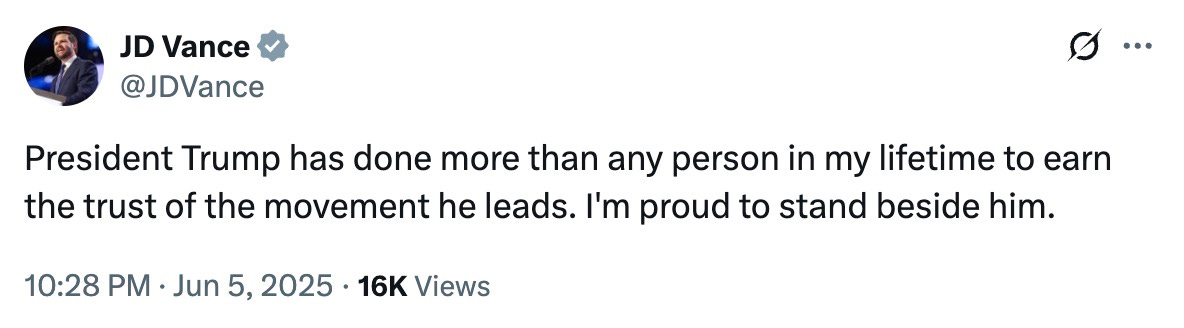
Right before I pressed send on this newsletter, Vance tweeted out a statement.
This is pretty weak stuff. Vance could have defended Trump by knifing Musk—you show loyalty by exposing yourself to consequences.
Instead, Vance waited until the retreat was underway and then put out a no-context “I support the king” pander.
Trump is smart enough to understand that this is a confession.
Leave a comment
Peter Thiel. He succeeded in enmeshing his worldview with Trump’s and is now reaping the rewards as Trump toys with using Palantir to build the American version of China’s Social Credit System.
Unlike Vance, though, Thiel could sit this one out. His goal is simply to avoid being forced to take a side so that he can ally with the winner and continue to press his quest to overturn democracy.
Congressional Republicans. Honestly? I feel bad for them.
They don’t want to get primaried by MAGA. But they also don’t want to get primaried by a Musk money bomb.
The good news is that they just have to hide for 12 months and hope that the fight is settled before the spring of 2026. At which point they “only” have to worry about the size of a potential Democratic wave.
Sarah and I taped a show an hour ago (it’s here) and while we were live we watched the outlines of a ceasefire take shape in real time. The White House press sec issued a statement basically saying that Musk was just being a good “businessman” and Musk walked back many (but not all) of his accusations and threats.
Maybe this peace can hold?
I’d trust Trump to keep up his end—he’s a transactional guy. But Musk? It is not clear that he is in control of his faculties. Maybe during his next episode he spins off and starts taking shots again.
Leave a comment
The bigger problem is the foot soldiers. During the last 12 hours a bunch of mid-level MAGA influencers took sides. Catturd. Alex Jones. You know the type.
These guys are now exposed and unlike Trump and Musk, they don’t have independent power bases. Their entire lives are dependent on being on the right side of the MAGA ecosystem. Meaning that it’s much harder for them to pretend that nothing happened. They need to make sure that they’re on the winning side and so will keep fighting.
Meaning that the Trump-Musk conflict can extend itself independent of Trump and Musk.
Now maybe it peters out. But maybe not. Maybe it’s a low-grade conflict that simmers and occasionally spikes. Maybe Republicans lose the House in 2026 and these factions try to blame each other.
All of which is to say: Once a war like this starts, no one can control it. These things can develop a logic of their own.
In a way, I’m glad that the bloom is off the schadenfreude because it lets us concentrate on the substance of what happened today.
A movement composed of money, technological infrastructure, government power, and popular support fractured.
Not entirely. Not irreparably. But meaningfully.
It’s an opportunity. It’s a reminder that these guys are not ten feet tall. And that they just might create the conditions for their own defeat.
Get on this level with us. Be part of our community. Take it all seriously. Join Bulwark+.
Great Job Jonathan V. Last & the Team @ The Bulwark Source link for sharing this story.
Breaking: Elon dumps Donald—in the most deliciously public way. Tune in at 9pm ET with JVL and Sarah for a very special live taping of The Secret Podcast.
Watch on Substack | Watch on YouTube
Share
This broadcast is brought to you by the very fine supporters of The Bulwark. Grab a drink and join us tonight as we pour one out for the demise of the greatest bromance you ever loved to hate. And consider becoming a free or paid subscriber.
Great Job The Bulwark & the Team @ The Bulwark Source link for sharing this story.
Trump publicly attacks Elon Musk during a White House press conference, accusing him of “Trump Derangement Syndrome” and blaming him for turning hostile. Musk fires back online, claiming Trump owes him credit for GOP victories. The feud exposes personal grudges, ego clashes, and policy tensions, especially over electric vehicle subsidies and a controver…
Great Job Tim Miller & the Team @ The Bulwark Source link for sharing this story.
Trump’s and Musk’s very public breakup may be amusing, but don’t lose sight of the fact that DOGE was a failure—despite what the manosphere says. Elon’s ego trip found no fraud and cut only a minor amount of spending. But those cuts are meaningfully hurting the global poor as well as scientific research at home. And now, Republicans are trying the same kind of DOGE sleight of hand on their spending bill, largely under the radar. Meanwhile, Megan McCain is getting in on the snake-oil gravy train, and the Epstein conspiracists may have it backwards. Plus, a deep dive into how Dems can win red states, fight the culture wars, and show how they’re looking out for the little guy.
Matt Yglesias joins Tim Miller.
Leave a comment
show notes
The Bulwark Podcast is available wherever you get your podcasts and on YouTube. Follow, leave us a review and wherever you tune in. Add the show to your player of choice, here.
As always: Watch, listen, and leave a comment.
Don’t care for video? Use the controls on the left-hand side of the player to toggle to the audio edition.
Ad-free editions of The Bulwark Podcast are available exclusively for Bulwark+ members.
Great Job Tim Miller & the Team @ The Bulwark Source link for sharing this story.
Well, we’re certainly not going to take advice from a political commentariat who would rather the Greens disappear altogether.
I think the first question is: How do we build a political movement that can withstand the sort of rip tides that influenced this election? I don’t just mean the enormous establishment mobilization against us, but also the contingent impacts of Trumpism, also a massive factor in the Canadian election, the collapse of the Liberal vote, and the consolidation of wealthier middle-class voters behind Labor.
The second question is whether it’s possible to build a broad coalition between renters and multicultural working-class people on the one hand, and progressive middle-class voters on the other. Some are arguing it’s not, but I disagree. To make change, it’s necessary to put together an alliance of different social groups, founded on a set of common interests. This requires a coherent political platform with material offerings that speak to both groups, broadly defined. The breakthroughs we have made in Queensland were thanks to this approach. And frankly, we aren’t winning more Lower House seats unless we can stitch together this kind of coalition.
In terms of what we can offer right now, I think a big part of it will be thanks to extraparliamentary, local organizing. In metropolitan Brisbane for instance, we still have the volunteer capacity — and, if we push, the financial resources — to run regular community meals, free family fun days, climate disaster response teams, and support networks. These initiatives can fill gaps in the lives of both renters and middle-class people. Given the experience of urban and outer-suburban life is increasingly isolated and alienated, it can be very powerful to offer both financial support and meaningful, enjoyable community engagement.
Beyond that, there are questions about the kind of extraparliamentary institutions, movements, and groups we need to build. From a structural, economic perspective, we know that the number of renters is going to keep growing and house prices will keep going up as a result of a housing system neither major party wants to touch. It’s this growing class of renters that also represent the fastest growing and most active part of the Greens volunteer and organizer base. So, how do we help foster genuine organizing among renters, to help them become self-empowered and to act collectively in their own interests?
The housing crisis is creating the basis for that kind of organizing, and for building a broader voting coalition. Although many middle-class people are not directly impacted by the housing crisis, their kids and grandkids are. Moreover, private developer–led urban development has seen Australian cities increasingly dominated by expensive, poorly built apartments or urban sprawl, without the public parks, community spaces, schools, and public transport that help people build good, meaningful lives.
Greens housing policy, by contrast, advocates for public and community-led, Viennese-style development, centered around beautifully designed, genuinely affordable medium-density apartments. Combined with expansive investment in public parks, community spaces. and public transport, it’s a vision that stands to benefit both middle-class homeowners as well as renters. Indeed, this style of “right to the city” politics was integral to the early growth of the Queensland Greens.
Beyond that, lower-income workers, renters and more middle-class, progressive voters also share an interest in tackling climate change. And importantly, this stands in direct conflict with the coal, oil, and gas industry, as well as their political wing, the Labor Party.
Also, privatized electricity, childcare, and aged-care systems are placing a real financial burden on a wide cross-section of Australian society, as well as an emotional burden, in the cases of childcare and aged care. At the same time, the share of GDP going to wages is at a record low, while the share going to profits is at a record high. And, to be honest, wages aren’t even that reliable a determinant of how wealthy you are, given the growth of asset inequality.
Growing inequality also harms communities. This can spur social concern among middle-class people, especially in suburbs where many renters also live. Interestingly enough, this is reflected in the Greens vote, which is often strongest in areas where there’s a greater disparity between the lowest and highest income earners. I think that tells us there’s a layer of better-off people who will vote for a political platform that materially lessens inequality.
Lastly, the establishment isn’t necessarily as strong as it seems. Despite Labor’s record parliamentary majority, it was their fourth-lowest primary vote in since World War II. That reflects declining trade union membership and the long-term hollowing out of the Labor Party — their support is a mile wide but an inch thick.
Given this context, the Greens have a lot to offer in the short to medium term. I still think it’s entirely possible to build a movement that both retains the inner-city electorates and grows in outer-suburban areas. I think both focuses are necessary, because if we want to see a Greens government, we need to hold on to seats like Melbourne or Griffith just as much as we need to win seats like Fraser, or Moreton.
Great Job Max Chandler-Mather & the Team @ Jacobin Source link for sharing this story.
“We have to pass the bill so you can find out what’s in it,” then-House Speaker Nancy Pelosi famously said while Democrats were negotiating the Affordable Care Act.
Republicans feasted off that quote for years, arguing that it showed how rushed and thoughtless the process was behind Barack Obama’s signature legislation. A decade-plus later, they’re now adopting that very same approach while forcefully pushing their “big, beautiful bill” through the Congress.
Great Job Joe Perticone & the Team @ The Bulwark Source link for sharing this story.
Trump publicly attacks Elon Musk during a White House press conference, accusing him of “Trump Derangement Syndrome” and blaming him for turning hostile. Musk fires back online, claiming Trump owes him credit for GOP victories. The feud exposes personal grudges, ego clashes, and policy tensions, especially over electric vehicle subsidies and a controversial bill. Trump makes a chilling comparison between the Ukraine war and a playground fight, drawing widespread criticism.
Leave a comment
As always: Watch, listen, and leave a comment. Bulwark+ Takes is home to short videos, livestreams, and event archives exclusively for Bulwark+ members.
Don’t care for video? Use the controls on the left side of the player to toggle to audio.
Add Bulwark+ Takes feed to your player of choice, here.
Great Job Andrew Egger & the Team @ The Bulwark Source link for sharing this story.
Didi Kuo’s The Great Retreat makes a compelling case that the hollowing out of political parties has played a leading role in unleashing the power of plutocrats and authoritarians around the world.
For decades after World War II, political scientists, reform-minded politicians, and pundits lamented the weakness of American political parties. Parties were seen as ideologically incoherent, dominated by regional or group interests rather than unified around a clear platform — think of the fact, for instance, that at one time arch-segregationists and civil rights leaders belonged to the same party. Reformers believed that greater ideological coherence would make government more accountable and party competition more meaningful and help voters better understand the stakes of elections.
Today, however, parties are more ideologically polarized, centralized, and internally disciplined than ever before. Roll-call unity in congressional voting is up; the ideological distance between the major parties has grown; and partisanship is a stronger predictor of citizens’ stances on the issues than ever before — and yet more Americans than ever hate political parties, and the future of democracy itself appears in doubt.
On the surface, this would seem to suggest that political parties are woefully inadequate as vehicles for effective representation and for maintaining a vibrant democracy.
To the contrary, in The Great Retreat: How the Decline of Political Parties Is Undermining American Democracy, Didi Kuo makes a forceful and largely persuasive case that strong political parties are indispensable to democratic health. Far from being obstacles to be overcome, parties with robust internal organization, deep ties to communities and interest groups, and ideologically coherent platforms that reflect the interests of their core constituencies are essential for stemming the tide of authoritarian backsliding and reasserting democratic control over an economy increasingly dominated by billionaires and plutocrats.
The real crisis, Kuo argues, lies not in excessive partisanship but in the hollowing out of parties. To defend democracy and reclaim citizen control over capitalism, she contends, we must rebuild parties as dense, associational intermediaries between citizens and the state.
Historically, Kuo notes, political parties were forged atop preexisting civic, class-based, and religious organizations. They did not merely contest elections but embedded themselves in local communities, linked citizens to state institutions, and cultivated political loyalty through ongoing interactions between election cycles. As Kuo notes of the era of machine politics in the late nineteenth century, maintaining strong connections with supporters “required knowing everything about voters: ‘their needs, their likes and dislikes, their troubles and their hopes.’”
In turn, parties served as the primary conveyor belt for ensuring information reached citizens about what the government was doing on their behalf. In this sense, parties are not just vote-getting machines but democratic intermediaries that both channel grassroots opinions and needs to the party and ensure that grassroots supporters are aware of the work the state performs for them.
In addition to the key intermediary function of parties in the early-to-mid-twentieth century, Kuo emphasizes the critical role played by labor-based and social democratic parties of the Left. These organizations, she argues, succeeded in transforming capitalism by embedding markets within democratic institutions. Left parties institutionalized collective bargaining between labor and capital, expanded social insurance, and advanced redistribution and economic planning to soften the harshest blows of the free market. During this period, political parties were widely understood as democratic solutions to capitalism’s excesses.
By the late twentieth century, however, political parties in the United States, Europe, and beyond had undergone a profound transformation. Where parties once operated as mass-membership organizations embedded in civil society, they have increasingly become professionalized, elite-driven, and disconnected from the everyday lives of most citizens.
This transformation involved the outsourcing of core party functions — such as voter mobilization, organizing, and issue framing — to networks of advocacy groups and consultants. As a result, what we call “parties” today are often little more than loosely affiliated constellations of interest groups, think tanks, donors, and media operations. As a result, parties have increasingly prioritized short-term electoral tactics, branding, and media messaging over sustained engagement with voters.
Rather than maintaining a durable, year-round presence in voters’ lives, modern parties typically appear shortly before elections — if at all — and deploy highly targeted outreach strategies to small and potentially decisive slices of the electorate. In this model, politics becomes episodic and transactional: voters are contacted when needed, segmented by demographic or behavioral traits, and urged to vote — but, beyond a small activist core, are rarely invited to engage in sustained, year-round party activities. Parties may still coordinate electoral coalitions, but they no longer serve as the primary site where political identities are forged or collective interests developed.
Kuo argues that the transformation of political parties was neither natural nor inevitable. It was the result of strategic choices and institutional shifts — many of them driven by center-left parties themselves. As neoliberalism took hold in the 1980s and 1990s, center-left leaders increasingly embraced market-oriented governance, turning to deregulation, privatization, and austerity as tools of statecraft.
During the neoliberal period, as center-left parties sought to stay within the acceptable bounds of economic orthodoxy, their capacity to offer bold and credible policies to help working people was severely curtailed. As left parties increasingly adopted market-friendly economic platforms and pursued political triangulation to broaden their electoral appeal, they became harder to distinguish from the Right on core economic issues.
In turn, their efforts to “compensate the losers” of economic globalization — particularly manufacturing jobs in industrial areas — did little to stem the decades-long decline in the living standards and life opportunities of communities left behind by neoliberal policies. This alienated many working-class voters, who found themselves increasingly unrepresented by the political system.
Yet as Kuo describes, the neoliberal shift did more than reshape economic and social policy; it redefined the role of the state and parties in society. Rather than positioning themselves as defenders of the state’s capacity to deliver collective goods, center-left parties often echoed the neoliberal view that government was inefficient or burdensome. In doing so, they contributed to a broader erosion of public trust in government.
This ideological turn was compounded by an organizational retreat: as parties shed their role as intermediary between state and society, they ceased to serve as the conduits through which citizens experienced the benefits of public policy. The result was a hollowing out of democratic representation, in which parties no longer linked voters to the state but merely sought their support at election time.
Meanwhile, elected officials from center-left parties grew more socially and economically distinct from their traditional working-class base and increasingly shifted their electoral appeals to more highly educated and affluent voters. This class divergence — combined with ever-more-professionalized and elite-driven party operations — further weakened parties’ ties to working-class communities and undercut their legitimacy among working-class voters.
In the political vacuum left by center-left parties’ pivot toward neoliberalism, disaffected working-class voters are often mobilized not by programs of economic renewal but by right-wing populists who redirect class grievances into resentment over immigration, multiculturalism, and crime. As Kuo explains, “Working-class voters opt for populist and extreme-right parties on issues related to immigration and law and order, particularly when the mainstream parties downplay the salience of economic issues.”
When mainstream parties fail to prioritize the economic concerns of left-behind communities, they leave space for authoritarian populist leaders who translate those anxieties into cultural grievances, often in the service of elite economic policy goals or undermining democratic institutions.
Kuo proposes a range of strategies aimed at reembedding parties in society and regaining the trust of citizens to stem the tide of authoritarianism and plutocracy. She calls for rebuilding parties as associational institutions through reforms such as centralizing party control over campaign financing to mitigate the role of outside funding, reinvesting in local party infrastructure, and broadening membership participation.
She also describes creative efforts by some European parties to offer incentives for joining — ranging from offering opportunities for policy input and discounted services to social events and leadership access. Other scholars have similarly found that grassroots inclusion is vital to maintaining strong ties between parties and citizens: research on Uruguay’s Frente Amplio shows that offering activists a real voice in decision-making helps sustain support and mobilization. In Mexico, the Morena party has taken a more radical approach, randomly selecting candidates from lists of party activists — dramatically increasing representativeness and deepening voter identification with the party. But while these measures may encourage involvement at the margins, they are unlikely to reestablish the kind of social embeddedness that once sustained mass parties.
Indeed, one of the limits of Kuo’s analysis is the extent to which it underestimates just how historically contingent strong parties were. As Kuo recounts in detail, strong parties emerged under very specific conditions: industrialization; a large, politically active, and less occupationally differentiated working class; and a much stronger fabric of civic-associational life.
Those conditions have largely disappeared. Without them, it’s unclear whether anything resembling the mass-party model can be revived. Kuo acknowledges this tension but does not fully reckon with its strategic implications. If parties can no longer rely on the labor movement or civil society to sustain them, what are the real prospects for party renewal? Or are we simply left with an understandable but largely unhelpful nostalgia for an admirable yet sadly anachronistic mode of politics?
If the era of mass-membership parties built over the scaffolding of strong civic institutions is unlikely to return, a different kind of party-building effort is needed — one that reverses the traditional relationship between parties and civil society. Instead of waiting for strong intermediary institutions to buoy party renewal, local party efforts may now have to generate social ties where few currently exist. That means rejecting the model of campaigns as large ad buys and last-minute voter-turnout efforts, and instead investing in long-term organizing strategies that build relationships, trust, and shared purpose in politically neglected communities.
One promising example comes from the Rural Urban Bridge Initiative (RUBI), whose Community Works program operates in low-income rural counties in Virginia and Georgia. These programs — food drives, safety equipment distribution, neighborhood cleanups — are nonpartisan in tone but backed quietly by local Democrats. They aim to reestablish a positive, sustained presence in communities often written off by the party.
Over time, such efforts might not only improve public perception but also provide the basis for more enduring political ties. While this is just one small example, it reflects a broader strategic orientation: progressives must think less in terms of electoral cycles and more in terms of the long-term rebuilding of hollowed-out institutions.
Of course, developing this kind of political infrastructure is a major challenge, but the resources needed to begin the work on a significant scale are not hard to find. In the 2024 election cycle, for instance, Democratic campaigns spent billions of dollars on ephemeral tactics like ad buys of uncertain electoral value. Redirecting even a modest share of that spending to year-round, community-rooted organizing could build meaningful ties in areas long abandoned by Democrats, and without significantly affecting the resources needed to compete effectively in the next election.
This is not to suggest that local party-building alone can resolve our current crisis of democracy. But it may be one of the few viable tools left for restoring the link between citizens and state. Political parties will not save democracy on their own. Yet without them, democracy’s future may prove tenuous.
Great Job Jared Abbott & the Team @ Jacobin Source link for sharing this story.
Guy Edward Bartkus, the suspect recently charged with suicide car-bombing a fertility clinic in California, was an efilist — a devotee of an extremist form of antinatalism.
Efilism, like all extreme ideologies today, is largely an internet phenomenon. Though, broader interest in antinatalism — the belief that having kids is morally wrong — has been on the rise. Some believe that parents have no right to bring children into the world. One antinatalist in India sued his parents over the fact that he didn’t consent to being born. Others think that voluntary human extinction is the only solution to the suffering wrought by humanity. The founder of the Antinatalism International, Anugraha Kumar Sharma, argues that “there is absolutely no hope whatsoever in this world.” He advocates for unconditional voluntary assisted suicide and claims to be a Marxist.
Antinatalism isn’t necessarily a partisan ideology, though the sentiments are mirrored in quarters of the contemporary left. “Personally, I do not think it is obvious that we have any obligation to ensure humankind continues” argues Nathan Robinson, publisher of the left-wing magazine Current Affairs. “Let the manatees inherit the Earth.” Meanwhile, Antonio Melonio, a left-wing writer who edits the popular Beneath the Pavement Substack argues that having children is “the end of radical sentiment and, in many ways, freedom itself.” For Melonio, starting a family, far from opening up a new window on the future, a new connection to posterity, marks the ultimate submission: “It is very hard to protest, organize, riot, and set police cars on fire when you have mouths to feed and mortgages to pay.”
For some, the progressive embrace of “antinatalism” might just be a reaction to the “pronatalism” espoused by the Right. Because Vice President J. D. Vance wants you to have more children, the only natural reply is that we ought to have none. For others, antinatalism is born of a kind of moral utilitarianism: the belief that not creating life is the surest way to prevent harm. And by far the most popular strand of antinatalism is climate related. People, it seems, contribute a great deal to global warming, and if they weren’t around, the planet could heal.
In fact, the reasons people give for swearing off progeny are myriad. And that might tell us something about the malaise afflicting society, and the Left in particular. The rise in antinatalist sentiments signals a collective loss of faith in the future, the exhaustion of hope, and the inability to imagine human flourishing for the next generation.
For some time now, it’s been fashionable on the Left to be “anti”: anti-racist, anti-fascist, anti-carceral, anti-capitalist, etc. Notably, these identities define themselves by what they oppose rather than what they aim to build. That is, they are progressive in form but reactive in function. After Bernie Sanders’s 2020 campaign, even many self-described socialists more closely resemble this “anti-” left than they do nineteenth- and twentieth-century social democrats. The latter had a self-assured confidence that the future was theirs to build.
In contrast, today’s progressives veer between despair and denial. Naomi Klein and Astra Taylor, for instance, insist that we’re witnessing “end-times fascism.” While they criticize the “bunker mentality” of the far right, their vision aims no higher, or further, than mere survival. “We have reached a choice point,” Klein and Taylor argue, “not about whether we are facing apocalypse but what form it will take.”
Elsewhere on the Left, prophets of climate catastrophe deliver millenarian sermons about the end of all life on Earth. It’s no wonder, then, that interest in left-wing “preppers” has recently surged. The “acclaimed climate expert” Alex Steffen commands a progressive audience that numbers in the tens of thousands. He offers a course on how to “Ruggedize Your Life” in preparation for impending social collapse.
With a discount code, you can secure a spot in the course for just $149.
This focus on survivalism is repeated by many of today’s radical abolitionists, whose guiding term is not socialism or any broader vision of collective flourishing, but a vision of simply getting by in ever-more harrowing circumstances. But a Left that prizes “survival” is one that thinks the future isn’t theirs to win, but a terrifying force to steel against.
As the economic historian Adam Tooze recently noted, these days the Trumpian right “is actually more willing to talk about the future and to do so in bold and bright terms” than the Left. Today the Right acts and the Left reacts — a stark reversal of their traditional relationship to history.
How did we get here? When did the Left get stuck in the present?
Since the decline of the postwar compact, liberals and progressives have trapped themselves in unceasing cycles of ’68, endlessly rehearsing the slogans and priorities of that cultural revolution over and over again. Periodic protests against racism and sexism burst out; ever-more discrete civil-rights-movements-for-our-time pop up. But little truly new takes shape. We measure progress by removing barriers to participation in liberal capitalist society, but we don’t aim for moving beyond it. By the 1990s — the inauguration of the “end of history” era and the big slide in social democratic party membership numbers — the Left gave up on providing any compelling vision of the future society.
Not surprisingly, a Left that doesn’t really know what it is fighting for hasn’t grown very strong.
The cycle of stagnation isn’t limited to activists either. Consider the major electoral breakthroughs of the broad left in the past half-century. Bill Clinton, the last Democratic president to carry the vote of all sections of the working class (white, black, and Latino) did so by adopting right-wing plans for the future: free trade, financial deregulation, and tax breaks.
Meanwhile, Barack Obama, the last Democratic president to carry the working class as a whole (despite losing working-class whites) promised “hope and change” while upholding a remarkable continuity with his predecessors. Liberals liked to think Obama’s election marked the ultimate triumph of the ideals of the civil rights movement, while overlooking his studied conservatism. His was a liberalism that borrowed its future from the Right and its prestige from its past. Perhaps more than anything, the Obama era unveiled a precursor to today’s futurelessness in the notion that “demographics are destiny.” The future didn’t need to be forged — it would simply arrive when all the stodgy old white people died.
And what about Joe Biden? He became the first Democrat to win the presidency while losing the working-class vote. He was, undoubtedly, more progressive than his predecessors. Yet it was Donald Trump who provided the historical rupture that made Biden’s experiments in de-globalization and fiscal policy possible. In the end, though, Bidenomics failed to deliver the goods. While some of Biden’s programs — like his infrastructure bill and the now dismantled Inflation Reduction Act — were genuine policy achievements, the government was ultimately unable to confront the interlocking challenges of rising prices, skyrocketing debt, stagnant wages, and low taxes.
He isn’t alone, the global democratic left has been incapable of developing an economic agenda that looks beyond the next election cycle. As Wolfgang Streeck has argued, social democratic parties all over the world have been “buying time,” literally borrowing their futures with debt backed spending in order to maintain social services and keep a modicum of social peace. No new model has emerged that can credibly promise prosperity and equality for the next generation.
No new social future has been invented, or even really contemplated, in decades.
A reluctance to stake flags deep into the future was once considered a hallmark of political conservatism. “Nothing is more foolish,” argued Karl Kautsky, the leading theorist of Germany’s Social Democratic Party, “than the idea that distant ideals have no practical significance in present politics.” Yet today, an obsession with the present is apparent among liberals, progressives, and socialists alike.
Among moderates, a near-sighted pragmatism forecloses long-term thinking about social reorganization. Among those further on the Left, catastrophism reigns. Ecoterrorists, various “abolitionist” tendencies, and radical antinatalists like Bartkus, are committed to foreshortening our future. By suggesting that tomorrow may never come, they overvalue the present. There is, no doubt, a certain narcissism in this. An ambivalence toward future generations involves an overestimation of one’s own.
Our view of the social horizon has steadily shortened. And now we just stare at ourselves. The demands of the present are inward-looking: more permissiveness, more tolerance, more autonomy for the individual. The new social horizon, it seems, is to be left alone. What’s more, a futureless left refuses to consider how the battles it picks today — from the liberalization of drug laws to the dismissal of social norms — affect tomorrow’s political ends.
To be sure, there are good reasons to avoid thinking about tomorrow. Escalating wars, dire climate projections, a bleak political outlook, and the slow-rolling economic crisis are reasonable causes for hopelessness. Add to these new anxieties about artificial intelligence and despair might seem a rational, not emotional response. But without a flag staked in the future — a clear vision of the world we want for our children and theirs — we lose track of where we want to go.
Not surprisingly, the contemporary left seems perennially lost and lacking the self-confidence needed to inspire followers. Intellectual timidity and insecurity prevails, despite the sheer number of academics, writers, and thinkers who count themselves among progressives. Are there any intellectuals of the Left today whose insights and commitment to humanity’s long-term horizon rival those of Karl Marx or Karl Polanyi?
Does this mean the Left is cooked? Not necessarily. Society needs — and will always need — a force that speaks for the interests of ordinary people, in favor of popular democracy, equality, and social solidarity. So long as liberal capitalist societies continue to disappoint, intelligent and ambitious people will be drawn to the socialist tradition. And the proactive among them will inspire new waves of reform. The reactivist left, however, will continue to lose. An “anti”-left can’t win.
What electorate would put their trust in a political cause that says it doesn’t care about what comes next? How could this Left inspire any faith in progress, if it’s all the same to them whether the manatees take over and the maternity wards empty out?
Ironically, to regain the future, we need to look backward. To be progressive is, definitionally, to be connected to the past. “Tradition” as G. K. Chesterton colorfully put it, “ is the democracy of the dead.”
It’s not only that all successful movements for human advancement draw inspiration from the past (this magazine is called Jacobin after all); it’s also that the old ideals have never been realized. Instead, innumerable new ideals have popped up purporting to take their place — many of them disconnected from the grand narratives of the past, or any coherent conception of a social and democratic future.
Our short-sightedness means we typically walk part way down the road of some faddish ideal before abruptly changing course — and then we wonder why we can’t seem to get anywhere. What we lack is fixity: a sense of where we’ve progressed from and to where we’re progressing. As a result, the New Deal’s Four Freedoms seem further away today than they did when they were first declared eighty-four years ago.
Meanwhile, with a new Pope Leo in the Vatican, it’s hard to ignore the warnings of his namesake predecessor: that the collapse of the future poisons our moral vision of the present. At its most extreme, giving up on the future means a surrender to the present as an endpoint — or as the end. It’s to see the project of humanity as completed.
The fertility clinic bomber and other “promortalists” embrace this mindset. In their own words, they are not wrathful, but charitable. They see humanity as defined by suffering — and reason that, because new life will suffer, the compassionate act is to prevent it altogether. Dwelling in this darkness, the whole of humanity unravels.
In contrast, Marxist philosopher Ernst Bloch, in The Principle of Hope, defended the future. He rejected what he called the “pure infamy” of the present. Capitalism, he believed, harbored a wickedness — a humiliation of human dignity through poverty and the instrumentalization of human life. He judged society not against the sins of the past, nor by some abstract principle of minimizing suffering, but against the potential of a brighter future. Evil, he argued, could only be conquered by hope — a concept defined by reference to the future.
And when it comes to children, contra the antinatalists, aren’t they the very embodiment of hope? There is no more concrete way to demonstrate faith in the future of humanity than to give life to it.
Great Job Dustin Guastella & the Team @ Jacobin Source link for sharing this story.