The storylines in Slumlord Millionaire, the documentary about the struggle of New York City tenants and homeowners confronting predatory real estate interests’ fast-gentrifying neighborhoods that is opening in theaters in New York today, are disturbing.
The youngest son of the Bravo family in Sunset Park, Brooklyn, struggles with asthma, like over 300,000 other New York children, his condition deeply connected to the mold and rodent droppings that the landlord has refused to remedy. The residents of Chinatown, one of the last working-class neighborhoods in Manhattan, fight both neglectful landlords and the takeover of their community by developers of luxury real estate. Janina Davis’s experience as a black woman scammed out of her home that was supposed to provide her with security is so common that Keeanga-Yamahtta Taylor coined the term “predatory inclusion” to describe the phenomenon.
At its most optimistic, Slumlord Millionaire highlights the power of tenant organizing. The Bravo family and other tenants play core roles in the passage of the Asthma Free Housing Act, which requires landlords to address mold and rodent infestation. And they ultimately win a ruling that required their landlord to make repairs and stop harassing them. Chinatown residents come together to resist developers’ plans for hundred-story glass skyscrapers in their neighborhood.
But the film’s core theme is the enormous social cost that comes with the United States’ commitment to treating housing as a wealth-building commodity, rather than as an essential need and human right.
The brazen toxicity of billionaire developers is demonstrated by the experience of Moumita Ahmed, who lives with her parents in a rent-stabilized apartment in Jamaica, Queens. When Ahmed runs for city council on a pro-tenant platform, she faces hundreds of thousands of dollars spent in shameless attack ads. The ads were funded in significant part by Stephen Ross, one of the two hundred richest people in the world, the owner of the NFL Miami Dolphins, and a billionaire who famously did not pay any federal taxes for more than a decade.
Even more disturbing is the success those wealthy real estate interests have had in weaponizing the government to further their displacement schemes. The local housing courts that host and fast-track the removal of renters are referred to here by legal aid lawyers as “eviction mills.”
Still from Slumlord Millionaire. (PBS)
New York’s notorious 421-a tax–break program is revealed to be directing billions of dollars to the landlords that kick out longtime renters to build luxury towers, a local iteration of the national tax policies that enrich luxury housing developers like Ross and Donald Trump. “The 421-a program cost the city of New York City $1.7 billion in the last fiscal year. That money could have been put towards building deeply affordable housing. Instead, it supports luxury housing.” Michelle de la Uz, executive director of Fifth Avenue Committee, says in the film.
A Manhattan Chinatown resident speaking at a demonstration was more blunt: “It is unconscionable that the government is paying these developers to destroy our communities.”
Ironically, a better approach is usually within sight of these corporate-welfare buildings. New York City’s public housing programs are far from perfect, but housing policy experts like Nicholas Dagen Bloom have held them up as multigenerational success stories. At its best, New York City public housing has approximated the shining social housing models already established in places like Vienna and Singapore, and actively being planned in Hawaii and California.
But more typical of the US housing story is the struggle of working-class renters and homeowners of color as depicted in Slumlord Millionaire, in stories that have been replicated for generations. “Our whole country is built on the theft of land from Native Americans and the theft of labor from African Americans. So what we are seeing with real estate fraud is just a continuation of that,” says one of the attorneys representing Davis. Davis herself connects the through-line of racist appropriation of property to redlining and, now, to deed theft.
Slumlord Millionaire does a service by shining a spotlight on these injustices. But maybe its greater contribution is lifting up the tenants who are fighting back.
Tenants vastly outnumber wealthy landlords, and the organizing depicted in Slumlord Millionaire is being replicated in places like Bozeman, Montana, Kansas City, and Louisville, along with New York, Los Angeles, and Chicago. The real estate developers’ attacks on Ahmed sank her city council campaign. But her vow near the close of the film is heartening: “There are always going to be people who stand up to corporate power and corruption, and they are gonna be attacked for it. Stephen Ross can bury me, but others will come.”
Great Job Fran Quigley & the Team @ Jacobin Source link for sharing this story.
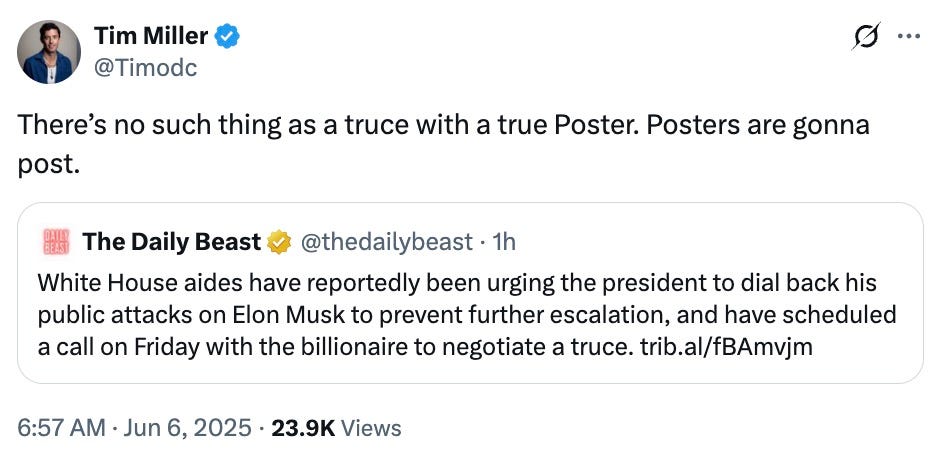
Ordinarily Bill and Andrew try to tackle different topics in Morning Shots, but you wouldn’t ask one of us to pass silently over this Trump/Musk story, would you? Pick your poison—and hey, maybe we’re both wrong! Happy Friday.
“AND ANOTHER THING: YOU DRESS LIKE A TODDLER” (Photo by Roberto Schmidt/AFP via Getty Images.)
by Andrew Egger
In yesterday’s Morning Shots, Bill wisely counseled Democrats (and the rest of us) to ward our hearts against developing a Strange New Respect for Elon Musk. We didn’t know how soon our resolve would be tested. Elon spent yesterday making some excellent points.
In a must-read emergency Triad last night, JVL laid out the stakes for what happens if the fight between the two men continues at a boil and what happens if it goes back to a simmer. These people, who have enormous opportunities to wound one another, have correspondingly massive incentives to go back to playing nice—but then, they had massive incentives never to pick the fight in the first place.
Whether they make peace or not, it would be malpractice for Democrats not to make this whole sordid episode a bedrock part of their critique of the Trump administration.
Since Trump retook office, the unholy MAGA/tech alliance personified in the persons of Musk and Trump has been fundamentally unlike ordinary political corruption or access-trading. Trump didn’t just give Musk ample opportunities to make himself richer; he gave him unprecedented authority to remake the U.S. government in his own image. It wasn’t just DOGE. Musk’s SpaceX was positioning itself to helm the effort to update the Federal Aviation Association’s creaky communications systems. Trump’s trade-war negotiators were hard at work strong-arming smaller nations into giving contracts to SpaceX’s Starlink service.
How confident was Musk that his businesses enjoyed a favored position in White House policy? Last month, he tried to bully the United Arab Emirates into shoehorning his AI startup into an Abu Dhabi data-center deal they had struck with Sam Altman’s OpenAI, claiming Trump would never approve the deal if Musk wasn’t included. (The White House did approve the deal, however, in what now appears to be a critical and underappreciated moment in the disintegration of the relationship between the two men.)
All along, the line from Trump world was that Elon was simply the best man for every job. “Elon loves the country,” the president said back in March. “He’s never asked me for a favor, not one time.” This convenient fiction lasted about five minutes into the men’s public feud. “The easiest way to save money in our Budget, Billions and Billions of Dollars, is to terminate Elon’s Governmental Subsidies and Contracts,” Trump posted on Truth Social. If those contracts were so good for the country yesterday, you’d think they’d be good for the country today, whatever Musk’s stance on the Big Beautiful Bill.
To this Musk responded: You can’t fire me if I quit. “In light of the President’s statement about cancellation of my government contracts,” he posted, “SpaceX will begin decommissioning its Dragon spacecraft immediately.” A few hours later, he backed off this specific threat. But the disquieting reality continues to hang in the air: Major parts of our government rely on a return to goodwill between two of the most arrogant and emotionally unbalanced men alive. In what world is that not a massive national security risk?
This is how Trump wants to run everything, of course—from the broadest-swath international trade policy down to the nitty-gritty level of individual government contracts. His lodestar is rewarding friends and punishing foes. It’s not even clear that, in his megalomania, he sees this as a different thing from rewarding good work and punishing bad work. Of course it was previously good for the country for the computer and business genius Elon Musk to run everything—it’s obvious what a good, patriotic guy he is from how much he loves Trump. Of course it’s good for the country now to pull the plug on everything Musk touches—tragically, you can tell he’s gone crazy by the fact he criticizes Trump.
Democrats need not embrace Elon Musk to hammer these points home. Two of the world’s most powerful men are having a dirt-kicking hissy fit. It’d be a better world if they couldn’t drag the rest of us into it too.
Share
by William Kristol
Some dramas end in postmodern ambiguity. But not, I think, the drama of Donald Trump and Elon Musk. The outcome of this confrontation will be straightforward. In fact it is already clear: Trump wins. Musk loses.
The action began a week ago when Donald Trump fired Elon Musk. Yes, fired. Musk had served his purpose. His money had helped Trump get elected. His shock troops had helped in the takeover of the executive branch in the first months of the administration. But Musk’s prominence had gone to his head. His shock troops had gotten too big for their britches. He’d outlived his usefulness as a separate force, though some of his people willing to pledge loyalty to Trump could be merged into Trump’s political apparatus.
Trump had gotten what he needed from Musk, and he wanted Musk gone. The firing was spun as a “breakup” or “divorce.” But in fact Musk was dumped.
Trump offered Musk a reasonably gracious exit, with a public expression of gratitude and a key to the White House. But Musk chose not to go quietly. The ketamine-addled Musk chose to go to battle stations.
But his attack on Trump fizzled.
The key moment yesterday was when Musk tweeted: “Time to drop the really big bomb: @realDonaldTrump is in the Epstein files. That is the real reason they have not been made public. Have a nice day, DJT!” The reaction in MAGA world was widespread disbelief or indifference. The threat fell flat. If you declare you’re dropping “the really big bomb” and it fails to detonate, you’re in trouble. Musk’s threats to start a third party and his apparent endorsement of the idea that Trump should be impeached made him seem even more desperate.
Share
Trump stayed relatively calm. Musk’s wealth depends to a large degree on federal government contracts or favorable treatment from the government. Trump simply reminded Musk that he’s president and could put those contracts and deals at risk. Implicit was the further threat that the massive power of the executive branch, staffed at every key position by Trump loyalists, could be deployed more broadly against Musk, with investigations into a host of his business dealings and, for that matter, his personal life.
To put it indelicately: Trump has Musk by the balls. Trump knows it. And now Musk knows it.
And so Musk has begun to back down. He’s probably realizing that he should be grateful that he lives here in America. He won’t have to face a fate analogous to that meted out by Trump’s role model Putin to the rebellious Yevgeny Prigozhin in 2023 (blown out of the air), or to the oligarch Mikhail Khodorkovsky in 2003 (thrown into prison).
The upshot is that Musk loses and Trump wins. It’s likely that, after weathering a little further turmoil, Trump will emerge stronger than ever, having crushed the richest man in the world. Musk operatives working in the administration—and Musk allies dealing with it from outside—will have to pledge fealty to Trump. Musk’s fellow oligarchs will be cowed. And Donald Trump, meanwhile, will have unparalleled personal control of the executive branch of the federal government.
If he then gets his budget bill through Congress—which I think likely—and concludes a nuclear deal with Iran—which I think quite possible—Trump will be riding high. The strongman will be stronger than ever.
Leave a comment
So, about last night… The Trump-Musk breakup became too big to ignore, so we went Bill O’Reilly on Inside Edition and did it live: JVL and SARAH did an emergency livestream on the intra-MAGA fight.
Taking the Trump-Musk War Seriously… And then JVL wrote this special emergency Triad: In chaos there is opportunity.
Why Is Trump Trying to Fire This Museum Director? If the president succeeds in sacking National Portrait Gallery Director Kim Sajet, writes CATHY YOUNG, it could put the whole Smithsonian under his thumb. That would be very bad.
We Have to Pass the Bill So You Can Find Out What to Regret…Plus, in JOE PERTICONE’s Press Pass, the CBO’s straight talk gets all the hate on Capitol Hill.
BANNON’S MODEST PROPOSALS: While many MAGA figures are hovering anxiously on the sidelines, hoping this whole Trump/Musk feud blows over before they’re compelled to pick sides, Steve Bannon wasted no time Friday settling scores against Musk, whose tech-forward program has shoved Bannon’s own nationalist-populist agenda to the side. And he’s got no shortage of ideas.
“They should initiate a formal investigation of [Musk’s] immigration status,” Bannon told the New York Times, “because I am of the strong belief that he is an illegal alien, and he should be deported from the country immediately.” He added that Musk should lose his security clearance and be investigated for his reported drug use.
On his own War Room podcast, Bannon said Trump should play hardball about Musk’s threat to decommission SpaceX craft: “When he threatens to take one of the big programs out of SpaceX, President Trump tonight should sign an executive order calling for the Defense Production Act to be called and seize SpaceX tonight before midnight.”
Musk responded by calling Bannon a “communist retard.”
Share
NO PRIDE: During last year’s Pride Month, the International Brotherhood of Teamsters did not waste any time celebrating. On June 1, the first day of the annual month-long celebration of the LGBTQ community, the union posted a digital flyer to their Facebook account stating that “Teamsters Celebrate Pride Month” in rainbow letters. They posted a rainbow flag emoji on Twitter and wrote: “We honor and celebrate our LGBTQ+ members and fight every day for equality and fair treatment at work regardless of sexual orientation.”
Fast-forward one year, and the union’s public embrace of Pride Month has been essentially nonexistent. As of this morning, the Teamsters have yet to post anything about it from their social media accounts.
That absence stands in contrast to other labor groups like the AFL-CIO, the United Steelworkers, and the United Auto Workers—all of which have shared Pride content this week. And it suggests that the Teamsters union, which sought good relations with Trump during the campaign, is making adjustments to stay in his good graces during his presidency. Trump has railed against DEI initiatives and rejected public embraces of identity groups. It’s a subtle capitulation that speaks to the lengths some groups will go to in order to avoid the administration’s ire.
The Teamsters press office did not respond before publication to The Bulwark’s request for comment. But Andrew Rivas, president of the Teamsters’ LGBTQ+ caucus, told The Bulwark the caucus felt supported by the union’s leadership and noted that sometimes it can take time for social media posts to make their way through the chain of approval.
Rivas acknowledged there had been some frustration among rank-and-file members after Teamsters president Sean O’Brien spoke at the Republican National Convention last summer and declined to endorse the Democratic ticket—the first time the union had not done so since 1996. Still, Rivas insisted the current political atmosphere hadn’t altered the union’s support for his caucus.
—Lauren Egan
SOME QUIET FUNCTIONING: While the president and the world’s richest man spent yesterday sucking up all the attention, the Supreme Court quietly had a pretty great day, issuing a string of strong unanimous decisions on ostensibly hot-button issues.
In Ames v. Ohio Department of Youth Services, the Court struck down a circuit-court ruling that had threatened to place a heavier burden of evidence on members of majority groups than on members of minority groups in bringing discrimination suits. “By establishing the same protections for every ‘individual’—without regard to that individual’s membership in a minority or majority group—Congress left no room for courts to impose special requirements on majority-group plaintiffs alone,” wrote Justice Ketanji Brown Jackson for the unanimous court.
In Catholic Charities Bureau v. Wisconsin Labor & Industry Review Commission, the Court found—unanimously again—that a Catholic charity could not be denied a tax break for religious institutions simply on the grounds that its work of caring for the poor was, in the judgment of state regulators, “charitable and secular.”
And in Smith & Wesson Brands v. Estados Unidos Mexicanos, the Court unanimously ruled that a lawsuit from the Mexican government seeking to hold U.S. gun manufacturers liable for cartel gun violence could not move forward. Setting aside the issue of moral culpability, the Court ruled that a 2005 law designed to shield the gun industry from lawsuits concerning misuse of guns was applicable here: “Mexico’s suit,” Justice Elena Kagan wrote, “closely resembles the ones Congress had in mind.”
Our pal Gregg Nunziata at the Society for the Rule of Law summed it up well yesterday: “While no human institution is perfect, we have a very high functioning federal judiciary, for which we should be grateful.”
Share The Bulwark
Leave a comment
Great Job William Kristol & the Team @ The Bulwark Source link for sharing this story.
Natasha Lyonne is the cofounder of AI-utilizing Asteria Film Co.
On this week’s episode, I’m joined by New York Magazine features writer Lila Shapiro to discuss her feature story on the growing utilization of generative AI by Hollywood studios to cut costs and speed up production times. From a party hosted by an AI studio to the work being done by Runway to the growing sense that, hey man, this is just The Future, it seems like AI is, as several folks in the piece put it, “inevitable.” If you enjoyed this episode or learned something in it, please share it with a friend!
Share
Great Job Sonny Bunch & the Team @ The Bulwark Source link for sharing this story.
The subreddit r/InformedWarriorRides offers an entertaining snapshot of the modern liberal bumper-sticker scene. It’s changed a lot since 2003, when I personally had my young liberal mind blown by bangers like “Homeland Security: Fighting Terrorism Since 1492.” But these days, you don’t see as many blanket denunciations of the US military-industrial complex as you used to. Certainly missing are complaints about government surveillance or the lying mass media — those are now over at the right-wing sister sub r/InfowarriorRides.
A bumper rhyming human need with corporate greed, paired with the command to “Buy Union,” is labeled in the liberal subreddit as “old school informed.” Today’s liberal informed warriors have more au courant concerns: Black Lives Matter, Palestine, abortion, and trans rights.
But there is one issue that truly dominates: Donald Trump.
Liberals are no longer thinking globally and acting locally: they’re thinking about Trump’s tiny hands, orange hue, and felony convictions. They’re telling Trump to go to hell and take Elon Musk with him. The vibe is less peace and harmony than visceral hatred and mockery: even the beloved “COEXIST” has been sacrilegiously restylized as “EAT A DICK.” And the primary target of this aggression is the “wannabe dictator,” the “shithole president,” the “fascist POTUS,” “Putin’s bitch,” the “clown” himself: Donald J. Trump.
Trump is certainly infuriating and dangerous. But single-minded fixations can produce some blinders on key issues, including on the desperate need to craft a substantive positive political vision that can successfully defeat someone as dangerous as Trump. The most important argument against what has been called “Trump Derangement Syndrome” is surely that it has not succeeded in stopping Trump.
The liberal base didn’t develop this fixation out of nowhere. Party leaders and sycophantic partisan media, lacking a defensible and coherent political vision of their own, cultivated it by speaking of little else but Trump for ten years straight — with a level of attention that far exceeds that given to previous presidents and presidential candidates.
Long faced with the challenge of defending an unpopular neoliberal agenda while maintaining credibility among progressive voters, Democratic Party elites discovered that Trump hatred could paper over every contradiction within the party. Why articulate a vision for free public health care for everyone or ending the affordable housing crisis or boosting stagnant wages when you can spend campaign funds on ads about Trump’s criminal record?
From fundraising emails to debate talking points, party messaging has reorganized around a single principle: nothing could be worse than Donald Trump. True enough. But this reflexive anti-Trumpism has become a substitute for a governing philosophy, leaving the party without coherent answers to the fundamental questions: What do we stand for? What future are we building? How do we improve people’s lives? This lack of an independent vision has left Democrats ideologically rudderless and robbed voters of a political identity beyond antipathy to the other party’s leader.
The liberal media ecosystem has enthusiastically enabled this Trump-centric worldview, turning political news into what-did-he-do-this-time entertainment and political commentary into therapy for traumatized Democrats. MSNBC and CNN discovered early on that Trump outrage drives ratings more effectively than policy discussions. In their pursuit of attention and advertising dollars, Democrat-aligned media has transformed liberal voters into obsessives and cranks, training viewers to see every issue through the lens of Trump rather than through the lens of a coherent politics.
Tragically this strategy has not made the Democratic Party any more adept at solving the one problem it elevates above the rest. Without a legible and popular political agenda, the Democrats have become enervated and disoriented. Voters perceive this: a recent survey finds that a mere 10 percent of Americans believe Democrats have a solid strategy for opposing the Trump administration. The highest share of respondents, 40 percent, believe Democrats have no plan, while the second-highest share, 24 percent, believe they have a plan and it’s bad.
Summarizing these survey results, the pollster said, “Voters correctly identified that the Democratic Party has lost its way.” Little wonder. A party defined entirely by opposition to its enemies is fundamentally controlled by them.
On issue after issue, Democrats have let opposing Trump guide them like a North Star. In some cases, this is a purely instinctual, visceral reaction. Some anti-Trumpisms lead to counterintuitive places and have serious political consequences. Take free speech, an issue long held sacred by and strongly associated with the broad left. It is also a popular political issue, with 91 percent of Americans saying that protecting free speech is integral to democracy.
There’s no political upside to ceding free speech to the Right — but that’s exactly what Democrats did as Trump elevated concerns about liberal censorship. Democrats responded by celebrating corporate deplatforming of their opponents, defending campus speech restrictions, and finding exceptions to their historic commitment to the First Amendment.
Now that Trump is targeting Palestinian solidarity activists for their political speech, the broad left has an opportunity to reclaim the issue. But we have our work cut out for us, given that Democrats have spent years dismissing civil liberties concerns and arguing in favor of cutting the mic.
For centrist Democratic Party legislators and strategists, there is a certain freedom in this moment. Pretenses can finally be dropped. For instance, Democrats have never been reliably antiwar, but their base has. Historically that contradiction has caused a great deal of trouble for party leadership, as at the 1968 Democratic National Convention in Chicago. Those contradictions have persisted into the twenty-first century. Liberals and leftists flooded the streets to oppose the invasion of Iraq, which many Democrats had voted for. After the Biden administration rolled over for Israel’s genocidal assault on Gaza, dissent from the base played a role in the party’s 2024 electoral defeat.
If only there were some way to make the liberal base more flexible on issues related to war. Enter the combination of Trump’s erratic foreign policy positions and liberals’ negative polarization. Many post–Cold War liberals saw NATO as an outdated institution that should have been dissolved alongside the Warsaw Pact. They viewed the alliance’s eastward expansion as a way of maintaining American dominance rather than promoting democracy, inevitably leading to costly military commitments and dangerous tensions. In the face of this skepticism, more hawkish elements within the party were obliged to temper their rhetoric.
Now Trump’s appalling coziness with Vladimir Putin, his humiliation of Volodymyr Zelensky, and his transactional approach to alliances have permitted interventionist Democrats to let their bloodthirsty freak flags fly. They can publicly extol the virtues of NATO without facing criticism from their own side, which is increasingly inclined to agree.
The negative polarization phenomenon also helps Democratic elites resolve long-standing contradictions around trade policy. It was the Democrats who passed NAFTA, while at the same time claiming to represent the blue-collar manufacturing workers and communities most negatively impacted by trade liberalization, as well as scores of other voters who were skeptical of its merits. Party leaders performed elaborate mental gymnastics to justify trade deals that their base correctly feared would harm American workers.
In this context, Trump’s crude protectionism has been a gift: now neoliberal Democrats can position themselves as the reasonable defenders of international commerce without blowback. They can dismiss neutral tools like tariffs as foolhardy meddling in exquisitely calibrated global markets. It is, for many neoliberal Democrats, surely a delight no longer to have to feign an interest in restricting the free movement of capital.
The story repeats itself on issue after issue. Corporate Democrats have long been financially enmeshed with major health care companies but haven’t been entirely free to openly defend them due to agitation from the base. For decades, the phrase “Big Pharma” has been associated with the Bernie Sanders–style left and associated causes like decreasing prescription drug costs and single-payer health care, decidedly uninteresting to Republicans. Now Trump’s head of Health and Human Services, Robert F. Kennedy Jr, is aggressively attempting to wrest the title of chief Big Pharma critic from Bernie Sanders — even accusing Sanders himself of being an industry shill. If Kennedy successfully tarnishes all critique of health care profiteering with his brand of anti-science quackery, it will be a comfort to mainstream Democrats in leadership or key committee roles, who routinely accept substantial sums from the major industries.
Likewise, the Democratic Party has long struggled to balance its base’s deep suspicion of the national security state with its own institutional investment in those agencies. Trump’s conflicts with the FBI and CIA have resolved this tension by casting intelligence services as heroic defenders of democracy. Historically Democratic voters have long been skeptical of the FBI, associating it with unsavory activities like illegal wiretapping and harassment of progressive movement leaders. Democrats and Republicans switched positions on the FBI between 2014 and 2017, coinciding precisely with the arrival of Trump on the political scene. Same story with the CIA, which lefty liberals long associated with coups, black sites, and torture. When the CIA determined that Russia had interfered to aid Trump’s victory in 2016, Trump declared war on the agency. Liberals’ and conservatives’ positions reversed that same year.
The irony of Democrats reducing their entire politics to opposition to Trump over the last decade is that, as a result, Trump now faces no credible opposition. Democrats have created a hollow, reactive politics that validates Trump’s centrality to American life while abandoning any semblance of independent political identity. With no anchor, the base is blowing listlessly in the wind, and whole segments are flying away.
The party’s Trump fixation is symptomatic of a broader refusal to resolve its own contradictions and develop a coherent, popular political program. What would genuine, successful political opposition to Trumpism look like? It would start with an internally coherent worldview rooted in easily explainable and morally defensible principles that speak to the values of average Americans. No party can fight and win without a consistent, legible politics that spans disparate issues and stands the test of time.
A successful opposition would articulate a vision of economic democracy that cuts through the cultural noise of our scrambled political moment. Positions would flow from the same underlying analysis of who holds power and how they use it. A principled politics would maintain that free speech is essential no matter who’s championing it, that unrestricted capital movement is predatory no matter who’s criticizing it, and that war is bad no matter who’s waging it.
A worthy opposition would speak to the material conditions that actually shape people’s lives, offering concrete solutions to housing costs, student debt, stagnant wages, and economic insecurity. It would unite people across lines of cultural difference on the basis that the vast majority of Americans, no matter how politically polarized, have similar problems and share similar common enemies: the economic elites who profit from their labor and prey on their misfortune.
Without an opposition like that, we’ll just be slapping on new bumper stickers every few years while nothing fundamentally changes.
Great Job Meagan Day & the Team @ Jacobin Source link for sharing this story.
DONALD TRUMP’S ANNOUNCEMENT in a May 30 Truth Social post that he had fired the director of the National Portrait Gallery, Kim Sajet, on the grounds of supposed partisanship and commitment to “DEI”—diversity, equity, and inclusion—has been the latest salvo in his fight to remake America’s elite cultural institutions. But this time, the attack has foundered, as Trump lacks the legal authority to dismiss Sajet or hire her replacement—although you can bet that administration lawyers are looking for legal theories to legitimize Trump’s action, or applying pressure on those actually empowered to fire her
So far, Sajet, a 60-year-old Dutch art historian with a long career in American and Australian art museums who became the National Portrait Gallery’s first female director in 2013, is reportedly still at her desk. The gallery’s website still lists her as director, and its press releases give no inkling of any turmoil at the museum. The Board of Regents of the Smithsonian Institution, of which the gallery is a part—and to which the task of hiring its directors is by law reserved—held an emergency meeting this past Monday to discuss the situation; one of its four regular annual in-person meetings is scheduled for Monday of next week. For now, everyone at the Smithsonian and at the National Portrait Gallery is maintaining a media silence. (Queries from The Bulwark have gone unanswered.)
While the Smithsonian was created by Congress, gets two-thirds of its funding from the federal government, and has such a close relationship with the government that it enjoys certain kinds of legal special treatment, it is not an executive branch agency. (The seventeen-person Board of Regents always includes, by law, several members of Congress, the vice president, and the chief justice of the United States, who by tradition is usually elected chancellor of the Smithsonian.) As is inevitable in a museum as large as the Smithsonian and covering the subjects that it does, it has faced political controversies and pressures through the years. However, as Philip Kennicott points out, if Trump succeeds in ousting Sajet, this would drastically change the institution’s status: all of the content and personnel decisions in its nineteen museums—seventeen in Washington, D.C. and two in New York—would fall directly under White House control.
But leaving aside the issue of legal authority, there’s also the question of Kulturkampf: What’s really driving Trump’s “war on woke” in cultural institutions and what is it meant to accomplish? Right-wing critics have portrayed Sajet as an ideologue who, according to New Criterion executive editor James Panero, has “shown contempt for the National Portrait Gallery’s collection” and focused on “politicized exhibitions.” The White House, meanwhile, has been touting a list of seventeen alleged transgressions by Sajet, from donations to Democratic politicians to past comments in favor of broader racial and cultural representation in art.
But while Sajet’s public statements and her stewardship of the gallery certainly suggest she shares the progressive sensibilities that tend to be standard in the art world, they also show that she is very far from being a militant ideologue or hostile to the gallery’s collection. Are some of her choices and policies open to reasonable criticism? Of course. But much of the right-wing criticism directed at Sajet is far more ideological and intolerant than any of the offenses imputed to her—particularly considering that those offenses include an entirely accurate label for a portrait of Donald Trump.
Share
LET’S START WITH THAT LABEL, which various sources quote as follows:
Impeached twice, on charges of abuse of power and incitement of insurrection after supporters attacked the U.S. Capitol on January 6, 2021, he was acquitted by the Senate in both trials. After losing to Joe Biden in 2020, Trump mounted a historic comeback in the 2024 election. He is the only president aside from Grover Cleveland (1837–1908) to have won a nonconsecutive second term.
The White House apparently thinks this text exposes the blatant hypocrisy of Sajet’s statement that “we try very much not to editorialize” and that the labels in the gallery’s American Presidents permanent exhibition should be based on “historical fact,” not the “curator’s opinion.” But where’s the lie? The above quote is solidly based on historical fact. Moreover, it’s also not the entirety of the label, which The Guardian has described as “delicately crafted.” The supposedly incendiary part is preceded by a remarkably—you could even say, undeservedly—positive writeup:
After a long career in business and television, Donald J. Trump overcame a crowded primary field to win the Republican Party’s nomination and the 2016 election. His campaign slogan, “Make America Great Again” (MAGA), has come to signify his supporters and his political agenda.
During his first term, Trump appointed a record number of federal judges, including three Supreme Court justices. He brokered a series of agreements between Israel and several Arab nations, focused on immigration policy, and reduced government regulations. He also promoted the development of COVID-19 vaccines while making economic prosperity a key priority.
If anything, I’d say the gallery was bending over backwards not to editorialize, with the effect of making Trump seem far more normal than he is. (Even a purely factual summary could have been far worse: There’s no mention, for instance, of the fact that Trump is the first U.S. president to have been convicted of a felony or found civilly liable for sexual assault.) For what it’s worth, the National Portrait Gallery label for Bill Clinton also acknowledges his impeachment for denying his sexual relationship with an intern while under oath. One could quibble with some of the other labels—read them for yourself—but overall, they simply don’t show the blatant bias Sajet’s detractors claim.
What about Sajet’s supposed excessive commitment to diversity? She has drawn fire for a policy requiring, in her own words, that “50 percent of all the funds we would spend should go to a minority subject or artist,” a definition that apparently includes women. While such decisions don’t constitute illegal discrimination, quotas are always counterproductive.
Sajet has made no secret of her commitment to countering the image of the National Portrait Gallery as a showcase for “the wealthy, the pale and the male.” But while this phrase may have fit the gallery’s early years—of the 161 portrait subjects in its 1968 opening exhibition, all but eight were men and all but eight were white—it had already come a long way from those stodgy beginnings well before Sajet’s tenure. Its 2007–08 exhibitions included four eighteenth-century portraits of Native American leaders, twentieth-century photographs of notable American women, and a tribute to hip-hop.
Did Sajet’s efforts to amount an overcorrection? Many of her “diverse” projects would raise no eyebrows except in the truly fetid corners of far-right Twitter: for instance, the 2020 “Votes for Women” exhibition on the suffrage movement, or the 2019–20 tribute to black singer and civil rights icon Marian Anderson. Others sound ill-conceived: for instance, much of the 2015–22 series of social justice-focused performance art events, Identify, seems heavy-handed or gimmicky. (That said: we’re talking about a total of eleven events spread out over seven years.) One may also deplore lapses into grating left-coded academic or activist jargon of the sort that refers to people from traditionally disenfranchised groups as “bodies.”
On the other hand, some of the attacks on Sajet either attribute a nefarious radicalism to even the most moderate acknowledgments of the darker aspects of American history (e.g., her remark at the 2018 Atlantic festival that “the ‘portrait of America’ has never been only about meritocracy but also social access, racial inequality, gender difference, religious preference and political power”) or plainly misrepresent the content at the gallery. Thus, the New Criterion’s Panero claims that the 2018–19 exhibition Unseen, featuring work by two artists critiquing the treatment (or exclusion) of race in traditional American portraiture, “depict[s] the symbolic destruction of historical portraits in the permanent collection” and thus demonstrates Sajet’s scorn for the museum’s historical fare.
Unseen was certainly a politically charged exhibition, although some of its messages—e.g., subverting mythologized or idealized notions of Thomas Jefferson or Christopher Columbus—were arguably pretty cliché by 2019. But the painting by Titus Kaphar in which a curtain with a famous Jefferson portrait is pulled back to reveal an image of a presumably enslaved black woman is actually quite striking, and it doesn’t depict the “destruction” of anything. (If Panero is referring to a partly sliced-up image of Andrew Jackson—another work by Kaphar—that image recreates a portrait installed in the Oval Office during Trump’s first term, apparently not a painting in the National Portrait Gallery collection.) Other parts of the exhibition juxtaposed busts and life masks of people from American and European elites with busts of African Americans and Native Americans in a way that conveyed equal humanity, not destruction.
Share
More importantly: One doesn’t have to like Unseen (which was underwritten by private foundation grants). But to suggest that it did not deserve a place in the National Portrait Gallery smacks of—say it with me—cancel culture. The backlash would be understandable if Sajet really had declared war on the gallery’s regular collection and filled most of the available space with “subversive” and activist progressive art. She has not.
A look at current and past exhibitions under Sajet’s tenure shows such subjects as antebellum portraits of West Point cadets; “namesakes” of Washington, D.C. streets and avenues; Abraham Lincoln’s contemporaries; early daguerreotype photos; charcoal portraits by John Singer Sargent; and tributes to the lives and careers of such varied American figures as Will Rogers, Sylvia Plath, Arnold Palmer, Nancy Reagan, Babe Ruth, John McCain, and Tom Wolfe. The ongoing exhibition Out of Many: Portraits from 1600 to 1900 still offers a reassuringly old-fashioned gallery of painting, busts, and nineteenth-century photographs of men and women as varied as Benjamin Franklin, Frederick Douglass, Louisa May Alcott, Julia Ward Howe, and Thomas Edison—along with lesser-known but fascinating figures such as eighteenth-century revolutionary gazetteer Anne Catherine Hoof Green and nineteenth-century American-British black actor and playwright Ira Aldridge. There’s also a four-year loan, running from 2023 to 2027, of a life-size 1865 painting of Abraham Lincoln by W.F.K. Travers. When the installation was announced, Sajet spoke enthusiastically of “reunit[ing] the Travers painting with Gilbert Stuart’s Lansdowne portrait of George Washington” with which it was displayed at the 1876 Centennial Exhibition in Philadelphia.
In other words, the gallery’s traditional content is still very much alive, well, and treated with respect and affection, not contempt.
And if one may quibble with some of its more political content in recent years, some of the charges levied against Sajet by the right are far more blatantly and ham-fistedly political—for instance, the complaint about the gallery’s display of Planned Parenthood’s founder Margaret Sanger. Some of Sanger’s views, such as support for the sterilization of people with mental disabilities, are today rightly considered repugnant, but she was a complex and important figure in American history.
Last but not least: Also on the White House’s list of seventeen supposed offenses Sajet has committed is “a social media post praising Anthony Fauci,” honored at the National Portrait Gallery in 2022.
WE STILL DON’T KNOW EXACTLY WHY Trump decided to sack Sajet. His Truth Social post referred to acting “upon the request and recommendation of many people.” Sajet’s name may have been the first suggested for the chopping block by Lindsey Halligan, Trump’s former defense attorney whom he has made a special assistant tasked with sniffing out “improper ideology” in the Smithsonian. Sajet may have been in the sights of right-wing militants who saw her a symbol of the pervasive “woke” dominance in cultural institutions, a dominance many on the right see as so insidious that it must be broken up by government muscle.
It’s also entirely possible that the real issue was just the label on the Trump portrait—which would be very much in line with Trump’s ego-obsessed, vindictive, petty narcissism.
As with the rest of Trump’s self-serving anti-DEI crusade, looking for valid points in the charges leveled against Sajet is irrelevant: The real point is the power grab. Which is why, even if progressive culture can produce its own variants of conformity, everyone who values artistic freedom should be standing with Kim Sajet right now—and hoping that the gallery won’t join the ranks of institutions that have caved to Trump. Otherwise, we may end up with a National Portrait Gallery where the text label that comes with Trump’s portrait will simply say, “GREATEST PRESIDENT EVER.”
Zip this article to a friend or zip it up onto social media:
Share
Great Job Cathy Young & the Team @ The Bulwark Source link for sharing this story.
(Composite / Photos: Sticking Place Books / MovieStillsDB)
DAVID MAMET, THE PULITZER PRIZE–WINNING, Trump-and-Israel-supporting writer and filmmaker, is having something of a banner year. After the premiere of the much-ballyhooed Broadway revival of Mamet’s essential play Glengarry Glen Ross (this time, boasting a headline-making cast that includes Bob Odenkirk, Bill Burr, and Kieran Culkin), Mamet premiered Henry Johnson, his first film as a director since Phil Spector in 2013. And now, this month, we have the publication, for the first time ever, of Russian Poland, an unproduced screenplay written by Mamet in 1993, when his then-burgeoning career as a movie director was really beginning to ramp up.
In 1991, Mamet released Homicide, his divisive but impactful third film as writer/director, and in 1992, the late James Foley’s electric film of Glengarry Glen Ross, featuring a stacked ensemble cast led by Jack Lemmon and Al Pacino, became something of a cultural event—not a box office hit, but critically acclaimed, nominated for a slew of awards, and considered a bit of a comeback for Lemmon, while its (movie-original) scene featuring Alec Baldwin as an abusive sales executive became instantly iconic. The stage should, by all rights, have been set for Mamet to get a new project, something really ambitious, off the ground. Mamet’s Jewish faith had been strengthening in those years, and had manifested itself in his writing most forcefully in Homicide, the victim at that film’s core murder investigation being an old woman whose corner shop was a front for an operation running guns into Israel. The opportunity to pursue these themes further seemed to have presented itself.
Mamet attaches a very brief introduction to the published screenplay of Russian Poland; in it, he lays out the historical, as well as the political, but more so the personal, inspiration for the script. For instance, he writes that his grandmother grew up near the Polish city of Chelm, and that she told him
stories of the pogroms she’d survived in the Pale of Settlement—the area permitted to the Russian Jews. The Pale was geographically known as Volhynia, known to her, and, then, to me, as Russian Poland.
The tales-within-the-tale, here, are fables of Isaac Luria, the Ari (lion) of Sfat, in the late 16th century…
I set his mystical tales in my grandmother’s Volhynia, and framed them in another fable.
And that is, ultimately and unexpectedly, what Russian Poland is: a collection of Jewish fables, almost an anthology, with an illegal shipment of supplies by air to Israel functioning as a kind of framing device.
This setting for this framing device is the late 1940s, shortly after the establishment of the state of Israel. The military men carrying out the mission are British RAF officers, and throughout the script, they are referred to only as Sergeant and Officer. Also on board is an elderly Holocaust survivor called Old Man. (Almost none of the characters are given names, except for one or two that appear in the fables.) Neither the Officer nor the Sergeant seem to know who the Old Man is, and they even ask him what he’s doing there. Not very talkative, the Old Man does indicate he’s on the plane because he’s going to Palestine. The RAF men object that none of the planes at the airfield have the fuel capacity to reach that destination (and the Officer also asks why the Old Man wants to go to Palestine, because, he says “The Arabs say they’re going to drive you people into the sea”), to which the Old Man offers only a shrug. Something mysterious has now been established.
The Old Man begins to drift into his past, and into Mamet’s fables, as the flight becomes more dangerous. In the first, set in a village in the 1890s, the Beggar roams the village, seeking charity, first from a pair of housewives, then from the local Rabbi, and then from the Rich Man (or, Reb Siegel, one of the few proper names in the script). As these short tales begin to take over the narrative of Russian Poland, the dialogue becomes less casual and more formal, but what’s most interesting about this aspect of Mamet’s script—Mamet being justly famous for his gift for stylish, stylized dialogue—is how it reflects his attitudes as a director more than as a writer.
In his book On Directing Film, and more recently when promoting Henry Johnson, Mamet has said that ideally, when directing a film, it should be possible to remove all the dialogue and, as in silent films, let the images and the editing tell the story. This is, of course, the central idea behind all motion pictures, but I can’t imagine following the narrative of a film as word-drunk as Henry Johnson with all the language removed. Henry Johnson is a very skillful and artful piece of film direction, but the words, and the performances of those words, are the whole show.
This is not the case with Russian Poland, or it wouldn’t have been, had a film ever been made from it. In the story about the Beggar, the Rabbi, and the Rich Man, Mamet lays out his scenes and his shots in strict visual terms, as directing choices he made at the screenplay stage. It begins with this image:
A longshot. A road on a hill. A Beggar comes into the shot, moving across the frame from left to right. A mullioned window bangs into the shot. Camera pulls back slightly to reveal we have been looking at the scene through a window. The window frame bangs in the window.
Then a cut to the Rabbi, outside the building, commenting on the deteriorated state of the window, and the Shul to which it is connected. We have also been introduced to the Beggar, and his journey. There is now a connection (ideally, anyway) in the viewer’s mind between the state of the shtetl, where this is all taking place, and the Beggar. There is conflict in this connection, one that will play out as both Rabbi and Rich Man are shown to be somewhat callous towards the Beggar—though the Rabbi is perhaps more officious than callous—but the story is one of redemption. More importantly, that window, through which we were introduced to a setting and a key character, returns as an image, and through it we are shown actions the meanings of which the audience understands better than the characters do. We see, more than hear, both the Beggar and the Rich Man, independent of each other, find evidence for the existence of God, through each man’s misunderstanding of events. To Mamet, these misunderstandings, and the revelations they inspire, are as true and as spiritual as would be those brought about by a literal angel appearing on the scene.
It’s difficult, in this venue, to get across how much of Russian Poland’s story is communicated visually rather than through dialogue. But this is very much a script written by a man who intended to direct: visuals, shot descriptions, and even camera edits are described at length, broken up by streams of conversation that is sometimes of a spiritual nature, sometimes just pure gossip. This is done in the same way that a film heavy with talk might find relief, or a heightening of emotion, through bursts of silence. I can imagine one fable, late in the script, being told entirely through images, with no dialogue whatsoever (not that there’s so very much of it to begin with). This fable is much darker than the life-affirming tale of the Beggar (Russian Poland can get pretty bleak at times), and it ends with a punchline—I think a certain gallows humor is at play here, but as far as gallows humor goes, it’s pretty heavy on gallows—that is entirely visual. (Words are spoken, but don’t need to be.) Granted, these visuals include words written on a piece of paper—words that reveal the aforementioned punchline—but this is all part of the silent film grammar Mamet aspires to.
Because of his outspoken conservative politics over the last several years, even well before Trump, Mamet long ago fell out of favor as an artist. Some artists, when confronting such a fate, will withdraw; others will lean into it, inflating the political rhetoric that had been subliminal or even non-existent in their work before. And while Mamet’s responses in interviews and his nonfiction writing have gotten nakedly reactionary, it has not gotten in the way of his fiction. As implied earlier, this unproduced screenplay is particularly compelling when looked at Mamet’s career as a film director as a whole, and especially in the context of his work during the 1990s. Once again, Homicide, his best film, can’t help but spring to mind.
Mamet’s current politics (many say his politics have always leaned right, if not far-right, but I don’t), and what I’d call the spiritual politics of Russian Poland, often seem to be at odds with each other. In Homicide, for example, the murder of the Zionist shopkeeper is not, as homicide detective Bobby Gold (Joe Mantegna) believes, an antisemitic act. In a final twist (a swing so wild I almost can’t believe Mamet brings it off), it’s shown to be a random act, an apolitical crime of greed, and evidence for the anti-Zionist motive is revealed as a blind alley. Though Gold has faced antisemitism in his past, and experiences it over the course of the film, his political righteousness becomes a mental trap, and his inability to view the situation from any other angle ultimately destroys him. Not the same kind of thing you’d expect from the author of Russian Poland, which radiates a kind of arcane energy.
If Russian Poland can seem esoteric, especially to a gentile like myself, it is nevertheless clearly the work of an artist who sees in it a grand truth, whereas Homicide is awash with uncertainty. Yet both works are about, essentially, the same thing. And if Henry Johnson, the story of an unprincipled idiot who believes everything people tell him, doesn’t seem like it could possibly have been made by someone who supports Donald Trump, well, the human brain is a complicated organ.
Share this article with someone who appreciates the complicated nature of the human brain.
Share
Great Job Bill Ryan & the Team @ The Bulwark Source link for sharing this story.
ProPublica is a nonprofit newsroom that investigates abuses of power. Sign up to receive our biggest stories as soon as they’re published.
This article is co-published with The Texas Tribune, a nonprofit, nonpartisan local newsroom that informs and engages with Texans. Sign up for The Brief Weekly to get up to speed on their essential coverage of Texas issues.
In a half-empty committee room in late April, one of Texas’ most powerful Republican state senators pitched legislation that would make it harder for immigrants in the country illegally to get jobs.
Her bill would require all employers in the state to use a free federal computer system, known as E-Verify, that quickly confirms whether someone has authorization to work in the United States. Sen. Lois Kolkhorst of Brenham ticked off a handful of Republican-led states that mandate the program for all private companies and listed others that require it for most over a certain size. Yet Texas, which prides itself on being the nation’s toughest on illegal immigration, instructs only state agencies and sexually oriented businesses to use it.
“E-Verify is the most functional and cost-effective method the state of Texas can implement to stem the flow of illegal immigration, or those that are here not legally, to ensure that U.S. citizens and those able to work in the state of Texas are the ones who get the Texas jobs,” Kolkhorst told fellow senators, reminding them that the Business and Commerce Committee passed her nearly identical bill two years ago. (That proposal never made it to the Senate floor.)
No one spoke against the new legislation. Only one committee member, a Democrat, questioned it, asking if supporters would also favor an immigrant guest worker program. A handful of labor representatives called the bill a bipartisan priority, testifying that too many employers cut corners by hiring workers illegally at lower wages. The bill went on to sail through the committee and the Senate.
But then, like dozens of E-Verify bills over the last decade, the legislation died.
Texas’ top Republican leaders have built a political brand on the state’s hard-line stance against illegal immigration, pouring billions of dollars into Gov. Greg Abbott’s state border security initiative, including funding construction of a border wall and deploying state police to arrest migrants on a newly created offense for trespassing. This session, lawmakers voted to require most sheriff’s offices to cooperate with federal immigration agents.
Yet again and again the state’s conservative Legislature has refused to take what some Republicans call the single most crucial step to preventing immigrants from coming and staying here illegally: mandating E-Verify to make it more difficult for them to work.
Since 2013, GOP lawmakers in Texas have introduced more than 40 E-Verify bills. Most tried to require the program for government entities and their contractors, but about a dozen attempted to expand the system to private employers in some capacity. With few exceptions, like mandating E-Verify for certain state contractors, Republican legislators declined to pass the overwhelming majority of those proposals.
This session, lawmakers filed about half a dozen bills attempting to require private companies to use the program. Kolkhorst’s legislation was the only one to make it out of either legislative chamber but eventually died because the state House did not take it up.
Given Texas leaders’ rhetoric on the border, it is a “glaring omission” not to more broadly require E-Verify as other GOP-led states have done, said Lynden Melmed, former chief counsel under Presidents George W. Bush and Barack Obama at U.S. Citizenship and Immigration Services, the federal agency that oversees E-Verify. At least nine majority Republican states — including Arizona, Georgia, Florida and South Carolina — require that most, if not all, private companies use the system. Abbott has frequently positioned Texas as harsher on immigration than each of them.
Still, that a private mandate made it further this session than ever before may illustrate the growing conflict in Texas between the pro-business side of the state’s GOP and Republicans who want to look tougher on immigration, said Melmed, who was a former special counsel on the issue to U.S. Sen. John Cornyn of Texas.
The resistance to E-Verify isn’t just about Texas Republicans’ reluctance to regulate business, Melmed said. It’s about how such a system could impact the state’s labor supply and economy.
An estimated 1.3 million Texas workers, more than 8% of the state’s work force, are here illegally, according to a 2023 analysis of U.S. census data by the Pew Research Center, a nonpartisan think tank in Washington, D.C. About a quarter of all construction workers in Texas lack legal status, for example, and the industry faces a critical labor shortage as a need for housing booms. Likewise, the state’s understaffed agricultural, restaurant and elder care sectors rely on workers here illegally.
“If you got serious about applying [E-Verify], you would create even worse problems” with labor shortages, said Bill Hammond, a GOP former state lawmaker who once led the Texas Association of Business. “Do you want to go to a restaurant and use paper plates because no one will wash dishes?”
Texas’ political leaders know this, Hammond said, but they don’t want to publicly acknowledge it.
A spokesperson for Abbott refused to say whether the governor supports mandating the program for private companies. However, when running for governor more than a decade ago, Abbott acknowledged that businesses had complained about instituting the system. At the time, he touted federal statistics that E-Verify was 99.5% accurate. State agencies, he said, could serve as a model before legislators imposed it on companies.
A spokesperson for Lt. Gov. Dan Patrick, who as a senator unsuccessfully pushed legislation to hold employers accountable for hiring immigrants here illegally, did not return requests for comment, nor did a spokesperson for Speaker Dustin Burrows explain why the House refused to take up E-Verify. Kolkhorst declined repeated interview requests on her legislation.
State Sen. Charles Schwertner, a Georgetown Republican who authored the first E-Verify bill that the Texas Legislature approved, said in an interview that his 2015 legislation did not go as far as he would have liked. He said that he agreed with Kolkhort’s private-company mandate.
“We need to enforce our immigration laws, both at the border and the interior of Texas, and E-Verify is an important component,” Schwertner said.
Some GOP lawmakers who pushed the issue this session faced “deafening silence” from many colleagues and impacted industries, said state Rep. Carl Tepper, a Lubbock Republican who filed two E-Verify bills.
Lawmakers and industry groups have a “misguided fear” about losing a portion of their workforce who are here illegally and whom they feel dependent on, he said. Although immigration enforcement is overseen by Congress, Tepper said that the state should do what it can to prevent such workers from coming to Texas by making it more difficult to hire them.
Even one of the state’s most influential conservative think tanks has supported more incremental E-Verify legislation, such as extending the state mandate to local governments. Doing so would be an “easier win” than requiring it for businesses, said Selene Rodriguez, a campaign director for the Texas Public Policy Foundation. Still, she said that the organization generally supports a broader mandate and is disappointed that Kolkhorst’s legislation failed.
E-Verify has been tricky for her group, Rodriguez acknowledged, because lawmakers have done so little over the years that it has had to prioritize what is “attainable.”
“Given the Trump agenda, that he won so widely, we thought maybe there’d be more appetite to advance it,” Rodriguez said. “But that wasn’t the case.”
She blamed “behind-the scenes” lobbying from powerful industry groups, particularly in agriculture and construction, as well as lawmakers who worry how supporting the proposal would influence reelection prospects.
A dozen prominent state industry groups declined to comment to ProPublica and The Texas Tribune on their stances relating to E-Verify.
E-Verify supporters admit the system is not a panacea. The computer program can confirm only whether identification documents are valid, not whether they actually belong to the prospective employee, and as a result a black market for such documents has surged. Employers, too, can game the system by contracting out work to smaller companies, which in many states are exempt from E-Verify mandates.
Even when states adopt these, most lack strong enforcement. Texas legislators have never tasked an agency with ensuring all employers comply. South Carolina, which has among the toughest enforcement, randomly audits businesses to see if they are using E-Verify, said Madeline Zavodny, a University of North Florida economics professor who studied the program for a 2017 Federal Reserve Bank of Dallas report. But South Carolina does not check whether companies actually hired immigrants here illegally, said Alex Nowrasteh, vice president for economic and social policy studies at the libertarian-leaning Cato Institute in Washington, D.C. Some states have carve-outs for small companies or certain employers that often rely on undocumented labor. North Carolina, for example, exempts temporary seasonal workers.
Immigrants here illegally contribute billions to the economy, said Tara Watson, an economist at the Brookings Institution, a Washington, D.C., think tank. Much of the rhetoric over the issue is “using immigration as a wedge issue to rile up the base of voters who are concerned about cultural change, but at the same time not wanting to disrupt the economy too much.”
Expanding E-Verify, she said, is “not really in anybody’s interest.”
Great Job by Lomi Kriel, ProPublica and The Texas Tribune & the Team @ ProPublica Source link for sharing this story.
From voting rights to health care to workplace equality, the U.S. Supreme Court will weigh in on a number of issues this summer that could have major implications for Black Americans.
“In America, for Black people, we’ve had a long season where our rights were generally respected,” said Andrea Young, executive director of the ACLU, who has been closely following the Trump administration’s legal moves. “We have Black elected officials … Black leaders in corporate America, we have extreme poverty, but we also have thriving middle class communities. We have many areas where we have lots of highly educated black people. All of those things rest on a legal framework that allows those rights to be protected.”
Over the next several weeks, the high court is expected to issue rulings that could disrupt that framework. Here are some of the cases Black Americans should watch out for this summer.
Easing “Reverse Discrimination” Criteria
Case:Ames v. Ohio Department of Youth Services
The question: Can a white people claim historical discrimination?
What’s Before the Court: Marlean Ames, a heterosexual woman, was denied a promotion at the Ohio Department of Youth Services and eventually demoted. She believes that she lost the role to a less experienced gay woman — her boss is also gay. Ames’ lawsuit was thrown out by the U.S. Court of Appeals for the 6th Circuit, citing a lack of evidence that a pattern of discrimination existed between a minority group (in this case, LGBTQ+ staff) and of the majority group.
What This Means for You: Ames sued using the Civil Rights Act of 1964, specifically the extended coverage for sexual orientation and gender identity (Bostock v. Clayton County, 2020). Typically, members of minority groups can cite historical discrimination as circumstantial evidence in workplace discrimination cases, unlike members of the majority group. The court will decide if this kind of circumstantial evidence can work the other way.
Decision: In a unanimous decision on June 5, the justices sided with Ames and said that she should not have to meet a different standard to file a discrimination claim because she is a member of a majority group. Justice Ketanji Brown Jackson wrote the opinion and noted that the court’s previous decisions “make clear that the standard for proving disparate treatment under Title VII does not vary based on whether or not the plaintiff is a member of a majority group.”
Birthright Citizenship and Nationwide Injunctions
Cases:Trump v. CASA, Trump v. New Jersey, and Trump v. Washington
The question: Can federal judges block Trump’s order nationwide?
The Legal Fight:The Trump administration filed an emergency appeal in response to lower-court rulings in multiple states that blocked a Jan. 19 executive order eliminating birthright citizenship. Universal injunctions by these judges have prevented the order from going into effect nationwide.
What’s at Stake: The cases before the court do not address whether Trump’s executive order overturning birthright citizenship is constitutional. Instead, the issue centers on whether federal judges should have the authority to issue decisions on executive orders that affect the entire nation, or whether those powers should be limited to the jurisdiction where the case was heard. During oral arguments before the Supreme Court this spring, Trump’s lawyers would not commit to following the orders of lower courts should the justices rule against them.
Decision: Expected by late June or early July
Demonstrators gather outside the U.S. Supreme Court in March to urge the justices to uphold a new congressional map in Louisiana v. Callais. (Jemal Countess/Getty Images for Legal Defense Fund)
Redistricting Congressional Maps
Case:Louisiana v. Callais
The question: Will Louisiana keep a fair map for Black voters?
What’s Before the Court: Louisiana had its congressional map redrawn to include two majority Black districts. Federal courts ruled the previous map — which contained one majority Black district — violated the Voting Rights Act and discriminated against Black residents, who make up about a third of the state’s population. Republican Gov. Jeff Landry proposed the current map in 2022 to amend what he called “grossly unbalanced districts.”
Opponents argue the Landry-endorsed maps violate the voting rights of “non-African American voters” under the 14th and 15th Amendments and want to return to the previous map.
Why It Matters for Black Communities: If the court rules that a congressional map redrawn to address racial gerrymandering violates the 14th and 15th Amendment rights of “non-African American voters,” it could inspire conservatives in other states to redraw their own maps to preserve the voting power of white residents at the expense of members of other groups.
In Louisiana, this ruling could also weaken the chance of proportional representation for Black residents in both the state legislature and Congress, where Republicans hold a razor-thin majority.
Decision: Expected by late June or early July
Health Care for Transgender Minors
Case:United States v. Skrmetti
The question: Will gender-affirming care stay legal?
The Legal Fight: The Tennessee Supreme Court ruled to ban gender-affirming care for minors, including puberty blockers, hormone therapy, and gender reassignment surgery, in 2023. A group of transgender minors and their families sued to prevent the laws — known as SB1 — from going into effect, arguing it was a violation of their 14th Amendment rights.
What’s at Stake: Studies show that transgender and nonbinary youth already experience worse mental health outcomes and higher rates of suicide than their cisgender peers; Black transgender and nonbinary youth, even more so. Researchers say that restricting their access to gender-affirming care could further worsen outcomes and quality of life.
Decision: Expected by late June or early July
Deportation of Immigrants Without Due Process
Case:A.A.R.P. and W.M.M. v. Trump
The question: Does the president have the authority to deport citizens of other nations without a hearing in peacetime?
What’s Before the Court: The Trump administration invoked the Alien Enemies Act of 1798 to deport Venezuelan immigrants in April. The act is a rarely invoked measure that gives the president the authority to detain or deport citizens of other nations during wartime without a hearing or traditional due process by labeling them as members of an “enemy nation.” The three prior uses of the act occurred during international conflicts and led to the internment of Japanese people, including Japanese-American citizens, during World War II.
Why It Matters for Black Communities: Legal scholars say thatgranting theexecutive branch the ability to invoke wartime authority during times of peace is concerning because it jeopardizes the system of checks and balances.
Scholars argue that if such powers were conferred on the president, immigrants from any country could potentially be labeled members of an enemy nation and subject to deportation or being detained. Black immigrants from the Caribbean, Africa, and across the diaspora would not be guaranteed due process should the order proceed.
Decision: Court Justices temporarily blocked the Trump administration’s ability to carry out deportations on May 16. The case has been sent back to the U.S. Court of Appeals for the 5th Circuit to determine if the immigrants’ due process rights were violated.
Parental Opt-Out for LGBTQ+ Content
Case:Mahmoud v. Taylor
The question: Can parents opt out of school board approved books and lessons?
The Legal Fight: School board officials in Montgomery County, Maryland, had previously allowed parents to opt-out of books and lessons related to gender or sexual identity as part of its curriculum. They abruptly changed their policy in March 2023 and removed the ability to opt-out. Parents and some religious groups sued, claiming the removal of the opt-out provision violated their religious freedoms.
The issue is solely related to removing their ability to opt-out, not banning the materials. The Court of Appeals for the 4th Circuit agreed with parents but denied their preliminary injunction to reinstate the ability to opt-out while the case is decided.
What’s at Stake: If the court allows parents to opt out of school-board approved curriculum on the basis of religious objections, it opens the door to parents opting out of any educational content with which they disagree. Supporters of the opt-out say, if the court sides with the schools, parents could lose their autonomy over which topics their children are taught.
Decision: Expected by late June or early July
Access to PrEP and Preventive Care
Case:Kennedy v. Braidwood Management Inc.
The question: Who has the power to recommend preventative care?
What’s Before the Court: The Affordable Care Act provides three agencies within the Department of Health and Human Services the power to recommend preventative care services for cost sharing, including pre-exposure prophylaxis (PrEP), a medication that reduces the risk of contracting HIV.
Four people and two Christian-based businesses in Texas argued that the structure of these agencies violates the Appointments Clause of the Constitution because its members are not directly selected by the president or confirmed by the Senate.
What’s at Stake: These agencies’ ability to recommend no-cost preventive care is critical to ensuring affordable access to treatment. In particular, PrEP has significantly reduced HIV infections since the passage of the ACA mandate, according to the Centers for Disease Control and Prevention. Public health researchers say that limiting access to low-cost PrEP medications would represent a step back in efforts to reduce the spread of HIV and result in more preventable infections for Black people.
Decision: Expected by late June or early July
This story has been updated.
Great Job Jonathan Forney & the Team @ Capital B News Source link for sharing this story.
Across the country, moms are calling for policies rooted in dignity, not bureaucracy.
Volunteers distribute food and water at a drive-thru food bank at the Russell C. Davis Planetarium on March 6, 2021, in Jackson, Miss. Parts of the city lived without running water for up to a month after being hit by back-to-back winter storms. (Michael M. Santiago / Getty Images)
We are living in challenging times. Fundamental rights are under attack, the economy is teetering on the edge of a recession, and our already-insufficient social safety net’s holes grow larger by the day. It is never easy to live in poverty in America, but the past four-plus months have managed to make a bad situation worse.
As I often say, policy only changes at the speed of narrative. And unless we start truly listening to the real stories of families living in poverty—with all their challenges, joys, complications and layers—we won’t be able to change poverty policy in this country.
In this time when so much effort is being put into erasing the history and stories that have stacked our systems, particularly against poor, Black women, for as long as this country has existed; the organization I lead is more committed than ever to hearing, sharing and amplifying the stories of the residents we serve, who are mostly mothers. Centering their voices is key to our work, including our ongoing series with Ms. in which we get to hear from moms in their own words. Not just their struggles—but their dreams for the future, what’s bringing them joy in this moment.
Springboard to Opportunities hosted its fifth annual Night of Storytelling on April 16. The event featured stories from Springboard mothers, followed by an conversation with Dr. Tressie McMillan Cottom, award-winning writer, sociologist and cultural critic. (Courtesy of Springboard to Opportunities)
The power of these narratives was on full display during our recent Night of Storytelling. For half a decade, we’ve invited mothers from our community to take the stage and share their perspectives. This year, we asked each of our storytellers to reflect on the theme of care. Four incredible women shared stories about caring for their children, their extended families, their communities and themselves. They spoke about the harmful systems and policies our leaders have created that function as roadblocks, rather than pathways out, as they try to navigate the nearly impossible task of pushing their way out of poverty.
The challenges are real, but they are also just one part of each person’s story. Each storyteller also talked about being unwilling to compromise on their dreams—even when the systems and circumstances seemed stacked against them—and their belief that their families deserve the same dignity, trust and care that are afforded to others. And as one mother, Amaya, eloquently said, each of these mothers was clear that their income does not determine their character, and they are tired of being treated as if it does.
After their stories, we were treated to a conversation between the mothers and Dr. Tressie McMillan Cottom, who encouraged us to remember that nothing in the history of the world has ever changed the world except a story, and whose story gets told will ultimately determine the change we see. In her signature style of getting directly to the point, she also succinctly summarized a central theme to the mothers’ experiences: “more cash, less paperwork.” This is exactly what we mean when we talk about shaping policy based on lived experience, as I took this same message to Capitol Hill to testify in support of making welfare less paternalistic, and thereby more effective.
Amaya, a mom of two, contrasted her experience receiving direct cash through our Magnolia Mother’s Trust program with her previous interactions trying to get government support: “There really wasn’t any paperwork, and everyone was nice.”
As Amaya laid out here in Ms., the money has been both a financial and emotional lifeline:
“I bought diapers, paid my car note and the light bill. That feeling of being able to take care of things has relieved a lot of stress. Before, it was so hard. I would cry in the shower so my kids wouldn’t hear me.”
(Photo courtesy of Springboard to Opportunities; art by Brandi Phipps)
Being treated with dignity and respect should be a given, yet generations of leaders have shaped our systems to create shame, pass judgment and ignore root causes of inequality. By highlighting the stories of those actually experiencing the deficiencies of our current policies, we are forging a roadmap to a better future.
We know the path is long and winding—but we also keep faith in the belief that as our collective power grows, the destination becomes inevitable.
Watch this year’s Night of Storytelling here:
Read more: In Front and Center, hear directly from Black women navigating existing social safety net programs, while also trying to care for their families and build a career—their struggles, their children, their work, their relationships and their dreams for the future.