Our VP used to think his path to power was through the ruling class at Yale Law School. But after 2016, he saw that his route was through Trump, so he swapped one set of elites for another. And now as a lord among the MAGA ruling class, he’s embracing his true cruel, lying self—and railing against the globalists who nitpick about this silly due process thing. Meanwhile, even Elon doesn’t like the bankruptcy-threatening reconciliation bill, even if it’s larded with kickbacks just for him. Plus, America: stay and fight. And the biggest theft in the history of the presidency is happening every day right before our eyes.
New Mexico congresswoman Melanie Stansbury and The Atlantic’sGeorge Packer join Tim Miller.
Leave a comment
show notes
The Bulwark Podcast is available wherever you get your podcasts and on YouTube. Follow, leave us a review and wherever you tune in. Add the show to your player of choice, here.
As always: Watch, listen, and leave a comment.
Don’t care for video? Use the controls on the left-hand side of the player to toggle to the audio edition.
Ad-free editions of The Bulwark Podcast are available exclusively for Bulwark+ members.
Great Job Tim Miller & the Team @ The Bulwark Source link for sharing this story.
Will Sommer joins Sonny Bunch to deep dive into all things MAGA chaos, from the growing rift within RFK Jr.’s anti-vaccine movement to James O’Keefe’s chaotic fallout with Project Veritas including his self-produced documentary.
Read Will’s Newsletter False Flag, “MAHA in Disarray: Leading Anti-Vaxxer Parts Ways with RFK”
Leave a comment
As always: Watch, listen, and leave a comment. Bulwark+ Takes is home to short videos, livestreams, and event archives exclusively for Bulwark+ members.
Don’t care for video? Use the controls on the left side of the player to toggle to audio.
Add Bulwark+ Takes feed to your player of choice, here.
Great Job Sonny Bunch & the Team @ The Bulwark Source link for sharing this story.
Hey fam: Supersized newsletter today. This Triad goes to four.
It’s about Tesla and Elon Musk and autonomous vehicles. It gets fairly technical at times. But it’s really about how we’ve turned over large portions of America to insanely rich people who have no idea what they’re doing.
It’s about oligarchy and technology. I hope you’ll take the ride with me—and share it if you are so inclined.
P.S.: If this edition ends abruptly in your inbox, click the title to get to the full version on the site. Like I said—it’s a long one.
For years, Elon Musk has been promising that Teslas will operate completely autonomously in “Full Self Driving” (FSD) mode. And when I say years, I mean years:
December 2015: “We’re going to end up with complete autonomy, and I think we will have complete autonomy in approximately two years.”
January 2016: “In ~2 years, summon should work anywhere connected by land & not blocked by borders, eg you’re in LA and the car is in NY.”
June 2016: “I really would consider autonomous driving to be basically a solved problem. . . . I think we’re basically less than two years away from complete autonomy, complete—safer than a human. However regulators will take at least another year.”
October 2016: By the end of 2017 Tesla will demonstrate a fully autonomous drive from “a home in L.A., to Times Square . . . without the need for a single touch, including the charging.”
March 2018: “I think probably by end of next year [end of 2019] self-driving will encompass essentially all modes of driving”
February 2019: “I think we will be feature complete—full self-driving—this year. Meaning the car will be able to find you in a parking lot, pick you up, take you all the way to your destination without an intervention, this year.”
I’m going to stop the litany here, but it continued. For a decade Tesla’s “Full Self Driving” has been a running joke. Every year, Musk says that FSD is months, or weeks away. Every year it slips over the horizon. And every year the media and the stock market pretend that Musk hasn’t failed.
But now Tesla’s FSD is really, truly, absolutely about to happen.
Maybe.
Tesla “Robotaxis” are coming to Austin in June and Elon Musk says they are the future of the company. Facing declining consumer sales, the company’s valuation is based on the idea that Tesla is about to transform the auto industry by turning car ownership into something akin to software-as-a-service.
As usual, the details are murky. Fortunereports that as of this week Tesla still has not briefed many of the relevant authorities in Austin about what the company’s Robotaxis are, how they will operate, or how first responders and law enforcement are supposed to deal with them. And the cars that appear on the street aren’t going to be the “Robotaxis” Musk keeps promising. They will be modified Model Y’s.
Also, there will only be 10 to 20 of them.
You may be forgiven for wondering if this Robotaxi launch will be a real proof-of-concept for autonomous driving, or the Tesla version of Amazon’s “Just Walk Out” technology.
Share
Of course we already have full self-driving technology. It’s called Waymo, it’s run by Google, and it operates a driverless taxi service in a growing number of cities across America. Just a few days ago, Tesla’s head of self-driving admitted that Tesla FSD is “a couple years” behind Waymo, which in Elon-speak probably means a decade. Or more.
So in a sense, Musk was correct that autonomous driving is a “solved problem.” Just not by him.
We have been chasing the driverless car for a hundred years. During that time people have tried all sorts of paradigms. At the 1939 World’s Fair, General Motors proposed a system of remote-controlled cars. (Put a pin in that.) At another phase, people thought that beacons on roadways could emit signals to guide cars or that “world maps” could give the car’s brain a detailed enough view for them to navigate on their own. Starting in the early 2000s the industry settled on the idea of making cars that navigated by “sensing” their surroundings.
This movement was kickstarted by a DARPA challenge (government intervention for the win) and only after university researchers showed that the sensing paradigm held promise did tech companies pile into the space.
Google started working on self-driving cars in 2009 and it was a slog. Initially they focused on the use of cameras to understand what was happening around the vehicle’s environment. But no matter how smart AI got, the cameras weren’t enough.
Eventually, Google took a hybrid approach. Its vehicles still had cameras trained on mountains of data. But they also relied on incredibly detailed maps of the drive area and—most importantly—advanced active sensors such as radar and lidar. It was only by combining all three of these techniques that Google was able to build a Level 4 autonomous vehicle.
And they work.
Under its Waymo brand, Google has driverless taxi fleets operating in eight cities (so far). They use a custom Jaguar, fitted with with cameras, sensors, and a fairly high-powered onboard computer. While Elon has been making FSD promises, Waymo vehicles have driven 40 million real-world miles.
What happened?
Elon Musk was stupid. That’s what happened.
Share
LiDAR (stands for “light detection and ranging”) is a technology that uses lasers to measure distance. It’s been around since the 1960s, but in the 2000s, lidar started making its way into automotive platforms to power what we now call advanced safety features.
Lane-departure detection, front-collision avoidance, adaptive cruise control, emergency break assist—all of these features are powered by lidar. Porting lidar into the automobile has been the most important car-safety advance since the airbag.
Elon Musk hated it.
Musk began a crusade against lidar in 2019, calling it “a fool’s errand.” Over the years he doubled down on this assessment calling lidar “freaking stupid” and “expensive and unnecessary.”
What galled him about lidar seems to be this last part: the cost. “You have expensive hardware that’s worthless on the car,” the visionary tech genius explained.
Musk never allowed lidar to be integrated with Tesla vehicles, but early Teslas did have radar. Until 2021, that is, when Musk became obsessed with cutting production costs and decreed that radar should be eliminated from new Tesla vehicles. And not just that: Tesla disabled the radar units on its existing cars, too.
So it wasn’t just cost. It was ideology.
Some Tesla engineers were aghast, said former employees with knowledge of his reaction, speaking on the condition of anonymity for fear of retribution. They contacted a trusted former executive for advice on how to talk Musk out of it, in previously unreported pushback. Without radar, Teslas would be susceptible to basic perception errors if the cameras were obscured by raindrops or even bright sunlight, problems that could lead to crashes.
Musk was unconvinced and overruled his engineers. In May 2021 Tesla announced it was eliminating radar on new cars. Soon after, the company began disabling radar in cars already on the road. The result, according to interviews with nearly a dozen former employees and test drivers, safety officials and other experts, was an uptick in crashes, near misses and other embarrassing mistakes by Tesla vehicles suddenly deprived of a critical sensor.
What a singular genius.
Musk was committed to a “vision only” approach for FSD that relied solely on cameras to passively collect data and onboard compute power to crunch it. Here is his sophisticated explanation for why he believed in “vision only”:
“The road system is designed for cameras (eyes) & neural nets (brains).”
Like I said: Genius.
There is an actually sophisticated version of the “vision only” argument—but it’s rooted in business imperatives.
To believe that “vision only” FSD can work is to believe that AI is the most important process and that data is the most important commodity. Which happens to line up nicely with Musk’s ambitions. Tesla, by dint of having so many cameras on the road, has more data than anyone else. So if Musk believed that data was his moat and that the future of his empire was xAI, then he would try to make FSD run on a camera-only platform, regardless of what the results were showing.
The problem is that even in this “sophisticated” theory, Elon Musk is less like Tony Stark and more like Michael Scott.
“People don’t shoot lasers out of their eyes to drive,” Musk said recently as an explanation for why Teslas didn’t need lidar.
You tell me: Is that The Avengers or The Office?
Leave a comment
And yet, Tesla has quietly been spending money on lidar. Why? Unclear.
I wonder if the Robotaxis Tesla puts in Austin in the coming weeks will be “vision-only” FSD or if they will be using lidar “crutches.”
Speaking of crutches, I want to highlight the disconnect between Musk’s FSD promises and the Robotaxi reality.
Musk promised a robot car that could drive from New York to Los Angeles, by itself, in 2018.
In June 2025, Musk is going to put between 10 and 20 robot taxis on the streets of Austin.
These vehicles will be strictly geofenced.
And they won’t even be truly self-driving! Because buried in all of the Robotaxi talk is the fact that Tesla has been hiring “tele ops”—meaning supervisors who watch the Robotaxis from afar and can take control of the vehicles remotely as needed.
In other words: Back to the Depression-era World’s Fair version of “autonomous vehicles” that we talked about up top.
If you’re keeping score, Elon Musk has:
Promised FSD every year for a decade.
Made terrible engineering decisions that hobbled his company’s progress.
Created a “vision-only” “self-driving” product that is vastly inferior to the state-of-the-art hybrid approach.
And is about to deliver a bait-and-switch “FSD” vehicle that is a glorified remote-control car.
This is the guy we put in charge of dismantling the federal government. Are you surprised that people are dying as a result?
Leave a comment
Last week Bloomberg published a big profile of Microsoft CEO Satya Nadella, in which he claimed to use AI for most of his job. Here’s Bloomberg:
He likes podcasts, but instead of listening to them, he loads transcripts into the Copilot app on his iPhone so he can chat with the voice assistant about the content of an episode in the car on his commute to Redmond. At the office, he relies on Copilot to deliver summaries of messages he receives in Outlook and Teams and toggles among at least 10 custom agents from Copilot Studio. He views them as his AI chiefs of staff, delegating meeting prep, research and other tasks to the bots. “I’m an email typist,” Nadella jokes of his job, noting that Copilot is thankfully very good at triaging his messages.
And here’s Ed Zitron putting the finest possible point on this madness:
Is it because we’ve handed our economy to men that get paid $79 million a year to do a job they can’t seem to describe, and even that, they would sooner offload to a bunch of unreliable AI models than actually do?
We live in the era of the symbolic executive, when “being good at stuff” matters far less than the appearance of doing stuff, where “what’s useful” is dictated not by outputs or metrics that one can measure but rather the vibes passed between managers and executives that have worked their entire careers to escape the world of work. Our economy is run by people that don’t participate in it and our tech companies are directed by people that don’t experience the problems they allege to solve for their customers, as the modern executive is no longer a person with demands or responsibilities beyond their allegiance to shareholder value.
Read the whole thing. It’s all of a piece with Musk and FSD.
Thanks for coming to my Ted talk. If you think others might find this interesting, do me a solid and share it.
Share
Great Job Jonathan V. Last & the Team @ The Bulwark Source link for sharing this story.
All is not well in the world of MAHA. The announcement of Donald Trump’s second nominee for surgeon general, Casey Means, has sparked considerable outrage within and beyond the MAHA/MAGA universe. Mainstream commentators have largely focused on her lack of qualifications — she did not complete her medical residency and no longer holds a license to practice medicine — as well as her promotion of dubious or unproven health claims.
The internal dispute within the movement is more complicated and reveals growing fissures between the administration and its adherents. Some media outlets have framed the conflict as a schism between MAGA and the Make America Healthy Again (MAHA) movement. The Means siblings — Casey and her older brother Calley, a former lobbyist who now serves as a senior health advisor for the Department of Health and Human Services — are generally seen as aligned with the MAHA faction. On the MAGA side, Laura Loomer has emerged as a vocal critic, attacking them on several fronts: Casey Means’s woo-woo inclinations (tree hugging, psychedelic mushrooms) and a children’s book, written by their father, called The Adventures of Felix the Flamingo, which Loomer believes has a “trans-friendly” subtext. Calley has vociferously rejected this criticism, insisting that the book was addressed to a gay friend and reaffirming that both he and his sister are staunchly anti-trans.
Another fault line within MAHA largely centers on vaccines. Casey Means has, on the whole, indicated that she is at the very minimum a vaccine skeptic, questioning the number, necessity, and composition of required childhood vaccines. Whatever her position, many within the MAHA fold find her opposition insufficient or unconvincing, spawning a line of Means-centric conspiracy theorizing: that she is actually a diversion, a Big Pharma plant, a globalist with Rockefeller ties, or a Manchurian Candidate. Her brother’s role in connecting Trump with RFK Jr has only added fuel to the fire.
So what does Casey Means actually stand for? One place to look is the 2024 book Good Energy, which she coauthored with her brother. The title is both somewhat misleading and typical of her style. While the book’s good energy/bad energy framework may conjure Marianne Williamson and crystals, it actually refers to metabolic health — and the foods, activities, and lifestyles Means thinks support or impair it.
Whether or not one accepts the specific health claims made throughout the book (a full analysis of which would require sifting through the footnotes — perhaps worthwhile, but not undertaken here), the overall picture is neither especially objectionable nor earth shattering. Means thinks we would all benefit from more nutrient-dense foods, movement, sunlight, and sleep. She is, perhaps surprisingly, clear-eyed about the root of the problem — not individual choices, but the systemic conflict between human well-being and profit seeking. “Patients are being crushed,” she writes, “by the devil’s bargain between the $6 trillion food industry (which wants to make food cheap and addictive) and the $4 trillion health care industry (which profits off the interventions on sick patients and stays silent about the reasons they’re getting sick).”
That last line hints at Means’s broader critique of the medical system — a system in which she was, for many years, deeply embedded. These reflections, a sort of ethnography of the surgical labor process, form one of the more compelling elements of the book. Means talks about her frustration with performing surgical interventions to treat ailments that were clearly downstream of more systemic, immune-related conditions. She points out how limiting this bureaucratic organization of the body can be — the mismatch between medical specialties and the messy reality of the human form.
Some reporting on Means has suggested she has obscured the real reason she left her residency. Journalists have interviewed other doctors who knew her at the time, and who suggest she just couldn’t hack it, too overwhelmed and stressed out to successfully complete her training. To her credit, Means is actually pretty transparent about this, and she weaves her own experience of exhaustion, panic, and depression into a broader discussion of the way the grueling labor conditions in hospitals may make doctors less able to perform their jobs and, ultimately, sick themselves.
So what does Means suggest we do about these enormous, deeply structural problems? Well, naturally, she says we all need to buy wearables to track our health data in real time and pay out of pocket for lab work to become informed, empowered, bio-decision-makers. Don’t trust your doctor, she says — trust yourself. Or rather, trust the devices and apps helpfully listed in the book. Specifically, she wants everyone wearing a Fitbit Inspire 2 and suggests we might also consider the continuous glucose monitor sold by her company Levels Health, which offers subscription-based health monitoring on an “AI-powered” platform. Means cofounded the company with former SpaceX engineer Josh Clemente, Department of Government Efficiency (DOGE) consultant Sam Corcos, and two Google engineers.
“What if we treated humans like rockets” she muses, discussing Clemente’s contributions to the start-up, “equipping them with sensors before systems fail. . . ?” This turn is a little jarring at first, given that the book begins with a critique of the anti-holistic bias in medicine and estrangement of humans from nature. That is until one recalls the long history of fraternization between back-to-the-landers, hi-tech evangelists, and the military-industrial complex — the cybernetic utopian milieu surrounding Stewart Brand and his proto–Silicon Valley set.
At first, Means’s vision seems to demand that everyone become their own doctor. But somehow, she arrives at something bleaker: a world where the doctors are AI and the patients are outfitted with an arsenal of digital devices. Not quite “machines of loving grace,” but tiny electric scolds and spies, perpetually harvesting the secrets of our bodies to sell to the highest bidder.
For all her concern about the profit motives of the food, medical, and pharmaceutical industries, Means seems untroubled by the implications of opting into large-scale, privately run biosurveillance. A quick search for one such platform — an AI-powered therapy platform called BetterHelp — reveals that it was recently fined $7.8 million by the Federal Trade Commission for selling users’ private data.
Also missing from the book is any real discussion of the obstacles people might encounter in attempting to pursue her “Good Energy” plan. Means does, rather ruthlessly, suggest that anyone whose sleep is disturbed by a pet jumping on their bed should consider rehoming said pet. But her discussion of how to become a “counterculture circadian warrior,” bucking the contemporary lifestyle habits that keep us up staring at screens late into the night, concludes without any mention of the expansion of nonstandard and unstable work schedules across the US economy in recent decades. Though Means reflects at some length on how the fragmented work schedule and high-stress environment in the hospital affected her and her colleagues, she fails to extend that insight to workers outside the medical field.
In Good Energy, what begins as a structural indictment ends as a shopping guide — directed to the savvy health “consumer” with time and income to spare. Though the problems Means identifies are rooted in the economic system, she is wholly committed to a purely market-based solution — a point she drives home when she assures the reader, “I am a huge believer in personal choice and individual freedoms.” That commitment renders Means’s prescriptions wholly inadequate to addressing the problems she identifies. She advocates for a “bottoms-up [sic] revolution,” but inaccessibility makes this revolution a dystopian one. Some may be able to buy their way out of the squalor of “modern industrial life,” but everyone else will be left to wade through the wreckage.
Great Job Hanna Goldberg & the Team @ Jacobin Source link for sharing this story.
I brightened up over the The Final Reckoning part of the new Mission: Impossible title, figuring if it really is the final reckoning, we all have something to celebrate. After all, retirements are happy occasions.
And Tom Cruise is finally showing his age a wee bit, looking in certain shots as if his face had puffed up like a Pillsbury crescent roll and in others as if it had melted slightly like ice cream. Though of course the body remains ripped, and Cruise always has his shirt torn off in fight scenes to prove it. The whole Mission: Impossible franchise that kicked off in 1996 is very long in the tooth by now. I had a brief, admittedly delusional hope that it could be exciting again if all the main characters die in the end because that last mission to save the world really did turn out to be impossible.
But in the end of this sequel, it’s clear that this doesn’t have to be the final reckoning at all. And given the enormous profits — along with the hit Lilo & Stitch live-action remake, Mission: Impossible 2025 has made this Memorial Day weekend the biggest box-office haul in history — there will always be somebody in Hollywood with a new idea for a sequel.
So I was disappointed and bored as hell by writer-director Christopher McQuarrie’s latest entry in the series. He’s on his fourth, out of a total of eight films, and this one is almost three hours long. The first hour is a slurry of incoherent flashbacks to catch you up on all that’s happened in the franchise, as if you cared. Does anyone really want these massive plot dumps impeding the lumbering progress of the rote narrative, or the elaborate explanations of the latest world-destroying doohickeys? Whatever the high-tech gadgetry, the unkillable Ethan Hunt (Tom Cruise) is going to wind up hanging off the underside of an airplane in flight, right? So let’s literally cut to the chase.
My “meh” reaction, however, was countered in the theater by the two middle-aged men who were avidly following every detail of the film, grunting and chuckling with approval and identifying with Ethan 100 percent. As we heard about the latest global crisis involving the takeover of the world’s computer systems by an evil AI force called “the Entity,” they muttered apprehensively to each other to indicate, “Uh-oh, Ethan really has his work cut out for him this time!”
But when Ethan came through once more, ripping off the fake head that perfectly obscured his identity, or running for miles to escape something or reach something or save something while the ticking clock announced he had mere seconds before kablooey, they shared in Ethan’s inevitable victory fondly, because absurd triumphs against all odds are just, like, so Ethan!
In other words, this ain’t my movie — it’s their movie.
I tend to have a hard time with action films when the hero is clearly being compared to Christ Almighty as is the case here. In these later Mission: Impossible films, lesser characters have this habit now of gazing at Ethan awestruck as he’s told he’s the only being that can save all of humankind or the only creature so saintly and incorruptible he can be trusted to contain a force of total world-controlling power. He sits with bent head, contemplating his vast burdens, then looks up with glowing determination to bear them for the good of all those little people out there.
But when Christ figures like Ethan keep not dying, always rising again no matter how absolutely dead they seemed a minute before, it gets monotonous. Ethan’s Impossible Missions Force (IMF) crew — the supporting cast — isn’t making things any more interesting either. IMF agent Luther (Ving Rhames) is now suffering from some unnamed but serious illness that makes him talk with great spiritual gravity at all times, and IMF field agent Benji (Simon Pegg), who used to bring a lot of humor to the team as I recall, is now mostly earnest, dull, and prepared to explain high-tech gizmos. The romantic interest, Grace (Hayley Atwell), a former thief turned IMF agent introduced in the last film, is about as low-wattage as can be without the screen fading to black. And there are a few other young IMF hangers-on, including Paris the stylish French assassin (Pom Klementieff).
Esai Morales, graying but still handsome as he gnashes his perfect teeth, returns as the villain Gabriel. Angela Bassett plays the former head of the CIA and current president who’s being forced into a nuclear Armageddon by “the Entity.” And there are several well-known faces among her advisors, such as Janet McTeer and Henry Czerny. Nick Offerman plays General Sidney, head of the Joint Chiefs of Staff with a chest full of medals, and he’s so naturally funny when he plays old-fashioned authority figures in crewcuts, it seems odd when the punch line never comes.
Hannah Waddingham of Ted Lasso shows up as a naval rear admiral, and Tramell Tillman of Severance, playing a formidable submarine commander with a stealthy adventurous streak, does so well he steals a few scenes from Tom Cruise, which is no small feat. Cruise has been a star for forty-some years and even in his more annoying roles, he has no trouble commanding the screen.
Probably the film’s best sequence is the central one involving Ethan’s deep dive in arctic waters to retrieve something from a sunken submarine. It has the advantage of being pared back to a few elements and concentrated on Ethan Hunt vs. this mission that maybe really, truly is impossible. There are so many ways to die horribly, you figure the grim reaper has a real shot at him at last. He can die of hypothermia, or get the bends so bad he drowns convulsing, or get crushed by the movement of untethered missiles knocking around inside the submarine, or drown if the escape hatches get blocked, or — on the off chance he gets out of the sub alive — he could run out of air before he reaches the surface. My favorite of the killer options piled one on top of the other is the way the submarine rolls so far because of Ethan’s floundering around inside it, it’s just about to plunge down a mile into a kind of Mariana Trench of the Arctic where the depth pressure will crush the sub like a tin can.
The stunt team is to be commended for its usual good work in these spectacles, especially the biplane fight scene. And the CGI work is subtle enough throughout that, for once, you aren’t constantly slapped in the eye with the phoniness of everything you’re watching.
The film concludes with a lot of language about how the world can only stay safe if we love and trust one another on a personal as well as a national level, or some damn thing. It’s part of what seems a vaguely anti-Trump tone to the film, or what can pass for one in this toothless era. Anti-humanist tech-driven aggression such as what “the Entity” represents can only be countered by daring acts of compassion and allyship. Women and people of color in positions of command keep surging into scenes in defiance of anti-DEI rhetoric and policies.
But as always, the safety of the world depends on a few good Americans running things for everybody. Are you sick of that message too? I know I am. But those two middle-aged guys in the theater loved it.
Great Job Eileen Jones & the Team @ Jacobin Source link for sharing this story.
EIGHT YEARS AFTER TRYING AND FAILING to repeal Obamacare, Donald Trump and congressional Republicans are taking another shot at the seminal health care law. This time, the plans are less ambitious and their work has garnered less attention. But, if successful, the efforts could still have devastating effects.
The attack is buried in the “Big Beautiful Bill” that the House sent over to the Senate for consideration last week. Much of the press coverage of that legislation has focused on the proposed cuts to Medicaid—which makes sense since together they would represent the biggest cuts in that program’s sixty-year history and could leave more than 7 million people without health insurance.
But the Republican legislation would also take a few hundred billion dollars out of the Affordable Care Act. As a result, an additional 4 million people could end up newly uninsured, according to an analysis by the Center on Budget and Policy Priorities. And even among those who do not lose their coverage, millions could end up paying more for their health care in the form of higher insurance premiums, higher out-of-pocket costs, or both.
As with the proposed Medicaid cuts, it can be difficult to wrap your mind around these changes because the GOP legislation calls for not one big transformation but a bunch of smaller ones, many of them technical and difficult to parse.
The bill would rewrite the rules for “passive enrollment” and “provisional eligibility”, for example, and alter the “allowable variation” for calculating “actuarial value” in insurance plans. It would also restore full funding for “cost-sharing reduction” payments that Trump took away in his first term—a move that, paradoxically, would make insurance more expensive in the future.
But if you can step back and see the full picture, and if you can find your way through the numbers and the wonky language, you’ll see how these shifts would affect millions of Americans. Among them would be clients of Courtney Callaway, an insurance broker in Omaha, Nebraska I first met about eight years ago, who is already thinking of what the changes would mean in her part of the country.
PART OF CALLAWAY’S BUSINESS is selling policies through HealthCare.gov, the marketplace created by the Affordable Care Act. It’s where people without employer coverage can buy reliable, comprehensive insurance even if they have pre-existing conditions, and where they may be eligible for subsidies worth hundreds or thousands of dollars a year depending on their incomes.
This past winter, more than 24 million people signed up for insurance on HealthCare.gov or one of its state-run equivalents, like Covered California. That was the highest number ever, and contributed to a new record low in the percentage of Americans without insurance.
ACA coverage has been a lifeline for many, despite its well-chronicled shortcomings. And Callaway has seen the program’s impact firsthand. Her customer base includes farmers and early retirees, hair stylists and small business owners—basically, the full spectrum of people who have no way to get reliable insurance through a job. During a recent phone interview, she told me she worries people like that will struggle with some of the law’s proposed changes.
As an example, she cited somebody applying for coverage with financial assistance following a layoff or a divorce or the death of a spouse—life-altering events that allow people to get insurance even outside normal open-enrollment periods. When they apply, marketplaces will attempt to verify income, citizenship status, and other key pieces of information by cross-checking with other federal databases. Discrepancies are common and getting the paperwork to document income or status changes can be difficult, Callaway said.
Share
“Maybe your spouse passed away and you had coverage through their work, and so now you’re dealing with losing a spouse and trying to get signed up for your own insurance for yourself and your kids, and get documentation from a job that wasn’t even yours,” Callaway explained. “Suppose you lose your job because the place closes down. So now who are you calling to ask for proof that you had coverage? What if you’ve moved and the documents are being sent by mail?”
The current system allows for that possibility by providing what amounts to a ninety-day grace period, during which the insurance coverage is in full effect and the financial assistance is flowing while people have a chance to sort through their paperwork. The GOP bill would effectively end the grace period so that anybody whose data didn’t match up immediately would have to pay the full premium until they work through the discrepancies.
In reality, Callaway said, some people just aren’t going to be able to keep up with the premiums. In some cases, they will be among those losing insurance altogether.
“It becomes a snowball, where they get behind . . . making their first payment, which backs them into the next payment that’s due,” Callaway said. “And depending on their financial situation, sometimes that’s a really big burden.”
THAT ONE HYPOTHETICAL MIGHT NOT SEEM like such a big deal, because not that many people would fall into that particular gap. But the end of the ninety-day grace period for people with life-changing events is just one of the ways the GOP bill would change enrollment and eligibility procedures.
Others include a provision that would shorten the annual open-enrollment period from two-and-a-half months to one-and-a-half, as well as one that appears to end automatic re-enrollment at the end of the year by requiring people to re-establish their eligibility for coverage and financial assistance.
“That doesn’t happen anywhere else in the healthcare system—everybody else has automatic re-enrollment for their insurance,” Christen Linke Young, a visiting fellow at the Brookings Institution, said in a phone interview. “And yet here they’re adding this mandatory annual process—and a bunch of additional paperwork—that’s going to snare other people.”
“We have a system today that verifies that income reasonably accurately,” added Young, who as a Biden administration official helped refine and maintain the enrollment system. “They are turning it from a system that is designed to verify income into a system that is designed to catch people and keep them out of coverage because they can’t make it through the hurdles.”
Making matters harder for those using the exchanges, the paperwork requirements would come on top of Trump administration cuts to the very agencies and contractors responsible for processing it. That includes “navigators,” the officially authorized enrollment counselors who specialize in helping people with complex personal circumstances or difficulty finding their way through insurance bureaucracies.
Zip this newsletter to a friend or zing it to social media:
Share
“They’ve slashed navigator funding by 90 percent and they’ve cut the case workers at the marketplaces,” Sabrina Corlette, a research professor at Georgetown’s Center Health Insurance Reform, said in a phone interview. “There may not be the human beings on the other end to do all this manual labor to receive the documentation and to assess it and then confirm it.”
The ostensible rationale the GOP has offered for these changes is to reduce fraudulent enrollment, following media exposés and HHS investigations into instances of agents and brokers exploiting loopholes in the system that made it possible, in some cases, to enroll people or switch their plans without their knowledge. (The agents and brokers would then collect the commissions.)
But the Biden administration took steps to combat these practices, in part by making some technical changes at HealthCare.gov and in part by suspending agents and brokers it accused of improper or unauthorized enrollments. Plan switches made by agents and brokers dropped by 70 percent following these changes, which—as a recent Commonwealth Fund report noted—is likely a sign the reforms were having an impact.
The Republican health care bill would focus its anti-fraud efforts on the behavior of applicants rather than agents and brokers, which is basically the opposite of what the Biden administration tried. That makes it hard not to suspect they are simply out to slash government health care assistance, especially when other parts of the legislation would shift more costs onto people buying marketplace coverage—by, among other things, allowing insurers to sell policies that have higher copayments and deductibles.
“The changes to the maximum out-of-pocket limit are a big deal—and again, that’s just making everybody’s coverage worse,” Young said.
BELIEVE IT OR NOT, THERE’S A WHOLE OTHER set of changes to the Affordable Care Act under consideration outside of the Big Beautiful Bill. It’s the debate about whether to extend a temporary boost in subsidies for people to buy insurance that is set to expire at the end of this year. If those subsidy enhancements lapse on schedule, an additional 4 million people could go uninsured.
If that took place total enrollment in the ACA marketplaces could fall by one-third. “Proportionately, that’s a much bigger enrollment and coverage loss than projected for Medicaid,” Drew Altman, president of the health research organization KFF, noted recently.
But even the numbers of people losing insurance don’t fully capture the impact of what Republicans are considering or proposing. That’s because the people most likely to go without coverage when enrollment gets more difficult—or more expensive—are healthier people who figure they have less to lose. And if they drop coverage in large numbers, insurers could struggle financially, since premiums from people in relatively good health are what cover the costs of people with large bills.
“Sick people will jump through hurdles to get coverage. Healthy people are less inclined to do so,” Louise Norris, a Colorado broker and widely read analyst at the website HealthInsurance.org, told me in a phone interview. “When you’re trimming enrollment like this, you are running the risk that the people you’re trimming across the roles are more likely to be the healthier population. So you do face the possibility of less stability in the individual market.”
“Less stability” in insurance markets translates into more expensive coverage, skimpier benefits and fewer insurance options. And if you know your Obamacare history, then you know this is what the program looked like in its early years.
It was a lot less popular back then, and helped far fewer people. Evidently Trump and the Republicans miss those days and want to go back to them.
Leave a comment
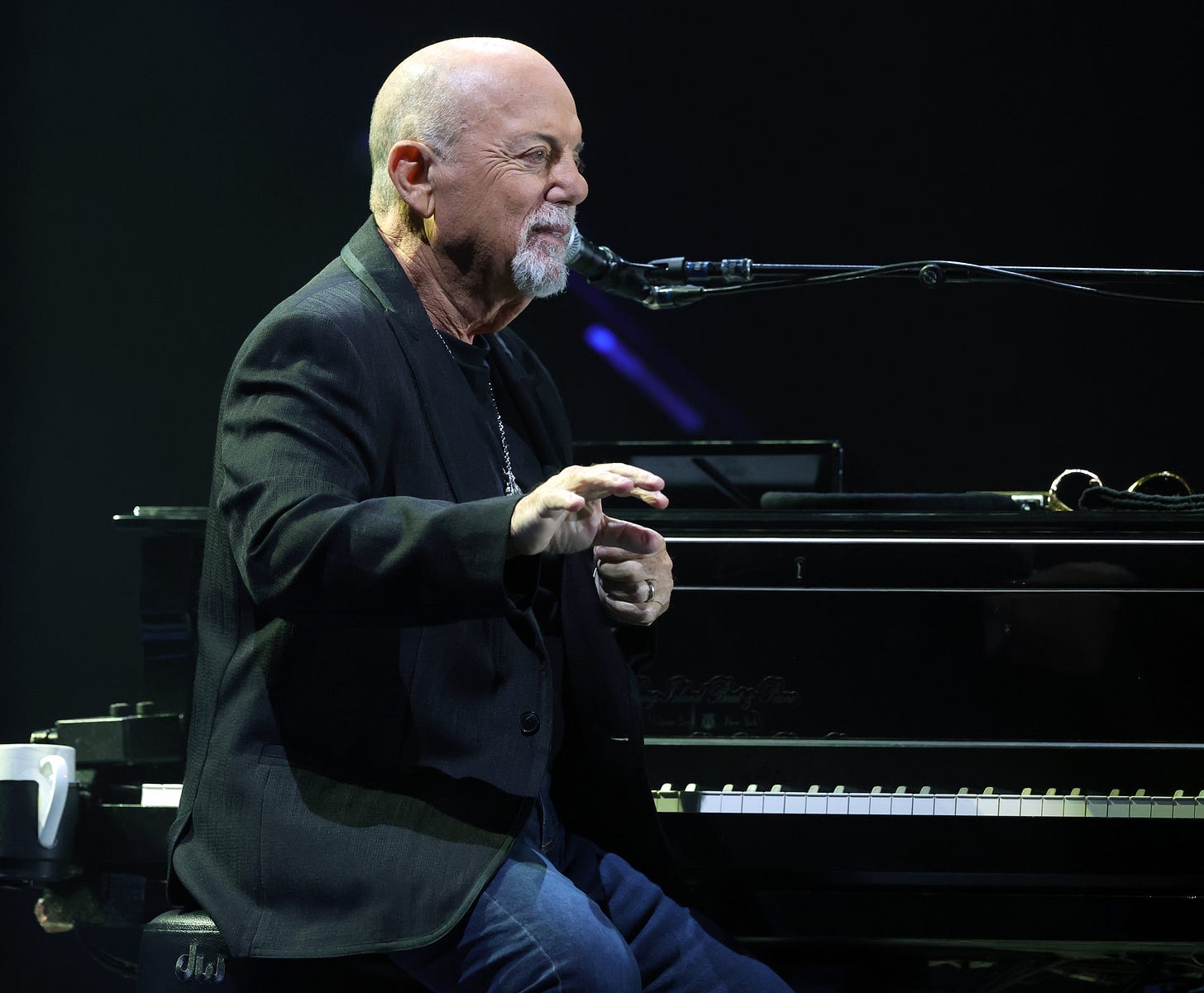
Billy Joel performing at Allegiant Stadium on November 9, 2024 in Las Vegas. (Photo by Ethan Miller/Getty Images)
Late last week pop icon Billy Joel announced he was suspending concerts through July 2026 in order to get treatment and therapy for a form of hydrocephalus, a neurological condition that can cause physical and cognitive impairment. It’s heartbreaking news about an entertainer who, even at 76, sells out stadiums for shows that stretch beyond two hours as they turn into singalongs for tunes that span the ages.
I was lucky enough to catch one of those performances last summer when Joel wrapped up a decade-long residency at Madison Square Garden, the New York City venue that now belongs to him as much as it does to the Knicks or the Rangers. And like the rest of his most devoted fans—yes, that’s the 1982 Long Island concert bootleg on my running mix—I hope he can perform again. He’s reportedly said he wants that to happen and experts have said that’s possible with early diagnosis and the right treatment—which, thankfully, he appears to be getting.
Interestingly, the scientist who first identified this form of hydrocephalus back in the 1950s was a Colombian neurologist who had trained in the United States and made some of his most important discoveries at Massachusetts General Hospital, the teaching institution affiliated with Harvard University. Since then, much of the essential research into diagnosis and treatment—into both what’s available already and what might be available in the future—has taken place with the help of funding from the federal government, including the National Institutes of Health.
I know that last part thanks to Michael Williams, a neurologist at the University of Washington who has done some of that groundbreaking research—and who told me about the critical role federal backing has played ever since the NIH convened a workshop on hydrocephalus in 2005. “If we had not had that funding for research since the 2005 NIH workshop, we wouldn’t understand nearly as much as we do now about the basic science and the clinical science of hydrocephalus,” he told me.
The context for our conversation was the cuts the Trump administration has been making to medical research—both through targeted attacks on institutions like Harvard and broad reductions in grants through agencies like NIH. (Oh, and the hostility to foreign-born researchers as well.) Williams didn’t comment on the Trump administration directly. But he did point out that investing in hydrocephalus can pay all kinds of dividends, including a chance to prevent future medical problems and their associated costs.
“Diagnosing and treating hydrocephalus saves health care costs every time an elderly person falls, every time they’re being evaluated for dementia, every time they’re ending up in a nursing home,” Williams said. He’s right, and that logic applies to all kinds of other medical research too.
I’m not trying to appropriate Joel for a partisan argument and I’m certainly not claiming to speak for him. He largely avoids talking about politics, and the most important thing by far is that he gets well. But for those of us who do think about politics and policy, at least when we’re not waving to Brenda and Eddie, the possibility of Joel making a strong recovery should serve as one more reminder of how important medical research is—and what we’d lose without it.
Leave a comment
Share The Bulwark
Great Job Jonathan Cohn & the Team @ The Bulwark Source link for sharing this story.
The recent release of Israeli American hostage Edan Alexander was the product of direct negotiations between the United States and Hamas. Presented as a confidence-building measure to establish a wider cease-fire, Israeli representatives were not party to the discussions.
This was seen as a historic departure in US-Israeli relations and precipitated serious debate over the interpersonal dynamics between Donald Trump and Benjamin Netanyahu. Avigdor Lieberman, the chair of conservative Israeli party Yisrael Beiteinu, says that the US-Israeli axis is enduring an “an unprecedented low.” Some have interpreted these dynamics as political theater, designed to provide cover for further bloody escalations. But we need to go beyond the temperament of individuals — the fixation of so much commentary today — and look to the structural trends and strategic tensions that form the backdrop to a changing world order.
The end of American unipolarity necessitates a paradigm shift in the Middle East and throws previous certainties into flux. The big picture is nothing less than a restructuring of the global state system: a world in transition, in which regional hegemons are arranging their own spheres of influence as part of the new multipolar order.
The United States, in decline relative to its erstwhile position as the single, undisputed superpower, is compelled to achieve the best possible deal from its managed retreat. The sprawling US apparatus is too costly to maintain, and critically, the wars it has fought in an effort to secure empire dominance have been abject, blundering failures. Within this shift, Israel is going to wield less strategic utility for the United States, who have no vital interests in the volatility intertwined with the Netanyahu era, such as a war with Iran.
This process will show that the Israel lobby, while influential, is not dictating US policy. This theory has been a popular one, but it has always risked underplaying the self-interest of the United States. Rather than being pulled along grudgingly, with the tail wagging the dog, the opposite is and has been the overriding dynamic: the US has invested in Israel as a garrison for securing its imperial objectives in the Middle East. As Joe Biden said in 1986: “[Supporting Israel] is the best $3 billion investment we make. Were there not an Israel, the United States of America would have to invent an Israel to protect her interests in the region.”
Biden’s thinking made sense for that phase of US imperialism, but this approach is now being challenged as this asset depreciates and, indeed, becomes a liability. Simply put, the region demands stability as multipolarity takes effect, and the Gulf states want authority in this field. The United States also prefers a reconfiguration that can protect its financial and long-term strategic interests, having accepted that endless military interventions in the Middle East prove deleterious. As the US prepares for escalating competition with China, it seeks a resolution in which its objectives can be flexed commercially through Gulf collaborators against a backdrop of regional integration.
This is why they have accelerated talks with Iran, and why it is likely Iran will agree to a deal. In addition, the United States has concluded hostilities with the Houthis and, quite remarkably, without Israeli support or coordination. As mentioned above, they have also engaged in direct talks with Hamas, much to the ire of the Israeli cabinet. On his recent tour, Trump conducted high-level talks with representatives from several key states in the region, but not Israel. The USS Harry S. Truman aircraft carrier has since left the Red Sea, with three fewer fighter jets. It is little wonder that Netanyahu grasps that Israel will need to “wean ourselves off US military aid.”
As interests reposition, the United States is also coordinating with the Saudis on the nature and implementation of a lasting cease-fire in Gaza — a difficult and messy process, as disentanglement generates its own dilemmas. This is partly why one day a report will suggest the Trump administration is planning to expel a million Palestinians from Gaza to Libya, and the next, the US embassy in the country denies it. It is plausible that briefing and counterbriefing reflects schisms inside the American establishment over the question, which takes us to the future of Gaza itself, largely obliterated by Israel with the support of its NATO allies.
The proposal for a Trump-Netanyahu “Riviera” in an ethnically cleansed Gaza was never going to be accepted by the region; the AI rendering of such a grotesque spectacle posted by Trump on social media was too on the nose. But the material effect of this proposition was to hasten the Egyptian plan for Gaza, which rejected the ethnic cleansing of the strip. This plan was supported by the Arab Summit, and quietly Britain, France, Germany, and Italy also backed it. Contrary to some initial reports, the US didn’t reject it. Middle East envoy Steve Witkoff said it was a “good faith first step from the Egyptians.”
Israel has been driven into a corner: it needs regional normalization, but its negotiating position has been undermined because of its criminal and genocidal actions. With each hour it remains on its current course, its position becomes weaker. Moody’s Ratings warns of “severe implications for the government’s finances” and “a further erosion in institutional quality,” as a result of high political risks. Israel could lose some $400 billion in economic activity over the next decade, according to some estimates.
Despite this, the United States will now make deals with Arab states without raising normalization as a prerequisite. In return, Trump has secured a $600 billion Saudi investment pledge, including in one of the largest arms deals in history. This also disrupts the ironclad US commitment to Israel’s “qualitative military edge,” which is meant to guarantee it military supremacy in the Middle East. Trump also made clear in his keynote speech that Western intervention was a failed enterprise and nodded toward the uprooting of American soft power NGOs by ending US Agency for International Development (USAID) funding.=
This gives the regional players and the Gulf Cooperation Council a historic opening to discipline Israel and advance a Palestinian state. It should be said that any such objective on their part would not be altruistic, given the lack of action these regimes have taken to stop the genocide in Gaza. They are incentivized to ensure their regional sphere in the new global order is anchored in a way that is favorable to them. Saudi Arabia, in this vein, sees Israel as a security threat to its ambitions for the region because its depraved expansionist approach to the Palestinians generates cyclical violence and political unrest. The righteousness of the Palestinian cause is quite incidental (which is why it is, inexcusably, in no rush to act).
The Palestinian question is, at the same time, hardwired into regional interstate competition and serves as a platform to bring Israel to heel. The questions are: to what extent and at what pace? Another important factor is the demand for regional harmony being made by international capital – given the trade geography of the global economy – which can no longer tether itself to the US bombing new markets open.
While a narrower set of interests around arms manufacturing prefers permanent conflict, there are broader and far more differentiated flows of commerce impeded by it. This partly explains why the Financial Times has been outspoken for a cease-fire since as early as October 2023, and why other establishment publications like the Economist are slowly breaking from Israel’s Gaza policy.
Pressure is growing, and relationships are straining. Britain, France, and Canada this month released a joint statement condemning Israel’s military expansion and the lack of aid entering the strip; for the first time, the threat of targeted sanctions was broadcast. In response, Netanyahu claimed this represented a “huge prize for the genocidal attack on Israel on October 7th.” The latest statement is itself cynical, given that its signatories have been unrepentant in their provision of arms, technical support, and political cover for Israel.
However, these nations have reputational interests, global security concerns, and economic competition to consider. It is no coincidence, for instance, that Rachel Reeves has said that Britain is targeting a major Gulf trade agreement, following recent negotiations between the European Union and India. Such arrangements will be thrown into disarray should Israel be allowed to conclude the genocide and ethnically cleanse Gaza, given the consequences entailed for the region.
In Spain, last week more than three hundred officials and investors convened in Riyadh for a Spanish-Saudi Business Forum in which substantial deals were made. At the same time, Spain is calling for an arms embargo on Israel and is urging its European allies to do the same. It has also called for concrete moves toward a Palestinian state. These and other items were discussed at a high-level summit known as the “Madrid Group” on Sunday, which included representatives from European countries, including France, Britain, Germany, and Italy, along with envoys from Egypt, Jordan, Saudi Arabia, Turkey, Morocco, the Arab League, and the Organisation of Islamic Cooperation. Israel is becoming a problem for the West to deal with, inhibiting its private sector and regional deals, rather than a rational and profitable partner.
Netanyahu, isolated and losing strategic value to the United States, has no viable path forward. It is possible he is negotiating his own “day after,” using his only remaining leverage: inflicting further misery on Palestinians and barbarically ratcheting up the stakes. His recent trip to Hungary was related to the International Criminal Court (ICC) proceedings. And while it is true the ICC is a colonial instrument, there is no guarantee that the drive to consolidate blame around one individual can be avoided; we can expect a harder Western turn against Netanyahu as states seek to distance themselves from the catastrophe they have jointly unleashed in a bid to reset relations with the Middle East, as well as the Global South.
Netanyahu also faces a domestic legal swamp involving corruption charges, which are much harder to evade. But the underlying and foundational issue is that the geopolitical recalibration attendant on the emerging multipolar world system relegates Israel’s comparative importance to US policy in the region — not just Netanyahu’s.
Netanyahu and his allies remain in control of the Israeli state — making it all the more dangerous and volatile — but their rule is fracturing and unsustainable. Netanyahu’s policy only eventuates in further curtailing Israel’s fortunes. It should also be said that this conflict is not between a handful of peaceniks and a united Israeli ruling class. Ruptures exist within the business elite, the military, security services, and among prominent political figures. We must also factor in the most fanatical and messianic elements, the settlers and so on, who are likely to become more dangerous as the situation evolves, fragmenting the state’s cohesion further. As the horrors intensify, splits will become more desperate in tone. One politician, Moshe Feiglin, recently argued on Channel 14 that “every child, every baby, is an enemy”; another, Yair Golan, has warned that “Israel is on the way to becoming a pariah state, like South Africa was . . . a sane country does not fight against civilians, does not kill babies as a hobby, and does not give itself the aim of expelling populations.”
Former Israeli prime minister Ehud Olmert has himself taken a critical stance, telling a “People’s Peace Summit” that “Gaza is Palestinian and not Israeli. It needs to be part of a Palestinian state.” This, he argued, is the basis for achieving normalization. Former Mossad and Shin Bet heads have also coauthored a letter with a former deputy IDF chief urging Trump not to listen to Netanyahu and to end the “war.” These interventions are, of course, based on self-interest and the knowledge that Netanyahu has run out of road. The mission now is a salvage operation: an attempt to realign Israel and the United States as far as possible. It is notable that Israel’s once-confident defenders in the media are now silent. There is no single propaganda line to coalesce around; the narrative has collapsed entirely. The international Palestine solidarity movement, meanwhile, has been justified in its key demands and its assessment of the scale and objectives of the horror unleashed on Gaza.
This movement has been the vanguard of moral conscience in these past months, and it has also been politically inclusive, despite the smears directed against it. Now in the West, the “great and the good” have started to turn. Although stopping short of identifying the apartheid nature of the Israeli state, New York Times columnist Thomas Friedman writes, ‘This Israeli government is behaving in ways that threaten hardcore US interests in the region. Netanyahu is not our friend.” In the Guardian, Jonathan Freedland predicts that Trump will betray his onetime ally. The former European Commission vice president Josep Borrell now says that Israel is committing genocide. Emmanuel Macron is due to cohost a summit in New York with Saudi Arabia on setting up a Palestinian state.
To reiterate, these moves are based on interests, not morality. In the case of France, Macron is vying for European and French objectives in the Middle East, for which loyalty to Israel yields diminishing returns. They, like the United States, require a new means through which to interface with the region. Others are looking to the long-term sanitization process of the Israeli state that will be required, by reducing the issue to one especially bad aberration in the form of Netanyahu.
Nothing can be taken for granted in the arguments made here — not least because the Israeli cabinet is likely to become ever more vexed. At every stage, the global Palestine movement must continue to mobilize, institutionalizing and universalizing its positions as it does. It is only because of the determination of the Palestinian people that, against all the odds, they are in the end the crucial and decisive factor in the overarching regional calculation. The struggle of the Palestinian people for dignity, freedom, and human rights has shown in practice what they have always attested to: existence is resistance.
Great Job Jonathon Shafi & the Team @ Jacobin Source link for sharing this story.
This month, Die Linke met for its congress in Chemnitz, under the motto “Organizing Hope.” Such a slogan would have seemed out of touch the last time it held such a meet-up in October 2024. Back then, activists were surely hopeful for Die Linke’s future, despite a damaging split by the Bündnis Sahra Wagenknecht (BSW). Yet in many polls, the party didn’t even register, and it feared falling out of parliament altogether.
What happened to change the mood? Between the two congresses, Chancellor Olaf Scholz’s government had collapsed, snap elections had been called for February 2025, and in that contest Die Linke achieved one of its best-ever results, with 8.8 percent of the vote nationally. Unlike the nail-biting federal election in 2021, when it relied on a technicality to return to the Bundestag, this year’s results night in Die Linke HQ saw a party mood.
The Chemnitz congress, then, saw a party whose fortunes had turned around almost overnight. But for the success to last, it was also decisive to agree on what had worked — and how it might be replicated in future.
According to much of the mainstream press and indeed Die Linke’s political opponents, it ought to be thanking the most unlikely of figures for its revival. We are told that it was the leader of the center-right Christian Democratic Union (CDU) Friedrich Merz, today Germany’s chancellor, who brought Die Linke back from the brink.
According to this narrative, what made the difference was Merz’s decision, in the middle of the campaign, to push a parliamentary resolution reliant on the votes of the far-right Alternative für Deutschland (AfD). Merz’s breaking of a taboo (it was the first time a Bundestag resolution was approved thanks to AfD votes, although the CDU’s overtures to the far right have a longer history) offered an opening to Die Linke’s joint lead candidate Heidi Reichinnek to shine in her speech denouncing the move, making her a popular icon among progressive voters. With her decisive intervention, she revived a party that otherwise would probably have fallen below 5 percent support.
That, at least, is the dominant account of how Die Linke turned around its fortunes. The 30 million views of Reichinnek’s speech in just one week provided a visibility such as Die Linke could otherwise only have dreamed of. But there are solid reasons to believe that Reichinnek’s speech simply accelerated and amplified an already existing trend. After all, the CDU’s vote together with the AfD came at the end of January 2025, when Die Linke had already been rising in polls throughout the month.
Absent from the mainstream narrative are the reasons why Reichinnek’s speech resonated so widely. First among these is the fact that the CDU’s joint vote with the AfD sought to impose an effective stop to asylum-seekers arriving in Germany. This also helps us understand why, when the Social Democrats (SPD) and the Greens also denounced Merz for reaching out to the AfD, their accusations rang somewhat hollow. Both these government parties had, during Scholz’s administration, presided over successive restrictions in provisions for asylum-seekers and imposed controls on some and then all German borders in September 2024. Meanwhile, in opposition Die Linke had defended the right to asylum even as it became increasingly unpopular (a poll this January indicated that 68 percent of Germans wanted to accept fewer refugees). Wagenknecht’s BSW split from it to advocate, among other things, a more restrictive immigration policy.
Second, the leader of the SPD parliamentary fraction might have accused Merz of having opened “the gates of hell” by reaching out to the AfD, with the Greens’ rhetoric only a little less harsh. But both parties remained open to forming a government with the CDU after the elections in the name of “taking responsibility.” No voter might similarly fear that Die Linke would make the deeply unpopular Merz chancellor. In short, whereas the SPD and the Greens had a credibility problem, Reichinnek’s angry speech criticizing Merz was not only well articulated but also authentic, because it built on Die Linke’s prior trajectory.
Considering the policy concessions that the SPD and Greens had made in government to both their own neoliberal-hawk government partner (the Free Democrats, FDP) and the right-wing opposition, observers could only wonder what they’d be ready to do to become the CDU’s junior partner. Joining Merz’s Christian Democrats in government this spring, the SPD has in fact accepted policies such as pushing back asylum-seekers at the German borders and replacing the eight-hour-day regulation with a weekly maximum.
Die Linke’s election effort was helped by the SPD’s and Greens’ mistakes (these parties’ previous voters were the main contributors to Die Linke’s increased vote), as leading members in the leftist party’s campaign privately acknowledge. After years of mainly worrying about attacks from the right-wing opposition, the SPD and Greens were forced to counter an agile and social-media-savvy Die Linke campaign that focused on neglected issues such as the increasing price of supermarket goods and rents, and the lack of fair taxes on the rich. Die Linke’s campaign remained laser-focused on a few key messages that activists stuck to, such as the need for a rent cap and eliminating the taxes on basic groceries. Die Linke’s creation of an app to check abusive heating and renting prices in some of the main cities was also key to positively entering the media conversation and showing that the party could practically help working-class people.
One measure of Die Linke’s recent success is that unlike at the previous congress in Halle, at this month’s edition in Chemnitz there was only scant talk of the BSW. The party founded by Wagenknecht had enjoyed around 8 percent polling support last fall, but it eventually scored 4.98 percent in February’s federal election — missing the 5 percent threshold to enter parliament by just over 9,000 votes.
The elections did not only reward Die Linke’s programmatic proposals as compared to the BSW’s, but also showed the value of its model of party organization. Whereas the highly centralized BSW has around one thousand members — each individually approved by its leadership — Die Linke entered 2025 with 58,532 members before experiencing a sudden surge to 100,000 ahead of the election (it currently has 112,000 members). Die Linke’s intensive street and door-knocking campaign contrasted with a BSW that was barely visible in the streets aside from election placards. After the campaign, one of the main challenges for Die Linke today is to integrate the wave of new sign-ups, which have made the party younger, more Western German, and more female.
The Chemnitz congress was also shaped by the perennial tension between Die Linke’s opposition course at the national level and its government participation in some federal states. February’s elections had given rival opposition parties AfD and Die Linke a combined one-third minority in parliament and, with it, the de facto power to block constitutional changes, notably to the “debt brake” which limits government deficit spending. However, after the election — but before the new parliament met — the Christian Democrats, Greens, and SPD cobbled together a two-thirds majority in the old parliament to exempt military spending from the debt brake and approve a special infrastructure fund.
In the Bundestag, Die Linke criticized the reforms because they maintain the debt brake for nonmilitary expenses while spending on the army is now theoretically unlimited. However, Die Linke members in the governments of Bremen and Mecklenburg-Vorpommern voted in favor of the package in the Bundesrat, i.e., the institution representing the federal states, where constitutional changes also need to be approved. Die Linke members in both states argued that the funds for the regional and communal governments in the approved infrastructure package were essential in times of austerity. Yet their decision clearly went against the party line and frustrated the national leadership.
The constitutional changes would have been approved even without Die Linke votes, and its recent polling remains strong in both Bremen and Mecklenburg-Vorpommern. Still, Die Linke can be thankful that the controversial votes took place when the BSW, which has strongly criticized remilitarization, is still recovering from the disappointment of not having entered parliament. What the representatives of Die Linke in both regional governments could not prevent was significant criticism of them at the congress in Chemnitz. Party activists lamented that they had spent the election campaign putting up placards against more military expenditure only for the Bremen and Mecklenburg-Vorpommern governments to vote for more cash for the army.
The congress also addressed the troubled question of Die Linke’s relationship with the CDU. On May 6, Merz became the first chancellor to need two voting rounds in the Bundestag before being elected. At least eighteen members of the government’s parliamentary majority did not express confidence in him. To organize a second voting attempt on the same day, Merz needed a two-thirds majority to change the procedural rules of the parliamentary session, thus requiring the help of either Die Linke or the AfD. While Merz’s CDU rules out “coalitions and other forms of content-related cooperation” with both these parties, the conservatives held conversations with Die Linke, and the leftist party decided to allow the second vote.
Whether voting together to change procedural rules qualifies as cooperation is debatable. But clearly, without Die Linke’s votes, Merz would have had to postpone his first international visits and wait at least three more days, until May 9, to be elected chancellor. There would have been mounting pressure to know whether Merz actually had a majority and which legislators had not supported him. The vote would also have collided with the first day of Die Linke’s congress.
Did it make the right decision by allowing his earlier election? A congress delegate from Frankfurt didn’t think so. She said it would have been nice “if Germany had lived three days without a king.” Die Linke’s parliamentary group was reportedly relatively divided on whether to allow the vote to proceed, but the “yes” side carried the day. Denying the early repeat vote would have reinforced Die Linke’s antiestablishment profile, a not-insignificant attribute in times of low popular support for the status quo. It is unclear, however, how it would have weathered three days being accused of bringing the country to a standstill (in fact, the situation was far less dramatic, as Scholz would have remained caretaker chancellor).
Equally important, there is no predicting what the CDU’s behavior during those three days could have been. Merz is famously impulsive and could even have prompted a move toward fresh elections, with the AfD poised to swell its ranks even further. These three days would also have opened a window of opportunity for those CDU members who had anyway preferred a minority government with, if needed, extragovernmental support from the AfD.
The conversation about the CDU’s relationship with Die Linke is expected to resurface soon, as the Bundestag needs to elect three new members for the Federal Constitutional Court and they need to be approved by a two-thirds majority. In Saxony and Thuringia, where the AfD surpassed 30 percent support in last year’s regional elections and the CDU rules without a majority, the center-right party has long been in conversations with Die Linke to approve its budgets.
The polarization between CDU and Die Linke has the positive aspect of showing that very different options are available to voters without having to opt for the AfD. Still, the new parliamentary arithmetic at both the regional and national levels will likely force CDU and Die Linke to talk more often.
“Die Linke is back” was a common line in party coleader Ines Schwerdtner’s intervention at the Chemnitz congress, as well as in Reichinnek’s comments. At least at the national level, Die Linke’s immediate strategy seeks frontal opposition to the new CDU-SPD government. In Chemnitz, for instance, Die Linke coleader Jan van Aken accused the ruling parties of being detached from ordinary people’s realities, with inflation and high grocery prices not even mentioned in their coalition agreement.
Unlike the Greens, who wanted to stay in government and will have to justify their recent record in office still for some time to come, Die Linke benefits from having long been in opposition and is currently polling 10–11 percent. Moreover, the Greens and the SPD appear to have no interest in covering their left flanks and are instead in search of centrist voters. Green politicians such as Ricarda Lang and Social Democrats such as Saskia Esken who represented the left wing of their parties have been relegated to a secondary role. Instead, the Greens appear to be taking the course of their only regional president, the centrist Winfried Kretschmann in Baden-Württemberg, whereas the SPD is firmly under the control of vice chancellor and finance minister Lars Klingbeil, a member of the party’s conservative Seeheimer Kreis faction.
Considering this and Die Linke’s internal strength, the hopes expressed at the party congress for the 2026 elections are not unfounded. Next year, it will seek to enter the Western parliaments of Rhineland-Palatinate and Baden-Württemberg for the first time and finish first in the Berlin elections, after winning most votes in the capital in February’s federal elections.
It will be in Saxony-Anhalt and Mecklenburg-Vorpommern, however, that Die Linke’s objective of recovering working-class voters from the AfD will be most important. In these two states, which also vote in 2026, the AfD doubled the second-place parties in votes in February. The case of Saxony-Anhalt is especially concerning. The AfD collected 37 percent of ballots there and enjoys an unusual strength even in the largest cities. In 2026, the flashy headlines for Die Linke could come from Western Germany and Berlin. Yet it is in the east of the country where any votes hard won from the AfD can prevent the first far-right regional president since 1945.
Great Job Marc Martorell Junyent & the Team @ Jacobin Source link for sharing this story.
The State Department has suspended interviews with foreign citizens applying for student visas from abroad while it sets up procedures to review their social media posts. The halt comes as President Trump is trying to coerce Harvard University and other institutions to restrict what can be said on campuses, with a particular focus on anti-Israel speech. (NYT)
The administration may already be abusing the customs process to block entry to the country for conduct as innocuous as criticism of the president. But we’re sure this power won’t be one they’ll abuse. Happy Wednesday.
(Composite / Photos: GettyImages / Shutterstock)
by Andrew Egger
Elon Musk’s bright-burning but brief turn as shadow president provided a lesson for other would-be revolutionaries in the Trump administration. Move too fast, break too many things, and you risk poisoning the public against you and your work.
It’s a lesson Robert F. Kennedy Jr. appears to be taking to heart. Follow along to understand why—and why now is the moment for public pushback. You’ll be glad you did.
By now it should be clear to everyone, if it somehow wasn’t before, that the secretary of health and human services is gunning for America’s vaccines. Kennedy, who just last year proclaimed that “there’s no vaccine that is safe and effective,” who has never stopped insisting that vaccines are connected to autism, and who has actively counseled people not to vaccinate their children for years, claimed implausibly after Trump’s reelection that “we’re not going to take vaccines away from anybody.” But since his confirmation, he has been busily laying the groundwork to do exactly that.
Weeks after Kennedy took the reins at HHS, he canceled the first of three yearly meetings of the CDC’s Advisory Committee on Immunization Practices, members of which he is also reportedly preparing to fire. He’s continued to claim that vaccines haven’t been “safety tested,” and his inaugural “Make America Health Again” report last week suggested that vaccines may play a role “in the growing childhood chronic-disease crisis.” Things look no better behind the scenes: HHS’s top spokesman quit in March after just two weeks on the job, and the FDA’s top vaccine official resigned a few weeks later, citing Kennedy’s avalanche of “misinformation and lies.” That same week, Kennedy brought prominent anti-vaxxer David Geier aboard to conduct a study hunting for a link between vaccines and autism.
In the last few days, Kennedy has started to make his anti-vaccine plans a reality. On Friday, his HHS announced that the FDA would revoke authorization for COVID boosters for most healthy Americans under 65 years old. And yesterday, Kennedy announced in a video posted to social media that the COVID shot would be removed from the vaccine schedule for healthy pregnant mothers and children—a change that will likely lead insurance companies to drop the vaccine from coverage for those groups.
In announcing the change, Kennedy didn’t just say he believed the COVID vaccine to be unnecessary for those groups. He said the change would bring the nation “one step closer to realizing President Trump’s promise to Make America Healthy Again.” The implication was obvious: In Kennedy’s view, the COVID vaccine is an active threat to America’s good health.
As the New York Times’s Maggie Astor notes, this suggestion not only contradicts all available science—infants under six months old face as high a risk of hospitalization with COVID as do people who are 65 to 74 years old, and the best way to give them some protection is for their mother to get the shot while pregnant—it also contradicts the FDA and CDC’s own current guidance as of last week. When the FDA announced Thursday it would revoke the COVID shot’s authorization for most healthy people under 65, it specifically mentioned pregnant women as a group that would likely remain eligible. Even this morning, you can still visit the CDC page that describes pregnancy as a conclusive “higher-risk” condition for COVID, complete with a helpful link to the relevant meta-analysis and systematic review. The HHS website—for now—has some videos urging pregnant mothers to get the shot, too.
In many ways, the COVID vaccine is low-hanging fruit for RFK Jr. The novel coronavirus is no longer novel; many people perceive it to be yesterday’s problem. Others assess that their own current level of immunity—from former doses of the vaccine or brushes with the disease—is good enough. COVID booster uptake in particular remains low, with less than a quarter of Americans receiving the annual shot.
But anyone who thinks Kennedy will stop at the COVID shot is deluding themselves. The man was agitating against vaccines long before COVID arrived on the scene, and his spurious arguments against the COVID shot are arguments he’s deployed time and again against other vaccines as well.
Leave a comment
Which brings me back to Elon.
This administration may carry itself like a relentless evil empire, but they have yet to show they can weather a real punch in the jaw in the field of public opinion. When Musk grew broadly unpopular, the White House quietly put him out to pasture. When the trade war went belly-up in the polls (and in the bond market), Trump pulled back there too.
That’s the only reason why Kennedy is moving this slowly and incrementally on his pet issue. He’s waiting to see what form—if any—public backlash against his early actions might take. It’s why he constantly tries to qualify his anti-vax rhetoric by insisting he just wants more “science” and study. And it’s why every time an incremental vaccine restriction results in a public shrug, he feels emboldened to go a bit further.
So don’t let him get comfortable. If you’re among the vast sea of Americans who remain enthusiastically grateful for vaccines, the time for pushing back against Kennedy isn’t later, when he’ll likely be ratcheting up his program to “reevaluate” longstanding pediatric vaccines. It is right now.
Vaccines are a modern medical miracle. We can’t just stand by while these jokers mess them up for the rest of us.
Share
by William Kristol
On Monday, Donald Trump pardoned former Culpeper sheriff and fervent Trumpist Scott Jenkins, who had been convicted by a jury of his peers of fraud and bribery. Jenkins was freed as he was about to begin a ten-year prison sentence. Trump’s pardon chief at the Department of Justice [sic], Ed Martin, triumphantly posted, “No MAGA left behind.”
So, there you have it, no potential MAGA enforcers and vigilantes are to be left behind.
It turns out no MAGA donors are to be left behind, either.
In April, Trump pardoned former nursing home executive Paul Walczak who had pleaded guilty to withholding more than $10 million from the paychecks of employees under the pretext of using it for Social Security, Medicare, and income taxes. Walczak stole the money to buy a $2 million yacht and to pay for other personal luxuries. He was due to pay nearly $4.4 million in restitution, and to report to prison for 18 months. At his sentencing, the judge explained that there “is not a get-out-of-jail-free card” for the rich.
But there is. As the New York Times reported yesterday, Walczak’s mother is Elizabeth Fago, a major fundraiser for and donor to Trump. Fago attended a $1-million-per-person fundraising dinner last month at Mar-a-Lago. Less than three weeks later, Trump signed the pardon.
Trump also announced yesterday that he intends to pardon the imprisoned reality television couple Todd and Julie Chrisley, found guilty by a jury in 2022 of millions of dollars of fraud and tax evasion.
In none of these cases is there any doubt as to guilt. In none of them are there extenuating circumstances. It’s simply the case that if you’re a Trump-supporting law enforcement officer, you can get pardoned. If you’re a Trump-supporting plutocrat, you can get pardoned. If you’re a Trump-supporting wealthy celebrity, you can get pardoned.
Trump’s autocratic project needs muscle and money, cash and celebrity. The presidential pardon power turns out to be a very useful part of this project.
To my knowledge, not a single lawyer in the White House counsel’s office has resigned in protest of these pardons. Not a single Trump political appointee anywhere in the government has resigned in protest. Not a single Republican member of Congress has denounced the pardons.
And so the rule of law is disassembled in broad daylight.
Share
Dream Bigger, Talk More Boldly… On The Bulwark Podcast, PETE BUTTIGIEG joins TIM MILLER to explain why he thinks the Democrats need more imagination to confront our enormous challenges, plus, cracking the manosphere, what Biden could’ve done differently on COVID, and why the era of politicians sticking to their talking points is over.
Feel the Power… On Just Between Us, ANDREW EGGER joins MONA CHARENto discuss the corruption of the pardon power that Bill writes about above. They also talk about Trump’s memecoin haul and the anti-vaccine insanity.
Finally ‘Reckoning’ with AI… From Mission: Impossible to large language models, wrestling with the future, ALYSSA ROSENBERG, PETER SUDERMAN, and SONNY BUNCHon Across the Movie Aisle discuss how AI is both helping animators lip sync cartoons and also completely inventing books for summer reading lists.
Scott Pelley Says the Quiet Part Out Loud… On Bulwark+ Takes, LAUREN EGAN joins SAM STEINto look at a rare moment when a veteran journalist like Scott Pelley publicly defends the press and issues a stark warning about Trumpism.
‘A STAGGERING PUNISHMENT’: Donald Trump’s attempt to bully formerly antagonistic law firms into becoming his vassals may have cowed some firms into submission. But it also keeps running aground in the courts. On Tuesday, a D.C. federal judge struck down an executive order targeting the firm WilmerHale on constitutional grounds. WaPo reports:
In a 73-page opinion accompanying his order, Leon wrote that it was necessary to block Trump’s punishments for WilmerHale to preserve “the independent and adversarial nature of our judicial system.”
Leon wrote that the Founding Fathers had understood the necessity of an independent judiciary and independent lawyers. Trump’s orders targeting law firms, the judge said, were “a staggering punishment” challenging that very concept.
“I have concluded that this Order must be struck down in its entirety as unconstitutional,” Leon wrote. “Indeed, to rule otherwise would be unfaithful to the judgment and vision of the Founding Fathers!”
Leon is the third judge so far to punch back at Trump’s punitive orders against law firms, although we’d venture to suggest he stands alone in the panache department.
WHAT HAPPENED TO MY GOOD BUDDY VLAD? Donald Trump’s approach so far to the war in Ukraine has been guided by a pair of goofball convictions as his twin North Stars: Vladimir Putin isn’t really all that bad a guy, and he never would have invaded Ukraine if a strong president like Trump had been around. In recent weeks, Trump has seemed genuinely baffled that his mere reemergence on the world stage hasn’t convinced Putin to be a good boy and pack it in. Doesn’t he know peace through strength is back???
It’s enough that Ukraine allies on Capitol Hill have begun hoping Trump might be persuaded to move forward with additional sanctions on Moscow. Politico reports:
Pro-Ukraine allies on Capitol Hill are treading carefully as they urge the White House to consider following up on his threats to Putin by backing their effort to enact new sanctions. And allies in Europe, facing the possibility that Trump could walk away from peace talks without punishing Russia, are scrambling to figure out how they could tackle taking the lead on support for Ukraine.
“What Vladimir Putin doesn’t realize is that if it weren’t for me, lots of really bad things would have already happened to Russia, and I mean REALLY BAD,” Trump wrote in a Truth Social post on Tuesday. “He’s playing with fire!”
Trump also told reporters on Sunday that he was “absolutely” considering additional economic sanctions on Russia and described Putin as having “gone absolutely CRAZY” in a social media post.
The president has issued similar, yet sporadic, threats since his first days in office. But at no point has he followed through and ratcheted up pressure on Moscow—despite Putin repeatedly telling Trump he supports peace while intensifying his bombing campaign in Ukraine.
Unfortunately, this last point is likely the key one. Putin’s insistence on continuing to bomb Ukraine into oblivion may draw a lot of confused bluster from the president. But we’ve yet to see evidence it will cause him to reevaluate his baseline, shirts-and-skins reflex to prefer Putin’s company to Volodymyr Zelensky’s.
SETTLING SCORES: First Daughter-in-Law Lara Trump appeared yesterday on Laura Ingraham’s Fox News show to try to squeeze just a bit more blood from Jake Tapper’s and Alex Thompson’s Original Sin. She recounted to Ingraham how Tapper called her to apologize for a contentious 2020 exchange in which he accused her of mocking Biden’s stutter and angrily cut her off when she asserted that Biden was “very clearly [in] cognitive decline.” It should be noted that Tapper has said she was right and he was wrong in some of his book tour interviews.
Yet Lara Trump remains unmollified. She scoffed that “it feels a little bit too late” and suggested that Tapper was trying to “discount his own role” in the cover-up. Meanwhile, Ingraham zinged Tapper on X for “smearing” Lara Trump in 2020.
But who’s really being “smeared”? In early 2024, Tapper was extremely tough on Democrats who tried to spin away special counsel Robert Hur’s report characterizing Biden as “an elderly man with a poor memory.” He also raised the age issue in an interview with Biden in 2022. The 2020 rebuke of Lara Trump was from a time when (as Original Sin details) Biden’s mental decline was far from “clear”—a time when he did well in debates against both Bernie Sanders and Donald Trump, even parrying Trump’s interruptions with the memorable, “Will you shut up, man?” (Are the MAGA media telling us their idol got smacked down by a rival with dementia?) Lara Trump’s diagnoses were almost certainly less about astute judgment than about throwing mud at the wall only to have it stick five years later. Tapper owed her no apology.
—Cathy Young
Share
Great Job William Kristol & the Team @ The Bulwark Source link for sharing this story.
ProPublica is a nonprofit newsroom that investigates abuses of power. Sign up for Dispatches, a newsletter that spotlights wrongdoing around the country, to receive our stories in your inbox every week.
Reporting Highlights
A “Valid” Threat: Schools must use threat assessments to determine if a threat of mass violence is “valid,” but they often carry them out inconsistently.
No State Transparency: Tennessee is supposed to track how effective schools’ threat assessments are, but the state does not release that information to the public.
Out of Sight, Out of Mind: Experts say it’s dangerous for schools to expel students without plans to follow up or address behavioral concerns.
These highlights were written by the reporters and editors who worked on this story.
The day after a teenager opened fire in a Nashville high school cafeteria early this year, officials in the district scrambled to investigate potential threats across their schools. Rumors flew that the shooter, who killed a student before turning the gun on himself, had accomplices at large.
At DuPont Tyler Middle School, the assistant principal’s most urgent concern was a 12-year-old boy. James, a seventh grader with a small voice and mop of brown hair, had posted a concerning screenshot on Instagram that morning, Jan. 23. He was arrested at school hours later and charged with making a threat of mass violence.
The assistant principal had to complete a detailed investigation called a threat assessment, as required by Tennessee law. First, she and other school employees had to figure out whether James’ threat was valid. Then, they had to determine what actions to take to help a potentially troubled child and protect other students.
Threat assessments are not public, but the district gave ProPublica a copy of James’ with his father’s permission. School officials did not carry out the threat assessment properly, according to experts who reviewed it at ProPublica’s request. Instead, the school expelled James without investigating further and skipped crucial steps that would help him or protect others. (We are using the child’s middle name to protect his privacy.)
The way school officials handled James’ case also exposes glaring contradictions in two recent Tennessee laws that aim to criminalize school threats and require schools to expel students who make them — with minimal recourse, transparency or accountability.
One obvious issue in the threat assessment, according to the experts, appeared on Page 20. That page features a checklist of options for how the school could address its concerns about James, including advising his parents to secure guns in their home and ensuring he has access to counseling.
Schools should take steps like these even when a student is expelled, according to John Van Dreal, a former school administrator who has spent decades helping schools improve their violence prevention strategies. Officials at James’ school opted for none of the options they could have taken. Instead, the assistant principal wrote under the list in blue pen, “student was expelled.”
“That’s actually about the most dangerous thing you can do for the student,” Van Dreal said, “and honestly for the community.”
Van Dreal’s name appears in tiny print at the bottom of each page of James’ threat assessment, because he helped the school district set up its current process. After ProPublica shared details about James’ case, Van Dreal said, “What I’m hearing is probably more training and more examples are needed.”
One page of the threat assessment form, created by John Van Dreal, used in James’ case
Credit:
Obtained by ProPublica. Highlighted by ProPublica.
Nashville’s school district does not collect data on how many threat assessments it does or how many result in expulsions, according to spokesperson Sean Braisted. “The goal is always to ensure the safety and well-being of all students while addressing incidents appropriately,” Braisted wrote. He later declined to answer questions ProPublica asked about James’ case, although James’ father signed a privacy waiver allowing the school to do so.
Tennessee schools must submit data to the state on how effective their threat assessments are — but the state does not release that information to the public. School districts are required to get training on threat assessments, but lawyers and parents say they often carry them out inconsistently and use varying definitions for what makes a threat valid.
Two recent contradictory Tennessee laws make it even harder to handle student threats. One mandates a felony charge for anyone who makes a “threat of mass violence” at school, without requiring police to investigate intent or credibility. The other requires schools to determine that a threat of mass violence is “valid” before expelling a student for at least a year.
James’ alleged threat was a screenshot of a text exchange. One person said they would “shoot up” a Nashville school and asked if the other would attack a different school. “Yea,” the other person replied. “I got some other people for other schools.” The FBI flagged the post for school officials and police. James told school officials that he reposted the screenshot from the Instagram page of a Spanish-language news site.
The Tennessean published a story in April detailing James’ arrest and overnight stay in juvenile detention. The story, and the ones ProPublica and WPLN published last year on other arrests, shows how quickly police move to take youth into custody.
Schools in Tennessee are supposed to follow a higher standard than police when it comes to investigating threats of mass violence: They’re supposed to determine whether a threat is valid. For instance, in Hamilton County, a few hours southeast of Nashville, school officials chose not to expel two students even after police arrested them for threats of mass violence, ProPublica and WPLN previously reported.
Yet when James’ father appealed his son’s expulsion at a March school district hearing, the assistant principal said repeatedly that James had to be expelled simply because he’d been arrested. “We did not investigate further,” she said. James’ father shared an audio recording of the hearing with ProPublica.
James, who turned 13 in February, is small for his age, still awaiting the teenage growth spurt of his three older brothers. At the hearing, his voice was soft but assured as he explained what happened. He said he understands why he shouldn’t have posted the screenshot. But he said he wanted to warn others and feel “heroic.”
Melissa Nelson, a national school safety consultant based in Pennsylvania who trains school employees on managing threats, reviewed James’ threat assessment at ProPublica’s request and concluded that “this is gross mismanagement of a case.”
“This tool has not been used as intended,” she said. “They didn’t do a behavior threat assessment. They filled out some paperwork.”
After the police took James away, assistant principal Angela Post convened a team of school employees to decide whether to expel him. They used a threat assessment form that Van Dreal had developed, one of the most commonly used across the country, to guide them on how to respond.
According to Van Dreal, Metro Nashville Public Schools is in an early phase of using the form, and its staff have flown to Oregon at least once to learn from his consulting group.
Van Dreal tells school officials to use the threat assessment to collect information about a student in trouble and address behavior that could signal future violence. If school officials worried that James was planning an act of violence, they should have pursued some of the many options outlined in the threat assessment to get him help and protect the school from harm.
Instead, they chose none of those options.
Experts said that is one of the biggest mistakes school officials make. “Even if a child is expelled, what I always train is: Out of sight, out of mind doesn’t help,” Nelson said. “Expelling a child doesn’t deescalate the situation or move them off the pathway of violence. A lot of times, it makes it worse.”
School officials also failed to seek out more information that could have helped them figure out whether the threat was valid. Post checked a box acknowledging that she hadn’t notified James’ parents of the threat assessment. She wrote beside it, as an explanation, “student was arrested and expelled.” On a line asking whether James had access to weapons, Post wrote that the threat assessment team did not know.
Interviewing parents is a crucial part of the process, said Rob Moore, a Tennessee psychologist who has helped schools conduct threat assessments for more than two decades. “When you sit in that room with those parents and you collect data from them, you really get a sense of things that teachers would never know, that the administrators would never know.”
Although school officials did not opt to investigate further or to monitor James, the threat assessment indicated they had concerns he may pose a threat. In response to a question about whether James’ caregivers, peers or staff were concerned about his potential for acting out aggressively, Post checked yes and wrote, “He has little to no supervision in discipline structures at home but might think he could get away with it.”
And although James told school administrators he was not a participant in the text thread he shared on Instagram, Post wrote that he had indicated a plan and intention to harm others. “See attached image. Shows location, intent to harm, targets and date,” she wrote, referencing a screenshot of James’ Instagram post. She also wrote that he had a motive: “The post indicated that he was being made fun of. See attached image.”
The threat assessment included questionnaires from James’ teachers; three out of four said they did not have concerns about potential aggression. One teacher, who taught James social studies, cited his disciplinary history: using racial slurs, fighting another student and “researching racially motivated things” on the school computer. “Dad seemed disengaged in conference & somewhat unaware of the child’s school or social or personal issues,” she wrote.
James’ dad and stepmom did not know that the threat assessment accused them of lax supervision at home. That’s because they didn’t even know the threat assessment existed until ProPublica told them about it, more than a week after it took place.
Upon reading the document, their first emotion, after shock, was anger. They said they hadn’t known about the incident with the racial slur, and it was not directly referenced in a copy of James’ disciplinary history. But they felt upset at the insinuation that they had not been involved in James’ life. “We’ve been asking for help, for grades, tutoring,” his dad, Kyle Caldwell, said. “And we really didn’t get any.”
James relaxes at home with his dad, Kyle Caldwell, and the family dog. James was put on court supervision following his arrest.
Credit:
Andrea Morales for ProPublica
James said that in early September, his social studies teacher taught the class about World War II. He said the teacher didn’t answer enough of his questions, so he started searching online. The school flagged that he had looked up swastikas. “I didn’t know much about it,” he said. “That’s why I searched it.”
As part of his discipline, the school prohibited him from using its computers. His stepmother, Breanne Metz, shared emails she sent to James’ teachers explaining she and Caldwell were worried about his grades and wanted to help him catch up.
James had been struggling with his parents’ contentious divorce; after his mom lost custody of him, he hadn’t been able to see her in months. Worried, his dad and stepmom arranged for him to see a school counselor. James said the counselor tried to connect with him through their mutual love of video games over about five sessions, which was nice, though “it didn’t really help.” Post wrote in the threat assessment that James had “disclosed confidential information to the school counselor that would support a feeling of being overwhelmed or distraught.”
Then James lost his best friend: Lieutenant Dan, a three-legged pitbull-lab mix named after a character from the movie “Forrest Gump.” Dan joined the family when he and James were both 1, and he died of cancer last November. As James describes it, he was at capacity with the emotions he was dealing with, and his dog’s death was the tipping point. “When someone you love or something you love for your whole life passes away, you can’t hold it,” he said. He sat in class feeling sad and exhausted.
Records show school staff talked with James’ parents about his attendance at school and he was disciplined for not complying with an unspecified request. Then in mid-December, he began a fight with another student, who had been “horseplaying” with him “off and on” and went too far, according to the school report. The following month, he was arrested and expelled.
In the days after the arrest, Caldwell considered hiring a lawyer. Reading the threat assessment “added the urgency” for him to finally make the call. “The puzzle pieces weren’t coming together in their story,” he said. “It really looked like they were going to try to be sweeping their stuff under the rug.”
In mid-March, James sat at the oval table in the district conference room next to his father and across from assistant principal Post. He wore a gray vest over his T-shirt in preparation for an appeal hearing that would determine whether he would be allowed back in school. It had been nearly two months since he had set foot on district property.
Caldwell brought his private lawyer, a rare resource for a school hearing. He showed up that morning nervous but eager to make his case directly to school administrators. The public rarely gets insight into what happens at a school appeal hearing, but Caldwell shared an audio recording with ProPublica.
Post started by reading aloud the social media post that landed James in trouble, stumbling over the shorthand and unfamiliar internet slang. Then, it was James’ turn to speak for himself.
Lisa Currie, the school district’s director of discipline, asked him to explain why he had reposted the screenshot of the texts. “You do understand that once you reposted them from somewhere else, it gave the appearance that this was a conversation that you were having?” she said.
“I just wanted to let people know, feel heroic,” James said. “I didn’t want more people to get hurt.”
James enjoys building and painting the model F-15E fighter jet his dad bought him.
Credit:
Andrea Morales for ProPublica
Over the next 40 minutes, Caldwell’s lawyer questioned Post about the process the school used to determine whether James should be expelled. When he pressed her for direct responses, Post repeatedly said that law enforcement and not the school held the primary responsibility for investigating the threat. Although the law requires schools to use a threat assessment to determine if the threat is “valid,” Post and her team based the expulsion entirely on the police’s arrest.
Once local police take over a case, she said, “then it’s not really our investigation anymore.”
“Was it your assessment at the time that he wrote this statement, like physically typed it out on a computer and posted it?” the lawyer asked.
“We did not make that determination,” Post said.
She said school staff did not look deeply through James’ disciplinary history as part of the threat assessment. “That’s not necessarily the purpose of the threat assessment,” she told the lawyer. Because James had been expelled and arrested, “there would not be a reason to be concerned about the return of a student.”
Currie indicated that Post’s approach was supported by district leaders. “The purpose of the threat assessment is to determine appropriate supports and interventions around the students while they’re in the building,” she said. Post and Currie did not respond to ProPublica’s requests for comment or to written questions.
Post told the lawyer she couldn’t remember whether school staff investigated the origin of the original threat.
“So if there was an actual threat made and somebody else authored this threat, then we don’t know who that is. Would that be a fair statement?” the lawyer asked.
“That is possible,” Post responded. She said James didn’t initially say that he had shared the post to warn others and it wasn’t her place to decide whether he intended to make a threat. “I don’t want to think, ‘Oh, he’s not going to do that.’ And then something just like the previous day happened,” she said, referring to the Antioch High School shooting. Once James was arrested, “it’s in MNPD’s hands,” Post said, referring to the Metropolitan Nashville Police Department.
The lawyer asked Post to explain whether the threat assessment could ever have changed school officials’ decision to expel James: What if school officials found out that the threat was not valid? “Had y’all come on information that he had not written these texts,” he asked, “would it have changed the punishment?”
“We would have had to let our [school resource officer] know and they would have had to go through the MNPD channels,” she said.
“You did not at that time know whether he wrote those text messages or not?” the lawyer asked again.
“Correct,” Post said.
Then, it was Caldwell’s turn to speak. He criticized the school’s decision to leave him out of the initial disciplinary process. He would have explained to James why he should go through “appropriate channels” to report a threat instead of posting it on Instagram. “As a dad,” he said, “there was a teachable parent moment that I didn’t get to have.”
As the hearing came to a close, Currie told Caldwell to expect a decision soon.
The arrest and expulsion cleaved James’ life in two. He now begins many sentences with the phrase “before everything happened.” Before everything happened, he would ride his bike with his brothers and friends to explore the forested land and abandoned houses in the surrounding neighborhoods. They found all sorts of strange garbage: a fire engine’s license plate, wooden pictures of “demonic rituals,” a dentist chair adorned with rusty handcuffs.
James looks for four-leaf clovers in his backyard.
Credit:
Andrea Morales for ProPublica
He was able to come home from his night in detention in exchange for agreeing to pretrial diversion with six months of court supervision, a common outcome for students charged with threats of mass violence. While under supervision, he wasn’t allowed to use the computer or phone unsupervised by an adult and was mostly restricted to the streets around his house. “It’s a big neighborhood, but once you get used to it, it’s small,” he said.
The court recently lifted his supervision, earlier than expected. Because he had completed the terms of pretrial diversion, his case was dismissed.
His parents declined Metro Nashville Public Schools’ offer to enroll him in the local alternative school, which primarily serves kids with disciplinary issues who were suspended or expelled from their original schools. Instead, they enrolled him at an online public charter school; he starts in the fall.
As James waited to hear the result of the expulsion hearing, he followed the schedule his dad and stepmom created for him — less a rigorous academic curriculum than a routine to keep him occupied while his stepmom takes calls in her home office. He gets most excited about the hands-on activities, like building and painting the model F-15E fighter jet his dad bought him online.
One night in early April, tornadoes touched down just outside Nashville. James, his five siblings, and two dogs huddled with Caldwell and Metz in the windowless laundry room; the kids wore helmets in case of falling debris. When they got up the next morning, groggy but unharmed, Caldwell checked the mailbox: A letter from the school district was inside.
District officials had reviewed the information from the hearing and determined that “there was not a due process violation of MNPS’ expulsion process.” James was still expelled. Caldwell had prepared his son for this outcome so that he wouldn’t be devastated. James would later joke that the storm had delivered the bad news.
The letter gave the family the option to escalate the appeal through the district process. But the odds of winning and the costs of retaining the lawyer made the effort feel futile. The more the family fought back, the more anxious the 13-year-old felt about his future. Would he feel even worse if they lost again? Would people start to think of him as a bad kid?
That afternoon, talking with his dad about the letter, James quietly considered these questions. Then he went outside to watch the storm clouds.