Andrew Egger and Mona discuss the corruption of the pardon power and the DOJ, Trump’s memecoin haul, and the vaccine insanity.
Leave a comment
Just Between Us is a podcast exclusively for members of Bulwark+ featuring Mona Charen and her Bulwark colleagues unburdening themselves each Tuesday evening. To listen to this episode become a Bulwark+ member today.
Great Job Mona Charen & the Team @ The Bulwark Source link for sharing this story.
Tim Miller gets another update from Caolan Roberston. Kyiv faces relentless Russian bombardments, leaving civilians vulnerable and air defenses overwhelmed. Despite Ukraine’s urgent need for Patriot missile replenishments, the U.S. hesitates, intensifying fears that without immediate support, the capital will remain dangerously exposed to deadly attacks…
Great Job Tim Miller & the Team @ The Bulwark Source link for sharing this story.
Sam Stein and Lauren Egan look at a rare moment when a veteran journalist like Scott Pelley publicly defends the press. They discuss Pelley’s warning about the rising threats to journalism and free speech, and why this moment feels different.
Leave a comment
As always: Watch, listen, and leave a comment. Bulwark+ Takes is home to short videos, livestreams, and event arc…
Great Job Sam Stein & the Team @ The Bulwark Source link for sharing this story.
We’re starting to get a fuller picture of just how much stock trading took place around when President Donald Trump suddenly reversed his market-ravaging “Liberation Day” tariffs. Members are required to disclose stock sales and purchases within a 45-day window. April 9, when Trump announced his reversal, was 48 days ago.
Initially, the markets soared upon hearing the news that there would be a 90-day pause in tariff hikes (with the exception of China). But in the days that followed, they slumped once more. In that period, many members of Congress bought up investments at lower prices, a prudent move that could result in considerable long-term gains after things rebound. Large purchases can be lucrative in the short term, as well, if the shares were bought quite low, and the rebound happens fast.
Rep. Byron Donalds (R-Fla.), who is running for governor to replace the soon-to-be termed-out Ron DeSantis, made four purchases and four sales on April 10, just one day after Trump’s pause announcement. Each transaction was in the $1,001–$15,000 range.
Sen. Tommy Tuberville (R-Ala.) sold as much as $715,000 in stocks on April 15.
Rep. Marjorie Taylor Greene (R-Ga.), whom Democrats believe may have engaged in insider trading prior to Trump’s market-bouncing tariff adjustments, made even more purchases this month. On May 5, Greene made 61 purchases in the $1,001–$15,000 range for an overall total that could be as much as $915,000. She then made twenty more stock purchases less than two weeks later. The upper limit for the combined value of her stock purchases between these two batches of disclosures comes to $1,285,000.
Among Democrats, Rep. Jared Moskowitz (D-Fla.) bought 23 shares during the market low period three days prior to Trump’s April 9 announcement of the tariff “pause,” totalling as much as $345,000. In April overall, he made 35 transactions. Ten were after April 9, while the rest came before. In addition, Reps. Josh Gottheimer (D-N.J.) and Julie Johnson (D-Texas) each made dozens of purchases and sales in early April as the market tumbled. Eleven of Gottheimer’s 118 trades occurred before April 9 and 79 took place on the “pause” day itself. Of Johnson’s 144 trades disclosed, 81 occurred the day before Trump’s “Liberation Day” announcement on April 2, while just six came after the pause announcement on April 9.
A common stock that members of Congress traded since April was UnitedHealth Group, one of the nation’s largest health insurers. They did this as members began considering major legislation that would have potentially dramatic impacts on the health industry, including the prospect of pushing millions of people off of Medicaid and into the private market.
Greene made two purchases of $UNH, one in the $1,001–$15,000 range and the other in the $15,001–$50,000 range. Rep. Dan Newhouse (R-Wash.)sold between $1,001 and $15,000 on April 11. Sen. John Boozman (R-Ark.) bought $1,001–$15,000 in UnitedHealth on April 16; freshman Rep. John McGuire (R-Va.) purchased $UNH in the same range on April 10. Boozman’s purchase was accompanied by several others that took place both before and after Trump’s tariff “pause,” while McGuire’s was a lone trade.
Ultimately, the stock market has still not fully recovered from the shock Trump applied to it when he initially announced Liberation Day tariffs on April 2. The Dow Jones Industrial average closed that day at 42,225. The Friday before Memorial Day weekend, it stood at 41,603.
Still, having access to inside information that can crater or catapult markets appears to be extremely lucrative for members of Congress, some of whom outperform the world’s leading hedge funds. While both parties’ leaders in the House have endorsed a ban on stock trading by lawmakers and a handful of bills have been introduced to that effect, there seems to be little appetite for taking real action on the issue. I have no idea why.
Share
David Sacks, the White House crypto czar, made something of a gaffe during an appearance on the “All In” podcast on Saturday, when he seemed to directly undermine the central messaging around the recently passed House Republican budget that aims to slash Medicaid rolls by imposing work requirements. Advocates for the bill insist it is not a “cut.” Sacks embraced the term.
“This bill cuts $880 billion for Medicaid over a decade, which is something that already is politically tough and controversial, and imposes work requirements for able-bodied adults,” Sacks said. “This is similar to what Bill Clinton did back in 1996 with welfare reform, basically saying that you cant be a layabout and get welfare. So these are relatively tough things to do, politically. It’s like, do I want to see even more cuts? Yeah, absolutely.”
Sacks’s comments are similar to those made by Rep. Jason Smith (R-Mo.), the chairman of the House Ways and Means Committee. Before Republicans passed the bill last week, Smith appeared on Fox News to make the case for the bill, which at the time had yet to be finalized.
“I would say that SALT is one of those items we have to thread,” Smith said. “And then you can look at Medicaid cuts—Medicaid reforms, I should say—these are all things that were right in the middle. And what we passed out of the House Ways and Means Committee yesterday, I believe, is a good balance.”
At least Smith was able to quickly correct himself. Sacks wasn’t as self-aware. Or maybe he just didn’t care.
Leave a comment
For Thrasher Magazine’s 540th issue, they attempted to teach a handful of professional skaters the 540 McTwist, which is spinning 540 degrees in vert. The trick used to be required learning if you wanted to go pro, but has since become a specialty for only certain kinds of skaters.
Mike McGill, the inventor of the trick, led the instruction along with some other pro skaters. The entire video is simultaneously excruciating and fun to watch.
Lance Mountain, one of the best skaters of the 1980s, quipped that if you can do a backflip on a trampoline, then you can do a 540. McGill immediately disagreed, noting he recently received stitches in his head while attempting a backflip on a diving board.
Either way, it’s very entertaining. Watch the whole video here. And if you can do a 540, let me know in the comments.
Great Job Joe Perticone & the Team @ The Bulwark Source link for sharing this story.
Democrats need vastly more imagination to confront the enormous challenges the country faces politically, economically, and on climate. The party can’t just focus on stopping what is happening in Washington. Meanwhile, Trump can’t stop insulting the intelligence of the American people, every part of the political spectrum has something to hate about the reconciliation bill, and libertarians need to speak up about a president disappearing people to a foreign black site. Plus, cracking the manosphere, what Biden could’ve done differently on Covid, and the era of politicians sticking to their talking points is over.
Pete Buttigieg joins join Tim Miller.
Leave a comment
show notes
The Bulwark Podcast is available wherever you get your podcasts and on YouTube. Follow, leave us a review and wherever you tune in. Add the show to your player of choice, here.
As always: Watch, listen, and leave a comment.
Don’t care for video? Use the controls on the left-hand side of the player to toggle to the audio edition.
Ad-free editions of The Bulwark Podcast are available exclusively for Bulwark+ members.
Great Job Tim Miller & the Team @ The Bulwark Source link for sharing this story.
Throughout decades of often disastrous American military interventions abroad, Washington has also claimed to support affected populations through the US Agency for International Development (USAID), promising some baseline level of survival. This relationship of dependency has served as a way for the United States to avoid accountability for its interventions. Yet now Donald Trump’s administration is pulling this support, with often devastating results.
One notable case is Syria. According to United Nations estimates, some 16.5 million people in this country need some form of humanitarian aid. Now the likely withdrawal of funds threatens one of the worst crises in decades. To speed up the process, Trump met with de facto president Ahmed al-Sharaa — formerly Mohammed al-Jolani — in Riyadh this month to agree that the new authorities would be involved in fighting terrorism in Syria and take responsibility for detention camps, implicitly in exchange for lifting economic sanctions.
In the latter half of the 2010s, the international coalition against the Islamic State (ISIS) was centered on the US alliance with the Syrian Democratic Forces (SDF). After the defeat of ISIS in 2019, a site was set up in northeastern Syria to contain the enduring threat it posed because of its disbanded or perhaps still-organized fighters: al-Hawl. Approximately 50,000 people live there in what is officially a refugee camp, but in practice it has become an open-air prison. These families are arbitrarily detained by the Kurdish- but also Arab-led SDF for having any links — real or suspected — with the Islamic State.
Conditions are appalling. Many detainees report that, far from being supporters of ISIS, they were trafficked by it — but also say they were tortured and abused inside the camp itself. Meanwhile, daily life there is rapidly deteriorating. Kaauthar Murshed, a fifty-year-old woman living in al-Hawl, explains “we were not with them, but we were farmers and we were displaced with them. My husband was not with ISIS.” However, the organization continues to regroup, as evidenced by attacks in Syria and Iraq, according to Pentagon reports.
As events unfold, SDF is moving toward an agreement with the new authorities in Damascus to integrate into the new Syria. What remains unclear is what that means for this camp.
Life in al-Hawl is unbearable. The air, thick with desert dust, makes it difficult for the inhabitants to breathe. The scorching heat blasts through the UN High Commissioner for Refugees–provided tents, which are caked with dirt and fleas. After midday, the streets become impassable, and the sun burns the skin. A large percentage of the residents are children, some of whom were born on the spot. For many, their life in the camp is an endless wait, with no future in sight.
The site is divided into two main areas. The larger one is where more than 50,000 people of Syrian and Iraqi nationality live (exact numbers do not exist and vary depending on the source). Walking through the market is Fatima al-Hussein, a fifty-seven-year-old woman from the Iraqi province of Al-Anbar. As she buys vegetables, she says that “the supply of food (such as oil, sugar, rice, etc.) is insufficient; now the quantity has been reduced by half.”
In the same vein, health services are poor. She recounts that she has “bad eyesight, but they don’t refer me to a doctor because it takes money and I don’t have money to pay for it. So I could go blind, maybe die, and even then I won’t be able to pay for proper treatment.”
“I am suffering a lot because of my condition; they only give us paracetamol and ibuprofen, which do us no good, as we have chronic diseases and we have to buy medicines, which are expensive,” says this grandmother of six.
These conditions have turned al-Hawl into a ticking time bomb, the detonation of which is being accelerated by Donald Trump’s policies. Just four days into his presidency, the Virginia-based Blumont was ordered to suspend humanitarian aid to the Roj and al-Hawl camps. In addition, Trump continues to push for the withdrawal of 2,000 troops from northern Syria, where they provide military and logistical support to the SDF to deal with threats from ISIS, whose sleeper cells continue to attack from the Deir Ezzor desert.
Despite all this, children play football, wearing shirts with Ronaldo or Messi’s name on them. Their obsession with these icons pushes them to constantly ask, “Which is your favorite team?” For children, education is at its worst. Zeina Khelaf, thirty-five, sitting at her kiosk, explains that “our children grow up without education; they can’t read or write. My daughter is now twelve years old, and we can hardly find a school for her.” Although “we are treated well here, we want to go back to our homeland where we can find proper schools or learn a profession. We want our children to travel to fulfill their dreams and build their future. There is no future here,” Zeina reflects.
Kaauthar Murshed, who has seven children, says despairingly that “there are many vulnerable people here in the camp. The situation is deteriorating. I bought a bag of Syrian bread, but it’s not enough to feed them. We don’t have oil or sugar — not enough — we don’t have anything.”
There is a second section where some five thousand people from different families with foreign passports live, from at least fifty-three countries in Asia, Europe, and Latin America. Violence is rife here. Only women and children live there, most of them under the age of twelve, but it is impossible to enter and talk to them. Crossing the fence, people are greeted by a brutal hail of stones thrown by hundreds of children shouting “Allahu Akbar” while pointing their fingers at the sky.
Cihan Hannan, a forty-year-old Kurdish woman who is head of the camp’s management, explains that “there are young generations who have grown up inside the camp, where women [there are no men in this section] have encouraged extremist ideologies to counteract the rehabilitation programs.” Part of the complexity lies in the fact that most are locked up without trial or conviction. Once the Islamic State was defeated, these families were detained to prevent its resurgence, but the inhumane living conditions generate a feedback loop of hatred.
At the same time, the camp administration’s dependence on international aid from Europe and the United States via NGOs has had a perverse effect, with no long-term solution. “I think there is some pressure to cut funding until the camp closes, but I see this as negative because you can’t cut aid to women and children,” says Hannan. For the camp director, “there must be two paths: the first is the return of the families, and the second is to improve living conditions. The two paths must run in parallel; it makes no sense to cut aid.”
Trump and Elon Musk gave the order in January and February 2025 to cut $117 million in humanitarian aid to fifteen projects in northeast Syria, as part of $60 billion in global foreign aid freezes. Twelve projects were for essential services such as medical care and water supply, according to the Northeast Syria Non-Governmental Organisations Forum (NES NGO Forum). The cuts directly affected al-Hawl and Roj camps, where, after the first cuts in January, security, bread, and fuel supplies were temporarily suspended. Funding shortages continue to jeopardize the delivery of essential supplies, especially bread, which is considered vital to avoid a collapse in the humanitarian situation.
The SDF has itself long expressed concern about the future of detention camps and prisons, warning that the current system is unsustainable. They also face the challenge of the lack of an effective education system to counteract the constant radicalization of minors by adults.
The security situation in the camp is also worsening. Kane Ahmad has been the head of the SDF in the camp since 2020, overseeing external security and leading rapid intervention forces in case of clashes. He explains, “We have different problems: We can’t cope with the surveillance because the international coalition is not providing the promised support. We have been bombed three times in the last year and a half, and fifteen soldiers have been killed.” There is a blind spot, the chief adds: “If we protect the area around the camp, Turkish surveillance will attack us,” and “if we don’t secure the perimeter, ISIS will expel people via smuggling.”
He adds that “we have sabotaged several operations prepared in the surrounding area, such as weapons and buried explosives,” gesturing with his hands to indicate that they were deep under the surface. “We have only one entrance through which 800 vehicles enter daily, and we don’t have the personnel or the technology to check them all 100 percent,” the sash-wearing chief details.
Weakened security at facilities such as the al-Sina’a prison in al-Hasakah, where around 12,000 ISIS members are held captive, has allowed attacks in the past. The lack of money to pay salaries has turned the situation into a latent danger, as indicated by the events of 2023 when ISIS deployed a large-scale operation against the al-Hasakah prison to free detainees. Ten days of heavy fighting in the city left at least 500 dead on both sides.
Dozens of SDF guards have been relocated to the west to slow the advance of Turkish-backed Syrian National Army (SNA) forces and Turkish air strikes. While NGOs must pay the Asayish (Kurdish private guards) escorts to enter the camp, salaries are dwindling due to lack of funds. Without US troops to support military and detention operations, the SDF may opt to prioritize offensive operations and abandon the prisons and camps, freeing thousands of ISIS fighters. The US troop presence in Syria was designed to maintain dominance over the fossil fuel fields, primarily to prevent them from falling into the hands of ISIS or the Assad regime. But the erosion of these resources has caused Washington to lose interest in the region.
Kane Ahmad, fifty-two, is concerned that “if basic needs such as food and clothing are not met, instability will increase, leading to more smuggling and chaos” because “if the violence escalates, thousands of ISIS detainees could be released, posing a threat to global security,” he concluded.
Camp manager Hannan explains that the Blumont organization — the main NGO working in the camp — secured funding from the US State Department until the end of September 2025. “Other organizations carried out advocacy activities and secured funding from other donors,” and the situation has “improved somewhat.” However, “the gap is in the health sector: the US State Department used to support the Hasakah People’s Hospital, but that support stopped completely,” she explains.
The situation remains uncertain and dangerous. It raises critical questions: How long will the camps hold, and what will happen if their defenses fall? Will this mean unleashing violent extremists? But above all, how can the humanitarian and human rights problem be solved?
Some answers can be found in the eight-point agreement between Syria’s interim president Ahmed al-Sharaa and SDF commander Mazloum Abdi on March 10 to advance the integration of the northeast into Syria’s new central administration. It may be key to the future of detainees in the camp. Al-Sharaa may revitalize the repatriation plan. Even so, US funding cuts and possible military withdrawal favor the return of ISIS, increasing the risk that it will regain territory and plan new attacks. Increasing destitution among detainees could make them more vulnerable to rejoining the radical Islamist organization.
The pact between the new government in Damascus and the SDF promises the protection and return of displaced people, which would significantly reduce the detained population and improve security. The camp administration is pushing for the release of 150 families to return to Syria and Iraq, while pressing for the extradition of foreigners from countries such as India, China, France, and Britain. Kurdish civil society groups are also working to assist in the reintegration of these families, helping women and children to abandon Islamic State ideology and start a new life. However, the process needs more support to provide a long-term solution.
Syria’s General Security Service recently conducted the first raids against ISIS in response to Trump’s announcement about easing sanctions. Meanwhile, the SDF continues to show that it is unpredictable in military operations against the extremist group. For now, we have seen only gestures between Trump, al-Sharaa, and the Autonomous Administration. Al-Hawl seems to be just one more shifting piece on the chessboard.
Faced with the new funding situation, Hannan asks, “Will the camp last beyond September, or for a year, or two or three? Will we be surprised by another cut in aid?” Under the new regime, nothing can be taken for granted.
Great Job Santiago Montag & the Team @ Jacobin Source link for sharing this story.
Heads up: This week I’m traveling for our Bulwark live shows in Chicago and Nashville, so the newsletter may be irregular, both in content and scheduling.
Today we’re going to talk about why JD Vance is going to fail in his quest to inherit MAGA from Donald Trump. As is usually the case, professional wrestling is the best guide to our political reality.
JD Vance and Honky Tonk Man. (Composite / Photos: WWE/WWE via Getty Images)
If you can’t force yourself to sit through JD Vance’s conversation with Ross Douthat, you should just watch Tim’s Cliff’s Notes version.
There’s a dark irony in Vance using Ross NeverTrump(?) Douthat and the woke New York Times as a vehicle for shoring up his position as the heir to MAGA. But also, it’s a revealing choice. Where Trump used Breitbart and Alex Jones to take over the Republican party by winning over the great unwashed, Vance has decided that his base is the conservative nomenklatura and that he can cement his claim to the throne with the support of Ross Douthat, Rod Dreher, and Peter Thiel.
This isn’t as crazy as it might seem. In politics, there is an inside game and an outside game.
The outside game is popular support—it’s when a figure harnesses public sentiment to capture political power. The inside game is more about attaining power by mastering the elites. The two ur-examples here in politics are Donald Trump and Mitch McConnell.
In professional wresting there is also an ur-example. Let me tell you a story about Hulk Hogan and the Honky Tonk Man.
Share
Roy Wayne Farris wrestled under the name Honky Tonk Man and his gimmick was that of a sweaty Elvis impersonator who hit people over the head with guitars. In the mid-1980s, Honky Tonk he worked in a Canadian promotion called Stampede Wrestling.
Honky Tonk was—in real life—a close friend of Hulk Hogan who at the time was the most powerful man in wrestling.
You know about Hogan. He’s the guy who took wrestling mainstream in the 1980s. Before Hogan, wrestling had been a regional subculture. Hogan transformed it into American pop culture. Because of Hogan, wrestling was on MTV and NBC. Wrestlers became movie stars. There were Saturday morning cartoons about wrestling; the aisles at Toys ‘R’ Us were filled with wrestling action figures.
During this period, the WWF was in the process of driving all of the regional promotions out of business as Vince McMahon (the owner of the WWF) and Hogan remade the industry into a monopoly.
As the top guy, Hogan exercised enormous influence over the WWF’s creative operations. If Hogan wanted to develop a storyline in a certain way, the company did it. If Hogan wanted to push a particular wrestler, the company did it. And if Hogan wanted to hire his buddies, the company did it.
Which is how the Honky Tonk Man came to be employed by the WWF in July of 1986.
Hogan liked having his friends around him, which is why the WWF of the 1980s had two kinds of stars.
There were sui generis stars, who were some of the greatest performers in the history of the business—Andre the Giant, Randy Savage, the Iron Shiek, Jake Roberts. And then there were Hulk Hogan’s buddies. This second group tened to be middling talents who kept the big guy happy on the road: Brutus Beefcake, the Nasty Boys, his IRL nephew Horace Hogan.
And the Honky Tonk Man.
Hogan convinced the WWF to hire Honky Tonk and position him as a face. Hogan pushed him behind the scenes and in the ring by cutting promos and telling fans to embrace him.
The problem was that the Honky Tonk Man couldn’t get over.
He was an average in-ring worker. His gimmick was silly. And he was a black hole of charisma.
For months the WWF the Honky Tonk Man to the moon. But no matter how hard the company tried, the audience rebelled. People hated the character.
Share
In an act of desperation, WWF started a write in campaign asking fans to give Honky Tonk a “vote of confidence.”
When that vote failed to materialize, the WWF didn’t fire Honky Tonk. They made him a heel.
Honky Tonk’s heel turn went somewhat better—his negative charisma worked in his favor when it came to making fans hate him. And Hogan kept pushing the WWF to promote him, even convincing them to give him the Intercontinental title, a traditional steppingstone to the top jobs in the company.
But Honky Tonk’s weaknesses as a wrestler couldn’t be overcome with his heel gimmick. He was still just an replacement-level worker and his lack of creativity made him lean on cheap heat to stoke the audience’s disapproval.
After winning the Intercontinental belt, fans went from hating the Honky Tonk character in the normal way (what’s called heel heat) and gave him what is known in the business as “nuclear heat.”
When a heel character is working well in wrestling, he gets a passionate response from fans who love to hate him. But when a character tips over into nuclear heat, it means the audience no longer enjoys watching him get humiliated. It means that they resent his presence and disagree with the company’s decision to push the character. In Honky Tonk’s case, the audience didn’t want him to lose—they wanted him written off the show. They wanted the Honky Tonk Man to go away.
In 1991, after five years of trying to make the Honky Tonk Man happen, the WWF gave up and sent him on his way.
The lesson is that in wrestling, you can have the best inside game in the world—you can be friends with all the power players and be a good corporate soldier—but you have to be able to make the audience embrace you.
And if you can’t, then you have a hard ceiling.
Share
JD Vance is the Republican party’s Honky Tonk Man.
His base of power isn’t Republican voters, but Republican elites. He’s spent his entire adult life currying favor with more powerful patrons—progressing from Amy Chua, to David Frum, to Peter Thiel, to Tucker Carlson, and finally to Donald Trump’s children. Instead of making himself popular with voters, Vance chose to work the inside game. He targeted people with enough juice to give him the prizes he wanted.
This campaign worked. The vice presidency is the Intercontinental title of American politics.
Vance has changed gimmicks, too—going from media-friendly Never Trump intellectual, to paleocon darling, to try-hard MAGA troll. He’s changed his politics, his name, and even his religion in an attempt to get over with the crowd. Just like Honky Tonk.
They even have the same dead, beady eyes.
His name is Beady-Eyes Vance. I’m sorry. I don’t make the rules.
If you don’t want to join The Bulwark just just on the strength of this, then I can’t help you. Because my friends, this is as good as it gets.
Just like Honky Tonk, Vance has never been able to overcome his intrinsic limitations. He’s smug and inauthentic; self-involved and utterly humorless. As good as he is in a room with VC funders or Claremont groupies, he seems to have no idea how to act around normal human beings.
While his heel turn has gone better than his run as a babyface, Vance’s reliance on cheap heat (insulting women; pushing lies about immigrants eating pets) betrays a lack of political imagination. And his preference for the Ross Douthats of the world over the Alex Joneses suggests that Vance believes a populist base can be built on the support of political elites.
Meaning that whatever lip service Vance pays to MAGA populism, he still holds a pre-Trump view of the Republican party as a place where elites have the power to foist leaders on the rubes.
Vance’s path to the White House relies on the inside game. He has positioned himself not as someone able to defeat his rivals, but as the guy who can convince them not to run. You can imagine Vance telling Tucker or Don Jr. how much work being president is and how they don’t really want the headache. How he can get them everything they want out of the presidency without them having to put up with the hassle. How all they have to do is stand aside and let him do the dirty job of being president for them while they get all the perks.
That inside game worked for Mitch McConnell as leader of a Senate conference made up of fifty drab, rich fogies. It seems unlikely to work for a guy who wants to be Mussolini’s successor at the head of a column of nationalist fervor.
Leave a comment
We’re going to talk about this Drew Pavlou piece later in the week, so go read it right now:
In 1958, Chairman Mao Zedong declared a jihad against the humble Eurasian tree sparrow.
Overnight, posters went up everywhere exhorting the Chinese to exterminate sparrows and other pests so as to ‘‘build happiness for ten thousand generations.’’
Hundreds of millions of Chinese were mobilised for the crusade. Mao himself demanded the enlistment of child soldiers, telling the Second Session of the Eighth Party Congress: ‘‘The whole people, including five-year old children, must be mobilized to eliminate the four pests.’’1
The sparrows were systematically hunted, burned and shot wherever they could be found. Millions terrorised them to their deaths, banging loud pots and drums near their nests until the frightened sparrows eventually dropped from the sky out of exhaustion. Others went out into the forests to climb trees and smash their eggs.
The societal mobilisation for this effort was total. Refusal to participate was tantamount to treason. Dutch historian Frank Dikotter found archival records showing at least one elderly man spent a month in confinement north of Beijing for failing to catch enough sparrows.2 All in all, up to two billion sparrows were slaughtered in a bloodbath of revolutionary fervour.
What on Earth motivated this maniacal crusade? Mao believed the tiny birds were robbing the Chinese people of their revolutionary gains by stealing the grain harvest. By wiping out the sparrow, Mao would ‘’conquer nature,’’ boosting grain yields to pay for the rapid forced industrialisation of China.
The only problem was that the sparrows hunted locusts. Free from their natural predators, locust populations exploded across China, blanketing the skies and devouring grain crops. The resulting famine killed at least 40 million people in a disaster of world-historic proportions.
Far from conquering nature, Mao and his regime were broken on its back; his fervent commitment to ideological purity and magical thinking in the face of science, reason and conflicting evidence brought about the single greatest economic policy disaster in the entirety of human history.
Trump’s Unique Pathologies
‘‘Chairman Mao is the reddest, reddest sun in our hearts’’ – Maoist Cultural Revolution era poster held by the Library of Congress
‘‘We can’t just ignore the president’s desires’’ – Vice President J.D. Vance
Like Chairman Mao, President Donald Trump subscribes to a wide range of bizarre crackpot theories about economics, politics and world affairs. And like the Great Helmsman, he too has managed to concentrate an extraordinary amount of power in his hands, building up an immense personality cult so as to terrify other figures in his party into submission.
Read the whole thing.
Great Job Jonathan V. Last & the Team @ The Bulwark Source link for sharing this story.
On Europe’s Balkan periphery, there is constant dispute over what space this region truly belongs to. It’s neither quite the West nor truly the East — let alone part of the Global South. In times of war, economic recession, and globalization, the Balkans are rarely mentioned: a “desert of post-socialism” left off the map.
A steady flow of neocolonial projects continues in the Balkans, often cast as an “unfinished capitalist transition.” The most recent example: an agreement signed between Montenegro and the United Arab Emirates (UAE). This deal grants extraordinary privileges to the investor, including the ability to bypass national legislations and to basically pick a piece of land they can privatize.
The tragicomedy of parliamentary democracy reached new heights when Montenegro’s government approved the act via legislators’ WhatsApp group. The message was sent by Prime Minister Milojko Spajić, a crypto evangelist and ex–Goldman Sachs analyst.
After that, Spajić triggered the urgent procedure in the Assembly to ratify the two agreements with the UAE: one on economic cooperation and the other on cooperation in tourism and real estate development. The Assembly passed them, after a debate that ended after 1 a.m. Following a public outcry due to blatant corruption, the appropriation of land, and the potential devastating environmental impact, President Jakov Milatović returned the controversial agreement to the Assembly unsigned, meaning a second vote is imminent.
The Agreement on Cooperation in Tourism and Real Estate Development is seen as especially problematic. It states that any contracts and further agreements with UAE investors are exempted from both countries’ legislation on public procurement and tendering. To put it simply: a UAE investor can choose any mountain, beach, or the land near any river or lake, and together with the Montenegrin government do whatever they want with it — even if that means expropriation, devastation, or the creation of a fancy apartheid-style resort for the oligarchy.
In this move, the ruling coalition clearly broke the Aarhus Convention, which guarantees the public’s rights of access to information, as well as public participation in the government decision-making on matters concerning the local, national, and transborder environment. Not only that, but it bypassed a whole bunch of basic bourgeois laws and directives: the National Strategy for Sustainable Development, the Spatial Planning Strategy, the Nature Protection Act, and the Environmental Impact Assessment Act. All of this in a state whose constitution declares it “democratic, social and ecological.”
Later it emerged that the government had already struck an agreement with the investor, Mohamed Alabbar, well before the formal agreement with the UAE. The legal framework wasn’t written to regulate the project — it was written to accommodate it. Evidence shows that by March 11, weeks before the public had any knowledge of the deal, Alabbar had already won bids to lease sections of the beach. The official signing came later, on March 28, and ratification was voted in (for the first time) on April 23. It’s hard to overstate just how rigged this was: secretive, rushed, and with zero public oversight.
The end goal? A ninety-nine-year takeover of Velika Plaža (Long Beach) — the longest beach in Montenegro, at around twelve kilometers, and one of the last wild coastlines in this part of Europe, protected under national law since the days of socialist Yugoslavia.
Prime Minister Spajić claimed the investor would receive the land for free but would bring €35 billion in investments. This absurd figure increased the already considerable suspicion over his statements. It seemingly paved the way for the standard practice of using power in Montenegro to corrupt ends: “give away” a public piece of land to investors for free and get your cut in the process.
According to Alabbar, who received substantial media coverage in Montenegro, his intention is to build a port for megayachts, an airport, shopping malls, luxury hotels, and most important: apartments for sale. Lots of them. Alabbar is known as an oligarch who builds “cities within cities” on the periphery, using initial capital from selling not-yet-built apartments to the rich. Previous projects revealed this as a common money-laundering scheme for big business owners and politicians. It’s the same scheme that failed to take off in Zagreb and Budapest, where initial agreements with authorities collapsed under public outrage over corruption and lack of transparency.
However, if the investor’s name sounds familiar, it’s likely because of the Belgrade Waterfront. The infamous deal between Serbian president Aleksandar Vučić and Alabbar sparked protests, mass organizing, and eventually the rise of Serbia’s first left-leaning movement party, Don’t Let Belgrade Drown, now the Green-Left Front. Despite years of public opposition and fierce resistance, the project went ahead and stands today as a concrete monument to authoritarian urbanism and financial opacity.
Eleven years later, after the Serbian government gave away 1.77 square kilometers of prime land for free, it owns just 32 percent of the project and has received only €9.7 million in dividends to the country’s budget.
The Montenegrin government is now using the same playbook for our coastline, but what is proposed for Velika Plaža looks even more sinister and ecologically disastrous.
Long Beach, also surrounded by the Bojana River Delta and the Solana Ulcinj, forms one of the most important ecological zones in the Balkans. It hosts numerous endangered plant and animal species, particularly migratory birds that rely on this rare ecosystem as a nesting ground. Preserving this space is vital for ecological balance, water quality, soil protection, and climate resilience.
To give a sense of what’s at stake: out of the forty-eight endangered bird species on Montenegro’s Red List of Birds, as many as thirty-five species — that is, 73 percent — are found in the Bojana Delta area and would be directly threatened by this project, representing an immeasurable negative impact and loss. Isn’t it ironic how those who built their entire careers critiquing the failures of “actually existing socialism” now find themselves killing birds — not out of misapprehension for food security, but for the speculative profits of oligarchs?
Besides the birds and plants, another victim of speculative profits would be the city itself. Coastal dunes, in Montenegro found only in this area, are directly endangered by this project. They are characterized by rich and unique biodiversity and serve as habitats for numerous protected species, but on another note provide coastal protection against storms, thus saving Ulcinj from floods and erosion.
What does Montenegro actually offer its people through projects like this? Nothing but the chance to serve drinks, clean hotel rooms, and manage check-ins for the rich. It’s the standard menu for every semiperipheral state trapped in a never-ending “capitalist transition.”
Meanwhile, the European Commission issued a lukewarm statement of concern. In Montenegro — an ever-yearning candidate for EU membership — this gave pro-European NGOs and opposition politicians the chance to say, “We told you so.” However, the letter from Marta Kos, who is European commissioner for enlargement, reveals what they’re really worried about: not the destruction of Ulcinj, but protecting the sanctity of “fair competition” — ensuring that every big player gets their turn to plunder.
We can’t rely on the EU to be our savior. The real story is this: the people rose up. And in Montenegro, that doesn’t happen often. A group of ideologically diverse activists, scientists, writers, journalists and NGOs came together and made a loose “coalition.”
While the government shifts narratives daily — inflating or deflating investment figures, promising “state co-investment,” or, together with the investor, even proposing to relocate the project due to strong opposition — people on the ground are organizing. In the media, in parliament, and in the streets, they are exposing the farce and providing information to the general public.
Now two paths are emerging. The first is the familiar NGO anti-corruption route — calling for transparency, fair competition, and “fair investors” instead of shady ones. In other words, business as usual, just with smoother PR. This dangerous logic is omnipresent, masquerading as pragmatic and nonideological. But it’s just another form of neocolonial growth, one that welcomes an investor who follows rigged rules with a red carpet. I often joke that “European values” exist only in the minds of Montenegrins — a kind of collective hallucination, shaped by longing for a better future, out of the fear of sliding toward the situation of Serbia and Russia, and not out of the experience of EU benevolence. Many NGOs, caught between material incentives and their relationships with embassies and officials, lack the political clarity to see through the mirage and realize that the EU is just ensuring its market dominance and not our freedom.
Yet there’s still hope. I believe that people will eventually realize that, to paraphrase Mikhail Bakunin, the stick hurts the same whether it is wrapped in the UAE flag or painted in blue with yellow stars on it.
The second path is grassroots: a bottom-up, anti-capitalist, anti-colonial resistance rooted in the working class and locals from Ulcinj. It rejects back-room deals with politicians or international donors. Less about career NGOs, more about self-organizing, direct action, civil disobedience, and public forums. A strategy that doesn’t demand better investors but rejects their very premise. A strategy that refuses to exchange Velika Plaža for another Dubai on the Adriatic.
These two paths aren’t just about how we fight this battle — they carve out the only real choice left to us: either we defend this sublime space and everyone who depends on it, or we spend the next decade debating which flavor of oppressor we prefer. The time is running out. The last grains of the hourglass are slipping into the sands of Long Beach, where the desert of postsocialism meets the mirage of “development.” In a liminal space, between post and pre, asking to yet again become a front line of resistance and possibility.
Great Job Dušan Pajović & the Team @ Jacobin Source link for sharing this story.
Del Bigtree greets supporters at a rally held by Children’s Health Defense in Washington, D.C. on Monday, March 18, 2024. (Photo by Jabin Botsford/the Washington Post via Getty Images)
There could be more trouble afoot in Robert F. Kennedy Jr.’s Make America Healthy Again movement.
The primary fault line in MAHA land runs between the anti-vaccine veterans and the more optics-focused influencers eager to tackle comparatively uncontroversial issues like reducing chronic illness or getting certain dyes out of processed foods.
The former group thinks the influencers’ food advocacy is both unlikely to succeed and trivial compared to the “real” problem: injections of poison administered forcibly by the government. At their most charitable, the anti-vaxxers see the food-obsessed faction as a distraction that will divert Kennedy’s focus from their priorities.
Kennedy hasn’t even been health and human services secretary for four months, and already this clash has become a recurring problem. It’s energizing the backlash on the right toward Trump’s new surgeon general pick, Casey Means, who is seen by some anti-vaccine activists as insufficiently opposed to vaccinations. And it’s given rise to a conspiracy theory that Kennedy himself is somehow being blackmailed by unnamed but definitely pro-vaccine forces, a wild notion that even his own former presidential running mate has promoted.
But now divisions in Kennedy’s camp may be getting even worse, as arguably the biggest anti-vaccine activist in the country is quitting the MAHA organization.
On May 15, Del Bigtree, a Kennedy ally and hugely prominent anti-vaccine figure, announced he was quitting his role as head of the Make America Healthy Again nonprofit that supports Kennedy’s agenda. Bigtree previously worked as the communications director for Kennedy’s presidential campaign. He attended Kennedy’s Senate confirmation vote, where he told reporters that Kennedy had instructed him personally “to go out and actually make America healthy again.”
While Bigtree didn’t cite any animosity toward Kennedy while announcing the news of his departure from the nonprofit on his podcast, he suggested that his closeness with Kennedy was making it hard to “objectively” criticize him and the government when necessary.
“I have to be able to call balls and strikes,” Bigtree said. “I have to be able to call what I like and what I don’t like.”
Bigtree predicted that reporters would “twist” his resignation into some kind of comment critical of Kennedy. He tried to preempt this by characterizing his role in the MAHA organization as creating “a bit of a conflict of interest”—famously a big issue in Trumpworld. He even said that quitting would make it easier for him to sue government officials, including Kennedy.
“I need to be able to sue the government, even if it’s Robert Kennedy Jr.” Bigtree said.
Bigtree and the MAHA organization didn’t respond to my requests for comment.
During the podcast, Bigtree also suggested that Kennedy has been pulling his punches on vaccines for strategic reasons. In his view, the HHS secretary—who has only reluctantly encouraged people to get the measles vaccine even amid an outbreak in West Texas—is playing “5D chess.” Bigtree described it as an approach that might work for Kennedy, but doesn’t suit him.
“I am not a chess player. I am a truth teller,” he said.
A few days after Bigtree’s resignation was announced, Jeff Dornik, the head of conservative social-media platform Pickax, posted on X that Bigtree had resigned over a vaccine policy dispute.
“I’ve been told that someone has been trying to stop him from talking about vaccines,” Dornik posted on May 21.
Dornik did not elaborate who was trying to “stop” Bigtree from addressing the topic. But in his resignation announcement, Bigtree did seem to hint that dissatisfaction with the administration’s handling of vaccines had influenced his decision. He questioned whether the then-upcoming HHS report on children’s health would be critical enough of vaccines, or if food advocacy would instead predominate.
“We know food is an issue, but are we focusing enough on vaccines?” he said.
His suspicions turned out to be fairly accurate: The final version of that report was indeed relatively light on attacks on vaccines, at least by the MAHA anti-vaxxers’ standards.
While Bigtree insisted that he wasn’t leaving the group as a direct result of infighting, during his resignation podcast, he did acknowledge a problematic degree of factionalism among the figures surrounding Kennedy. MAHA, he said, needed to “get rid of some of the infighting that’s going on.”
Share
When undercover video provocateur James O’Keefe releases a new video, he’s typically taking on a big target: ACORN, Jeffrey Epstein, the anti-Trump deep state itself.
But last week, O’Keefe published an hour-long premium “documentary” that is essentially about how much his former employees and board members hate him.
I came away from watching The Truth About Veritas—available for only $9.99!—thinking that members of O’Keefe’s former organization really loved making rude memes about O’Keefe and then for some reason sending those memes directly to him. I mean, they really didn’t like the guy!
O’Keefe has been in the wilderness for two years following his bitter departure from Project Veritas amid a dispute with just about everyone else who worked there. Allegations against him include misspending Project Veritas money, bizarre behavior, and a passion for musical theater. It was one of the biggest implosions on the right in recent memory, and people couldn’t get enough of the stories about what went down at the organization: O’Keefe had allegedly taken an unnecessary helicopter flight on the organization’s dime, and someone purportedly defecated on the deck of a boat during a raucous party. One former colleague claimed O’Keefe had kept women’s underwear in his safe.
O’Keefe seems hellbent on getting revenge by retaking Project Veritas. His new documentary is just one piece of it. He’s also been filming investigations standing in front of the Project Veritas logo, fueling speculation among his fans that he’s coming back to power. And he’s been on a media tour, appearing on shows hosted by the likes of Tim Pool and Laura Loomer during which he has claimed he’s in talks to get his organization back.
This seems a little hard to believe. O’Keefe and Project Veritas are currently locked in a two-year-long legal battle, with Project Veritas’s remaining leadership accusing him of making off with its donor list. The discovery and depositions from that court fight appear to have been used to fill out much of this documentary.
On the other hand, Project Veritas has little reason to exist without O’Keefe. After a halfhearted and ultimately abortive attempt to relaunch under a new CEO, the group is now mostly defunct—the most recent post on its website is over a month old. And O’Keefe is legally in the clear after the Trump administration recently closed a long-running FBI investigation into Project Veritas’s handling of Ashley Biden’s diary.
Project Veritas didn’t respond to a request for comment.
In The Truth About Veritas, O’Keefe says he didn’t do anything wrong—nothing worth pushing him out over, at least. He runs through the allegations in exhaustive detail, even interviewing a pregnant woman whose sandwich another employee claimed he stole. (The woman, identified in an onscreen name key only as “the formerly pregnant lady,” says O’Keefe is innocent on that count, at least.)
O’Keefe’s larger argument is that elements on the Project Veritas board were out to get him, and he implies that they were working on behalf of Big Pharma. He doesn’t explain the case with as much detail as he does the sandwich theft allegation, but this is only Part 1! Presumably, he has more to reveal in the next installment.
O’Keefe devotes a surprisingly large amount of the video to demonstrating how rude his employees were to him, listing out numerous mean texts they sent him. For example, one of them sent a picture of him that had been edited to put a dildo in his face.
That’s not close to the worst. Another Project Veritas employee sent “a text message of me eating a sandwich covered in semen,” O’Keefe said, offering his phone to the camera to show the image and the messages that followed. “He said ‘cry harder, James, they’re effing memes.’ That’s sexual harassment!”
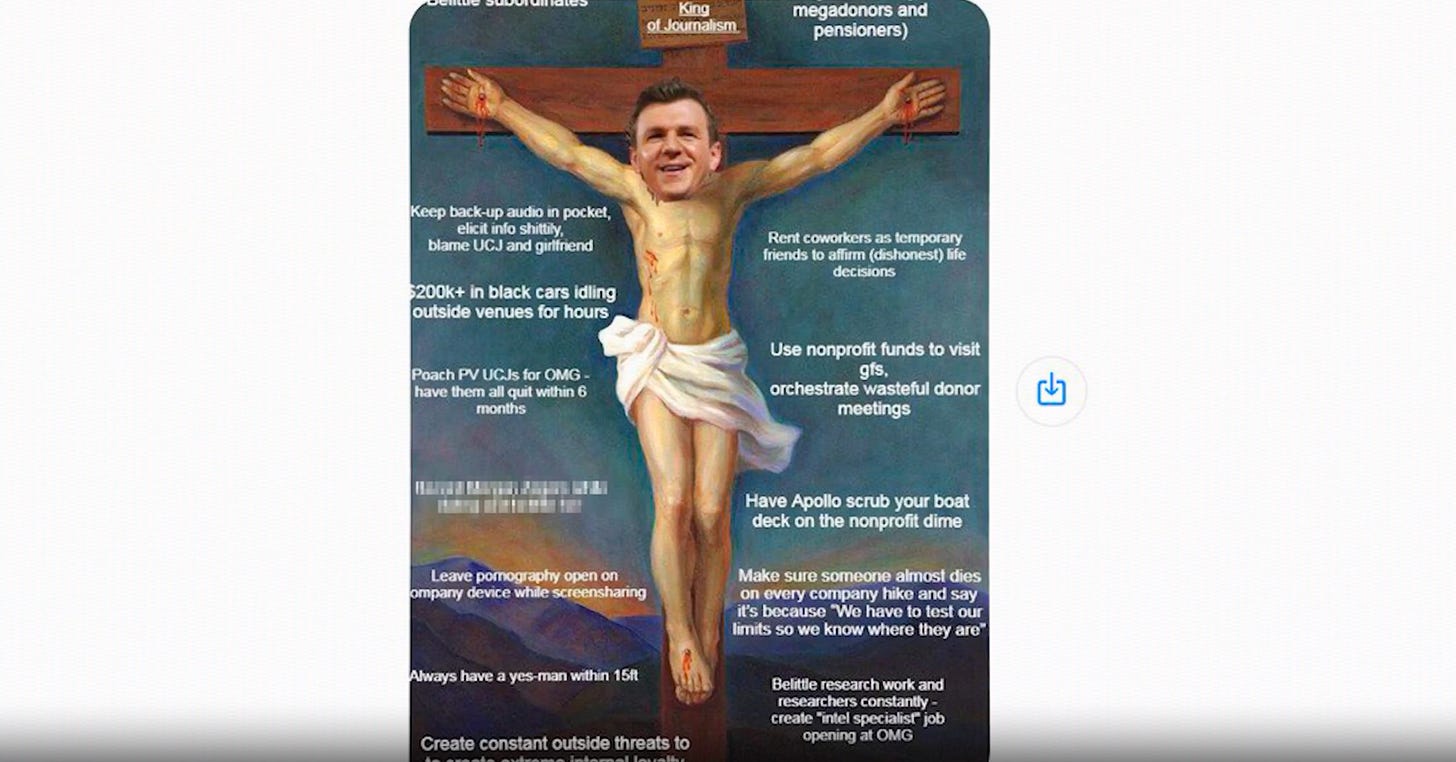
It’s difficult to convey how self-pitying this project is. O’Keefe likens his treatment at the hands of the Project Veritas board to a “struggle session” and a “crucifixion,” and he said that after the meeting in which he was shoved out, “the people with these grievances” actually sent him a picture in which he had been photoshopped onto a cross.
(Screenshot from The Truth About Veritas)
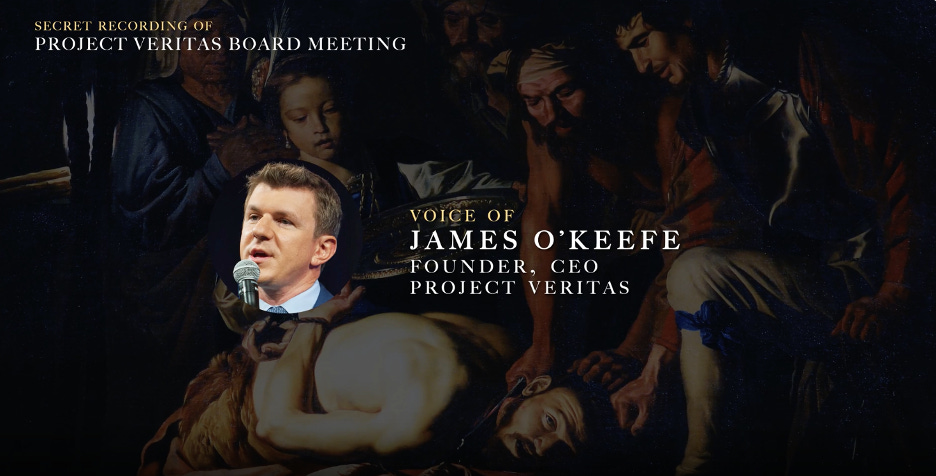
At one point, he plays an audio recording of himself apologizing to the board, with his words set to a mournful score. In keeping with the style of the video, the apology recording is illustrated with a series of paintings. One of these background images is The Beheading of John the Baptist by seventeenth-century Dutch painter Matthias Stom. (It seems we’re meant to take O’Keefe to be, metaphorically, John the Baptist.)
(Screenshot from The Truth About Veritas)
At one point in the video, O’Keefe reviews footage of happier days at Project Veritas, just him yukking it up with his undercover operatives.
“It doesn’t look like a hostile work environment,” he said. “It looks like a special place.”
Leave a comment
Share The Bulwark
Great Job Will Sommer & the Team @ The Bulwark Source link for sharing this story.
A saga that ended with the rebel preacher Thomas Müntzer beneath an executioner’s axe in Mühlhausen on May 27, 1525, began not with his radical Protestant preaching or his apocalyptic visions, but rather a year before with snails.
Helix pomatia, better known as the Burgundy snail, is common throughout Europe and found in the town of Stühlingen just below the Black Forest. Among other uses, it is prized for its large, brownish-cream-colored spiral shell that can be useful as a thread spool.
During the notoriously difficult harvest of 1524, when inclement weather had caused disastrous crop failures throughout the Holy Roman Empire, the countess of Lupfen ordered over a thousand of her serfs to cease working their fields so as to collect snail shells to be used as spools in her estate.
In feudal Europe, the serfs were only a step up in the great chain of being from actual possessions, so what the countess willed, the peasants had to abide. But Müntzer had imagined a different creed, that ancient command of “Omnia sunt communia” — the notion that “All property shall be held in common.”
Already at risk of starvation, the peasants couldn’t quit their farm labor to gather trifles, so they didn’t. It was the first volley in Müntzer’s revolution. The example of the humble snail shows us that the origins of the rebellion lay in the basest of material realities, for all of the debates about the role of the Protestant Reformation in general and Müntzer’s antinomian gospel in particular.
Rather than serving as a vanguard figure in his own right, Müntzer in some ways discovered a revolution that was in search of a leader. The conditions across southern Germany, from crop failure and catastrophic weather to hyperinflation, offered impetus enough to the rebellion, but Müntzer provided a powerful rhetoric and theory that justified the uprising.
He denounced the princes and lords — the same men who protected Luther from the Roman Catholic Church — as a
stinking puddle from which usury, thievery and robbery arises. . . . They make all creatures their property — the fish in the water, the bird in the air, the plants in the earth must all be theirs. . . . They oppress everyone, the poor peasant, the craftsman are skinned and scraped.
Among the most salient novelties of the rebellion were the Twelve Articles composed in Altstadt, though Müntzer himself was only minimally involved in this task. Anticipating subsequent texts like the US Declaration of Independence and the French Declaration of the Rights of Man, the demands of the rebels largely dealt with issues of church governance, but they also expressed the beginnings of a language of human rights — though one that was far more radical than would later be promulgated during the American Revolution or even the French.
Such rights included common ownership of all livestock, free access to all to the commons, collective ownership of woodlands, and the prohibition of arbitrary punishment. “Accordingly we hereby declare that we are free and want to remain free,” wrote the authors.
So powerful was that call — and so hungry were peasant bellies — that as many as 300,000 women and men throughout Germany rose up in rebellion during those lean months a half-millennium ago. In her book Summer of Fire and Blood, Lyndal Roper describes the spread of the revolt “like a vast contagion . . . from southwest Germany through Württemberg, Swabia, the Allgäu, Franconia, Thuringia, and Saxony to Alsace in what is now France, Austria, and Switzerland.”
Rebel leaders like Michael Gaismair, Hans Müller, Wendel Hipler, Florian Geyer, and Müntzer himself faced off on the battlefield against the combined military expertise of the Swabian League, the Landgraviate of Hesse, and the Electorate of Saxony. Sieges, battles, and massacres marked that brief but bloody war, where the professional armies of the nobility had perhaps no more than 8,500 men engaged in battle against more than a quarter of a million peasants.
Yet the nobles won, and handily, with perhaps a third of the peasants killed while the princes suffered virtually no losses at all. The peasants were fighting a professional fighting force of men conditioned and trained in military strategy. Furthermore, when they marched into battle armed with hoes, spades, and shovels, they were confronted by men who carried swords, crossbows, and blunderbusses.
By the time of the Battle of Frankenhausen in mid-May, the rebellion was all but lost, with most leaders either dead or captured and executed shortly thereafter. A particularly gruesome example was the fate of the commander “Little” Jack Rohrbach, who was chained to a stake in the middle of a ring of fire, while being forced to run in circles until consumed by the flames.
A contemporary pamphlet described the scenes of devastation:
Houses are burned; fields and vineyards lie fallow. . . . The prince, the gentleman, or the nobleman will have his rent and due. Eternal God, whither shall the widows and poor children go forth to seek it?
One of those bereaved widows was Müntzer’s, having wed her husband, the former priest, only a year before his execution. He stood on a scaffold where he was decapitated, his head displayed on a pike as a warning to any others who might have the temerity to dream of a better world.
Some historians have presented Müntzer as the driving force behind the rebellion, while others reduce him to the status of an ancillary player. There is a similar diversity of opinion about the balance between religious and socioeconomic motivations among the rebels. Yet Müntzer’s name remains the one that is most often associated with the events of 1524–25.
As such, there have been various ways of commemorating Müntzer. Just a few months after the collapse of the rebellion, the elector Cardinal Albert of Brandenburg commissioned a fountain for the Marktbrunnen in Mainz that mockingly depicted a drunken peasant lollygagging with the words “O Consider the End” emblazoned on the base. In the twentieth century, on the other hand, the East German authorities placed the preacher on a banknote, sternly gazing out from beneath his reformer’s cap.
They also marked the five-hundredth anniversary of Müntzer’s birth in 1989 with the opening of the Peasants’ War Panorama in Bad Frankenhausen, Thuringia. This was a museum that featured a gigantic oil painting by Werner Tübke, the largest mural in the world, unveiled shortly before the demise of the German Democratic Republic itself.
In his new study of Müntzer’s life, Alex Drummond presents him as “a man dedicated to improving the spiritual position of the common people,” who was “deeply sympathetic to the misery of the peasantry and the poor,” whether his motivations were political, religious, or both.
Marxist theorists have often been drawn to Müntzer as a forerunner of latter-day revolutionary movements. In his 1850 pamphlet The Peasant War in Germany, Engels interpreted the central apocalyptic vision in Müntzer’s rhetoric as fundamentally a secular call for revolution filtered through religious language, with the preacher as a “representative of a budding proletariat.” Karl Kautsky’s 1897 work Communism in Central Europe in the Time of the Reformation praised his “revolutionary vigor” and “statesmanlike view.”
Contemporary scholars of the early modern period, on the other hand, are much more cautious about separating faith from politics when it comes to a figure like Müntzer. After all, Müntzer’s call for all property to be held in common can be traced all the way back to the New Testament Book of Acts, which spoke of a moment in the early days of Christianity when “distribution was made unto every man according as he had need” and the followers of Jesus “had all things in common.” The rebellion was both a religious war and a social conflict over material demands.
While historians have debated just how much of a catalyzing role Müntzer played in the revolt, it is beyond dispute that many of the peasant rebels marched under the preacher’s standard, a white flag emblazoned with a curved rainbow that read “The word of the Lord remains eternal.” His former mentor Luther certainly blamed Müntzer for the rebellion in his 1525 pamphlet Against the Murderous, Thieving Hordes of Peasants.
Luther’s text asserted that the revolutionaries “doubly deserved death in body and soul as highwaymen and murderers,” branding them as “the worst blasphemers of God and slanderers of his holy name” while singling out his former colleague as the “arch-devil himself who reigns at Mühlhausen.” This was the city where, just a few weeks after Luther had finished the pamphlet, the radical preacher would take his last stand.
Luther’s pamphlet would most likely have been printed and distributed only after the rebellion had ended and thus had less influence on the decisions of the nobles than some accounts might suggest. Yet it certainly gave the nobility moral cover for the violent atrocities they committed.
Müntzer saw Luther as a Judas who had betrayed the Reformation beliefs that he believed himself to be carrying to their logical conclusion, branding the father of Protestantism as “Brother Fatted Pig and Brother Soft Life.” Müntzer, who challenged the inequities of civil authority, was beheaded for his pains, while Luther preached subservience to the powers that be and expired peacefully in his bed two decades later.
Great Job Ed Simon & the Team @ Jacobin Source link for sharing this story.