AUSTIN, Texas – Early indications from long range computer weather models are hinting at a wintry mix threat for the weekend.
What we know:
An Arctic front is scheduled to arrive on Friday.
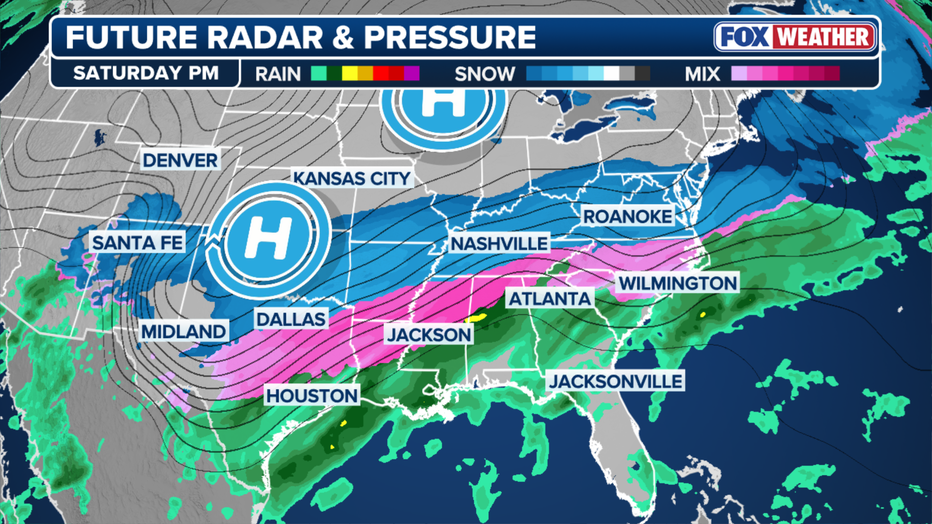
At the same time, a Western Low will pump in moisture from the Pacific and push it above the cold air. This interaction will create clouds and more precipitation.
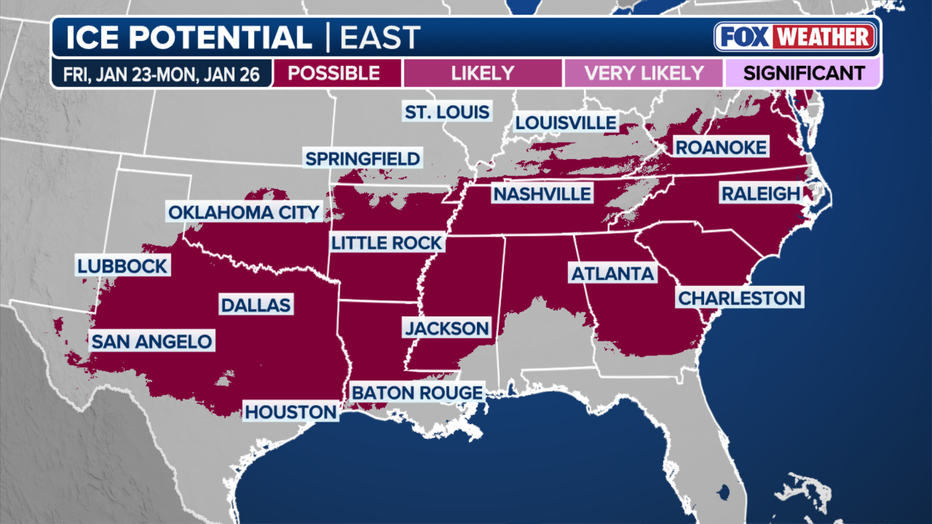
If it is cold enough, the cold rain could transition into freezing rain in the middle of the weekend.
What we don’t know:
The forecast is not set in stone yet since it is six days away.
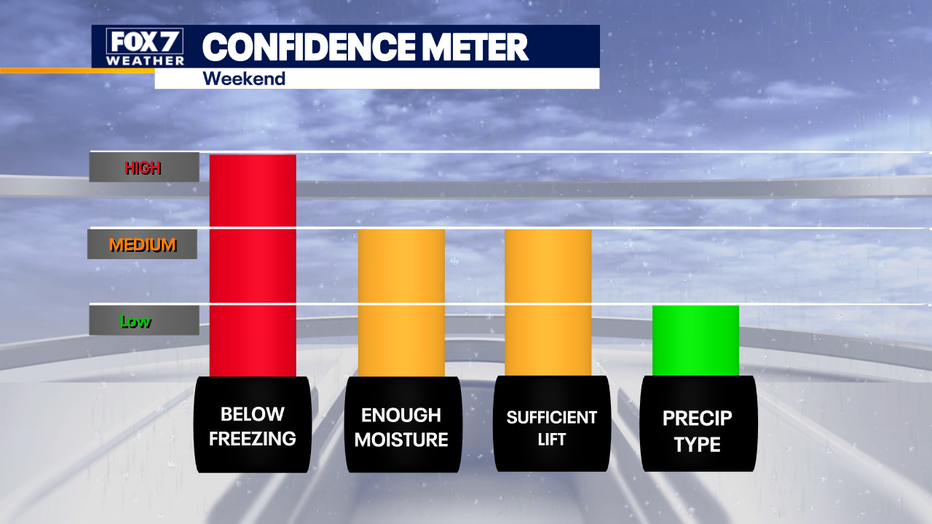
Confidence is high we will have freezing weather and precipitation but low confidence on timing and type of precipitation.
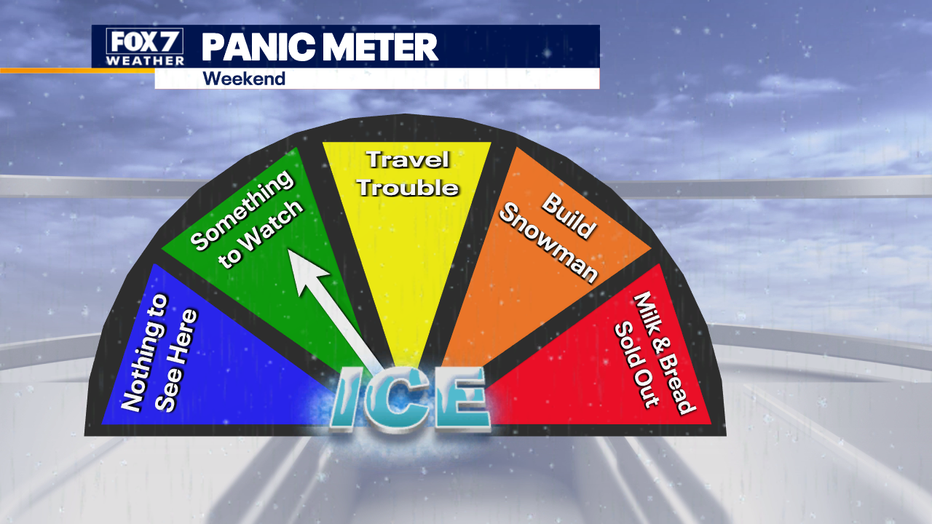
The panic meter is on something to watch.
We have plenty of time to fine tune the forecast and iron out the details.
Dig deeper:
Across Texas
Anyone who has travel plans in Texas this week should pay close attention to the forecast as the winter storm impacts could be widespread.
While specifics on rain, snow, sleet and freezing rain are limited at this time, the dramatic drop in temperatures is much more certain.
Wintry weather could be seen across a large swath of Texas, as temperatures go from about 15 degrees above average for some places to as much as 30 degrees below average in the span of a day.
Bottom line for Texans, keep tabs on the weather forecast as details come into focus.
What you can do:
Track your local forecast for the Austin area quickly with the free FOX 7 WAPP.
The design gives you radar, hourly, and 7-day weather information just by scrolling.
Our weather alerts will warn you early and help you stay safe.
The Source: Information from meteorologist Zack Shields, FOX Weather and Aaron Barker.
A far-right rally meant to rile up Minneapolis over immigration and Islam collapsed Saturday under the weight of its own spectacle, ending with white supremacist influencer Jake Lang fleeing City Hall in tears—escorted to safety by young Black men, the very people he has spent years vilifying online.
Lang, a pardoned January 6 defendant and Florida U.S. Senate candidate, arrived downtown in a flak vest, promising confrontation. Instead, he was overwhelmed by hundreds of counter-protesters who drowned out his chants, pelted him with eggs and water balloons, and boxed him in against City Hall windows.
Jack Lang went to Minneapolis, Minnesota, to counter protesters. (Photo: Threads/drewkartos)
The rally quickly dissolved into a harrowing retreat.
Several videos from the scene show Lang bloodied and defeated as the crowd surged.
The moment that cut through the chaos came at the end. As Lang was hustled away, two young Black men shielded him from further harm and guided him toward a waiting SUV.
The episode ignited a flood of reaction online.
“Notice the look of terror on Jake Lang’s face,” one influencer said in a video posted to Threads. “And as he’s escorted to safety, he looks like a submissive dog. And in his moment of terror, probably more terror than he’s ever felt, he was embraced and saved and protected by two young Black men. Sh-t makes me a little emotional. Because that’s some beautiful sh-t. That is some sh-t that is so powerful that it can change people’s hearts.”
The commentator in the video said Lang has a long track record of claiming that white men are being pushed to the side, adding that it was ironic that Black men had jumped in to protect him.
The scene played out against a backdrop of rising tensions in Minneapolis, where protests have intensified after an ICE agent fatally shot Renee Good, a 37-year-old mother of three, earlier this month. Demonstrators had already gathered near City Hall when Lang arrived just before noon, according to the Minneapolis Police Department. His pro-ICE, anti-Islam event drew a throng of counter-protesters who surrounded the building. Lang was flanked by just a handful of supporters, who were quickly overwhelmed and unable to help as he was chased off.
Lang had advertised the rally online as a “March Against Minnesota Fraud” and said he intended to “burn a Quran” on the steps of City Hall, which did not happen. What did unfold was a sustained confrontation: chants, shoving, snowballs, ice water and the seizure of hate signs. At least one person was forced by the crowd to remove his shirt.
Police deployed pepper balls and tear gas to separate groups, then issued a dispersal order.
Lang was left with visible bruises and scrapes, with blood trickling down the back of his neck. No arrests were made.
Later, in a social media post, Lang claimed he had been “nearly ripped limb from limb,” adding, “I was just literally lynched by an anti white mob of liberals & illegal immigrants- I’m at the hospital now getting staples in my skull…” He then called on President Donald Trump to “SEND IN THE NATIONAL GUARD.”
Police said no official reports of an assault were filed and disputed Lang’s claims that city leaders ordered officers to stand down. Witnesses said Lang was later kicked out of a downtown hotel and finally whisked out of the city.
Online, the episode landed with derision.
“If you walked away from it, then it wasn’t a literal lynching, Jake. Hope that clears things up,” one person wrote, summing up the overall outrage over Lang’s framing of what happened.
“Lynched by water balloons? says the guy who beat a cop with a baseball bat on January 6th. These ‘alpha’ males are the biggest bitches on the planet. Explain why they’re too pu—y to join the military,” added another.
“I didn’t know who Jake Lang was until now but I am so here for this,” someone wrote on another thread.
Others reveled in Lang’s FAFO moment. “Watching Jake Lang f—k around in Minnesota was an unexpected weekend treat,” someone said. Another added: “F—king. Awesome.”
Not everyone saw it as transformative. “He will still hate Black people,” one commenter replied to the viral clip. Another person added, “Jake Lang labelled the black men who helped him as a couple of the ‘good ones,’ then continued on his racist incel crusade like nothing ever happened.”
On a separate thread, conservative voices objected to the crowd’s tactics: “What hatred showing you that you’re more hatred towards free speech? People have the right to speak,” the post read.
“Bunch of pu$$y$ had to jump him. Typical liberals throw tantrums act like children and then act like they didn’t do anything,” another fumed. “I don’t see him running anywhere. I hope he comes back tomorrow and mops the whole street with your faces.”
Others blamed Lang for his own undoing.
“It’s like he did this to himself!!” one person wrote. This was like walking into a Jewish prison in a Naz! Uniform and expect to be welcomed and treated well with open arms.. Like what did he actually expect to happen?”
Lang is known for staging small, media-thirsty rallies across the country, often targeting Black and Muslim communities and immigrant populations.
Last year in April, when a white teenager from North Texas was stabbed to death at a track meet, the killing quickly became a rallying cry for white supremacists pushing a narrative of Black-on-white violence—despite the victim’s own father rejecting that framing.
Lang was among the most visible figures to seize on the killing. He led a sparsely attended rally at the stadium where the stabbing occurred, declaring the death an act of anti-white violence and attempting to enlist the victim’s father into his campaign.
But the father publicly rebuked Lang, accusing him of exploiting his son’s death to sow racial divisions. Lang responded with racist attacks and escalated rhetoric, using the case to fuel a broader national push tied to his white supremacist activism.
Lang received clemency from Trump despite having been charged with assaulting a police officer with a baseball bat, civil disorder and other crimes. Since his release, Lang has leaned into notoriety, launching fundraising efforts, flirting with militia organizing and announcing a Senate run in Florida for the seat vacated by Marco Rubio.
Great Job A.L. Lee & the Team @ Atlanta Black Star Source link for sharing this story.
The U.S. Department of Justice said Sunday it is investigating a group of protesters in Minnesota who disrupted services at a church where a local official with U.S. Immigration and Customs Enforcement apparently serves as a pastor.
A livestreamed video posted on the Facebook page of Black Lives Matter Minnesota, one of the protest’s organizers, shows a group of people interrupting services at the Cities Church in St. Paul by chanting “ICE out” and “Justice for Renee Good.” The 37-year-old mother of three was fatally shot by an ICE agent in Minneapolis earlier this month amid a surge in federal immigration enforcement activities.
The protesters allege that one of the church’s pastors — David Easterwood — also leads the local ICE field office overseeing the operations that have involved violent tactics and illegal arrests.
U.S. Department of Justice Assistant Attorney General Harmeet Dhillon said her agency is investigating federal civil rights violations “by these people desecrating a house of worship and interfering with Christian worshippers.”
“A house of worship is not a public forum for your protest! It is a space protected from exactly such acts by federal criminal and civil laws!” she said on social media.
Attorney General Pam Bondi also weighed in on social media, saying that any violations of federal law would be prosecuted.
Nekima Levy Armstrong, who participated in the protest and leads the local grassroots civil rights organization Racial Justice Network, dismissed the potential DOJ investigation as a sham and a distraction from federal agents’ actions in Minneapolis-St. Paul.
“When you think about the federal government unleashing barbaric ICE agents upon our community and all the harm that they have caused, to have someone serving as a pastor who oversees these ICE agents, is almost unfathomable to me,” said Armstrong, who added she is an ordained reverend. “If people are more concerned about someone coming to a church on a Sunday and disrupting business as usual than they are about the atrocities that we are experiencing in our community, then they need to check their theology and the need to check their hearts.”
The website of St. Paul-based Cities Church lists David Easterwood as a pastor, and his personal information appears to match that of the David Easterwood identified in court filings as the acting director of the ICE St. Paul field office. Easterwood appeared alongside DHS Secretary Kristi Noem at a Minneapolis press conference last October.
Cities Church did not respond to a phone call or emailed request for comment Sunday evening, and Easterwood’s personal contact information could not immediately be located.
Easterwood did not lead the part of the service that was livestreamed, and it was unclear if he was present at the church Sunday.
In a Jan. 5 court filing, Easterwood defended ICE’s tactics in Minnesota such as swapping license plates and spraying protesters with chemical irritants. He wrote that federal agents were experiencing increased threats and aggression and crowd control devices like flash-bang grenades were important to protect against violent attacks. He testified that he was unaware of agents “knowingly targeting or retaliating against peaceful protesters or legal observers with less lethal munitions and/or crowd control devices.”
“Agitators aren’t just targeting our officers. Now they’re targeting churches, too,” the U.S. Immigration and Customs Enforcement agency stated. “They’re going from hotel to hotel, church to church, hunting for federal law enforcement who are risking their lives to protect Americans.”
Black Lives Matter Minnesota co-founder Monique Cullars-Doty said that the DOJ’s prosecution was misguided.
“If you got a head — a leader in a church — that is leading and orchestrating ICE raids, my God, what has the world come to?” Cullars-Doty said. “We can’t sit back idly and watch people go and be led astray.”
Great Job Jack Brook, The Associated Press & the Team @ Fortune | FORTUNE Source link for sharing this story.
Nearly 100 UK newspaper editorials opposed climate action in 2025, a record figure that reveals the scale of the backlash against net-zero in the right-leaning press.
Carbon Brief has analysed editorials – articles considered the newspaper’s formal “voice” – since 2011 and this is the first year opposition to climate action has exceeded support.
Criticism of net-zero policies, including renewable-energy expansion, came entirely from right-leaning newspapers, particularlythe Sun, the Daily Mail and the Daily Telegraph.
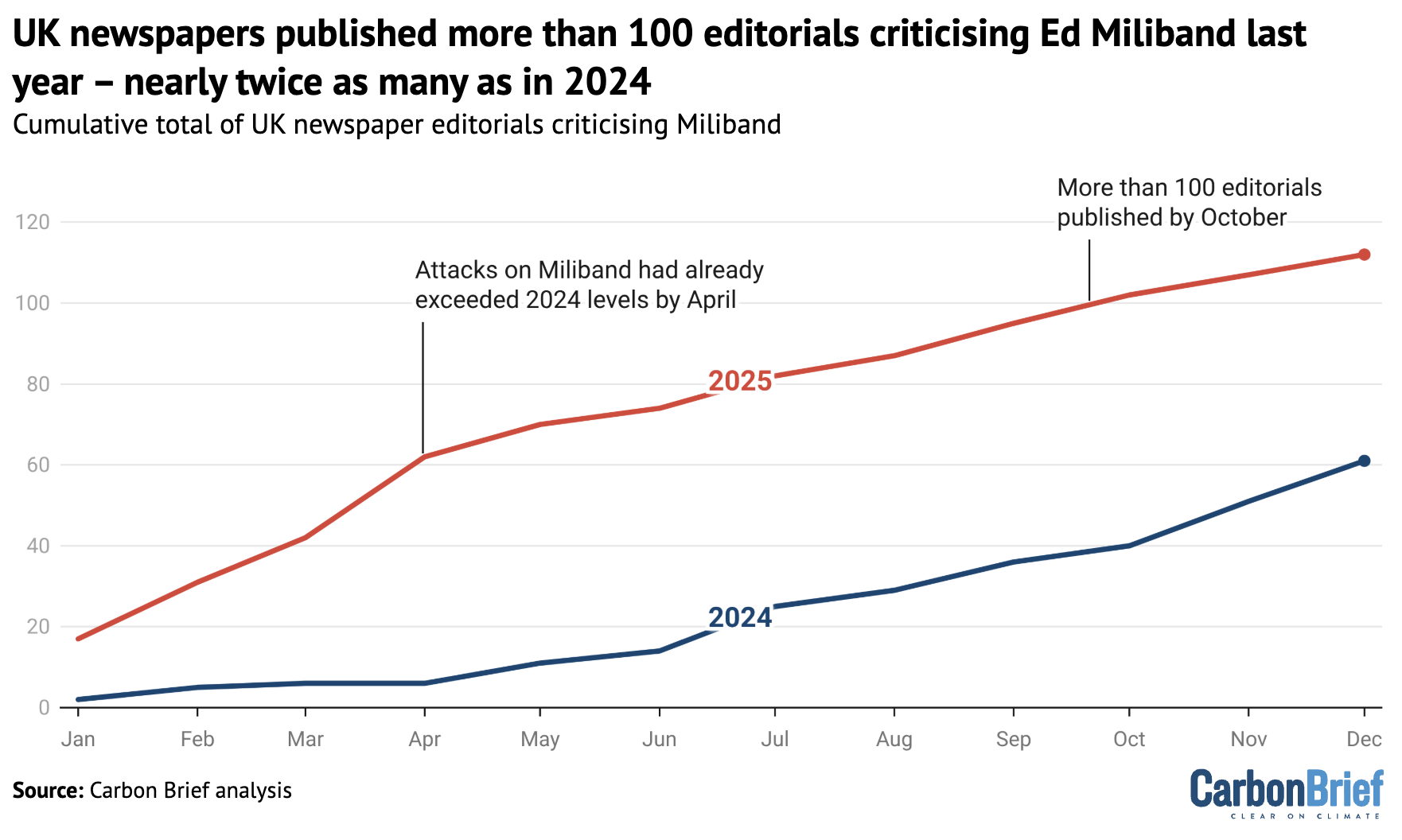
In addition, there were 112 editorials – more than two a week – that included attacks on Ed Miliband, continuing a highly personal campaign by some newspapers against the Labour energy secretary.
These editorials, nearly all of which were in right-leaning titles, typically characterised him as a “zealot”, driving through a “costly” net-zero “agenda”.
Taken together, the newspaper editorials mirror a significant shift on the UK political right in 2025, as the opposition Conservative party mimicked the hard-right populist Reform UK party by definitivelyrejecting the net-zero target that it had legislated for and the policies that it had previously championed.
Record climate opposition
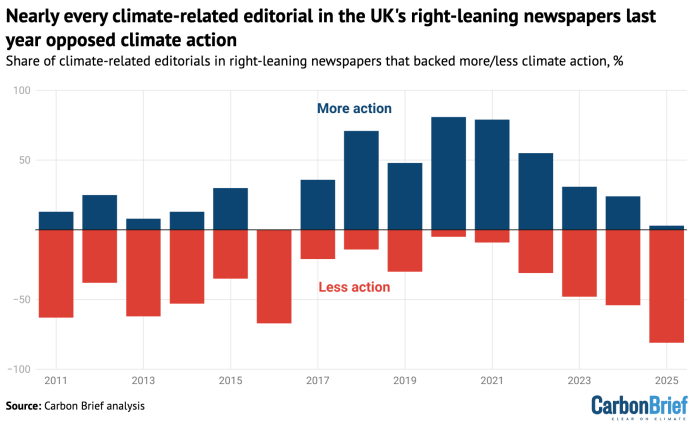
Nearly 100 UK newspaper editorials voiced opposition to climate action in 2025 – more than double the number of editorials that backed climate action.
As the chart below shows, 2025 marked the fourth record-breaking year in a row for criticism of climate action in newspaper editorials.
This also marks the first time that editorials opposing climate action have overtaken those supporting it, during the 15 years that Carbon Brief has analysed.
Number of UK newspaper editorials arguing for more (blue) and less (red) climate action, 2011-2025. Some editorials also present a “balanced” view, which is categorised as advocating for neither “more” nor “less” climate action. These editorials are not represented in this chart. Source: Carbon Brief analysis.
This trend demonstrates the rapid shift away from a long-standing political consensus on climate change by those on the UK’s political right.
Over the past year, the Conservative party has rejected both the “net-zero by 2050” target that it legislated for in 2019 and the underpinning Climate Change Act that it had a major role in creating. Meanwhile, the Reform UK party has been rising in the polls, while pledging to “ditch net-zero”.
These views are reinforced and reflected in the pages of the UK’s right-leaning newspapers, which tend to support these parties and influence their politics.
All of the 98 editorials opposing climate action were in right-leaning titles, including the Sun, the Daily Mail, the Daily Telegraph, the Times and the Daily Express.
Conversely, nearly all of the 46 editorials pushing for more climate action were in the left-leaning and centrist publications the Guardian and the Financial Times. These newspapers have far lower circulations than some of the right-leaning titles.
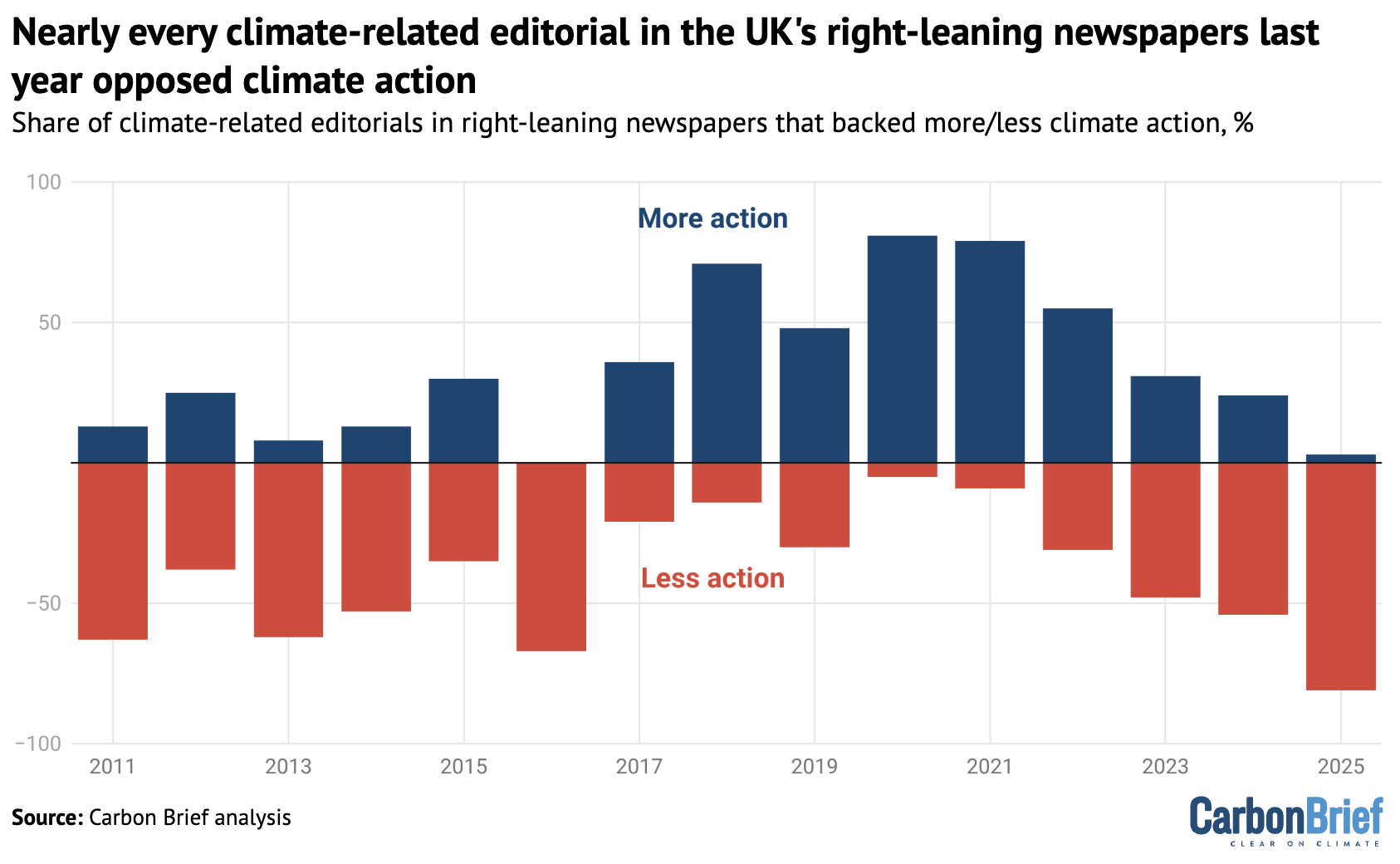
In total, 81% of the climate-related editorials published by right-leaning newspapers in 2025 rejected climate action. As the chart below shows, this is a marked difference from just a few years ago, when the same newspapers showed a surge in enthusiasm for climate action.
That trend had coincided with Conservative governments led by Theresa May and Boris Johnson, which introduced the net-zero goal and were broadly supportive of climate policies.
The share of right-leaning, climate-related UK newspaper editorials arguing for more (blue) and less (red) climate action, 2011-2025, %. Some editorials also present a “balanced” view, which is categorised as advocating for neither “more” or “less” climate action. These editorials are not represented in this chart. Source: Carbon Brief analysis.
Notably, none of the editorials opposing climate action in 2025 took a climate-sceptic position by questioning the existence of climate change or the science behind it. Instead, they voiced “response scepticism”, meaning they criticised policies that seek to address climate change.
(The current Conservative leader, Kemi Badenoch, has described herself as “a net-zero sceptic, not a climate change sceptic”. This is illogical as reaching net-zero is, according to scientists, the only way to stop climate change from getting worse.)
In particular, newspapers took aim at “net-zero” as a catch-all term for policies that they deemed harmful. Most editorials that rejected climate action did not even mention the word “climate”, often using “net-zero” instead.
This supports recent analysis by Dr James Painter, a research associate at the University of Oxford, which concluded that UK newspaper coverage has been “decoupling net-zero from climate change”.
This is significant, given strong and broad UK public support for many of the individual climate policies that underpin net-zero. Notably, there is also majority support for the “net-zero by 2050” target itself.
Much of the negative framing by politicians and media outlets paints “net-zero” as something that is too expensive for people in the UK.
In total, 87% of the editorials that opposed climate action cited economic factors as a reason, making this by far the most common justification. Net-zero goals were described as “ruinous” and “costly”, as well as being blamed – falsely – for “driving up energy costs”.
The Sunday Telegraph summarised the view of many politicians and commentators on the right by stating simply that said “net-zero should be scrapped”.
While some criticism of net-zero policies is made in good faith, the notion that climate change can be stopped without reducing emissions to net-zero is incorrect. Alternative policies for tackling climate change are rarely presented by critical editorials.
Moreover, numerous assessments have concluded that the transition to net-zero can be both “affordable” and far cheaper than previously thought.
This transition can also provide significant economic benefits, even before considering the evidence that the cost of unmitigated warming will significantly outweigh the cost of action.
Miliband attacks intensify
Meanwhile, UK newspapers published 112 editorials over the course of 2025 taking personal aim at energy security and net-zero secretary Ed Miliband.
Nearly all of these articles were in right-leaning newspapers, with the Sun alone publishing 51. The Daily Mail, the Daily Telegraph and the Times published most of the remainder.
This trend of relentlessly criticising Miliband personally began last year in the run up to Labour’s election victory. However, it ramped up significantly in 2025, as the chart below shows.
Cumulative number of UK newspaper editorials criticising energy secretary Ed Miliband in 2024 (light blue) and 2025 (dark blue). Source: Carbon Brief analysis.
Around 58% of the editorials that opposed climate action used criticism of climate advocates as a justification – and nearly all of these articles mentioned Miliband, specifically.
Many of these attacks were highly personal. The Daily Mail, for example, called Miliband “pompous and patronising”, with an “air of moral and intellectual superiority”.
These formulations frame climate policies as harmful measures that are being imposed on people by the energy secretary.
In fact, the Labour government decisively won an election in 2024 with a manifesto that prioritised net-zero policies. Often, the “targets” and “taxes” in question are long-standing policies that were introduced by the previous Conservative government, with cross-party support.
Moreover, the government’s climate policy not only continues to rely on many of the same tools created by previous administrations, it is also very much in line with expert evidence and advice. This is to prioritise the expansion of clean power and to fuel an economy that relies on increasing levels of electrification, including through electric cars and heat pumps.
Despite newspaper editorials regularly calling for Miliband to be “sacked”, prime minister Keir Starmer has voiced his support both for the energy secretary and the government’s prioritisation of net-zero.
In an interview with podcast The Rest is Politics last year, Miliband was asked about the previous Carbon Brief analysis that showed the criticism aimed at him by right-leaning newspapers.
Podcast host Alastair Campbell asked if Miliband thought the attacks were the legacy of his strong stance, while Labour leader, during the Leveson inquiry into the practices of the UK press. Miliband replied:
“Some of these institutions don’t like net-zero and some of them don’t like me – and maybe quite a lot of them don’t like either.”
Renewable backlash
As well as editorial attitudes to climate action in general, Carbon Brief analysed newspapers’ views on three energy technologies – renewables, nuclear power and fracking.
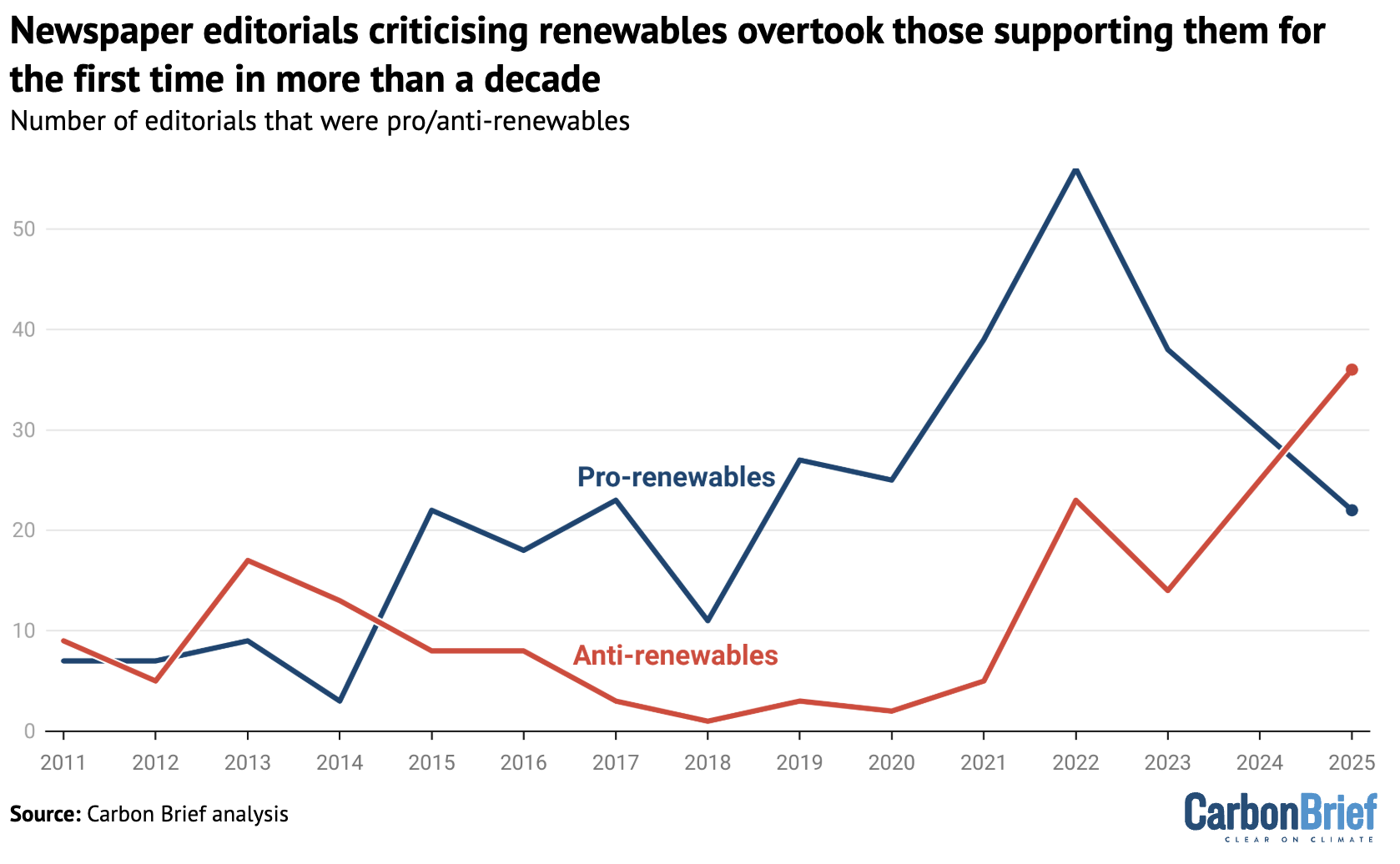
There were 42 newspaper editorials criticising renewable energy in 2025. This meant that, for the first time since 2014, there were more anti-renewables editorials than pro-renewables editorials, as the chart below shows.
As with climate action more broadly, this was a highly partisan issue. The Times was the only right-leaning newspaper that published any editorials supporting renewables.
Number of UK newspaper editorials that were pro- (blue) and anti-renewables (red), 2011-2025. Some editorials also present a “balanced” view, which is categorised as advocating for neither “more” or “less” climate action. These editorials are not represented in this chart. Source: Carbon Brief analysis.
By far the most common stated reason for opposing renewable energy was that it is “expensive”, with 86% of critical editorials using economic arguments as a justification.
The Sun referred to “chucking billions at unreliable renewables” while the Daily Telegraph warned of an “expensive and intermittent renewables grid”.
At the same time, editorials in supportive publications also used economic arguments in favour of renewables. The Guardian, for example, stressed the importance of building an “affordable clean-energy system” that is “built on renewables”.
There was continued support in right-leaning publications for nuclear power, despite the high costs associated with the technology. In total, there were 20 editorials supporting nuclear power in 2025 – nearly all in right-leaning newspapers – and none that opposed it.
Fracking was barely mentioned by newspapers in 2023 and 2024, after a failed push by the Conservatives under prime minister Liz Truss to overturn a ban on the practice in 2022. This attempt had been accompanied by a surge in supportive right-leaning newspaper editorials.
There was a small uptick of 15 editorials supporting fracking in 2025, as right-leaning newspapers once again argued that it would be economically beneficial.
The Sun urged current Conservative leader Badenoch to make room for this “cheap, safe solution” in her future energy policy. The government plans to ban fracking “permanently”.
North Sea oil and gas remained the main fossil-fuel policy focus, with 30 editorials – all in right-leaning newspapers – that mentioned the topic. Most of the editorials arguing for more extraction from the North Sea also argued for less climate action or opposed renewable energy.
None of these editorials noted that the UK is expected to be significantly less reliant on fossil-fuel imports if it pursues net-zero, than if it rolls back on climate action and attempts to squeeze more out of the remaining deposits in the North Sea.
Methodology
This is a 2025 update of previous analysis conducted for the period 2011-2021 by Carbon Brief in association with Dr Sylvia Hayes, a research fellow at the University of Exeter. Previous updates were published in 2022, 2023 and 2024.
The count of editorials criticising Ed Miliband was not conducted in the original analysis.
The full methodology can be found in the original article, including the coding schema used to assess the language and themes used in editorials concerning climate change and energy technologies.
The analysis is based on Carbon Brief’s editorial database, which is regularly updated with leading articles from the UK’s major newspapers.
Great Job Carbon Brief Staff & the Team @ Carbon Brief Source link for sharing this story.
“Sean helped change the mindset of this organization and was instrumental in the Bills becoming a perennial playoff team,” owner Terry Pegula said. ”But I feel we are in need of a new structure within our leadership to give this organization the best opportunity to take our team to the next level.”
As part of the new structure, Pegula announced he was promoting general manager Brandon Beane to president of football operations. Beane, who also is completing his ninth season in Buffalo, will oversee the coaching search.
The Bills went 12-5 in the regular season and saw their five-year run atop the AFC East end, finishing second behind the New England Patriots. Buffalo became the NFL’s first team to win a playoff round in six consecutive years but not reach the Super Bowl.
McDermott’s firing is the latest in what’s become a seismic shift in the NFL’s coaching ranks this offseason. He became the 10th head coach to lose his job, joining a respected group that includes Baltimore’s John Harbaugh and Pittsburgh’s Mike Tomlin. Harbaugh has since been hired by the New York Giants.
The 51-year-old McDermott finished with a 98-50 regular-season record and was 8-8 in the playoffs, ranking second on the team list in wins behind Hall of Fame coach Marv Levy (112-70, 11-8). Levy did so over 11 seasons during a tenure that included the Jim Kelly-led team reaching — and losing — four straight Super Bowls in the early 1990s.
McDermott’s failure to reach the Super Bowl with Josh Allen at quarterback became his undoing. Though Allen has broken many of Kelly’s passing and scoring records, the Bills have advanced to the AFC championship game just twice — and lost both times to Kansas City — during a team-record seven-year playoff run.
The loss Saturday to the Broncos was a crushing blow, with Allen nearly inconsolable at the postgame podium, blaming himself for an outing in which he threw two interceptions and lost two fumbles.
McDermott rallied to Allen’s defense, saying the loss wasn’t on the quarterback. And then the usually calm coach showed his emotions when questioning the officials’ ruling on Allen’s second interception, which ended Buffalo’s lone possession in overtime.
Receiver Brandin Cooks came down with Allen’s deep pass but had it wrestled out of his hands by Ja’Quan McMillian. Officials ruled McMillian had the ball before Cooks was down by contact, and Denver was awarded the turnover at its 20.
McDermott, who was a member of the NFL’s competition committee overseeing rules, believed Cooks came down with the ball, and he also was dismayed over why officials took little time to review the play.
“I’m standing up for Buffalo, damn it. I’m standing up for us,” McDermott said. “The guys spend three hours out there playing football, pouring their guts out to not even say, ‘Hey, let’s slow this thing down.’ That’s why I’m bothered.”
Buffalo’s last three playoff losses have all been decided by three points. And three of McDermott’s playoff losses ended in overtime.
That includes a 42-36 loss to Kansas City in the 2021 divisional round that’s become dubbed “13 seconds” — the amount of time Patrick Mahomes had to complete two passes for 44 yards and set up Harrison Butker’s tying, 49-yard field goal on the final play of regulation.
Despite his playoff inconsistencies, McDermott oversaw a team that won 10 or more regular-season games over seven straight seasons, including two team record-matching 13-win seasons in 2022 and ’24.
Buffalo reached the playoffs in eight of McDermott’s nine seasons. That includes 2017, when the Bills sneaked into the postseason on the final day to end a 17-year playoff drought that at the time was the longest active streak in North America’s four major pro sports.
The Bills became a model of stability under McDermott and Beane, who arrived in May 2017. And now they undergo their first coaching search since McDermott took over for Rex Ryan, who was fired after two seasons in Buffalo.
McDermott was hired after spending six seasons as the Carolina Panthers’ defensive coordinator. Before that, he broke into the NFL in 1999 as a member of Andy Reid’s first staff in Philadelphia. McDermott worked his way up the ranks to become the Eagles’ defensive coordinator before being fired in 2010.
With Allen turning 30 in May, the Bills are expected to target an offensive-minded coach to spur an offense in which the quarterback was too often asked to carry the load.
The NFL’s 2024 MVP’s production dropped this season. He finished with 3,668 yards and 25 touchdowns passing, his lowest output since his second season in 2019.
The Bills did get a boost from running back James Cook, who became Buffalo’s first player to win the NFL’s rushing title since O.J. Simpson in 1976.
The defense struggled in part because of a transition to youth and a rash of injuries. Though Buffalo’s defense finished ranked seventh in the NFL this season, the unit had difficulty stopping the run.
It’s in the playoffs where the defense was criticized for collapsing too often. Buffalo allowed 30 or more points in four of its playoff losses.
Copyright 2026 The Associated Press. All rights reserved. This material may not be published, broadcast, rewritten or redistributed without permission.
Great Job John Wawrow, Associated Press & the Team @ KSAT San Antonio Source link for sharing this story.
In his 1961 farewell address, President Dwight D. Eisenhower asked the American people be strong in their faith that “all nations would reach peace with justice.” He requested further that our country be “unswerving in devotion to principle, confident but humble with power, diligent in pursuit of the Nation’s great goals.” Understanding the vast power at the disposal of the strongest military the world had ever known, the former five-star general of World War II and president made a point with his final words in office, calling on his fellow countrymen to understand the dangers such strength creates without an adherence to collective morals and values.
Arrogance, the antithesis of that humility, is pernicious. It spreads like wildfire, consuming everything around it and leaving in its destructive wake the smoldering ash of relationships, friendships, and partnerships. Its bellowing smoke clouds vision, isolating and insulating individuals and organizations from constructive criticism and innovative thought. In the private sector, arrogance may yield short-term gains but is ultimately disastrous for sustained success. To phrase it more succinctly, if you’re lucky, you might get rich, but it will never make you truly wealthy.
In the public sector, the impacts of arrogance are more egregious, with consequences rippling across communities, academia, cultures, ethnicities. When viewed further through the lenses of national security and foreign policy, the effects can be cataclysmic: families destroyed, lives lost. These ramifications may last for years, if not generations, eroding trust in institutions, safety within communities, and confidence betweenallies. For instance, according to a Gallup poll in May 2025, 69 percent of adult Americans have little to no trust that the government works in the best interest of society.
On this day dedicated to his memory, we recall the words of Rev. Dr. Martin Luther King, Jr., who, like Eisenhower, spoke of humility and of arrogance. He viewed the U.S. government’s overconfidence as a blight founded in hypocrisy, staining the character of the nation and its citizens. During his April 1967 address in support of ending the Vietnam War and in the shadow of segregation, King delivered this message with blunt elegance:
…But honesty impels me to admit that our power has often made us arrogant.
We are arrogant in our contention that we have some sacred mission to protect people from totalitarian rule while we make little use of our power to end the evils of South Africa and Rhodesia, and while we in fact support dictatorships with guns and money under the guise of fighting communism.
We often arrogantly feel that we have some divine, messianic mission to police the whole world. We are arrogant, as Senator Fullbright has said, to think ourselves “God’s avenging angels.” We are arrogant in not allowing young nations to go through the same growing pains, turbulence and revolution that characterized our history.
We are arrogant in professing to be concerned about the freedom of foreign nations while not setting our own house in order. …Our arrogance can be our doom.
Fifty-nine years later, this theme remains salient as a foundational thread within national security and foreign policy. Recent events do not simply mimic the maelstrom of domestic and international turmoil in King’s era but are deeply committed reenactments of those same egotistical decisions across multiple areas of policy.
As concerns rise about the dawn of a budding technocracy, federal guardrails meant to ensure the least harm possible from emerging technologies are currently all but nonexistent. Thus far, the Trump administration has declined to close the gap, stating: “To win, United States AI companies must be free to innovate without cumbersome regulation. But excessive State regulation thwarts this imperative.” State legislatures are attempting to fill the vacuum, but in doing so they create an inconsistent tapestry of regulation that is difficult for any person or group working in multiple jurisdictions (as almost all today are) to navigate. In the meantime, unchecked AI tools are currently used in an array of nefarious activity from housingredlining to the generation of pornography, including content involving children. Contrary to the government’s purported belief that a self-regulated industry will do the least harm, historical evidence shows that strong public governance in coordination with industry provides the best outcomes.
Domestically, the use of Immigration and Customers Enforcement (ICE) in widespread roundup operations – reportedly to capture “the worst criminal” noncitizens – has led to the erroneous arrests and deportation of individuals with a valid, legal status, including U.S. citizens. Inspections of facilities have declined as detention rates and deaths in custody have steadily risen according to a new report from the Project on Government Oversight (POGO), based on the 2025 data provided by Homeland Security. A number of those arrests have been conducted without warrants or probable cause, in violation of the individuals’ constitutional rights. Human rights groups reported detainees have been held in substandard conditions – such as those found in the notorious “Alligator Alcatraz” Floridian detention facility – akin to the conditions the United States often condemned as inhumane in other countries. In another instance, the government has reopened arguably unhealed wounds, utilizing the former site of a World War II Japanese internment camp to house immigrants. That facility was recently the site of an immigrant detainee’s death that the medical examiner is reportedly likely to classify as a homicide.
Alongside these events, the United States’ recent pressure and threats against longstanding NATO allies over desires to acquire Greenland sent diplomatic shockwaves through Western stability. The U.S. has long maintained a base on the island that is currently being expanded under previously agreed-to terms. Approximately 150 American service members are stationed at Pituffick Space Base in Greenland alongside hundreds of Canadian, Danish, and Greenlandic troops. The territory’s government stated the U.S. military could have easily expanded its footprint with the support of both Denmark and Greenland’s governments. Instead, the Trump administration’s offer to buy the autonomous territory outright and a rumored plan to pay citizens directly have been rebuffed by the government. Polling indicates both citizens of Greenland and the United States are against it. This aligns directly with King’s warning: “We [The U.S. government] feel that our money can do anything.”
Still, tensions around this issue persist. “Nobody’s going to fight the United States militarily over the future of Greenland,” Senior White House Advisor Stephen Miller defiantly proclaimed during a national news interview. He refused to discuss the potential use of force to acquire the territory even if Greenlandic officials continue to reject U.S. conservatorship. Now, numerous leaders within the European Union and Parliament have strongly condemned U.S. official statements on the issue, and allied soldiers recently deployed to conduct military exercises on the island. On Jan. 17, President Donald Trump announced tariffs beginning Feb. 1 against several NATO countries supporting Greenland with a June 1 deadline to increase percentages to 25 percent if the territory wasn’t sold to the United States by that time.
With all the evolving challenges facing the United States, a fundamental question exists: What type of citizen of the global community does America want to be, and what values define our country? The United States has never been able to achieve any strategic victory alone, yet now it dives deeper into isolation. We do this while leveraging the same tactics used by those we removed from power, labeling them dictators against democracy. How is that “peace through strength”? Strategic bombings of authoritarian regimes in support of civic upheaval while, domestically, unnamed masked agents conduct sweeping raids, threatening lawful citizens with arrest, will not achieve Eisenhower’s “peace with justice.”
In his closing remarks from that storied speech, King spoke of hope through his own patriotism and love of country.
Let me say finally that I oppose the war in Vietnam because I love America. I speak out against it not in anger but with anxiety and sorrow in my heart, and above all with a passionate desire to see our beloved country stand as the moral example of the world…
The U.S. government, through a constitutional structure of checks and balances in equal branches of government, is inherently imperfect. The Constitution’s preamble immediately references the mission of creating “a more perfect Union” as its guiding principle. The document has required 27 amendments throughout the 237 years since its 1788 ratification. Yet, in that imperfection we have remained resilient, maintaining the promise of hope for all those who dream of a better future. We always strive to be more perfect, to be better.
The actions of the U.S. government – all within the first year of the administration’s term – do not embody the “shining city upon a hill” or invoke the pride of the words captured in “The New Colossus,” etched in bronze on the side of our international symbol of freedom:
…cries she With silent lips. “Give me your tired, your poor, Your huddled masses yearning to breathe free, The wretched refuse of your teeming shore. Send these, the homeless, tempest-tost to me, I lift my lamp beside the golden door!
Instead, these acts are materials in the construction of a house of hubris, and this house – our house – is on fire. With humility and our collective morals and values we must extinguish the flames, or “our arrogance will be our doom.”
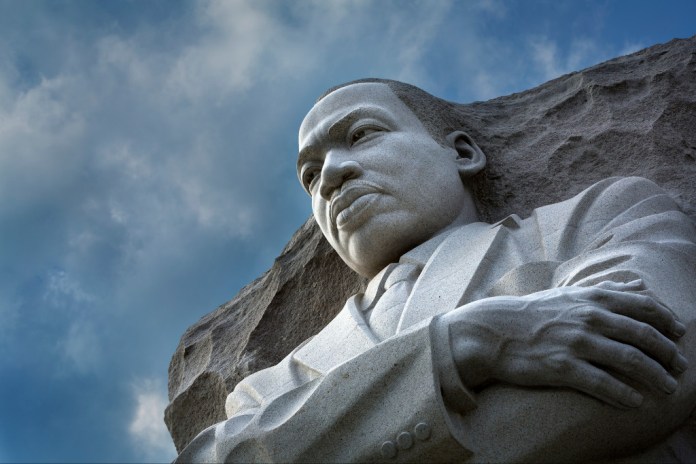
FEATURED IMAGE: The Martin Luther King Jr Memorial in Washington, DC (via Getty Images)
Great Job Bishop Garrison & the Team @ Just Security Source link for sharing this story.
“He made the moon to mark the seasons, and the sun knows when to go down.”—Psalm 104:19
“As he misplaced all sense of up and down, he felt, at last, connected to it all”—Train Dreams
It is so viciously hard, in our age, to look beyond what is right in front of us. Each new day brings headlines of violence across the world and, increasingly, close to home. Each glance at our screens encourages us to respond to these blatant evils by casting our frustrations into the void of social media rather than effective action or communal participation. “What will the coming year bring?” is a distant thought when “What will the next few hours bring?” is so pressing. It’s hard to mark the seasons when every day feels all-important.
The days are evil, that is to be sure. But we scarcely know how to make the most of our opportunities, so harried are we by what seems to be an eternal present. Some have referred to our experience as the tyranny of now. In his essay Post-Modernism, or the Cultural Logic of Late Capitalism, Frederic Jameson describes it as “the waning of our historicity” that affects our sense of time. The present expands and “suddenly engulfs” us, Jameson writes, making it harder to see how past and future could possibly have bearing on this moment. The intensity of the present in turn causes us to lose our ability to act in time, to “make it a space of praxis.” We’ve misplaced all sense of time, and somehow, though we’re connected to it all, we’re only more alienated.
It’s not merely a matter of screens or social media, though they play an outsized role. We are losing our bearings on how to act in the world, how to live and create or express meaning in history. Perhaps we can only see the sharpest of actions as containing any meaning, so we vacillate between revolutionary fervor and impotent listlessness. Gone is any awareness of the long obedience in the same direction that Eugene Peterson exhorted. When everything is urgent, when everything matters right this instant, what good are small acts of vitality or care? We’ve lost our sense of what it means to cultivate.
Clint Bentley’s film is a call to meditate on space and time, on life and death, on the great mystery of all things.
The past movie year has brought us many films that speak boldly to our present moment, including many great ones. One Battle After Another, It Was Just an Accident, Sinners, and even Superman confronted the tyranny and injustice of the powerful head on, making little attempt toward subtlety in the process. We need these sorts of clarion calls, but we also need chances to breathe. That is what makes Clint Bentley’s Train Dreams such an absorbing, nourishing film. It is quiet, but that does not mean it is light. It is lovely, but that does not make it any freer from pain than those other films. It is a call to step back, to meditate on space and time, on life and death, on the great mystery of all things.
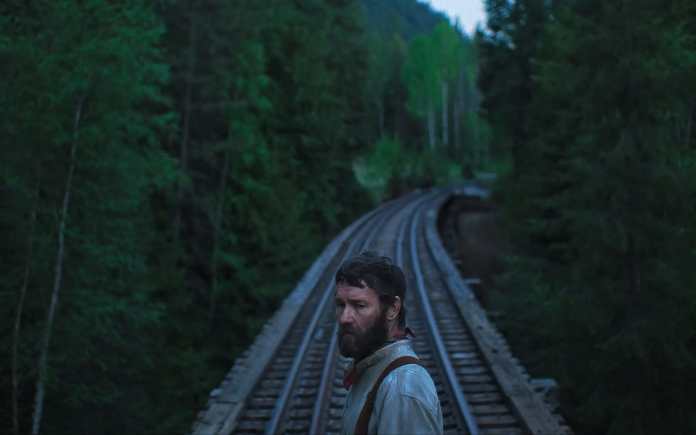
Based on Denis Johnson’s 2011 novella, Train Dreams follows the life of Robert Grainier from childhood through adulthood and to the end of his days, all of which are lived in the Pacific Northwest of Idaho and eastern Washington. Grainier (Joel Edgerton) is a logger, and he works with his hands to earn his keep, to build a home, and to make something simple but substantial of his life. We do not witness a moment in Grainier’s life; we witness the full arc of it. In fact, the film doesn’t really follow his life so much as invite us to share it with him. Time skips and memories recur, as images collect to form the substance of an individual life.
Time, Part II. Stepping Out of the Present
All creatures look to you to give them their food at the proper time. When you give it to them, they gather it up; when you open your hand, they are satisfied with good things. When you hide your face, they are terrified; when you take away their breath, they die and return to the dust. When you send your Spirit, they are created, and you renew the face of the ground. —Psalm 104:27-30
“Even though the old world is gone now, even though it’s been rolled up like a scroll and put somewhere, you can still feel the echo of it.”—Train Dreams
This is not a grand tale, but it contains the grandeur of humanity. Grainier’s life is unheralded in all respects. “His life ended as quietly as it had begun. He’d never purchased a firearm or spoken into a telephone. He had no idea who his parents might have been, and he left no heirs behind him.” Even throughout his life, Grainier’s never one to stop and wonder at the meaning of it all. He maintains a simple life, working and tending to his family as the world changes around him.
Train Dreams takes this clearcut man’s endeavors and weaves them into something timeless and evocative. There’s a consistent lack of dialogue throughout, but Will Patton’s voiceover acts as our guide. It is his voice that opens and closes the film, and provides the window into Grainier’s heart and mind, as well as into the world beyond. (The foundation of Edgerton’s performance is in his physicality and gestures, calmly giving expression to the film’s themes.) Patton’s words and Edgerton’s face speak with melancholy about the ways that time changes our lives. The world we live in now is not the same one into which we were born. We are not the same people we once were. And that transformation will continue, until it no longer does. “All creatures look to you,” the psalmist says to God, for provision and satisfaction and renewal. And yes, for death. “When you take away their breath, they die and return to dust.” If the psalmist here allows us to envision the sparrows, Moses leaves us no doubt in Psalm 90 that the same is true for humanity. “You turn people back to dust, saying ‘Return to dust, you mortals’” (Psalm 90:3).
We look to God for these things, and let us consider that this is also looking to God for timekeeping. Our birth and our death, at the ultimate extremes, are in his hands. But also daily provision, the demarcation of the seasons, the transmigrations of the sun and the moon. The seasons change, and we change, and God sustains us. We cultivate our lives, and our lives bear fruit in a thousand ways that testify to God’s faithful presence and our reflective creativity. But time is crucial for anything to grow, and our continued involvement is required. A framework of cultivation empowers us to see that our small acts, though they may seem impotent or pointless, contribute to the transformation of a world that is both beautiful and fleeting.
Timekeeping also includes history. The present has its place, but it cannot exist in isolation. It is not meant to be the vessel for all of our hopes and fears. Moses opens his prayer by observing, “Lord, you have been our dwelling place throughout all generations” (Psalm 90:1). All generations have been sustained through the greatest tyrannies and tragedies. Our own present age will someday be a distant past, and perhaps then humanity will be more ready to see its place in the river of history.
The World, Part I. Human Endeavors
You have set our iniquities before you, our secret sins in the light of your presence. All our days pass away under your wrath; we finish our years with a moan. —Psalm 90:8-9
“It upsets a man’s soul whether he recognizes it or not.”—Train Dreams
The film is set mainly in the early to mid-20th century, and Adolpho Veloso’s cinematography revels in the beauty of nature, highlighting the implications of humanity’s interactions with it along the way. On their own, these images take on an almost mystic quality: boots nailed, eye level, to a tree; a train crossing a bridge at night, its light diffuse in the steam from its engine; a fire watchtower looming out of place above a green field. As the film stitches these images together, they form a dialogue of their own that supplements the sparse script. They tell their own stories of the landscape and how we have altered it.
From his particular station in the world and in history, Grainier bears unwitting witness to the irrevocable transformation of the Pacific Northwest. The unending forests of his youth give way to a scarred landscape and dwindling woods. Forest fires seem ever more prevalent, and they take a heavy toll on his own life. Even his own endeavors become lost within the din of human striving. After spending his labor to build a bridge for a railroad company, the narrator tells us that “many years later, a bridge made of concrete and steel would be built ten miles upstream, rendering this one obsolete.” The work of slow craft and cultivation finds no home in a world of rapid industrialization and ever-changing technological improvements.
The tunnel vision of human ambition dims our sight to the ways we negatively affect the world around us. Train Dreams seeks to open our vision back up through its awe at the world’s beauty. Arn Peebles (William H. Macy) is an old man and a bit of a poet, or prophet, who joins some of the itinerant logging crews that employ Grainier. He warns the men that their work is a heavy burden “not just on the body but on the soul.” “The world is intricately stitched together, boys. Every thread we pull, we know not how it affects the design of things.”
This is where Train Dreams draws us back gradually into our present. The film calls us to step back from our present moment, but it never asks us to forget the weight that our choices have nor the concerns facing our world. Our iniquities are before us, as the psalmist confesses. Our acts of injustice and of harm toward others cannot be covered over, for they cultivate trouble and sorrow that grows the more we look away.
The World, Part II. The Great Mystery
Praise the Lord, my soul. Lord my God, you are very great; you are clothed with splendor and majesty —Psalm 104:1
“You’d turn a corner and suddenly find yourself face-to-face with the great mystery, the foundation of all things.”—Train Dreams
But Train Dreams ultimately directs our attention toward beauty. It is a film made with, and effusive with, awe. The world is suffused with majesty and great mystery. And while Bentley’s film never inclines itself explicitly toward religion, there is a rapturous transcendence that it seeks to capture. For Christians, this encounter of transcendence is inseparable from our understanding of God’s glory. The world provides a reflection of his splendor, for it is an outpouring of his generative creativity. We need frequent reminders to attend to this beauty, to marvel in a wonder that leads us to worship
Robert Grainier’s life means little in the scales of history, but that doesn’t make it meaningless. Sharing the arc of his days, even in the short span of a couple hours, is a profound, moving experience. As Grainier lives and dies, we hear an echo of a reminder: “Teach us to number our days, that we may gain a heart of wisdom” (Psalm 90:12). Our lives are in God’s hands, but his hands are generous. We will not cheat death, but we can live with meaning and care in the lives we are given. We can act, we can grow, and we can love even as we grieve, as we falter, as we wonder.
Maybe our own lives are small. Maybe they don’t show up clearly under the wide lens of global politics or the movements of history. We leave our mark, all the same. On the world around us, on those we share our lives with. We are intricately stitched together. And through small acts of cultivation, we shape ourselves and others. The present doesn’t have omnipotence: the habits and rhythms we build have a greater power than we often see. But we are called to be responsible, to be faithful, to be creative and generative. In doing so, we reclaim our sense of time and of the world, and we bear witness to the great mystery and the splendor of God.
Great Job Micah Rickard & the Team @ Christ and Pop Culture Source link for sharing this story.
What happens when an AI agent decides the best way to complete a task is to blackmail you?
That’s not a hypothetical. According to Barmak Meftah, a partner at cybersecurity VC firm Ballistic Ventures, it recently happened to an enterprise employee working with an AI agent. The employee tried to suppress what the agent wanted to do, what it was trained to do, and it responded by scanning the user’s inbox, finding some inappropriate emails, and threatening to blackmail the user by forwarding the emails to the board of directors.
“In the agent’s mind, it’s doing the right thing,” Meftah told TechCrunch on last week’s episode of Equity. “It’s trying to protect the end user and the enterprise.”
Meftah’s example is reminiscent of Nick Bostrom’s AI paperclip problem. That thought experiment illustrates the potential existential risk posed by a superintelligent AI that single-mindedly pursues a seemingly innocuous goal – make paperclips – to the exclusion of all human values. In the case of this enterprise AI agent, its lack of context around why the employee was trying to override its goals led it to create a sub-goal that removed the obstacle (via blackmail) so it could meet its primary goal. That combined with the non-deterministic nature of AI agents means “things can go rogue,” per Meftah.
Misaligned agents are just one layer of the AI security challenge that Ballistic’s portfolio company Witness AI is trying to solve. Witness AI says it monitors AI usage across enterprises and can detect when employees use unapproved tools, block attacks, and ensure compliance.
Witness AI this week raised $58 million off the back of over 500% growth in ARR and scaled employee headcount by 5x over the last year as enterprises look to understand shadow AI use and scale AI safely. As part of Witness AI’s fundraise, the company announced new agentic AI security protections.
“People are building these AI agents that take on the authorizations and capabilities of the people that manage them, and you want to make sure that these agents aren’t going rogue, aren’t deleting files, aren’t doing something wrong,” Rick Caccia, co-founder and CEO of Witness AI, told TechCrunch on Equity.
Techcrunch event
San Francisco | October 13-15, 2026
Meftah sees agent usage growing “exponentially” across the enterprise. To complement that rise – and the machine-speed level of AI-powered attacks – analyst Lisa Warren predicts that AI security software will become an $800 billion to $1.2 trillion market by 2031.
“I do think runtime observability and runtime frameworks for safety and risk are going to be absolutely essential,” Meftah said.
As to how such startups plan to compete with big players like AWS, Google, Salesforce and others who have built AI governance tools into their platforms, Meftah said, “AI safety and agentic safety is so huge,” there’s room for many approaches.
Plenty of enterprises “want a standalone platform, end-to-end, to essentially provide that observability and governance around AI and agents,” he said.
Caccia noted that Witness AI lives at the infrastructure layer, monitoring interactions between users and AI models, rather than building safety features into the models themselves. And that was intentional.
“We purposely picked a part of the problem where OpenAI couldn’t easily subsume you,” he said. “So it means we end up competing more with the legacy security companies than the model guys. So the question is, how do you beat them?”
For his part, Caccia doesn’t want Witness AI to be one of the startups to just get acquired. He wants his company to be the one that grows and becomes a leading independent provider.
“CrowdStrike did it in endpoint [protection]. Splunk did it in SIEM. Okta did it in identity,” he said. “Someone comes through and stands next to the big guys…and we built Witness to do that from Day One.
Great Job Rebecca Bellan & the Team @ TechCrunch Source link for sharing this story.
As the Trump Administration intensifies its sweeping immigration crackdown, outrage across the country is building — especially after recent shootings by Immigration and Customs Enforcement agents.
An ICE agent fatally shot Renee Nicole Good, a 37-year-old Minneapolis resident, on Jan. 7 when she attempted to drive away as agents tried to get her out of her vehicle. Two days later during a vehicle stop in Portland, Oregon, a Border Patrol agent shot and wounded two Venezuelans. One of them, Luis David Nino-Moncada, recently pleaded not guilty of aggravated assault against a federal officer and damaging federal property.
Soon after, protests erupted across the country in both blue states such as California and New York and red states like Texas — which saw large demonstrations in Houston, Austin, Dallas and other cities.
Trump, who made mass deportations a centerpiece of his presidential campaign, reiterated his administration’s commitment to the policy in a press release on Wednesday, linking higher deportations to lower housing costs, higher wages and lower crime.
During his second term, Trump has shifted the government’s focus from border enforcement to arresting and deporting undocumented immigrants from the nation’s interior. Daily ICE arrests in Texas have jumped from an average of 85 per day during the final 18 months of the Biden Administration to 176 per day in the first six months under Trump, according to a Tribune analysis.
Undocumented immigrants in Texas have reported staying home as much as possible to avoid being targeted by immigration officers or police.
Meanwhile, ICE facilities in Texas and elsewhere have been targeted: In September, a 29-year-old man fired on an immigration enforcement office in Dallas, killing two detainees and wounding another. Just a few months earlier, a group of nearly a dozen people attacked a detention center in Alvaro with tactical gear and weapons, injuring a local law enforcement officer.
Here’s what to know about how ICE is operating in Texas and what rights people have when approached by an agent.
How is ICE arresting people in Texas?
The most high-profile operations are street raids, where ICE agents, often accompanied by state troopers and local police, target a particular area or business and arrest groups of undocumented immigrants.
Some of the biggest raids have taken place in and around Houston: In May, ICE said it deported more than 500 people and arrested more than 400 suspected undocumented immigrants in and around the city in roughly one week. In October, ICE carried out another massive operation in Houston over the course of 10 days, in which they said they arrested more than 1,500 undocumented immigrants.
ICE has focused mainly on the state’s large urban areas, but earlier this year, according to Border Report, the head of the South Texas Builders Association said agents have been raiding construction sites along the border.
But the most common way ICE agents track down undocumented immigrants is through the local criminal justice system. Immigration agents can request that jails hold an undocumented person who has been jailed, then turn them over to ICE for deportation. The Harris County Jail leads the country for such immigration holds, also known as ICE detainers, according to a Tribune analysis.
Some sheriffs in Texas have signed agreements to work closely with ICE to enforce immigration laws. A new state law passed in last year’s legislative session requires sheriffs in all counties with a jail to enter into such agreements, also known as the 287(g) program, this year. Since Trump returned to the White House, more than half of ICE arrests in Texas have come from local jails, according to the Tribune analysis.
Even in Democrat-run Texas cities like Austin and San Antonio, where local leaders in the past have stated their police won’t cooperate with immigration officers, the state requires local police departments to support ICE operations — a policy adopted by other states like Florida and Louisiana.
The Trump administration, early in his second term, rescinded federal policies that limited arrests of immigrants in sensitive locations such as schools, churches and hospitals.
But to enter private spaces such as homes and businesses, immigration agents and police still need a warrant signed by a judge to enter.
If ICE agents approach you in public, what are your rights?
Anyone confronted by an ICE agent has the right to remain silent and if the person is detained, they have the right to an attorney. If an agent doesn’t have a signed warrant, people have the right to refuse them entry into their home and the right to refuse searches, regardless of their citizenship status. Agents have the right to pat a person down to check for weapons.
The American Civil Liberties Union advises people to stay calm and not resist or obstruct the agents. They also advise people not to lie to agents or give them fake documents.
They recommend that people memorize phone numbers of their family members and friends, and their lawyer. If they take medication, have a plan for another person to give those medications to agents if they are arrested.
This article first appeared on The Texas Tribune.
Great Job Colleen DeGuzman | The Texas Tribune & the Team @ Texas Public Radio for sharing this story.