

Home News Page 33

Caleb Williams’ ‘ridiculous’ TD pass draws raves from his coach and teammates after Bears’ loss

Caleb Williams’ ‘ridiculous’ TD pass draws raves from his coach and teammates after Bears’ loss

CHICAGO – Caleb Williams’ last throw in regulation was a backpedaling, fourth-down rainbow that landed in Cole Kmet’s hands in the corner of the end zone for a breathtaking touchdown.

His last throw of the game was the beginning of the end for Chicago’s surprising season.

Williams almost rallied the Bears to another memorable win on Sunday night. But he threw his third interception in overtime and Matthew Stafford drove the Los Angeles Rams to Harrison Mevis’ winning field goal in a 20-17 victory in the divisional round of the playoffs.

“It’s tough. In these moments, you feel that you let your team down,” Williams said. “You feel this or that. It’s a good lesson learned for us, first time being in this situation for me and for us as a team. I’m excited for what’s to come. But obviously going to go back and watch this and figure out how I can be better, and that’s the exciting part.”

The 24-year-old Williams led Chicago to an NFL-record seven wins this season when trailing in last 2 minutes of regulation. He threw a 25-yard touchdown pass to DJ Moore with 1:43 left in a 31-27 victory over Green Bay in the first round of the playoffs.

This time, the Bears (12-7) were losing 17-10 when they got the ball back with 1:50 left in the fourth quarter. And, just like before, Williams delivered.

Facing a fourth-and-4 at the Rams 14 with 27 seconds left, Williams took a shotgun snap and surveyed the field. The No. 1 pick in the 2024 draft was forced to backpedal as the pocket collapsed, and he scampered all the way back to the 40 with Jared Verse, Josaiah Stewart and Braden Fiske all in pursuit for the Rams.

Williams turned, saw Kmet in the end zone and threw the ball in his direction just as Verse and Stewart got to the second-year QB.

“I ended up getting a little bit of pressure, so try and break contain and just break angles and slow those guys down so that when I do turn around, I can have a little bit more time possibly to find somebody,” Williams said, “and they did a good job containing me, so I just gained a little bit more depth, and I saw Cole one-on-one over there.”

Kmet wrestled with Rams cornerback Cobie Turner before hauling in the pass, sending a charge through the crowd of 60,253 on a frigid night at Soldier Field.

“It felt like a pretty easy pitch-and-catch and kind of felt like it was in slow motion,” Kmet said. “I can’t believe Caleb.”

Bears coach Ben Johnson called the throw “ridiculous.”

“There’s some things that you just can’t coach. … He’s got a knack, he’s clutch,” Johnson said.

According to Next Gen Stats, Williams’ pass traveled 51.2 yards in the air for the longest completed pass by air distance in the red zone since at least 2016. He made the throw from 26.5 yards behind the line of scrimmage; no quarterback since 2016, according to Next Gen Stats, had completed a pass from a depth of more than 22 yards.

It had a completion probability of 17.8%.

“It was the most special throw that I’ve ever seen. I’ve seen him do that so many times this year,” Bears safety Kevin Byard said.

Williams also threw a 3-yard touchdown pass to Moore on fourth down on the first play of the second quarter. But his three interceptions were costly.

The Bears had a chance to win the game in overtime. They drove to the Los Angeles 48 before Williams was picked off by Rams safety Kam Curl on a deep ball intended for Moore.

“Just a miscommunication between him and I,” Williams said. “Tried to flatten him off under the safety, and he kept it vertical from what I saw, obviously, in the moment.”

___

AP NFL: https://apnews.com/hub/NFL

Copyright 2026 The Associated Press. All rights reserved. This material may not be published, broadcast, rewritten or redistributed without permission.

Great Job Jay Cohen, Associated Press & the Team @ KSAT San Antonio Source link for sharing this story.

How to Understand Trump’s Obsession With Greenland

How to Understand Trump’s Obsession With Greenland

European leaders are in a dither, understandably but inexcusably, about Donald Trump’s threats to take Greenland by force, and to use tariffs to slap around anyone who objects: understandably, because no previous president would ever have acted this way; inexcusably, because a clear if unpalatable solution lies right before them.

If European countries were to permanently deploy, say, 5,000 soldiers armed with surface-to-air and anti-ship missiles to Greenland, keeping them there with orders to fight invading American soldiers to the last round of ammunition, Trump would not order the paratroops and the Marines to assault that frozen wasteland—too many body bags. If they were willing to put comparable economic sanctions in place—denying American companies access to Europe’s economy, still collectively the world’s third largest—he would back down from those threats as well. Such policies go against the grain of a continent that is, to use the word popularized by the British military historian Michael Howard, debellated, but that’s the world they are in.

The Greenland episode, disgraceful and shameful as it is, should be seen in the context of Trump’s other foreign-policy escapades—the capturing of Nicolás Maduro; the bombing of the Iranian nuclear program; the attempt to rebuild and reorient war-shattered Gaza; the on-again, off-again relationships with Vladimir Putin and Volodymyr Zelensky; the tariff bazookas that get downgraded to squirt guns with China. Erratic as the president sounds, the Trumpian worldview is comprehensible and even, in some respects, predictable.

Trump is an ignorant man; unlike many other would-be or actual dictators, he does not read books and has difficulty writing more than a few badly spelled sentences on social media. But he does intuit certain truths, and one must give him credit for those, because he is not stupid and they animate his policy. Greenland really has been neglected by Denmark and, since after the American Civil War, has been coveted by the United States. The Iranian nuclear program was a regional and in some respects global menace, and, after a week and a half of Israel softening up, was vulnerable to a single heavy punch. Europe has long underspent on defense, and where American cajoling for decades had not worked, a few face slaps succeeded.

Trump’s domestic political gift is the feral instinct for weakness that characterizes most authoritarians. That instinct is shakier in international affairs, but it shapes the way in which he views the world. With an image of American industrial and military power that is rooted in the world of several generations ago, he has enormous confidence in American strength and therefore assumes that bullying is preferable to negotiation, unless you are up against someone who is as tough as you, even if less muscle-bound.

He knows what he hates in foreign affairs—the mealymouthed multilateralism of the Biden administration, its catering to deadbeat allies, and its weakness in fleeing Afghanistan. He likewise despises the caterwauling about liberal values and democracy and the long-term military commitments of the George W. Bush administration. Indeed, although he cannot get over Joe Biden—Trump’s insecurities and grievances about the 2020 election and the various prosecutions he has faced between then and now prohibit it—from a foreign-policy point of view, he is at least as anti–George W. Bush as he is anti-Biden. And he despises the reverence for deliberate decision making, consultation with experts, and the willingness to engage in the conventional diplomacy that characterizes both. He views talk of international leadership, much less its practice, as claptrap.

Above all, he has three principal instruments in foreign policy: tariffs and kindred economic sanctions, brief bombing campaigns, and commando raids. He has no tolerance for bloody battles, which is why he will not authorize an Arctic amphibious campaign that faces real opposition. If he is going to negotiate, he will use friends such as Steven Witkoff and family members such as Jared Kushner, who might have an eye for lucrative deals that will enrich the United States and privileged relatives and friends. Nothing wrong with greed-driven foreign policy, in his view.

For Trump, foreign policy is a game of checkers (he does not have the temperament for chess) played one move at a time. The notion of reputational damage is alien to someone whose image was long ago tarnished beyond repair by grifting, lying, bullying, and double-dealing. He surely thinks nothing of the price that Iranian demonstrators (and ultimately the United States) may pay for having promised assistance and then shrugged it off with the claim that the Iranian regime has stopped killing people. (It has not; it just now does so in a way that Trump can claim he cannot see.)

If Trump were a poker player, he would bluff half the time. But games may be the wrong metaphor to understand him, because unless he is up against Xi Jinping and possibly Vladimir Putin, he struggles with the idea that other people have agency. In 2015, a senior politician who knew Trump well described to me a small dinner he attended at Mar-a-Lago. Trump ordered for each guest; from his point of view, the menu and their wishes were irrelevant.

These last two qualities explain many of his failures thus far, with more to come. Chess players who think only a single move ahead invariably lose; states and peoples, even quite small ones, have agency. Not only that, they can read him—the only question is whether they have the guts and competence to stare him down, or the wiliness to outmaneuver him.

He has, for example, put Turkey and Qatar on the Board of Peace that will supposedly run Gaza—without anyone, other than the Israeli military, actually willing to take on Hamas gunmen. The Israelis are furious that two hostile countries have been placed in that position. They are likely to acquiesce formally and to undermine their efforts privately. Trump thinks he can run Venezuela by remote control, but the head of ExxonMobil recently pointed out to him that until the country has something like rule of law and reasonable security, rebuilding its oil industry is not going to be possible. He continues to threaten Canada, and Prime Minister Mark Carney flies to Beijing. Volodymyr Zelensky was supposed to bow to Trump’s wishes. Instead, the Ukrainians, with help from Europe, adroitly manipulated a supposed agreement with Russia on ending the war into a proposal that Putin will not accept.

Having a president conducting foreign policy who thinks in this way—who fantasizes about a fleet of battleships named after him and a dome as golden as the Oval Office spreading over North America, who believes he can rename the Gulf of Mexico and that it will stick after he has left office—is undoubtedly scary. But there is some comfort in it as well.

In politics, gravity still works. A man entering his ninth decade has diminishing energy and stamina, and so Trump drowses off in meetings. He has excluded all but sycophants from his inner circle, and so he hears only his version of the truth. He faces the likely loss of the House of Representatives (at least) within a year. Little cracks are visibly spreading in the unwieldy coalition that only he could create, while even populists grow uneasy at the outlandish thuggery of Kristi Noem’s masked green-shirts. Indeed, he may find himself dealing at home with bloody insurgencies of the kind he hoped to avoid abroad if he persists in allowing Stephen Miller to press for the indiscriminate roundups of immigrants, or merely people who speak Spanish or have brown skin. His successors are already jostling one another.

This era will leave lasting foreign-policy damage. One Trump term could look like a fluke; two will certainly convince many abroad that the United States has become unreliable and even dangerous. But this emergence of a new, more transactional, and less peaceful world is unfortunately something that Trump has only accelerated, not created. His hopefully wiser and more sober successors will call the Gulf of Mexico by its name and pry Trump’s name off the United States Institute of Peace. More important, they will need to figure out how to restore a modicum of decency, good judgment, and international leadership once he is gone; rebuilding America’s reputation, unfortunately, will be the work of a generation. Such pivots have happened before—in the 1940s and the 1980s, for example. Let’s hope they will happen again.

Great Job Eliot A. Cohen & the Team @ The Atlantic Source link for sharing this story.

Martin Luther King’s Most Iconic Speeches Of All Time

Martin Luther King’s Most Iconic Speeches Of All Time

UPDATED: 6:30 a.m. ET, Jan. 18, 2021:

The Rev. Dr. Martin Luther King, Jr., might be the greatest orator in American history. This year would have marked his 92nd birthday, but the civil rights icon’s words and speeches have grown to become timeless while greatly contributing to changing the tide of American history.

Not only did King give speeches on the urgency of achieving racial integration in the U.S. but he also gave powerful addresses on the topics of poverty and the war in Vietnam. The legacy behind those and other sentiments he expressed in life has only magnified since his assassination more than a half-century ago.

To further recognize King’s greatness and his inimitable gift of oration, keep reading to revisit five of his greatest speeches of all time.

1. I Have A Dream. This is one of the most well-known and referred to speeches in modern American history.

2. Why I am Opposed to the War In Vietnam. Many people forget about King’s strong anti-war stance. Many of the reasons he opposed the war in Vietnam relate to the subsequent conflicts in Gaza and Iraq.

3. I’ve Been to the Mountain Top. King’s final speech was prophetic. He would be assassinated shortly afterward but his words would live on and inspire people forever.

4. The Urgency of Now. In a theme later used by Barack Obama, Martin Luther King showed why racial integration couldn’t wait.

5. A Time to Break Silence. In this speech, Martin Luther King again outlined his opposition to the war in Vietnam


SEE ALSO:

How Much Have Black People Really Progressed Since Dr. Martin Luther King Jr.’s Death?

All The King’s Words: Dr. Martin Luther King Jr.’s Most Riveting Quotes


Martin Luther King’s Most Iconic Speeches Of All Time
was originally published on
newsone.com

Great Job NewsOne Staff & the Team @ Black America Web Source link for sharing this story.

C.J. Stroud throws 4 INTs in loss to Patriots as Texans again fall short of AFC title game | Houston Public Media

C.J. Stroud throws 4 INTs in loss to Patriots as Texans again fall short of AFC title game | Houston Public Media

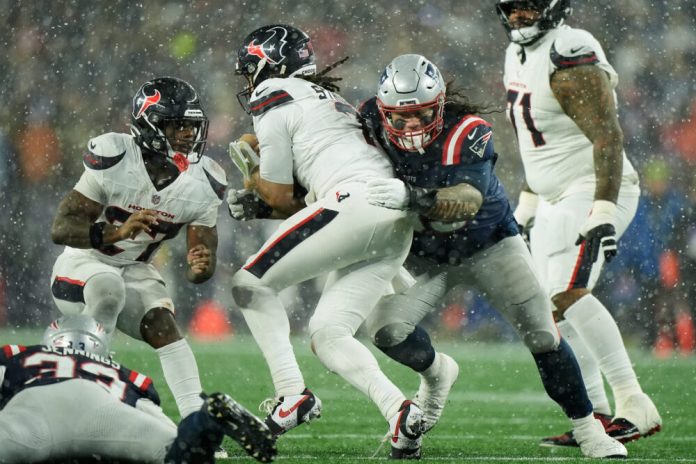
(AP Photo/Robert F. Bukaty)

New England Patriots defensive tackle Khyiris Tonga, middle right, sacks Houston Texans quarterback C.J. Stroud during the second half of an NFL divisional playoff football game, Sunday, Jan. 18, 2026, in Foxborough, Mass.

FOXBOROUGH, Mass. (AP) — Drake Maye threw three touchdown passes, Marcus Jones returned one of C.J. Stroud’s four interceptions for a score and the New England Patriots defeated the Houston Texans 28-16 on Sunday to advance to the AFC championship game for the first time in seven years.

In Mike Vrabel’s first season as coach, the Patriots will make their 16th conference championship game appearance and first since their run to their sixth Super Bowl title under Bill Belichick in the 2018 season. New England has won its last nine divisional round games.

Maye finished 16 of 27 for 179 yards, but had an interception and fumbled four times, losing two in cold conditions in which snow and rain fell throughout the game. One of Maye’s fumbles set up Houston’s first touchdown.

Carlton Davis III had two interceptions for New England. Craig Woodson added an interception and fumble recovery.

The eight combined turnovers — Woody Marks also lost a fumble for Houston — were the most in a playoff game since 2015 when the Cardinals and Panthers combined for eight in the NFC championship game.

The Texans have lost in the divisional round in three straight seasons under coach DeMeco Ryans. The franchise is now 0-7 all-time in this round.

Stroud finished 20 of 47 with a TD pass. All of his interceptions came in the first half as he became the first player with five or more INTs and five or more fumbles in a single postseason. Will Anderson forced two fumbles for the Texans.

Leading 21-16 in the fourth quarter, the Patriots stretched their lead to 27-16 when Kayshon Boutte got behind Derek Stingley Jr. and pulled in a diving, one-hand catch in the corner of the end zone for a touchdown.

The Texans had the ball with 5:48 to play, but punted on fourth-and-18 at their own 21 with 4:18 remaining.

New England’s next drive took the clock under two minutes. But the Texans turned it over on downs when Stroud’s fourth-down pass to Xavier Hutchinson was batted down by Robert Spillane.

Great Job & the Team @ Houston Public Media for sharing this story.

This Brooklyn bagel shop is saving money with plug-in batteries

This Brooklyn bagel shop is saving money with plug-in batteries

BROOKLYN, N.Y. — In the back of Black Seed Bagels in northern Brooklyn is a giant catering kitchen filled with industrial-size condiments and freezers full of dough. A tall, silver electric oven, named the Baconator, stands in a far corner, cooking thousands of pounds of meat every week to accompany Black Seed’s hand-rolled, wood-fired bagels.

The Baconator is connected to a battery the size of a carry-on suitcase, which is plugged into the wall. While the morning rush is underway, the 2.8-kilowatt-hour battery can directly power the commercial oven to reduce the company’s reliance on the electric grid, Noah Bernamoff, Black Seed’s co-owner, explained recently at the company’s Bushwick shop. Two more batteries are paired with energy-intensive refrigerators in the front.

Businesses like Black Seed often pay hefty demand charges on their utility bills that reflect the maximum amount of power they use during a month — costs that can represent as much as half their total bill, on average. By shifting to battery power during key times, Black Seed aims to lower its peak grid needs and reduce monthly fees from the utility Con Edison in the process.

Black Seed is part of a battery pilot program run by David Energy, a New York–based retail energy provider. The startup supplied the batteries for free last August and, using its software platform, controls exactly when the three appliances draw on backup power. Vivek Bhagwat, David Energy’s head of engineering, said he expects that tapping batteries for the refrigerators — which are always humming — will be especially helpful during the hottest months, when the shop’s air conditioners run around the clock.

Noah Bernamoff at Black Seed’s Bushwick shop, which serves as the company’s headquarters (Maria Gallucci/Canary Media)

We’re pretty optimistic about our ability to curtail energy in the summer, when it really matters most, through this machine,” he said while standing beside a doorless fridge holding water, juice, and soda.

For Black Seed, even modest benefits from batteries could make a difference if multiplied across the company’s 10 locations in New York City, Bernamoff said. By way of example, he noted that saving $80 at every shop every month could add up to almost $10,000 a year in avoided utility costs.

We’re in the game of nickels and dimes,” he said of the bagel business. So we’re always happy to save the money.”

James McGinniss, David Energy’s CEO, thinks this do-it-yourself battery” strategy has some serious potential to help small businesses combat rising electricity costs, both in New York City and beyond. Along with Black Seed’s Bushwick shop, his company has installed batteries at fast-food restaurants, a day spa, and a dog grooming store, where the battery is cushioning the power draw of a fur-drying machine. As of mid-January, David Energy has signed deals with customers to put plug-in batteries in about 50 locations, adding up to more than 500 kilowatt-hours of energy storage capacity. 

This Brooklyn bagel shop is saving money with plug-in batteries
Outside Black Seed’s shop in Brooklyn’s Williamsburg neighborhood (Stephanie Primavera/Canary Media)

Backup batteries, however, are ready for market. Portable batteries from companies like Jackery and EcoFlow are increasingly affordable and popular options for households that are looking for backup power during blackouts but can’t, or don’t want to, install fossil fuel–burning generators. A handful of startups like Pila Energy have plug-in batteries meant to operate around the clock to reduce utility bills as well as to keep refrigerators and other critical appliances running through power outages. 

As a retail energy provider, David Energy competes with large utilities and other energy retailers to provide customers with cheaper electricity plans. It does so primarily by purchasing electricity from wholesale markets and then reselling it to businesses and households. But the battery pilot is part of the company’s broader long-term goal to run the grid 24/7 on clean energy,” McGinniss said.

As solar and batteries have become the cheapest electron we can create,” giving customers access to those technologies has become a business priority for David Energy as well — because people like cheap energy,” he said. Plug-in batteries, in particular, enable the company to rapidly scale our storage under management, even in the existing regulatory construct,” according to McGinniss. 

That last point underscores the challenges that New York City businesses face in installing the type of wired-in and utility-interconnected battery backup systems that are more common in other parts of the country. For years, concerns about fire risks have led the New York City Fire Department to subject stationary lithium-ion battery installations to strict fire-safety regulations that have made them impractical for most building owners. 

Great Job Maria Gallucci, Jeff St. John & the Team @ Canary Media Source link for sharing this story.
The Race to Build the DeepSeek of Europe Is On

The Race to Build the DeepSeek of Europe Is On

Against that backdrop, Europe’s reliance on American-made AI begins to look more and more like a liability. In a worst case scenario, though experts consider the possibility remote, the US could choose to withhold access to AI services and crucial digital infrastructure. More plausibly, the Trump administration could use Europe’s dependence as leverage as the two sides continue to iron out a trade deal. “That dependency is a liability in any negotiation—and we are going to be negotiating increasingly with the US,” says Taddeo.

The European Commission, White House, and UK Department for Science, Innovation and Technology did not respond to requests for comment.

To hedge against those risks, European nations have attempted to bring the production of AI onshore, through funding programs, targeted deregulation, and partnerships with academic institutions. Some efforts have focused on building competitive large language models for native European languages, like Apertus and GPT-NL.

For as long as ChatGPT or Claude continues to outperform Europe-made chatbots, though, America’s lead in AI will only grow. “These domains are very often winner-takes-all. When you have a very good platform, everybody goes there,” says Nejdl. “Not being able to produce state-of-the-art technology in this field means you will not catch up. You will always just feed the bigger players with your input, so they will get even better and you will be more behind.”

Mind the Gap

It is unclear precisely how far the UK or EU intends to take the push for “digital sovereignty,” lobbyists claim. Does sovereignty require total self-sufficiency across the sprawling AI supply chain, or only an improved capability in a narrow set of disciplines? Does it demand the exclusion of US-based providers, or only the availability of domestic alternatives? “It’s quite vague,” says Boniface de Champris, senior policy manager at the Computer & Communications Industry Association, a membership organization for technology companies. “It seems to be more of a narrative at this stage.”

Neither is there broad agreement as to which policy levers to pull to create the conditions for Europe to become self-sufficient. Some European suppliers advocate for a strategy whereby European businesses would be required, or at least incentivized, to buy from homegrown AI firms—similar to China’s reported approach to its domestic processor market. Unlike grants and subsidies, such an approach would help to seed demand, argues Ying Cao, CTO at Magics Technologies, a Belgium-based outfit developing AI-specific processors for use in space. “That’s more important than simply access to capital,” says Cao. “The most important thing is that you can sell your products.” But those who advocate for open markets and deregulation claim that trying to cut out US-based AI companies risks putting domestic businesses at a disadvantage to global peers, left to choose whichever AI products suit them best. “From our perspective, sovereignty means having choice,” says de Champris.

But for all the disagreement over policy minutiae, there is a broad belief that bridging the performance gap to the American leaders remains eminently possible for even budget- and resource-constrained labs, as DeepSeek illustrated. “If I would already think we will not catch up, I would not [try],” says Nejdl. SOOFI, the open source model development project in which Nejdl is involved, intends to put out a competitive general purpose language model with roughly 100 billion parameters within the next year.

“Progress in this field will not to the larger part depend anymore on the biggest GPU clusters,” claims Nejdl. “We will be the European DeepSeek.”

Great Job Joel Khalili & the Team @ WIRED Source link for sharing this story.

Inequality and unease are rising as elite Davos event opens with pro-business Trump set to attend

Inequality and unease are rising as elite Davos event opens with pro-business Trump set to attend

DAVOS – Corporate chiefs and government leaders including U.S. President Donald Trump swarm into Davos, Switzerland this week, joining an elite annual meeting that promotes dialogue and economic progress — even as a domineering tone from Washington has upended the global order and billionaires have reaped trillions in new wealth as the poor lag behind.

The World Economic Forum, the think tank whose four-day annual meeting opens Tuesday, has a stated motto of “improving the state of the world,” and this year’s theme is “A spirit of dialogue.” One question is whether Trump will speak with attendees — or at them.

Nearly 3,000 attendees from the interlinked worlds of business, advocacy and policy will tackle issues including the growing gap between rich and poor; AI’s impact on jobs; concerns about geo-economic conflict; tariffs that have rocked longstanding trade relationships; and an erosion of trust between communities and countries.

“It’s really going to be a discussion at a very important moment … geopolitics is changing,” said Mirek Dušek, a forum managing director in charge of programming. “Some people think we’re in a transition. Some people think we’ve already entered a new era. But I think it’s undeniable that you are seeing a more competitive, more contested landscape.”

Trump set to loom large

Trump’s third visit to Davos as president comes as U.S. allies worry about his ambition to take over Greenland, Latin America is grappling with his efforts to reap Venezuela’s oil, and his hardball tactics toward Federal Reserve Chair Jerome Powell have stirred concern among business leaders and lawmakers alike.

Trump’s peace-making credentials also will be on the table: An announcement looms about his “ Board of Peace ” for Gaza, and he and his administration are expected to have bilateral meetings in the warren of side rooms at the Congress Center.

The U.S. leader seems to revel in strolling through the Davos Congress Center and among executives who back his business-minded, money-making approach to politics.

Critics will also be nearby: He’s blown hot and cold recently with Colombian President Gustavo Petro, an invitee; Foreign Minister Abbas Araghchi of Iran, whose leaders face U.S. sanctions over their handling of recent protests, will be on hand.

The two likeliest counterweights to Trump’s administration on the international scene — China and the European Union — get top billing on the first day of the event: EU Commission President Ursula von der Leyen will speak Tuesday morning, right before Vice Premier He Lifeng, China’s “economic czar” — as Dušek put it.

Founder Schwab sits out, as Nvidia chief makes a debut

The forum will be without its founder, Klaus Schwab, who hosted the first event in Davos 55 years ago focusing on business, only to see it since balloon into a catchall extravaganza. He stepped down in April. New co-chairs Larry Fink, the head of investment firm BlackRock, and Andre Hoffman, vice chair of pharmaceuticals firm Roche, are in charge.

This year will also mark the debut appearance of Nvidia CEO Jensen Huang, arguably the world’s most important tech leader today, among some 850 CEOs and chairs of global companies – along with some celebrities like Hollywood actor and safe-water advocate Matt Damon.

The future of AI, its impact on business and work, and the prospects for artificial general intelligence will be key themes.

The presidents of Argentina, France, Indonesia, Syria and Ukraine will be among the dozens of national leaders on hand.

As rich-poor divide widens, trust in institutions falters

Leading public-relations firm Edelman reports in its annual trust barometer – launched a quarter-century ago and this year surveying nearly 34,000 people in 28 countries – that trade and recession fears have climbed to an all-time high, optimism is falling especially in developed countries, and “grievance” last year has morphed into broader “insularity.”

“People are retreating from dialogue and compromise, choosing the safety of the familiar over the perceived risk of change,” said CEO Richard Edelman. “We favor nationalism over global connection and individual gain over joint progress. Our mentality has shifted from ‘we’ to ‘me’.”

The survey found that about two-thirds of respondents said their trust was concentrated toward CEOs of the companies that they work for, fellow citizens or neighbors, while nearly 70% believed institutional leaders — such as from business or government — deliberately mislead the public.

Oxfam, the world-renowned advocacy group, issued a report ahead of the Davos event which showed that billionaire wealth rose by more than 16% last year, three times faster than the past five-year average, to more than $18 trillion. It drew on Forbes magazine data on the world’s richest people.

Oxfam said the $2.5 trillion rise in the wealth of billionaires last year would be enough to eradicate extreme poverty 26 times over. Their wealth has risen by more than four-fifths since 2020, while nearly half the world’s population lives in poverty, the group said.

The Trump administration has led a “pro-billionaire agenda,” the group said, through actions such as slashing taxes for the wealthiest, fostering the growth of AI-related stocks that help rich investors get richer, and thwarting efforts to tax giant companies.

The advocacy group wants more national efforts to reduce inequality, higher taxes on the ultra-rich to reduce their power, and greater limits on their ability to shape policy through lobbying.

With such concerns filtering through to policymakers, Trump, who is leading the biggest-ever U.S. delegation and will have about a half-dozen Cabinet secretaries in tow, is expected to discuss housing and affordability in his Davos speech on Wednesday.

Critics of WEF, and Trump, take to the streets

As usual, protesters rallied over the weekend in and near Davos ahead of the event. Hundreds of marchers scaled an Alpine road up to the town on Saturday behind a banner in German that read “No Profit from War” and alongside a truck that bore a sign: World Economic Failure.

Companies like Microsoft, India’s Tata Consultancy, social media titan TikTok and cybersecurity firm CrowdStrike have joined governments from countries like Nigeria, Qatar, Ukraine and the United States — a USA House is making a debut this year — to set up shop on the Davos Promenade to promote their services, products and national economies.

Davos storekeepers rent out their premises so that forum participants can have the prime real estate for the week.

Critics have long accused the annual meeting in Davos of generating more rhetoric than results, and they see Trump’s return as sign of the disconnect between haves and have-nots. Some say Swiss leaders who support the event and flock to Davos too are adding to the problem.

“It is worrying how Swiss politicians are courting warmongers and their profiteers in Davos,” said Mirjam Hostetmann, president of Switzerland’s Young Socialists, who have led protests against the event. “The WEF will never bring peace, but will only fuel escalation.”

Copyright 2026 The Associated Press. All rights reserved. This material may not be published, broadcast, rewritten or redistributed without permission.

Great Job Jamey Keaten, Associated Press & the Team @ KSAT San Antonio for sharing this story.

Social Media Explodes After Justin Bieber’s Instagram Account Likes Comment Under 2016 Pic Of Him & Selena Gomez

Social Media Explodes After Justin Bieber’s Instagram Account Likes Comment Under 2016 Pic Of Him & Selena Gomez

Roomies, things are heating up in the world of Justin Bieber and Selena Gomez—even years after their on-again, off-again romance. The Biebs just reignited online chatter after interacting with a comment on a throwback Instagram post featuring his ex, Selena. Now, fans are dissecting every detail, wondering if this was just a harmless scroll down memory lane or something more.

RELATED: Beliebers Unite! Social Media Reacts After Justin Bieber Returns To The Iconic ‘Baby’ Music Video Set (WATCH)

Justin Bieber Sparks After Double Tapping Comment Under Old Selena Gomez Photo

The original post, shared back on March 20, 2016, shows Justin Bieber kissing Selena Gomez during the peak of their highly publicized relationship. Recently, Bieber’s account allegedly liked a comment under the photo was written in Spanish, which translates to, “Long live the newlyweds!” Screenshots quickly circulated online, confirming the interaction came directly from Bieber’s verified account. While he didn’t add a caption or make a statement, fans went wild, debating whether this was a subtle nod to his past or just random social media activity.

Adding fuel to the fire, Hailey Bieber had just shared a carousel of nostalgic 2016 photos days before, including one of her kissing Justin at sunset, captioned “You just had to be there.”  Neither Justin, Hailey, nor Selena have commented on the interaction, but that hasn’t stopped online communities from breaking down every move and predicting what it could mean for the Biebs’ love life.

Fans Are Split Over The Accident Or Subtle Backtrack

Fans didn’t waste a second before flooding The Shade Room’s Instagram comments with their takes on Justin’s interaction. Many pointed out that it could honestly have been an accident, since comments often show up in notifications, while others wondered why the 2016 post was still up in the first place.

One Instagram user @christine.elizabeth said, “Uh oh that 2016 nostalgia kicking in

This Instagram user @pooraudixoxo commented, “The fact that he even still has these pictures up

Meanwhile, Instagram user @excel_osato added, “Or he probably liked by mistake omg yall are insufferable

While Instagram user @melitosmami shared, “I LOVE 2026 ALREADY

Then Instagram user @kylaaleshaeee wrote, “Y’all know new comments shows in y’all notifications, rt???? Or this an old comment n he liked it?

Finally, Instagram user @oneamazingirl joked, “Coming soon to a blog near you… ‘my account was hacked’

Fans Speculate About Bieber’s Love Life After Past Posts

Justin Bieber had fans talking last year after going public with some very messy messages. Back in June, he shared screenshots of a conversation with an unnamed individual, admitting he “will never suppress” his emotions. The exchange ended with Bieber declaring the friendship “officially over” and calling the person an expletive, leaving fans shook by how raw he kept it.

The following day, Bieber continued the conversation on his Instagram Story, urging people to stop asking if he was okay and reflecting on the exhaustion of self-healing. “I know I’m broken, I know I have anger issues,” he wrote, sparking even more chatter online.

RELATED: Justin Bieber Shares Message About Feeling “Broken” After Airing Out “Conflict” In Unnamed Relationship

What Do You Think Roomies?

Great Job Desjah & the Team @ The Shade Room Source link for sharing this story.

Fort Worth interfaith communities gather to honor MLK, advocate for social justice

Fort Worth interfaith communities gather to honor MLK, advocate for social justice

Fort Worth interfaith communities gather to honor MLK, advocate for social justice

The night before Martin Luther King Jr. Day, Brittany Course went to church. 

On Jan. 18, she sat in a wooden pew in the middle of Carter Metropolitan CME Church’s  sanctuary as she listened to worship music and prayers sung in English, Spanish and Hebrew. 

Being surrounded by people of different faiths, racial and ethnic backgrounds all worshipping in one space made Course think to herself: “This is what heaven is going to look like.” 

“It’s all of us together, worshiping God together in one spirit and one faith,” Course said. “And so that’s what really draws me here every time, because it’s a beautiful sight to see this, like this is a glimpse of heaven.”

Kal Silverberg, member of the Makom Shelanu congregation, left, and Michael Ross, member of Beth-El congregation, attend the Martin Luther King Jr. interfaith service on Jan. 18 in Fort Worth. Kal’s wife, Karen Silverberg, said justice and faith span all populations. Religious leaders shared prayers of hope and sent forth the congregation in English, Spanish and Hebrew. (Christine Vo | Fort Worth Report)

She was among several at the second annual Martin Luther King Jr. Interfaith Service held at the southeast Fort Worth church — which is part of the Christian Methodist Episcopal faith, a historically African-American religious denomination branching from Wesleyan Methodism. The service was organized by the clergy-based group known as the Faith and Justice Coalition of Tarrant County. 

The group is co-led by Rev. Dr. Michael Bell of Greater St. Stephen First Church and Rev. Ryon Price of Broadway Baptist Church. 

The gathering comes at a time where it is “critical that diverse people come together” amid division, Price said in opening the service. 

He highlighted some of the coalition’s efforts, such as urging officials to condemn a former GOP chair’s anti-Muslim social media posts, hosting community forums on Tarrant County’s redistricting process and leading marches during the “No Kings” and anti-ICE protests.  

“Now is an urgent time, and it is a moment where people of faith everywhere must be fierce, must be courageous, must stand up, must give voice, and must be the people that we are called to be,” Price said. 

The service included a section called “prayers of hope” from Rabbi Brian Zimmerman of Beth-El Congregation, a reform Jewish synagogue in Fort Worth. Anyra Cano and her husband Rev. Dr. Carlos Valencia of Iglesia Bautista Victoria en Cristo offered a prayer in both Spanish and English. Rev. Dr. Stephen Cady, president of Brite Divinity School, also shared a prayer during the gathering. 

“Remind us of the gift that it is to be together right now in this moment. And when we walk out of here this evening, help this to matter. Help it to not end here,” Cady said in prayer. 

Tarrant County commissioner Alisa L. Simmons greets the congregation during the Martin Luther King Jr. interfaith service on Jan. 18 in Fort Worth. Simmons served as the Grand Marshal for the Neighborhood Parade and Events Committee’s 8th Annual Martin Luther King Jr. Parade the day before. (Christine Vo | Fort Worth Report)

The theme for Sunday’s service was “the fierce urgency of now,” a phrase in King’s “I have a Dream” speech that served as a call to advocate for civil rights. 

Stacey Floyd-Thomas, a professor of ethics and society at Vanderbilt University’s Divinity School, returned to Fort Worth on Sunday evening as the event’s keynote speaker. In 2002, Floyd-Thomas and her husband were faculty members at Brite Divinity School. She worked at Brite for six years and founded its Black Church Studies program. 

To remember King rightfully is “not to sentimentalize him but to take responsibility for the unfinished work his life leaves in our hands,” Floyd-Thomas said from the pulpit. 

In her sermon, Floyd-Thomas urged attendees to take action and not wait for change. She spoke of the dangers of delaying justice and the consequences of inaction.

“King understood that injustice anywhere was a threat to injustice everywhere,” Floyd-Thomas said. “Not because he was sentimental but because he was realistic. That is why the fierce urgency of now is not merely local. It is global.” 

Keynote speaker Stacey Floyd-Thomas speaks about the injustices in America during the Martin Luther King Jr. interfaith service on Jan. 18 in Fort Worth. Floyd-Thomas said it was an honor to stand with so many faiths, races and generations gathered by the Justice Coalition of Tarrant County. She said they all come together not because they all agree but because they are all bound by the conviction that human dignity is nonnegotiable. (Christine Vo | Fort Worth Report)

Course, 36, who has attended the church since 2017, said she plans to stay civically engaged. While she may not be participating in marches, she plans to find her “piece of the puzzle” by writing letters or sitting in on local government meetings. 

“Some of us are not the loud speakers. Some of us are the mail writers and the letter stuffers, and we go get the water and the snacks for those that are protesting,” Course said. “But there was a Coretta to a Martin.”

Keynote speaker Stacey Floyd-Thomas, left, and Fort Worth resident Alfie Wines reunite before a Martin Luther King Jr. interfaith service Jan. 18 in Fort Worth. The two met nearly 20 years ago, and Wines said she had missed Floyd-Thomas after the latter moved out of Texas, and described their minutes-long embrace as a spiritual moment filled with love. (Christine Vo | Fort Worth Report)

In the audience was Alfie Wines. Attending the service was in some ways a “homecoming.” Wines, 76, first attended Carter Metropolitan in 1978. 

She taught an adult Sunday school class and played piano for the youth choir before she became an ordained Methodist minister. Events like these emphasize a need to respect one another and honor the humanity of every person, Wines said. But it’s going to take everyone to get more civically engaged, she added. 

“Don’t stop believing, and start doing your part,” Wines said. “Whatever your part is, do your part, and then we all put our parts together. Then that can happen.”  

Marissa Greene is a Report for America corps member, covering faith for the Fort Worth Report. You can contact her at marissa.greene@fortworthreport.org.

At the Fort Worth Report, news decisions are made independently of our board members and financial supporters. Read more about our editorial independence policy here.

Great Job Marissa Greene & the Team @ Fort Worth Report for sharing this story.

Trump is charging world leaders $1 billion each for their countries to permanently join Gaza ‘Board of Peace’ | Fortune

Trump is charging world leaders  billion each for their countries to permanently join Gaza ‘Board of Peace’ | Fortune

At least eight more countries say the United States has invited them to join President Donald Trump’s Board of Peace, a new body of world leaders meant to oversee next steps in Gaza that shows ambitions for a broader mandate in global affairs. Two of the countries, Hungary and Vietnam, said they have accepted.

A $1 billion contribution secures permanent membership on the Trump-led board instead of a three-year appointment, which has no contribution requirement, according to a U.S. official who spoke on condition of anonymity about the charter, which hasn’t been made public. The official said the money raised would go to rebuilding Gaza.

Hungarian Prime Minister Viktor Orbán has accepted an invitation to join the board, Foreign Minister Péter Szijjártó told state radio Sunday. Orbán is one of Trump’s most ardent supporters in Europe.

Vietnam’s Communist Party chief, To Lam, also has accepted, a foreign ministry statement said.

India has received an invitation, a senior government official with knowledge of the matter said, speaking on condition of anonymity as the information hadn’t been made public by authorities.

Australia has been invited and will talk it through with the U.S. “to properly understand what this means and what’s involved,” Deputy Prime Minister Richard Marles told Australian Broadcasting Corp. on Monday.

Jordan, Greece, Cyprus and Pakistan said Sunday they had received invitations. Canada, Turkey, Egypt, Paraguay, Argentina and Albania have already said they were invited. It was not clear how many have been invited in all.

The U.S. is expected to announce its official list of members in the coming days, likely during the World Economic Forum meeting in Davos, Switzerland.

Those on the board will oversee next steps in Gaza as the ceasefire that took effect on Oct. 10 moves into its challenging second phase. It includes a new Palestinian committee in Gaza, the deployment of an international security force, disarmament of Hamas and reconstruction of the war-battered territory.

In letters sent Friday to world leaders inviting them to be “founding members,” Trump said the Board of Peace would “embark on a bold new approach to resolving global conflict.”

That could become a potential rival to the U.N. Security Council, the most powerful body of the global entity created in the wake of World War II. The 15-seat council has been blocked by U.S. vetoes from taking action to end the war in Gaza, while the U.N.’s clout has been diminished by major funding cuts by the Trump administration and other donors.

Trump’s invitation letters for the Board of Peace noted that the Security Council had endorsed the U.S. 20-point Gaza ceasefire plan, which includes the board’s creation. The letters were posted on social media by some invitees.

The White House last week also announced an executive committee of leaders who will carry out the Board of Peace’s vision, but Israel on Saturday objected that the committee “was not coordinated with Israel and is contrary to its policy,” without details. The statement by Prime Minister Benjamin Netanyahu’s office was rare criticism of its close ally in Washington.

The executive committee’s members include U.S. Secretary of State Rubio, Trump envoy Steve Witkoff, Trump’s son-in-law Jared Kushner, former British Prime Minister Tony Blair, World Bank President Ajay Banga and Trump’s deputy national security adviser Robert Gabriel, along with an Israeli business owner, billionaire Yakir Gabay.

Members also include representatives of ceasefire monitors Qatar, Egypt and Turkey. Turkey has a strained relationship with Israel but good relations with Hamas and could play an important role in persuading the group to yield power in Gaza and disarm.

___

Boak reported from West Palm Beach, Florida. Associated Press writers Justin Spike in Budapest, Hungary, Rajesh Roy in New Delhi and Rod McGuirk in Canberra, Australia, contributed to this report.

Great Job Cara Anna, Josh Boak, The Associated Press & the Team @ Fortune | FORTUNE Source link for sharing this story.

Secret Link