

Home News Page 36

The Residents of Minneapolis Are Fighting for All of Us

The Residents of Minneapolis Are Fighting for All of Us

For as long as Donald Trump has deployed his ICE brownshirts in the “Democrat” cities he so despises, Americans have been out in the streets, confronting his masked goons and making sure the rest of the world sees what’s going on. One of the first witness videos I saw was in Washington, D.C., in the Mount Pleasant neighborhood where my father grew up. A woman espied three Immigration and Customs Enforcement agents loitering in the area, harangued them, ran them off their roost, and then followed them around until they finally piled in their car and drove off.

ICE confrontations have necessarily evolved since then, as agents have become more wantonly violent. The New Republic has been chronicling the community response to ICE, from Los Angeles to Chicago to Minneapolis. But one thing we haven’t done, and which I feel compelled to do, is simply say this: I think the people risking their lives and livelihoods to protect their neighbors are the best of us, and I feel like we all owe them a debt of gratitude.

I’m thankful for all the people who’ve filmed ICE agents slipping and falling on Minneapolis’s icy streets. Fascism is more a set of aesthetics than it is a legible system of political beliefs, so it actually matters that we make fun of these jabronis—humiliation pushes our lines forward. Creativity is needed, as well. I’ve thrilled to the sight of Minnesotans gathered outside the hotels harboring these hoodlums, banging on drum kits late into the night. And ordinary citizens seem very composed and ready to protect their city. One especially inspiring sight came this week when ICE agents pounded on the door of the Wrecktangle Pizza shop in Minneapolis’s Lyn Lake neighborhood: There’s a “tweet tweet” blast on a whistle, and suddenly scores of people swarm the sorry ICE agents and run them off.

While we should be rightly delighted by these sights, they might be occluding a darker part of this story. The murder of Renee Good has engendered a righteous fury in the people of Minneapolis, but if my friends there are any guide, it’s also sparked genuine sorrow and spiky, persistent fear. People that I know normally to be rocks of confidence are communicating a despair that I’ve never heard them express.

In my group chats, I’ve been told about restaurant workers who’ve disappeared from their workplaces. Those friends of mine with kids have had to go to exhausting lengths to protect them. One told me about how his daughter’s preschool had to close because the Methodist Church that hosted it was tipped off that ICE would be executing a raid on its property that day—the day of the church’s food pantry. And the reason ICE was rumbling Wrecktangle Pizza, I was told, was because the chain raised $85,000 to help area restaurants cope with the strain of their agents’ presence in the city. ICE knows who the most vulnerable Minneapolitans are, and also the ones who’ve done them the most damage, and they are targeting both, with state-of-the-art surveillance technology and the tacit permission of the Trump administration to terrorize.

Minneapolis truly can be likened to a city under siege from a foreign threat. As The Minneapolis Star Tribune recently reported, the Trump administration’s plans to deploy as many as 3,000 ICE or Customs and Border Protection agents to the Twin Cities would make the occupying force “equivalent to five times the manpower of the Minneapolis Police Department.” Moreover, they report, it would be “close to the total headcount of sworn officers among the region’s largest 10 law enforcement agencies and equals nearly one agent for every 1,000 of the Twin Cities’ 3.2 million residents.”

This is an important side of the story to tell for many reasons, not the least of which is that ICE cannot deploy enough people to put every American city in check. So for the moment, Minneapolis is really taking it on the chin for most of the rest of us. The reason the streets of my own dense liberal enclave are not ringing out with shouts and whistles is because Trump’s “day of reckoning” isn’t being fought here—yet. When this fight does come to our own neighborhoods, we will have Minneapolitans—like the Chicagoans, Portlanders, Los Angelenos, and Washingtonians before them, among others—to thank for cheering our hearts, deepening our knowledge of how to fight back, and making these ICE deployments more costly.

The people of the Twin Cities feel isolated and alone; local officials have lamented that they are literally outgunned, and politicians in Washington have offered little respite beyond the occasional galaxy-brained idea. We owe a debt to the people of this besieged city. We should take some time to comfort friends and loved ones who are under fire. We should share their stories, good and bad, widely, with an eye toward building a repository of evidence that a future federal government can use to prosecute lawless ICE agents and those who gave them marching orders. In the meanwhile, to everyone putting your bodies on the line in this fight, you have my thanks. And to the ICE agents out there causing violence and mayhem, let me say—from the heart—get fucked.

For those interested in ways to help the people of Minneapolis, there are a number of organizations to which you can donate. Unidos MN has been helping to train Minneapolitans to observe and report on ICE activity and run the city’s rapid response hotline. Take Action MN is constructing a hub for mutual aid groups in the city. Families Helping Families has organized 120 parents to do grocery and rent relief, student transportation, school patrols, and more. Isaiah is a multiracial organization of faith communities that has organized rallies to remember Renee Good. There are a number of national civil rights organizations operating in the city, including the Immigrant Defense Network, the Council on American-Islamic Relations of Minnesota, and the Minnesota Immigrant Rights Action Committee. There are a number of legal aid organizations, as well, including the Midwest Immigration Bond Fund, the Immigrant Law Center of Minnesota, and the Minnesota chapter of the National Lawyers Guild.

This article first appeared in Power Mad, a weekly TNR newsletter authored by deputy editor Jason Linkins. Sign up here.

Great Job Jason Linkins & the Team @ The New Republic Source link for sharing this story.

Whew Lawd! The Hottest Thirst Traps Of The Week, Vol. 127

Whew Lawd! The Hottest Thirst Traps Of The Week, Vol. 127

You’re welcome!

Source: Jade Tillman Belmes/Getty Images

Back at it again with this week’s hottest thirst traps that dropped during an eventful week dominated by Ludacris getting dragged over his involvement in The Rock The Country Tour, A$AP Rocky seemingly firing shots at Drake on his new album, Kandi Burruss accusing Todd Tucker of faking ‘daddy daycare,’ the flyest (and finest) ladies stunning during Founders’ Week, and more.

As promised, we’ve compiled swoon-worthy stunners (and our thirst-trappin’ celebrity faves) with Latto making her return to the series after reigniting those pesky pregnancy rumors over the holidays.

The benevolent baddie reignited pregnancy rumors while blessing more than 500 Atlanta families at the epic giveaway for her Win Some Give Some foundation.

Naturally, social media launched an investigation after seeing the latest photos and video of Latto from her foundation’s event.

*zooms in*

Based on a preliminary investigation, the internet concluded that Latto was, indeed, pregnant but we’re not too sure based on the hitmaking rapper’s viral birthday sleigh.

This week’s thirst trap compilation also features Lori Harvey delivering heat along with Kayla Nicole and Chlöe Bailey giving what needs to be gave.

There’s also big baddie energy from Demetria Obilor, Vicky Lauren, and more so we invite you to enjoy our latest collection of top-tier thirst traps on the flip.

Great Job Alex Ford & the Team @ Bossip Source link for sharing this story.

Trump’s voice in new Fannie Mae ad generated by AI, with his permission

Trump’s voice in new Fannie Mae ad generated by AI, with his permission

What sounds like President Donald Trump narrating a new Fannie Mae ad actually is an AI-cloned voice reading text, according to a disclaimer in the video.

The voice in the ad, created with permission from the Trump administration, promises an “all new Fannie Mae” and calls the institution the “protector of the American Dream.” The ad comes as the administration is making a big push to show voters it is responding to their concerns about affordability, including in the housing market.

Trump plans to talk about housing at his appearance at the World Economic Forum in Davos, Switzerland, where world leaders and corporate executives meet this week.

This isn’t the first time a member of the Trump family has used AI to replicate their voice, First Lady Melania Trump recently employed AI technology firm Eleven Labs to help voice the audio version of her memoir. It’s not known who cloned President Trump’s voice for the Fannie Mae ad.

Last month, Trump pledged in a prime-time address that he would roll out “some of the most aggressive housing reform plans in American history.”

“For generations, home ownership meant security, independence, and stability,” Trump’s digitized voice says in the one-minute ad aired Sunday. “But today, that dream feels out of reach for too many Americans not because they stopped working hard but because the system stopped working for them.”

Fannie Mae and its counterpart Freddie Mac, which have been under government control since the Great Recession, buy mortgages that meet their risk criteria from banks, which helps provide liquidity for the housing market. The two firms guarantee roughly half of the $13 trillion U.S. home loan market and are a bedrock of the U.S. economy.

The ad says Fannie Mae will work with the banking industry to approve more would-be homebuyers for mortgages.

Trump, Bill Pulte, who leads the Federal Housing Finance Agency, and others have said they want to sell shares of Fannie Mae and Freddie Mac on a major stock exchange but no concrete plans have been set.

Trump and Pulte have also floated extending the 30-year mortgage to 50 years in order to lower monthly payments. Trump appeared to back off the proposal after critics said a longer-term loan would reduce people’s ability to create housing equity and increase their own wealth.

Trump also said on social media earlier this month that he was directing the federal government to buy $200 billion in mortgage bonds, a move he said would help reduce mortgage rates at a time when Americans are anxious about home prices. Trump said Fannie Mae and Freddie Mac have $200 billion in cash that will be used to make the purchase.

Earlier this month, Trump also said he wants to block large institutional investors from buying houses, saying that a ban would make it easier for younger families to buy their first homes.

Trump’s permission for the use of AI is interesting given that he has complained about aides in the Biden administration using autopen to apply the former president’s signature to laws, pardons or executive orders. An autopen is a mechanical device that is used to replicate a person’s authentic signature.

However, a report issued by House Republicans does not include any concrete evidence that autopen was used to sign Biden’s name without his knowledge.

Nine humanoid robots gathered at the ‘AI for Good’ conference in Geneva, Switzerland, where organizers are seeking to make the case for artificial intelligence to help resolve some of the world’s biggest challenges.

Great Job Anne D’innocenzio | The Associated Press & the Team @ NBC 5 Dallas-Fort Worth for sharing this story.

The Sorcerer’s Apprentice Problem in the Age of AI

The Sorcerer’s Apprentice Problem in the Age of AI

AI is understood to be an unstoppable force, but it is still wholly dependent on human labor to function. Whether these technologies liberate or create misery will depend on who controls their development and deployment.


Neo, a humanoid robot that “can be both autonomous and “driven” remotely” by an operator, demonstrates watering plants in the 1X office in Palo Alto, California. (Camille Cohen / The Washington Post via Getty Images)

Talk of the artificial intelligence revolution tends to skip over workers unless it’s a warning that the new technologies will disempower and displace human labor. That the klaxons should be sounding louder and louder is a given — but they are the sort that encourages a collective shrug. After all, what can you do? It’s the great sweep of technology, of history, of progress. History will sort it out. It always does.

History, in fact, does sort it out. But never in the way promised. Technological revolutions of the past did not eliminate labor, but they very much transformed it. This process of transformation does generate new work — as tech advocates often claim — but it is work that is more fragmented, more surveilled, and more alienated. Early mechanization de-skilled craftspeople, concentrating control over production even as employment expanded. Sure, from clerical automation to platform logistics, technological innovation does create “new jobs,” but worker autonomy takes hit after hit as labor is reorganized around ever more tightly managed systems.

The fatalism surrounding AI contributes to a shared complicity in the potential social, political, and economic collapse that threatens to accompany mass unemployment brought about by AI adoption. However, there’s a further dimension to the labor-technology dynamic that’s ignored or downplayed in assessments of these great leaps forward: the role workers play in training and otherwise enabling these new technologies.

This is not simply a matter of labor being replaced by machines, but of labor being reorganized by capital. It is the threat of skills and knowledge being extracted and formalized by new tech and productive systems that are designed to function without the workers who made them possible.

Training the Tools to Bury Old Jobs

You could call it digging your own grave, although the reality is more complicated than that. A new short film, Their Eyes, by Nicolas Gourault, documents the work of overseas laborers who train driverless cars by analyzing and annotating the images the vehicles rely on to learn how to navigate the road. Gourault says he hopes his work “illuminates a part of the extractive reality that many of our current AI systems rely on.” He succeeds.

If workers are, in some sense, digging their own graves by enabling AI technologies that will eventually render themselves and other laborers obsolete and powerless, they’re doing it at the barrel of a gun. Technology companies seek low-paid labor to train their machines, and the workers who take these jobs have less room to worry about the long-run effects of their work than, say, making a living and surviving today. They aren’t exactly calling the shots.

It’s a familiar dynamic, both historically and in the current AI moment. In the fall of 2020, reports of robot workers captured public attention when a machine appeared to stock shelves in a Japanese shop. In reality, it was operated remotely by a nearby worker through a video camera. At the time, both literal and figurative forms of remote work were not just appealing, but necessary — a matter of life and death. By the summer of 2025, a new robot, Neo, among others, was touted as the future of domestic work.

An AI robot could fold your laundry, water your plants, load your dishwasher, and otherwise manage the mundane tasks that we’ve been promised for decades would someday be the purview of automated technology. But as it turns out, Neo and most of its counterparts are controlled by humans with cameras — at least for now. Not only, then, are the automated robots an illusion (again, at least for now), but they’re a window into your home, with their operators able to see what the robot “sees.” At $20,000, it’s an expensive window into your private space, but the true costs are much higher than the price tag.

Hal’s Human Minders

As Alex Hanna and Emily M. Bender put it, “most AI tools require a huge amount of hidden labor to make them work at all.” Labor creates, analyzes, and sorts data for machines; in some cases, it operates them too, deploying the dexterity and judgment that is natural and easy for humans but exceedingly difficult for robots.

At some point, no doubt, the plan is to wean off human labor and increase the share of AI and robotic control. Whether the tipping point arrives in five years or twenty is uncertain. What is not in doubt is that big capital is all-in on the play, with trillions invested, and more piling up each year.

In the short term, laborers are indispensable to developing AI and making it run. In the long run, however, their work risks becoming not merely precarious, but utterly redundant. The same labor that generates enormous value for tech investors and shareholders may leave workers themselves on the outside looking in. But they won’t be alone: millions of jobs worldwide are at risk from AI.


Some believe that the AI bubble will pop. But even if it does, that won’t forestall or eliminate the long-term technological and economic changes that will accompany AI development. Some AI technologies are here to stay, and they will be permanently folded into blue- and white-collar job flows and systems, reshaping job categories and rendering swaths of workers redundant. Transcription work, for instance, is particularly vulnerable. It’s difficult to imagine a return to transcription pools — and their associated costs — when cheap services can deliver usable copy quickly and with reasonable accuracy. Self-driving cars and robot domestic workers may be a riskier bet, but that’s not going to stop Silicon Valley from trying.

Workers Should Run the Shops

At this point, labor’s best bet is to pick battles very carefully and organize strategically in key industries, prepared to go to the mat to protect jobs and workers in those spaces at scale — for instance, in manufacturing and the automotive industry. But organized labor can only go so far on its own.

Worker control of enterprise, authority of workplaces, and production, ought to be nonnegotiable. Entrenching worker power within industry itself, on shop floors and in office spaces, gives labor a direct control that can’t be achieved through, say, collective bargaining or strike action alone.

Worker ownership and control of industry isn’t easily achieved. Models vary, and no single approach fits every industry. Interests vary across and even within sectors, and solidarity across geographical borders, foreign and domestic, can be tricky to maintain. But we are in an all-hands-on-deck moment.

AI development’s large-scale reliance on workers at home and abroad lays bare the power technology companies have over laborers and their future. If companies can use workers to render those very workers powerless and obsolete in real time, with full knowledge of the long-term individual and collective effects of their strategy, then they can get away with just about anything they please.

Proving otherwise requires more than recognition of the critical role labor plays in developing and deploying AI. Technology is not simply some exogenous force, impacting society from the beyond. It is a social relation, shaped by ownership, control, and those whose interests it serves. There is no question that AI will transform labor — the question is to what extent workers will have a say in how that reorganization unfolds. We need to construct economic and political arrangements that permit the many to shape technologies and their use in a way that works for everyone, not just for tech executives and their investors.


Great Job David Moscrop & the Team @ Jacobin Source link for sharing this story.

TechCrunch Mobility: ‘Physical AI’ enters the hype machine | TechCrunch

TechCrunch Mobility: ‘Physical AI’ enters the hype machine | TechCrunch

Welcome back to TechCrunch Mobility, your hub for all things “future of transportation.” To get this in your inbox, sign up here for free — just click TechCrunch Mobility!

It’s been a minute, folks! As you might recall, the newsletter took a little holiday break. We’re back and well into 2026. And a lot has happened since the last edition. 

I spent the first week of the year at the Consumer Electronics Show in Las Vegas. And while I wrote about this last January, it’s worth repeating: U.S. automakers have left the building. 

What has filled the void in the Las Vegas Convention Center? Autonomous vehicle tech companies (Zoox, Tensor Auto, Tier IV, and Waymo, which rebranded its Zeekr RT, to name a few), Chinese automakers like Geely and GWM, software and automotive chip companies, and loads of what Nvidia CEO Jensen Huang calls “physical AI.” 

The term, which is sometimes called “embodied AI,” describes the use of AI outside the digital world and into the real, physics-based one. AI models, combined with sensors, cameras, and the motorized controls, allow that physical thing — humanoid robot, drone, autonomous forklift, robotaxi — to detect and understand what’s in this real environment and make decisions to operate within it. And it was all over the place from agriculture and robotics to autonomous vehicles and drones, industrial manufacturing, and wearables. 

Hyundai had one of the busiest and largest exhibits with a near-constant line wrapped around the entrance. The Korean automaker wasn’t showing cars. Nope, it was robots of various forms, including the Atlas humanoid robot, courtesy of its subsidiary Boston Dynamics. There were also innovations that have come out of Hyundai Motor Group Robotics LAB, including a robot that charges electric autonomous vehicles, and a four-wheel electric platform called the Mobile Eccentric Droid (MobEd) that is going into production this year. It seems everyone was embracing and showcasing robotics, particularly humanoids. 

The hype around humanoids, specifically, and physical AI, in general, was palpable. I asked Mobileye co-founder and president Amnon Shashua about this because his company just bought his humanoid robotics startup for $900 million: “What do you say when people tell you humanoid robots are all hype?” 

Techcrunch event

San Francisco
|
October 13-15, 2026

“The internet was also a hype, remember in 2000, the crisis of the internet,” Shashua said. “It did not mean that [the] internet is not a real thing. Hype means that companies are overvalued for a certain period of time, and then they crash. It does not mean that the domain is not real. I believe that the domain of humanoids is real.”

A few notable stories from CES:
Nvidia launches Alpamayo, open AI models that allow autonomous vehicles to ‘think like a human’

This is Uber’s new robotaxi from Lucid and Nuro

Mobileye acquires humanoid robot startup Mentee Robotics for $900M

Now onto the other non-CES and more recent news … 

A little bird

Image Credits:Bryce Durbin

President Trump made comments this week at a Detroit Economic Club meeting about welcoming Chinese automakers into the United States that did not sit well with many in the auto industry, according to insiders I have spoken to. Specifically, I have been told the Alliance for Automotive Innovation (the industry lobbying group) is “freaking out,” one DC insider told me. 

“If they want to come in and build a plant and hire you and hire your friends and your neighbors, that’s great, I love that,” Trump said, according to reporters in attendance. “Let China come in, let Japan come in.”

A couple of notes. Japanese companies like Toyota are already very much in the United States. The bigger hurdle, beyond protests from within the boardrooms of U.S. automakers, is existing law. In 2025, the U.S. Department of Commerce’s Bureau of Industry and Security issued a rule that restricts the import and sale of certain connected vehicles and related hardware and software linked to China or Russia. This essentially bans the sale of Chinese vehicles in the country. 

Avery Ash, who is CEO of SAFE, a nonpartisan organization focused on securing U.S. energy, critical materials, and supply chains, weighed in about the dangers of allowing Chinese automakers to sell their vehicles in the United States. Side note: Ash was on my podcast, the Autonocast, which touches on some of this subject.

“Welcoming Chinese automakers to build cars here in the U.S. will reverse these hard-won accomplishments and put Americans at risk,” he said. ”We’ve seen this strategy backfire in Europe and elsewhere — it would have potentially catastrophic impacts on our automotive industry, have ripple effects on our entire defense industrial base, and make every American less secure.”

Meanwhile, Canada is opening the door to Chinese automakers. Canadian prime minister Mark Carney announced his country will slash its 100% import tax on Chinese EVs to just 6.1%, Sean O’Kane reports.

Got a tip for us to share in the Little Bird section? Email Kirsten Korosec at kirsten.korosec@techcrunch.com or my Signal at kkorosec.07, or email Sean O’Kane at sean.okane@techcrunch.com

Deals!

TechCrunch Mobility: ‘Physical AI’ enters the hype machine | TechCrunch
Image Credits:Bryce Durbin

Budget carrier Allegiant agreed to buy rival Sun Country Airlines for about $1.5 billion in cash and stock.

Dealerware, which sells software services to automotive OEMs and retailers, was acquired by a group of investors led by Wavecrest Growth Partners and Radian Capital. Automotive Ventures and automotive industry executives David Metter and Devin Daly also participated. The terms were not disclosed.

Long-distance bus and train provider Flix acquired the majority share of European airport transfer-platform Flibco. Luxembourg company SLG will retain some ownership stake in Flibco. Terms weren’t disclosed. 

JetZero, the Long Beach, California, startup developing a midsized triangular aircraft designed to save on fuel, raised $175 million in a Series B round led by B Capital, Bloomberg reported.

Joby Aviation, a company developing electric air taxis, reached an agreement to buy a 700,000-square-foot manufacturing facility in Dayton, Ohio, to support its plans to double production to four aircraft per month in 2027.

Luminar has reached a deal to sell its lidar business to a company called Quantum Computing Inc. for just $22 million. If that seems low, you’re right. Luminar’s valuation peaked in 2021 at $11 billion.

Notable reads and other tidbits

Image Credits:Bryce Durbin

Bluspark Global, a New York-based shipping and supply chain software company, didn’t realize its platform was vulnerable and open to anyone on the internet. Here’s how a security researcher (and TechCrunch) got it fixed.

The Federal Trade Commission finalized an order that bans General Motors and its OnStar telematics service from sharing certain consumer data with consumer reporting agencies. Read the full story on what that means.

InDrive, the company that started as a ride-hailing platform that lets users set the price, is diversifying and starting to execute on its “super app” strategy. That means more in-app advertising across its top 20 markets and expanding grocery delivery to Pakistan. Read the full story here. 

Motional, the majority Hyundai-owned autonomous vehicle company, has rebooted. When Motional paused its operations last year, I wasn’t sure it was going to survive. Other AV companies with big backers have seen their funding disappear in a blink, so it was certainly plausible. But the company is here and with a new AI-first approach. Before you roll your eyes at that term, take a read of my article, which includes a demo ride and an interview with CEO Laura Major. Then feel free to hit my inbox with your thoughts. 

New York governor Kathy Hochul plans to introduce legislation that would effectively legalize robotaxis in the state with the exception of New York City. No details on this yet; I’ve been told it will all be revealed in her executive budget proposal next week. What we do know is the proposal is designed to expand the state’s existing AV pilot program to allow for “the limited deployment of commercial for-hire autonomous passenger vehicles outside New York City.” My article delves deeper into what she shared and gives an update on Waymo’s NYC permit

Tesla is ditching the one-time fee option for its Full Self-driving (Supervised) software and will now sell access to the feature through a monthly subscription.

On-demand drone delivery company Wing is bringing its service to another 150 Walmart stores as part of an expanded partnership with the retailer.

Great Job Kirsten Korosec & the Team @ TechCrunch Source link for sharing this story.

Volente celebrates newest fire station

Volente celebrates newest fire station

The community of Volente packed into their newest fire station Saturday afternoon, as county officials celebrated the opening with a ceremonial hose uncoupling.

The completion marks the end of 15 months of construction, as operations have officially begun on the new 9,500 SF facility. 

State of the art facility open in Volente

What they’re saying:

“This is a community asset. It’s not the fire department’s, it’s the communities. It’s all about our ability to respond to their needs,” says Volente Fire Chief, Rob Zimmerman, who’s served with ESD 14 since 2009. As the area around Lake Travis continues to see expanded growth, he says firefighters having the best facility at their disposal has become a top priority. 

“Everything in this building design was revolved around health and safety for our personnel. Personnel are our number one asset.”

The new station comes equipped with a climatized vehicle bay, new sleeping pods, and equipment rooms, as well as a state-of-the-art kitchen. It also comes with a day room for entertainment, new shower spaces, as well as a laundry room. Zimmerman told FOX 7 that the department’s nine firefighters made the transition to the new station back in December. 

In order to move to the new facility, Volente firefighters didn’t have to go very far. The department’s old station is located just feet away from the new facility. It’s where the town’s fire department has been based for 65 years, but wasn’t a space solely dedicated to first responders. 

“It was a fire department and a community center. The shared space was sometimes a conflict. As the fire service grows, so do our needs grow, and we needed to move into a dedicated facility,” says Chief Zimmerman.

The need for their own space is what started conversations for the new facility back in 2008 and eventually led to a groundbreaking in October 2024. After a year of construction, final landscaping was accomplished in December 2025, with the project on time as well as on budget. 

“There were many, many opportunities for this to go sideways and this is one of the smoothest construction projects I’ve been associated with,” says Zimmerman.

Big picture view:

With its completion, Travis County officials believe the new facility won’t just benefit the people of Volente, but everyone else who calls Travis County Home. Emergency Services Districts across the county work under an agreement known as automatic aid, meaning, regardless of jurisdiction, the closest available unit will be assigned when an emergency call is made. 

“When the Volente Fire Department is functioning at a high level, that benefits all of us, because they might be the folks that answer the call when I need it,” says Ann Howard, the Precinct 3 Commissioner for Travis County. 

Through Texas law, ESD NO. 14 levies a property tax of ten cents per $100 property value. The money collected is used to fund first responders as well as support projects like the new fire facility, something which Howard says can make all the difference. 

“It’ll keep us safer because it helps the firefighters have what they need when they need it.”

ESD 14 is responsible for fire protection and first aid medical response in 16 square miles of western Travis County. 

The Source: Information in this article is from the Volente fire department and interviews during the celebration.

Travis County

Great Job & the Team @ Latest & Breaking News | FOX 7 Austin for sharing this story.

‘OMG Gross Gross’: Trump Puts on a Cringe Performance Singling Out Laura Loomer at Mar-a-Lago — but It’s His Creepy Words That Has Viewers Gagging

‘OMG Gross Gross’: Trump Puts on a Cringe Performance Singling Out Laura Loomer at Mar-a-Lago — but It’s His Creepy Words That Has Viewers Gagging

‘Disgusting’: Donald Trump Gives Press Secretary Karoline Leavitt ‘Cringe’ Nickname After Letting His Thoughts About Her Slip

President Donald Trump repulses people on a daily basis with his rhetoric and dictator-like actions, but his latest display from the White House prompts another kind of distaste.

Trump gathered the press to announce that a street in West Palm Beach, Florida, Palm Beach Boulevard, was being renamed President Donald J. Trump Boulevard. However, it was his remarks to the “nasty” far-right political activist Laura Loomer that are giving folks the ick.

‘OMG Gross Gross’: Trump Puts on a Cringe Performance Singling Out Laura Loomer at Mar-a-Lago — but It’s His Creepy Words That Has Viewers Gagging
Donald Trump flirts with “nasty” Laura Loomer during a White House press meeting. (Photos: Samuel Corum/Getty Images, YouTube/PBS NewsHour)

‘She Has Morphed Into Laura Loomer’: Karoline Leavitt Ditches ‘Wholesome’ Image, Turns Heads with Bold MAGA Makeover

Trump claimed that the United States was a “dead country” when he began his second term last January, and he added that countries like Saudi Arabia and the United Arab Emirates are investing trillions of dollars in the US. While boasting about the economy, he gestured toward Loomer and said, “That helps, right? Laura? Is that right?”

After that, the moment veered uncomfortably close to R-rated territory when the president singled out Laura Loomer and referred to her as “honey.”

“Hi, Laura,” Trump said in a low, almost theatrical tone. “Boy, you are something. What spirit you have. Laura Loomer. Thank you, honey, for being here. I appreciate it.”

He didn’t stop there, adding a backhanded compliment about her reputation.

“She can be a little nasty,” Trump said, before quickly qualifying it. “To me, she’s always nice, and that’s all that matters. I want her to stay that way, too.”

A video of the flirtation was shared on Threads with Trump’s words as the caption, and the internet could not be contained as social media users weighed in.

One user replied with a meme that read, “First of all, EW. Second of all, EW,” which prompted another user to agree. “Omg. My thoughts exactly. Gross Gross gross.”

Another user was equally grossed out and wrote, “I just threw up in my mouth a little.”

Several other users also noted their “disgust” for the pouncing president, including one who replied, “The more this man speaks, the more my disgust grows for him by leaps and bounds. I never knew I could harbor such hatred for one individual.”

Another zeroed in on his choice of words, adding, “Honey? How condescending. How 1950’s.”

In the past, Trump has publicly gushed over Loomer, who is a political gadfly who once called Democratic Rep. Jasmine Crockett of Texas “a ghetto Black b—h.”

During an interview with reporters before boarding Air Force One in Pennsylvania back in August, he was asked his opinion of Loomer.

“I know she’s known as a ‘radical right,’ but I think Laura Loomer is a very nice person,” Trump replied to the press. “I think she’s a patriot, and she gets excited because of the fact she’s a patriot, and she doesn’t like things going on that she thinks are bad for the country. I like her!”

In a video compilation of shared online, Trump commented multiple times over the years about how much he adores Loomer, who wields considerable influence in his administration.

The exchange also echoed Trump’s long-running pattern of making personal remarks about women in his orbit, particularly those who work for or closely alongside him.

From public praise that veers into familiarity to off-script comments that shift attention away from the message, the moment fit neatly into a broader history that has followed him from the campaign trail to the White House, including past scrutiny of how he speaks about figures like press secretary Karoline Leavitt when the cameras are on.

Great Job Niko Mann & the Team @ Atlanta Black Star Source link for sharing this story.

‘We believe in Allah, but we can’t do anything’: Somali shops reel in Minneapolis because ICE is bad for business | Fortune

‘We believe in Allah, but we can’t do anything’: Somali shops reel in Minneapolis because ICE is bad for business | Fortune

Rows of businesses stood shuttered inside a sprawling complex of Somali businesses on a recent afternoon.

Karmel Mall in south Minneapolis contains more than a hundred small businesses in suites offering everything from clothing and food to insurance and accounting services. On Thursday, the noisy hallways inside lay quiet, save for occasional chatter between neighboring vendors. The smell of fried food still wafted from the bakeries, the central heating hummed and the sound of Quran recitation flowed quietly from some shops.

But many sellers sat alone in their clothing stores, waiting for the occasional customer to walk by. Everyone is afraid of federal immigration agents, business owners said. Sellers and customers, citizens and noncitizens. Some don’t bother opening shop because they aren’t expecting any customers.

“It’s been like this for three weeks now,” said Abdi Wahid, who works at his mom’s convenience store in the mall. “Everywhere it’s all been closed up, all the stores.”

Karmel Mall is an economic hub for the area’s Somali population, which is the largest in the U.S. But it also features housing, a mosque and Quran classes, serving as a robust community center for the area.

The economic impact of the Trump administration’s “Operation Metro Surge” stretches beyond the Somali community: many immigrants are on edge, afraid to go to work or leave their homes amid the immigration crackdown.

But President Donald Trump has made the Somali community a special target of his deportation rhetoric after a recent government fraud case in Minnesota included a number of Somali defendants. Since December, Trump has made numerous jabs at the community, calling them “garbage” and saying “they contribute nothing.”

Wahid said early afternoons at the family business once meant 15 to 20 customers. These days, it’s tough to get one.

Wahid is a citizen, but he said the fear extends beyond just immigrants. Citizens are also scared of coming in, especially following the killing of Renee Good and the ICE raid at Roosevelt High School in south Minneapolis.

“I think that caused a lot of people to not even want to come,” he said, because they could be targeted “just because of their race.”

Homeland Security assistant secretary Tricia McLaughlin said in a statement that law enforcement uses “reasonable suspicion” to make arrests under the fourth amendment.

“A person’s immigration status makes them a target for enforcement, not their skin color, race or ethnicity,” she said.

Upstairs, Bashir Garad runs Safari Travel & Accounting Services. Not only has the crackdown in Minneapolis meant he’s lost almost all his customers, but his existing clients are cancelling upcoming trips because they’re worried they won’t be let back into the country.

“They see a lot of unlawful things going on in the city,” he said. “They look at something bad, and then they think some bad things may happen to them.” The majority of his clients are East African, and nearly all are U.S. citizens. They still hesitate to travel.

“The government is not doing the right thing,” he said. “If there’s a criminal, there’s a criminal. Regardless, there are ways to find the criminal, but to marginalize the community’s name, and a whole people, that is unlawful.”

Ibrahim Dahiye, who sells electronics, said winter always used to be slow, “but now it’s totally different. No one comes here. All the stores are closed, few are open.”

Since the crackdown began, Dahiye said his business is down $20,000 monthly, and he’s now pooling funds to make rent.

He said he’s lost most of his customers. His employees are too scared to come to work. He tapped his jacket pocket, saying he keeps his passport on him at all times.

“I don’t know what we can do,” Dahiye said. “We believe in Allah, but we can’t do anything.”

Great Job Sarah Raza, The Associated Press & the Team @ Fortune | FORTUNE Source link for sharing this story.

Elizabeth Gurley Flynn’s Life of Class Struggle

Elizabeth Gurley Flynn’s Life of Class Struggle

Elizabeth Gurley Flynn ought to be a household name, given the decades she spent challenging an assortment of powerful forces, including big business, the police, politicians, and judges in her devotion to fighting for a better society. Sadly, she is not.  Mary Anne Trasciatti’s new, meticulously researched book about this political radical, Elizabeth Gurley Flynn: The Rebel Girl, Democracy, and Revolution, may help change that.

Flynn’s significance, after all, is beyond question. She was a type of leftist that, sadly, no longer exists. She crisscrossed the nation and was active in numerous leftist organizations throughout her rich life, including the Industrial Workers of the World (IWW), the Workers Defense League, the International Labor Defense, the American Civil Liberties Union, the Anti-Fascist Alliance of North America, the American Communist Party (CPUSA), and the Women’s International Democratic Federation. She marched on picket lines, championed the rights of political prisoners, hobnobbed with a host of leftist luminaries, and was featured in prominent magazines like the Nation.

For much of her life, she saw the fundamental agent for social change as the working class. But she also believed in America’s core political institutions.

In Trasciatti’s interpretation, Flynn engaged in class struggles with the US constitution — which Flynn believed protected basic civil liberties — on her mind. Foundational to Flynn’s worldview, according to Trasciatti, were the Bill of Rights and the Declaration of Independence. As Trasciatti explains, Flynn was an advocate of “the American civil liberties movement, an ardent and active defender of the right to hold and express one’s own political views and to associate with like-minded people in peaceful pursuit of economic, social, and political change.” She tested these rights throughout her long life.

Flynn, whether speaking on picket lines or defending herself or others in courtrooms, believed that the Constitution was intended to protect civil liberties. As Trasciatti explains, “She believed that freedom of speech, press, assembly, and the right to a fair trial by jury are necessary for democracy.” In Flynn’s mind, according to Trasciatti, “the best way to defend free speech was to occupy a terrain, claim your right to do so — with justification from the Declaration of Independence or the Constitution articulated with the language of Americanism — and speak.” Trasciatti seeks to show, through her analysis of Flynn, that working-class radicalism and patriotism were, in fact, compatible.

Flynn’s commitments were frequently put to the test in the early twentieth century, when the IWW, the radical syndicalist organization founded in 1905, staged numerous “free speech fights” against dictatorial authorities, those responsible for imposing restrictions on left-wing public speakers. During strikes and union organizing campaigns, Wobblies, including Flynn, spoke on city streets, ranting against bosses and the politicians who served their interests. Flynn threw herself into the movement.

It did not take long for authorities to, as Trasciatti put it, recognize “Flynn as the unquestioned leader of the free speech movement.” From western cities like Missoula, Montana, and Spokane, Washington, to Lawrence, Massachusetts, and Paterson, New Jersey, on the east coast, Flynn and her comrades faced state and vigilante violence as they denounced capitalism’s horrors and the bosses responsible for making ordinary people’s lives miserable.

In these years, Flynn conducted herself with skill and creativity. During struggles in Paterson in 1913, for example, she once disguised herself with elegant clothing she borrowed from an affluent suffragette to avoid detection. Trasciatti emphasizes the class-based reasons for free speech restrictions, explaining that city leaders saw “anything that threatened the profits of business interests [as] harmful to the city [of Paterson].”

Strike leaders at the Paterson silk strike of 1913: from left, Patrick Quinlan, Carlo Tresca, Elizabeth Gurley Flynn, Adolph Lessig, and Bill Haywood

The repression, backed and sometimes directed by businessmen, continued well into the World War I years, undoubtedly one of the low points for the organized left. The era’s infamous Espionage and Sedition Acts, as Trasciatti puts it, “provided legitimacy for the federal government to silence critics of the war and capitalism.” Federal repressive activities were complemented by the actions of vigilantes, including the American Protective League and the Ku Klux Klan. The question for historians is, was the bourgeois-generated vigilantism directed at organizations like the IWW during the World War I period distinct from earlier eras of repression? Building on Michael Mark Cohen’s scholarship, Trasciatti appears to accept that the World War I years were, in fact, distinctive. This was especially true given that the federal government was directly involved in efforts to crush the IWW.

Yet Flynn continued to challenge the forces of exploitation and oppression in the 1920s. She was an active member of the American Civil Liberties Union (ACLU), which, according to Trasciatti, aided “the class struggle by protecting workers’ rights of free expression and assembly.” In this decade, she became a fierce critic of the far right, including the Ku Klux Klan at home and fascist organizations overseas. In the face of rising fascist threats, she joined with others to form the Anti-Fascist Alliance of North America, an organization consisting of anarchists, communists, socialists, and labor unions.

As Trasciatti explains, “When she spoke, she often drew parallels between the Fascisti’s persecution of labor activists in Italy and the American Legion’s hyperpatriotism and xenophobia or the Ku Klux Klan’s reign of terror over African Americans.” Flynn believed the class struggle had to be fought globally.

One of the most consequential decisions Flynn made was to join the American Communist Party in 1937, when the organization was in its Popular Front phase and reconciled “itself to U.S. liberalism.” Most famously, Earl Browder, CPUSA head, proudly exclaimed that “Communism is Twentieth Century Americanism” — in other words, nothing for the average American to be afraid of.

Trasciatti appears to believe that this period represented a step forward for the party, because Communist Party members played “a key role in the economic, political, and cultural upheavals that transformed U.S. society in the 1930s.” The achievements, especially the Congress of Industrial Organizations’ (CIO) massive membership gains and combative presence in workplaces around much of the nation, were impressive (though many of labor’s breakthroughs, including the victorious strikes in 1934, predate the CIO’s formation).

Elizabeth Gurley Flynn’s Life of Class Struggle
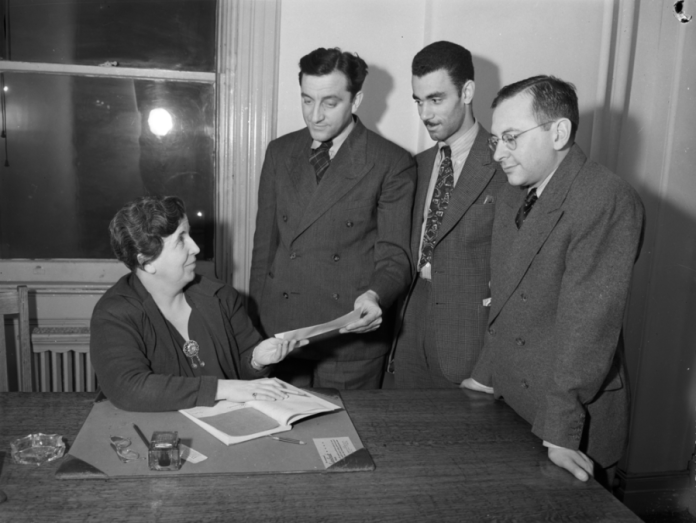
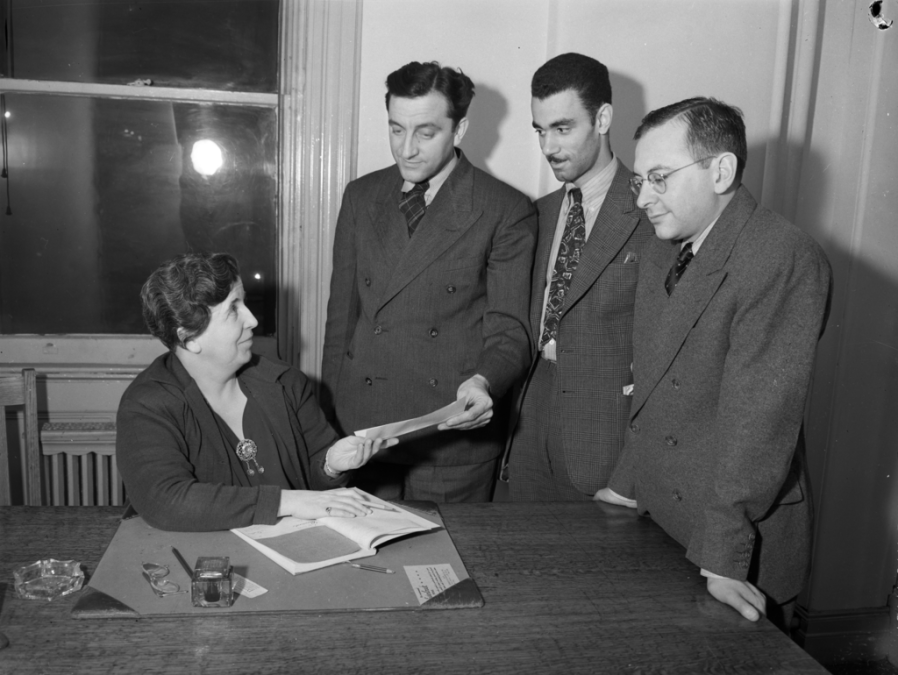
In her New York City office, Elizabeth Gurley Flynn receives a check from Young Communist League activists for the bail fund of the Committee for the Defense of Civil Rights for Communists. (Daily Worker, December 1939)

Flynn’s membership in the Communist Party put her at odds with both the federal government and the ACLU, an organization that had become increasingly intolerant of the period’s labor radicalism. A split emerged within the ACLU that pitted liberal New Deal liberals against leftist Popular Fronters. As Trasciatti explains, the leftists, including Flynn, faced opposition from anti-communist liberals like John Haynes Holmes, Morris Ernst, and Roger William Riis: “The latter group held to the ACLU’s original commitment to free speech as a necessary tool for working-class organizing and activism in the struggle for economic justice in a hostile political environment, while the former was nudging the ACLU in a new direction toward free speech as a value-neutral right that could be invoked by capital as well as labor.”

The more conservative members, who identified as “value-neutral” advocates despite their anti-communist views, believed that management deserved speech rights and expressed discomfort by the outbreak of a series of sit-down strikes. The rightist faction emerged strongest. Trasciatti revisits some of the compelling material that she also discussed in Jacobin. In February 1940, the leadership announced its opposition to what it called “organizations in the United States supporting the totalitarian governments of the Soviet Union and of the Fascist and Nazi Countries (such as the Communist Party, the German-American Bund and others); as well as native organizations with obvious anti-democratic objectives or practices.” This was a response partially to the work of the House Committee on Un-American Activities, which labeled the ACLU a front for the Communist Party.

Seeking to rid itself of what it considered a stigma, ACLU director Roger Baldwin appointed journalist Dorothy Dunbar Bromley to oversee the expulsion process. The Board of Directors ousted Flynn for holding CPUSA membership in May 1940, even though they had reelected Flynn to her leadership position in 1939.

In this context, Flynn expressed disappointment that the organization had drifted sharply from defending underdogs in class struggles to embracing the anti-communist ideas shared by members of both political parties. By the time Flynn left the organization, it had “become,” as she put it, “an ‘open shop’ organization.” It was no longer a friend of labor or the Left at a time when anti-union and red-baiting activities were picking up steam.

The federal government was a far more malevolent, powerful, and unyielding foe. Trasciatti deserves praise for her treatment of official politics during the 1930s. She does not glorify Franklin D. Roosevelt, noting his involvement in undermining large sections of the Left. She reminds us that Roosevelt gave the FBI the green light to monitor suspected subversives and signed the 1940 Smith Act, which criminalized them for holding membership in leftist organizations. Roosevelt and his successors did not care that Communist Party had shifted to the right.

The Smith Act, which authorities first used against Trotskyists before prosecuting members of the CPUSA, including Flynn, put the Left squarely on the defensive. Yet it was not until authorities went after the Communist Party that Flynn mounted a series of strong fights that paralleled her involvement in defending the free speech rights of her Wobbly comrades more than two decades earlier. She noted, “We contend that Americans have a right to speak their minds out on any subject. We Communists have a right to defend socialism or the evolution of the capitalist system and economy and of the private ownership of the means of life of all the people.” Yet she showed no inclination to speak out in favor of the first victims of the Act, the Trotskyist Teamsters from Minnesota.

Nevertheless, one of the great strengths of Trasciatti’s book is its excellent, blow-by-blow accounts of the Smith Act trials, including one involving Flynn herself. Her incarceration at Anderson Federal Industrial Institute for Women in West Virginia did not shatter her spirit: “My body can be incarcerated, but my thoughts will be free.”

Flynn lived a selfless life of struggle. Yet her record was far from flawless. First, as a leading member of the CPUSA, she was part of a top-down Stalinist organization, which, despite the organization’s noble and heroic participation in a wide range of struggles from early racial justice fights to the labor movement, also made policy decisions that constantly zigzagged based on the dictates of the Communist leadership in the Soviet Union.

Trasciatti mentions that Flynn shifted to the right in the 1940s and ’50s, noting that the “days when Flynn and other Wobblies climbed atop street corner soapboxes in Missoula, Montana, and exercised their right to speak for the abolition of wage labor in defiance of the law were long gone.” I would make the point stronger: Flynn had essentially abandoned radicalism and rejected her IWW heritage during the heyday of the New Deal years.

The shift happened at a time when Stalinism was dominant on the Left, and the dominant left-liberal coalitions prioritized electoral politics while deprioritizing more confrontational actions like promoting factory occupations and other expressions of working-class militancy. During this period, as Bryan D. Palmer put it, “socialism stalled in the ruts of bureaucratic ossification.”

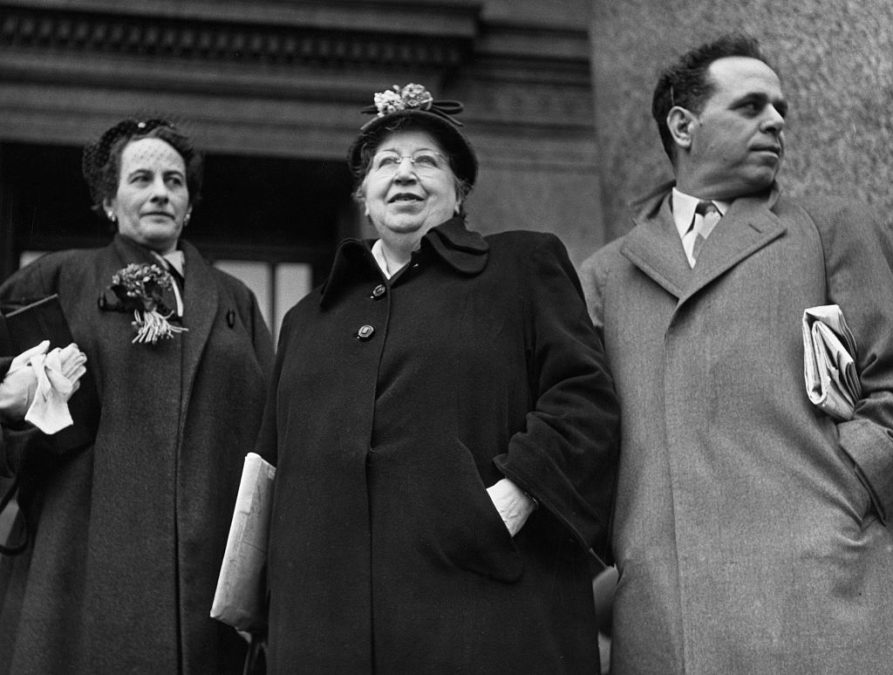
CPUSA militants Marion Bachrach, Elizabeth Gurley Flynn, and Al Lannon, 3 of the 16 Communists on trial for conspiring to advocate the overthrow of the US Government by force, leaving the Federal Court in New York City, on May 31, 1952. (Ruth Sondak / Keystone Pictures / FPG / Archive Photos / Getty Images)

This was a time when labor-liberal coalitions, led partially by pro-FDR union heads like Sidney Hillman, helped to cement organized labor’s ties to the Democratic Party, the start of a coalition that continues to bedevil the labor movement to this day. Of course, these relationships were rooted in the structural limitations of our electoral system. The party, under FDR’s leadership, oversaw US entry into World War II, a war that Flynn supported as part of a broad anti-fascist campaign.

Flynn and her comrades were undoubtedly sincere that they wanted to defeat fascism, but one must ask: Was supporting war the only way to achieve this end? Flynn must have known that the war planners entered the conflict not out of any deeply felt commitments to anti-fascism but out of a desire to achieve global power. Moreover, many US wartime policies, both foreign and domestic, needed leftist critique. Dropping nuclear weapons on Japan, the no-strike pledge, internment of Japanese people within the United States, and an exceptionally exploitative Bracero Program, were hardly signs of working-class progress or expressions of anti-fascism. As the late Howard Zinn, who served in World War II, put it, “When I examined the best of wars [like World War II], I found it so ridden through with immorality and atrocity, not just on the Nazi side, but on our side.”

And what did Flynn make of her old comrade, James P. Cannon, the Trotskyist who had closely collaborated with the “rebel girl” during the great IWW struggles and as part of the International Labor Defense organization? Trasciatti notes that Flynn refused to defend Cannon against the Smith Act. Given the importance of this trial, the first time the US government used the Smith Act against “subversives,” she could have explored this shortcoming more fully. Neither Flynn nor Trasciatti addressed several thorny questions.

And why was Flynn so committed to the idea that it was best for activists to champion the United States and its revered documents like the Constitution? Was an embrace of the American Flag the best way to organize? Did working-class people benefit from rituals like waving American flags at demonstrations? Certainly, Flynn must have recognized the tensions between class struggle unionism and a full embrace of patriotism, which was pushed most aggressively by an assortment of reactionary organizations like the National Association of Manufacturers, the American Legion, and the Ku Klux Klan. If she was as committed to the United States’ sacrosanct documents, as Trasciatti notes, we must ask how Flynn reconciled her early IWW membership with her professed Americanism.

Moreover, critical scholars of the Constitution, including Daniel Lazare and Robert Ovetz have pointed out that the founders developed the Constitution not out of any high-minded enlightened commitment to helping “the people,” but rather to serve their own narrow class and racial interests. Flynn’s own life showed that the legal system, far from serving any emancipatory role, repeatedly punished leftists. Did a steady stream of government-generated punishments ever convince Flynn to abandon her belief in the Constitution?

Despite Flynn’s meaningful shortcomings, her exceptional life is worth celebrating, as Trasciatti’s terrific book does. This was especially clear during her early years of activism, when she traveled to the nation’s class-conflict hot spots, built solidarity with activists, and engaged in direct struggles. The days of the roaming activist, sustained by tight networks of socialists and Wobblies around the nation, seem distant today. But the need for spreading a message of class struggle far and wide with enormous courage, undaunted by state and vigilante repression, is timeless.

Great Job Chad Pearson & the Team @ Jacobin Source link for sharing this story.

Science & Medicine: A mother’s mission transforms care for Chromosome 18 disorders

Science & Medicine: A mother’s mission transforms care for Chromosome 18 disorders

In 1985, Jannine Cody gave birth to a baby girl with a missing piece of her 18th chromosome. “And when she was born 41 years ago, the diagnosis was easy. It was a chromosome test, but that’s where it ended. Then you go home, and there’s nothing,” Cody said.

Cody’s daughter, Elizabeth, had a disorder called 18q- syndrome. 18q- is a spectrum disorder that can include issues of varying severity, including intellectual disability, hearing loss, heart defects, endocrine issues, and developmental delays. Other disorders that can occur when chromosome 18 is altered include trisomy 18, tetrasomy 18, and Ring 18.

Each syndrome has unique health impacts, and when Cody and her child began their journey, little was known beyond diagnosis. Cody noted that many parents who have children with disabilities must go on what she called a “diagnostic odyssey” to discover the cause. “We have the exact opposite problem. We can get a diagnosis very quickly, sometimes prenatally. Then we’re going on a clinical odyssey, in which you have to go to every possible specialist to try to figure out what’s going right and what’s going wrong.”

One of the first things Cody sought out was community. She founded a family support group for people with chromosome 18 conditions, and together, they began to seek out resources to improve the health and lives of their children.

“One of the things I learned really quickly was we didn’t have the expertise to really take it very far,” Cody said. “The other thing I learned was that nobody I could find anywhere was interested in these conditions beyond diagnosis, and diagnosis is just day one. Then, as a parent, you have every other day after that. You’ve got to figure out how to manage.”

So Cody decided to gain the expertise she’d been looking for elsewhere: “I enrolled in graduate school here at UT Health and was able to slowly but surely build a program almost entirely funded by the families and all the fundraising that they do,” she said.

Creative Media Services;Lester Rosebrock

Jannine Cody, PhD, professor of pediatrics, director of pediatric clinical research and director of the Chromosome 18 Clinical Research Center at UT Health San Antonio.

Cody founded The Chromosome 18 Registry and Research Society, and, eventually, the Chromosome 18 Clinical Research Center, which is the world’s only center dedicated specifically to the study of chromosome 18 conditions. Cody, who now has a PhD and is a professor in the Department of Pediatrics at UT Health San Antonio, also leads a study of more than 700 people with chromosome 18 disorders that she hopes will lead to treatments that further improve their lives.

“It’s a lifetime longitudinal study. So we do genetic testing, analysis, and set up a cell line. We have a tissue bank. And we try to learn everything we can about their lives.”

The first goal is to create standards of care for people with chromosome 18 disorders. Cody’s daughter, Elizabeth, was born with a cleft palate, and surgeries to repair it didn’t heal well because doctors did not know that people with 18q- are deficient in growth hormone. Now they do, and it changes the standard of care for surgery and healing. Cody explained that they have compiled everything they have learned into clinical management guides for clinicians.

“But that’s not enough,” she said. “All the management guides do is employ standard medical treatments that we know about today; how to treat irritable bowel syndrome or growth hormone deficiency or whatever. But we’re also learning what we can about the genetics. We know that learning more about genetics will give us more insight into the nature of some of the problems, and we can develop new drug therapies.”

Cody also plans to track what happens as those with chromosome 18 disorders age. “Are they predisposed for things that, if you knew about it early enough, you could prevent it or at least help the condition?”

Cody’s daughter recently celebrated her 41st birthday, and Cody said perhaps the greatest challenge Elizabeth has faced has not come directly from having 18q- syndrome. It’s come from low expectations.

“People see she has a chromosome abnormality, and suddenly she can’t do anything. She can’t learn, she can’t run—and their expectations become so low,” Cody explained. But Elizabeth has flourished, despite this. She has a job she loves and a passion for Scottish dancing. “This girl’s gotten me into more things that are so much fun that I never would’ve expected,” she laughed.

Cody’s work has revolutionized the world’s understanding of chromosome 18 conditions, but for her, there is profound personal value in what this work means for new parents like she once was. “Instead of being handed a book with a very long list of all kinds of scary problems, we can give them a much shorter list and hopefully some guidance on what to do.”

She added that she and the other families that have worked alongside her now for decades are not done yet. ” When we go to Washington, we tell policymakers our goal is to make our kids not able to qualify for SSI (federal financial assistance for people with disabilities), because why not?”

“I mean, it’s just biology,” Cody concluded. “And if it’s just biology, we can figure it out. And we will.”

Great Job Bonnie Petrie & the Team @ Texas Public Radio for sharing this story.

Secret Link