Rows of businesses stood shuttered inside a sprawling complex of Somali businesses on a recent afternoon.
Karmel Mall in south Minneapolis contains more than a hundred small businesses in suites offering everything from clothing and food to insurance and accounting services. On Thursday, the noisy hallways inside lay quiet, save for occasional chatter between neighboring vendors. The smell of fried food still wafted from the bakeries, the central heating hummed and the sound of Quran recitation flowed quietly from some shops.
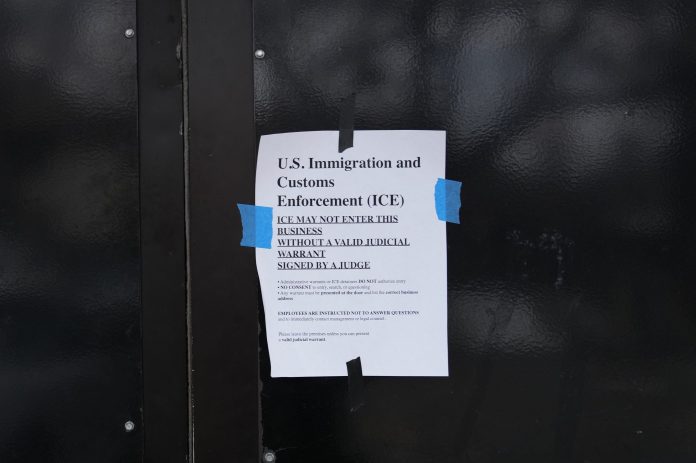
But many sellers sat alone in their clothing stores, waiting for the occasional customer to walk by. Everyone is afraid of federal immigration agents, business owners said. Sellers and customers, citizens and noncitizens. Some don’t bother opening shop because they aren’t expecting any customers.
“It’s been like this for three weeks now,” said Abdi Wahid, who works at his mom’s convenience store in the mall. “Everywhere it’s all been closed up, all the stores.”
Karmel Mall is an economic hub for the area’s Somali population, which is the largest in the U.S. But it also features housing, a mosque and Quran classes, serving as a robust community center for the area.
The economic impact of the Trump administration’s “Operation Metro Surge” stretches beyond the Somali community: many immigrants are on edge, afraid to go to work or leave their homes amid the immigration crackdown.
But President Donald Trump has made the Somali community a special target of his deportation rhetoric after a recent government fraud case in Minnesota included a number of Somali defendants. Since December, Trump has made numerous jabs at the community, calling them “garbage” and saying “they contribute nothing.”
Wahid said early afternoons at the family business once meant 15 to 20 customers. These days, it’s tough to get one.
Wahid is a citizen, but he said the fear extends beyond just immigrants. Citizens are also scared of coming in, especially following the killing of Renee Good and the ICE raid at Roosevelt High School in south Minneapolis.
“I think that caused a lot of people to not even want to come,” he said, because they could be targeted “just because of their race.”
Homeland Security assistant secretary Tricia McLaughlin said in a statement that law enforcement uses “reasonable suspicion” to make arrests under the fourth amendment.
“A person’s immigration status makes them a target for enforcement, not their skin color, race or ethnicity,” she said.
Upstairs, Bashir Garad runs Safari Travel & Accounting Services. Not only has the crackdown in Minneapolis meant he’s lost almost all his customers, but his existing clients are cancelling upcoming trips because they’re worried they won’t be let back into the country.
“They see a lot of unlawful things going on in the city,” he said. “They look at something bad, and then they think some bad things may happen to them.” The majority of his clients are East African, and nearly all are U.S. citizens. They still hesitate to travel.
“The government is not doing the right thing,” he said. “If there’s a criminal, there’s a criminal. Regardless, there are ways to find the criminal, but to marginalize the community’s name, and a whole people, that is unlawful.”
Ibrahim Dahiye, who sells electronics, said winter always used to be slow, “but now it’s totally different. No one comes here. All the stores are closed, few are open.”
Since the crackdown began, Dahiye said his business is down $20,000 monthly, and he’s now pooling funds to make rent.
He said he’s lost most of his customers. His employees are too scared to come to work. He tapped his jacket pocket, saying he keeps his passport on him at all times.
“I don’t know what we can do,” Dahiye said. “We believe in Allah, but we can’t do anything.”
Great Job Sarah Raza, The Associated Press & the Team @ Fortune | FORTUNE Source link for sharing this story.
Elizabeth Gurley Flynn ought to be a household name, given the decades she spent challenging an assortment of powerful forces, including big business, the police, politicians, and judges in her devotion to fighting for a better society. Sadly, she is not. Mary Anne Trasciatti’s new, meticulously researched book about this political radical, Elizabeth Gurley Flynn: The Rebel Girl, Democracy, and Revolution, may help change that.
Flynn’s significance, after all, is beyond question. She was a type of leftist that, sadly, no longer exists. She crisscrossed the nation and was active in numerous leftist organizations throughout her rich life, including the Industrial Workers of the World (IWW), the Workers Defense League, the International Labor Defense, the American Civil Liberties Union, the Anti-Fascist Alliance of North America, the American Communist Party (CPUSA), and the Women’s International Democratic Federation. She marched on picket lines, championed the rights of political prisoners, hobnobbed with a host of leftist luminaries, and was featured in prominent magazines like the Nation.
For much of her life, she saw the fundamental agent for social change as the working class. But she also believed in America’s core political institutions.
In Trasciatti’s interpretation, Flynn engaged in class struggles with the US constitution — which Flynn believed protected basic civil liberties — on her mind. Foundational to Flynn’s worldview, according to Trasciatti, were the Bill of Rights and the Declaration of Independence. As Trasciatti explains, Flynn was an advocate of “the American civil liberties movement, an ardent and active defender of the right to hold and express one’s own political views and to associate with like-minded people in peaceful pursuit of economic, social, and political change.” She tested these rights throughout her long life.
Flynn, whether speaking on picket lines or defending herself or others in courtrooms, believed that the Constitution was intended to protect civil liberties. As Trasciatti explains, “She believed that freedom of speech, press, assembly, and the right to a fair trial by jury are necessary for democracy.” In Flynn’s mind, according to Trasciatti, “the best way to defend free speech was to occupy a terrain, claim your right to do so — with justification from the Declaration of Independence or the Constitution articulated with the language of Americanism — and speak.” Trasciatti seeks to show, through her analysis of Flynn, that working-class radicalism and patriotism were, in fact, compatible.
Flynn’s commitments were frequently put to the test in the early twentieth century, when the IWW, the radical syndicalist organization founded in 1905, staged numerous “free speech fights” against dictatorial authorities, those responsible for imposing restrictions on left-wing public speakers. During strikes and union organizing campaigns, Wobblies, including Flynn, spoke on city streets, ranting against bosses and the politicians who served their interests. Flynn threw herself into the movement.
It did not take long for authorities to, as Trasciatti put it, recognize “Flynn as the unquestioned leader of the free speech movement.” From western cities like Missoula, Montana, and Spokane, Washington, to Lawrence, Massachusetts, and Paterson, New Jersey, on the east coast, Flynn and her comrades faced state and vigilante violence as they denounced capitalism’s horrors and the bosses responsible for making ordinary people’s lives miserable.
In these years, Flynn conducted herself with skill and creativity. During struggles in Paterson in 1913, for example, she once disguised herself with elegant clothing she borrowed from an affluent suffragette to avoid detection. Trasciatti emphasizes the class-based reasons for free speech restrictions, explaining that city leaders saw “anything that threatened the profits of business interests [as] harmful to the city [of Paterson].”
Strike leaders at the Paterson silk strike of 1913: from left, Patrick Quinlan, Carlo Tresca, Elizabeth Gurley Flynn, Adolph Lessig, and Bill Haywood
The repression, backed and sometimes directed by businessmen, continued well into the World War I years, undoubtedly one of the low points for the organized left. The era’s infamous Espionage and Sedition Acts, as Trasciatti puts it, “provided legitimacy for the federal government to silence critics of the war and capitalism.” Federal repressive activities were complemented by the actions of vigilantes, including the American Protective League and the Ku Klux Klan. The question for historians is, was the bourgeois-generated vigilantism directed at organizations like the IWW during the World War I period distinct from earlier eras of repression? Building on Michael Mark Cohen’s scholarship, Trasciatti appears to accept that the World War I years were, in fact, distinctive. This was especially true given that the federal government was directly involved in efforts to crush the IWW.
Yet Flynn continued to challenge the forces of exploitation and oppression in the 1920s. She was an active member of the American Civil Liberties Union (ACLU), which, according to Trasciatti, aided “the class struggle by protecting workers’ rights of free expression and assembly.” In this decade, she became a fierce critic of the far right, including the Ku Klux Klan at home and fascist organizations overseas. In the face of rising fascist threats, she joined with others to form the Anti-Fascist Alliance of North America, an organization consisting of anarchists, communists, socialists, and labor unions.
As Trasciatti explains, “When she spoke, she often drew parallels between the Fascisti’s persecution of labor activists in Italy and the American Legion’s hyperpatriotism and xenophobia or the Ku Klux Klan’s reign of terror over African Americans.” Flynn believed the class struggle had to be fought globally.
One of the most consequential decisions Flynn made was to join the American Communist Party in 1937, when the organization was in its Popular Front phase and reconciled “itself to U.S. liberalism.” Most famously, Earl Browder, CPUSA head, proudly exclaimed that “Communism is Twentieth Century Americanism” — in other words, nothing for the average American to be afraid of.
Trasciatti appears to believe that this period represented a step forward for the party, because Communist Party members played “a key role in the economic, political, and cultural upheavals that transformed U.S. society in the 1930s.” The achievements, especially the Congress of Industrial Organizations’ (CIO) massive membership gains and combative presence in workplaces around much of the nation, were impressive (though many of labor’s breakthroughs, including the victorious strikes in 1934, predate the CIO’s formation).
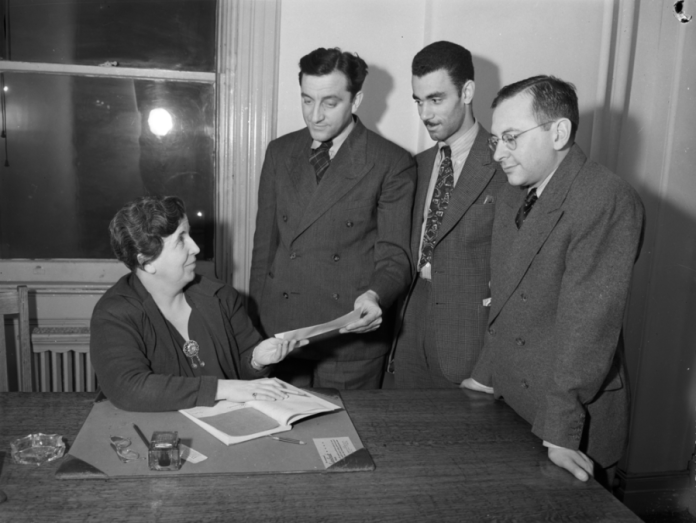
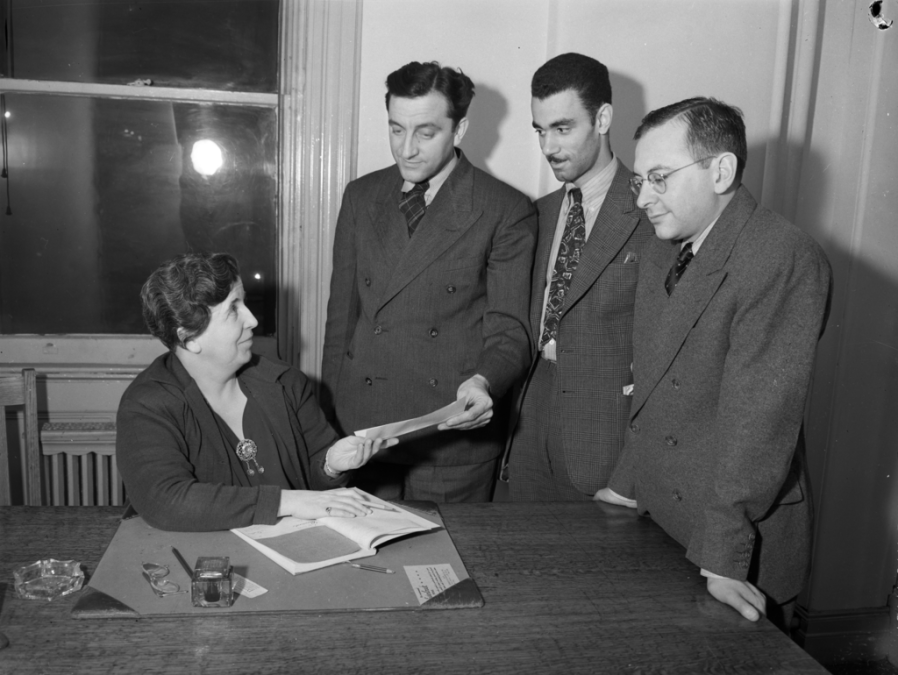
In her New York City office, Elizabeth Gurley Flynn receives a check from Young Communist League activists for the bail fund of the Committee for the Defense of Civil Rights for Communists. (Daily Worker, December 1939)
Flynn’s membership in the Communist Party put her at odds with both the federal government and the ACLU, an organization that had become increasingly intolerant of the period’s labor radicalism. A split emerged within the ACLU that pitted liberal New Deal liberals against leftist Popular Fronters. As Trasciatti explains, the leftists, including Flynn, faced opposition from anti-communist liberals like John Haynes Holmes, Morris Ernst, and Roger William Riis: “The latter group held to the ACLU’s original commitment to free speech as a necessary tool for working-class organizing and activism in the struggle for economic justice in a hostile political environment, while the former was nudging the ACLU in a new direction toward free speech as a value-neutral right that could be invoked by capital as well as labor.”
The more conservative members, who identified as “value-neutral” advocates despite their anti-communist views, believed that management deserved speech rights and expressed discomfort by the outbreak of a series of sit-down strikes. The rightist faction emerged strongest. Trasciatti revisits some of the compelling material that she also discussed in Jacobin. In February 1940, the leadership announced its opposition to what it called “organizations in the United States supporting the totalitarian governments of the Soviet Union and of the Fascist and Nazi Countries (such as the Communist Party, the German-American Bund and others); as well as native organizations with obvious anti-democratic objectives or practices.” This was a response partially to the work of the House Committee on Un-American Activities, which labeled the ACLU a front for the Communist Party.
Seeking to rid itself of what it considered a stigma, ACLU director Roger Baldwin appointed journalist Dorothy Dunbar Bromley to oversee the expulsion process. The Board of Directors ousted Flynn for holding CPUSA membership in May 1940, even though they had reelected Flynn to her leadership position in 1939.
In this context, Flynn expressed disappointment that the organization had drifted sharply from defending underdogs in class struggles to embracing the anti-communist ideas shared by members of both political parties. By the time Flynn left the organization, it had “become,” as she put it, “an ‘open shop’ organization.” It was no longer a friend of labor or the Left at a time when anti-union and red-baiting activities were picking up steam.
The federal government was a far more malevolent, powerful, and unyielding foe. Trasciatti deserves praise for her treatment of official politics during the 1930s. She does not glorify Franklin D. Roosevelt, noting his involvement in undermining large sections of the Left. She reminds us that Roosevelt gave the FBI the green light to monitor suspected subversives and signed the 1940 Smith Act, which criminalized them for holding membership in leftist organizations. Roosevelt and his successors did not care that Communist Party had shifted to the right.
The Smith Act, which authorities first used against Trotskyists before prosecuting members of the CPUSA, including Flynn, put the Left squarely on the defensive. Yet it was not until authorities went after the Communist Party that Flynn mounted a series of strong fights that paralleled her involvement in defending the free speech rights of her Wobbly comrades more than two decades earlier. She noted, “We contend that Americans have a right to speak their minds out on any subject. We Communists have a right to defend socialism or the evolution of the capitalist system and economy and of the private ownership of the means of life of all the people.” Yet she showed no inclination to speak out in favor of the first victims of the Act, the Trotskyist Teamsters from Minnesota.
Nevertheless, one of the great strengths of Trasciatti’s book is its excellent, blow-by-blow accounts of the Smith Act trials, including one involving Flynn herself. Her incarceration at Anderson Federal Industrial Institute for Women in West Virginia did not shatter her spirit: “My body can be incarcerated, but my thoughts will be free.”
Flynn lived a selfless life of struggle. Yet her record was far from flawless. First, as a leading member of the CPUSA, she was part of a top-down Stalinist organization, which, despite the organization’s noble and heroic participation in a wide range of struggles from early racial justice fights to the labor movement, also made policy decisions that constantly zigzagged based on the dictates of the Communist leadership in the Soviet Union.
Trasciatti mentions that Flynn shifted to the right in the 1940s and ’50s, noting that the “days when Flynn and other Wobblies climbed atop street corner soapboxes in Missoula, Montana, and exercised their right to speak for the abolition of wage labor in defiance of the law were long gone.” I would make the point stronger: Flynn had essentially abandoned radicalism and rejected her IWW heritage during the heyday of the New Deal years.
The shift happened at a time when Stalinism was dominant on the Left, and the dominant left-liberal coalitions prioritized electoral politics while deprioritizing more confrontational actions like promoting factory occupations and other expressions of working-class militancy. During this period, as Bryan D. Palmer put it, “socialism stalled in the ruts of bureaucratic ossification.”
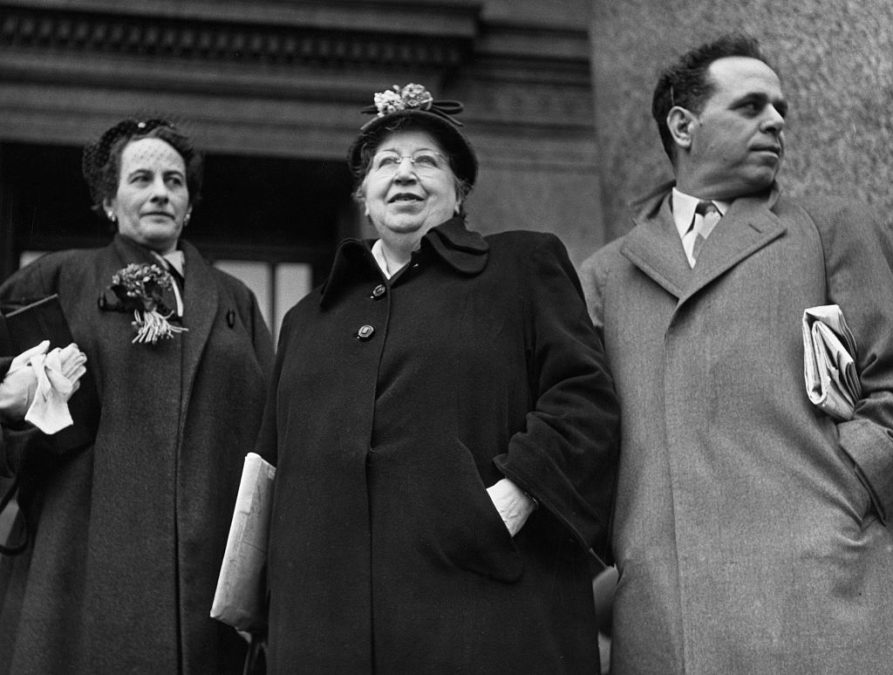
CPUSA militants Marion Bachrach, Elizabeth Gurley Flynn, and Al Lannon, 3 of the 16 Communists on trial for conspiring to advocate the overthrow of the US Government by force, leaving the Federal Court in New York City, on May 31, 1952. (Ruth Sondak / Keystone Pictures / FPG / Archive Photos / Getty Images)
This was a time when labor-liberal coalitions, led partially by pro-FDR union heads like Sidney Hillman, helped to cement organized labor’s ties to the Democratic Party, the start of a coalition that continues to bedevil the labor movement to this day. Of course, these relationships were rooted in the structural limitations of our electoral system. The party, under FDR’s leadership, oversaw US entry into World War II, a war that Flynn supported as part of a broad anti-fascist campaign.
Flynn and her comrades were undoubtedly sincere that they wanted to defeat fascism, but one must ask: Was supporting war the only way to achieve this end? Flynn must have known that the war planners entered the conflict not out of any deeply felt commitments to anti-fascism but out of a desire to achieve global power. Moreover, many US wartime policies, both foreign and domestic, needed leftist critique. Dropping nuclear weapons on Japan, the no-strike pledge, internment of Japanese people within the United States, and an exceptionally exploitative Bracero Program, were hardly signs of working-class progress or expressions of anti-fascism. As the late Howard Zinn, who served in World War II, put it, “When I examined the best of wars [like World War II], I found it so ridden through with immorality and atrocity, not just on the Nazi side, but on our side.”
And what did Flynn make of her old comrade, James P. Cannon, the Trotskyist who had closely collaborated with the “rebel girl” during the great IWW struggles and as part of the International Labor Defense organization? Trasciatti notes that Flynn refused to defend Cannon against the Smith Act. Given the importance of this trial, the first time the US government used the Smith Act against “subversives,” she could have explored this shortcoming more fully. Neither Flynn nor Trasciatti addressed several thorny questions.
And why was Flynn so committed to the idea that it was best for activists to champion the United States and its revered documents like the Constitution? Was an embrace of the American Flag the best way to organize? Did working-class people benefit from rituals like waving American flags at demonstrations? Certainly, Flynn must have recognized the tensions between class struggle unionism and a full embrace of patriotism, which was pushed most aggressively by an assortment of reactionary organizations like the National Association of Manufacturers, the American Legion, and the Ku Klux Klan. If she was as committed to the United States’ sacrosanct documents, as Trasciatti notes, we must ask how Flynn reconciled her early IWW membership with her professed Americanism.
Moreover, critical scholars of the Constitution, including Daniel Lazare and Robert Ovetz have pointed out that the founders developed the Constitution not out of any high-minded enlightened commitment to helping “the people,” but rather to serve their own narrow class and racial interests. Flynn’s own life showed that the legal system, far from serving any emancipatory role, repeatedly punished leftists. Did a steady stream of government-generated punishments ever convince Flynn to abandon her belief in the Constitution?
Despite Flynn’s meaningful shortcomings, her exceptional life is worth celebrating, as Trasciatti’s terrific book does. This was especially clear during her early years of activism, when she traveled to the nation’s class-conflict hot spots, built solidarity with activists, and engaged in direct struggles. The days of the roaming activist, sustained by tight networks of socialists and Wobblies around the nation, seem distant today. But the need for spreading a message of class struggle far and wide with enormous courage, undaunted by state and vigilante repression, is timeless.
Great Job Chad Pearson & the Team @ Jacobin Source link for sharing this story.
In 1985, Jannine Cody gave birth to a baby girl with a missing piece of her 18th chromosome. “And when she was born 41 years ago, the diagnosis was easy. It was a chromosome test, but that’s where it ended. Then you go home, and there’s nothing,” Cody said.
Each syndrome has unique health impacts, and when Cody and her child began their journey, little was known beyond diagnosis. Cody noted that many parents who have children with disabilities must go on what she called a “diagnostic odyssey” to discover the cause. “We have the exact opposite problem. We can get a diagnosis very quickly, sometimes prenatally. Then we’re going on a clinical odyssey, in which you have to go to every possible specialist to try to figure out what’s going right and what’s going wrong.”
One of the first things Cody sought out was community. She founded a family support group for people with chromosome 18 conditions, and together, they began to seek out resources to improve the health and lives of their children.
“One of the things I learned really quickly was we didn’t have the expertise to really take it very far,” Cody said. “The other thing I learned was that nobody I could find anywhere was interested in these conditions beyond diagnosis, and diagnosis is just day one. Then, as a parent, you have every other day after that. You’ve got to figure out how to manage.”
So Cody decided to gain the expertise she’d been looking for elsewhere: “I enrolled in graduate school here at UT Health and was able to slowly but surely build a program almost entirely funded by the families and all the fundraising that they do,” she said.
Creative Media Services;Lester Rosebrock
Jannine Cody, PhD, professor of pediatrics, director of pediatric clinical research and director of the Chromosome 18 Clinical Research Center at UT Health San Antonio.
“It’s a lifetime longitudinal study. So we do genetic testing, analysis, and set up a cell line. We have a tissue bank. And we try to learn everything we can about their lives.”
The first goal is to create standards of care for people with chromosome 18 disorders. Cody’s daughter, Elizabeth, was born with a cleft palate, and surgeries to repair it didn’t heal well because doctors did not know that people with 18q- are deficient in growth hormone. Now they do, and it changes the standard of care for surgery and healing. Cody explained that they have compiled everything they have learned into clinical management guides for clinicians.
“But that’s not enough,” she said. “All the management guides do is employ standard medical treatments that we know about today; how to treat irritable bowel syndrome or growth hormone deficiency or whatever. But we’re also learning what we can about the genetics. We know that learning more about genetics will give us more insight into the nature of some of the problems, and we can develop new drug therapies.”
Cody also plans to track what happens as those with chromosome 18 disorders age. “Are they predisposed for things that, if you knew about it early enough, you could prevent it or at least help the condition?”
Cody’s daughter recently celebrated her 41st birthday, and Cody said perhaps the greatest challenge Elizabeth has faced has not come directly from having 18q- syndrome. It’s come from low expectations.
“People see she has a chromosome abnormality, and suddenly she can’t do anything. She can’t learn, she can’t run—and their expectations become so low,” Cody explained. But Elizabeth has flourished, despite this. She has a job she loves and a passion for Scottish dancing. “This girl’s gotten me into more things that are so much fun that I never would’ve expected,” she laughed.
Cody’s work has revolutionized the world’s understanding of chromosome 18 conditions, but for her, there is profound personal value in what this work means for new parents like she once was. “Instead of being handed a book with a very long list of all kinds of scary problems, we can give them a much shorter list and hopefully some guidance on what to do.”
She added that she and the other families that have worked alongside her now for decades are not done yet. ” When we go to Washington, we tell policymakers our goal is to make our kids not able to qualify for SSI (federal financial assistance for people with disabilities), because why not?”
“I mean, it’s just biology,” Cody concluded. “And if it’s just biology, we can figure it out. And we will.”
Great Job Bonnie Petrie & the Team @ Texas Public Radio for sharing this story.
VIRGINIA BEACH, Va. – Harlan’s Tate Taylor shattered the high school boys’ national record in the 300-meter dash Saturday at the Virginia Showcase, clocking 32.45 seconds to win the USATF division race and claim his third national record.
The San Antonio sprinter beat the previous mark of 32.64 seconds set by Brian Herron in 2018 and tied by Jayden Horton-Mims in 2025.
Big Game Coverage
More Stories Like This In Our Email Newsletter
The Texas Tech commit’s performance at Liberty University’s indoor track complex also established a new under-20 world record in the event.
The victory adds to Taylor’s growing list of accomplishments. He previously set high school national records in the 100-meter dash with a time of 9.92 seconds in May 2025 and in the indoor 200-meter dash, with 20.46 seconds in March 2025.
The Virginia Showcase, one of the nation’s premier high school indoor track meets, drew top talent from across the country for its 2026 edition, held Jan. 16-18.
The reference points were readily identifiable: a chance meeting between characters from different worlds, a sport involving sticks and a flying round projectile whose nuances would be lost on the average American. Yep, Saturday Night Live was doing yet another Harry Potter sketch—but this time with a spicy twist.
As those descriptions—and the furtive glances exchanged by last night’s host, Finn Wolfhard, and the SNL cast member Ben Marshall, playing Potter and Ron Weasley—implied, a page-to-screen sensation of a more recent vintage was also being spoofed. Count SNL’s writers among the many HBO Max watchers who have jumped on the Heated Rivalry bandwagon, giving us the pretaped sketch “Heated Wizardry,” an elaborate, meme-ready mash-up of J. K. Rowling’s wizarding world and the streaming show based on Rachel Reid’s hockey-themed gay romance series.
For “Heated Wizardry” to land, viewers had to have at least a passing familiarity with each story’s component parts: the enemies-turned-lovers arc of Reid’s protagonists, Shane Hollander and Ilya Rozanov; the broad strokes of Rowling’s boarding school for magical kids. Fans of the former could get a kick out of seeing Wolfhard and Marshall in saucy stretching poses previously struck by the Heated Rivalry stars Connor Storrie and Hudson Williams. Fans of the latter could enjoy the realization of online fan-fiction fantasies pairing Harry with his best friend. And the gags kept coming: Harry and Ron canoodling beneath an invisibility cloak; barely coded sexts sent via owl; Jason Momoa, popping up as Hagrid, punning on the name of Harry and Ron’s classmate Neville Longbottom.
The most telling joke rested in a fake blurb from the equally fake website Hornymuggles.net—“Finally, finally, yes!”—mocking the unwavering attachment of Harry Potter fans. The seventh and final Potter novel was published in 2007, and the eight-part film franchise it inspired wrapped in 2011. But in today’s TV and movie environment, fans, studios, and streamers can’t let any story end. That’s how an in-world textbook from Harry Potter and the Sorcerer’s Stone became a fundraising tie-in that launched a full-fledged trilogy of shoddy Fantastic Beasts movies, and why the books are being refashioned into what HBO envisions as a decade-long TV series.
The potential for endless extension is especially true of anything as massively popular and lucrative as Stranger Things, the recently concluded Netflix show that launched Wolfhard’s career. Stranger Things’ transformation—from a charming homage to ’80s blockbusters to a sprawling transmedia franchise—was ribbed later in last night’s episode, in a commercial parody imagining a string of continuations. The final beat was dedicated to devotees who had such a hard time letting go that they whipped up the viral rumor of a “secret” series finale.
That flurry of (to quote the sketch) “sequels, prequels, requels, and spin-offs” lampooned another property that HBO’s corporate parent keeps reviving: Sex and the City. Jumping off from the actual ending of Stranger Things—in which Wolfhard’s character realizes his writerly ambitions—SNL dropped the actor and his co-stars Gaten Matarazzo and Caleb McLaughlin into ’90s New York City. Over cosmos, they traded the kind of cheeky banter that defined the interactions among Carrie Bradshaw and her friends across 94 episodes, two movies, a YA origin story adapted into a show on the CW network, and an HBO Max follow-up series.
Heated Rivalry could be destined for a similar drawn-out fate. The Canadian streaming platform Crave, which first aired the show in November, has ordered a second season. And the show’s source material, Reid’s Game Changers series, has included six novels thus far and features plenty of other couples who could take to the ice on-screen. A seventh Game Changers installment is due this fall. Seven books? That sounds like something a premium TV service and its subscribers could keep a good, heavily suggestive grip on for at least 10 years.
Great Job Erik Adams & the Team @ The Atlantic Source link for sharing this story.
The much-awaited Animal Crossing: New Horizons 3.0.0 update has finally arrived, bringing a deluge of new content to the beloved virtual island. The new update also sees the addition of several classic Nintendo game systems like the NES, Famicom, Super NES, and Game Boy, all of which can be obtained in-game. Better yet, these consoles are fully interactive, with each one boasting a built-in retro game that you can play straight from the console itself. That said, unlocking and playing these classic Nintendo games in Animal Crossing: New Horizons requires a bit of in-game progress before they become available. So, to clear things up, here’s how to unlock and play classic Nintendo games in Animal Crossing: New Horizons.
Animal Crossing: New Horizons: How to Unlock and Play Classic Nintendo Games
To unlock and play classic Nintendo games in Animal Crossing: New Horizons, you need to progress through the game until the Resort Hotel becomes available on your pier. From there, you’ll need to decorate the hotel and perform crafting requests for visiting islands to gain access to the retro Nintendo consoles and their playable games.
When you enter the hotel for the first time, you’ll be greeted by Tom Nook, who’ll introduce you to Leilani. She will then ask for your help furnishing the guest rooms. You can decorate up to two rooms per day, and there are no rules on how fancy the designs have to be. You’ll need to complete eight rooms before you can move on to the next stage, which usually takes four to five real-time days unless you choose to time-travel.
Once you’re done renovating the guest rooms, head back to the pier and speak to Cap’n on his boat. He will ask you to craft DIY items that can be delivered to other islands to promote your hotel. Each request you complete will reward you with Hotel Tickets (which you can redeem for items in the hotel’s shop) and gradually expand the items available in the hotel shop.
You’ll need to work through quite a few of these crafting requests, and when you reach the five- and 50-item milestones, Cap’n will thank you again with more Hotel Tickets. At that point, return inside and speak with Grams, who runs the hotel shop. She will mention that the shop’s selection has expanded and that some of the rarest items her son has found are now in stock.
This will unlock the Special tab in her shop, where classic Nintendo game consoles will become available. You can buy each console for 500 Hotel Tickets, and it’ll show up in your mailbox the next day. From there, all that’s left to do is fire up a console and have fun. Nintendo games in Animal Crossing: New Horizons are fully playable and each console will run a specific classic game. Just keep in mind that you’ll need an active Nintendo Switch Online membership to play them.
The weather in Las Vegas wasn’t looking good. The plan had been that each employee of YC-backed Bucket Robotics would carry parts of their booth in their luggage to the 2026 Consumer Electronics Show. But CEO and founder Matt Puchalski didn’t want to take the chance that one (or all) of their flights would be delayed. So he rented a Hyundai Santa Fe and packed it up.
“It was… it was tight,” he said with a laugh on the show floor.
It took 12 hours driving in the rain, but the gear – and Puchalski – made it safely to Las Vegas, and so began the young company’s first-ever CES.
San Francisco-based Bucket Robotics was just one of thousands of companies exhibiting at the annual tech conference, a speck of sand on a beach full of products and promises. But despite its modest setup in the automotive-focused West Hall, Puchalski said the trip was worth it.
Part of that was a willingness to be tireless, observant, and always ready to pitch.
An engineer by trade, Puchalski spent most of the last decade working on autonomous vehicles at Uber, Argo AI, Ford’s subsidiary Latitude AI, and SoftBank-backed Stack AV.
At those jobs, Puchalski developed deep connections in the automotive industry, and we crossed paths all week.
Techcrunch event
San Francisco | October 13-15, 2026
There he was at an industry networking party one night. On another night, in my hotel lobby at 10 p.m., he was debating how to balance quality and manufacturing yield with Sanjay Dastoor — founder of mobility startups Skip and Boosted, both of which also got off the ground at YC.
But I first ran into Puchalski during breakfast at the hotel. Seated at the table next to me, he and sales associate Max Joseph were running through preparations for the conference’s “Media Day” over (allegedly) cage-free eggs.
Puchalski’s verve piqued my interest, and after making an intro, he told me what Bucket Robotics is up to. Before I knew it, he had cracked open a bright yellow Pelican case and I was holding a small piece of plastic.
Started as part of YC’s Spring 2024 batch, Bucket Robotics is all about using advanced vision systems to do quality inspections, specifically for surfaces. The goal is to automate a menial task that Puchalski joked is usually done by “dudes in Wisconsin,” and to accelerate the broad, multi-industry effort to onshore manufacturing.
One example Puchalski offered was car door handles. It’s a part customers touch every day, so it needs to be structurally sound, and that kind of quality inspection is basically solved.
But it can be challenging to make sure the surface is flawless. Is the color right? Are there any burn or scuff marks? These are the questions Bucket Robotics wants to answer.
“It’s deeply hard to automate these types of challenges without huge volumes of data, so auto manufacturers just throw dudes in Wisconsin at this problem,” he said.
Bucket Robotics solves that data problem by working from the CAD files for a particular part. It then generates a bunch of simulated defects – burn marks, bumps, breaks – so that its vision software can detect those problems quickly on a production line.
There’s no need for manual labeling, and the company claims its models can deploy “in minutes” while also adapting if products or production lines change. One of the big selling points to date is that Bucket Robotics can integrate into existing production lines without adding new hardware, Puchalski said.
This has already attracted customers in automotive and in defense, setting up Bucket Robotics to pursue the increasingly popular path of becoming a “dual-use” company.
When the show floor opened, the first two hours were “intense,” Puchalski said. Attendees in suits snooped around the startup’s tables, plucked orange stickers with the Bucket Robotics logo, and quizzed the employees about their tech.
More importantly, Puchalski said the level of interest stayed consistent throughout the week. He had “real technical discussions” with people from the worlds of manufacturing, robotics, and automation. He said Friday that he’s spent the week since the show on follow-up calls with prospective customers and investors.
CES can be a slog, but Bucket Robotics survived. Now comes the actual hard part: building a business, scaling, fundraising, and striking commercial deals.
As for the “dudes in Wisconsin,” Puchalski doesn’t see his company as a threat to their livelihoods. Those jobs are just as much about spotting defects as they are about identifying the root cause of the problem, he said.
And besides, Puchalski added, automating surface quality inspection is something that the manufacturing industry has been trying to do for decades.
“So when we go to our customers, it’s incredibly exciting,” he said.
Great Job Sean O’Kane & the Team @ TechCrunch Source link for sharing this story.
MLK Jr. Planner (Copyright KSAT-12 2026 – All Rights Reserved)
FORECAST HIGHLIGHTS
FREEZE WARNING: All of us will see freezing temperatures Sunday morning
MLK JR. DAY: Pleasant and cool
RAIN RETURNS: Tuesday night and Wednesday
FORECAST
TODAY
The chill won’t last long, temperatures are expected to climb steadily. By 10 a.m., most areas are forecast to be in the low 40s. By the afternoon, highs should reach the low 60s across much of the area.
Several hours of below freezing conditions are possible this morning (Copyright KSAT-12 2026 – All Rights Reserved)
RAIN CHANCES
After a dry start to the week, keep an eye out for rain beginning Tuesday afternoon. A weather shift arrives bringing moisture from the Gulf.
Rain chances increase Tuesday night into Wednesday (Copyright KSAT-12 2026 – All Rights Reserved)
Scattered showers are forecast to develop mainly out west Tuesday afternoon and evening, with spotty coverage elsewhere. Keep your umbrella handy as some areas could see heavy rain midweek.
THIS WEEK
Chilly conditions continue through MLK Jr. Day. Layer up in the morning, then shed those coats as temperatures rise in the afternoon. Relief is on the way as the week warms into the 60s by midweek, and near the 70s by next weekend.
7 Day Forecast (Copyright KSAT-12 2026 – All Rights Reserved)
Daily Forecast
KSAT meteorologists keep you on top of the ever-changing South Texas weather.
Shelby Ebertowski joined KSAT 12 News in January 2025. She came to San Antonio from Fargo, North Dakota via the University of North Dakota, where she learned the ropes as a weekend forecaster over two years at KVLY. Her love of weather love began after experiencing Hurricane Harvey in 2017.
Great Job Shelby Ebertowski & the Team @ KSAT San Antonio for sharing this story.
Reporting for this story was supported by a grant from the Fund for Investigative Journalism.
WINKLER COUNTY, Texas—The first sign of trouble appeared in 2003 when the water samples came back salty.
This remote corner of West Texas, known as the T-Bar Ranch, had long served as the City of Midland’s insurance policy for water security. Midland purchased 20,000 acres spanning Winkler and Loving Counties in 1965, waiting for the day it would need to pump water from the property.
Extra salts in the aquifer was not part of the plan.
The city’s investigation soon landed on Heritage Standard Corporation as the prime suspect. The small Dallas-based company operated oil and gas wells and a disposal well near Midland’s water source.
In 2007, the city filed a formal complaint with the state, alleging that Heritage Standard’s injection well had contaminated the groundwater. The Railroad Commission of Texas, which regulates oil and gas, ordered the company to remediate. But in 2010, Heritage Standard filed for bankruptcy.
The saga continues to this day. The pollution is still being cleaned up more than two decades after its discovery. Heritage Standard also abandoned six inactive wells, known as orphan wells, that the state is now on the hook to plug. These are among the more than 11,000 orphan wells on the list for plugging in Texas.
Protecting water from pollution is one of the Railroad Commission’s primary mandates. But T-Bar Ranch shows how costly, complicated and time-consuming it can be to clean up groundwater pollution left by oil companies. The bankruptcy process allowed Heritage Standard to shed troublesome assets. But the pollution persists. This is one of more than 500 active cases of groundwater contamination attributed to oil and gas activities, going back decades, that the Railroad Commission oversees.
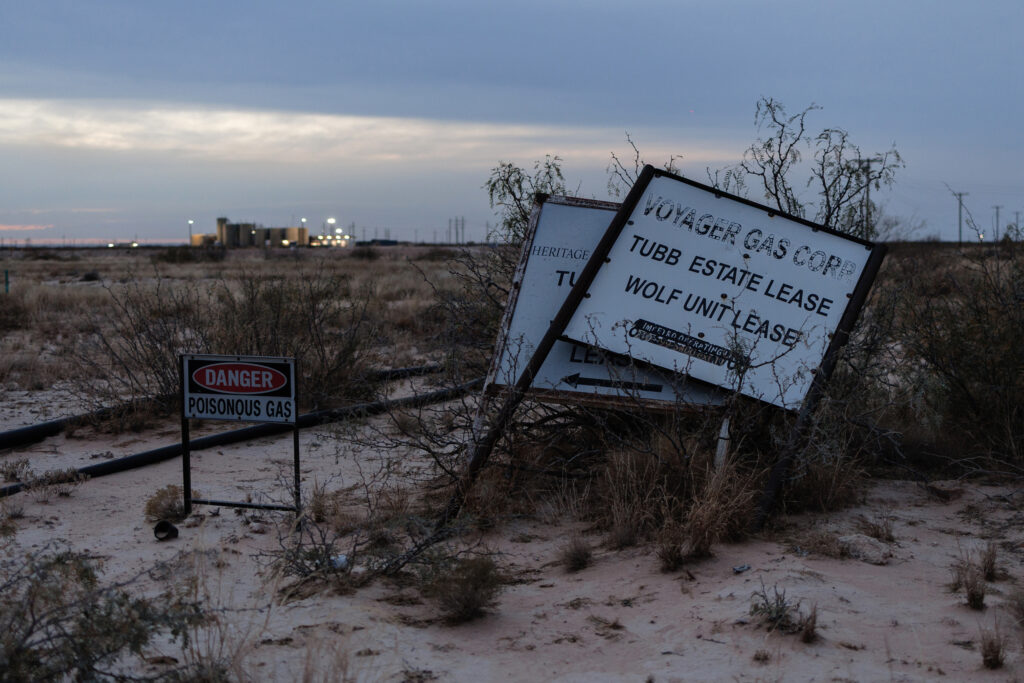
An old sign for Heritage Standard leans by the side of Frying Pan Ranch Road in Winkler County, Texas, on Nov. 19, 2025. Credit: Paul Ratje/Inside Climate News
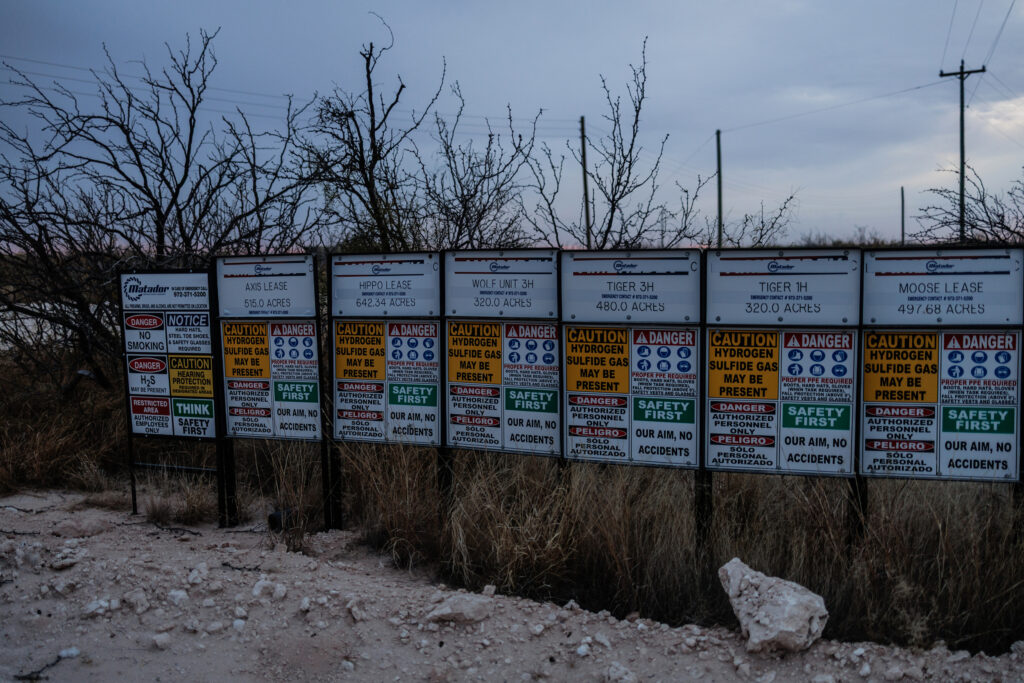
Signs for oil lease sites are posted next to warning signs for poisonous gas along Frying Pan Ranch Road at the T-Bar Ranch in Winkler County, Texas. Credit: Paul Ratje/Inside Climate News
A representative of Heritage Standard’s executive Michael B. Wisenbaker Sr. declined to comment.
“The existing regulatory framework has been effective,” said Railroad Commission spokesperson Bryce Dubee. “The agency’s critical mission is to protect public safety and the environment, and protection of groundwater is our primary concern with regard to the commission’s federally approved Underground Injection Control (UIC) program.”
Oilfield contamination can threaten precious water supplies in a growing, thirsty state. In November 2025, Texans voted to dedicate up to $1 billion annually to the Texas Water Fund to grow the state’s water supply.
“We’re putting one billion dollars toward finding new supplies of water,” said Julie Range, policy manager at Commission Shift, an organization focused on reforming the Railroad Commission. “We should be protecting every drop of water we have—that should include these operations that we know are risky.”
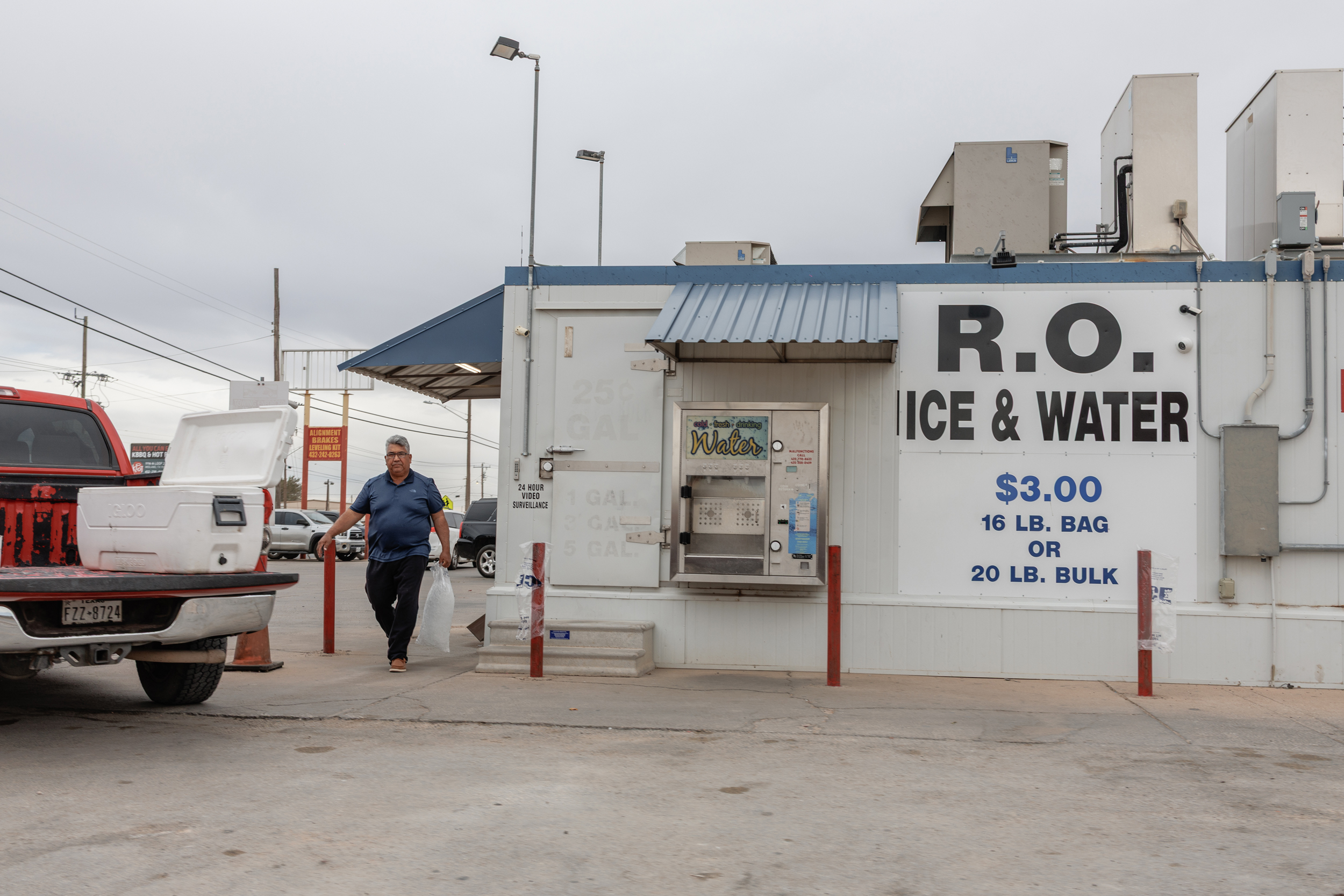
A man carries a bag of ice from a purified water and ice business in Midland, Texas, on Nov. 20, 2025. Credit: Paul Ratje/Inside Climate News
Where Oil and Water Mix
The 2024 Texas Joint Groundwater Monitoring and Contamination Report lists 531 current cases of groundwater pollution linked to the oil and gas industry under Railroad Commission jurisdiction. Another 348 cases of contamination are listed as “inactive” because the Railroad Commission decided to leave the pollution in place. Injection wells, spills and pipeline leaks are some of the ways oil and gas companies have contaminated groundwater.
Most of these incidents do not impact groundwater currently used for domestic consumption. But T-Bar isn’t the only place where oil and gas activities are suspected to have impacted public water reserves. The Colorado River Municipal Water District, which provides water for Big Spring and Odessa, found benzene in a water well in 2012.
Public water sources have tested positive for industrial contaminants more than 200 times around Texas, according to the state’s contamination report. It is unclear how often this pollution comes from the oil and gas industry, which in addition to fossil fuels produces billions of gallons of highly toxic wastewater, called produced water, primarily disposed of underground in injection wells.
Finding suitable drinking water in the Permian Basin isn’t easy. Aquifers in West Texas are often slightly saline or laced with naturally occurring arsenic. The first Permian oil wells were drilled in the 1920s and hundreds of thousands now pockmark the surface. The risk of contamination is ever present. More insidious is the vast quantity of produced water, the salty byproduct of drilling, that was disposed of in open pits for decades. These pits, banned in 1969, allowed pollution to leach underground.
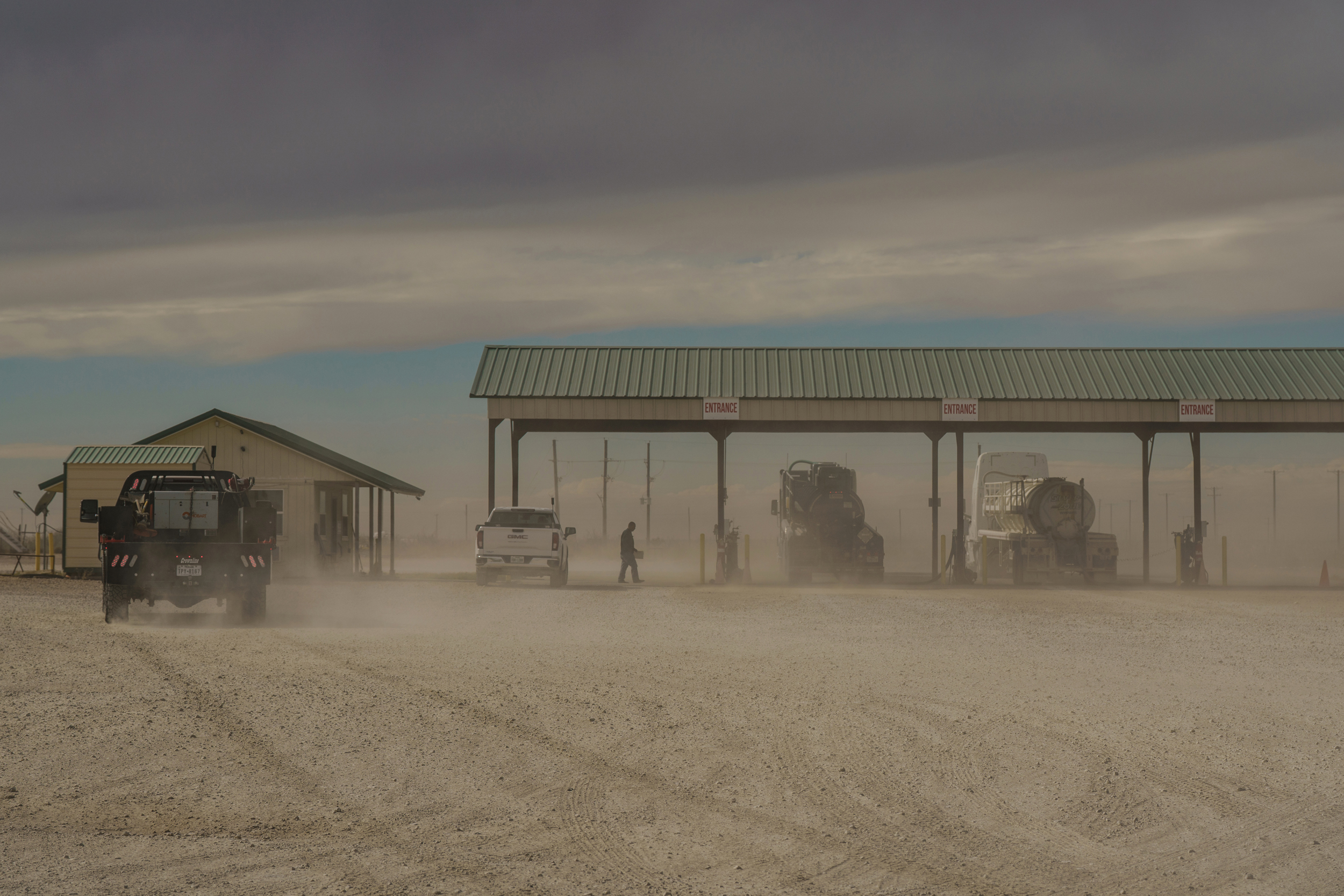
A man walks between trucks at a saltwater disposal site on the outskirts of Midland, Texas, on Nov. 20, 2025. Credit: Paul Ratje/Inside Climate News
The Texas Water Commission, a precursor to the Texas Commission on Environmental Quality, wrote in 1989 that brine, another name for produced water, is one of the “principal pollutants” of the state’s aquifers. The report cautioned that contaminated groundwater plumes could exist below old pits but concluded it was not “practical, nor economical” to remediate these areas.
As one Texas Monthly writer put it in 1991, “Having polluted water, a good lawyer, and a pending lawsuit against a major oil company has become a tradition in West Texas.”
The problem continues. A 2020 paper in the International Journal of Environmental Research and Public Health found that groundwater quality degraded in the Permian Basin between 1992 and 2019. The authors found two primary contributors: chemical fertilizers in agriculture and spills in the oil and gas industry.
Improperly plugged oil and gas wells have also allowed naturally occurring salty groundwater to migrate upward and contaminate shallow groundwater, according to the regional water plan. More recently, Permian Basin landowners Ashley Watt and Schuyler Wight have brought attention to groundwater contamination on their ranches.
But the experience of Midland, a city at the heart of the Texas oil industry, demonstrates the broader risk of oil and gas drilling in close proximity to water wells.
T-Bar Ranch
Midland sits on the edge of the Chihuahuan Desert and receives on average 13 inches of rain a year. The city’s primary water sources are reservoirs on the Colorado River.
Before and after Midland purchased T-Bar Ranch, scores of oil and gas wells were drilled on the property.
In Texas, the Rule of Capture dictates that a landowner can pump water from the underlying aquifer without restrictions unless there is a groundwater district. But owning the land doesn’t convey the mineral rights, including the right to drill for oil and gas. Therefore, Midland must cooperate with companies that drill for oil and gas and dispose of their waste at the property.
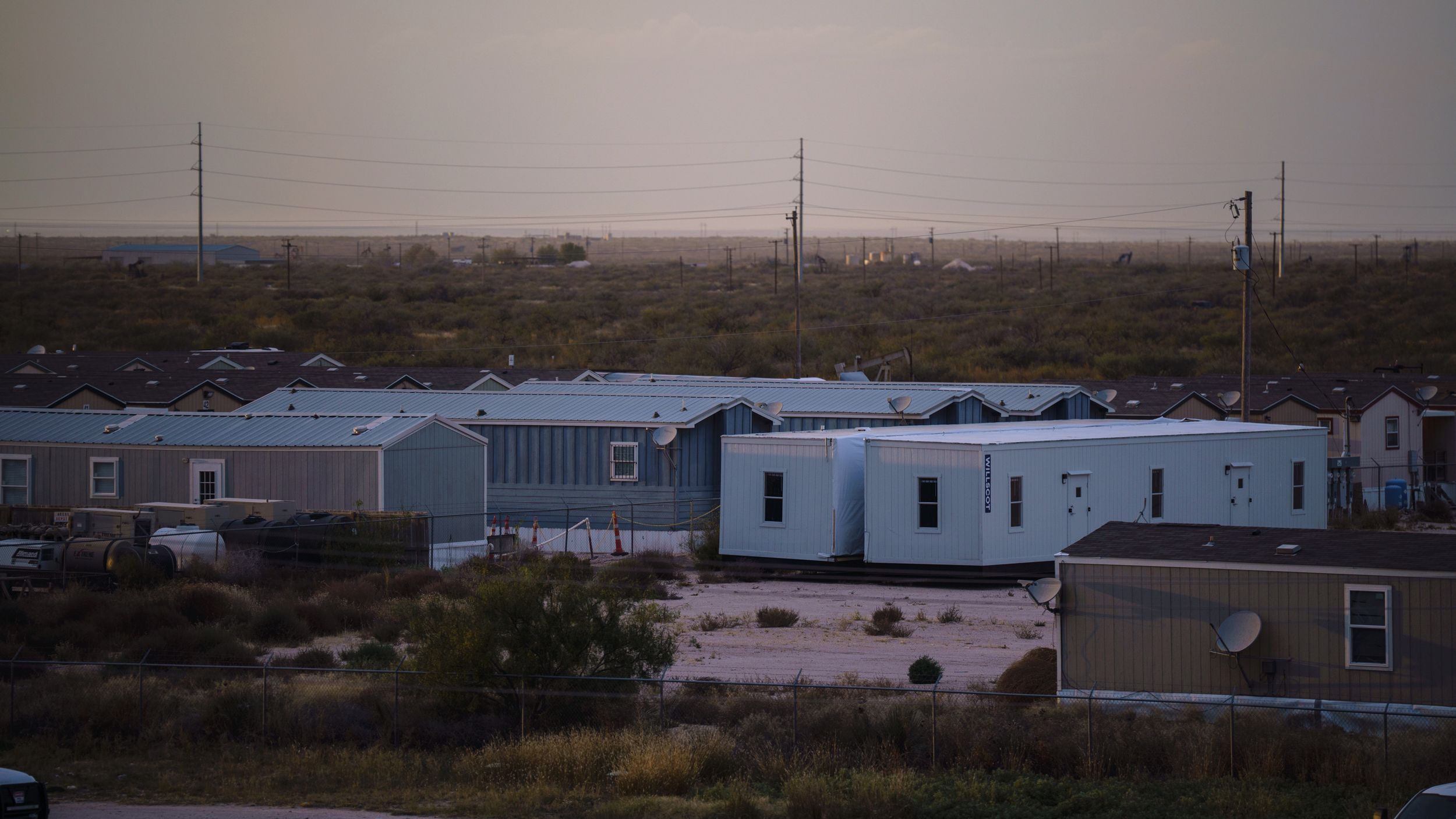
Pre-fabricated structures are seen in the desert near Monahans, Texas. Credit: Paul Ratje/Inside Climate News
“They have mineral rights. We have water rights,” Midland utilities director Carl Craigo explained in an interview. “We have to become a team.”
In 1994, Heritage Standard repurposed a 1970s oil well at T-Bar Ranch, called J.B. Tubb 1-A, as an injection well for the disposal of produced water. The wastewater is injected into underground cavities that are significantly deeper than groundwater reserves.
In 2003, Midland did a round of water sampling at the T-Bar wells. The results from Test Hole 6 were alarming. Chlorides and total dissolved solids, signatures of produced water, had shot up since the last round of tests in 2000. The city investigated the source of the sudden salinization.
The City of Midland wrote to the Railroad Commission in 2007 to file a complaint about the increased chlorides and total dissolved solids at a T-Bar test well.
Injection wells have several layers of casing to prevent the waste from leaking into aquifers. But testing on the well in 2007 determined that several holes had formed in the Tubb well’s casing sometime around 1999. By the time Heritage Standard shut down the injection well in 2006, environmental contractors later estimated, between 50 million and 63 million gallons of produced water had already potentially leaked into shallow underground formations. Other investigations considered the possibility that produced water dumped on the ground could have caused the contamination and estimated a much lower volume of wastewater released.
In May 2007, Midland lodged a formal complaint with the Railroad Commission, accusing Heritage Standard of polluting the groundwater. Kay Snyder, the city utility director, wrote in the complaint that the contaminated groundwater plume posed “a significant threat” to fresh groundwater at T-Bar Ranch.
“We have alerted them to the problem,” Snyder wrote to the regulators. “However, they have not seen the urgency of addressing the issue, nor do they admit to any responsibility in causing the contamination.”
The Railroad Commission approved a remediation plan that involved monitoring the plume, pumping contaminated water out of the aquifer and injecting it into a nearby disposal well. Heritage Standard’s insurance company assumed some of the costs.
The Railroad Commission did not issue fines to Heritage Standard for the pollution.
On September 8, 2010, the Railroad Commission requested Heritage Standard conduct a full investigation to delineate the groundwater pollution plume.
The company filed for bankruptcy in the Northern District of Texas less than one week later. According to legal filings, Heritage Standard had spent millions trying to re-open a plugged well to drill for gas in Winkler County. The filing said the failed drilling effort had left the company with $11.6 million in debt and no income from the well to pay it off.
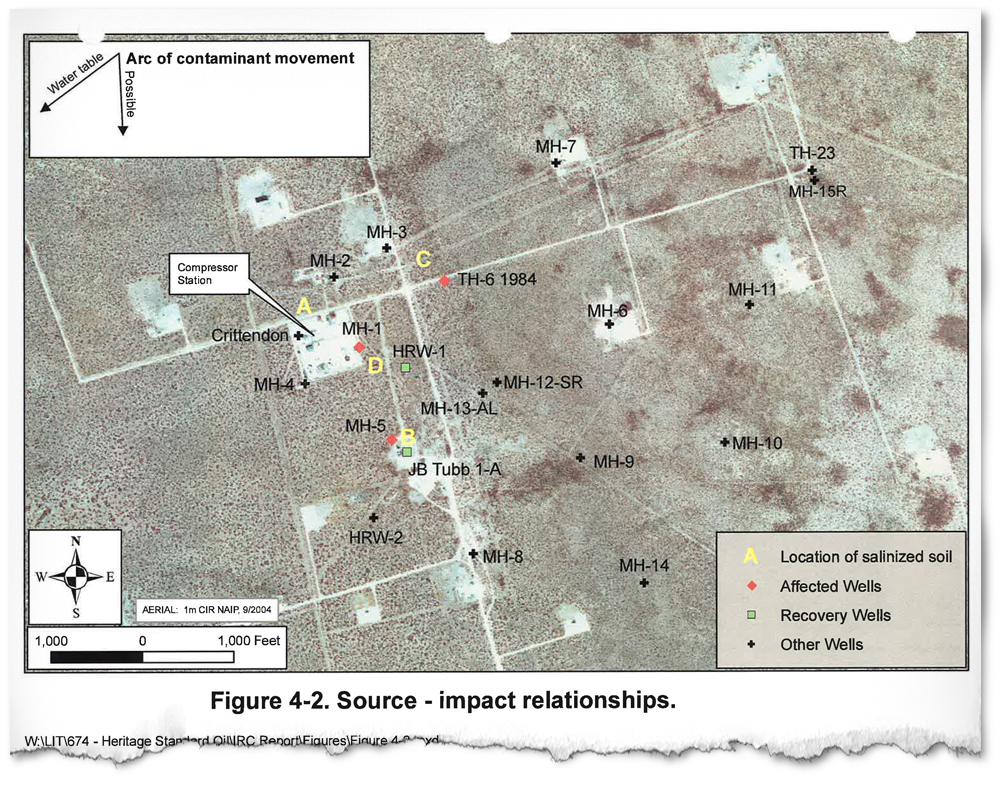
A map created by consultants early in the remediation process showed the location of polluted soil and groundwater at the T-Bar Ranch.
“Kicking the Can Down the Road”
The boom and bust cycle of the oil industry makes it particularly prone to bankruptcies. The law firm Haynes Boone found that between January 2015 and July 2020, 115 exploration and production companies in Texas filed for bankruptcy. That was the most of any state, with the 36 bankruptcies in corporate haven Delaware a distant second. These companies can leave behind unplugged wells, water and soil pollution and crumbling infrastructure.
Chapter 11 bankruptcy sets a structure for companies to prioritize creditors and shed burdensome assets. The process is described as a “waterfall” in which one class of creditors is paid before the funds flow down to the next class of creditors.
Inside Climate News consulted court filings and public records from the Railroad Commission to reconstruct the bankruptcy proceedings for Heritage Standard.
Dozens of creditors lined up to get paid back, including the company that was owed nearly $5 million for drilling the gas well.
Secured debt—backed up by collateral—takes priority in bankruptcy. In theory, when a company goes bankrupt it still must cover environmental liabilities. But environmental cleanup costs, an administrative debt, are a lower priority than secured debt.
Midland and the Railroad Commission made their case to the bankruptcy court for cleanup money to remediate the groundwater and plug Heritage Standard wells.
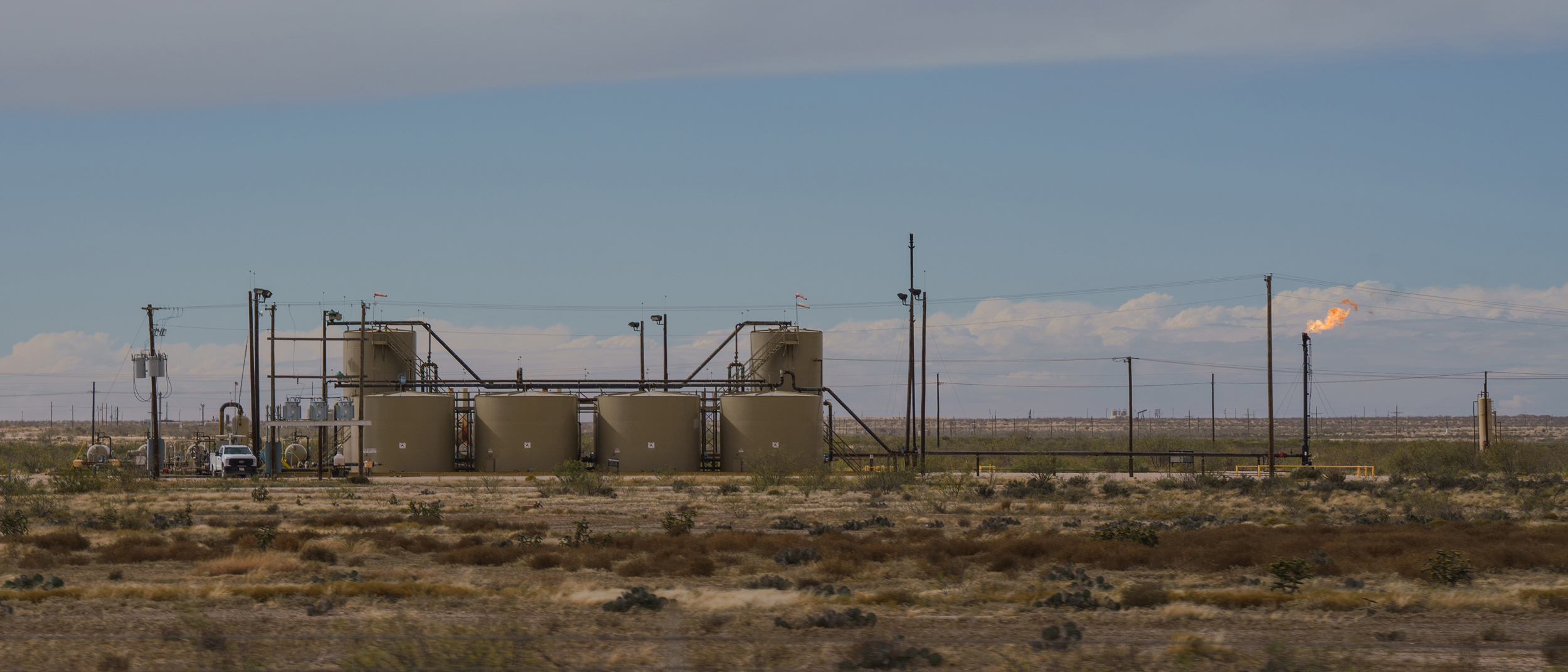
An oil and gas tank battery and flare are seen on the outskirts of Midland, Texas. Credit: Paul Ratje/Inside Climate News
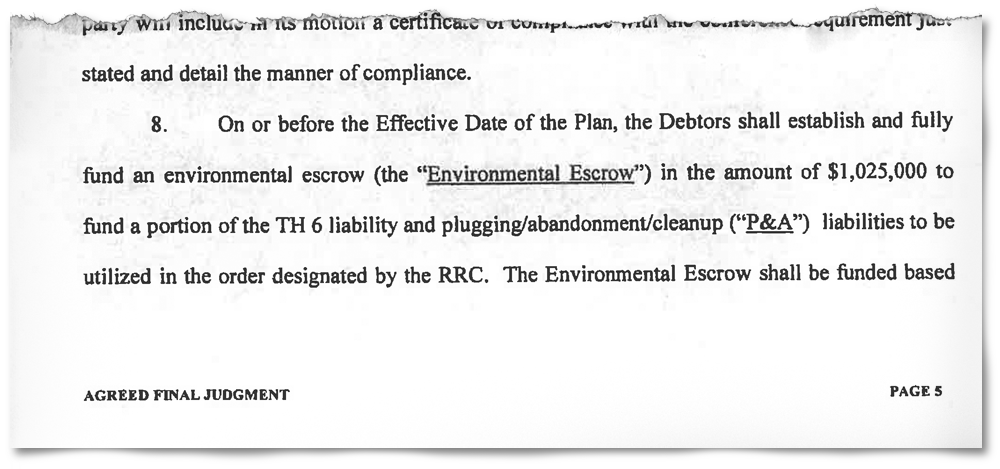
Midland, the Railroad Commission, Heritage Standard and its insurance company eventually reached a settlement. In August 2013, the bankruptcy court released its final decision. Heritage Standard would put $1.025 million in an environmental escrow to fund remediation and well plugging, far less than Midland’s claims of $6.5 million.
“The settlement significantly benefits the Estates by limiting and capping the exposure from the Environmental Claims, which could have all but eliminated recoveries for certain creditors in the case,” Judge Harlin D. Hale wrote at the time.
In other words, environmental costs were capped to ensure that Heritage would pay back creditors it owed. The final judgement stipulated that the Railroad Commission would cover remediation and well plugging costs if the environmental escrow ran out of money.
Kelli Norfleet, an attorney and chair of the restructuring group at Haynes Boone in Houston, told Inside Climate News that there often isn’t much money left by the time environmental costs are being considered during bankruptcy.
“If the money is gone, the money is gone,” said Norfleet, who was not involved with the Heritage Standard case. “So you have to look to other sources to try to cover those costs.”
East Texas lawyer Jason Searcy, who acted as trustee for the Heritage Standard case, died in 2019. Joe Marshall, the attorney representing Heritage Standard, could not be reached for comment. Judge Hale has retired and did not respond to questions.
Clark Williams-Derry, an energy finance analyst at the Institute for Energy Economics and Financial Analysis, said that the U.S. bankruptcy system prioritizes getting companies “back up and running” even if they do not have enough money to cover their operating costs and environmental liabilities.
“Oil and gas assets that really should be retired—because there’s no economic benefit to them at all—they will just keep going, keep chugging along,” Williams-Derry said. “Chapter 11 is a way of kicking the can down the road.”
“Bankruptcy becomes a bailout for oil and gas companies,” he said.
Midland Takes Over Cleanup
While the bankruptcy case progressed, a deep drought gripped West Texas. In spring 2011, Midland imposed water restrictions as reservoirs dipped dangerously low. By the end of that year, it had rained a mere five and a half inches and Midland needed water
Midland rushed to build a 60-mile water pipeline to the ranch. In May 2013, the pipeline came online and water began flowing. Midland drew from an uncontaminated part of the aquifer. But city officials worried that, if the contamination wasn’t cleaned up, it could reach their wells.
The Railroad Commission worked with Heritage Standard to implement the remediation plan. The full $1.025 million from the environmental escrow was spent on environmental assessment and well plugging, according to the Railroad Commission’s Dubee. The Railroad Commission spent an additional $462,000 from its cleanup fund, which comes from fees and penalties paid by industry, on the T-Bar remediation.
The agreed final judgement from Heritage Standard’s bankruptcy case required funds to be set aside for environmental cleanup.
Letters to the Railroad Commission from a firm hired by Heritage and its insurance company said the remediation effort had steadily decreased chloride levels and that the contamination was contained. The plume, which covered an area of up to 15 acres, did not contain hydrocarbons or heavy metals, according to the consultants.
They wrote that they expected the remaining plume of contaminated water to mix and blend with the non-contaminated water to the point that the plume would no longer be distinguishable. “On this basis, Heritage considers that the remnant Tubb plume poses no threat to the [City of Midland] water supply,” the consultants wrote.
During a May 13, 2015 meeting, representatives of Heritage, the Railroad Commission and Midland discussed leaving “the small residual chloride plume” and compensating Midland monetarily, according to a letter written a few days later by the consultants.
The Railroad Commission was open to this idea, according to emails obtained via record requests. Commission staff later wrote in an email that the RRC considered leaving the pollution in place, referred to as “control,” to be an “acceptable” outcome.
Midland officials later objected. “[Midland] is not convinced that the extent of the plume has been appropriately characterized or that remediation is complete,” a hydrologist working for the city wrote the Railroad Commission in July 2017.
In September 2018, city manager Courtney Sharp sent a letter to the commission expressing “great concern” that the contamination was “migrating towards the heart of the City’s water supply at the T-Bar wellfield.”
Midland petitioned to take over the remediation. The commission approved Midland’s new plan to install “interceptor wells” between the contamination and the city water wells.
Texas law describes the goal of groundwater policy as ensuring “the existing quality of groundwater not be degraded.” It says groundwater should be kept “reasonably free” of contaminants that would interfere with present or future uses. The state uses a risk-based approach to determine whether groundwater contamination should be cleaned up or left in place, known as “control.”
While Midland officials were still concerned that the contamination could impact their water supply, the Railroad Commission considered the “control” option an acceptable outcome. Midland then stepped in to ensure remediation continued—on its own dime.
Commission spokesperson Dubee said that the fact that Midland assumed responsibility for the cleanup was not an indication that regulations had been ineffective. He re-iterated the “control” option would have been an “acceptable regulatory endpoint.”
Current Remediation Plan
The pandemic delayed Midland’s implementation plan. In 2022, the city approved a contract for up to $3.5 million to begin; the full process could cost up to $9 million.
In March 2023, Midland utilities director Carl Craigo addressed the city council in a drab conference room, clicking through slides. Craigo explained that the city plans to sell water pumped out of the aquifer to oil companies to recoup remediation costs. Oil companies can drill with water that is too salty for municipal use.
During the meeting, Craigo described the Railroad Commission remediation efforts as “very small.”
“What they had the company doing just drained the settlement of money to a point where the city needed to take it on,” he explained.
“The Railroad Commission wasn’t our friend back then,” quipped one council member under his breath.
In an interview, Craigo said that the city took over the remediation to ensure its water supply would be protected.
“It was not enough to make a difference,” he said of the remediation overseen by the Railroad Commission. “It was really just enough to monitor it.”
Monitoring and delineation, in which the contours of the plume are mapped, are important components of groundwater remediation, the commission spokesperson told Inside Climate News.
Midland, with a population of 143,000, now relies on T-Bar for about a third of its water supply. Craigo said that communication with the other oil companies operating at T-Bar remains essential to protecting that water source.
“They luckily come through us and make sure what they’re doing coincides with what we’re doing,” he said.
The City of Midland denied requests to tour T-Bar Ranch. In late November, trucks barreled down the two-lane highway leading to the property, dodging gaping potholes. Oilfields stretch to the horizon in all directions. The ragged highway shoulder drops off precipitously into the desert sand.
Trucks speed through the dust along Frying Pan Ranch Road near the City of Midland’s T-Bar Ranch in Winkler County, Texas. Credit: Paul Ratje/Inside Climate News
From the highway, a battered metal sign reading “Heritage” points down a private road to the Midland wellfield. It’s the only indication of the contamination that threatened the city’s water supply and the perpetrators who were allowed to walk away.
In response to a detailed list of questions for this story, Midland communications officer Stewart Doreen said, “we have addressed this issue in the past and nothing further to add at this time.”
Leaving Behind Orphan Wells
Post-bankruptcy, Heritage Standard became a company in name only. It stopped filing state paperwork or reporting oil and gas production after 2013.
Dwayne Purvis, of Purvis Energy Advisors in Fort Worth, said it is common for small oil companies to stop operating without filing for bankruptcy. “If there’s no means of paying creditors, or if they don’t have very many creditors, they will just fold and disappear and never go through bankruptcy court,” he said.
This story is funded by readers like you.
Our nonprofit newsroom provides award-winning climate coverage free of charge and advertising. We rely on donations from readers like you to keep going. Please donate now to support our work.
That appears to be what happened to Heritage Standard. But the company still had one parting gift for the state of Texas.
The state requires wells to be plugged after they stop producing oil or gas. During the bankruptcy, the Railroad Commission had identified 16 wells that Heritage Standard would continue to operate but was unlikely to plug and set aside funds in the firm’s environmental escrow for plugging.
Nine wells were plugged between 2014 and 2017, commission records show; another became a monitoring well. That left six unplugged wells in Heritage Standard’s name.
The Railroad Commission considers a well orphaned once it has not been producing oil or gas for at least 12 months and the operator’s organizational report has been delinquent for longer.
Commission inspectors repeatedly visited the unplugged wells. The commission issued violations and ordered the company to bring the wells into compliance.
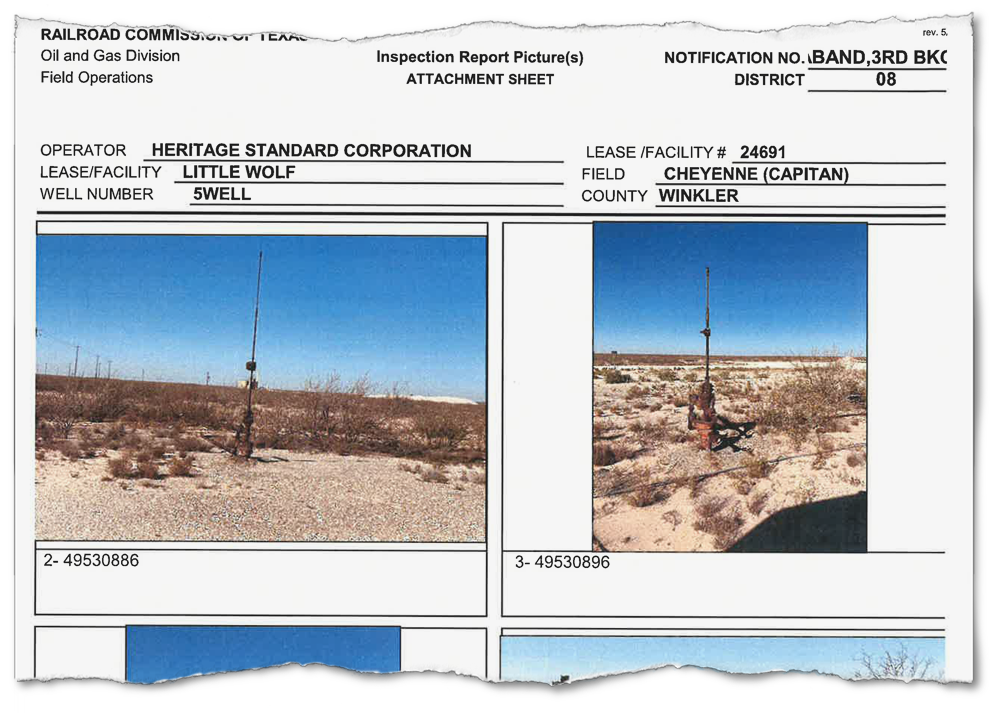
Inspection documents from the Railroad Commission show the orphan wells that Heritage Standard left behind in Winkler County.
The six wells were finally added to the Railroad Commission’s list of orphan wells and classified as priority level 3, with 1 being the highest and 4 the lowest.
Midland’s Craigo said the city monitors wells that may need to be plugged at T-Bar. Geolocation data indicates Heritage Standard’s six orphan wells are on city property, but the City of Midland declined to answer questions about the wells.
Statewide, the backlog of orphan wells is the highest since 2006. The commission warns that orphan wells can be a conduit for groundwater contamination.
“Projecting Problems”
The Railroad Commission recently secured more funding from the state legislature to plug orphan wells. But the extent of groundwater contamination has received little attention. Cases like Heritage Standard are buried deep in state records or decade-old court filings.
Still, Commissioner Wayne Christian, a Republican from East Texas, dismissed the problem at an April 2025 monthly meeting of the three elected commission leaders.
He and his fellow commissioners had sat silently as members of the public approached the lectern. Commission Shift’s Julie Range briefly mentioned polluted aquifers during her comments about the agency’s annual monitoring and enforcement plan.
Christian cut in.
“In Texas, where have we polluted underground drinking water for a municipality where it’s irreparable?” he asked Range.
“Midland,” she said.
Frowning, Christian asked for more examples. He scoffed at the idea that “one well” was a problem if the city could drill others. “Where I see a problem is us projecting problems when they don’t exist,” he sniped. “To the public, it does a disservice to represent an overage of problems.”
Christian did not respond to questions for this story.
Christian’s comments focused on existing municipal water supplies. But Texas law also requires the future use of water to be protected. Polluting groundwater today limits supplies for tomorrow.
As rivers and reservoirs dry up and climate change increases water stress, Texas will increasingly rely on aquifers. Groundwater is especially important for Texas during droughts, like the one that sparked panic in 2011.
Texas has ample reserves of oil and gas. Economists project the Permian Basin will remain the country’s most productive oilfield for decades.
But projections for water in the arid region are less rosy. Fracking wells have increased nationwide water use by seven times since 2011 because of new drilling techniques called “monster fracks.” The region’s water planning district projects that, if additional water sources aren’t developed, Midland could face water shortages as soon as 2050. For other cities in the Permian Basin, that day could come as soon as 2030.
While Texas has reached new heights in oil and gas production, good water is getting harder to find.
About This Story
Perhaps you noticed: This story, like all the news we publish, is free to read. That’s because Inside Climate News is a 501c3 nonprofit organization. We do not charge a subscription fee, lock our news behind a paywall, or clutter our website with ads. We make our news on climate and the environment freely available to you and anyone who wants it.
That’s not all. We also share our news for free with scores of other media organizations around the country. Many of them can’t afford to do environmental journalism of their own. We’ve built bureaus from coast to coast to report local stories, collaborate with local newsrooms and co-publish articles so that this vital work is shared as widely as possible.
Two of us launched ICN in 2007. Six years later we earned a Pulitzer Prize for National Reporting, and now we run the oldest and largest dedicated climate newsroom in the nation. We tell the story in all its complexity. We hold polluters accountable. We expose environmental injustice. We debunk misinformation. We scrutinize solutions and inspire action.
Donations from readers like you fund every aspect of what we do. If you don’t already, will you support our ongoing work, our reporting on the biggest crisis facing our planet, and help us reach even more readers in more places?
Please take a moment to make a tax-deductible donation. Every one of them makes a difference.
Martha Pskowski covers climate change and the environment in Texas from her base in El Paso. She was previously an environmental reporter at the El Paso Times. She began her career as a freelance journalist in Mexico, reporting for outlets including The Guardian and Yale E360. Martha has a B.A. in Environmental Studies from Hampshire College and a master’s degree in Journalism and Latin American Studies from New York University. She is a former Fulbright research fellow in Mexico. Martha can be reached on Signal at psskow.33.
Great Job By Martha Pskowski & the Team @ Inside Climate News Source link for sharing this story.
Blaupunkt has launched the BH71 Moksha Hybrid ANC Headphones in India, setting a new standard in premium personal audio. The headphones feature India’s first 360° spatial audio with gyro head tracking, along with Moksha Hybrid True ANC and ultra-low latency performance. Designed for Indian consumers, the BH71 focuses on delivering advanced technology, immersive sound, and long-lasting comfort.
Noise cancellation on the Blaupunkt BH71 is powered by Moksha Hybrid True ANC, supported by a quad AI microphone array that continuously captures surrounding noise. Using intelligent real-time processing, the system reduces unwanted sounds to deliver a clearer and more immersive listening experience across varied environments such as busy streets, offices, and flights.
At the core of the headphones is a high-performance RTL audio chipset that enables spatial audio processing, gyro-based head tracking, and effective ANC. This ensures stable and consistent performance regardless of the listening scenario, helping maintain audio clarity and immersion even in challenging surroundings.
The BH71 is also optimised for gaming and content consumption, offering ultra-low latency of under 28ms. This feature helps maintain precise audio-visual synchronisation during fast-paced gameplay and video playback, making the headphones suitable for gamers and multimedia users alike.
Designed for comfort and portability, the headphones feature memory soft protein ear pads, a padded headband, durable metal structural elements, and a foldable design for extended use. The Blaupunkt BH71 Moksha Hybrid ANC Headphones will be available in India via Amazon, Flipkart, and the Blaupunkt India website at Rs 4,999.
“India is a key market for Blaupunkt,” said Sukhesh Madaan, CEO of Blaupunkt Audio India. “With the BH71 Moksha Hybrid ANC, we are bringing globally advanced audio technologies to Indian consumers who are ready for the next evolution in sound.”