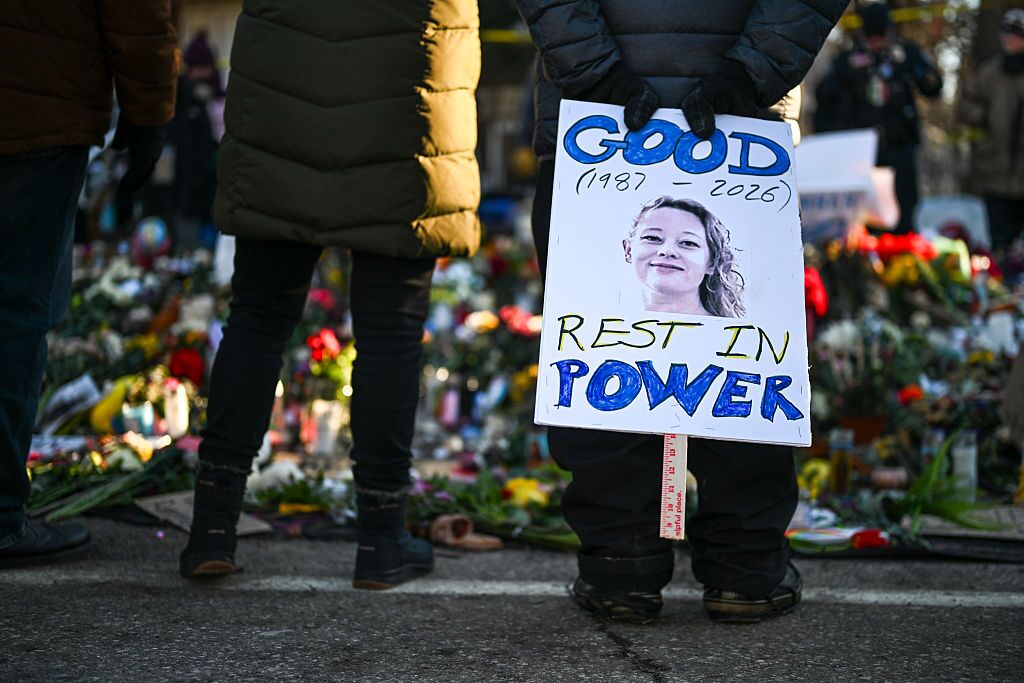
NICK FUENTES (HOST): Our featured story, we’re talking all about Renee Good, the 37-year-old activist who was shot and killed by ICE last week, tragically.
…
I have to tell you, it is really striking that there was apparently a divide about this on the far right. And it seems that the more race-conscious, immigration-restrictionist, far-right people knew that this is not a tragedy, this is probably a good thing. And then it seems that the Israel critical, Jewish critical elements on the far right, for whatever reason, said this is a horrible tragedy and they’re coming out against ICE. And I saw some ridiculous cope about this. I saw some people say that ICE is trained by the Israeli Defense Forces, so this is Trump siccing the IDF on white people, on white women. Wow, that’s a stretch. That’s a new one. And I’m really shocked by that, but it’s a little bit alarming.
…
Nobody on our side should be mourning this person. Once you know who she is and what she’s about and everything, and yes, actually all of that matters. I see a lot of people hand-waving that away and saying, “It doesn’t matter what side she’s on. She’s a human being.” Don’t get me wrong, I wish we lived in a world where nobody was dying and nobody had to die and we weren’t engaged in this conflict. But the fact of the matter is, as we all know, we are.
We do live in a world where we are engaged in a political struggle. We are engaged in a war actually, and the stakes could not be higher. This is about our civilization. This is about our ancestors, about our posterity. Their future is at stake, whether white people exist as a race. And everything that that entails, Christendom, Western civilization, all of it, it’s all at stake. And of course we have people in the country that are fighting to prevent this from happening, fighting to prevent us from preserving these things all the time.
And so, it absolutely matters what side of this issue you’re on. We’re being invaded. The people come here. They take advantage. They loot and pillage. They get caught red-handed, in this case in Minneapolis, this Somalian enclave, they get caught with their hand in the cookie jar, stealing perhaps billions of dollars of federal assistance and other money. And some people, it’s their first instinct to jump in and defend those people literally at the peril of their own life. I say, if that’s a game you want to play, good riddance.
Great Job Media Matters for America & the Team @ Media Matters for America Source link for sharing this story.
For many patients today, a decision about which weight loss medication to try may come down to several factors, including what other medications they take, which drugs are covered by insurance or are most affordable, and whether people prefer pills or injected medicines, Dr. Jay says.
“I advise people to speak to their physician to choose an initial medication and see how they respond,” Jay says. “It’s not uncommon to switch medications or have to add a second or third medication.”
This weekly injected medicine was approved by the FDA in 2023 to treat adults with obesity and overweight adults with at least one weight-related chronic health problem.
How it works: Tirzepatide mimics two hormones that regulate insulin secretion and digestion: glucagon-like peptide 1 (GLP-1) and glucose-dependent insulinotropic polypeptide (GIP). It is widely believed to be the most potent weight loss drug ever approved for sale: In the SURMOUNT-1 trial, participants using the highest dose lost an average of 22.5 percent of their body weight.
Common side effects: Nausea, diarrhea, vomiting, and constipation.
Interactions and risks: Rare but potentially dangerous reactions include severe gastrointestinal disease and acute injury to the pancreas, kidneys, or gallbladder.
Semaglutide (Wegovy)
Wegovy was approved by the FDA to treat adults with obesity as well as adults who are overweight and also have at least one weight-related chronic health problem. The weekly injected form of the medicine was approved in 2021, and the once-daily oral version was approved in 2025.
How it works: It’s another GLP-1 receptor agonist that mimics a hormone in the brain that regulates appetite.
Common side effects: Nausea, diarrhea, vomiting, constipation, stomach pain, headache, and fatigue.
Interactions and risks: It can’t be used in combination with liraglutide or other GLP-1 receptor agonists that are prescribed for type 2 diabetes. Like other drugs in this family of medicines, including tirzepatide and liraglutide, it carries an increased risk of pancreatitis and has been linked to thyroid tumors in animals.
Naltrexone-Bupropion (Contrave)
This oral drug was approved by the FDA in 2014.
How it works: It’s a combination of two drugs that are used to treat addiction and depression, and it suppresses appetite and makes people feel full sooner.
Common side effects: Constipation, dizziness, diarrhea, dry mouth, headache, increased blood pressure, elevated heart rate, insomnia, liver damage, nausea, and vomiting.
Interactions and risks: It shouldn’t be used by people with uncontrolled blood pressure, seizures, a history of anorexia or bulimia, people taking psychiatric drugs containing bupropion (Wellbutrin, Zyban), or individuals dependent on opioids or in withdrawal from drugs or alcohol. It can increase suicidal thoughts or actions.
Liraglutide (Saxenda)
This daily injected drug was approved by the FDA in 2014 for adults and in 2020 for children ages 12 and older with obesity.
How it works: It’s in a family of medicines known as glucagon-like peptide-1 (GLP-1) receptor agonists, which work by mimicking a hormone in the brain that regulates appetite and food consumption.
Common side effects: Nausea, diarrhea, constipation, abdominal pain, headache, and increased heart rate. Rare side effects include an increased risk of pancreatitis, and it’s been linked to thyroid tumors in animals.
Interactions and risks: In a smaller dose, liraglutide is used as a diabetes medication called Victoza, which should not be used in conjunction with Saxenda.
Phentermine-Topiramate (Qsymia)
This pill was approved by the FDA in 2012 for adults who are overweight or obese, and in 2022 for patients ages 12 and older with obesity.
How it works: This combination pill suppresses appetite and makes people feel full sooner.
Common side effects: Constipation, dizziness, dry mouth, tingling in hands and feet, brain fog or cognitive impairment, and difficulty sleeping.
Interactions and risks: It shouldn’t be used by people with glaucoma or hyperthyroidism, by women who are pregnant or breastfeeding, or by some individuals with a history of heart attack, stroke, heart rhythm disorders, kidney disease, or mood problems.
Orlistat (Xenical, Alli)
This pill was approved by the FDA in 1999 as a prescription weight loss drug (Xenical) and in 2007 at a lower dose for nonprescription use (Alli).
How it works: It works in the gut to limit the amount of fat absorbed from foods you eat.
Common side effects: Diarrhea, gas, stomach pain, and oily stool leakage.
Interactions and risks: It’s linked to rare cases of severe liver injury; dangerous interactions with cyclosporine, a drug to prevent organ transplant rejections; and the potential for malnutrition if patients don’t take a multivitamin. Orlistat has been shown to decrease the absorption of fat-soluble vitamins as well as some prescription medications, including Amiodarone (used to treat irregular heartbeats)and ciclosporin (used to treat inflammatory diseases like rheumatoid arthritis). Orlistat may also affect the dosage of warfarin, an anticoagulant.
Great Job Lisa Rapaport & the Team @ google-discover Source link for sharing this story.
Elon Musk’s X is experiencing its second large-scale outage this week.
The site and app, formerly known as Twitter, are either not loading at all or glitching into life briefly before throwing up error messages like gang signs.
The site Down Detector shows nearly 80,000 reports of X being down starting at around 10am eastern time, and is still down at the time of this writing.
This is the second major outage at X this week, following an earlier technical issue. It comes as the platform faces criticism after Grok, xAI’s chatbot that is integrated into X, has been fulfilling user requests to manipulate real photos of women, and even children, into nonconsensual sexual and violent imagery.
The recalled fridges have electrical components that can short circuit and ignite the plastic used to make the product — risking fires and potential burns for users. The company has received six reports of fires resulting in property damage linked to these products, according to the CPSC.
The 330,000 Frigidaire minifridges now under recall carry the model number EFMIS121 and were sold exclusively at Target, both in-stores and online, for about $30. Curtis International says the recalled fridges were made between January 2020 and December 2023.
The 634,000 minifridges recalled last year had model numbers EFMIS129, EFMIS137, EFMIS149 and EFMIS175 and were sold by retailers like Walmart and Amazon for between $36 and $40, per the CPSC. Another 26 incidents that included the products overheating, melting or catching fire were reported at the time, as well as two related smoke inhalation injuries.
Owners of the recalled minifridges are urged to stop using them immediately and visit Curtis International’s website to learn how to request a refund. Eligible consumers will need cut their product’s power cord, write “recall” in permanent marker on the fridge’s front door and send photos to the company.
Curtis International has licenses to make and distribute a range of consumer electronics and appliances — including some Frigidaire products. But the larger Frigidaire brand is owned by the Electrolux Group, a Swedish company.
Great Job NBC Staff and AP & the Team @ NBC 5 Dallas-Fort Worth for sharing this story.
A program in New York City is helping train people for jobs in energy efficiency – and changing their lives.
Smith: “It gives people hope. And it gives people opportunity that they might not feel like they had.”
Munir Smith graduated from the nonprofit Stacks and Joules’ building automation training program. It’s run in partnership with Henry Street Settlement, a social service agency on Manhattan’s Lower East Side.
Trainees learn how to install and operate technology that automates a building’s lights and HVAC equipment, which can save a lot of energy.
Michael Conway, cofounder of Stacks and Joules, says the program goes beyond teaching skills. It also provides comprehensive support to students, some of whom struggle with poverty or homelessness.
Conway: “If housing comes up, there’s access to support there. If there’s food or nutritional requirements, if there’s transportation, if they need eyeglasses, if they need, you know, clothes that are appropriate for interviews.”
So by helping trainees overcome barriers, the program provides a path to well-paying careers in energy efficiency.
Smith: “And so, you know, I’m always looking at my classmates achieve great things. … So it’s a proud fraternity to be in.”
Reporting credit: Sarah Kennedy / ChavoBart Digital Media
Great Job YCC Team & the Team @ Yale Climate Connections Source link for sharing this story.
In every issue of Ms., we track research on our progress in the fight for equality, catalogue can’t-miss quotes from feminist voices and keep tabs on the feminist movement’s many milestones. We’re Keeping Score online, too—in this biweekly roundup.
Lest We Forget
“We had whistles. They had guns.”
—Becca Good, wife of Renee Good, who was shot and killed by ICE agent Jonathan Ross in Minneapolis. Renee was an American mother of three, whose murder sparked protests against ICE in Minneapolis and cities across the country.
A vigil on Jan. 14, 2026, at a memorial near the site where Renee Good was killed in Minneapolis. Good was fatally shot by an immigration enforcement agent during an incident in south Minneapolis on Jan. 7. (Stephen Maturen / Getty Images)
“If you have ever received healthcare in America, you have been cared for by a nurse. A federal proposal under review excludes graduate nursing education from consideration as a professional degree and therefore excludes nurses from some federal graduate student loan programs. Over time, this could impact both patient safety and access to healthcare services. A strong nursing workforce is critical to high-quality patient care.”
—Virginia Nurses Association president Dr. Kathy Baker, PhD, RN, NE-BC, FAAN. The Trump administration plans to remove graduate-level nursing programs from their list of “professional degrees,” which will greatly restrict the amount of federal student loan support available.
“In one night, the Sandy Creek flood wiped out everything my family had built over 36 years—three homes, our business, and our sense of safety. We lost neighbors, were stranded for days without help, and watched as FEMA response was delayed while families were left to survive on their own.
“More than five months later, many are still homeless, and only 36 percent of FEMA claims in our area have been approved. Disasters don’t care about politics, and emergency response shouldn’t either. FEMA must be independent, fully funded and strengthened—because when it fails to function, real families pay the price.”
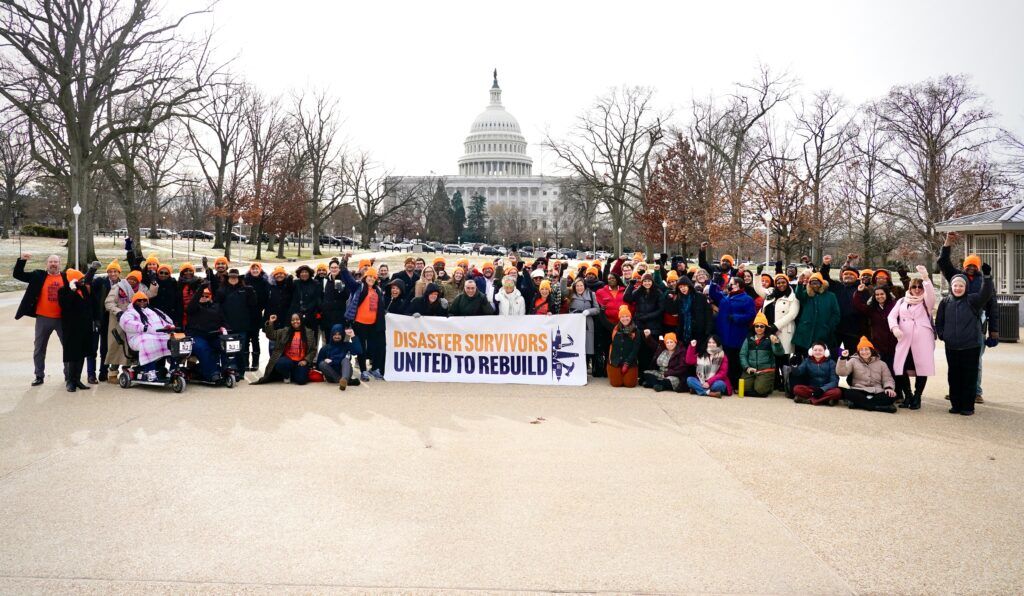
— Brandy Gerstner, survivor of the Sandy Creek flooding in Texas. More than 80 disaster survivors shared their stories at the U.S. Capitol and warned of systemic failures under Homeland Security Secretary Kristi Noem.
Disaster survivors in front of the U.S. Capitol.
“To my brown sisters and little brown girls watching tonight: Our softness is not a liability. Our depth is not too much. Our light does not need permission to shine. We belong in every room we walk into. Our voices matter, and our dreams deserve space.”
—Actor, singer and songwriter Teyana Taylor at the Golden Globessent a powerful message after winning the award for Best Supporting Female Actor in a Motion Picture.
“Over the past several weeks, Republican members of Congress and local elected officials across the country have actively spread vile, anti-Muslim and xenophobic rhetoric that puts millions of innocent people at risk. Some have called for the ‘expulsion of Muslims from western nations;’ the ‘revocation of citizenship’ of Muslim Americans; and gone so far as to say that Islam is ‘incompatible with our culture and our governing system.’ These statements are deplorable, dangerous, and disqualifying for any elected official.
“Calls to target Muslims through deportation or denaturalization are as hateful as they are un-American. Normalizing Islamophobic behavior and rhetoric gives license to the racist fearmongering that has long endangered Muslim American and South Asian communities.”
—The Congressional Asian Pacific American Caucus (CAPAC) warned about the normalization of anti-Muslim hate, amid a 238 percent increasein anti-Muslim and anti-South Asian slurs leading up to New York Mayor Mamdani’s election.
“Make no mistake, this new wave of ICE agents descending on American cities is a purposeful campaign of fear and intimidation by the administration meant to distract from Trump’s cruel policies that have tanked the economy and are impacting everyday Americans who can no longer afford basic needs like healthcare, rent, utilities, medicines and groceries.
“Violence like this does not exist in isolation—it undermines public safety and strikes at the very foundation of our democracy. It’s atrocious, it’s dangerous, and it’s un-American.”
+ Minneapolis woman Renee Good was killedby on-duty ICE agent Jonathan Ross while in her car observing ICE activity. A viral video shows Ross firing three times through the driver’s side window as Good attempted to turn away, and a male voice calling her “fucking bitch.” ICE refused to allow an onlooking doctor to provide first aid, delaying six minutes until EMS arrived.
This morning, an ICE agent murdered a woman in Minneapolis—only the latest horror in a year full of cruelty.
As ICE attacks our neighbors across America, it is an attack on us all. New York stands with immigrants today, and every day that follows.
+ Many members of the Trump administration immediately blamed Good, lied about her actions before the shooting and downplayed the horrific killing by claiming she was “disrespectful” and even a “domestic terrorist.”
Kristi Noem is a stone-cold liar who has zero credibility.
There is nothing to suggest the shooting of an unarmed woman in Minneapolis was justified.
This heinous killing must be criminally investigated to the full extent of the law.
+ Antiabortion lawyer March Bell was confirmed by the Senate as inspector general for the Department of Health and Human Services. “March Bell is an antiabortion zealot whose record of extreme partisanship and ethical misconduct should have immediately disqualified him for this watchdog position. We are deeply concerned that he will use his new role to harass reproductive health care providers with endless audits and investigations and seek to block funding for this vital care,” warns Katie O’Connor, senior director of federal abortion policy at NWLC Action Fund.
+ A federal court temporarily blocked Trump’s attacks on DEI by deciding Head Start childcare programscan continue to use words like “women” and “race” on grant applications.
+ Jan. 6 was the five-year anniversary of the insurrection. Last year, President Trump granted clemency to nearly 1,600 insurrectionists. At least 33 peopleinvolved on Jan. 6 have been rearrested since 2021, with six charged with child sex crimes, two with rape and five with illegal possession of weapons.
+ The Department of Veterans Affairs (VA) will now block abortion care at all VA health facilities, with no exceptions for rape or serious health risks. They will also prohibit providers from offering abortion counseling or referrals.
+ A group of faith leaders and civil liberties organizations are challenging the Trump administration’s policy allowing immigration raids at houses of worship. In February, a federal court upheld 30 years of protections and barred immigration enforcement at or near those sensitive areas, but the government has appealed.
+ Tennessee state employee Monica Meeks was fired for criticizing Charlie Kirk on her personal Facebook account. Now, she’s suing for reinstatement and damages due to the illegal firing.
+ South Carolinians are working to stop their governor from deploying National Guard troopsto police Washington, D.C. They argue it violates state law and is a politically-motivated misuse of power.
+ An appeals court allowed the Trump administration to continue “defunding” Planned Parenthoodby stripping their Medicaid funding in 22 states and D.C. This policy puts the health of over a million patients at stake, and has already led to the closure of 20 health centers in the past few months. Recent polls show 65 percent of the publicoppose banning Medicaid funding for those clinics.
+ New York Gov. Hochul and NYC Mayor Mamdani announced a plan to expand free childcare for 2-year-olds in New York City, and make childcare more affordable for all children under age five.
The Congressional Black Caucus emphasized: “For Republicans, cruelty is always the point. Donald Trump is wielding a politically vindictive agenda against blue states across the nation while sacrificing the well-being of women and children in his path of destruction. Not only are these assistance programs intended to make childcare more affordable for families struggling to make ends meet, but they also provide critical stability to the childcare economy. This loss of funding threatens the foundation of a job sector that operates on slim margins and is supported largely by women of color—specifically Black women.”
+ The Wyoming Supreme Court overturned two antiabortion laws, deciding that they violate a 2012 voter referendum stating “each competent adult shall have the right to make his or her own healthcare decisions.”
+ Almost a quarter of American adults provided care last year to someone with a medical condition or disability. The demand for at-home caregiverswill continue to rise, but recent Medicaid cuts could threaten programs supporting at-home hospice and end-of-life care. Organizations like Wake and Compassion & Choices are teaching families how to care for their loved ones and act as death doulas.
+ The House of Representatives passed two bills criminalizing gender-affirming carefor trans youth and banning their Medicaid coverage. If enacted, the laws would threaten medical providers with up to ten years in prison. Conversely, the bills actually endorse non-consensual surgery on intersex infants and children.
+ After two National Guard members were shot in D.C., the Trump administration immediately increased restrictions on Afghan refugeesand froze the asylum process. ICE began specifically targeting 1,800 Afghans with past deportation orders.
+ The State Department has refused to provide information about their plansto destroy a $10 million contraception stockpile meant to go to low-income countries in sub-Saharan Africa. The pills, implants and IUDs have been abandoned in Belgium since the Trump administration slashed USAID, which could lead to hundreds of thousands of unplanned pregnancies.
+ On Jan. 12, roughly 15,000 nurses went on strike at New York City hospitals. The nursing strike, now the largest in the city’s history, comes with demands for increased salaries and new contract provisions on AI and workplace violence.
+ Just minutes before he was set to be expelled from the Nebraska legislature on Jan. 13, now former Republican state Sen. Dan McKeon resigned following allegations that he inappropriately touched a legislative staffer. His expulsion—which is said to have had the 33 necessary votes needed to remove him—would have been the first expulsion of a lawmaker in Nebraska’s history, according to the National Women’s Defense League.
+ Claudette Colvin, a legend of the Civil Rights Movement, died on Jan. 13 at 86. At just 15 years old, Colvin was arrested for refusing to give up her seat on the bus to a white woman in Montgomery, Ala., inspiring the actions Rosa Parks 9 months later and eventually the Montgomery bus boycott beginning in 1955. Colvin went on to become a plaintiff in the U.S. Supreme Court case Browder v. Gayle, which lead to the desegregation of Montgomery’s busses.
How We’re Doing
+ Since October, Meta has restricted or removedthe Facebook, Instagram or WhatsApp accounts of more than 50 reproductive health organizations and queer groups. Repro Uncensored reported more than 200 similar incidents this year worldwide, compared to 81 last year. Many accounts have been reinstated, but the increase in 2025 is concerning.
+ Worldwide, women work more hours than men and earn just a third of what men are paidper hour, when unpaid domestic labor is taken into account. When domestic work is not included, women earn just 61 percent of what men make. The largest gender gaps in hours worked is over 12 hours a week, while Europe, North America and Oceania see a gap of six to seven hours per week. But in all regions, women are employed less and earn less than men.
+ Sixty percent of Americans are buying cheaper or less groceries, and 28 percent have skipped meals to save money. Black and Latino adults are most affected, with almost 40 percent skipping meals.
Almost a quarter of American adults have been forced to get a second job or side work to make ends meet. Sixty-four percent of Black Americans and 55 percent of Latinos have more than $5,000 in non-mortgage debt, with almost half of Black adults carrying more than $10,000 in debt.
+ Politics along with healthcare and housing costs are fueling a mental health crisis in the U.S. Non-white adults are more likely than white adults to say their mental health is poor or only fair. Overall, 68 percent of Americans say the country is on the wrong track, and 80 percent believe the next generation will have it harder.
An abortion-rights rally outside the Supreme Court during oral arguments in the case of the U.S. Food and Drug Administration v. Alliance for Hippocratic Medicine on March 26, 2024. The case challenges the 20-plus-year legal authorization by the FDA of mifepristone, a commonly used abortion medication. (Anna Moneymaker / Getty Images)
+ Just half of Americans have heard of mifepristone, and less than a quarter are aware it is used for most abortions in the U.S. About 40 percent say abortion pills are safe, but the same amount are unsure. This is a decrease since 2023, when 55 percent said they were safe and 35 percent unsure.
Over two-thirds of adults, including half of Republicans, oppose banning mifepristone nationwide or making mailing abortion pills a crime.
+ More than 91 percent of the top streaming shows in 2024were created by a white person, with white men making up 79 percent of show creators. White actors were overrepresented, cast in 80 percent of all roles. This marks a troubling decrease in diversity from previous years.
Great Job Katie Fleischer & the Team @ Ms. Magazine Source link for sharing this story.
(WBAP/KLIF) — A planned Muslim community slated for North Texas hits another snag.
The former East Plano Islamic Center (EPIC), now re-branded as “The Meadow”, has failed to achieve preliminary approval from Collin county development services.
Collin county Judge Chris Hill issued a release, Thursday, explaining that the group behind “The Meadow” failed to provide necessary documentation to initiate the review process.
Collin county cited the lack of documentation assuring that electric and wastewater services will be provided for the community by utility companies.
Hill says once the required documentation is provided, the approval process can move forward.
(Copyright 2026 WBAP/KLIF Newsroom News. All rights reserved.)
Great Job & the Team @ News Talk WBAP-AM for sharing this story.
Thank you for your interest in supporting KFF Health News, the nation’s leading nonprofit newsroom focused on health and health policy. We distribute our journalism for free and without advertising through media partners of all sizes and in communities large and small. We appreciate all forms of engagement from our readers and listeners, and welcome your support.
KHN is an editorially independent program of KFF (Kaiser Family Foundation). You can support KHN by making a contribution to KFF, a non-profit charitable organization that is not associated with Kaiser Permanente.
Click the button below to go to KFF’s donation page which will provide more information and FAQs. Thank you!
Great Job Aneri Pattani & the Team @ Public Health Archives – KFF Health News Source link for sharing this story.
It’s worth noting that some of what you’re going to read here won’t be found in other reviews because the 8K 30 fps video capabilities were not added until near the end of 2025, when DJI delivered a firmware update which enabled 8K video. So if you see those initial, rushed reviews going for that Google juice, saying that the Action 5 tops out at 4K—well, they’re wrong now.
The new sensor is a 1/1.1-inch chip and it’s square, which means you can shoot once and crop to various formats, including the evil that is vertical video. One caveat there is that shooting in custom mode for the largest possible use of the sensor and then cropping to 16:9 does not produce as good of footage as shooting in 16:9 mode. I can’t figure out why this would be, but I’ve done multiple tests, and it is. Possibly the same is true for vertical video, but no one cares because all vertical video is crap.
The other, better benefit of the larger sensor is that the stabilization feature doesn’t crop as much so you get a wider field of view with stabilization enabled than you do with the Action 5. This is also true of horizon leveling, which can now be set to either 45 degrees in either direction, or 360 degrees.
Variable Aperture
Probably the most exciting feature in the Action 6 though is not the new sensor, but the variable aperture lens. Yes, DJI put teeny tiny aperture blades in there to allow the lens to shoot at f/2 to f/4. The idea is to improve the low light capability of the camera without sacrificing too much depth of field. So you can use the f/2 to shoot while surfing at sunset and then stop down to f/4 when vlogging back at the hotel, or something like that.
Low light performance is better, as you would expect with a wider aperture lens. The video is cleaner and sharper than either the Action 5 Pro or the Ace Pro 2. And that’s true whether you use SuperNight mode or not. You can really see this shooting D-Log—the ungraded footage is much brighter and sharper. I would say it’s a full stop brighter.
Alas, there is a good bit of noise still and the codec does show its limitations at times. The only way I know around this is to increase the bitrate, which unfortunately isn’t possible in the Action 6 (the only camera I’m aware of that lets you shoot in high bitrates is the GoPro and that requires using the GoPro Labs software). Overall though, for most people, the Osmo Action 6 is going to give you the best low light performance of any action camera currently on the market.
I think it’s also worth noting that there is a potential danger here. DJI has put a mechanical piece inside a camera that often gets put through the ringer—will the aperture end up failing on people two years down the road? DJI has probably done a good bit of testing, but the real world is different than lab tests. I would be particularly worried about high vibration environments like mounted on the handlebars of a bike, which happens to be my main use for an action camera. I know far to many people who have destroyed cameras just from keeping them in a handlebar bag, let alone mounted to the actual bike. Unfortunately, only time will tell.
Great Job Scott Gilbertson & the Team @ WIRED Source link for sharing this story.