

Home News Page 57

PJM’s power-starved grid will finally get a big battery this year

PJM’s power-starved grid will finally get a big battery this year

The mid-Atlantic grid operator PJM Interconnection faces a capacity crunch of titanic proportions as AI computing investment rushes headlong into its 13-state region, home to more than 67 million people. The most recent PJM capacity auctions — where the grid operator pays in advance for power plants to be available to serve the grid — hit record-high clearing prices in December, portending more expensive electricity for the region.

The developer Elevate Renewables is tackling that dire need by accomplishing something unheard of in the PJM region: building a really big battery. The company, launched by private equity firm ArcLight in 2022, announced today that it had acquired a 150-megawatt/600-megawatt-hour battery project in northern Virginia and will complete construction by mid-2026. Called Prospect Power, the project could be bolstering the grid near the state’s famed Data Center Alley” just in time for the summer spike in electricity use.

The states want capacity, they want affordability, they want in-state resources,” Elevate CEO Joshua Rogol told Canary Media. Storage can clearly be part of the solution to that problem. It is one of the few resources that can come online quickly, given how long it takes to develop and build a project given the supply chain as it exists today.”

Fossil gas still generates more power across the U.S. than any other resource, but battery storage has become the top source of on-demand power being built today (solar, as an intermittent producer, does not meet that definition).

However, almost all the storage action, and its resulting benefits, has happened in California and Texas. Data firm Modo Energy drew the comparison in a report last year: In the past five years, PJM has added just 200 MW of grid-scale battery capacity — while Texas and California have cumulatively built more than 20 GW of [battery energy storage systems] over the same period.” It’s as if a major swath of the country saw a few states adopting smartphones and said, No, thanks, we’re happy with flip phones.”

Tough times for batteries in PJM

PJM’s failure to keep up with this particular grid technology is particularly surprising because PJM actually created the modern storage market back in 2012, by letting batteries compete for the rapid-fire grid service known as frequency regulation. Those rules spurred a buildout of 181 megawatts by 2016, according to Modo — heady stuff at the time, and well before storage in California and Texas took off. But these batteries tended to have just 15 minutes of duration, because that’s all that was needed to perform that role for the grid.

The economic strategy was always to build a very short-duration battery, just participate in regulation services and make really substantial returns that way,” said Julia Hoos, head of USA East at Aurora Energy Research.

Frequency regulation has stayed lucrative for battery owners, Hoos noted, in part due to quirks in PJM’s rules that reserved some of the market for thermal generators like gas plants, which set a higher clearing price than batteries do. But rule changes now underway will likely reduce the payoff in future years.

In any case, the amount of regulation PJM needs for the grid isn’t enough to support a larger battery buildout on its own. Currently, PJM has more than 400 megawatts of batteries operating, meaning individual projects elsewhere in the country contain more battery capacity than is in the entirety of the nation’s largest wholesale market.

Beyond the limited regulation market, PJM’s rules and market dynamics make it hard for developers to finance storage projects. In California and Texas, battery owners can profit by charging up at times when solar generation makes grid power very cheap and selling back to the grid when prices are high. But PJM doesn’t experience that level of daily swing from cheap to expensive power, Hoos said.

Battery developers could try to make money instead by committing their batteries in the capacity auction. However, PJM awards capacity contracts on a one-year basis, which prevents developers from locking down long-term revenue certainty, like they can in California.

Aurora modeled a hypothetical four-hour duration battery in Virginia and found that half its revenue would come from capacity payments and half from energy arbitrage. But, Hoos added, the revenue from both of those is still not enough for an investor to build a merchant battery.”

State policy and utility contracts make storage possible

Prospect Power could be the project that breaks the dry spell, and it’s taken many hands to make that possible.

Great Job Julian Spector & the Team @ Canary Media Source link for sharing this story.

Matt Walsh on Minneapolis: “The whole city must be taught a lesson. How much do we have to deal with from these people? They must be punished.”

Matt Walsh on Minneapolis: “The whole city must be taught a lesson. How much do we have to deal with from these people? They must be punished.”

MATT WALSH (HOST): But as pathetic as they are, these people are managing to do real damage. As you just saw, they stole weapons from outside the back of the ICE vehicle. But they also took more than that. Late last night, as various antifa livestreams revealed that these domestic terrorists have obtained a significant amount of documentation from inside the ICE vehicles that were left behind as the mob surrounded them. And specifically, according to those livestreams, they’ve obtained the full names of many ICE agents, location of the hotels that they’re staying in, including the room numbers, and so on. They’ve also obtained FBI badges and badge numbers, and they’re broadcasting it all over the Internet. This is unequivocally domestic terrorism. We need to see prosecutions and crackdowns as soon as possible for everybody involved in this. They’re all on camera.

The residents of Minnesota are waging a campaign of terrorism against federal law enforcement, which is carrying out lawful orders. Thousands more federal agents need to be sent to Minneapolis at a minimum. That’s what sane Americans want to see, the restoration of law and order. And indeed, that does appear to be what’s coming next. Within minutes of the shooting, Federal Bureau of Prison guards were on the scene keeping the agitators at bay and preventing ICE from being overwhelmed. They prevented ICE agents from being dragged away by the mob and murdered, which is what they wanted. They, apparently, weren’t able to prevent some ICE vehicles from being looted, but there was — they did prevent any loss of life. Fox also reported that ICE’s special response team, which is their SWAT team essentially, deployed as well. So this was a unified immediate response to flood the area with manpower. And very soon, we can expect many more federal agents in Minneapolis because the population is clearly out of control.

And they’ve gone full Canada in Minneapolis, and and they need to be dealt with. All of their screeching and whining needs to be ignored. Minneapolis has been ground zero for lawless chaos for years now. The rest of us are sick of it. The whole city must be taught a lesson. How much do we have to deal with from these people? They must be punished. It’s a city full of overgrown children that won’t learn anything unless they’re forced to learn it the hard way. Well, it’s time for the hard way.

Great Job Media Matters for America & the Team @ Media Matters for America Source link for sharing this story.

Texas food banks to receive 2 million eggs following pandemic lawsuit over price gouging

Texas food banks to receive 2 million eggs following pandemic lawsuit over price gouging

(Photo by Matthias Bein/picture alliance via Getty Images)

Attorney General Ken Paxton has finalized a settlement with Cal-Maine Foods Inc. that will provide more than 2 million eggs to food banks across the state following allegations of price gouging.

The agreement stems from a lawsuit filed in April 2020. Paxton accused the company, which is among the largest egg suppliers in Texas, of illegally raising prices by approximately 300 percent during the COVID-19 pandemic.

Timeline:

As part of the settlement, Cal-Maine will donate 180,000 dozen large eggs to various Texas food banks within the next 120 days. Paxton said his office will crack down on any corporation that illegally raises prices on Texans. He described the settlement as an important step toward securing justice for what he called the company’s unethical actions.

Where are the eggs going?

  • At least 30,000 dozen eggs to each of the following food banks: North Texas Food Bank and Houston Food Bank;
  • At least 20,000 dozen eggs to each of the following food banks: Tarrant Area Food Bank; Central Texas Food Bank; and San Antonio Food Bank;
  • At least 10,000 dozen eggs to each of the following food banks: Food Bank of the Rio Grande Valley; East Texas Food Bank; and El Pasoans Fighting Hunger Food Bank;
  • At least 5,000 dozen eggs to each of the following food banks: Coastal Bend Food Bank; South Texas Food Bank; Southeast Texas Food Bank; and South Plains Food Bank; and
  • At least 2,000 dozen eggs to each of the following food banks: High Plains Food Bank; West Texas Food Bank; Food Bank of West Central Texas; Food Bank of the Golden Crescent; and Wichita Falls Area Food Bank.

The settlement also prohibits Cal-Maine from selling eggs at prices that violate the Texas Deceptive Trade Practices Act during designated disaster periods. Paxton said these reforms are intended to prevent future instances of price gouging similar to the conduct reported in 2020.

The Source: Information in this article is from the Office of Texas Attorney General.

TexasFood and DrinkTexas PoliticsKen Paxton

Great Job & the Team @ Latest & Breaking News | FOX 7 Austin for sharing this story.

Improve Your Gut Health With These 8 High-Inulin Foods

Improve Your Gut Health With These 8 High-Inulin Foods

Reyna Franco, RDN, is a New York City–based dietitian-nutritionist, certified specialist in sports dietetics, and certified personal trainer. She is a diplomate of the American College of Lifestyle Medicine and has a master’s degree in nutrition and exercise physiology from Columbia University.

In her private practice, she provides medical nutrition therapy for weight management, sports nutrition, diabetes, cardiac disease, renal disease, gastrointestinal disorders, cancer, food allergies, eating disorders, and childhood nutrition. To serve her diverse patients, she demonstrates cultural sensitivity and knowledge of customary food practices. She applies the tenets of lifestyle medicine to reduce the risk of chronic disease and improve health outcomes for her patients.

Franco is also a corporate wellness consultant who conducts wellness counseling and seminars for organizations of every size. She taught sports nutrition to medical students at the Albert Einstein College of Medicine, taught life cycle nutrition and nutrition counseling to undergraduate students at LaGuardia Community College, and precepts nutrition students and interns. She created the sports nutrition rotation for the New York Distance Dietetic Internship program.

She is the chair of the American College of Lifestyle Medicine’s Registered Dietitian-Nutritionist Member Interest Group. She is also the treasurer and secretary of the New York State Academy of Nutrition and Dietetics, having previously served in many other leadership roles for the organization, including as past president, awards committee chair, and grant committee chair, among others. She is active in the local Greater New York Dietetic Association and Long Island Academy of Nutrition and Dietetics, too.

Great Job Kelsey Casselbury & the Team @ google-discover Source link for sharing this story.

AI video startup, Higgsfield, founded by ex-Snap exec, lands $1.3B valuation | TechCrunch

AI video startup, Higgsfield, founded by ex-Snap exec, lands .3B valuation | TechCrunch

Through an extension to its previous $50 million Series A round that closed in September, AI video generation startup Higgsfield has sold another $80 million worth of stock, bringing its total Series A to $130 million. The company says it has now hit a $1.3 billion valuation.

Higgsfield offers a tool that allows consumers, creators, and social media teams to create and edit AI-generated videos. The company was founded by Alex Mashrabov, former head of Generative AI at Snap, who landed at the company after it bought his previous startup, AI Factory, in 2020 for $166 million. Mashrabov was a co-founder of AI Factory.

Five months after Higgsfield launched its tool, it touted 11 million users and said it was a platform of choice for content creators. Nine months in, it has now reached over 15 million users and is on a $200 million annual revenue run rate, with that figure doubling from a $100 million trajectory in about two months, it says.

The startup believes this puts it in rarified growth terrain, outpacing companies like Lovable, Cursor, OpenAI, Slack, and Zoom, according to its press release.

To position itself less as an AI slop maker and more as a business tool, Higgsfield now emphasizes that the product is primarily used by professional social media marketers, “a major sign that the platform adoption has evolved beyond casual content creation.”

Of course, it’s still an AI slop engine as well. Last month, Higgsfield was used to create a video called “Island Holiday” that depicted people mentioned in the Epstein files alongside fictional characters on “vacation” on Epstein’s island. (Because of its offensive nature, we’re not going to link to the viral X post.)

On the other hand, its users also share plenty of projects centered on fashion and Hollywood-esque story telling, as well.

Techcrunch event

San Francisco
|
October 13-15, 2026

Investors in the Series A extension include Accel, AI Capital Partners, Menlo Ventures, and GFT Ventures.

Great Job Julie Bort & the Team @ TechCrunch Source link for sharing this story.

Weekend Worthy: Learn about Mexican influence on Western culture at Fort Worth rodeo

Weekend Worthy: Learn about Mexican influence on Western culture at Fort Worth rodeo

by David Moreno, Fort Worth Report
January 15, 2026

Happy Thursday,

The Fort Worth Stock Show & Rodeo officially kicks off tomorrow so be ready to put your boots on the ground. There will be dozens of events at Dickies Arena and Will Rogers Memorial Center over a 23-day period honoring Fort Worth’s history and culture. 

If you’re a bit overwhelmed on what events to check out, click here for a curated list of key happenings to keep on your radar. 

One of those big celebrations is the Best of Mexico Celebración on Sunday, which puts a spotlight on Mexico’s influence on today’s cowboy and Western lifestyle. My family and I plan to be there. If you hear a “grito” coming from the crowd, that will most likely be us. 

Also, Tarrant County residents will soon commemorate the legacy of Martin Luther King Jr. with parades and community festivities. Click here to find out where you can honor his legacy.

Learn about history of vaqueros at Fort Worth rodeo

The event will feature performances from Mexican charros, escaramuzas , folklorico dancers and mariachi groups. The rodeo is choreographed and produced by famed charro Jerry Diaz.

What: FWSSR Best of Mexico Celebración

When: 7:30 p.m. Jan. 18

Where: Dickies Arena, 1911 Montgomery St., Fort Worth

Admission: $44-$361

Giddy up for rodeo season at hotel celebration

The Crescent Hotel is welcoming the Fort Worth Stock Show & Rodeo with a ticketed event that includes a BBQ buffet, live music, drinks and on-site bandana personalization by Fowl & Maker. Guests can also get shuttled to and from the rodeo.

What: Rodeo Kick-off Party

When: 4-7 p.m. Jan. 16

Where: The Crescent Hotel, 3300 Camp Bowie Blvd., Fort Worth

Admission: $100

Light up the night at park department’s winter festival

Dance under the stars with DJ Glow Dance Party, which features glow sticks, lights and beats to keep you moving all night long. There will also be food trucks, kid zones and vendors on-site.

What: Frost Worth Festival 

When: 3-8 p.m. Jan. 17

Where: Gateway Park Softball Fields, 751 Beach St., Fort Worth

Admission: Free

March through downtown streets in remembrance of MLK

The annual holiday parade will return for its 41st anniversary as community leaders march several blocks to remember the living hope of King’s 1963 “I Have a Dream” speech. The celebration will conclude with a rally at Sundance Square. 

What: Greater Fort Worth Martin Luther King Jr. Holiday Committee Parade & Rally

When: 11 a.m.-2 p.m. Jan. 19

Where: Fort Worth Convention Center, 1201 Houston St., Fort Worth

Admission: Free to watch; $28 to participate

Thanks for reading! Do you have a Weekend Worthy event? Add it to our community calendar.

David Moreno is the arts and culture reporter for the Fort Worth Report. Contact him at david.moreno@fortworthreport.org or @davidmreports.

At the Fort Worth Report, news decisions are made independently of our board members and financial supporters. Read more about our editorial independence policy here.

This <a target=”_blank” href=”https://fortworthreport.org/2026/01/15/weekend-worthy-learn-about-mexican-influence-on-western-culture-at-fort-worth-rodeo/”>article</a> first appeared on <a target=”_blank” href=”https://fortworthreport.org”>Fort Worth Report</a> and is republished here under a <a target=”_blank” href=”https://creativecommons.org/licenses/by-nd/4.0/”>Creative Commons Attribution-NoDerivatives 4.0 International License</a>.<img src=”https://i0.wp.com/fortworthreport.org/wp-content/uploads/2021/04/cropped-favicon.png?resize=150%2C150&amp;quality=80&amp;ssl=1″ style=”width:1em;height:1em;margin-left:10px;”>

<img id=”republication-tracker-tool-source” src=”https://fortworthreport.org/?republication-pixel=true&post=369588&amp;ga4=2820184429″ style=”width:1px;height:1px;”><script> PARSELY = { autotrack: false, onload: function() { PARSELY.beacon.trackPageView({ url: “https://fortworthreport.org/2026/01/15/weekend-worthy-learn-about-mexican-influence-on-western-culture-at-fort-worth-rodeo/”, urlref: window.location.href }); } } </script> <script id=”parsely-cfg” src=”//cdn.parsely.com/keys/fortworthreport.org/p.js”></script>

Great Job David Moreno & the Team @ Fort Worth Report for sharing this story.

‘My Family Has a Lot of Money’: Physician Assistant Arrested for Trespassing at Game Offered Cops Bribe Before Officers Found Cocaine, Police Say

‘My Family Has a Lot of Money’: Physician Assistant Arrested for Trespassing at Game Offered Cops Bribe Before Officers Found Cocaine, Police Say

A Florida physician’s assistant who was arrested for trespassing at a basketball game attempted to bribe the officers who took her into custody before she was discovered carrying suspected drugs, police say.

Authorities took 34-year-old Marissa Amina Kazim into custody on Jan. 12 in Medley, a suburb just outside Miami.

‘My Family Has a Lot of Money’: Physician Assistant Arrested for Trespassing at Game Offered Cops Bribe Before Officers Found Cocaine, Police Say
Marissa Amina Kazim, 34, was arrested for allegedly trespassing at a women’s basketball game, then trying to bribe officers $5,000 for her release, police say. (Photo: Screenshot/WSVN)

Security guards at an Unrivaled Basketball game reported her to local police when she refused to leave the premises, WSVN reported, citing an arrest report.

Officers reportedly gave Kazim multiple warnings to leave the property, but she continued to refuse, prompting police to arrest her for trespassing.

‘Are You an Idiot?’: Texas Judge Berates Black Amazon Delivery Drivers In Heated Road Rage Clash and His Son Spits at Them, Allegedly Calls Them Racial Slurs

Police took her to the Turner Guilford Knight Correctional Center. On the way there, Kazim reportedly offered the arresting officer $1,000 for her release. She later increased the offer to $5,000 to have the incident dropped entirely.

According to the police, she said, “Just let me go, my family has a lot of money.”

During her transport to jail, she displayed erratic behavior, including rapid speech and mood swings, according to police.

After arriving at the detention center, jail staff found a clear plastic bag containing a white powdery substance that officers suspected was cocaine, the police report states.

Kazim was booked on charges of bribery of a public servant, possession of a controlled substance, and trespassing on property after warning.

The event Kazim attended before her arrest was a basketball game for the Unrivaled league, a three-on-three women’s basketball league that runs during the WNBA offseason from January to March.

The association offers the top WNBA players the opportunity to remain in the United States during the offseason, rather than playing overseas to supplement their income. Games are typically held in a facility in Miami, according to ESPN. Eight teams make up the league.

It’s unclear why security ordered Kazim to leave the basketball game.

Great Job Yasmeen F. & the Team @ Atlanta Black Star Source link for sharing this story.
Exclusive: Former OpenAI policy chief debuts new institute called AVERI, calls for independent AI safety audits | Fortune

Exclusive: Former OpenAI policy chief debuts new institute called AVERI, calls for independent AI safety audits | Fortune

Miles Brundage, a well-known former policy researcher at OpenAI, is launching an institute dedicated to a simple idea: AI companies shouldn’t be allowed to grade their own homework.

Today Brundage formally announced the AI Verification and Evaluation Research Institute (AVERI), a new nonprofit aimed at pushing the idea that frontier AI models should be subject to external auditing. AVERI is also working to establish AI auditing standards.

The launch coincides with the publication of a research paper, coauthored by Brundage and more than 30 AI safety researchers and governance experts, that lays out a detailed framework for how independent audits of the companies building the world’s most powerful AI systems could work.

Brundage spent seven years at OpenAI, as a policy researcher and an advisor on how the company should prepare for the advent of human-like artificial general intelligence. He left the company in October 2024. 

“One of the things I learned while working at OpenAI is that companies are figuring out the norms of this kind of thing on their own,” Brundage told Fortune. “There’s no one forcing them to work with third-party experts to make sure that things are safe and secure. They kind of write their own rules.”

That creates risks. Although the leading AI labs conduct safety and security testing and publish technical reports on the results of many of these evaluations, some of which they conduct with the help of external “red team” organizations, right now consumers, business and governments simply have to trust what the AI labs say about these tests. No one is forcing them to conduct these evaluations or report them according to any particular set of standards.

Brundage said that in other industries, auditing is used to provide the public—including consumers, business partners, and to some degree regulators—assurance that products are safe and have been tested in a rigorous way. 

“If you go out and buy a vacuum cleaner, you know, there will be components in it, like batteries, that have been tested by independent laboratories according to rigorous safety standards to make sure it isn’t going to catch on fire,” he said.

New institute will push for policies and standards

Brundage said that AVERI was interested in policies that would encourage the AI labs to move to a system of rigorous external auditing, as well as researching what the standards should be for those audits, but was not interested in conducting audits itself.

“We’re a think tank. We’re trying to understand and shape this transition,” he said. “We’re not trying to get all the Fortune 500 companies as customers.”

He said existing public accounting, auditing, assurance, and testing firms could move into the business of auditing AI safety, or that startups would be established to take on this role.

AVERI said it has raised $7.5 million toward a goal of $13 million to cover 14 staff and two years of operations. Its funders so far include Halcyon Futures, Fathom, Coefficient Giving, former Y Combinator president Geoff Ralston, Craig Falls, Good Forever Foundation, Sympatico Ventures, and the AI Underwriting Company. 

The organization says it has also received donations from current and former non-executive employees of frontier AI companies. “These are people who know where the bodies are buried” and “would love to see more accountability,” Brundage said.

Insurance companies or investors could force AI safety audits

Brundage said that there could be several mechanisms that would encourage AI firms to begin to hire independent auditors. One is that big businesses that are buying AI models may demand audits in order to have some assurance that the AI models they are buying will function as promised and don’t pose hidden risks.

Insurance companies may also push for the establishment of AI auditing. For instance, insurers offering business continuity insurance to large companies that use AI models for key business processes could require auditing as a condition of underwriting. The insurance industry may also require audits in order to write policies for the leading AI companies, such as OpenAI, Anthropic, and Google.

“Insurance is certainly moving quickly,” Brundage said. “We have a lot of conversations with insurers.” He noted that one specialized AI insurance company, the AI Underwriting Company, has provided a donation to AVERI because “they see the value of auditing in kind of checking compliance with the standards that they’re writing.”

Investors may also demand AI safety audits to be sure they aren’t taking on unknown risks, Brundage said. Given the multi-million and multi-billion dollar checks that investment firms are now writing to fund AI companies, it would make sense for these investors to demand independent auditing of the safety and security of the products these fast-growing startups are building. If any of the leading labs go public—as OpenAI and Anthropic have reportedly been preparing to do in the coming year or two—a failure to employ auditors to assess the risks of AI models could open these companies up to shareholder lawsuits or SEC prosecutions if something were to later go wrong that contributed to a significant fall in their share prices.  

Brundage also said that regulation or international agreements could force AI labs to employ independent auditors. The U.S. currently has no federal regulation of AI and it is unclear whether any will be created. President Donald Trump has signed an executive order meant to crack down on U.S. states that pass their own AI regulations. The administration has said this is because it believes a single, federal standard would be easier for businesses to navigate than multiple state laws. But, while moving to punish states for enacting AI regulation, the administration has not yet proposed a national standard of its own.

In other geographies, however, the groundwork for auditing may already be taking shape. The EU AI Act, which recently came into force, does not explicitly call for audits of AI companies’ evaluation procedures. But its “Code of Practice for General Purpose AI,” which is a kind of blueprint for how frontier AI labs can comply with the Act, does say that labs building models that could pose “systemic risks” need to provide external evaluators with complimentary access to test the models. The text of the Act itself also says that when organizations deploy AI in “high-risk” use cases, such as underwriting loans, determining eligibility for social benefits, or determining medical care, the AI system must undergo an external “conformity assessment” before being placed on the market. Some have interpreted these sections of the Act and the Code as implying a need for what are essentially independent auditors.

Establishing ‘assurance levels,’ finding enough qualified auditors

The research paper published alongside AVERI’s launch outlines a comprehensive vision for what frontier AI auditing should look like. It proposes a framework of “AI Assurance Levels” ranging from Level 1—which involves some third-party testing but limited access and is similar to the kinds of external evaluations that the AI labs currently employ companies to conduct—all the way to Level 4, which would provide “treaty grade” assurance sufficient for international agreements on AI safety.

Building a cadre of qualified AI auditors presents its own difficulties. AI auditing requires a mix of technical expertise and governance knowledge that few possess—and those who do are often lured by lucrative offers from the very companies that would be audited.

Brundage acknowledged the challenge but said it’s surmountable. He talked of mixing people with different backgrounds to build “dream teams” that in combination have the right skill sets. “You might have some people from an existing audit firm, plus some people from a penetration testing firm from cybersecurity, plus some people from one of the AI safety nonprofits, plus maybe an academic,” he said.

In other industries, from nuclear power to food safety, it has often been catastrophes, or at least close calls, that provided the impetus for standards and independent evaluations. Brundage said his hope is that with AI, auditing infrastructure and norms could be established before a crisis occurs.

“The goal, from my perspective, is to get to a level of scrutiny that is proportional to the actual impacts and risks of the technology, as smoothly as possible, as quickly as possible, without overstepping,” he said.

Great Job Jeremy Kahn & the Team @ Fortune | FORTUNE Source link for sharing this story.
Former NCAA players and fixers charged over rigged basketball games, prosecutors say

Former NCAA players and fixers charged over rigged basketball games, prosecutors say

PHILADELPHIA – A sprawling betting scheme to rig NCAA and Chinese Basketball Association games ensnared 26 people, including more than a dozen college basketball players who tried to fix games as recently as last season, federal prosecutors said Thursday.

The scheme generally revolved around fixers recruiting players with the promise of a big payment in exchange for those players purposefully underperforming during a game, prosecutors said. Then the fixers placed big bets against those players’ teams in those games, defrauding sportsbooks and other bettors, according to the indictment unsealed Thursday.

Fixers started with two games in the Chinese Basketball Association in 2023 and, successful there, moved on to fixing NCAA games as recently as January 2025, authorities say. The “bribe payments” to players ranged from $10,000 to $30,000 per game, authorities said.

Four of the players charged — Simeon Cottle, Carlos Hart, Oumar Koureissi and Camian Shell — played for their current teams in the last few days, although the allegations against them do not involve this season.

Calling it an “international criminal conspiracy,” U.S. Attorney David Metcalf told reporters in Philadelphia that this case represents a “significant corruption of the integrity of sports.”

Concerns about gambling and college sports have grown since 2018, when the U.S. Supreme Court struck down a federal ban on the practice, leading some states to legalize it to varying degrees. The NCAA does not allow athletes or staff to bet on college games, but it briefly allowed student-athletes to bet on professional sports last year before rescinding that decision in November.

Of the defendants, 15 played basketball for Division 1 NCAA schools during 2024-25 season, prosecutors say. Several of them are playing this season.

Five others last played in the NCAA in the 2023-24 season while another, former NBA player Antonio Blakeney, played in the Chinese Basketball Association in the 2022-23 season.

The other five defendants were described by authorities as fixers.

They include two men who prosecutors say worked in the training and development of basketball players. Another was a trainer and former coach, one was a former NCAA player and two were described as gamblers, influencers and sports handicappers.

In many instances, the defendants’ wagers on the fixed games were successful. The sportsbooks paid out the winnings, and took losses, authorities say.

“The sportsbooks would not have paid out those wagers had they known that the defendants fixed those games,” the indictment said.

Meanwhile, other bettors unaware of the scheme lost money on their bets and would not have placed those bets had they known about it, authorities say.

The charges, filed in federal court in Philadelphia, include bribery, wire fraud and conspiracy.

One betting scandal after another has rocked the sports world, where gambling revenue topped $11 billion for the first three-quarters of last year, according to the American Gaming Association. That’s up more than 13% from the prior year, the group said.

The indictment follows a series of NCAA investigations that led to at least 10 players receiving lifetime bans this year for bets that sometimes involved their own teams and their own performances. And the NCAA has said that at least 30 players have been investigated over gambling allegations. More than 30 people were also charged in last year’s sprawling federal takedown of illegal gambling operations linked to professional basketball.

___

Levy reported from Harrisburg, Pennsylvania. Associated Press writer Maryclaire Dale in Philadelphia contributed.

Copyright 2026 The Associated Press. All rights reserved. This material may not be published, broadcast, rewritten or redistributed without permission.

Great Job Associated Press & the Team @ KSAT San Antonio Source link for sharing this story.
Methodology

Methodology

Overview

Data in this report comes from Wave 182 of the American Trends Panel (ATP), Pew Research Center’s nationally representative panel of randomly selected U.S. adults. The survey was conducted from Oct. 20 to 26, 2025. A total of 5,111 panelists responded out of 5,866 who were sampled, for a survey-level response rate of 87%.

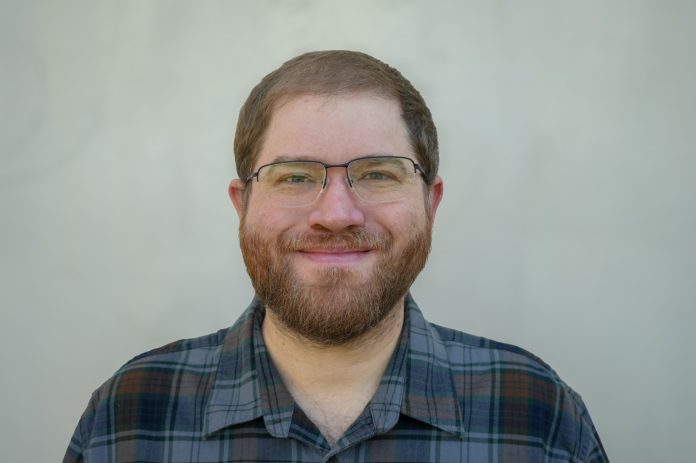
The cumulative response rate accounting for nonresponse to the recruitment surveys and attrition is 3%. The break-off rate among panelists who logged on to the survey and completed at least one item is 1%. The margin of sampling error for the full sample of 5,111 respondents is plus or minus 1.7 percentage points.

The survey includes an oversample of non-Hispanic Asian adults and parents with children younger than 18 in order to provide more precise estimates of the opinions and experiences of these smaller demographic subgroups. These oversampled groups are weighted back to reflect their correct proportions in the population.

SSRS conducted the survey for Pew Research Center via online (n=4,945) and live telephone (n=166) interviewing. Interviews were conducted in both English and Spanish.

To learn more about the ATP, read “About the American Trends Panel.”

Panel recruitment

Since 2018, the ATP has used address-based sampling (ABS) for recruitment. A study cover letter and a pre-incentive are mailed to a stratified, random sample of households selected from the U.S. Postal Service’s Computerized Delivery Sequence File. This Postal Service file has been estimated to cover 90% to 98% of the population. Within each sampled household, the adult with the next birthday is selected to participate. Other details of the ABS recruitment protocol have changed over time but are available upon request. Prior to 2018, the ATP was recruited using landline and cellphone random-digit-dial surveys administered in English and Spanish.

A national sample of U.S. adults has been recruited to the ATP approximately once per year since 2014. In some years, the recruitment has included additional efforts (known as an “oversample”) to improve the accuracy of data for underrepresented groups. For example, Hispanic adults, Black adults and Asian adults were oversampled in 2019, 2022 and 2023, respectively.

Sample design

The overall target population for this survey was noninstitutionalized persons ages 18 and older living in the United States. It featured a stratified random sample from the ATP in which non-Hispanic Asian adults and parents with children younger than 18 were selected with certainty. The remaining panelists were sampled at rates designed to ensure that the share of respondents in each stratum is proportional to its share of the U.S. adult population to the greatest extent possible. Respondent weights are adjusted to account for differential probabilities of selection as described in the Weighting section below.

Questionnaire development and testing

The questionnaire was developed by Pew Research Center in consultation with SSRS. The web program used for online respondents was rigorously tested on both PC and mobile devices by the SSRS project team and Pew Research Center researchers. The SSRS project team also populated test data that was analyzed in SPSS to ensure the logic and randomizations were working as intended before launching the survey.

Incentives

All respondents were offered a post-paid incentive for their participation. Respondents could choose to receive the post-paid incentive in the form of a check or gift code to Amazon.com, Target.com or Walmart.com. Incentive amounts ranged from $5 to $20 depending on whether the respondent belongs to a part of the population that is harder or easier to reach. Differential incentive amounts were designed to increase panel survey participation among groups that traditionally have low survey response propensities.

Data collection protocol

The data collection field period for this survey was Oct. 20 to 26, 2025. Surveys were conducted via self-administered web survey or by live telephone interviewing. 

For panelists who take surveys online: Postcard notifications were mailed to a subset on Oct. 20. Survey invitations were sent out in two separate launches: soft launch and full launch. Sixty panelists were included in the soft launch, which began with an initial invitation sent on Oct. 20. All remaining English- and Spanish-speaking sampled online panelists were included in the full launch and were sent an invitation on Oct. 21.

Panelists participating online were sent an email invitation and up to two email reminders if they did not respond to the survey. ATP panelists who consented to SMS messages were sent an SMS invitation with a link to the survey and up to two SMS reminders.

For panelists who take surveys over the phone with a live interviewer: Prenotification postcards were mailed on Oct. 17. Soft launch took place on Oct. 20 and involved dialing until a total of four interviews had been completed. All remaining English- and Spanish-speaking sampled phone panelists’ numbers were dialed throughout the remaining field period. Panelists who take surveys via phone can receive up to six calls from trained SSRS interviewers.

Data quality checks

To ensure high-quality data, Center researchers performed data quality checks to identify any respondents showing patterns of satisficing. This includes checking for whether respondents left questions blank at very high rates or always selected the first or last answer presented. As a result of this checking, three ATP respondents were removed from the survey dataset prior to weighting and analysis.

Weighting

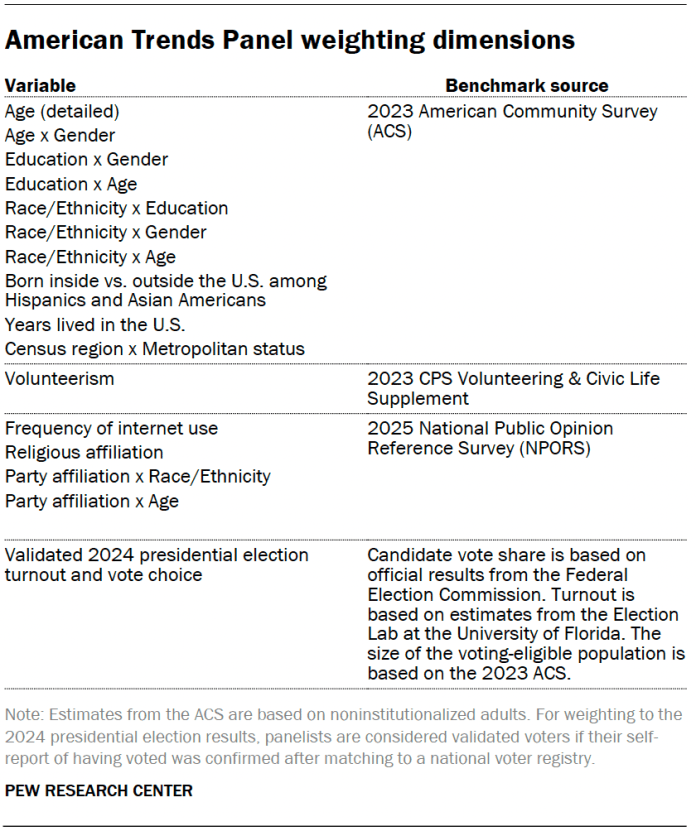
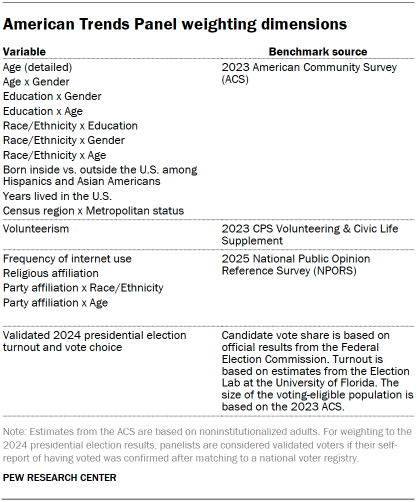
The ATP data is weighted in a process that accounts for multiple stages of sampling and nonresponse that occur at different points in the panel survey process. First, each panelist begins with a base weight that reflects their probability of recruitment into the panel. These weights are then calibrated to align with the population benchmarks in the accompanying table to correct for nonresponse to recruitment surveys and panel attrition. If only a subsample of panelists was invited to participate in the wave, this weight is adjusted to account for any differential probabilities of selection.

Among the panelists who completed the survey, this weight is then calibrated again to align with the population benchmarks identified in the accompanying table and trimmed at the 1st and 99th percentiles to reduce the loss in precision stemming from variance in the weights. Sampling errors and tests of statistical significance take into account the effect of weighting.

Methodology

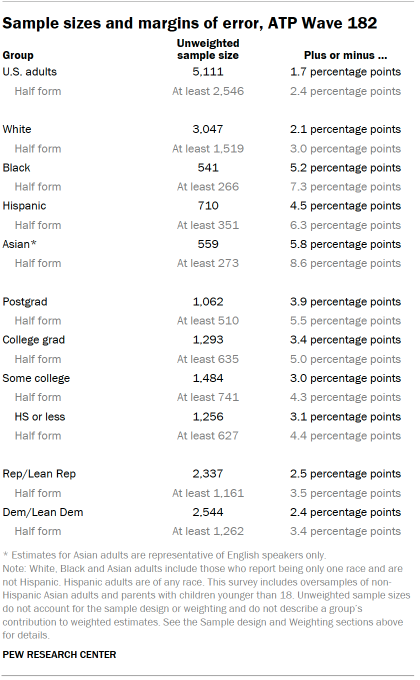
The following table shows the unweighted sample sizes and the error attributable to sampling that would be expected at the 95% level of confidence for different groups in the survey.

Table shows Sample sizes and margins of error, ATP Wave 182

Sample sizes and sampling errors for other subgroups are available upon request. In addition to sampling error, one should bear in mind that question wording and practical difficulties in conducting surveys can introduce error or bias into the findings of opinion polls.

Dispositions and response rates

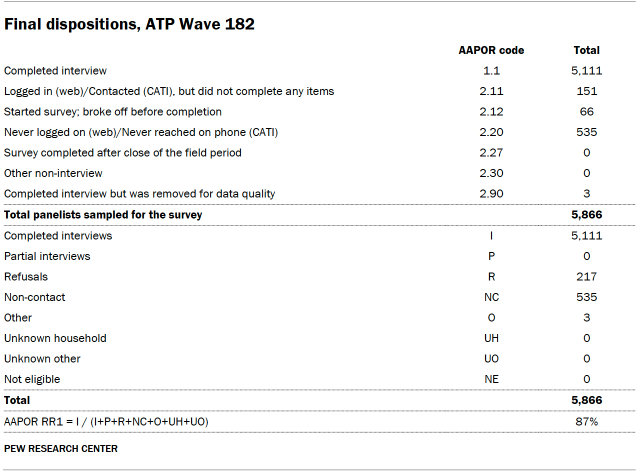
Table shows Final dispositions, ATP Wave 182
Table shows Cumulative response rate, ATP Wave 182

Great Job Reem Nadeem & the Team @ Pew Research Center Source link for sharing this story.
Secret Link