
Home News Page 58

Methodology

Methodology

Overview

Data in this report comes from Wave 182 of the American Trends Panel (ATP), Pew Research Center’s nationally representative panel of randomly selected U.S. adults. The survey was conducted from Oct. 20 to 26, 2025. A total of 5,111 panelists responded out of 5,866 who were sampled, for a survey-level response rate of 87%.

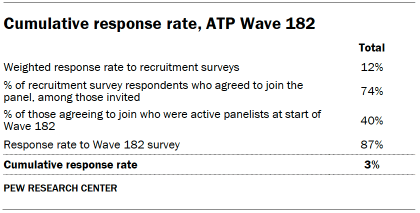
The cumulative response rate accounting for nonresponse to the recruitment surveys and attrition is 3%. The break-off rate among panelists who logged on to the survey and completed at least one item is 1%. The margin of sampling error for the full sample of 5,111 respondents is plus or minus 1.7 percentage points.

The survey includes an oversample of non-Hispanic Asian adults and parents with children younger than 18 in order to provide more precise estimates of the opinions and experiences of these smaller demographic subgroups. These oversampled groups are weighted back to reflect their correct proportions in the population.

SSRS conducted the survey for Pew Research Center via online (n=4,945) and live telephone (n=166) interviewing. Interviews were conducted in both English and Spanish.

To learn more about the ATP, read “About the American Trends Panel.”

Panel recruitment

Since 2018, the ATP has used address-based sampling (ABS) for recruitment. A study cover letter and a pre-incentive are mailed to a stratified, random sample of households selected from the U.S. Postal Service’s Computerized Delivery Sequence File. This Postal Service file has been estimated to cover 90% to 98% of the population. Within each sampled household, the adult with the next birthday is selected to participate. Other details of the ABS recruitment protocol have changed over time but are available upon request. Prior to 2018, the ATP was recruited using landline and cellphone random-digit-dial surveys administered in English and Spanish.

A national sample of U.S. adults has been recruited to the ATP approximately once per year since 2014. In some years, the recruitment has included additional efforts (known as an “oversample”) to improve the accuracy of data for underrepresented groups. For example, Hispanic adults, Black adults and Asian adults were oversampled in 2019, 2022 and 2023, respectively.

Sample design

The overall target population for this survey was noninstitutionalized persons ages 18 and older living in the United States. It featured a stratified random sample from the ATP in which non-Hispanic Asian adults and parents with children younger than 18 were selected with certainty. The remaining panelists were sampled at rates designed to ensure that the share of respondents in each stratum is proportional to its share of the U.S. adult population to the greatest extent possible. Respondent weights are adjusted to account for differential probabilities of selection as described in the Weighting section below.

Questionnaire development and testing

The questionnaire was developed by Pew Research Center in consultation with SSRS. The web program used for online respondents was rigorously tested on both PC and mobile devices by the SSRS project team and Pew Research Center researchers. The SSRS project team also populated test data that was analyzed in SPSS to ensure the logic and randomizations were working as intended before launching the survey.

Incentives

All respondents were offered a post-paid incentive for their participation. Respondents could choose to receive the post-paid incentive in the form of a check or gift code to Amazon.com, Target.com or Walmart.com. Incentive amounts ranged from $5 to $20 depending on whether the respondent belongs to a part of the population that is harder or easier to reach. Differential incentive amounts were designed to increase panel survey participation among groups that traditionally have low survey response propensities.

Data collection protocol

The data collection field period for this survey was Oct. 20 to 26, 2025. Surveys were conducted via self-administered web survey or by live telephone interviewing. 

For panelists who take surveys online: Postcard notifications were mailed to a subset on Oct. 20. Survey invitations were sent out in two separate launches: soft launch and full launch. Sixty panelists were included in the soft launch, which began with an initial invitation sent on Oct. 20. All remaining English- and Spanish-speaking sampled online panelists were included in the full launch and were sent an invitation on Oct. 21.

Panelists participating online were sent an email invitation and up to two email reminders if they did not respond to the survey. ATP panelists who consented to SMS messages were sent an SMS invitation with a link to the survey and up to two SMS reminders.

For panelists who take surveys over the phone with a live interviewer: Prenotification postcards were mailed on Oct. 17. Soft launch took place on Oct. 20 and involved dialing until a total of four interviews had been completed. All remaining English- and Spanish-speaking sampled phone panelists’ numbers were dialed throughout the remaining field period. Panelists who take surveys via phone can receive up to six calls from trained SSRS interviewers.

Data quality checks

To ensure high-quality data, Center researchers performed data quality checks to identify any respondents showing patterns of satisficing. This includes checking for whether respondents left questions blank at very high rates or always selected the first or last answer presented. As a result of this checking, three ATP respondents were removed from the survey dataset prior to weighting and analysis.

Weighting

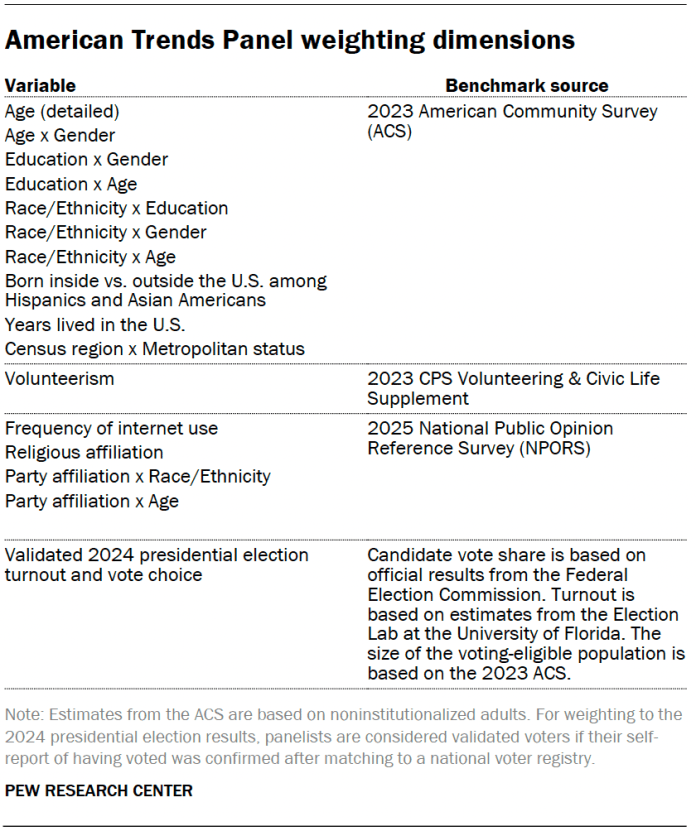
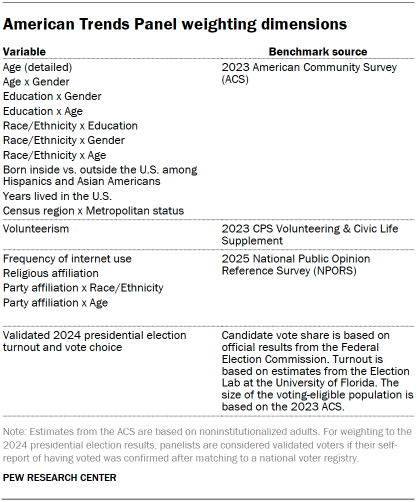
The ATP data is weighted in a process that accounts for multiple stages of sampling and nonresponse that occur at different points in the panel survey process. First, each panelist begins with a base weight that reflects their probability of recruitment into the panel. These weights are then calibrated to align with the population benchmarks in the accompanying table to correct for nonresponse to recruitment surveys and panel attrition. If only a subsample of panelists was invited to participate in the wave, this weight is adjusted to account for any differential probabilities of selection.

Among the panelists who completed the survey, this weight is then calibrated again to align with the population benchmarks identified in the accompanying table and trimmed at the 1st and 99th percentiles to reduce the loss in precision stemming from variance in the weights. Sampling errors and tests of statistical significance take into account the effect of weighting.
Methodology

The following table shows the unweighted sample sizes and the error attributable to sampling that would be expected at the 95% level of confidence for different groups in the survey.
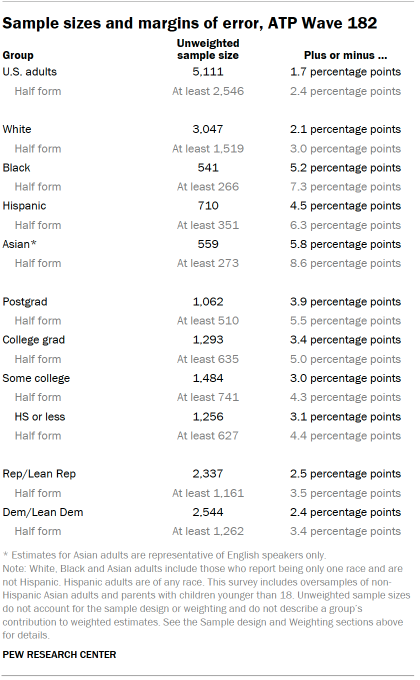
Table shows Sample sizes and margins of error, ATP Wave 182

Sample sizes and sampling errors for other subgroups are available upon request. In addition to sampling error, one should bear in mind that question wording and practical difficulties in conducting surveys can introduce error or bias into the findings of opinion polls.

Dispositions and response rates
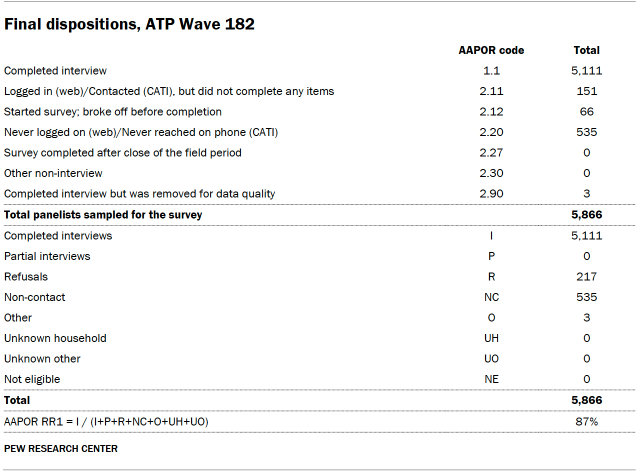
Table shows Final dispositions, ATP Wave 182
Table shows Cumulative response rate, ATP Wave 182

Great Job Reem Nadeem & the Team @ Pew Research Center Source link for sharing this story.
Blood, Vampires, and Dirty Cops: ‘Night Patrol’ Is Coming

Blood, Vampires, and Dirty Cops: ‘Night Patrol’ Is Coming

Source: Shudder Films / Shudder Films

A new Black horror film is about to hit audiences, and Night Patrol: Defang the Police is not easing anyone in gently. Packed with nonstop action, shocking twists, blood-soaked violence, and a chilling conspiracy at its core, the independent thriller takes direct aim at a rogue group of cops who are terrorizing the Black community under the cover of the night.

Set in Los Angeles, Night Patrol follows an LAPD officer who uncovers a horrifying secret behind an elite police unit known as the Night Patrol. What begins as a routine investigation quickly spirals into a nightmare when he learns the group is more than corrupt. They are part of a Klan-inspired operation preying on Black residents in the housing projects where he grew up, and the danger is far bigger than anyone imagined. Vampires, brutal attacks, and a widening trail of bodies turn the city into a battleground after dark.

With the community under siege, old rivalries are forced aside. The film pushes its characters into uneasy alliances, including street gangs who must work together to survive and fight back. The result is a high-octane thriller that moves fast, hits hard, and never lets up, blending horror and action with street-level urgency.

Directed by Ryan Prows and written by Ryan and Ben ProwsNight Patrol stars Jermaine Fowler, Justin Long, RJ Cyler, Freddie Gibbs, and Nicki Micheaux.

Radio and TV personality Jazmyn Summers caught up with RJ Cyler for Radio One at an advance screening of Night Patrol in Harlem, where the actor explained why the film matters beyond the scares. It’s important because it’s really fun. You get Black people in horror,” Cyler said. “I feel like because we don’t get the chance to be in a lot of horror movies, ” he shared.

Cyler also pointed to the film’s deeper message beneath the gore. He described it as carrying an important message, especially in a moment when people are often encouraged to look out only for themselves. 

“It’s a message of community, which is really important, especially now, because we’re being taught the selfish route a lot.  We have a lot of partnership that is shown in this movie, even from opposite sides. We got Bloods and Crips making amends. I love that. It’s a really exciting film and everybody will have a good time.” 

The film emphasizes the idea that survival sometimes depends on unity. Cyler added that he hopes audiences leave not only entertained, but thinking about being somewhat better to your neighbor,” because you may need each other when it matters most.

With its mix of horror, action, and social commentary, Night Patrol stands out as an independent Black film unafraid to push boundaries. It delivers fear, fury, and fast-moving thrills, while turning the spotlight on who really poses the greatest threat once the sun goes down.

Blood, Vampires, and Dirty Cops: ‘Night Patrol’ Is Coming
Source: Jazmyn Summers / Jazmyn Summers

Article by Jazmyn Summers.  You can hear Jazmyn every morning on “Jazmyn in the Morning “on Sirius XM Channel 362 Grown Folk Jamz .  Subscribe to Jazmyn Summers’ YouTube. Follow her on Facebook and Instagram. 

Great Job Jazmyn Summers & the Team @ Black America Web Source link for sharing this story.

5 climate resources to get you up to speed for 2026 » Yale Climate Connections

5 climate resources to get you up to speed for 2026 » Yale Climate Connections

The turn of the year is an appropriate time for overviews. In that spirit, here are a few good ones to complement Dana Nuccitelli’s excellent recent piece for Yale Climate Connections, “Where things stand on climate change in 2026.

  • 10 big energy stories Canary Media is tracking in 2026.” Notes from 10 Canary writers about what they think will be the most important and interesting stories on the clean energy front in the year to come – from vibes to virtual power plants, wind and geothermal to AI. It seems likely that energy technology advances will continue to be the bright spots in the U.S. climate picture, and this publication is on the case.
  • Greenwashing, illegality and false claims: 13 climate litigation wins in 2025.” Isabella Kaminski, The Guardian. This piece looks backward to see what legal efforts to slow climate change have accomplished – whether or not the cases actually won in court. Many suits were on procedural grounds, but some were grounded in principles such as truth-telling and human rights, and in a number of important instances, new precedents were set.
  • Rethinking our assumptions and financing tools for community resilience in the face of growing climate loss and risk.” Matt Posner and Xavier de Souza Briggs, Brookings. This research/policy report contains useful reminders and new ideas for how communities of many sizes might rethink how they pay for improvements to their climate resiliency. Written in report style, but very clear and readable.
  • Unthinkable resource hub.” From Unthinkable, a “nonprofit tackling the mental health crisis within the climate crisis,” this rich library of resources offers – among many other things – personalized help for individuals who want to move through distress into focused action. It is one of many outgrowths of Britt Wray’s work – work that includes the Substack newsletter Unthinkable, formerly Gen Dread.
  • Tipping points: Window to avoid irreversible climate impacts is ‘rapidly closing’.” Multiple authors, Carbon Brief. Results from a summer 2025 conference on tipping points. Full of links, this summary of conference talks considers both harmful physical tipping points (coral deaths, ice melt) and possible positive human tipping points in policy, business, society, and culture (with the latter more likely to be called social transformations or social changes).

5 climate resources to get you up to speed for 2026 » Yale Climate Connections

Republish our articles for free, online or in print, under a Creative Commons license.


SueEllen Campbell

SueEllen Campbell created and for over a decade curated the website “100 Views of Climate Change,” a multidisciplinary collection of pieces accessible to interested non-specialists. She is especially interested…
More by SueEllen Campbell

Great Job SueEllen Campbell & the Team @ Yale Climate Connections Source link for sharing this story.

Tim Pool: “At what point will Trump just do it? Invoke the Insurrection Act. Round these people up.”

Tim Pool: “At what point will Trump just do it? Invoke the Insurrection Act. Round these people up.”

Citation

From the January 15, 2026, edition of Timcast, posted to YouTube

TIM POOL (HOST): In a major escalation, Donald Trump is threatening to invoke the Insurrection Act over the extremism we have seen in Minneapolis. Last night, videos went viral showing far-left extremists breaking into a federal agent’s vehicle, stealing weapons, using tow ropes to break open a locker and steal a rifle from what is presumed to be an FBI agent. They stole charging documents, presumably arrest warrants, and other secure information from a federal law enforcement agency, all while being filmed not wearing masks and using tools to do this. It is getting absolutely out of hand. This is not protest. This is not free speech. This is violent terroristic extremism. You even have a video of a local coming out and screaming for these people to leave because they have kids sleeping.

At what point will Trump just do it? Invoke the Insurrection Act. Round these people up. Peaceful protesters, that was always allowed. You want to link arms and sing songs and block roads, by all means, you get a slap on the wrist, you get arrested. That is what we tolerate for civil disobedience. But we’ve got video of these people breaking into a federal officer’s vehicle.

So the first thing I’m gonna do, I’m gonna show you this video, play this video for you, then we’ll talk about the response. We got tons of these videos. We’ve gotta break them all down. This is a degree of insanity that I have not seen in my lifetime on the ground covering these things. This video from Nick Sorter — breaking, Minneapolis police rider successfully broke open a weapons locker in a federal vehicle and stole a rifle and ammunition. I captured the thief’s face and license plate on the getaway vehicle. Please share and help identify this POS. I have forwarded this to the top levels of the FBI.

Additionally, we’ve got more information on the shooting that took place. Apparently, as federal law enforcement officers were attempting to arrest a criminal, two individuals came out of the house and tried to beat the agent with a shovel. He responded by opening fire. And now we are just seeing the breakdown.

I’m sorry.

Insurrection Act now or forever hold your peace because this is escalation we’ve not experienced before.

Great Job Media Matters for America & the Team @ Media Matters for America Source link for sharing this story.
Uvalde school shooting trial: Witness testimony continues Thursday

Uvalde school shooting trial: Witness testimony continues Thursday

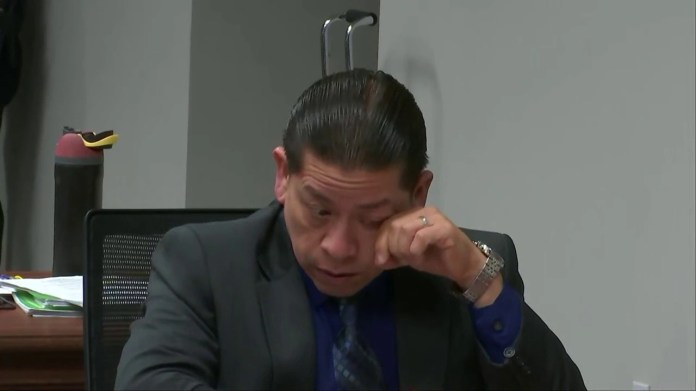
Former Uvalde CISD officer Adrian Gonzales is in court again Thursday morning as witness testimony continues. 

Gonzales is charged with 29 counts of abandoning or endangering a child. Prosecutors say he didn’t act quickly enough during the 2022 massacre, where 19 students and two teachers were killed. 

Proceedings are set to resume at 9 a.m. Thursday.

Trial for former Uvalde officer

The backstory:

So far in the trial, witness testimony has been heard from former teachers who sheltered in classrooms and district employees who were on the scene during the mass shooting at Robb Elementary School. Forensic experts and federal agents have also weighed in on video from the shooting and evidence examined at the scene. 

Relatives of victims in the shooting have shared their stories as well. Tuesday, the sister of a victim made an emotional outburst in court, causing a disturbance in which she was escorted from the building. 

Wednesday, Gonzalez showed his first apparent signs of emotion in the trial, seeming to wipe away tears as a medical examiner described the wounds sustained by some of the children in the shooting.

Nearly 400 officers responded to the school on May 24, 2022. More than 70 minutes passed before a tactical team entered, killing the shooter.

Read more:

Click here for the Uvalde, Texas School Shooting article backlog

The Source: Information in this article was provided by previous FOX 4 and FOX 7 reporting.

Uvalde, Texas School ShootingTexas

Great Job & the Team @ Latest & Breaking News | FOX 7 Austin for sharing this story.

OpenAI invests in Sam Altman’s brain computer interface startup Merge Labs | TechCrunch

OpenAI invests in Sam Altman’s brain computer interface startup Merge Labs | TechCrunch

Just when you thought the circular deals couldn’t get any more circular, OpenAI has invested in CEO Sam Altman’s brain computer interface startup Merge Labs

Merge Labs, which defines itself as a “research lab” dedicated to “bridging biological and artificial intelligence to maximize human ability,” came out of stealth on Thursday with an undisclosed seed round. A source familiar with the matter confirmed previous reports that OpenAI wrote the largest single check in Merge Labs’s $250 million seed round at a $850 million valuation.

“Our individual experience of the world arises from billions of active neurons,” reads a statement from Merge Labs. “If we can interface with these neurons at scale, we could restore lost abilities, support healthier brain states, deepen our connection with each other, and expand what we can imagine and create alongside advanced AI.”

Merge Labs said it intends to reach these feats non-invasively by developing “entirely new technologies that connect with neurons using molecules instead of electrodes” to “transit and receive information using deep-reaching modalities like ultrasound.” 

The move deepens Altman’s competition with Elon Musk, whose own startup Neuralink is also developing computer interface chips that allow people who suffer from severe paralysis to control devices with their thoughts. Neuralink currently requires invasive surgery for implantation, where a surgical robot removes a small piece of skull and inserts ultra-fine electrode threads into the brain to read neural signals. The company last raised a $650 million Series E at a $9 billion validation in June 2025. 

While there are undoubtedly medical use cases for BCIs, Merge Labs seems more focused on using the technology to fulfill a Silicon Valley fantasy of combining human biology with AI to give us superhuman capabilities. 

“Brain computer interfaces (BCIs) are an important new frontier,” OpenAI wrote in a blog post. “They open new ways to communicate, learn, and interact with technology. BCIs will create a natural, human-centered way for anyone to seamlessly interact with AI. This is why OpenAI is participating in Merge Labs’ seed round.” 

Techcrunch event

San Francisco
|
October 13-15, 2026

Aside from Altman, other co-founders include Alex Blania and Sandro Herbig, respectively CEO and product and engineering lead at Tools for Humanity, another Altman-backed company (and creator of the eye-scanning World orbs); Tyson Aflalo and Sumner Norman, co-founders of implantable neural tech company Forest Neurotech; and Mikhail Shapiro, a researcher at Caltech.

As part of the deal, OpenAI will work with Merge Labs on scientific foundation models and other frontier tools to “accelerate progress.” In its blog post, OpenAI noted that AI will not only help accelerate R&D in bioengineering, neuroscience, and device engineering, but that the interfaces will also benefit from AI operating systems that “can interpret intent, adapt to individuals, and operate reliably with limited and noisy signals.”

In other words, Merge Labs could function as a remote control for OpenAI’s software. That leads into the circular nature of the deal: if Merge Labs succeeds, it could drive more users to OpenAI, which then justifies OpenAI’s investment into the company. It also increases the value of a startup Altman owns using resources from a company he runs.

OpenAI is also working with Jony Ive’s startup io, which it acquired last year, to produce a piece of AI hardware that doesn’t rely on a screen. Recent unconfirmed leaks suggest the device might be an earbud. 

OpenAI primarily invests through the OpenAI Startup Fund, which has invested in several other startups connected to Altman, including Red Queen Bio, Rain AI, and Harvey. OpenAI has also entered into commercial agreements with startups Altman personally owns or chairs, including nuclear fusion startup Helion Energy and nuclear fission company Oklo.

Altman has been dreaming about the so-called “Merge” – the idea that humans and machines will merge – since at least 2017 when he published a blog post guessing it would happen somewhere between 2025 and 2075. He also speculated that the merge could take many forms, including plugging electrons into our brains or becoming “really close friends with a chatbot.”

He said a merge is our “best-case scenario” for humanity surviving against superintelligence AI, which he describes as a separate species that’s in conflict with humans. 

“Although the merge has already begun, it’s going to get a lot weirder,” Altman wrote. “We will be the first species ever to design our own descendants. My guess is that we can either be the biological bootloader for digital intelligence and then fade into an evolutionary tree branch, or we can figure out what a successful merge looks like.”

TechCrunch has reached out to OpenAI and Merge Labs for more information.

Great Job Rebecca Bellan & the Team @ TechCrunch Source link for sharing this story.
BUSY FORECAST: Weekend freeze with rain chances next week for San Antonio

BUSY FORECAST: Weekend freeze with rain chances next week for San Antonio

FORECAST HIGHLIGHTS

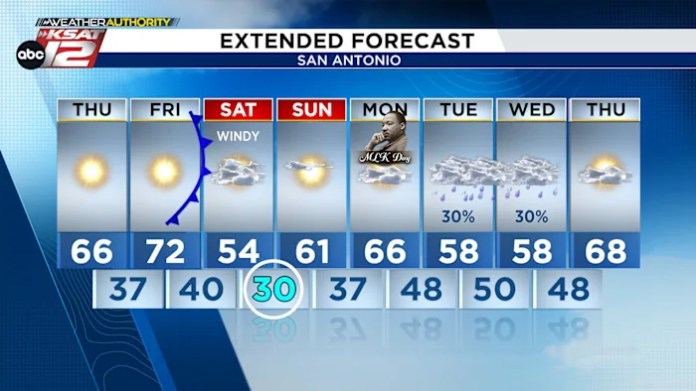
  • TODAY: Cold start, sunny & pleasant afternoon

  • FRIDAY: Warmer, but midday front will impact weekend

  • SATURDAY: Chilly & breezy, 50s.

  • SUNDAY: Morning freeze, 60s afternoon

  • MLK JR. DAY: Cool, but pleasant

  • RAIN NEXT WEEK: Possible Tuesday through Wednesday

FORECAST

While today will be quiet and pleasant, there are a few notable things that you need to know over the weekend and early next week.

TODAY

It’ll be a pleasant day around San Antnio (Copyright 2026 by KSAT – All rights reserved.)

It’s cold to start our Thursday. Temps are in the 30s, but with total sunshine, expect a high in the mid- to upper-60s. Less wind today, too.

FRIDAY

After another cold start, we’ll quickly warm into the 70s. However, a cold front will be moving in during the afternoon. This will allow for highs only in the 50s north of San Antonio.

Friday night will be gusty and chilly, with temperatures quickly falling into the 40s after sunset.

MLK Jr Weekend will be rain-free, but variable when it comes to temperatures (Copyright 2026 by KSAT – All rights reserved.)

CHILLY SATURDAY

We’ll have clouds and breezy, chilly conditions Saturday. Temperatures will struggle to get out of the 50s!

With clearing skies Saturday night, San Antonio will likely see its first freeze of the season by sunrise Sunday. So, it’ll be best to cover or bring in your plants Saturday night. Don’t forget your precious pets, too!

SUNDAY

Sunday morning will be cold with our first freeze likely for San Antonio (Copyright 2026 by KSAT – All rights reserved.)

It’s likely we’ll start the day below freezing. Temps in the 30° to 32° range are likely for San Antonio, but a deeper freeze (25° to 30°) is possible for the Hill Country.

However, with plenty of sun, we’ll quickly warm. Temps will stay cool, however, with highs near 60°.

MONDAY – MARTIN LUTHER KING JR. DAY

Monday morning temperatures should start around 40 degrees at sunrise, but rise to near 50 for the beginning of the MLK March at 10 a.m.

Lower 60s are likely by noon, so have a jacket but be prepared to shed a layer. Lastly, it’s looking dry with some sun as our next chance of rain isn’t until Tuesday.

TUESDAY THROUGH WEDNESDAY

Exact timing is a little uncertain, but it is starting to look like we could see some rain at some point Tuesday through Wednesday.

We’ll be keeping you posted on a timeline and potential rainfall amounts!

The latest extended forecast from Your Weather Authority (Copyright 2026 by KSAT – All rights reserved.)

QUICK WEATHER LINKS

Copyright 2026 by KSAT – All rights reserved.

Great Job Sarah Spivey & the Team @ KSAT San Antonio for sharing this story.

Small farms fight for survival in a warming Midwest » Yale Climate Connections

Small farms fight for survival in a warming Midwest » Yale Climate Connections

Transcript:

As the climate warms, farmers in the Midwest are struggling with more extreme weather – from floods to droughts, heat waves, and wildfires.

Hoidal: “It kind of feels like every year is a new unexpected challenge.”

And Natalie Hoidal, an extension educator at the University of Minnesota, says small vegetable farms – like those that sell produce at farmers markets – are among the most vulnerable.

These businesses operate on narrow profit margins. Many farmers work second jobs to afford health insurance and make ends meet. And they have less access to crop insurance and other supports than many big industrial farms.

Hoidal: “They don’t have these safety nets that a lot of other farmers do.”

So even in good times, it’s a hard business. And a bad year can be devastating.

She says farmers are trying to adapt – for example, by relying more on crops that grow in the spring or fall, when warming can be an advantage.

But she says they need support, too.

Hoidal: “Having better crop insurance options, having funding to implement resilience measures … even like bigger societal changes like affordable health care … that would really influence the viability of a lot of farms.”

So they can keep growing food for their communities, even as the climate warms.

Reporting credit: Sarah Kennedy / ChavoBart Digital Media / Thanks to the Midwest Climate Resilience Conference for logistical support.

Great Job YCC Team & the Team @ Yale Climate Connections Source link for sharing this story.

Jasmine Crockett’s pastor, Frederick Haynes III, sees Congress as stage to pursue social justice

Jasmine Crockett’s pastor, Frederick Haynes III, sees Congress as stage to pursue social justice

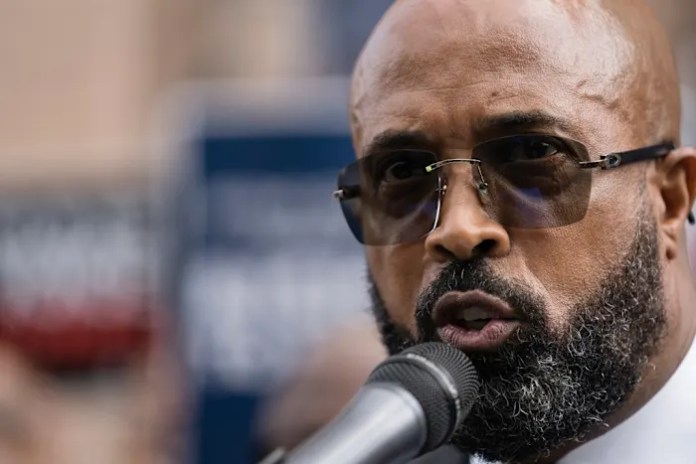
The Rev. Frederick Haynes III has supported Dallas Democratic Rep. Jasmine Crockett for years, offering her spiritual guidance and political support as her pastor and friend.

Now, with her endorsement, the longtime Baptist minister is seeking to succeed Crockett in Texas’ 30th Congressional District, after she decided to pursue a Senate bid rather than run for reelection to the House.

Haynes, who has served as the senior pastor at Friendship-West Baptist Church in Oak Cliff for over 40 years, has been involved in social justice and political causes for decades as one of the nation’s most visible Black Baptist leaders. He briefly served as president and CEO of the Rainbow PUSH Coalition, founded by civil rights leader and former Democratic presidential candidate Jesse Jackson, and is a board member of major civil rights and Baptist advocacy organizations. 

At an event formally kicking off his campaign this week, Haynes staked out several progressive policy positions, saying he supported “quality affordable health care for all” and dismantling Immigration and Customs Enforcement, the federal agency in charge of enforcing immigration laws, which has come under scrutiny recently after an agent shot and killed a U.S. citizen in Minneapolis.

Well known to Democratic politicians and Black leaders in Dallas, Haynes counts Crockett and Georgia Sen. Raphael Warnock, a senior pastor as well, as confidantes. He told The Texas Tribune he consulted with both in the days leading up to the December filling deadline, and ultimately decided that Congress was another forum for the advocacy he’s done from the pulpit. 

“This is a continuation of the mission I’ve been doing for so many years, and it’s just extending it to a political platform, even though I’ve always been one to stand for justice and try to bring justice to politics,” Haynes said in an interview. “I just think it was a matter of prayer, responding to the push of my people and then my own sense of calling.”

Haynes, 65, is running in a deep-blue district whose boundaries were shifted by Republicans during their mid-decade redistricting summer to shrink the number of Democratic-held seats in North Texas from three to two. The newly constituted 30th District contains the southern portion of Dallas County, including downtown Dallas and Oak Cliff, and stretches to DeSoto and Lancaster. It also extends into Tarrant County, encompassing portions of Arlington and Grand Prairie. 

Long a bastion of Black political power, the district was represented by Rep. Eddie Bernice Johnson for 20 years before Crockett succeeded her in 2023.

Haynes said he was first approached about running for Congress after testifying against the GOP’s redistricting push at hearings in Arlington and Austin in July. In the days leading up to the Dec. 8 filing deadline, as Crockett remained publicly mum about her plans, Haynes said he began hearing from more people encouraging him to run — an effort that spilled into public view with a website encouraging voters to “draft” Haynes for Congress.

Two days before the deadline to get on the 2026 ballot, Haynes spoke to Warnock, who told the Dallas pastor he had run for Senate several years ago because he had felt a calling to serve in politics. In the final 48 hours of the filing period, Haynes said he prayed about the decision, and ultimately decided on the day of the deadline to file.

That same day, he appeared at Crockett’s Senate launch event; in turn, Crockett filmed a video in support of Haynes that he played at his own launch event this week. In the video, she said Haynes, despite never having been elected to office before, has “been at this fight at every level” and “knows what it’s going to take to win, to lead, to govern.”

While Haynes has provided Crockett with spiritual guidance, he said their roles have now somewhat reversed as she offers him campaign pointers. 

“Even though I’ve been with her during her previous campaigns, I never paid attention with a view toward, okay, I’ll be doing this one day,” Haynes said. “And so she’s been really helpful in that regard. She has been very encouraging about my prospects of serving and serving well.”

The seat is safely blue, but Haynes will have to make it out of a primary against two lesser-known Democrats, pastor Rodney LaBruce and former state Rep. Barbara Mallory Carroway.

Besides Crockett, Haynes has been endorsed by state Rep. Chris Turner, D-Grand Prairie, Tarrant County Commissioner Alisa Simmons and Johnson’s son, Kirk, who said at Haynes’ launch event that Haynes was like an adopted son to his mother, and she would have encouraged voters to support him.

U.S. Rep. Marc Veasey, D-Fort Worth, also considered running after the seat he currently represents was dismantled by Republicans. But Veasey, one of Texas’ longest-tenured members from either party, ultimately decided against a bid.

If Haynes wins, he will join a Democratic delegation from Texas that, due to redistricting, will include fewer members and a crop of freshmen. Under the current boundaries, 12 of Texas’ 38 House districts are represented by Democrats, with a 13th set to join their ranks after a special election between two Democratic candidates at the end of the month. The new GOP map was drawn to narrow the number of blue seats to as little as eight, while forcing some veteran Democrats into retirement or difficult matchups against younger challengers. 

Haynes said it will be critical for the remaining Texas Democrats in Congress to organize cohesively for future elections.

“We have to play chess,” he said. “And a part of playing chess is looking not just to what happens this year, but what’s going to happen in ‘28 and what will happen in 2030. And that’s what I try to bring — a long-term vision so that we can turn this thing around and make some changes that will benefit the people I know.”

Congress already has a handful of ordained members, including Warnock. Haynes said there is overlap between the skills required for pastoral and public service, including listening, organizing and offering people a vision.

If elected, he said he plans to focus on lowering the cost of health care, housing, child care and college. 

“The sad reality is that most in District 30, for example, are one crisis away from economic disaster,” Haynes said. “And that has to do with the fact that, sadly, what many people are making does not keep up with inflation. And so we have to rethink what a living wage is, as opposed to talking about minimum wage.”

Haynes also expressed an interest in using congressional oversight powers to investigate what he sees as ethical violations by the Trump administration. If Democrats take the House majority in 2026, party leaders could compel Trump administration figures to testify before Congress and use subpoena power to investigate government agencies, from ICE conduct to the president and his family’s business dealings. 

Crockett has garnered national attention for her questioning of witnesses on the House Oversight Committee, the accountability-focused panel that counts many of the party’s rising stars as members.

“We have a president and a Congress that run roughshod over the law, over ethics,” Haynes said. “Congress is supposed to — in their job description — hold the executive branch accountable, and that has not been done. And so that is a part of my ‘why’ for running for Congress.”

Haynes took a medical leave of absence from Friendship-West last fall after having surgery on his prostate in September. He said he is in better shape now and is fit to run. 

The health of congressional hopefuls is under a microscope more than ever this cycle, with both parties recently affected by the deaths and medical absences of members in a narrowly divided House. Two Texas Democrats have died in office in the past two years.

“I am healthier today than I was before surgery, and I’m healthier this year than I was at this time last year,” Haynes said.

Great Job Texas Tribune, Gabby Birenbaum & the Team @ KSAT San Antonio for sharing this story.

GOP Cuts Will Cripple Medicaid Enrollment, Warns CEO of Largest Public Health Plan – KFF Health News

GOP Cuts Will Cripple Medicaid Enrollment, Warns CEO of Largest Public Health Plan – KFF Health News

When the head of the nation’s largest publicly operated health plan worries about the looming federal cuts to Medicaid, it’s not just her job. It’s personal.

Martha Santana-Chin, the daughter of Mexican immigrants, grew up on Medi-Cal, California’s version of Medicaid, the government-run health care program for people with low incomes and disabilities. Today, she is CEO of L.A. Care, which runs by far the biggest Medi-Cal health plan, with more than 2.2 million enrollees, exceeding the Medicaid and Children’s Health Insurance Program enrollments in 41 states.

“If it weren’t for safety nets like the Medi-Cal program, I think, many people would be stuck in poverty without an ability to get out,” she said. “For me personally, not having to worry about health care allowed me to really focus on what I needed to focus on, which was my education.”

As she begins her second year steering L.A. Care, Santana-Chin is grappling with federal and state spending cuts that complicate her task of providing health care to the poor and medically vulnerable enrollees in Medicaid. The insurer also provides Affordable Care Act marketplace plans through Covered California.

Santana-Chin warns that the GOP’s One Big Beautiful Bill Act, enacted last year and also known as HR 1, could result in 650,000 enrollees falling off L.A. Care’s Medi-Cal rolls by the end of 2028. This will strain the plan’s finances as revenues decline. The insurer had revenues of $11.7 billion in the last fiscal year.

HR 1 is expected to cut more than $900 billion from Medicaid over the next 10 years — including $30 billion or more in California, according to the Department of Health Care Services, which runs Medi-Cal.

Like other states facing big deficits, California has reduced its Medicaid spending through such steps as freezing new enrollments for immigrants without legal status and reintroducing an asset limit. And that’s before the state reckons with the spending cuts that likely will be required by the withdrawal of so many federal dollars under HR 1.

Santana-Chin oversaw Medi-Cal and Medicare operations for the for-profit insurer Health Net before taking the helm of L.A. Care in January 2025, nearly three years after state regulators fined L.A. Care $55 million over violations they said compromised the health and safety of its members. L.A. Care paid $27 million in penalties to the state and agreed to contribute $28 million to community health projects.

In a wide-ranging interview, Santana-Chin talked to KFF Health News senior correspondent Bernard J. Wolfson about the financial headwinds facing L.A. Care and why she believes health care shouldn’t be restricted based on a person’s immigration status. This interview has been edited for length and clarity.

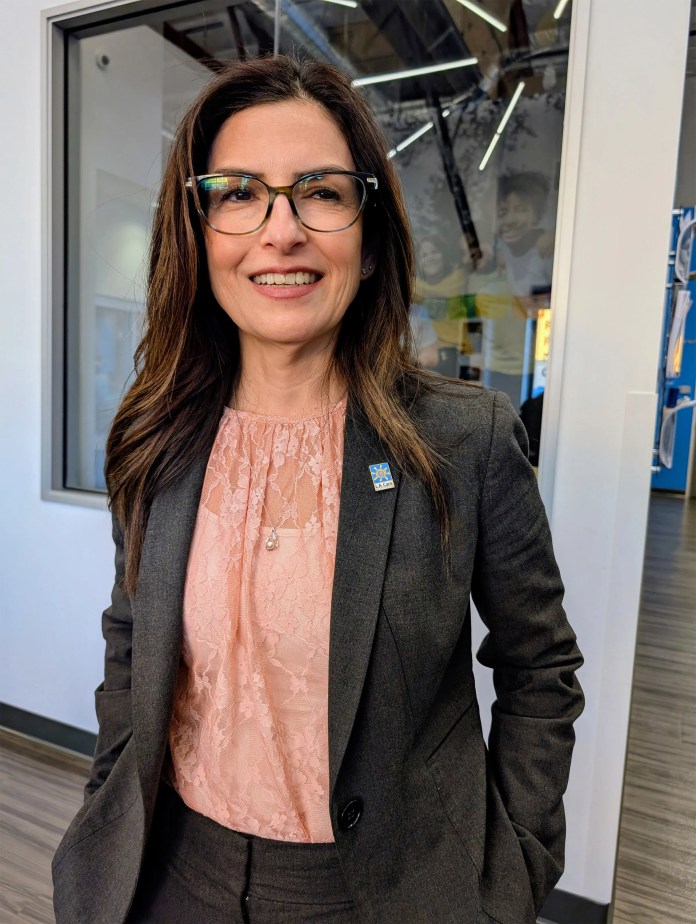
Santana-Chin is the daughter of Mexican immigrants and was a beneficiary of Medi-Cal throughout her childhood. Because of that experience, she says, the concerns of L.A. Care members resonate with her on a personal level.(Bernard J. Wolfson/KFF Health News)

Q: You grew up on Medicaid. How has that shaped your views now that you run one of the largest Medicaid plans in the country?

What really motivates me is knowing that many of the people that we’re serving are just like my family. They’ve struggled and have had to have their own children translate things that were very difficult to translate. I remember doing that for my own mother. You know, basic human dignity requires that you have access to health care.

Q: Has anything you’ve dealt with at Health Net or L.A. Care reminded you of your childhood experiences in Medi-Cal?

Back then they didn’t cover transportation, and we didn’t have a vehicle. Today, one of the issues we’ll hear from our members is the need to make sure we have trustworthy transportation that shows up on time, where the drivers treat them with respect. Had I had that, had my mother had that, life would have been much easier.

Q: What do you think the impact of HR 1 will be?

It’s going to devastate the delivery system. The state obviously isn’t going to be able to make up for the shortfalls in federal funding, and over the course of the next several years, funding is going to be less and less, and the people we cover are going to decrease significantly. We are expecting between now and the end of 2028 that we’re going to see 650,000 people drop off the rolls. That’s just L.A. Care.

Q: That’s over a quarter of your Medi-Cal enrollment.

Yes, it’s very, very significant. The reductions in payment and the rise in uncompensated care are really going to impact our delivery system. As the delivery system gets destabilized and hospitals and other health care providers are forced to close services or reduce the number of sites they have, it’s going to impact access. And it’s not only going to impact those that lose coverage.

Q: How will L.A. Care respond?

Obviously, we’re going to see a significant drop in revenue. We’re very focused on making sure that we are operating as efficiently as we can operate. And we are looking at creative ways to use technology to empower our people to do higher-level work. Mostly supporting our call center agents with smarter technology that helps them answer questions and resolve problems more quickly. Some of it is automating processes on the claims payment side.

Q: What do you have to say to congressional Republicans who passed HR 1?

We are at a point of inflection in the health care delivery system. And we have to recognize that some of the components of HR 1 will have long-term unintended consequences — maybe they were intended; I’ve got to believe that some of these things are not. There’s probably a need to reconsider some of the things that were passed.

Q: Such as?

Work requirements are an example of something that many people did believe was the right thing to do to be good stewards of the health care dollar. It is very complex and is going to cause people to lose coverage that actually do qualify. It’s unfortunate, and that would be something that I would urge folks to reconsider.

Q: What impact do you expect from California’s decision to freeze Medi-Cal enrollment for immigrants without legal status?

It doesn’t matter what immigration status you are. If you are a human being and you need health care, you’re going to try to access health care wherever you can. That’s going to put a strain on the delivery system if you’re uninsured.

Q: What has L.A. Care done to address the state’s concerns in 2022 that it delayed authorizing care and addressing patient grievances?

There has been quite a bit of investment in the L.A. Care infrastructure over the last several years — our IT platforms, our data. There’s also quite a bit of investment in adding new capacity, adding bandwidth to many of the teams, more folks to help support the work.

Q: How have federal immigration raids in L.A. affected L.A. Care members and the broader community?

It absolutely has had a chilling effect. Families are afraid to come in. They’re not taking their children to get vaccinated. I’ve had numerous providers in emergency departments say that they have experienced a drop in the volume of individuals coming in. One of our case managers was really distraught because there was an individual that decided to forgo serious lifesaving treatment because of fear.

Great Job Bernard J. Wolfson & the Team @ Public Health Archives – KFF Health News Source link for sharing this story.

Secret Link