The Federal Trade Commission said Wednesday it has finalized an order that bans General Motors and its OnStar telematics service from sharing certain consumer data with consumer reporting agencies. The finalized order, which comes a year after the agency reached a proposed settlement with GM, also requires the automaker to be more transparent with its consumers and obtain their explicit consent on any data collection.
The finalized order comes nearly two years after a New York Times report showed how GM and OnStar collected, used, and sold drivers’ precise geolocation data and driving behavior to third parties, including data brokers LexisNexis and Verisk. The data was collected through GM’s Smart Driver program, a free feature contained within its connected car apps that tracked and rated driving behaviors and seatbelt use. Data brokers sold this information to insurance providers, which could affect customers’ rates, the NYT reported at the time.
GM discontinued the Smart Driver program in April 2024 across all of its brands, citing customer feedback. GM said at the time it unenrolled all customers and ended its third-party telematics relationships with LexisNexis and Verisk.
The FTC alleged that GM and OnStar used a misleading enrollment process to get consumers to sign up for its OnStar connected vehicle service and OnStar Smart Driver feature. The FTC also alleged the automaker failed to clearly disclose that the data would be collected and sold to third parties.
Under the order finalized Wednesday, GM is also required to obtain explicit consent from consumers prior to collecting, using, or sharing connected vehicle data. This process occurs at the dealership when a consumer buys a car from a GM brand. At that point, the OnStar system is linked to that particular vehicle VIN number and the new owner is asked whether they agree or not with data collection, according to GM.
There are some exceptions to the data collection ban, however. GM is allowed to share location data with emergency first responders and for internal research, the FTC said. GM confirmed this, noting it collects data for internal research and development and sometimes shares de-identified, or anonymized data (not associated with specific drivers or vehicles) with select partners to enhance city infrastructure and improve road safety. For instance, data has been shared with the University of Michigan, which used it for urban planning.
GM must also establish a way for all U.S. consumers to request a copy of their data and seek its deletion and give them the ability to disable the collection of precise geolocation data from their vehicles. GM says it has already complied with these mandates.
Techcrunch event
San Francisco | October 13-15, 2026
GM says it began overhauling its policies and programs on data collection and privacy in 2024. For instance, the automaker said it has consolidated many of its U.S. privacy statements into a single, simpler statement and expanded its a GM privacy program that allows customers to access and delete their personal information.
“The Federal Trade Commission has formally approved the agreement reached last year with General Motors to address concerns,” an emailed statement from GM reads. “As vehicle connectivity becomes increasingly integral to the driving experience, GM remains committed to protecting customer privacy, maintaining trust, and ensuring customers have a clear understanding of our practices.”
Great Job Kirsten Korosec & the Team @ TechCrunch Source link for sharing this story.
Gas prices have been dropping under President Donald Trump, and with Americans so concerned about affordability, that’s a good thing.
But the White House fumbled the ball when it posted the news on social media, showing the U.S. really does need a Department of Education.
Republican presidential nominee, former President Donald Trump, holds a campaign rally at the PPG Paints Arena on November 04, 2024, in Pittsburgh, Pennsylvania. With one day left before the general election, Trump is campaigning for re-election in the battleground states of North Carolina, Pennsylvania, and Michigan. (Photo by Chip Somodevilla/Getty Images)
The White House post on X on Monday, Jan. 12, not only showed a map that didn’t make sense, but the word “forty” was misspelled. The post spelled it “fourty.”
“Gas prices continue to plummet nationwide. Now FOURTY THREE U.S. states feature average gas prices under $3/gallon!” the post stated.
The actual press release cited Gas Buddy for the price data, but Triple A shows 41 states with gas prices under $3 a gallon as of Tuesday, Jan. 13, not the 43 the Trump administration was trying to brag about before the word misspelling hijacked the conversation.
By the way, forty was spelled “fourty” 600 years ago in Middle English.
And social media did exactly what it’s known for: zeroing in on the misspelling until the actual news about decreasing fuel costs got lost in the blowback.
“Attempting to dismantle the Department of Education all while spelling the word FORTY incorrectly is hilarious!” a Threads user said.
Another noted, “It’s not ‘incorrect,’ it’s just not the American spelling that we use in the USA. Which begs the question: who TF is running official social media for the White House?
Others pointed out it’s not just Trump and his cronies who can’t spell.
“My maga congressman can’t spell,” this Threads user chined in above a post with a misspelling about SNAP benefits.
Still, more users have had enough of what critics call the obvious stupidity of members of the Trump administration.
“It’s to the point when I can’t tell if this is real, or if it’s @theonion,” poster Alex V Sim admitted. This Threads user agreed, “The audacity and idiocy are just incredible.”
But the post shows that Trump is finally taking the affordability crisis many Americans are facing seriously. For months last year, the President unbelievably seemed to have no clue about what affordability even meant, let alone the high prices for everyday goods and services. Then, when the issue wouldn’t go away, he claimed affordability issues were a “Democratic hoax” before finally acknowledging the problem and promising to address it.
Trump and Vice President JD Vance actually ran for the White House in 2024, promising to lower prices, as Trump said at the time, “on his first day in office.” That didn’t happen and it still hasn’t.
But what has happened, especially given it’s a mid-term election year, is that the President finally announced an effort at lowering prices on everyday goods, according to NBC News.
The last inflation report of 2025 from the Bureau of Labor Statistics showed inflation is still higher than the Federal Reserve would like. Prices rose 2.7 percent in December compared to a year ago, NBC reported, and the Fed likes to see inflation at 2 percent as a standard marker for a healthy economy.
And while gas prices dropped 0.5 percent in December, food prices soared 0.7 percent. Many of the stats the agency is reporting may be off because of the longest government shutdown in U.S. history, which began at the start of October and ended in mid-November.
Great Job Shelby E. & the Team @ Atlanta Black Star Source link for sharing this story.
A top Danish official said Wednesday that a “fundamental disagreement” over Greenland remains with President Donald Trump after holding highly anticipated White House talks with Vice President JD Vance and Secretary of State Marco Rubio.
“The group, in our view, should focus on how to address the American security concerns, while at the same time respecting the red lines of the Kingdom of Denmark,” Danish Foreign Minister Lars Løkke Rasmussen told reporters after joining Greenland’s foreign minister, Vivian Motzfeldt, for the talks. He added that it remains “clear that the president has this wish of conquering over Greenland.”
Trump is trying to make the case that NATO should help the U.S. acquire the world’s largest island and says anything less than it being under American control is unacceptable.
Denmark, meanwhile, announced plans to boost the country’s military presence in the Arctic and North Atlantic as Trump tries to justify his calls for a U.S. takeover of the vast territory by repeatedly claiming that China and Russia have their designs on Greenland, which holds vast untapped reserves of critical minerals.
The president did not take part in Wednesday’s meeting. In an Oval Office exchange with reporters following the talks, he reiterated his commitment to acquiring the territory.
“We need Greenland for national security,” Trump said. He added: “We’ll see how it all works out. I think something will work out.”
Before the meeting, Trump took to social media to make the case that “NATO should be leading the way” for the U.S. to acquire the territory.
“NATO becomes far more formidable and effective with Greenland in the hands of the UNITED STATES,” Trump wrote. “Anything less than that is unacceptable.”
NATO Secretary General Mark Rutte has sought to keep an arms-length away from the dispute between the most important power and the other members of the 32-country alliance unnerved by the aggressive tact Trump has taken toward Denmark.
Both Løkke Rasmussen and Motzfeldt offered measured hope that the talks were beginning a conversation that would lead to Trump dropping his demand of acquiring the territory and create a path for tighter cooperation with the U.S.
“We have shown where our limits are and from there, I think that it will be very good to look forward,” Motzfeldt said.
Denmark bolstering presence in Arctic
In Copenhagen, Danish Defense Minister Troels Lund Poulsen announced an increase in Denmark’s “military presence and exercise activity” in the Arctic and the North Atlantic, “in close cooperation with our allies”.
Poulsen said the stepped-up military presence was necessary in a security environment in which “no one can predict what will happen tomorrow.”
“This means that from today and in the coming time there will be an increased military presence in and around Greenland of aircraft, ships and soldiers, including from other NATO allies,” Poulsen said.
Other NATO allies were arriving in Greenland along with Danish personnel, he said. Poulsen declined to name the other countries contributing to an increased Arctic presence, saying that it is up to the allies to announce their own participation.
The new security commitments, at least those publicized by Greenland’s allies, appeared modest.
Germany said it would send 13 personnel this week to Greenland “to explore the framework for potential military contributions” on the island. Sweden announced Wednesday it was sending an unspecified number of personnel to Greenland for military exercises. And two Norwegian military personnel also were being sent to Greenland to map out further cooperation with allies, the country’s defense minister, Tore O. Sandvik, told newspaper VG.
NATO is also looking at how members can collectively bolster the alliance’s presence in the Arctic, said a NATO official who was not authorized to comment publicly and spoke on condition of anonymity. The official added there’s consensus “that security in the High North is a priority.”
Greenlanders want the US to back off
Greenland is strategically important because, as climate change causes the ice to melt, it opens up the possibility of shorter trade routes to Asia. That also could make it easier to extract and transport untapped deposits of critical minerals which are needed for computers and phones.
Trump says Greenland is also “vital” to the United States’ Golden Dome missile defense program. He also has said he wants the island to expand America’s security and has repeatedly cited what he says is the threat from Russian and Chinese ships as a reason to control it.
“If we don’t go in, Russia is going to go in and China is going to go in,” Trump argued anew Wednesday. “And there’s not a thing that Denmark can do about it, but we can do everything about it.”
But experts and Greenlanders question that claim, and it has become a hot topic on the snow-covered main street in Greenland’s capital, where international journalists and camera crews have descended as Trump continues his takeover talk.
“The only Chinese I see is when I go to the fast food market,” heating engineer Lars Vintner said. He said he frequently goes sailing and hunting and has never seen Russian or Chinese ships.
In interviews, Greenlanders said the outcome of the Washington talks didn’t exactly evince confidence that Trump can be persuaded.
“Trump is unpredictable,” said Geng Lastein, who immigrated to Greenland 18 years ago from the Philippines.
Maya Martinsen, 21, said she doesn’t buy Trump’s arguments that Greenland needs to be controlled by the U.S. for the sake maintaining a security edge in Arctic over China and Russia. Instead, Martinsen said, Trump is after the plentiful “oils and minerals that we have that are untouched.”
Greenland “has beautiful nature and lovely people,” Martinsen added. “It’s just home to me. I think the Americans just see some kind of business trade.”
Denmark has said the U.S., which already has a military presence, can boost its bases on Greenland. The U.S. is party to a 1951 treaty that gives it broad rights to set up military bases there with the consent of Denmark and Greenland.
Løkke Rasmussen and Motzfeldt, along with Denmark’s ambassador to the U.S., planned to meet later Wednesday with senators from the Arctic Caucus. A bipartisan delegation of U.S. lawmakers is also heading to Copenhagen this week to see Danish and Greenlandic officials.
Both Løkke Rasmussen and Motzfeldt said while they remain at loggerheads with Trump, it remains critical to keep talking.
“It is in everybody’s interest — even though we disagree — that we agree to try to explore whether it is doable to accommodate some of the concerns while at the same time respecting the integrity of the Danish kingdom’s territory and the self-determination of the Greenlandic people,” Løkke Rasmussen said.
___
Burrows reported from Nuuk, Greenland and Ciobanu from Warsaw, Poland. Associated Press writers Stefanie Dazio and Geir Moulson in Berlin, Lisa Mascaro, Aamer Madhani and Will Weissert in Washington and Catherine Gaschka in Paris contributed to this report.
Great Job Emma Burrows, Claudia Ciobanu, Ben Finley, The Associated Press & the Team @ Fortune | FORTUNE Source link for sharing this story.
Left-hander Ranger Suárez and the Boston Red Sox agreed Wednesday to a $130 million, five-year contract, a person familiar with the negotiations told The Associated Press.
The person spoke to the AP on condition of anonymity because the agreement had not been announced.
An All-Star in 2024, Suárez had spent his entire professional career with the Philadelphia Phillies after signing at age 16 in April 2012. The 30-year-old from Venezuela pitched out of the bullpen early on but has been a steady performer and mostly a reliable winner since moving into the rotation exclusively in 2022.
The deal is the first for a major league free agent for the Red Sox this season. It comes days after they were outbid for Alex Bregman by the Chicago Cubs, who gave the incumbent Boston third baseman a five-year, $175 million deal with a no-trade clause that the Red Sox wouldn’t offer.
Instead, Chief Baseball Officer Craig Breslow bolstered the pitching staff with a lefty who doesn’t throw hard but limits home runs and keeps batters off balance by changing speeds and hitting the corners.
Suárez was 12-8 with a 3.20 ERA last season in 26 starts covering a career-high 157 1/3 innings, then became a free agent for the first time and turned down a $22,025,000 qualifying offer from Philadelphia in November.
His calling card is consistency. Suárez went 8-5 with a 1.36 ERA and four saves in 12 starts and 27 relief outings in 2021. He finished 10-7 with a 3.65 ERA over 29 starts and 155 1/3 innings the following season, then fell off to 4-6 with a 4.18 ERA across 22 starts in 2023, when he landed on the injured list for a left elbow strain and later for a right hamstring strain. But he bounced right back the next year, going 12-8 with a 3.46 ERA in 27 starts and 150 2/3 innings.
During that stretch, he was a big reason the Phillies made four straight playoff appearances from 2022-25, winning one National League pennant and back-to-back NL East titles the past two years.
Suárez has been outstanding on the mound in postseason play, too, going 4-1 with a 1.48 ERA and one save in eight starts and three relief appearances totaling 42 2/3 innings.
Overall in eight regular seasons in the majors, he is 53-37 with a 3.38 ERA, two shutouts and four saves in 187 games, including 119 starts. He has struck out 705 batters and walked 240 in 762 innings.
Back trouble has been an issue occasionally. Three times in the past four seasons Suárez spent time on the IL for lower back spasms, soreness or stiffness.
He joins a rotation projected to include left-hander Garrett Crochet, right-handers Sonny Gray and Brayan Bello and perhaps rookie Payton Tolle or Connelly Early.
Because Suárez turned down the qualifying offer, the Phillies get an additional draft pick after the fourth round of the amateur draft this July as compensation.
___
AP Baseball Writer Mike Fitzpatrick contributed to this report.
Copyright 2026 The Associated Press. All rights reserved. This material may not be published, broadcast, rewritten or redistributed without permission.
Great Job Ronald Blum, Associated Press & the Team @ KSAT San Antonio Source link for sharing this story.
Welcome back to World Brief, where we’re looking at Iran’s response to domestic protests, the Trump administration’s pressure campaign on the U.S. Federal Reserve, and allegations of genocide against Myanmar.
Intervention or Negotiations?
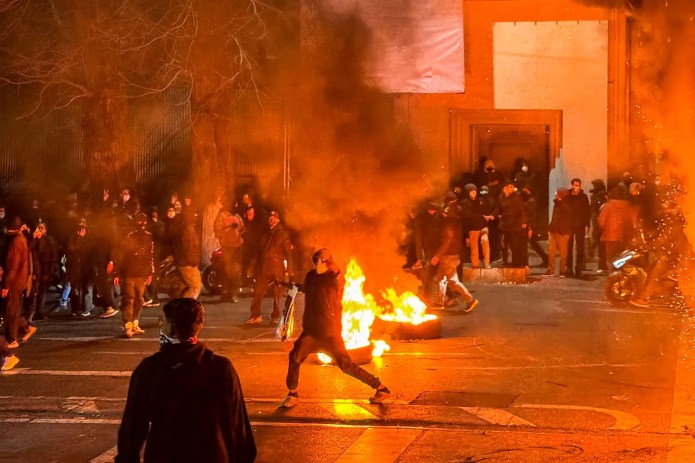
After two weeks of mass anti-government protests, Iran’s authoritarian regime is seeking to toe the line between escalating its bloody crackdown against the opposition and averting possible U.S. military intervention.
Welcome back to World Brief, where we’re looking at Iran’s response to domestic protests, the Trump administration’s pressure campaign on the U.S. Federal Reserve, and allegations of genocide against Myanmar.
Sign up to receive World Brief in your inbox every weekday.
Intervention or Negotiations?
After two weeks of mass anti-government protests, Iran’s authoritarian regime is seeking to toe the line between escalating its bloody crackdown against the opposition and averting possible U.S. military intervention.
“We are not looking for war, but we are prepared for war—even more prepared than the previous war,” Iranian Foreign Minister Abbas Araghchi said on Monday, seemingly referring to Tehran’s 12-day conflict with Israel last June that also saw the United States launch military strikes on Iran’s nuclear facilities.
Protests first ignited on Dec. 28 over Iran’s high inflation rate and plummeting currency, which trades at more than 1.4 million rial to $1. Fighting with Israel last summer drained the country’s limited financial resources, further compounding the economic hardships from years of U.S. and European sanctions.
But the start of 2026 saw the demonstrations spiral into a larger movement aimed at the Iranian regime, led by 86-year-old Supreme Leader Ayatollah Ali Khamenei. The government response has been brutal. In just 15 days, Iranian forces have killed nearly 600 people and detained around 10,600 others, according to the U.S.-based Human Rights Activists News Agency. Although internet blackouts and cut phone lines have made exact estimates of the protests’ size and geographical spread difficult, experts suggest that the protests are the most serious domestic threat the regime has faced since mass demonstrations broke out in 2022 over the Iranian morality police’s alleged killing of 22-year-old Mahsa Amini.
Araghchi insisted on Monday that the situation in the country had “come under total control” and accused Western powers of turning the peaceful protests “violent and bloody to give an excuse” to intervene. Iranian state media on Monday showed large crowds of regime supporters rallying in Tehran and other cities, chanting “Death to America” and “Death to Israel.” Iran’s attorney general has warned that anyone protesting against the government will be considered an “enemy of God,” which carries the death penalty in Iran.
On Sunday, U.S. President Donald Trump reiterated his threat to militarily intervene to curb Tehran’s repression campaign. “We’re looking at it very seriously, the military is looking at it, and we’re looking at some very strong options,” Trump told reporters aboard Air Force One. “I’m getting an hourly report, and we’re going to make a determination.” He added that he spoke to the “leaders of Iran” on Saturday to discuss potential negotiations, though he did not provide specifics.
Araghchi has since said that Iran is also “ready for negotiations” and has open communication channels with U.S. Middle East envoy Steve Witkoff.
However, hawkish lawmakers in both the United States and Iran are pushing for harsher measures. On Sunday, U.S. Republican Sen. Lindsey Graham told Fox News that if he were Trump, “I would kill the leadership that are killing the people.” In a similar vein, Iranian parliamentary Speaker Mohammad Bagher Ghalibaf issued a grave warning: “Let us be clear. In the case of an attack on Iran, the occupied territories [Israel] as well as all U.S. bases and ships will be our legitimate target.”
Today’s Most Read
The World This Week
Tuesday, Jan. 13: British Prime Minister Keir Starmer hosts Polish President Karol Nawrocki.
South Korean President Lee Jae-myung begins a two-day trip to Japan to meet with Japanese Prime Minister Sanae Takaichi.
Wednesday, Jan. 14: U.S. Secretary of State Marco Rubio hosts Danish Foreign Minister Lars Lokke Rasmussen and Greenlandic Foreign Minister Vivian Motzfeldt.
Canadian Prime Minister Mark Carney begins a four-day trip to China.
Thursday, Jan. 15: Uganda holds a general election.
Italian Prime Minister Giorgia Meloni begins a three-day trip to Japan before traveling to South Korea.
Saturday, Jan. 17: The European Union-Mercosur trade deal is signed in Paraguay.
Sunday, Jan. 18: Portugal holds a presidential election.
Monday, Jan. 19: The World Economic Forum kicks off its annual conference in Davos, Switzerland.
What We’re Following
Fight at the Fed. The Trump administration has ramped up its pressure campaign against the U.S. Federal Reserve, with the Justice Department issuing subpoenas to Fed Chair Jerome Powell on Friday as part of an investigation related to Powell’s testimony to Congress last summer regarding oversight of the multibillion-dollar renovation of the Fed’s headquarters.
In a rare public statement, Powell on Sunday said that the investigation “is not about my testimony last June or about the renovation of the Federal Reserve buildings” but rather “is a consequence of the Federal Reserve setting interest rates based on our best assessment of what will serve the public, rather than following the preferences of the President.”
“This is about whether the Fed will be able to continue to set interest rates based on evidence and economic conditions—or whether instead monetary policy will be directed by political pressure or intimidation,” Powell added.
Trump has repeatedly demanded that Powell cut interest rates, claiming that the Fed’s decision not to do so is hurting the U.S. economy. However, Powell maintains that current central bank policy is in the public’s best interests. His refusal to bow to presidential demands has worsened his rift with Trump in recent months, leading the U.S. president to threaten to fire Powell despite the chair being legally protected from such action.
Trump on Sunday denied that the Justice Department subpoenas are meant to pressure Powell on interest rates.
Allegations of genocide. The International Court of Justice (ICJ) began public hearings on Monday in a landmark case accusing Myanmar of committing genocide against its mostly Muslim Rohingya minority. This is the first genocide case that the U.N.’s top court is hearing in full in more than a decade, and it could have widespread repercussions for how allegations of genocide are determined going forward, including concerning South Africa’s similar ICJ case against Israel over its war in Gaza.
Gambia has accused Myanmar of subjecting the Rohingya to the “most horrific violence and destruction one could imagine.” At least 730,000 Rohingya have been forcibly displaced since Myanmar’s armed forces launched its initial offensive in October 2016 before its larger one several months later.
A U.N.-mandated independent fact-finding mission said in a 2018 report that the mission had “established consistent patterns of serious human rights violations and abuses” as well as “serious violations of international humanitarian law … principally committed by the Myanmar security forces, particularly the military.” It recommended “that named senior generals of the Myanmar military should be investigated and prosecuted in an international criminal tribunal for genocide, crimes against humanity and war crimes.” Myanmar denies all allegations of genocide. The ICJ’s hearings are expected to last three weeks.
Political asylum. Hungary granted former Polish Justice Minister Zbigniew Ziobro asylum on Monday, widening the diplomatic rift between Budapest and Warsaw. “I decided to take advantage of the asylum granted to me by the Hungarian government due to political repression in Poland,” Ziobro wrote on X, claiming that he is the subject of a witch hunt orchestrated by Poland’s pro-EU leader, Donald Tusk.
When Poland’s nationalist Law and Justice party was in power, Ziobro enacted changes to Warsaw’s judicial system that the EU said undermined rule of law in the country. Since Tusk took power in late 2023, Warsaw has sought to prosecute Ziobro for allegedly misusing money allocated to help victims of crime, accusing him of instead spending the funds on Pegasus spyware and to target political opponents.
“A former justice minister fleeing the Polish justice system like a coward. A complete downfall!” Polish cabinet minister Tomasz Siemoniak wrote on X on Monday.
Odds and Ends
As China grapples with population decline, a new app is checking on the health of the country’s citizens. “Are You Dead?”—which requires users to check in every two days or else have their emergency contact notified—has become the most popular paid app for Chinese Apple Store customers. The app is particularly popular among young people living alone (despite Beijing taking steps to promote marriage and birthrates) and older adults without relatives nearby. And you thought Duolingo notifications were threatening.
Great Job Alexandra Sharp & the Team @ World Brief – Foreign Policy Source link for sharing this story.
Source: ione nicole thomas / IONE, VIA NICOLE THOMAS
We are keeping our ear to the streets and bringing you the hottest updates that everyone is talking about. Get the inside scoop on Jill Scott’s emotional Why Did I Get Married? confession, the latest buzz on her new album, and our Founders Day shoutout to Delta Sigma Theta,here is everything you need to know.
Here’s a closer look at the stories that had everyone talking about:
Anticipation Builds for Jill’s Next Album
It’s been a minute since we’ve heard this much from our favorite Neo-soul queen, but Jill Scott has been on a serious run lately. During a recent sit-down with Angie Martinez, the legendary songstress opened up about her iconic role as Sheila in Tyler Perry’s Why Did I Get Married? and the emotional toll it took on her behind the scenes. While we all remember rooting for Sheila to find her self-worth, Jill revealed that filming the pivotal airplane scene was harder than it looked. Tyler Perry apparently instructed the extras to go in on her with jokes, and even though she was wearing a fat suit, the insults cut deep.
Jill admitted that the experience of being “bullied” by strangers on set, even for the sake of acting, was genuinely painful. “I hated that,” she confessed, explaining how the extras’ comments about Sheila’s weight felt incredibly real in the moment. It speaks to the power of words and how easily they can affect us, regardless of the context. As discussed on the timeline, Jill is a true empath—she feels everything deeply, which is exactly what makes her music and her acting resonate so profoundly with us. We love her for speaking her truth and reminding us that even the strongest among us have moments of vulnerability.
Love Posted On The Corner? Get more! Join the Black America Web Newsletter
While we are still processing that revelation, the timeline is also buzzing with anticipation for new music. We cannot wait for that new album to drop! Jilly from Philly has a way of soundtracking our lives like no one else, and if her recent interviews are any indication, she has plenty of stories left to tell. We’d also love to see her grace the big screen again soon. Whether she is singing her heart out or delivering a powerhouse performance in a movie, Jill Scott remains a national treasure, and we are here for whatever she decides to do next.
Honoring Delta Sigma Theta: Founders Day Shines Bright
Finally, we have to take a moment to send a huge shoutout to the devastating divas of Delta Sigma Theta Sorority, Incorporated! The timeline is lit up with Crimson and Cream as the sorority celebrates its Founders Day. We see you, we appreciate you, and we celebrate the incredible legacy of service and sisterhood you continue to build.
Follow your girl on the ‘Gram (@djmisses) and check out Posted On The Corner for more updates.
Stay plugged in, keep the discussion going, and make sure your voice is part of the movement shaping what’s next.
Great Job Nia Noelle & the Team @ Black America Web Source link for sharing this story.
Nearly 50 community members came out to NB Housing Partners First Footing to help move supplies and assemble furniture to support the shelter’s expansion and help our neighbors in need.
While 2025’s warmth did not set a new record, it was extraordinary because human-caused global warming pushed global temperatures to near-record levels despite the cooling influence of the La Niña phenomenon, which typically suppresses global temperatures. The record-warm years of 2023 and 2024 both lacked this cooling influence, and both were affected by the strong 2023-24 El Niño event. El Niño typically warms the global atmosphere.
According to Berkeley Earth, 9.1% of the Earth’s surface had a record-warm year, including 10.6% of land areas and 8.3% of ocean areas. They estimated that 770 million people — 8.5% of Earth’s population — experienced a locally record warm annual average in 2025. The largest population centers affected by record warmth in 2025 were mostly in Asia, including about 450 million people in China.
Figure 1. Departure of temperature from average for 2025. Record-high annual temperatures were widespread, covering parts of the Arctic, Europe, Asia, Antarctica, the Southern Ocean, and the western and central Pacific Ocean. Smaller pockets of record heat were also observed across North and South America, Africa, and the Atlantic and Indian Oceans. In contrast, while some areas experienced near- to cooler-than-average conditions, no land or ocean areas experienced record-cold annual temperatures. (Image credit: NOAA)
2025 was an exceptional year for the Earth’s climate Warmest ocean heat content Tied as second warmest surface temps Second warmest troposphere Record high sea level and GHGs Record low winter Arctic iceNew State of the Climate over at Carbon Brief: www.carbonbrief.org/…
Europe and Oceana had their second-warmest year on record; Asia, its third-warmest; North America, its fourth-warmest; South America, its sixth-warmest; and Africa, its seventh-warmest. The Arctic had its second-warmest year on record, and the Antarctic, its fourth-warmest. As reported by Bob Henson yesterday, the contiguous U.S. experienced its fourth-warmest year on record in 2025.
Global satellite-measured temperatures in 2025 for the lowest eight kilometers of the atmosphere were second-warmest in the 47-year satellite record, behind only 2024, according to the University of Alabama, Huntsville.
NOAA is giving a less than 1% chance that 2026 will surpass 2024 as the hottest year on record, with a 75% chance of being a top-five hottest year. If an El Niño event were to arrive in 2026-27, it would boost the odds of 2027 setting a new global record.
A mix of unusually wet and unusually dry conditions for the globe
Asia had its third-wettest year on record during 2025, while Australia and Africa had their 12th- and 15th-wettest, respectively. In contrast, conditions were dry across much of Europe and the Americas, with 2025 ranking as the fifth-driest year on record for Europe and South America, while North America ranked sixth-driest on record.
New: We estimate that in 2025, US greenhouse gas emissions increased by 2.4%, marking a change from the prior two years of decreases in emissions. Emissions also grew faster than the economy in 2025, reversing the decoupling of emissions and economic activity of the prior two years.
No clear signs of a peak in global CO2 emissions yet
Carbon dioxide emissions from fossil fuels and cement production rose by around 1.1% in 2025, reaching a record 38.1 billion tons of carbon dioxide, according to the 2025 Global Carbon Budget report by the Global Carbon Project, released November 13. The 1.1% annual increase is roughly on par with the 0.9% average annual increase during the 2010s and higher than the 0.8% growth in 2024. Some highlights from the report:
The concentration of CO2 in the atmosphere in 2025 was near 426 ppm — about 53% above pre-industrial levels.
About 8% of the rise in atmospheric CO2 concentration since 1960 is due to climate change weakening the amount of CO2 that the land and ocean surfaces can remove (their sinks).
The projected rise in fossil CO2 emissions in 2025 was driven by all fuel types: coal +0.8%, oil +1%, natural gas +1.3%.
The projected emissions for 2025 increased by 6.8% for international aviation (exceeding pre-COVID levels) but remained flat for international shipping.
Atmospheric CO2 concentrations increased by about 2.3 ppm in 2025, down from the record-high increase of 3.7 ppm observed in 2024. The increase that year was so high mainly because the 2023/2024 El Niño weakened the amount absorbed by land. The decadal average increase of CO2 has been 2.6 ppm per year, suggesting the land absorption largely returned to its pre-El Niño level during 2025.
“With CO2 emissions still increasing, keeping global warming below 1.5°C is no longer plausible,” said Professor Pierre Friedlingstein, of Exeter’s Global Systems Institute, who led the study. “The remaining carbon budget for 1.5°C, 170 billion tons of carbon dioxide, will be gone before 2030 at current emission rate. We estimate that climate change is now reducing the combined land and ocean sinks – a clear signal from Planet Earth that we need to dramatically reduce emissions.”
The other two primary human-emitted heat-trapping gases — methane and nitrous oxide — also reached all-time highs in 2025.
Hottest year on record for total ocean heat content
For the ninth consecutive year, the total heat content in the topmost 2,000 meters of the world’s oceans in 2025 was the hottest in data going back to 1955, according to a study published Friday involving more than 50 scientists from 31 international institutions — Ocean Heat Content Sets Another Record in 2025. The extra ocean heat in 2025 compared to 2024 amounted to 23 zettajoules — more than 200 times the electrical energy usage of the entire planet, the researchers said. About 33% of the global ocean area ranked among its historical (1958–2025) top three warmest conditions, while about 57% fell within the top five.
More than 90% of the increasing heat from human-caused global warming accumulates in the ocean as a result of its large heat capacity. The remaining heating manifests through atmospheric warming, the overall drying and warming of global landmasses, and the melting of land and sea ice. Increases in ocean heat content cause sea level rise through thermal expansion of the water and melting of glaciers in contact with the ocean, resulting in increased coastal erosion and more damaging storm surges. Increased ocean heat content also produces stronger and more rapidly intensifying hurricanes, causes more intense precipitation events that can lead to destructive flooding, contributes to marine heat waves that damage or destroy coral reefs, and disrupts atmospheric circulation patterns. A number of extreme weather events in 2025 can all be linked back to long-term ocean heat accumulation, according to the paper:
Global number of named tropical cyclones: 3rd-highest since 1980
A total of 102 named tropical cyclones occurred across the globe in 2025, which is the third-highest number since 1980, according to the Colorado State Real-Time Tropical Cyclone Activity page. Of those, 52 reached the equivalent of hurricane strength (winds of 74 mph or higher) during 2025 — the ninth-highest number since 1980; 24 reached the equivalent of major hurricane strength (winds of 111 mph or higher), which was near average. The global accumulated cyclone energy, or ACE — an integrated metric of the strength, frequency, and duration of tropical storms — was also near average. There were five Cat 5s globally, which is near the 1990-2025 average of 5.3 per year. NOAA reported that there were 101 named tropical cyclones in 2025, compared to the 1991-2020 average of 87.7.
A La Niña event continues but is expected to end by March
A weak La Niña event continues in the Eastern Pacific, NOAA reported in its January monthly discussion of the state of the El Niño/Southern Oscillation, or ENSO. La Niña conditions are expected to end in the January-March 2026 period (75% chance), becoming ENSO-neutral. An increasing chance of El Niño conditions is predicted as 2026 progresses, according to the NOAA/Columbia University International Research Institute for Climate and Society forecast. The forecast for the August-September-October peak of hurricane season, issued in mid-December, called for a 38% chance of El Niño, a 44% chance of ENSO-neutral, and an 18% chance of La Niña. El Niño conditions tend to suppress Atlantic hurricane activity through an increase in wind shear, but La Niña conditions tend to have the opposite effect.
December 2025 #Arctic sea ice extent was the *lowest* on record for the month…This was 1,620,000 km² below the 1981-2010 average. December ice extent is decreasing at about 3.5% per decade. Data: @nsidc.bsky.social at nsidc.org/data/seaice_…
Arctic sea ice extent during December 2025 was the lowest in the 47-year satellite record, according to the National Snow and Ice Data Center. December 2025 sea ice extent in the Antarctic was the seventh-lowest on record.
For the year, the average sea ice extent and sea ice volume in the Arctic hit a record low, according to Zack Labe (see Bluesky post below). However, the annual minimum (reached on September 10) was not impressively low by recent standards, ranking as the joint-10th lowest in the satellite record.
2025 observed the lowest #Arctic sea-ice extent AND the lowest sea-ice volume for their yearly average values. This comes as no surprise to me as the polar environment continues to change. The consequences are far-reaching.More graphics & stats already on my website: zacklabe.com/arctic-sea-i…
The annual Arctic Report Card was issued in December and reported these highlights from October 2024 to September 2025:
Surface air temperatures across the Arctic from October 2024 through September 2025 were the warmest recorded since records began in 1900, including the warmest autumn, second-warmest winter, and third-warmest summer.
The last 10 years are the 10 warmest on record in the Arctic.
Since 2006, Arctic annual temperature has increased at more than double the global rate of temperature change.
Precipitation from October 2024 to September 2025 set a new record high.
In March 2025, Arctic winter sea ice reached the lowest annual maximum extent in the 47-year satellite record.
The oldest, thickest Arctic sea ice (> 4 years) has declined by more than 95% since the 1980s. Multiyear sea ice is now largely confined to the area north of Greenland and the Canadian archipelago.
The Greenland ice sheet lost an estimated 129 billion tons of ice in 2025, less than the annual average of 219 billion tons between 2003 and 2024, but continuing the long-term trend of net loss.
In 2025, maximum Arctic tundra greenness was the third-highest in the 26-year satellite record, continuing a sequence of record or near-record high values since 2020.
Figure 2. Change in total ice in Greenland, 1981-2025. (Image credit: Carbon Brief)
Greenland Ice Sheet loses mass for the 29th consecutive year
The Greenland Ice Sheet lost 105 billion tons of ice in 2024-25, marking the 29th consecutive year it has lost ice, according to a December 2025 post on Carbon Brief by Greenland ice experts Martin Stendel and Ruth Mottram of the Danish Meteorological Institute. However, the amount of ice lost has not been increasing in recent years (Fig. 2).
The 2025 ice melt season saw an unusually early start — May 14, about 12 days earlier than the 1981-2025 average. There is evidence that the length of the melt season in Greenland is lengthening. A remarkably large percentage of the ice sheet was melting at once — from mid-June to the end of September, the area undergoing melting was larger than the 1981-2010 average. In mid-July, melting occurred over a record area. For three days in a row, melting was present over 80% of the ice sheet, peaking at 81.2%, the highest observed since records began in 1981.
Notable global heat and cold marks for December 2025
Weather records expert Maximiliano Herrera documents world temperature extremes in remarkable detail and has provided us with the following info for May. Follow him on Bluesky: @extremetemps.bsky.social
Hottest temperature in the Northern Hemisphere: 40.6°C (105.1°F) at Garoua, Cameroon, Dec. 29
Coldest temperature in the Northern Hemisphere: -59.0°C (-74.2°F) at Delyankir, Russia, Dec. 25
Hottest temperature in the Southern Hemisphere: 47.5°C (117.5°F) at Eyre, Australia, Dec. 17
Coldest temperature in the Southern Hemisphere: -44.3°C (-47.7°F) at Concordia, Antarctica, Dec. 3
Major weather stations in December 2025: three all-time heat records, one all-time cold record
Among global stations with a record of at least 40 years, three set, not just tied, an all-time heat record in December, one set an all-time cold record:
Kanton Island (Kiribati) max. 35.9°C, December: New national record high for Kiribati Braeburn (Canada) min. -55.7°C, December 23 Mirnjyi (Antarctica) max. 10.8°C, December 24 Kaimana (Indonesia) max. 37.7°C, December 29
National and territorial heat records of 2025
International weather records researcher Maximiliano Herrera (who posts on Bluesky and X) monitors the pulse of the planet in remarkable detail, and he logged 10 nations or territories that set or tied their all-time reliably measured heat records in 2025 and no nations that set or tied an all-time cold record. Three nations or territories beat or tied their old all-time heat record multiple times in 2025. In 2024, 25 such records were set, the most Herrera has logged in any singe year.
Among global weather stations having at least 40 years of record-keeping, Herrera documented 388 that exceeded (not just tied) their all-time heat record in 2025 and eight that set an all-time cold record. For comparison, 502 stations set their all-time heat record in 2024.
Ten all-time national/territorial heat records set in 2025
Maldives: 35.8°C (96.4°F) at Hanimadhoo, Feb. 27 (previous record: 35.1°C (95.2°F) at Hanimadhoo, Mar. 24, 2024)
Togo: 44.0°C (111.2°F) at Mango, Mar. 16 and Apr. 5 (tie)
Turkey: 50.5°C (122.9°F) at Silopi, Jul. 25
Kosovo: 42.5°C (108.5°F) at Kline, Jul. 25
Brunei: 39.2°C (102.6°F) at Sukang, Jul. 29; tied again on Aug. 1 at the same location
Japan: 41.2°C (106.2°F) at Kaibara, Jul. 30; broken again on Aug. 5 with 41.8°C (107.2°F) at Isesaki
United Arab Emirates: 51.8°C (125.2°F) at Swiehan, Aug. 1 (tie)
Martinique (territory of France): 37.0°C (98.6°F) at Le Lamentin, Aug. 22
St. Eustatius (territory of the Netherlands): 34.4°C (93.9°F) at Roosevelt Airport, Sep. 13
Kiribati: 35.9°C (96.6°F) at Kanton Island. Dec. 8
No nations or territories set or tied an all-time national/territorial cold record in 2025.
An additional 76 monthly national/territorial heat records beaten or tied in 2025
In addition to the 10 all-time national/territorial records listed above (plus three nations that beat or tied their record in two separate months), 76 nations or territories set monthly all-time heat records in 2025, for a total of 89 monthly all-time records. Here are the additional 76 monthly heat records set in 2025:
January (6): Cocos Islands, French Southern Territories, Faroe Islands, Maldives, Northern Marianas, Martinique
February (3): Northern Marianas, Argentina, Togo
March (8): French Southern Territories, Algeria, Saba, South Korea, Kyrgyzstan, Georgia, Mauritius, Cocos Islands
April (11): French Southern Territories, British Indian Ocean Territory, Latvia, Estonia, Kuwait, Saudi Arabia, Iraq, Iran, Turkmenistan, Kyrgyzstan, Ireland
May (5): French Southern Territories, Iceland, Kyrgyzstan, China, Qatar
June (7): Cocos Islands, Hong Kong, Slovenia, Spain, Portugal, Jersey, Gabon
July (7): Maldives, Ukraine, Honduras, French Southern Territories, U.S. Virgin Islands, Malaysia, Japan
August (10): Honduras, Cocos Islands, Lebanon, Albania, French Southern Territories, Israel, Iceland, Grenada, St. Vincent and the Grenadines, Martinique
September (4): Canada, Namibia, Chile, Central African Republic
October (5): Taiwan, French Southern Territories, New Caledonia, Cocos Islands, Martinique
November (4): Singapore, Israel, Cape Verde, U.S. Virgin Islands
December (6): Kuwait, Dominica, Iceland, Cameroon, Congo, French Guiana
Two nations or territories set an all-time monthly cold record in 2025: Qatar in January, and Puerto Rico in December.
Notable global heat and cold records for 2025
Hottest temperature in the Northern Hemisphere: 52.8°C (127.0°F) at Shabankareh, Iran, Jul. 19
Coldest temperature in the Northern Hemisphere: -61.0°C (-77.8°F) at Summit, Greenland, Jan. 16
Hottest temperature in the Southern Hemisphere: 49.3°C (120.7°F) at Geraldton Airport, Australia, Jan. 20
Coldest temperature in the Southern Hemisphere: -82.0°C (-115.6°F) at Dome Fuji, Antarctica, Jul. 24
Highest average temperature in the Northern Hemisphere in 2025: 32.1°C (89.8°F) at Makkah (Saudi Arabia) Highest average temperature in the Southern Hemisphere in 2025: 29.7°C (85.5°F) at Teresina (Brazil)
Three notable hemispherical and continental temperature records set in 2025
Highest temperature ever recorded in South America in February: 46.5°C (115.7°F) at Rivadavia, Argentina, February 4
Highest minimum temperature ever recorded in South America in February: 30.8°C (87.4°F) at Catamarca, Argentina, February 10.
Highest minimum temperature ever recorded in Africa in November: 31.9°C (89.4°F) at Vioolsdrif, South Africa, November 14.
Bob Henson contributed to this post.
Republish our articles for free, online or in print, under a Creative Commons license.
Great Job Jeff Masters & the Team @ Yale Climate Connections Source link for sharing this story.
Influencers associated with the QAnon conspiracy theory movement have boasted about multiple social media posts shared by the Trump administration’s Department of Labor that invoke phrases tied to the movement.
In the first two weeks of 2026, the Department of Labor has posted QAnon-tied phrases at least four times. On January 4, the Labor Department uploaded an image to social media that said, “Patriots in control,” alongside text reading, “Patriots are in control, and we’re never giving up our fight to put AMERICA FIRST.” A few days later, the department posted an image saying, “Trust the plan,” alongside text that read, “Trust the Plan. Trust Trump.” On January 10, the department posted an image saying, “Hold the line,” alongside the text, “Hold the line, Patriots. Our Nation is worth Fighting For.” And on January 12, the department posted another image reading, “Patriots in control.”
Great Job Media Matters for America & the Team @ Media Matters for America Source link for sharing this story.
The following workouts developed by Botsford each target all the muscles of your back. They are separated into three fitness levels, depending on where you’re starting.
If you’re new to back exercises, consider starting with the beginner circuit before moving to intermediate and advanced.
Botsford suggests completing three rounds of each three exercises in your chosen level and alternating between 30 seconds of work and 30 seconds of rest. Try starting with this twice a week and aiming for three as you get stronger.
For these exercises, you will need a pair of heavy weights, such as large books of similar weight, and a pair of light or medium weights, such as canned goods.
Stand with feet hip- to shoulder-width apart, arms at your sides. Keep knees slightly bent and shoulders pulled down. Keeping your lower back naturally arched, push your hips back as far as possible and lower your torso by hinging at the hips. Lower until your torso forms a 45-degree angle with the floor, or as close as you can. Hold for 30 seconds, then reverse to return to start.
Lie faceup on the floor with legs long and arms extended over your head. (Increase the intensity by holding weights in your hands.) Press your lower back into the floor as you lift your arms and legs so your body forms a C (your shoulders and feet should be hovering several inches above the floor). Squeeze abs and butt muscles and hold for one minute.
Stand with your feet hip-width apart and knees slightly bent. Hold a dumbbell in each hand in front of your hips, with your palms facing your thighs. Squeeze your shoulders together, then hinge at the hips to bend over, lowering dumbbells along the fronts of your legs until your torso is parallel to the ground. Return to standing, shifting your weight through your feet. Repeat for 30 seconds, working slowly and paying attention to form.
Stand with your feet hip-width apart and knees slightly bent. Hold a light- or medium-weight dumbbell in each hand at your sides. Hinge forward at the hips until your torso forms a 45-degree angle with the floor, or as close as you can get. Allow the dumbbells to hang below your shoulders, wrists facing in. While engaging your core, pull the dumbbells up next to your ribs, drawing your elbows straight back and keeping your arms tight to your sides. Slowly lower the weights back to starting position. Repeat for 30 seconds.
Stand with feet hip-width apart and hold a light- or medium-weight dumbbell in each hand by your sides. Hinge forward at the hips until your torso forms a 45-degree angle with the floor, or as close as you can get. Allow the dumbbells to hang below your shoulders, wrists facing in. Keeping a slight bend in the elbows and engaging your core, lift dumbbells up laterally and out to the side until they reach shoulder height. Slowly lower weights back to starting position. Repeat for 30 seconds. Increase the intensity by using your heaviest dumbbells.
Stand with feet hip-width distance or less apart and with heavy dumbbells on the floor beside each foot. Bend to pick up the dumbbells, driving through your heels to lift the weights. Stand tall, shoulders back and core engaged with the weights hanging next to your thighs, and take short, quick steps to move forward at least 50 feet. Turn around and continue walking for a total of 30 seconds.
Stand with feet hip-width apart, a heavy dumbbell on the floor by your right foot. Bend to pick up the dumbbell with your right arm, focusing on driving your body weight down through your heels to lift the weight up until your torso is back in an upright, standing position. Slowly lower the weight back to the ground. Continue for 30 seconds, then repeat on the opposite side.
Stand with feet hip-width apart and hold a heavy dumbbell or kettlebell with both hands, gripping from the top. Push your hips back, knees slightly bent, and lower your chest to bring the dumbbell between your legs. Push your hips forward to slowly swing the dumbbell up to shoulder height. Reverse the movement, slowly swinging the weight back between your legs. Continue for 30 seconds.
Place a dumbbell on the left side of your body, choosing the best weight for you. Start at the top of a pushup position by placing palms on the ground, directly below your shoulders, and walking your feet back until your body forms a straight line from shoulders to heels above the ground. Alternatively, drop down to your knees so that your body is in a straight line from your shoulders to your knees. Reach your right hand under and through to the left side of your body, grasping the weight. Slowly drag it and place it on the right side of your body. Return your right palm to the floor and repeat with your left hand reaching through to the right. Alternate for 30 seconds.
Great Job Ashley Mateo & the Team @ google-discover Source link for sharing this story.