
Home News Page 65

2025 was Earth’s 3rd-warmest year on record » Yale Climate Connections

2025 was Earth’s 3rd-warmest year on record » Yale Climate Connections

In 2025, the planet had its third-hottest year on record, NOAANASA, the European Copernicus Climate Change ServiceBerkeley Earth, the Japan Meteorological Agency, and the UKMET Office reported. The year 2024 remains the hottest year on record, with 2023 in second place, but only slightly ahead of 2025. (In fact, Carbon Brief concluded that 2023 and 2025 were essentially tied for second place.)

While 2025’s warmth did not set a new record, it was extraordinary because human-caused global warming pushed global temperatures to near-record levels despite the cooling influence of the La Niña phenomenon, which typically suppresses global temperatures. The record-warm years of 2023 and 2024 both lacked this cooling influence, and both were affected by the strong 2023-24 El Niño event. El Niño typically warms the global atmosphere.

According to Berkeley Earth, 9.1% of the Earth’s surface had a record-warm year, including 10.6% of land areas and 8.3% of ocean areas. They estimated that 770 million people — 8.5% of Earth’s population — experienced a locally record warm annual average in 2025. The largest population centers affected by record warmth in 2025 were mostly in Asia, including about 450 million people in China.

2025 was Earth’s 3rd-warmest year on record » Yale Climate Connections
Figure 1. Departure of temperature from average for 2025. Record-high annual temperatures were widespread, covering parts of the Arctic, Europe, Asia, Antarctica, the Southern Ocean, and the western and central Pacific Ocean. Smaller pockets of record heat were also observed across North and South America, Africa, and the Atlantic and Indian Oceans. In contrast, while some areas experienced near- to cooler-than-average conditions, no land or ocean areas experienced record-cold annual temperatures. (Image credit: NOAA)

2025 was an exceptional year for the Earth’s climate Warmest ocean heat content Tied as second warmest surface temps Second warmest troposphere Record high sea level and GHGs Record low winter Arctic iceNew State of the Climate over at Carbon Brief: www.carbonbrief.org/…

Zeke Hausfather (@hausfath.bsky.social) 2026-01-14T14:53:38.000Z

Europe and Oceana had their second-warmest year on record; Asia, its third-warmest; North America, its fourth-warmest; South America, its sixth-warmest; and Africa, its seventh-warmest. The Arctic had its second-warmest year on record, and the Antarctic, its fourth-warmest. As reported by Bob Henson yesterday, the contiguous U.S. experienced its fourth-warmest year on record in 2025.

Global satellite-measured temperatures in 2025 for the lowest eight kilometers of the atmosphere were second-warmest in the 47-year satellite record, behind only 2024, according to the University of Alabama, Huntsville.

NOAA is giving a less than 1% chance that 2026 will surpass 2024 as the hottest year on record, with a 75% chance of being a top-five hottest year. If an El Niño event were to arrive in 2026-27, it would boost the odds of 2027 setting a new global record.

A mix of unusually wet and unusually dry conditions for the globe

Asia had its third-wettest year on record during 2025, while Australia and Africa had their 12th- and 15th-wettest, respectively. In contrast, conditions were dry across much of Europe and the Americas, with 2025 ranking as the fifth-driest year on record for Europe and South America, while North America ranked sixth-driest on record.

New: We estimate that in 2025, US greenhouse gas emissions increased by 2.4%, marking a change from the prior two years of decreases in emissions. Emissions also grew faster than the economy in 2025, reversing the decoupling of emissions and economic activity of the prior two years.

Rhodium Group (@rhg.com) 2026-01-13T16:18:16.218Z

No clear signs of a peak in global CO2 emissions yet

Carbon dioxide emissions from fossil fuels and cement production rose by around 1.1% in 2025, reaching a record 38.1 billion tons of carbon dioxide, according to the 2025 Global Carbon Budget report by the Global Carbon Project, released November 13. The 1.1% annual increase is roughly on par with the 0.9% average annual increase during the 2010s and higher than the 0.8% growth in 2024. Some highlights from the report:

  • The concentration of CO2 in the atmosphere in 2025 was near 426 ppm — about 53% above pre-industrial levels.
  • About 8% of the rise in atmospheric CO2 concentration since 1960 is due to climate change weakening the amount of CO2 that the land and ocean surfaces can remove (their sinks).
  • The projected rise in fossil CO2 emissions in 2025 was driven by all fuel types: coal +0.8%, oil +1%, natural gas +1.3%.
  • The projected emissions for 2025 increased by 6.8% for international aviation (exceeding pre-COVID levels) but remained flat for international shipping.
  • Atmospheric CO2 concentrations increased by about 2.3 ppm in 2025, down from the record-high increase of 3.7 ppm observed in 2024. The increase that year was so high mainly because the 2023/2024 El Niño weakened the amount absorbed by land. The decadal average increase of CO2 has been 2.6 ppm per year, suggesting the land absorption largely returned to its pre-El Niño level during 2025.

“With CO2 emissions still increasing, keeping global warming below 1.5°C is no longer plausible,” said Professor Pierre Friedlingstein, of Exeter’s Global Systems Institute, who led the study. “The remaining carbon budget for 1.5°C, 170 billion tons of carbon dioxide, will be gone before 2030 at current emission rate. We estimate that climate change is now reducing the combined land and ocean sinks – a clear signal from Planet Earth that we need to dramatically reduce emissions.”

The other two primary human-emitted heat-trapping gases — methane and nitrous oxide — also reached all-time highs in 2025.

Hottest year on record for total ocean heat content

For the ninth consecutive year, the total heat content in the topmost 2,000 meters of the world’s oceans in 2025 was the hottest in data going back to 1955, according to a study published Friday involving more than 50 scientists from 31 international institutions — Ocean Heat Content Sets Another Record in 2025. The extra ocean heat in 2025 compared to 2024 amounted to 23 zettajoules — more than 200 times the electrical energy usage of the entire planet, the researchers said. About 33% of the global ocean area ranked among its historical (1958–2025) top three warmest conditions, while about 57% fell within the top five.

More than 90% of the increasing heat from human-caused global warming accumulates in the ocean as a result of its large heat capacity. The remaining heating manifests through atmospheric warming, the overall drying and warming of global landmasses, and the melting of land and sea ice. Increases in ocean heat content cause sea level rise through thermal expansion of the water and melting of glaciers in contact with the ocean, resulting in increased coastal erosion and more damaging storm surges. Increased ocean heat content also produces stronger and more rapidly intensifying hurricanes, causes more intense precipitation events that can lead to destructive flooding, contributes to marine heat waves that damage or destroy coral reefs, and disrupts atmospheric circulation patterns. A number of extreme weather events in 2025 can all be linked back to long-term ocean heat accumulation, according to the paper:

Global number of named tropical cyclones: 3rd-highest since 1980

A total of 102 named tropical cyclones occurred across the globe in 2025, which is the third-highest number since 1980, according to the Colorado State Real-Time Tropical Cyclone Activity page. Of those, 52 reached the equivalent of hurricane strength (winds of 74 mph or higher) during 2025 — the ninth-highest number since 1980; 24 reached the equivalent of major hurricane strength (winds of 111 mph or higher), which was near average. The global accumulated cyclone energy, or ACE — an integrated metric of the strength, frequency, and duration of tropical storms — was also near average. There were five Cat 5s globally, which is near the 1990-2025 average of 5.3 per year. NOAA reported that there were 101 named tropical cyclones in 2025, compared to the 1991-2020 average of 87.7.

A La Niña event continues but is expected to end by March

A weak La Niña event continues in the Eastern Pacific, NOAA reported in its January monthly discussion of the state of the El Niño/Southern Oscillation, or ENSO. La Niña conditions are expected to end in the January-March 2026 period (75% chance), becoming ENSO-neutral. An increasing chance of El Niño conditions is predicted as 2026 progresses, according to the NOAA/Columbia University International Research Institute for Climate and Society forecast. The forecast for the August-September-October peak of hurricane season, issued in mid-December, called for a 38% chance of El Niño, a 44% chance of ENSO-neutral, and an 18% chance of La Niña. El Niño conditions tend to suppress Atlantic hurricane activity through an increase in wind shear, but La Niña conditions tend to have the opposite effect.

December 2025 #Arctic sea ice extent was the *lowest* on record for the month…This was 1,620,000 km² below the 1981-2010 average. December ice extent is decreasing at about 3.5% per decade. Data: @nsidc.bsky.social at nsidc.org/data/seaice_…

Zack Labe (@zacklabe.com) 2026-01-02T19:58:46.635Z

Arctic sea ice: lowest December extent on record

Arctic sea ice extent during December 2025 was the lowest in the 47-year satellite record, according to the National Snow and Ice Data Center. December 2025 sea ice extent in the Antarctic was the seventh-lowest on record.

For the year, the average sea ice extent and sea ice volume in the Arctic hit a record low, according to Zack Labe (see Bluesky post below). However, the annual minimum (reached on September 10) was not impressively low by recent standards, ranking as the joint-10th lowest in the satellite record.

2025 observed the lowest #Arctic sea-ice extent AND the lowest sea-ice volume for their yearly average values. This comes as no surprise to me as the polar environment continues to change. The consequences are far-reaching.More graphics & stats already on my website: zacklabe.com/arctic-sea-i…

Zack Labe (@zacklabe.com) 2026-01-09T23:36:17.940Z

The annual Arctic Report Card was issued in December and reported these highlights from October 2024 to September 2025:

  • Surface air temperatures across the Arctic from October 2024 through September 2025 were the warmest recorded since records began in 1900, including the warmest autumn, second-warmest winter, and third-warmest summer.
  • The last 10 years are the 10 warmest on record in the Arctic.
  • Since 2006, Arctic annual temperature has increased at more than double the global rate of temperature change.
  • Precipitation from October 2024 to September 2025 set a new record high.
  • In March 2025, Arctic winter sea ice reached the lowest annual maximum extent in the 47-year satellite record.
  • The oldest, thickest Arctic sea ice (> 4 years) has declined by more than 95% since the 1980s. Multiyear sea ice is now largely confined to the area north of Greenland and the Canadian archipelago.
  • The Greenland ice sheet lost an estimated 129 billion tons of ice in 2025, less than the annual average of 219 billion tons between 2003 and 2024, but continuing the long-term trend of net loss.
  • In 2025, maximum Arctic tundra greenness was the third-highest in the 26-year satellite record, continuing a sequence of record or near-record high values since 2020.
Figure 2. Change in total ice in Greenland, 1981-2025.Figure 2. Change in total ice in Greenland, 1981-2025.
Figure 2. Change in total ice in Greenland, 1981-2025. (Image credit: Carbon Brief)

Greenland Ice Sheet loses mass for the 29th consecutive year

The Greenland Ice Sheet lost 105 billion tons of ice in 2024-25, marking the 29th consecutive year it has lost ice, according to a December 2025 post on Carbon Brief by Greenland ice experts Martin Stendel and Ruth Mottram of the Danish Meteorological Institute. However, the amount of ice lost has not been increasing in recent years (Fig. 2).

The 2025 ice melt season saw an unusually early start — May 14, about 12 days earlier than the 1981-2025 average. There is evidence that the length of the melt season in Greenland is lengthening. A remarkably large percentage of the ice sheet was melting at once — from mid-June to the end of September, the area undergoing melting was larger than the 1981-2010 average. In mid-July, melting occurred over a record area. For three days in a row, melting was present over 80% of the ice sheet, peaking at 81.2%, the highest observed since records began in 1981.

Notable global heat and cold marks for December 2025

Weather records expert Maximiliano Herrera documents world temperature extremes in remarkable detail and has provided us with the following info for May. Follow him on Bluesky: @extremetemps.bsky.social

  • Hottest temperature in the Northern Hemisphere: 40.6°C (105.1°F) at Garoua, Cameroon, Dec. 29
  • Coldest temperature in the Northern Hemisphere: -59.0°C (-74.2°F) at Delyankir, Russia, Dec. 25
  • Hottest temperature in the Southern Hemisphere: 47.5°C (117.5°F) at Eyre, Australia, Dec. 17
  • Coldest temperature in the Southern Hemisphere: -44.3°C (-47.7°F) at Concordia, Antarctica, Dec. 3

Major weather stations in December 2025: three all-time heat records, one all-time cold record

Among global stations with a record of at least 40 years, three set, not just tied, an all-time heat record in December, one set an all-time cold record:

Kanton Island (Kiribati) max. 35.9°C, December: New national record high for Kiribati
Braeburn (Canada) min. -55.7°C, December 23
Mirnjyi (Antarctica) max. 10.8°C, December 24
Kaimana (Indonesia) max. 37.7°C, December 29

National and territorial heat records of 2025

International weather records researcher Maximiliano Herrera (who posts on Bluesky and X) monitors the pulse of the planet in remarkable detail, and he logged 10 nations or territories that set or tied their all-time reliably measured heat records in 2025 and no nations that set or tied an all-time cold record. Three nations or territories beat or tied their old all-time heat record multiple times in 2025. In 2024, 25 such records were set, the most Herrera has logged in any singe year.

Among global weather stations having at least 40 years of record-keeping, Herrera documented 388 that exceeded (not just tied) their all-time heat record in 2025 and eight that set an all-time cold record. For comparison, 502 stations set their all-time heat record in 2024.

Ten all-time national/territorial heat records set in 2025

  • Maldives: 35.8°C (96.4°F) at Hanimadhoo, Feb. 27 (previous record: 35.1°C (95.2°F) at Hanimadhoo, Mar. 24, 2024)
  • Togo: 44.0°C (111.2°F) at Mango, Mar. 16 and Apr. 5 (tie)
  • Turkey: 50.5°C (122.9°F) at Silopi, Jul. 25
  • Kosovo: 42.5°C (108.5°F) at Kline, Jul. 25
  • Brunei: 39.2°C (102.6°F) at Sukang, Jul. 29; tied again on Aug. 1 at the same location
  • Japan: 41.2°C (106.2°F) at Kaibara, Jul. 30; broken again on Aug. 5 with 41.8°C (107.2°F) at Isesaki
  • United Arab Emirates: 51.8°C (125.2°F) at Swiehan, Aug. 1 (tie)
  • Martinique (territory of France): 37.0°C (98.6°F) at Le Lamentin, Aug. 22
  • St. Eustatius (territory of the Netherlands): 34.4°C (93.9°F) at Roosevelt Airport, Sep. 13
  • Kiribati: 35.9°C (96.6°F) at Kanton Island. Dec. 8

No nations or territories set or tied an all-time national/territorial cold record in 2025.

An additional 76 monthly national/territorial heat records beaten or tied in 2025

In addition to the 10 all-time national/territorial records listed above (plus three nations that beat or tied their record in two separate months), 76 nations or territories set monthly all-time heat records in 2025, for a total of 89 monthly all-time records. Here are the additional 76 monthly heat records set in 2025:

  • January (6): Cocos Islands, French Southern Territories, Faroe Islands, Maldives, Northern Marianas, Martinique
  • February (3): Northern Marianas, Argentina, Togo
  • March (8): French Southern Territories, Algeria, Saba, South Korea, Kyrgyzstan, Georgia, Mauritius, Cocos Islands
  • April (11): French Southern Territories, British Indian Ocean Territory, Latvia, Estonia, Kuwait, Saudi Arabia, Iraq, Iran, Turkmenistan, Kyrgyzstan, Ireland
  • May (5): French Southern Territories, Iceland, Kyrgyzstan, China, Qatar
  • June (7): Cocos Islands, Hong Kong, Slovenia, Spain, Portugal, Jersey, Gabon
  • July (7): Maldives, Ukraine, Honduras, French Southern Territories, U.S. Virgin Islands, Malaysia, Japan
  • August (10): Honduras, Cocos Islands, Lebanon, Albania, French Southern Territories, Israel, Iceland, Grenada, St. Vincent and the Grenadines, Martinique
  • September (4): Canada, Namibia, Chile, Central African Republic
  • October (5): Taiwan, French Southern Territories, New Caledonia, Cocos Islands, Martinique
  • November (4): Singapore, Israel, Cape Verde, U.S. Virgin Islands
  • December (6): Kuwait, Dominica, Iceland, Cameroon, Congo, French Guiana

Two nations or territories set an all-time monthly cold record in 2025: Qatar in January, and Puerto Rico in December.

Notable global heat and cold records for 2025

  • Hottest temperature in the Northern Hemisphere: 52.8°C (127.0°F) at Shabankareh, Iran, Jul. 19
  • Coldest temperature in the Northern Hemisphere: -61.0°C (-77.8°F) at Summit, Greenland, Jan. 16
  • Hottest temperature in the Southern Hemisphere: 49.3°C (120.7°F) at Geraldton Airport, Australia, Jan. 20
  • Coldest temperature in the Southern Hemisphere: -82.0°C (-115.6°F) at Dome Fuji, Antarctica, Jul. 24

Highest average temperature in the Northern Hemisphere in 2025: 32.1°C (89.8°F) at Makkah (Saudi Arabia)
Highest average temperature in the Southern Hemisphere in 2025: 29.7°C (85.5°F) at Teresina  (Brazil)

Three notable hemispherical and continental temperature records set in 2025

  • Highest temperature ever recorded in South America in February: 46.5°C (115.7°F) at Rivadavia, Argentina, February 4
  • Highest minimum temperature ever recorded in South America in February: 30.8°C (87.4°F) at Catamarca, Argentina, February 10.
  • Highest minimum temperature ever recorded in Africa in November: 31.9°C (89.4°F) at Vioolsdrif, South Africa, November 14.

Bob Henson contributed to this post.

Creative Commons LicenseCreative Commons License

Republish our articles for free, online or in print, under a Creative Commons license.

Great Job Jeff Masters & the Team @ Yale Climate Connections Source link for sharing this story.


QAnon community declares vindication as Trump’s Labor Department pens multiple posts echoing QAnon phrases

QAnon community declares vindication as Trump’s Labor Department pens multiple posts echoing QAnon phrases

Influencers associated with the QAnon conspiracy theory movement have boasted about multiple social media posts shared by the Trump administration’s Department of Labor that invoke phrases tied to the movement.

In the first two weeks of 2026, the Department of Labor has posted QAnon-tied phrases at least four times. On January 4, the Labor Department uploaded an image to social media that said, “Patriots in control,” alongside text reading, “Patriots are in control, and we’re never giving up our fight to put AMERICA FIRST.” A few days later, the department posted an image saying, “Trust the plan,” alongside text that read, “Trust the Plan. Trust Trump.” On January 10, the department posted an image saying, “Hold the line,” alongside the text, “Hold the line, Patriots. Our Nation is worth Fighting For.” And on January 12, the department posted another image reading, “Patriots in control.”

Great Job Media Matters for America & the Team @ Media Matters for America Source link for sharing this story.

The Best At-Home Exercises for a Stronger Back

The Best At-Home Exercises for a Stronger Back

The following workouts developed by Botsford each target all the muscles of your back. They are separated into three fitness levels, depending on where you’re starting.

If you’re new to back exercises, consider starting with the beginner circuit before moving to intermediate and advanced.

Botsford suggests completing three rounds of each three exercises in your chosen level and alternating between 30 seconds of work and 30 seconds of rest. Try starting with this twice a week and aiming for three as you get stronger.

For these exercises, you will need a pair of heavy weights, such as large books of similar weight, and a pair of light or medium weights, such as canned goods.

Beginner Circuit

1. Hip Hinge Hold

via GIPHY

Stand with feet hip- to shoulder-width apart, arms at your sides. Keep knees slightly bent and shoulders pulled down. Keeping your lower back naturally arched, push your hips back as far as possible and lower your torso by hinging at the hips. Lower until your torso forms a 45-degree angle with the floor, or as close as you can. Hold for 30 seconds, then reverse to return to start.

2. Hollow Hold

via GIPHY

Lie faceup on the floor with legs long and arms extended over your head. (Increase the intensity by holding weights in your hands.) Press your lower back into the floor as you lift your arms and legs so your body forms a C (your shoulders and feet should be hovering several inches above the floor). Squeeze abs and butt muscles and hold for one minute.

3. Dumbbell Deadlift

via GIPHY

Stand with your feet hip-width apart and knees slightly bent. Hold a dumbbell in each hand in front of your hips, with your palms facing your thighs. Squeeze your shoulders together, then hinge at the hips to bend over, lowering dumbbells along the fronts of your legs until your torso is parallel to the ground. Return to standing, shifting your weight through your feet. Repeat for 30 seconds, working slowly and paying attention to form.

Intermediate Circuit

1. Dumbbell Bent Over Row

via GIPHY

Stand with your feet hip-width apart and knees slightly bent. Hold a light- or medium-weight dumbbell in each hand at your sides. Hinge forward at the hips until your torso forms a 45-degree angle with the floor, or as close as you can get. Allow the dumbbells to hang below your shoulders, wrists facing in. While engaging your core, pull the dumbbells up next to your ribs, drawing your elbows straight back and keeping your arms tight to your sides. Slowly lower the weights back to starting position. Repeat for 30 seconds.

2. Dumbbell Reverse Fly

via GIPHY

Stand with feet hip-width apart and hold a light- or medium-weight dumbbell in each hand by your sides. Hinge forward at the hips until your torso forms a 45-degree angle with the floor, or as close as you can get. Allow the dumbbells to hang below your shoulders, wrists facing in. Keeping a slight bend in the elbows and engaging your core, lift dumbbells up laterally and out to the side until they reach shoulder height. Slowly lower weights back to starting position. Repeat for 30 seconds. Increase the intensity by using your heaviest dumbbells.

3. Dumbbell Farmer Carry

via GIPHY

Stand with feet hip-width distance or less apart and with heavy dumbbells on the floor beside each foot. Bend to pick up the dumbbells, driving through your heels to lift the weights. Stand tall, shoulders back and core engaged with the weights hanging next to your thighs, and take short, quick steps to move forward at least 50 feet. Turn around and continue walking for a total of 30 seconds.

Advanced Circuit

1. Single-Arm Suitcase Deadlift

via GIPHY

Stand with feet hip-width apart, a heavy dumbbell on the floor by your right foot. Bend to pick up the dumbbell with your right arm, focusing on driving your body weight down through your heels to lift the weight up until your torso is back in an upright, standing position. Slowly lower the weight back to the ground. Continue for 30 seconds, then repeat on the opposite side.

2. Dumbbell Swing

via GIPHY

Stand with feet hip-width apart and hold a heavy dumbbell or kettlebell with both hands, gripping from the top. Push your hips back, knees slightly bent, and lower your chest to bring the dumbbell between your legs. Push your hips forward to slowly swing the dumbbell up to shoulder height. Reverse the movement, slowly swinging the weight back between your legs. Continue for 30 seconds.

3. Dumbbell Plank Lateral Drag

via GIPHY

Place a dumbbell on the left side of your body, choosing the best weight for you. Start at the top of a pushup position by placing palms on the ground, directly below your shoulders, and walking your feet back until your body forms a straight line from shoulders to heels above the ground. Alternatively, drop down to your knees so that your body is in a straight line from your shoulders to your knees. Reach your right hand under and through to the left side of your body, grasping the weight. Slowly drag it and place it on the right side of your body. Return your right palm to the floor and repeat with your left hand reaching through to the right. Alternate for 30 seconds.

Great Job Ashley Mateo & the Team @ google-discover Source link for sharing this story.

Science with Sarah: Fossil Sandwiches

Science with Sarah: Fossil Sandwiches

Millions of years of geology, pressed into a sandwich

Hello parents, teachers and students! If you’re looking for a fun way to explore how fossils are made, check out these gummy worms and bread fossils.

Be sure to check out GMSA@9 on Wednesdays, when KSAT Meteorologist Sarah Spivey demonstrates and explains the science behind it.

HERE’S WHAT YOU’LL NEED

Here are the materials you’ll need to make your own bread fossils (Copyright KSAT 2022 – All rights reserved)
  • 4 slices of bread

  • Gummy candy

  • Plastic wrap

  • Heavy books

DO THE EXPERIMENT

  • STEP 1: Place a few gummy candies onto a slice of bread. SEE BELOW

STEP 1: Place a few gummies on a slice of bread (Copyright KSAT 2022 – All rights reserved)
  • STEP 2: Top the gummy candies with another slice of bread, and repeat until you use 4 slices of bread.

  • STEP 3: Wrap your “sandwich” in plastic wrap. SEE BELOW

Wrap your “sandwich” in plastic wrap (Copyright KSAT 2022 – All rights reserved)
  • STEP 4: Place heavy books on top of the “sandwich.” You can either wait for 24 hours or press down on the books.

  • STEP 5: Unwrap your “sandwich” and remove the layers of bread and gummy candies. Notice how the gummy candies leave imprints in the bread.

“Fossils” formed on your bread sandwiches! (Copyright 2026 by KSAT – All rights reserved.)

HOW IT WORKS

This experiment shows how pressure over time can create fossils.

  • The books represent the pressure on soil and rock over millions of years.

  • The imprints left by the gummy candies represent fossils!

SCIENCE WITH SARAH

If you’d like Sarah to come to your school and conduct a science experiment live on KSAT, fill out this form. “Winners” are selected at random.


Great Job Sarah Spivey & the Team @ KSAT San Antonio for sharing this story.

App downloads declined again in 2025, but consumer spending soared to nearly $156B | TechCrunch

App downloads declined again in 2025, but consumer spending soared to nearly 6B | TechCrunch

The subscription economy helped boost mobile app revenues in 2025, even as app downloads declined for the fifth consecutive year, according to app intelligence firm Appfigures‘ annual report. In 2025, global downloads of all mobile apps and mobile games via the App Store and Google Play reached an estimated 106.9 billion, 2.7% lower than the year prior. Consumer spending, meanwhile, climbed 21.6% to reach an estimated $155.8 billion during the same period.

The data indicates that app developers, marketers, and publishers have been successful in getting their users to make in-app purchases or activate subscriptions, even as the number of new users downloading apps has been falling.

App downloads declined again in 2025, but consumer spending soared to nearly 6B | TechCrunch

The report also reflected the continued shift away from mobile games as the primary revenue driver for the app economy. In 2025, consumers spent $72.2 billion on mobile games, accounting for about 46% of all spending within mobile apps. While that figure is up 10% year-over-year, spending on non-game mobile apps also increased. In fact, non-game app spending is up 33.9% year-over-year and reached $82.6 billion in 2025, Appfigures said.

While consumers may not like that nearly every app now has in-app purchases or a subscription model built in, this has offered a more sustainable path for app developers. Plus, the shift toward ongoing payments for apps has helped fuel an ecosystem of businesses serving the mobile app ecosystem. This includes subscription management platform RevenueCat, which raised a $50 million Series C this past year, and Appcharge, a startup helping mobile games improve their monetization, which announced a $58 million Series B back in August. This week, Liftoff Mobile, which helps market and monetize apps, filed for an IPO.

As revenue rose, downloads dropped again in 2025.

After reaching an all-time high of 135 billion in 2020 during the pandemic, downloads have been on the decline. This year’s figure of 106.9 billion installs was down from 109.8 billion in 2024, and follows slowed download growth between 2023 and 2024, when installs were down 3.3%.

Mobile game downloads saw a larger decline this year. In 2025, mobile games were downloaded 39.4 billion times, down 8.6% year-over-year, after a 6.6% decline from 2023 to 2024. Non-game app downloads were essentially flat — they only saw a slight increase of 1.1% year-over-year, reaching 67.4 billion.

Techcrunch event

San Francisco
|
October 13-15, 2026

The full report also takes a look at the U.S. market specifically. Here, consumers spent an estimated $55.5 billion across all mobile apps, up 18.1% year-over-year from $47 billion in 2024. Downloads reached 10 billion, down 4.2% from the 10.4 billion in 2024. U.S. consumers spent $33.6 billion on non-game apps, up 26.8% year-over-year, and spent $21.9 billion on games, up just 6.8%.

U.S. non-game app downloads were an estimated 7.1 billion in 2025, while games were downloaded 2.9 billion times.

Great Job Sarah Perez & the Team @ TechCrunch Source link for sharing this story.

UH plans to build a police substation in the Welcome Center retail area – The Cougar

UH plans to build a police substation in the Welcome Center retail area – The Cougar

Jose Gonzalez-Campelo/The Cougar

According to a document UH President Renu Khator sent to the UH community on Oct. 22, UHPD and the facilities department will meet to discuss adding a functioning police substation in the Welcome Center retail space facing Martin Luther King Boulevard. 

In addition to the substation, UH will seek funding from the Texas legislature to expand the current UH Police building to accommodate future security initiatives, which include combining UHPD dispatchers and video monitoring personnel into a single room. 

UH has also allocated a permanent budget to pay 80 security personnel and provide funding for new equipment. 

The security consultant firm, Security Risk Management Consultants, LLC, suggested 10 improvements for UH to consider, which have either been addressed or are in the works: 

  1. Hire a physical security technology expert and integrate new and existing UHPD technologies. 
  2. Replace the current access control system. 
  3. Enhance security cameras. 
  4. Upgrade the Call for Assistance (CFA) stations.
  5. Combine UHPD dispatchers and video monitoring personnel into a single room to enhance collaboration within the Communications Center team. 
  6. Implement lighting improvements. 
  7. Hire all UHPD vacant positions and ensure staffing at all University events follows a best practice standard. 
  8. Expand UHPD presence by adding a substation to the center of campus. 
  9. Restructure of the current Campus Police Visibility Initiative. 
  10. Expand the UH Police building. 

To read UH’s full statement and updates, click here.

Great Job Cindy Rivas Alfaro & the Team @ The Cougar for sharing this story.

Tennessee College Professor Gets $500,000 and Job Back at University That Tried to Fire Him Over ‘Insensitive, Disrespectful’ Charlie Kirk Post

Tennessee College Professor Gets 0,000 and Job Back at University That Tried to Fire Him Over ‘Insensitive, Disrespectful’ Charlie Kirk Post

A college professor will receive $500,000 from a Tennessee university that moved to fire him last year for a Facebook post about Charlie Kirk that school leadership called insensitive.

Darren Michael, a 56-year-old associate professor of acting and directing, will return to teach at Austin Peay State University in Clarksville as part of a half-million-dollar settlement in a wrongful termination claim.

Tennessee College Professor Gets 0,000 and Job Back at University That Tried to Fire Him Over ‘Insensitive, Disrespectful’ Charlie Kirk Post
Darren Michael, a 56-year-old associate professor at Austin Peay State University in Clarksville, Tennessee. (Photos: LinkedIn/Google)

The settlement comes three months after Michael was suspended pending termination in September 2025.

Following Kirk’s assassination on Sept. 10, Michael shared a screenshot of a Newsweek article from 2023 that quoted the slain right-wing activist’s own thoughts on gun violence and the right to bear arms.

‘Don’t Touch’: Black Father Flew Over ‘Like Superman’ and Tackled White Man Who Put Hands on His Son at a Youth Basketball Game in Viral Video

The article — published a week after a school shooting that claimed the lives of six people, including three children — was titled “Charlie Kirk Says Gun Deaths ‘Unfortunately’ Worth It to Keep 2nd Amendment.”

Michael’s post went viral after catching the attention of Tennessee Senator Marsha Blackburn, who reposted it on X on Sept. 12 with the college professor’s headshot and biography, tagging Austin Peay State in the caption that read, “What do you say, @austinpeay?”

That same day, Michael received an email from the university’s president, Michael Licari, notifying him that he had been fired effective immediately.

“This decision is being made due to recent social media posts that have caused significant reputational damage to the university,” Dr. Licari wrote in the letter, per The New York Times.

In another statement reported by Clarksville Now, Licari said that Michael’s post didn’t align with the school’s principles and characterized it as “insensitive, disrespectful and interpreted by many as propagating justification for unlawful death.”

Two weeks later, the university backpedaled on its decision to fire Michael after admitting that due process had not been followed, and instead put him on paid suspension. Still, school officials continued to pursue his termination.

What ensued after was a months-long dispute over Michael’s employment with the university.

He was reinstated to his teaching position on Dec. 30 after state officials, including the governor and attorney general, approved the settlement. The university will also reimburse Michael for therapeutic counseling services he received in the weeks after his suspension.

“APSU agrees to issue a statement acknowledging regret for not following the tenure termination process in connection with the Dispute,” the compromise and settlement agreement reads in part, per WKRN.

Michael’s lawyer believes the effort to fire the professor stemmed from political pressure on the university.

“All he did was repost the same thing that Mr. Kirk had said,” attorney David King said. “I don’t think that Austin Peay and its leadership acted independently.”

Other cases similar to the college professor’s also emerged in the weeks after Kirk’s death. Reports surfaced about firings and arrests over social media posts considered inflammatory and threatening by employers and law enforcement.

A former cop in Tennessee was arrested and jailed on a $2 million bond after being accused of threats of mass violence for posting a meme of President Donald Trump in a Facebook group organizing a local vigil for Charlie Kirk. Charges were dropped two weeks after the arrest.

Great Job Yasmeen F. & the Team @ Atlanta Black Star Source link for sharing this story.

Forget the K-Shape: We have a barbell economy—and the middle class is buckling under the weight | Fortune

Forget the K-Shape: We have a barbell economy—and the middle class is buckling under the weight | Fortune

If you look at the aggregate numbers, the U.S. economy in early 2026 appears resilient. GDP is humming and the soft landing engineered by the Federal Reserve seems to have held. But aggregates are often optical illusions. As a gender economist who analyzes disaggregated data, I do not see a resilient system. I see a dangerously brittle one.

We have transitioned from a K-shaped recovery into a Barbell Economy, a system heavily weighted at the extremes of wealth and precarity, connected by a middle class that is rapidly snapping.

By concentrating wealth, assets, and leverage in a specific, homogenous demographic while hollowing out the economic stabilizers traditionally provided by women and people of color, we have engineered a single point of failure. We have built an economy with a massive engine and insufficient braking mechanisms.

Here is the anatomy of that fracture, and why the next recession won’t be caused by a labor collapse, but by a demographic margin call.

The Risk of the Fragile Top

The prevailing wisdom in corporate boardrooms for the last three years has been simple: Pivot to the premium consumer. As inflation eroded the purchasing power of the middle class, companies shifted strategies to chase the resilient top 20%.

This was a strategic error based on a misunderstanding of risk.

The prosperity of this top cohort is not driven by wage growth. While their wages have risen, they have stagnated relative to the explosive returns on capital. Instead, their consumption is driven by the “Wealth Effect.” New analysis shows that 70% of recent economic growth is now driven by just 20% of earners. These consumers aren’t spending wages; they are spending paper gains tethered to a market bubble.

This makes U.S. GDP effectively a leveraged bet on the sentiment of a single cohort. With the CAPE ratio (Cyclical Adjusted Price-to-Earnings) at its highest level since the Dot-Com bubble, the market they rely on is dangerously extended. Furthermore, the engine is tiny: the top 10 companies now comprise 40% of the S&P 500’s value, a historic concentration risk.

When the market corrects, this group doesn’t just taper spending; they freeze it.

We are already seeing the cracks. The aspirational consumer, the wage-earning professional in the 80th to 95th percentile, has retreated. They are the bridge between the middle class and the wealthy. Yet, in 2025, they reduced luxury spending by roughly 35%.

This retreat exposes the structural flaw. It leaves the economy dependent on the 95th to 99th percentile, the asset-rich households. While wealthy, this cohort is not immune; their consumption is psychologically tethered to their portfolio balance. When the S&P 500 drops, they feel significantly poorer and freeze discretionary spending. In a healthy economy, the middle and working classes provide a floor of stable demand that cushions this volatility.

In 2026, there is no one there to catch it.

The Missing Floor: A Failure of Redundancy

In portfolio theory, redundancy is safety. You hedge volatile assets with stable ones. In an economy, women and people of color have historically acted as that hedge, providing the inelastic demand for care, food, and community services that keeps an economy moving when financial markets seize up.

But we have stripped that floor away. While the top 20% spends paper gains, the bottom 80% is currently financing groceries with shadow debt, having fully depleted their pandemic-era savings buffers.

My analysis of 2020–2025 data shows that the handle of the barbell, the shock absorbers of the economy, has been decimated.

This is not a social justice issue; it is a liquidity crisis.

The subprime auto loan market is currently flashing red, with delinquency rates surpassing 2008 levels. But the risk isn’t contained to car lots; it is moving upstream into asset-backed securities (ABS) held by pension funds and insurers. We are learning the hard way that you cannot build a AAA-rated financial system on the back of a subprime workforce.

The Corporate “Premium Trap”

For the Fortune 500, this demographic concentration has created a premium trap.

By chasing the top of the barbell, companies like Starbucks and Target have exposed their earnings to the specific volatility of the affluent consumer. We are seeing a gentrification by basket, where Walmart reports that its primary growth is coming from households earning over $100,000.

This is not a sign of health; it is a sign of distress. Analysis shows that 80% of luxury sector growth since 2019 was driven by price hikes rather than sales volume. Companies are priced for perfection in an economy that is running on fumes.

Diversity is a Hedge

It is time to stop viewing equity as a moral preference or a CSR initiative. In 2026, equity is structural risk management.

An economy that relies on the asset-derived spending of a homogenous top 10% is inherently unstable. It is subject to groupthink, correlated panic, and rapid contraction. This dependency on the wealth effect accounts for 0.3% of annualized consumption growth, growth we cannot afford to lose in a low-margin world.

To stabilize the U.S. economy, we must diversify our shareholder base. We need to capitalize the real economy,  Black and Latina women who are currently the most under-utilized assets in the nation. By clearing the capital bottlenecks for Latina entrepreneurs and closing the wage arbitrage that drains Black and Native households, we unlock $3.1 trillion in economic growth. Closing the wealth gap is not charity; it is the only way to build a floor under the stock market.

We do not diversify our economy to be nice. We diversify so that when the top weight of the barbell slips, the whole system doesn’t collapse.

The opinions expressed in Fortune.com commentary pieces are solely the views of their authors and do not necessarily reflect the opinions and beliefs of Fortune.

This story was originally featured on Fortune.com

Great Job Katica Roy & the Team @ Fortune | FORTUNE Source link for sharing this story.

American international Sam Coffey signs for Man City

American international Sam Coffey signs for Man City

MANCHESTER – United States midfielder Sam Coffey joined Manchester City from the Portland Thorns on Wednesday, signing a 3 1/2-year contract.

The fee was worth a reported $800,000.

Coffey, who won Olympic gold and the SheBelieves Cup with the USWNT, was described by City as one of the best players in the world.

“Sam is playing at the top of her game, and I think her decision to come here shows the incredible progress we’ve made as a club and the ambitions we have moving forward,” said City director of football Therese Sjogran.

City hopes the 27-year-old Coffey will help lead the club to the Women’s Super League title this season, with Andree Jeglertz’s team currently top of the standings. Its only league title came back in 2016, with Chelsea dominating the division over the past 11 years.

“It’s a club with so much history, so much success, so much influence in the city,” Coffey said about City. “I think it’s also a place that just has proven its investment in women’s soccer and being a part of this movement that is going on.”

Coffey won the NWSL championship with Portland.

“Sam’s reputation as one of the world’s best speaks for itself, and we’re delighted she’s chosen to come here ahead of other potential suitors,” Sjogran said. “We believe she has all the qualities needed to thrive at City and, more broadly, the WSL, and we’re excited to see how she can elevate our already superb squad of players.”

___

AP soccer: https://apnews.com/hub/soccer

Copyright 2026 The Associated Press. All rights reserved. This material may not be published, broadcast, rewritten or redistributed without permission.

Great Job Associated Press & the Team @ KSAT San Antonio Source link for sharing this story.

Proving Genocide: Party Presentation

Proving Genocide: Party Presentation

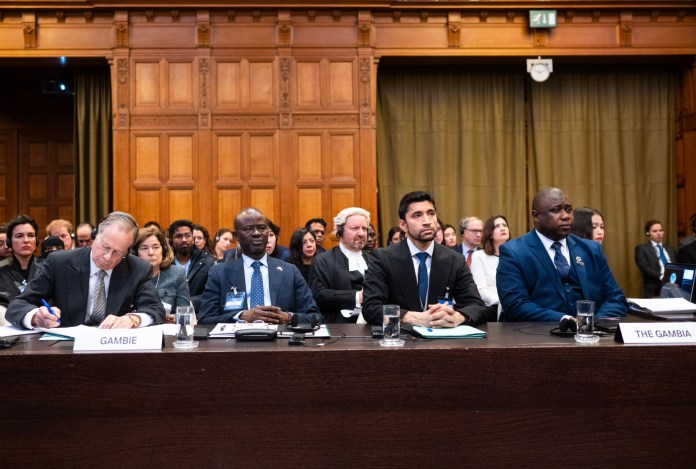
The International Court of Justice opened its public hearings this week in Gambia v. Myanmar. The Gambia maintained its consistent position that Myanmar committed genocide when its armed forces committed acts of violence against members of the Rohingya group—including large-scale killing and widespread rape—with the intent to destroy the Rohingya group, in whole or in part, as such. In contrast, it appears that Myanmar’s position has fundamentally changed. In an earlier proceeding, Myanmar argued that the evidence presented by the Gambia allowed for a reasonable inference that the alleged acts were intended to deport rather than destroy the Rohingya group. But it seems that Myanmar now plans to argue that its actions were carried out in the name of counterterrorism, with the intent to defeat or suppress an armed group. Myanmar’s apparent change in position may prove decisive. To explain why, this article first explores the role of party presentation in the Court’s genocide cases.

Party Presentation

At the ICJ, contentious cases are brought by one State (the applicant) against another (the respondent). The parties present evidence and offer competing explanations of the evidence presented. The Court evaluates the evidence presented to it and considers the explanations offered to it, applying the relevant standard of proof. Each party is master of its own case. Each party is responsible for presenting the evidence and arguments that it wishes the Court to consider. And each party responds to the evidence and arguments presented by the opposing party. The parties present, and the Court decides. This is the principle of party presentation.

Party presentation respects the autonomy of each State to speak in its own voice, whether to allege a violation of its rights or to offer its own account of its conduct, in its own words. Party presentation also facilitates reliable truth-seeking, by clearly defining the issues in dispute so they may be tested through an adversarial process, with each party afforded an opportunity to challenge the evidence or arguments presented by the other. Consider the alternative. Imagine the Court issues a judgment in which it gives decisive weight to evidence not presented by either party, or to an explanation of the evidence not offered by either party. The losing party would be denied the opportunity to contest the reliability of the evidence or the plausibility of the explanation, including the opportunity to gather and present further evidence that might have persuaded the Court. Even the prevailing party may consider their victory a partial defeat, as it may be based on an account of its actions that it rejects. Wisely, the Court typically adheres to the principle of party presentation. (For an arguable exception involving Court-appointed experts, see here.)

In a genocide case, the applicant presents evidence and offers one explanation of the evidence: that the respondent’s officials (or other individuals under the respondent’s effective control) committed genocidal acts with genocidal intent. The respondent may or may not present evidence but, in any case, will offer a competing explanation of the evidence before the Court: that the acts were not committed by its officials (or others it effectively controlled), that the acts were not committed at all, or that the acts were committed with a different intent. The Court evaluates the competing explanations under its established standard of proof. If the Court is fully convinced by the applicant’s explanation of the evidence, then the Court should find that the respondent committed genocide. In contrast, if the Court finds that the respondent’s explanation of the evidence is reasonable, then the Court will not find the applicant’s explanation fully convincing.

Put another way, the Court will not find that a State acted with genocidal intent if another reasonable inference may be drawn from all the evidence before it. But that State must present an alternative inference to the Court and explain why it is reasonable in light of all the evidence. If the State fails to present the Court with a reasonable alternative inference, then it should not expect the Court to find one on its own.

In Bosnia v. Serbia, the Court noted that Serbia’s position “changed in a major way” during the oral proceedings, and “based itself” on the trial and appellate judgments of the International Criminal Tribunal for the former Yugoslavia (ICTY). These ICTY judgments found that the relevant acts of violence were committed with genocidal intent in Srebrenica, but were committed with the intent to displace rather than destroy the Bosnian Muslim group in other regions. The Court agreed. The Court was fully convinced that the Srebrenica massacre was committed with genocidal intent, but found that in other regions “an essential motive of much of the Bosnian Serb leadership—to create a larger Serb State, by a war of conquest if necessary—did not necessarily require the destruction of the Bosnian Muslims and other communities, but their expulsion.” These objectives “were capable of being achieved by the displacement of the population and by territory being acquired, actions which the Respondent accepted (in the latter case at least) as being unlawful.” The Court appeared to accept Serbia’s explanation of the evidence, and found that Serbia had not committed genocide or failed to prevent genocide except in Srebrenica.

In Croatia v. Serbia, the Court emphasized that “Serbia does not contest the systematic and widespread nature of certain attacks. However, it claims that these were intended to force the Croats to leave the regions concerned. In this regard, it cites [cases] in which the ICTY found that the purpose of the attacks on the Croat population was to force it to leave.” In other words, Serbia’s explanation of the evidence was that the attacks were intended to displace the Croat group but not to destroy it. More broadly, Serbia maintained that the evidence “shows a multitude of patterns giving rise to inferences of combat and/or forcible transfer and/or punishment” rather than genocide. The Court found Serbia’s explanation reasonable, drawing heavily on several judgments of the ICTY, and accordingly found that “Croatia has not established that the only reasonable inference that can be drawn from the pattern of conduct it relied upon was the intent to destroy, in whole or in part, the Croat group.”

With respect to Serbia’s counter-claims against Croatia, the Court observed that Croatia “maintains that the purpose of all the acts and statements of the Croatian authorities cited by Serbia was strictly confined to regaining possession of areas under Serb control.” The Court found that it “cannot see in the pattern of conduct on the part of the Croatian authorities … a series of acts which could only reasonably be understood as reflecting the intention, on the part of those authorities, physically to destroy, in whole or in part, the group of Serbs living in Croatia.” The Court could be understood as finding that Serbia failed to show that Croatia’s explanation of the evidence was unreasonable, or simply that Serbia’s own explanation of the evidence was unreasonable or unconvincing on its own terms.

The basic point is that, in each case and context, the Court considered whether the applicant’s explanation of the evidence was fully convincing, or whether the respondent’s explanation of the evidence was reasonable. The Court did not develop its own explanations of the evidence, untested by a rigorous adversarial process.

Myanmar’s Changing Position

Returning to the current proceedings, it appears that Myanmar’s legal strategy has fundamentally changed. In 2019, in response to the Gambia’s request for provisional measures, Myanmar’s counsel argued that there was “a reasonable alternative explanation for the intent behind the alleged acts,” namely the intent to deport the Rohingya group from Myanmar. Myanmar relied extensively on proceedings at the International Criminal Court (ICC), where the Prosecutor sought to open an investigation into whether Myanmar’s officials were individually responsible for the crime against humanity of deportation. According to Myanmar, the ICC proceedings showed that genocidal intent was not the only reasonable inference that may be drawn from the acts alleged. While counsel for Myanmar noted for the record that they “intend no admission or acknowledgment,” their legal strategy was to establish that it was reasonable to infer from the acts alleged an intent to deport rather than destroy the Rohingya. Notably, in 2024, the ICC Prosecutor applied for an arrest warrant for Senior General and acting President Min Aung Hlaing for the crimes against humanity of deportation and persecution of the Rohingya. Although ordinary people may find “crimes against humanity, not genocide” a damning admission rather than a clever defense, it largely worked for Serbia and might have worked for Myanmar as well.

But Myanmar’s legal strategy appears to have changed. It seems that Myanmar no longer plans to argue that its intent was to deport rather than destroy (or that it is reasonable to infer as much). Instead, it seems that Myanmar plans to argue that its armed forces were engaged in counterterrorism operations and their acts were intended to suppress or defeat the Arakan Rohingya Salvation Army (ARSA), an armed Rohingya group operating in northern Myanmar. As the Gambia’s counsel, citing Myanmar’s written submissions, told the Court:

Myanmar’s pattern of conduct, in contrast to that of Serbia, does not permit the Court to reasonably infer that its intent was to forcibly displace, or ethnically cleanse, the Rohingya Muslim group. Myanmar itself does not claim that this was its intent, or that such an intent can be reasonably inferred from its conduct. In fact, Myanmar has consistently denied this. …

Myanmar argues that the “clearance operations” were intended neither to forcibly displace, ethnically cleanse or destroy the Rohingyas as a group. Its only defence of this conduct is to claim that its actions were intended to combat terrorism, specifically to counter the activities of the Arakan Rohingya Salvation Army, referred to by the acronym ARSA throughout the pleadings. The “clearance operations” were exercises in counter-terrorism against ARSA, says Myanmar, not efforts to destroy the Rohingya as a group.

Myanmar’s written submissions are not yet publicly available, but it is unlikely that the Gambia is mischaracterizing them. It seems that the Gambia has relied on Myanmar’s representations and now plans to call its sole expert witness to testify that Myanmar’s acts cannot be reasonably explained as a form of counterterrorism. The Gambia has also focused its oral arguments on refuting Myanmar’s “counter-terrorism narrative” (see here, here, and here). The parties will join issue, and the Court will decide whether the Gambia’s explanation of the evidence (genocide) is fully convincing, or whether Myanmar’s explanation of the evidence (counterterrorism) is reasonable.

It is not hard to see why Myanmar might change its line of defense. Any evidence it might present or argument it might offer at the ICJ to avoid a finding of genocide could be used against its leaders at the ICC on charges of crimes against humanity. Indeed, any evidence or admission of an intent to deport would carry weight at the ICJ precisely because it would be a statement against interest (or at least the interest of its leaders). At the same time, Myanmar’s new line of defense seems less likely to succeed. On its face, the idea that Myanmar’s acts with respect to the Rohingya were exclusively intended to suppress the ARSA appears not only unreasonable but preposterous. While there is no point prejudging Myanmar’s presentation a few days before it will be made, the scale and brutality of the violence directed at civilian members of the Rohingya group, including women and children, makes it difficult to see how the Court could possibly find it reasonable to infer from all the evidence taken together that Myanmar’s acts were exclusively intended to suppress an armed group.

Myanmar may try to revive its original strategy by arguing that the Gambia’s explanation of the evidence is less than fully convincing even if Myanmar’s alternative counterterrorism explanation is unreasonable. The idea here would be that an applicant must persuade the Court both that the respondent’s explanation of the evidence is unreasonable, and also that the evidence strongly supports each element of its claims. An applicant should not automatically win, by default, simply because the respondent’s defense is implausible. Whatever the merits of this idea, based on the first days of the proceedings, it seems unlikely that the Gambia’s case contains some fatal flaw, gap, or oversight that would lead the Court to reject its claims in the absence of a reasonable alternative explanation of the evidence put forward by Myanmar.

Whether a State committed genocide against a particular group is an objective matter of fact and law. But proving genocide at the ICJ is largely a matter of the evidence and arguments presented by the parties. Although the Court interprets the law for itself, it necessarily relies on the parties to bring forward evidence and contest its significance. The ultimate question for the Court is whether the Gambia’s explanation of all the evidence is fully convincing, or whether Myanmar’s explanation of all the evidence is reasonable. If Myanmar does not explain, in detail, how an intent to deport rather than destroy the Rohingya can be reasonably inferred from all the evidence before the Court, then the Court is highly unlikely to do Myanmar’s work for it. Nor should it. It is not the Court’s job to develop possible explanations of the evidence put forward by neither party, then evaluate their reasonableness in light of all the evidence before it without the benefit of adversarial testing. The parties present. The Court decides.

FEATURED IMAGE: Members of the Delegation of The Gambia

Monday 12 January 2026
Photograph: UN Photo/ICJ-CIJ/Frank van Beek. Courtesy of the ICJ. All rights reserved.

Great Job Adil Ahmad Haque & the Team @ Just Security Source link for sharing this story.

Secret Link