About two-thirds of all fresh water on Earth is frozen.
This water is trapped in glaciers, which cover mountains and wind through valleys, and in the massive ice sheets that blanket Greenland and Antarctica.
But as the climate warms, much of that ice is melting and raising sea levels around the world.
Glaciers and ice sheets form as snow piles up on land and compresses down into a thick block of ice.
Each year, many glaciers lose ice in the summer as they melt and chunks break off or calve into the ocean.
Then in winter, when temperatures drop and new snow accumulates, glaciers can build back up again.
But the warming climate is now causing many glaciers and ice sheets to melt faster than they regrow – so they are shrinking dramatically over time.
The Greenland ice sheet, for example, has lost more than 5 trillion tons of ice in just 20 years. That’s about 15 million times the weight of the Empire State Building.
Just hours after Rhonda Swaney left a prenatal appointment for her first pregnancy, she felt severe pain in her stomach and started vomiting.
Then 25 years old and six months pregnant, she drove herself to the emergency room in Ronan, Montana, on the Flathead Indian Reservation, where an ambulance transferred her to a larger hospital 60 miles away in Missoula. Once she arrived, the staff couldn’t detect her baby’s heartbeat. Swaney began to bleed heavily. She delivered a stillborn baby and was hospitalized for several days. At one point, doctors told her to call her family. They didn’t expect her to survive.
“It certainly changed my life — the experience — but my life has not been a bad life,” she told KFF Health News.
Though her experiences were nearly 50 years ago, Swaney, a member of the Confederated Salish and Kootenai Tribes, said Native Americans continue to receive inadequate maternal care. The data appears to support that belief.
In response to this disparity, Native organizations, the CDC, and some states are working to boost tribal participation in state maternal mortality review committees to better track and address pregnancy-related deaths in their communities. Native organizations are also considering ways tribes could create their own committees.
State maternal mortality review committees investigate deaths that occur during pregnancy or within a year after pregnancy, analyze data, and issue policy recommendations to lower death rates.
According to 2021 CDC data, compiled from 46 maternal mortality review committees, 87 percent of maternal deaths in the United States were deemed preventable. Committees reported that most, if not all, deaths among Native American and Alaska Native people were considered preventable.
Native American women face higher rates of death than other demographics.
(Orozco Rodriguez/KFF Health News)
State committees have received federal money through the Preventing Maternal Deaths Act, which President Donald Trump signed in 2018.
But the money is scheduled to dry up on January 31, when the short-term spending bill that ended the government shutdown expires.
Funding for the committees is included in the Labor, Health and Human Services, Education, and Related Agencies appropriations bill for fiscal year 2026. That bill must be approved by the House, Senate, and president to take effect.
Native American leaders said including members of their communities in maternal mortality review committee activities is an important step in addressing mortality disparities.
In 2023, tribal leaders and federal officials met to discuss four models: a mortality review committee for each tribe, a committee for each of the 12 Indian Health Service administrative regions, a national committee to review all Native American maternal deaths, and the addition of Native American subcommittees to state committees.
Whatever the model, tribal sovereignty, experience, and traditional knowledge are important factors, said Kim Moore-Salas, a co-chair of the Arizona Maternal Mortality Review Committee. She’s also the chairperson of the panel’s American Indian/Alaska Native mortality review subcommittee and a member of the Navajo Nation.
“Our matriarchs, our moms, are what carries a nation forward,” she said.
Mental health conditions and infection were the leading underlying causes of pregnancy-related death among Native American and Alaska Native women as of 2021, according to a CDC report that analyzed data from maternal mortality review committees in 46 states.
The CDC found an estimated 68 percent of pregnancy-related deaths among Native American and Alaska Native people happened within a week of delivery to a year postpartum. The majority of those happened between 43 days and a year after birth.
The federal government has a responsibility under signed treaties to provide health care to the 575 federally recognized tribes in the U.S. through the Indian Health Service. Tribal members can receive limited services at no cost, but the agency is underfunded and understaffed.
A study published in 2024 that analyzed data from 2016 to 2020 found that approximately 75 percent of Native American and Alaska Native pregnant people didn’t have access to care through the Indian Health Service around the time of giving birth, meaning many likely sought care elsewhere. More than 90 percent of Native American and Alaska Native births occur outside of IHS facilities, according to the agency. For those who did deliver at IHS facilities, a 2020 report from the Department of Health and Human Services’ Office of Inspector General found that 56 percent of labor and delivery patients received care that did not follow national clinical guidelines.
The 2024 study’s authors also found that members of the population were less likely to have stable insurance coverage and more likely to have a lapse in coverage during the period close to birth than non-Hispanic white people.
Cindy Gamble, who is Tlingit and a tribal community health consultant for the American Indian Health Commission in Washington, has been a member of the state’s maternal mortality review panel for about eight years. In the time she’s been on the state panel, she said, its composition has broadened to include more people of color and community members.
The panel also began to include suicide, overdose, and homicide deaths in its data analysis and added racism and discrimination to the risk factors considered during its case review process.
Solutions need to be tailored to the tribe’s identity and needs, Gamble said.
“It’s not a one-size-fits-all,” Gamble said, “because of all the beliefs and different cultures and languages that different tribes have.”
Gamble’s tenure on the state committee is distinctive. Few states have tribal representation on maternal mortality review committees, according to the National Indian Health Board, a nonprofit organization that advocates for tribal health.
The National Council of Urban Indian Health is also working to increase the participation of urban Indian health organizations, which provide care for Native American people who live outside of reservations, in state maternal mortality review processes. As of 2025, the council had connected urban Indian health organizations to state review committees in California, Kansas, Oklahoma, and South Dakota.
Native leaders such as Moore-Salas find the current efforts encouraging.
“It shows that states and tribes can work together,” she said.
In March 2024, Moore-Salas became the first Native American co-chair of Arizona’s Maternal Mortality Review Committee. In 2025 she and other Native American members of the committee developed guidelines for the American Indian/Alaska Native subcommittee and reviewed the group’s first cases.
The subcommittee is exploring ways to make the data collection and analysis process more culturally relevant to their population, Moore-Salas said.
But it takes time for policy changes to create widespread change in the health of a population, Gamble said. Despite efforts around the country, other factors may hinder the pace of progress. For example, maternity care deserts are growing nationally, caused by rapid hospital and labor and delivery unit closures. Health experts have raised concerns that upcoming cuts to Medicaid will hasten these closures.
Despite her experience and the ongoing crisis among Native American and Alaska Native people, Swaney hopes for change.
She had a second complicated pregnancy soon after her stillbirth. She went into labor about three months early, and the doctors said her son wouldn’t live to the next morning. But he did, and he was transferred about 525 miles away from Missoula to the nearest advanced neonatal unit, in Salt Lake City.
Her son, Kelly Camel, is now 48. He has severe cerebral palsy and profound deafness. He lives alone but has caregivers to help with cooking and other tasks, said Swaney, 73.
He “has a good sense of humor. He’s kind to other people. We couldn’t ask for a more complete child.”
KFF Health News is a national newsroom that produces in-depth journalism about health issues and is one of the core operating programs at KFF— the independent source for health policy research, polling, and journalism.
Great Job Ajohnston & the Team @ The 19th Source link for sharing this story.
For many Black women, higher education has long been framed as both a pathway to security and a form of social currency. But when does the pursuit of another degree serve our growth—and when does it distract us from the work we actually want to do?
In this episode, I’m joined by Melissa Ifill, LCSW for a thoughtful conversation about the “grad school urge,” credential collecting, and the complicated relationship Black women have with education, labor, and legitimacy. Together, we explore the emotional, cultural, and political forces that push so many of us toward advanced degrees—and what it looks like to pause, reflect, and choose intentionally.
About the Podcast
The Therapy for Black Girls Podcast is a weekly conversation with Dr. Joy Harden Bradford, a licensed Psychologist in Atlanta, Georgia, about all things mental health, personal development, and all the small decisions we can make to become the best possible versions of ourselves.
Resources & Announcements
If this episode resonated, JOIN US ON PATREON for a deeper conversation using our Free “Define Your Grad School Why” worksheet, designed to help you slow down and get clear before making a big decision.
We’ll walk through it together during our weekly Sunday Night Live Check-In on Patreon, January 18th.
Sign up for TPR Today, Texas Public Radio’s newsletter that brings our top stories to your inbox each morning.
Velma Lisa Duran took a second day off from work on Monday to represent her sister in the courtroom during the second week of the trial of former Uvalde school police officer Adrian Gonzales.
The trial is being held in Corpus Christi after a judge ruled Gonzales could not get a fair trial in Uvalde, where the 2022 Robb Elementary School shooting took place.
Duran originally planned to drive two hours home to San Antonio after court on Monday so she could return to her classroom and teach the next day. She’s a first-grade teacher.
But sitting in a Corpus Christi hotel room Monday evening, she said she just didn’t have it in her to teach the next day.
“That was the plan for today, go back home, go to work tomorrow. I just can’t. I can barely breathe,” Duran told Texas Public Radio.
One of Velma Duran’s treasured photos with her sister Irma Garcia is the two of them when they were bridesmaids for a friend.
She said it was a very tough day in court. She was taken off guard by how often her sister’s classroom was mentioned, and by autopsy photos of the children who were killed.
Duran’s little sister, Irma Linda Garcia, was killed in the 2022 mass shooting alongside her co-teacher, Eva Mireles, and 19 fourth-grade students.
“Seeing the faces on the screen today, it was just like I couldn’t breathe, and then having to be really quiet, because if you cry, you make an outburst, the chance is that you won’t be able to return. So it was really, really difficult,” she said.
Part of what she’s struggling with is that no criminal charges have been filed for her sister’s death. Adrian Gonzales is on trial for 29 counts of child endangerment for the 19 children who were killed in the shooting, and for 10 more children who survived.
“My sister not being on the indictment … I just, I don’t know. DA Mitchell, the last time I spoke to her, she said it was going to take time… And, you know, to let the process work,” she said.
Duran believed the charges announced more than a year ago were only the beginning, and more charges would come later.
“Now I know no one’s going to take accountability for my sister’s death. It’s like she never existed, and so that’s hitting me really hard right now,” she said.
She said she only learned about two weeks before the trial that there would be no indictment for the teachers.
“It’s always been so difficult to get a hold of DA Mitchell, so I didn’t want to impede her ability to focus on the case, so I sort of just stepped back,” she said.
Uvalde District Attorney Christina Mitchell did not respond to a request for comment.
“Instead of spending my time online and trying to figure things out and going to different platforms, I just sort of just stay away. And it was my way of surviving because it’s been really lonely and difficult,” Duran said.
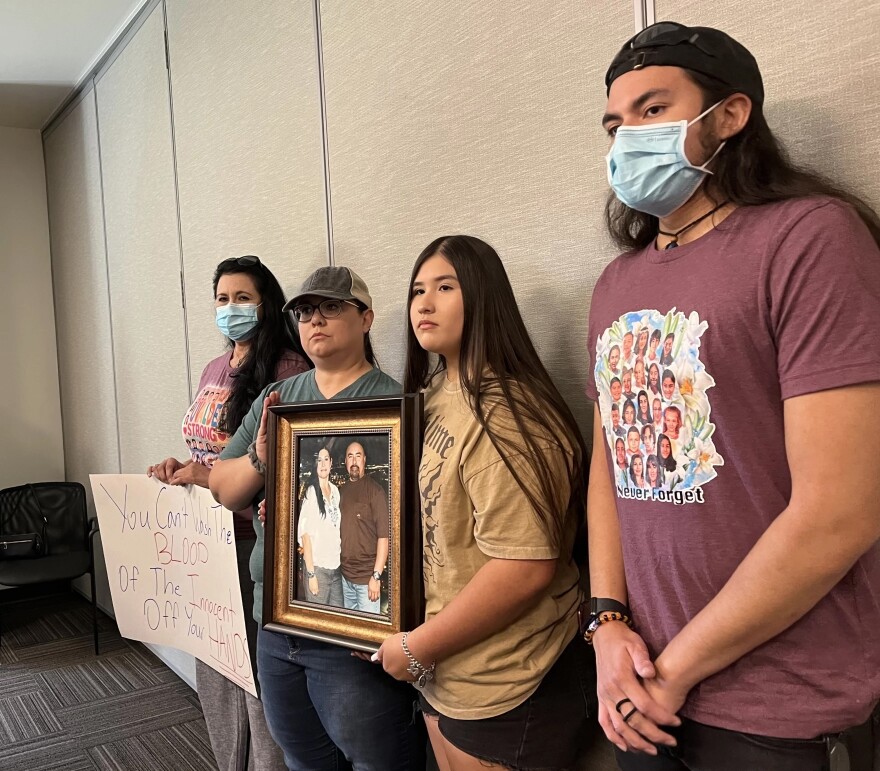
Relatives of Irma and Joe Garcia, including Irma’s sister Velma Duran and their 16-year-old daughter Lyliana, attended Uvalde’s city council meeting June 30, 2022.
Duran added that it’s also really hard to listen to the defense make their case — like when they explained Gonzales’ inaction by pointing to his lack of high-tech gear.
“There’s two wonderful women dead who tried their best to protect their students. They didn’t need a shield, and they didn’t need an AR 15, a pistol. They didn’t need nothing. They used themselves to protect their children. When these men had every opportunity to go in. They were armed,” she said.
Gonzales’s attorneys often call the gunman a monster. But Duran said that misses the point because nearly 400 officers waited more than an hour to confront him — and that everyone who failed her sister and her students shares the blame.
“She lost children. And the children that survived are her kids. Her kids deserve justice. And that’s not justice, putting it all on one officer,” she said.
Duran said she reached a breaking point Tuesday when the defense described Gonzales as a “hero” for finding the key to unlock her sister’s classroom.
“Why are you trying to portray him as a hero? Because at the end, after an hour, he finds the master key? That was just ridiculous. I just couldn’t …” she said.
Now barred from the courtroom, Duran is watching the trial from a distance. She said she worried justice may never come for the children of Uvalde. But even if the jury finds Gonzales guilty of child endangerment, she said it won’t be justice for her sister.
Great Job Camille Phillips & the Team @ Texas Public Radio for sharing this story.
There are thousands of satellites orbiting the Earth, and an increasing number of them are able to capture all types of images in near real time.
It used to be a somewhat cumbersome process to access those images. But Austin-based startup SkyFi has built a platform that acts as a sort of “Getty Images” for more than 50 geospatial imagery partners that has proven popular in the worlds of finance, defense, infrastructure, and insurance — to name a few.
That popularity escalated as SkyFi began offering more analytics and insights to its customers through its website and mobile app, along with the ability to “task” satellites to capture images of a location at a specific time, CEO Luke Fischer recently told TechCrunch in an interview.
“I think the real goal for us is providing answers for customers, both government and commercial,” Fischer said. “Imagery is a commodity, or it’s closely becoming a commodity, [so it’s] not just about speed of delivery, but more importantly, speed of delivery of answers to customers.”
Being able to offer insights along with easy-to-access imagery is a big reason why SkyFi was just able to close a $12.7 million Series A funding round, according to Fischer.
That’s reflected in the investor makeup of the round. It was co-led by climate-focused fund Buoyant Ventures and IronGate Capital Advisors, which invests in dual-use companies. Other investors included DNV Ventures (the investment arm of 160-year-old maritime company DNV), Beyond Earth Ventures (a space-focused firm), and TFX Capital (which has made a number of defense-related space investments).
Fischer said he and co-founder Bill Perkins — who comes from the hedge fund world, hence the emphasis on generating actionable insights — initially only sought to raise a round of about $8 million.
Techcrunch event
San Francisco | October 13-15, 2026
But 2025 was a record year for defense-related investments, and SkyFi received more investor demand than expected, Fischer said. The company upped its target to $10 million, and again to $12 million, before arriving at the $12.7 million figure after some strategic investors joined the round. (One was DNV; Fischer declined to name the other on the record.)
Fischer said SkyFi used to have a harder time convincing satellite imagery providers to hand over access to their data. Now, he said, onboarding new providers is “table stakes.”
“It took a took a little bit for us to get to this point, [but] we have largest virtual constellation of assets. That means we have all the data supply in the world for us, all the different sensor types,” he said. SkyFi has been able to leverage all of that data and, crucially, the many requests it’s received from customers over the last few years to build up analytical offerings worth selling to commercial and government customers.
“We know better than anyone what they’re asking for,” he said.
Fischer said he learned first-hand how powerful this kind of feedback loop can be from his time helping lead Uber’s Elevate division.
“Uber has data on where people move in the world. They layer different products, the bikes, the scooters, the electric aircraft, the drone delivery. We have that equivalent data on what people are looking at in the world they’re asking of that data,” he said. “It gives us a much better purview. And again. We’re software first, so I don’t have the burden of having to pay for hardware capital expenses.”
Some of those customers will want to do their own analytics, like the hedge funds, Fischer explained. But most are increasingly interested in what SkyFi has to offer on the insights side, he said.
The company plans to use the new funding to expand on all this, though Fischer is clearly proud of building a product that is deeply capable but inherently approachable, to the point that even his family uses the product.
“My teenage daughters task satellites for their high school, and now college, homework on their iPhones,” he said.
Great Job Sean O’Kane & the Team @ TechCrunch Source link for sharing this story.
Gayle King knows how to command a room, but sometimes the room decides what it wants to talk about instead. The veteran broadcaster has spent decades shaping conversations and showing up exactly as she is.
However, after being spotted at a Hollywood awards show with a new look, the energy around the Maryland native quickly went from admiration to nitpicking over what she tried to hide in photos.
Gayle King’s red carpet moment shifted from celebration to critique as online attention zeroed in on old pictures of her feet instead of her overall look. (Photo by Steve Granitz/FilmMagic)
Over the past year, King has appeared increasingly confident and visibly slimmer, a shift she has never hidden or dramatized. She has been open about her wellness journey for years. Still, with every high-profile appearance, speculation tends to follow, with people weighing in on her shedded pounds, wondering if she used the weight loss drugs her bestie, Oprah Winfrey, has used.
The same conversation resurfaced after King stepped onto the Golden Globes red carpet in a plunging, figure-hugging gown that highlighted her transformed silhouette. Her feet were covered with heels to match the dress, likely to prevent further ridicule about her toes.
While the look initially drew praise, the focus didn’t stay there for long when the Daily Mail started to dig in deeper on her public journey to getting smaller.
As photos from 2020 recirculated on the site, attention veered away from the dress and landed somewhere far more specific: her feet.
What might have been a fleeting observation quickly took on a life of its own online. Instead of lingering on the gown or King’s overall presentation, Daily Mail readers zeroed in on close-up images and began dissecting details that had little to do with the event itself.
One person wrote, “The pic of her hideous feet is embarrassing.”
Another asked, “All that money she has and she can’t get a pedicure?”
Others went further, with one comment reading, “Gayle and Shaq have the worst looking feet. All that money she has she can get them things fixed.”
Another added, “What is up with those nasty feet? Like some kind of evil demon creature’s hooves.”
One more commenter piled on, saying, “Does she ever get a fresh pedicure??? I would never take a photo of my feet looking like that…much less post it to social media! She still looks like a big girl.”
The reactions illustrated how quickly social media can turn a full red carpet moment into a single-point critique.
This wasn’t the first time King found herself under that kind of microscope.
Last summer, a yacht day photo featuring King alongside Oprah Winfrey and Kris Jenner went viral, prompting a similar cycle of scrutiny. While many admired the image of the longtime friends enjoying a luxurious day together, others focused on King’s wig, then zeroed in on her feet. Even amid wealth, friendship, and ease, the internet found details to debate.
At the same time, King continues to be celebrated for far more than viral moments. She has remained candid about her life, her confidence, and her desire for companionship, speaking openly about wanting love without turning it into a performance.
She has also embraced visibility on her own terms, including posing in swimwear for Sports Illustrated, a move that underscored her comfort with her body and her refusal to fade quietly into the background.
Gayle King is a man
1) blatantly flashing devil horns in a Sports Illustrated Swimsuit issue…a smiling satanist with black hole eyes 2) touching the masonry, big chin, long arms 3) huge mastoids, huge hand with male digits 4) with another dude with a gigantic head, Tyra Banks pic.twitter.com/SLpVy7T4Kj
While the Daily Mail had people talking about her feet, this magazine cover had people talking about her booty.
While critics fixate on what they see as imperfections, others point to King’s consistency, warmth, and willingness to live visibly and honestly. At 71, she remains present, engaged, and unapologetic about occupying space exactly as she is.
And if her toes aren’t polished enough for the world, perhaps the issue is theirs and not hers. People will hate as she enjoys rubbing elbows and tiptoeing on the red carpet with people they only read about.
Great Job Nicole Duncan-Smith & the Team @ Atlanta Black Star Source link for sharing this story.
Plus: All the news and watercooler chat from Fortune.
Good morning. The World Economic Forum published its 2026 Global Risks Report this morning, ahead of its annual meeting in Davos, Switzerland next week. This annual survey of more than 1,300 global leaders and experts shows a fascinating divide in perceptions of short-term and longer-term risks. Most are anxious about physical conflict in the short term, ranking “geoeconomic confrontation” as the most pressing global risk over the next two years. Misinformation and disinformation came second, with societal polarization coming third. Collectively, economic risks showed the largest jump, with more concerns about an economic downturn, inflation and an asset bubble burst
When asked to rank the impact of global risks over the next decade, though, the physical environment came first, with extreme weather events, biodiversity loss and a “critical change to Earth systems” topping the list. The specter of adverse outcomes from AI technologies is seen as a longer-term threat. You can read the full report here.
Why does it matter? For one thing, this is not a public opinion poll but rather a survey of global elites: the political leaders, CEOs, and experts charged with shaping policy in their countries and setting strategy for their companies. Their job is to identify, prioritize, and deal with the risks of today and tomorrow. It’s also a global survey, which illustrates how perceived risks like climate change are playing out in different parts of the world.
WEF’s main value, in my view, is in creating a place for leaders with diverse backgrounds and points of view to learn from each other, to talk about the big problems and partner on the big opportunities. It can also be a place of more talking than listening, with too little focus on those who can’t afford to gather at a Swiss ski resort. But I’ve found it’s a place where leaders are often more reflective, relaxed and ready to debate.
This year, Fortune will create even more opportunities to foster those discussions through expanded programming and coverage. I’ll be joined on the ground by a team that includes editor in chief Alyson Shontell, AI editor Jeremy Kahn, and Kamal Ahmed, executive editorial director for the U.K. and Europe. We’ll bring you dispatches and insights in CEO Daily all week, along with videos, vodcasts and articles. In addition to C-suite lunches, partner events and annual gatherings like Fortune’s Most Powerful Women reception and the Global Leadership dinner, we’re creating Fortune @USA House, a special afternoon program of newsmaker conversations and analysis at USA House, followed by a VIP reception on Jan. 21, when President Trump is expected to speak in Davos.
Curious to know what global risks are on your radar and what you’d like to ask the leaders we meet next week. Contact CEO Daily via Diane Brady at diane.brady@fortune.com
When Ciji Graham visited a cardiologist on Nov. 14, 2023, her heart was pounding at 192 beats per minute, a rate healthy people her age usually reach during the peak of a sprint. She was having another episode of atrial fibrillation, a rapid, irregular heartbeat. The 34-year-old Greensboro, North Carolina, police officer was at risk of a stroke or heart failure.
In the past, doctors had always been able to shock Graham’s heart back into rhythm with a procedure called a cardioversion. But this time, the treatment was just out of reach. After a pregnancy test came back positive, the cardiologist didn’t offer to shock her. Graham texted her friend from the appointment: “Said she can’t cardiovert being pregnant.”
The doctor told Graham to consult three other specialists and her primary care provider before returning in a week, according to medical records. Then she sent Graham home as her heart kept hammering.
Like hundreds of thousands of women each year who enter pregnancy with chronic conditions, Graham was left to navigate care in a country where medical options have significantly narrowed.
As ProPublica has reported, doctors in states that ban abortion have repeatedly denied standard care to high-risk pregnant patients. The expert consensus is that cardioversion is safe during pregnancy, and ProPublica spoke with more than a dozen specialists who said they would have immediately admitted Graham to a hospital to get her heart rhythm under control. They found fault, too, with a second cardiologist she saw the following day, who did not perform an electrocardiogram and also sent her home. Although Graham’s family gave the doctors permission to speak with ProPublica, neither replied to ProPublica’s questions.
Graham came to believe that the best way to protect her health was to end her unexpected pregnancy. But because of new abortion restrictions in North Carolina and nearby states, finding a doctor who could quickly perform a procedure would prove difficult. Many physicians and hospitals now hesitate to discuss abortion, even when women ask about it. And abortion clinics are not set up to treat certain medically complicated cases. As a result, sick pregnant women like Graham are often on their own.
“I can’t feel like this for 9mo,” Graham wrote her friend. “I just can’t.”
She wouldn’t. In a region that had legislated its commitment to life, she would spend her final days struggling to find anyone to save hers.
Carolyn Graham holds a portrait of her daughter Ciji, who was a police officer.Andrea Ellen Reed for ProPublica
Graham hated feeling out of breath; her life demanded all her energy. Widely admired for her skills behind the wheel, she was often called upon to train fellow officers at the Greensboro Police Department. At home, she needed to chase her 2-year-old son, SJ, around the apartment. She was a natural with kids — she’d helped her single mom raise her nine younger siblings.
She thought her surprise pregnancy had caused the atrial fibrillation, also called A-fib. In addition to heart disease, she had a thyroid disorder; pregnancy could send the gland into overdrive, prompting dangerous heart rhythms.
When Graham saw the first cardiologist, Dr. Sabina Custovic, the 192 heart rate recorded on an EKG should have been a clear cause for alarm. “I can’t think of any situation where I would feel comfortable sending anyone home with a heart rate of 192,” said Dr. Jenna Skowronski, a cardiologist at the University of North Carolina. A dozen cardiologists and maternal-fetal medicine specialists who reviewed Graham’s case for ProPublica agreed. The risk of death was low, but the fact that she was also reporting symptoms — severe palpitations, trouble breathing — meant the health dangers were significant.
All the experts said they would have tried to treat Graham with IV medication in the hospital and, if that failed, an electrical shock. Cardioversion wouldn’t necessarily be simple — likely requiring an invasive ultrasound to check for blood clots beforehand — but it was crucial to slow down her heart. A leading global organization for arrhythmia professionals, the Heart Rhythm Society, has issued clear guidance that “cardioversion is safe and effective in pregnancy.”
Even if the procedure posed a small risk to the pregnancy, the risk of not treating Graham was far greater, said Rhode Island cardiologist Dr. Daniel Levine: “No mother, no baby.”
Custovic did not answer ProPublica’s questions about why the pregnancy made her hold off on the treatment or whether abortion restrictions affect her decision-making.
The next day — as her heart continued to thump — Graham saw a second cardiologist, Dr. Will Camnitz, at Cone Health, one of the region’s largest health care systems.
According to medical records, Graham’s pulse registered as normal when taken at Camnitz’s office, as it had at her appointment the previous day. Camnitz noted that the EKG from the day before showed she was in A-fib and prescribed a blood thinner to prepare for a cardioversion in three weeks — if by then she hadn’t returned to a regular heart rhythm on her own.
Some of the experts who reviewed Graham’s care said that this was a reasonable plan if her pulse was, indeed, normal. But Camnitz, who specializes in the electrical activity of the heart, did not order another EKG to confirm that her heart rate had come down from 192, according to medical records. “He’s an electrophysiologist and he didn’t do that, which is insane,” said Dr. Kayle Shapero, a cardio-obstetrics specialist at Brown University. According to experts, a pulse measurement can underestimate the true heart rate of a patient in A-fib. Every cardiologist who reviewed Graham’s care for ProPublica said that a repeat EKG would be best practice. If Graham’s rate was still as high as it was the previous day, her heart could eventually stop delivering enough blood to major organs. Camnitz did not answer ProPublica’s questions about why he didn’t administer this test.
Three weeks was a long time to wait with a heart that Graham kept saying was practically leaping out of her chest.
Ciji Graham’s business card from the Greensboro Police Department hangs on the fridge in Shawn Scott’s home above a baby picture of their son, SJ. Graham used to leave love notes on the fridge for Scott before she left for work.Andrea Ellen Reed for ProPublica
Camnitz knew about Graham’s pregnancy but did not discuss whether she wanted to continue it or advise her on her options, according to medical records. That same day, though, Graham reached out to A Woman’s Choice, the sole abortion clinic in Greensboro.
North Carolina bans abortion after 12 weeks; Graham was only about six weeks pregnant. Still, there was a long line ahead of her. Women were flooding the state from Tennessee, Georgia and South Carolina, where new abortion bans were even stricter. On top of that, a recent change in North Carolina law required an in-person consent visit three days before a termination. The same number of patients were now filling twice as many appointment slots.
Graham would need to wait nearly two weeks for an abortion.
It’s unclear if she explained her symptoms to the clinic; A Woman’s Choice spokesperson said it routinely discards appointment forms and no longer had a copy of Graham’s. But the spokesperson told ProPublica that a procedure at the clinic would not have been right for Graham; because of her high heart rate, she would have needed a hospital with more resources.
Dr. Jessica Tarleton, an abortion provider who spent the past few years working in the Carolinas, said she frequently encountered pregnant women with chronic conditions who faced this kind of catch-22: Their risks were too high to be treated in a clinic, and it would be safest to get care at a hospital, but it could be very hard to find one willing to terminate a pregnancy.
In states where abortions have been criminalized, many hospitals have shied away from sharing information about their policies on abortion. Cone Health, where Graham typically went for care, would not tell ProPublica whether its doctors perform abortions and under what circumstances; it said, “Cone Health provides personalized and individualized care to each patient based on their medical needs while complying with state and federal laws.”
Graham never learned that she would need an abortion at a hospital rather than a clinic. Physicians at Duke University and the University of North Carolina, the premier academic medical centers in the state, said that she would have been able to get one at their hospitals — but that would have required a doctor to connect her or for Graham to have somehow known to show up.
Had Graham lived in another country, she may not have faced this maze alone.
In the United Kingdom, for example, a doctor trained in caring for pregnant women with risky medical conditions would have been assigned to oversee all of Graham’s care, ensuring it was appropriate, said Dr. Marian Knight, who leads the U.K.’s maternal mortality review program. Hospitals in the U.K. also must abide by standardized national protocols or face regulatory consequences. Researchers point to these factors, as well as a national review system, as key to the country’s success in lowering its rate of maternal death. The maternal mortality rate in the U.S. is more than double that of the U.K. and last on the list of wealthy countries.
Graham’s friend Shameka Jackson could tell that something was wrong. Graham didn’t seem like her usual “perky and silly” self, Jackson said. On the phone, she sounded weak, her voice barely louder than a whisper.
When Jackson offered to come over, Graham said it would be a waste of time. “There’s nothing you can do but sit with me,” Jackson said she replied. “The doctors ain’t doing nothing.”
Graham no longer cooked or played with her son after work, said her boyfriend, Shawn Scott. She stopped hoisting SJ up to let him dunk on the hoop on the closet door. Now, she headed straight for the couch and barely spoke, except to say that no one would shock her heart.
“I hate feeling like this,” she texted Jackson. “Ain’t slept, chest hurts.”
“All I can do is wait until the 28th,” Graham said, the date of her scheduled abortion.
Scott sits on a bed in the apartment complex where he once lived with Graham.Andrea Ellen Reed for ProPublica
On the morning of Nov. 19, Scott awoke to a rap on the front door of the apartment he and Graham shared. He’d been asleep on the couch after a night out with friends and thought that Graham had left for work.
A police officer introduced himself and explained that Graham hadn’t shown up and wasn’t answering her phone. He knew she hadn’t been feeling well and wanted to check in.
Most mornings, Graham was up around 5 a.m. to prepare for the day. With Scott, she would brush SJ’s teeth, braid his hair and dress him in stylish outfits, complete with Jordans or Chelsea boots.
When Scott walked into their bedroom, Graham was face down in bed, her body cold when he touched her. The two men pulled her down to the floor to start CPR, but it was too late. SJ stood in his crib, silently watching as they realized.
The medical examiner would list Graham’s cause of death as “cardiac arrhythmia due to atrial fibrillation in the setting of recent pregnancy.” There was no autopsy, which could have identified the specific complication that led to her death.
Scott shows a collage of photos from his relationship with Graham.Andrea Ellen Reed for ProPublica
High-risk pregnancy specialists and cardiologists who reviewed Graham’s case were taken aback by Custovic’s failure to act urgently. Many said her decisions reminded them of behaviors they’ve seen from other cardiologists when treating pregnant patients; they attribute this kind of hesitation to gaps in education. Although cardiovascular disease is the leading cause of death in pregnant women, a recent survey developed with the American College of Cardiology found that less than 30% of cardiologists reported formal training in managing heart conditions in pregnancy. “A large proportion of the cardiology workforce feels uncomfortable providing care to these patients,” the authors concluded in the Journal of the American Heart Association. The legal threats attached to abortion bans, many doctors have told ProPublica, have made some cardiologists even more conservative.
Custovic did not answer ProPublica’s questions about whether she felt she had adequate training. A spokesperson for Cone Health, where Camnitz works, said, “Cone Health’s treatment for pregnant women with underlying cardiac disease is consistent with accepted standards of care in our region.” Although Graham’s family gave the hospital permission to discuss Graham’s care with ProPublica, the hospital did not comment on specifics.
Three doctors who have served on state maternal mortality review committees, which study the deaths of pregnant women, told ProPublica that Graham’s death was preventable. “There were so many points where they could have intervened,” said Dr. Amelia Huntsberger, a former member of Idaho’s panel.
Shawn “SJ” Scott Jr. at his aunt’s house in Kannapolis, North CarolinaAndrea Ellen Reed for ProPublica
The week after she died, Graham’s family held a candlelight ceremony outside of her high school, which drew friends and cops in uniform, and also Greensboro residents whose lives she had touched. One woman approached Graham’s sisters and explained Graham had interrupted her suicide attempt five years earlier and reassured her that her life had value; she had recently texted Graham, “If it wasn’t for you, I wouldn’t be here today, expecting my first child.”
As for Graham’s own son, no one explained to SJ that his mother had died. They didn’t know how to describe death to a toddler. Instead, his dad and grandmother and aunts and uncles told him that his mom had left Earth and gone to the moon. SJ now calls it the “Mommy moon.”
For the past two years, every night before bed, he asks to go outside, even on the coldest winter evenings. He points to the moon in the dark sky and tells his mother that he loves her.
Great Job Lizzie Presser & the Team @ ProPublica Source link for sharing this story.