
Home News Page 66

Forget the K-Shape: We have a barbell economy—and the middle class is buckling under the weight | Fortune

Forget the K-Shape: We have a barbell economy—and the middle class is buckling under the weight | Fortune

If you look at the aggregate numbers, the U.S. economy in early 2026 appears resilient. GDP is humming and the soft landing engineered by the Federal Reserve seems to have held. But aggregates are often optical illusions. As a gender economist who analyzes disaggregated data, I do not see a resilient system. I see a dangerously brittle one.

We have transitioned from a K-shaped recovery into a Barbell Economy, a system heavily weighted at the extremes of wealth and precarity, connected by a middle class that is rapidly snapping.

By concentrating wealth, assets, and leverage in a specific, homogenous demographic while hollowing out the economic stabilizers traditionally provided by women and people of color, we have engineered a single point of failure. We have built an economy with a massive engine and insufficient braking mechanisms.

Here is the anatomy of that fracture, and why the next recession won’t be caused by a labor collapse, but by a demographic margin call.

The Risk of the Fragile Top

The prevailing wisdom in corporate boardrooms for the last three years has been simple: Pivot to the premium consumer. As inflation eroded the purchasing power of the middle class, companies shifted strategies to chase the resilient top 20%.

This was a strategic error based on a misunderstanding of risk.

The prosperity of this top cohort is not driven by wage growth. While their wages have risen, they have stagnated relative to the explosive returns on capital. Instead, their consumption is driven by the “Wealth Effect.” New analysis shows that 70% of recent economic growth is now driven by just 20% of earners. These consumers aren’t spending wages; they are spending paper gains tethered to a market bubble.

This makes U.S. GDP effectively a leveraged bet on the sentiment of a single cohort. With the CAPE ratio (Cyclical Adjusted Price-to-Earnings) at its highest level since the Dot-Com bubble, the market they rely on is dangerously extended. Furthermore, the engine is tiny: the top 10 companies now comprise 40% of the S&P 500’s value, a historic concentration risk.

When the market corrects, this group doesn’t just taper spending; they freeze it.

We are already seeing the cracks. The aspirational consumer, the wage-earning professional in the 80th to 95th percentile, has retreated. They are the bridge between the middle class and the wealthy. Yet, in 2025, they reduced luxury spending by roughly 35%.

This retreat exposes the structural flaw. It leaves the economy dependent on the 95th to 99th percentile, the asset-rich households. While wealthy, this cohort is not immune; their consumption is psychologically tethered to their portfolio balance. When the S&P 500 drops, they feel significantly poorer and freeze discretionary spending. In a healthy economy, the middle and working classes provide a floor of stable demand that cushions this volatility.

In 2026, there is no one there to catch it.

The Missing Floor: A Failure of Redundancy

In portfolio theory, redundancy is safety. You hedge volatile assets with stable ones. In an economy, women and people of color have historically acted as that hedge, providing the inelastic demand for care, food, and community services that keeps an economy moving when financial markets seize up.

But we have stripped that floor away. While the top 20% spends paper gains, the bottom 80% is currently financing groceries with shadow debt, having fully depleted their pandemic-era savings buffers.

My analysis of 2020–2025 data shows that the handle of the barbell, the shock absorbers of the economy, has been decimated.

This is not a social justice issue; it is a liquidity crisis.

The subprime auto loan market is currently flashing red, with delinquency rates surpassing 2008 levels. But the risk isn’t contained to car lots; it is moving upstream into asset-backed securities (ABS) held by pension funds and insurers. We are learning the hard way that you cannot build a AAA-rated financial system on the back of a subprime workforce.

The Corporate “Premium Trap”

For the Fortune 500, this demographic concentration has created a premium trap.

By chasing the top of the barbell, companies like Starbucks and Target have exposed their earnings to the specific volatility of the affluent consumer. We are seeing a gentrification by basket, where Walmart reports that its primary growth is coming from households earning over $100,000.

This is not a sign of health; it is a sign of distress. Analysis shows that 80% of luxury sector growth since 2019 was driven by price hikes rather than sales volume. Companies are priced for perfection in an economy that is running on fumes.

Diversity is a Hedge

It is time to stop viewing equity as a moral preference or a CSR initiative. In 2026, equity is structural risk management.

An economy that relies on the asset-derived spending of a homogenous top 10% is inherently unstable. It is subject to groupthink, correlated panic, and rapid contraction. This dependency on the wealth effect accounts for 0.3% of annualized consumption growth, growth we cannot afford to lose in a low-margin world.

To stabilize the U.S. economy, we must diversify our shareholder base. We need to capitalize the real economy,  Black and Latina women who are currently the most under-utilized assets in the nation. By clearing the capital bottlenecks for Latina entrepreneurs and closing the wage arbitrage that drains Black and Native households, we unlock $3.1 trillion in economic growth. Closing the wealth gap is not charity; it is the only way to build a floor under the stock market.

We do not diversify our economy to be nice. We diversify so that when the top weight of the barbell slips, the whole system doesn’t collapse.

The opinions expressed in Fortune.com commentary pieces are solely the views of their authors and do not necessarily reflect the opinions and beliefs of Fortune.

This story was originally featured on Fortune.com

Great Job Katica Roy & the Team @ Fortune | FORTUNE Source link for sharing this story.

American international Sam Coffey signs for Man City

American international Sam Coffey signs for Man City

MANCHESTER – United States midfielder Sam Coffey joined Manchester City from the Portland Thorns on Wednesday, signing a 3 1/2-year contract.

The fee was worth a reported $800,000.

Coffey, who won Olympic gold and the SheBelieves Cup with the USWNT, was described by City as one of the best players in the world.

“Sam is playing at the top of her game, and I think her decision to come here shows the incredible progress we’ve made as a club and the ambitions we have moving forward,” said City director of football Therese Sjogran.

City hopes the 27-year-old Coffey will help lead the club to the Women’s Super League title this season, with Andree Jeglertz’s team currently top of the standings. Its only league title came back in 2016, with Chelsea dominating the division over the past 11 years.

“It’s a club with so much history, so much success, so much influence in the city,” Coffey said about City. “I think it’s also a place that just has proven its investment in women’s soccer and being a part of this movement that is going on.”

Coffey won the NWSL championship with Portland.

“Sam’s reputation as one of the world’s best speaks for itself, and we’re delighted she’s chosen to come here ahead of other potential suitors,” Sjogran said. “We believe she has all the qualities needed to thrive at City and, more broadly, the WSL, and we’re excited to see how she can elevate our already superb squad of players.”

___

AP soccer: https://apnews.com/hub/soccer

Copyright 2026 The Associated Press. All rights reserved. This material may not be published, broadcast, rewritten or redistributed without permission.

Great Job Associated Press & the Team @ KSAT San Antonio Source link for sharing this story.

Proving Genocide: Party Presentation

Proving Genocide: Party Presentation

The International Court of Justice opened its public hearings this week in Gambia v. Myanmar. The Gambia maintained its consistent position that Myanmar committed genocide when its armed forces committed acts of violence against members of the Rohingya group—including large-scale killing and widespread rape—with the intent to destroy the Rohingya group, in whole or in part, as such. In contrast, it appears that Myanmar’s position has fundamentally changed. In an earlier proceeding, Myanmar argued that the evidence presented by the Gambia allowed for a reasonable inference that the alleged acts were intended to deport rather than destroy the Rohingya group. But it seems that Myanmar now plans to argue that its actions were carried out in the name of counterterrorism, with the intent to defeat or suppress an armed group. Myanmar’s apparent change in position may prove decisive. To explain why, this article first explores the role of party presentation in the Court’s genocide cases.

Party Presentation

At the ICJ, contentious cases are brought by one State (the applicant) against another (the respondent). The parties present evidence and offer competing explanations of the evidence presented. The Court evaluates the evidence presented to it and considers the explanations offered to it, applying the relevant standard of proof. Each party is master of its own case. Each party is responsible for presenting the evidence and arguments that it wishes the Court to consider. And each party responds to the evidence and arguments presented by the opposing party. The parties present, and the Court decides. This is the principle of party presentation.

Party presentation respects the autonomy of each State to speak in its own voice, whether to allege a violation of its rights or to offer its own account of its conduct, in its own words. Party presentation also facilitates reliable truth-seeking, by clearly defining the issues in dispute so they may be tested through an adversarial process, with each party afforded an opportunity to challenge the evidence or arguments presented by the other. Consider the alternative. Imagine the Court issues a judgment in which it gives decisive weight to evidence not presented by either party, or to an explanation of the evidence not offered by either party. The losing party would be denied the opportunity to contest the reliability of the evidence or the plausibility of the explanation, including the opportunity to gather and present further evidence that might have persuaded the Court. Even the prevailing party may consider their victory a partial defeat, as it may be based on an account of its actions that it rejects. Wisely, the Court typically adheres to the principle of party presentation. (For an arguable exception involving Court-appointed experts, see here.)

In a genocide case, the applicant presents evidence and offers one explanation of the evidence: that the respondent’s officials (or other individuals under the respondent’s effective control) committed genocidal acts with genocidal intent. The respondent may or may not present evidence but, in any case, will offer a competing explanation of the evidence before the Court: that the acts were not committed by its officials (or others it effectively controlled), that the acts were not committed at all, or that the acts were committed with a different intent. The Court evaluates the competing explanations under its established standard of proof. If the Court is fully convinced by the applicant’s explanation of the evidence, then the Court should find that the respondent committed genocide. In contrast, if the Court finds that the respondent’s explanation of the evidence is reasonable, then the Court will not find the applicant’s explanation fully convincing.

Put another way, the Court will not find that a State acted with genocidal intent if another reasonable inference may be drawn from all the evidence before it. But that State must present an alternative inference to the Court and explain why it is reasonable in light of all the evidence. If the State fails to present the Court with a reasonable alternative inference, then it should not expect the Court to find one on its own.

In Bosnia v. Serbia, the Court noted that Serbia’s position “changed in a major way” during the oral proceedings, and “based itself” on the trial and appellate judgments of the International Criminal Tribunal for the former Yugoslavia (ICTY). These ICTY judgments found that the relevant acts of violence were committed with genocidal intent in Srebrenica, but were committed with the intent to displace rather than destroy the Bosnian Muslim group in other regions. The Court agreed. The Court was fully convinced that the Srebrenica massacre was committed with genocidal intent, but found that in other regions “an essential motive of much of the Bosnian Serb leadership—to create a larger Serb State, by a war of conquest if necessary—did not necessarily require the destruction of the Bosnian Muslims and other communities, but their expulsion.” These objectives “were capable of being achieved by the displacement of the population and by territory being acquired, actions which the Respondent accepted (in the latter case at least) as being unlawful.” The Court appeared to accept Serbia’s explanation of the evidence, and found that Serbia had not committed genocide or failed to prevent genocide except in Srebrenica.

In Croatia v. Serbia, the Court emphasized that “Serbia does not contest the systematic and widespread nature of certain attacks. However, it claims that these were intended to force the Croats to leave the regions concerned. In this regard, it cites [cases] in which the ICTY found that the purpose of the attacks on the Croat population was to force it to leave.” In other words, Serbia’s explanation of the evidence was that the attacks were intended to displace the Croat group but not to destroy it. More broadly, Serbia maintained that the evidence “shows a multitude of patterns giving rise to inferences of combat and/or forcible transfer and/or punishment” rather than genocide. The Court found Serbia’s explanation reasonable, drawing heavily on several judgments of the ICTY, and accordingly found that “Croatia has not established that the only reasonable inference that can be drawn from the pattern of conduct it relied upon was the intent to destroy, in whole or in part, the Croat group.”

With respect to Serbia’s counter-claims against Croatia, the Court observed that Croatia “maintains that the purpose of all the acts and statements of the Croatian authorities cited by Serbia was strictly confined to regaining possession of areas under Serb control.” The Court found that it “cannot see in the pattern of conduct on the part of the Croatian authorities … a series of acts which could only reasonably be understood as reflecting the intention, on the part of those authorities, physically to destroy, in whole or in part, the group of Serbs living in Croatia.” The Court could be understood as finding that Serbia failed to show that Croatia’s explanation of the evidence was unreasonable, or simply that Serbia’s own explanation of the evidence was unreasonable or unconvincing on its own terms.

The basic point is that, in each case and context, the Court considered whether the applicant’s explanation of the evidence was fully convincing, or whether the respondent’s explanation of the evidence was reasonable. The Court did not develop its own explanations of the evidence, untested by a rigorous adversarial process.

Myanmar’s Changing Position

Returning to the current proceedings, it appears that Myanmar’s legal strategy has fundamentally changed. In 2019, in response to the Gambia’s request for provisional measures, Myanmar’s counsel argued that there was “a reasonable alternative explanation for the intent behind the alleged acts,” namely the intent to deport the Rohingya group from Myanmar. Myanmar relied extensively on proceedings at the International Criminal Court (ICC), where the Prosecutor sought to open an investigation into whether Myanmar’s officials were individually responsible for the crime against humanity of deportation. According to Myanmar, the ICC proceedings showed that genocidal intent was not the only reasonable inference that may be drawn from the acts alleged. While counsel for Myanmar noted for the record that they “intend no admission or acknowledgment,” their legal strategy was to establish that it was reasonable to infer from the acts alleged an intent to deport rather than destroy the Rohingya. Notably, in 2024, the ICC Prosecutor applied for an arrest warrant for Senior General and acting President Min Aung Hlaing for the crimes against humanity of deportation and persecution of the Rohingya. Although ordinary people may find “crimes against humanity, not genocide” a damning admission rather than a clever defense, it largely worked for Serbia and might have worked for Myanmar as well.

But Myanmar’s legal strategy appears to have changed. It seems that Myanmar no longer plans to argue that its intent was to deport rather than destroy (or that it is reasonable to infer as much). Instead, it seems that Myanmar plans to argue that its armed forces were engaged in counterterrorism operations and their acts were intended to suppress or defeat the Arakan Rohingya Salvation Army (ARSA), an armed Rohingya group operating in northern Myanmar. As the Gambia’s counsel, citing Myanmar’s written submissions, told the Court:

Myanmar’s pattern of conduct, in contrast to that of Serbia, does not permit the Court to reasonably infer that its intent was to forcibly displace, or ethnically cleanse, the Rohingya Muslim group. Myanmar itself does not claim that this was its intent, or that such an intent can be reasonably inferred from its conduct. In fact, Myanmar has consistently denied this. …

Myanmar argues that the “clearance operations” were intended neither to forcibly displace, ethnically cleanse or destroy the Rohingyas as a group. Its only defence of this conduct is to claim that its actions were intended to combat terrorism, specifically to counter the activities of the Arakan Rohingya Salvation Army, referred to by the acronym ARSA throughout the pleadings. The “clearance operations” were exercises in counter-terrorism against ARSA, says Myanmar, not efforts to destroy the Rohingya as a group.

Myanmar’s written submissions are not yet publicly available, but it is unlikely that the Gambia is mischaracterizing them. It seems that the Gambia has relied on Myanmar’s representations and now plans to call its sole expert witness to testify that Myanmar’s acts cannot be reasonably explained as a form of counterterrorism. The Gambia has also focused its oral arguments on refuting Myanmar’s “counter-terrorism narrative” (see here, here, and here). The parties will join issue, and the Court will decide whether the Gambia’s explanation of the evidence (genocide) is fully convincing, or whether Myanmar’s explanation of the evidence (counterterrorism) is reasonable.

It is not hard to see why Myanmar might change its line of defense. Any evidence it might present or argument it might offer at the ICJ to avoid a finding of genocide could be used against its leaders at the ICC on charges of crimes against humanity. Indeed, any evidence or admission of an intent to deport would carry weight at the ICJ precisely because it would be a statement against interest (or at least the interest of its leaders). At the same time, Myanmar’s new line of defense seems less likely to succeed. On its face, the idea that Myanmar’s acts with respect to the Rohingya were exclusively intended to suppress the ARSA appears not only unreasonable but preposterous. While there is no point prejudging Myanmar’s presentation a few days before it will be made, the scale and brutality of the violence directed at civilian members of the Rohingya group, including women and children, makes it difficult to see how the Court could possibly find it reasonable to infer from all the evidence taken together that Myanmar’s acts were exclusively intended to suppress an armed group.

Myanmar may try to revive its original strategy by arguing that the Gambia’s explanation of the evidence is less than fully convincing even if Myanmar’s alternative counterterrorism explanation is unreasonable. The idea here would be that an applicant must persuade the Court both that the respondent’s explanation of the evidence is unreasonable, and also that the evidence strongly supports each element of its claims. An applicant should not automatically win, by default, simply because the respondent’s defense is implausible. Whatever the merits of this idea, based on the first days of the proceedings, it seems unlikely that the Gambia’s case contains some fatal flaw, gap, or oversight that would lead the Court to reject its claims in the absence of a reasonable alternative explanation of the evidence put forward by Myanmar.

Whether a State committed genocide against a particular group is an objective matter of fact and law. But proving genocide at the ICJ is largely a matter of the evidence and arguments presented by the parties. Although the Court interprets the law for itself, it necessarily relies on the parties to bring forward evidence and contest its significance. The ultimate question for the Court is whether the Gambia’s explanation of all the evidence is fully convincing, or whether Myanmar’s explanation of all the evidence is reasonable. If Myanmar does not explain, in detail, how an intent to deport rather than destroy the Rohingya can be reasonably inferred from all the evidence before the Court, then the Court is highly unlikely to do Myanmar’s work for it. Nor should it. It is not the Court’s job to develop possible explanations of the evidence put forward by neither party, then evaluate their reasonableness in light of all the evidence before it without the benefit of adversarial testing. The parties present. The Court decides.

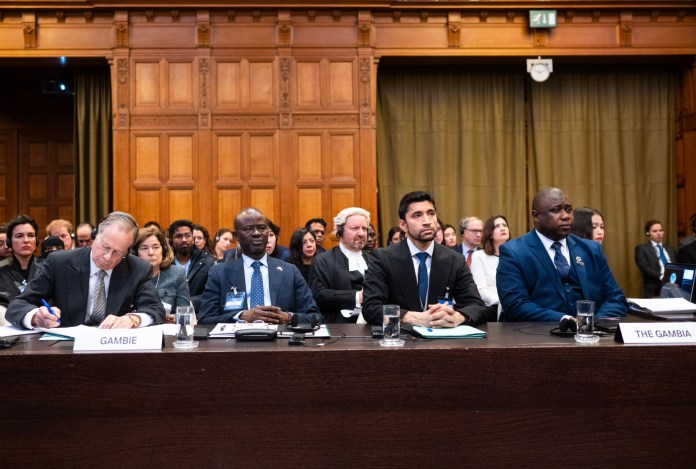
FEATURED IMAGE: Members of the Delegation of The Gambia

Monday 12 January 2026
Photograph: UN Photo/ICJ-CIJ/Frank van Beek. Courtesy of the ICJ. All rights reserved.

Great Job Adil Ahmad Haque & the Team @ Just Security Source link for sharing this story.
Sybil Wilkes Breaks Down What We Need to Know: January 14, 2026

Sybil Wilkes Breaks Down What We Need to Know: January 14, 2026

Source: Reach Media / Radio One

Sybil Wilkes delivers the latest on “What We Need to Know,” keeping our community informed and empowered. From serious questions about accountability in the justice system to celebrating the unsung heroes of our history, here is the breakdown of the top stories impacting Black America today.

Justice Department Resignations Raise Concerns

Concerns are growing over the integrity of the Justice Department following the resignation of at least three federal prosecutors in Minnesota. The prosecutors stepped down due to the department’s handling of the investigation into the fatal shooting of Renee Nicole Good by an ICE agent. Minnesota Governor Tim Walz expressed his support for one of the departing attorneys, describing them as a “principled public servant.” He suggested the resignations are a troubling sign of political pressure forcing dedicated career professionals out of the Justice Department, raising questions about accountability and justice in cases involving law enforcement.

Remembering Claudette Colvin

The community mourns the loss of a true civil rights pioneer, Claudette Colvin, who passed away at the age of 86. The Claudette Colvin Legacy Foundation confirmed her death. At just 15 years old in 1955, Ms. Colvin bravely refused to give up her seat on a segregated bus in Montgomery, Alabama, months before Rosa Parks’ more widely known act of protest. Her arrest was a pivotal moment that helped ignite the modern civil rights movement. Colvin later became a key plaintiff in the landmark legal case that successfully challenged and ended bus segregation in Montgomery, securing a victory that changed the course of American history.

2026 Tax Season Begins

As we move into the new year, it’s time to get your finances in order. The IRS has officially announced that the 2026 tax season will begin on Monday, January 26. This is the date the agency will start accepting and processing federal tax returns for the 2025 tax year. Taxpayers should be on the lookout for important documents. Employers are required to send out W-2 forms by January 31. Additionally, most 1099 forms, which report non-wage income, are also expected to be mailed by the end of January. Organizing your documents now will help ensure a smoother filing process.

Elderly Fraud Case Resolved

Finally, in a piece of good news that shows the power of community and media, an 83-year-old Dallas resident has found resolution. Mrs. Billy Young, who had been fighting her bank for over a year regarding a fraud case involving an altered check, saw her situation resolved just days after a local TV station shared her story. Her bank initially claimed she had missed a 30-day deadline to report the fraud, a deadline she argued was impossible to meet since she was unaware the check had been altered. After the story aired, Wells Fargo quickly contacted Mrs. Young, reversed its previous decision, and confirmed the issue was settled.

Great Job Nia Noelle & the Team @ Black America Web Source link for sharing this story.

Illinois’ booming solar sector entices young job seekers

Illinois’ booming solar sector entices young job seekers

Sergio Mendez was tired of earning a living by working security in nightclubs. So the 22-year-old resident of Chicago’s Southwest Side decided to make a big change, enrolling in a 10-week program that promised to teach him the fundamental skills needed to pursue a career in the solar industry.

I was just dealing with a lot of drunk people. I wanted to get out of it,” Mendez said of his former job. Now he envisions a future as a solar salesperson or installer. In late December, he graduated alongside six other young adults enrolled in the course, run by Elevate, a national clean-energy nonprofit based in Chicago.

Illinois has emerged as a solar leader in recent years, thanks in large part to its robust incentives and its mandates that utilities get an increasing amount of electricity from renewables. In 2024, the state ranked fourth nationwide in terms of new solar capacity, with over 2,800 megawatts installed, and it added another 815 megawatts in the first three quarters of 2025, according to a December report by consultancy Wood Mackenzie and the Solar Energy Industries Association.

The industry’s momentum translates to lots of employment opportunities: The Solar Energy Industries Association counted almost 6,000 solar jobs in Illinois in 2025, and it projects that the state will add close to another 15,000 megawatts of solar over the next five years.

With energy demand growing — some would say, out of control — solar is the fastest [generation source] to deploy,” said J.D. Smith, a spokesperson for the Wisconsin-based solar installer Arch Electric. From a technical standpoint, if you’re trying to power the grid, [solar] is such a good decision. You can get it cheap and fast, and it’s repeatable.”

Companies expanding to meet that demand are eager to snap up graduates of workforce development programs.

In the past year, Arch — one of the employers at a December job fair for Mendez and his peers — has hired 14 graduates of training programs run by Elevate and other Chicago-area nonprofits. Seven of those individuals are already in apprenticeships to become certified electricians.

If you know at least 50% of the people you hire from these organizations will want to be an apprentice and invest in their future with your organization, that makes it a business no-brainer,” Smith said.

Solar companies also rely on training programs to produce qualified candidates from what the state has defined as equity” communities, he explained. Under Illinois’ 2021 clean-energy law, firms can access incentives for hiring individuals from these areas, which face disproportionate amounts of pollution and have historically been excluded from economic opportunities.

Great Job Kari Lydersen & the Team @ Canary Media Source link for sharing this story.
The Fed Is Quietly Bailing Out Wall Street

The Fed Is Quietly Bailing Out Wall Street

The Federal Reserve has quietly delivered nearly half a trillion dollars to Wall Street with few strings attached over the past few months through an obscure government financial program intended for banks struggling to make cash payments.

These cash infusions could signal instability in the broader financial sector — and come as the central bank is besieged by potentially market-rattling turmoil following the Trump administration’s launch of a criminal investigation into Federal Reserve chair Jerome Powell.

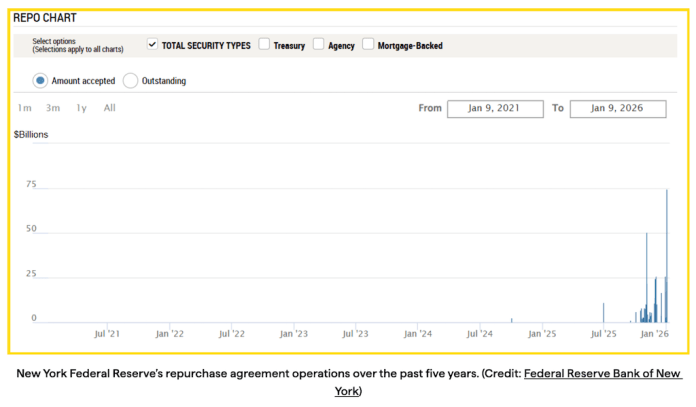
The New York Federal Reserve, a regional branch of the larger central bank that works to maintain the country’s financial stability, kicked off the new year by dumping nearly $97 billion into the banking sector since December 31, 2025.

The move is the latest in a series of major cash transfers the New York Federal Reserve has recently delivered to Wall Street.

The infusions began with an $11 billion transfer on June 30. In October, the transfers became much more frequent, culminating in a massive $50 billion infusion on Halloween, as first reported by investigative news outlet DCReport. In total, after doling out little to no money since July 2020, the New York Federal Reserve has transferred more than $420 billion to Wall Street in the past seven months — a record amount from the program.

For comparison, that lump sum is nearly equivalent to the pot of money that Congress passed to bail out the banks during the 2008 financial crisis under the Troubled Asset Relief Program.

Amid the deluge, the central bank has encouraged Wall Street to make use of the program and lifted its $500 billion cap on such transactions, meaning there is no limit to how much banks can borrow to meet their cash liquidity needs.

All of these cash infusions — issued through an arcane and newly restructured division of the New York Federal Reserve branch — amount to some of the largest cash bailouts since the COVID-19 pandemic sent shock waves through financial markets in 2020.

Experts argue that this uptick in Federal Reserve lending could indicate that banks do not have the liquid cash on hand to make payments and dole out loans. But the circumstances driving those transactions — and whether they signify broader financial turmoil — remain unknown. It’s unclear, for example, which banks received the funds, since that information is kept secret for two years to help protect the institutions’ reputations.

“Without more information, it’s impossible to say whether this is a good big deal or a bad big deal [that] regulators are getting banks to use liquidity facilities or . . . if the financial system is under stress,” said Todd Phillips, a former senior attorney at the Financial Deposit Insurance Corporation, a federal agency that oversees the banking sector.

In an email sent to the Lever after publicationthe New York Federal Reserve said the large infusions were routine activities and disputed the idea that they might indicate looming market disruptions.

“[These] are temporary short-term loans to assist in funding operations . . . they are a market functioning tool, primarily used to support effective monetary policy implementation and interest rate control,” wrote a bank spokesperson.

The cash infusions are intended to provide additional liquidity to banks that are short on cash so they can continue extending lines of credit to the public and businesses.

These infusions, called repurchase agreements, are a form of short-term lending in which the Federal Reserve trades cash in exchange for assets, usually Treasury bills and mortgage-backed securities, as collateral from the banks. But according to critics, the money has instead frequently ended up in the hands of hedge funds and other financial firms, which often use it to make risky bets on various securities and derivatives that can be more profitable than ordinary loans.

“It’s a problematic signal that markets are using the liquidity for reasons that are not part of the intention of providing liquidity in the first place,” said Phillip Basil, a director at the consumer advocacy group Better Markets. “That’s the problematic thing about this, [banks] end up using [the funds] for just financial market transactions, instead of allowing it to flow to more productive places.”

If banks are tapping the Federal Reserve’s repurchase agreement operation to cover their losses from poor financial decisions, that could encourage further risky financial behaviors.

“Financial firms have learned and are just kind of expecting that anytime something bad happens, the Fed is going to bail them out . . . it’s a moral hazard,” said Phillips.

Banks usually first turn to the private markets when they need cash to make payments on loans and for lending purposes. But higher interest rates for private repurchase agreements have led to a recent slump in the industry, so the New York Federal Reserve stepped in and encouraged banks to instead use its in-house repurchase agreement provider, offering more favorable rates than those available in the private market.

While this practice was previously only used for emergency circumstances, the central bank in 2021 turned the operation into a “standing repo facility” to expand its lending even in noncrisis periods and “support smooth market functioning.”

Historically, banks have been reluctant to use the Federal Reserve for short-term lending unless they’re desperate because it can send a signal to the market that the institution is short on cash. Over the past year, the Federal Reserve has tried to break that stigma by urging banks to utilize the system. Federal Reserve economists believe the policy acts as a relief valve to keep interest rates within their target margins.

“With the steady decline in the level of reserves, we have observed upward pressure on [repurchase agreement] rates at times in recent months,” New York Federal Reserve president John C. Williams told the New Jersey Bankers Association on December 15. “When this occurs, the Fed’s standing [repurchase agreement] operations can act as a shock absorber by capping pressures on money market rates resulting from strong liquidity demand or market stress. I fully expect that standing [repurchase agreement] operations will continue to be actively used in this way.”

While the recipients of these infusions aren’t immediately disclosed, the considerable size of the recent repurchase agreements suggests that one or more of the largest banks in the country are likely involved.

Financial analysts writing for DCReport suggest the massive cash infusion could be an effort to shore up the billions of dollars that some major banks have lost from shorting precious metals. The commodity’s price has soared to historic levels thanks in part to technology- and defense-sector demand, leading to massive losses for those who had bet that prices would drop.

President Donald Trump has long tried to exert more control over the Federal Reserve, an independent banking regulator whose top official is appointed by the president and confirmed by the Senate.

During his 2024 presidential campaign, Trump said the president should have a say in setting interest rates and other economic matters. Then, last March, after Trump took office, the president began publicly pressing the Federal Reserve to lower interest rates to help stimulate borrowing and economic activity.

In August, the Trump administration accused Federal Reserve governor Lisa Cook, who helps set interest rates, of mortgage fraud and referred the matter to the Justice Department. Later that month, Trump tried to remove Cook from her position, but the Supreme Court allowed her to remain in her position at least until it hears arguments on the matter on January 18.

Now the Trump administration has launched a criminal investigation into Powell, the Federal Reserve chairman who sets policy on interest rates and other economic matters, over whether he lied to Congress about the agency’s $2.5 billion renovation of its Washington, DC, office.

On Sunday, Powell released a statement claiming the probe is likely an attempt to pressure him and other high-ranking Federal Reserve officials to lower interest rates.

A number of former Federal Reserve officials, including Alan Greenspan, Ben Bernanke, and Janet Yellen, called the investigation an “unprecedented attempt” to undermine the Federal Reserve’s independence and warned that “This is how monetary policy is made in emerging markets with weak institutions, with highly negative consequences for inflation and the functioning of their economies more broadly.”

Great Job Luke Goldstein & the Team @ Jacobin Source link for sharing this story.

Las vacunas ayudan a las personas mayores más de lo que se pensaba – KFF Health News

Las vacunas ayudan a las personas mayores más de lo que se pensaba – KFF Health News

Seamos claros. La razón principal para vacunarse contra la culebrilla (shingles, la infección que genera el virus herpes zóster) es que dos dosis brindan una protección del  90% contra una enfermedad dolorosa, que produce ampollas y puede causar dolor nervioso persistente y otras complicaciones graves a largo plazo. Y que afectará a un tercio de los estadounidenses a lo largo de su vida.

El motivo más importante para que las personas mayores se vacunen contra el virus respiratorio sincitial (VRS) es que su riesgo de ser hospitalizadas por esta infección respiratoria disminuye casi un 70% durante el año en que reciben la vacuna, y cerca de un 60% en los dos años posteriores.

Y la principal razón para recibir la vacuna anual contra la gripe es que, si bien no siempre evita el contagio, reduce de forma confiable la gravedad de la enfermedad, aunque su eficacia varía según qué tan bien hayan anticipado los científicos cuál será la cepa de influenza predominante ese año.

Pero también están surgiendo razones para que las personas mayores se vacunen. En el lenguaje médico, se conocen como “beneficios indirectos”: efectos positivos que van más allá de prevenir la enfermedad para la que esas vacunas fueron diseñadas.

La lista de estos beneficios indirectos sigue creciendo porque “las investigaciones se han ido acumulando y se han acelerado en los últimos 10 años”, explicó el doctor William Schaffner, especialista en enfermedades infecciosas en el Centro Médico de la Universidad de Vanderbilt.

Algunos de estos efectos protectores están respaldados por décadas de datos; otros provienen de estudios más recientes y sus beneficios aún no están del todo claros. La vacuna contra el VRS, por ejemplo, estuvo disponible recién en 2023.

Aun así, los hallazgos “son realmente muy consistentes”, señaló la doctora Stefania Maggi, geriatra e investigadora senior del Instituto de Neurociencias del Consejo Nacional de Investigación en Padua, Italia.

Maggi es la autora principal de un reciente análisis de múltiples estudios publicado en la revista británica Age and Ageing, que encontró una reducción en el riesgo de demencia después de la vacunación contra diversas enfermedades. Dado ese tipo de “efectos secundarios en cadena, las vacunas son herramientas clave para promover un envejecimiento saludable y prevenir el deterioro físico y cognitivo”, expresó Maggi.

Sin embargo, demasiados adultos mayores no se han vacunado, pese a que su sistema inmune está debilitado y la alta prevalencia de afecciones crónicas aumenta el riesgo de contraer enfermedades infecciosas.

A mediados de diciembre, los Centros para el Control y la Prevención de Enfermedades (CDC) informaron que aproximadamente el 37% de las personas mayores todavía no se había vacunado contra la gripe. Solo el 42% se ha vacunado alguna vez contra el VRS, y menos de un tercio recibió la vacuna más reciente contra covid.

Los CDC recomiendan una sola dosis de la vacuna antineumocócica para adultos de 50 años o más. Sin embargo, un análisis publicado en American Journal of Preventive Medicine estimó que, desde 2022 —cuando se actualizaron las recomendaciones— hasta 2024, solo el 12% de las personas de entre 67 y 74 años las recibieron, y apenas el 8% de quienes tienen más de 75.

La evidencia más sólida de los beneficios indirectos, que se remonta a 25 años, muestra una reducción del riesgo cardiovascular tras la administración de vacunas contra la gripe.

Los adultos mayores sanos que se vacunan contra la gripe tienen un riesgo considerablemente menor de ser hospitalizados por insuficiencia cardíaca, así como por neumonía y otras infecciones respiratorias. La vacunación contra la gripe también se ha asociado con un menor riesgo de ataque cardíaco y accidente cerebrovascular.

Además, muchos de esos estudios se realizaron antes de que estuvieran disponibles las vacunas contra la gripe más potentes, que se recomiendan actualmente para adultos mayores.

¿Podría la vacuna contra el VRS —que protege contra otra enfermedad respiratoria— ofrecer beneficios cardiovasculares similares?

Un estudio reciente con adultos mayores, realizado en Dinamarca a gran escala, encontró que las hospitalizaciones cardiorrespiratorias (que involucran al corazón y a los pulmones) habían disminuido casi el 10% entre las personas vacunadas, en comparación con un grupo de control. Una reducción significativa.

Sin embargo, la baja de las tasas de hospitalización por enfermedades cardiovasculares y accidentes cerebrovasculares no fue estadísticamente importante. Esto podría deberse a que el período de seguimiento fue demasiado corto o a que  las pruebas diagnósticas resultaron inadecuadas, advirtió la doctora Helen Chu, especialista en enfermedades infecciosas de la Universidad de Washington y coautora de un editorial que acompañó el estudio en JAMA.

“No creo que el VRS se comporte de forma muy distinta a la gripe”, dijo Chu. “Aún es demasiado pronto para tener toda la información sobre el VRS, pero creo que va a mostrar el mismo efecto, tal vez incluso mayor”.

Vacunarse contra otra enfermedad respiratoria peligrosa —covid-19— también se ha asociado con un menor riesgo de desarrollar covid prolongado, cuyos efectos dañan tanto la salud física como la mental.

Tal vez los hallazgos más provocadores tengan que ver con la vacuna contra la culebrilla. Los investigadores fueron noticia el año pasado, cuando mostraron que existía una asociación entre esta vacuna y menores tasas de demencia, incluso con la versión anterior y menos eficaz de la vacuna, que ya fue reemplazada por Shingrix, aprobada en 2017.

Casi todos los estudios sobre beneficios indirectos se basan en la observación, ya que los científicos no pueden, por razones éticas, negar una vacuna segura y eficaz a un grupo de control que podría terminar desarrollando la enfermedad.

Esto implica que los resultados podrían estar afectados por el “sesgo del voluntario saludable”, ya que las personas vacunadas tienden a tener otros hábitos saludables que las diferencian de quienes no lo hacen.

Aunque los investigadores intentan ajustar los datos considerando edad, sexo, salud y nivel educativo, “solo podemos afirmar que existe una asociación sólida entre la vacuna y la baja de la demencia, pero no una relación causal”, explicó Maggi.

Investigadores de Stanford aprovecharon un experimento natural ocurrido en Gales en 2013, cuando la primera vacuna contra la culebrilla, Zostavax, se ofreció a personas mayores que aún no habían cumplido los 80 años. Quienes ya tenían 80 o más no fueron elegibles.

Durante siete años, las tasas de demencia en quienes sí habían sido elegibles para la vacuna se redujeron un 20% —aunque solo la mitad de ellos efectivamente se vacunó— en comparación con quienes quedaron fuera por pocos días.

“No hay motivos para pensar que las personas nacidas una semana antes fueran distintas de las nacidas unos días después”, dijo Maggi.

Estudios en Australia y Estados Unidos también han detectado que vacunarse contra la culebrilla reduce las probabilidades de desarrollar demencia.

De hecho, en la revisión de estudios que Maggi y su equipo publicaron, varias vacunas infantiles y para adultos parecen tener efectos similares. “Ahora sabemos que muchas infecciones están asociadas al desarrollo de demencia, ya sea tipo Alzheimer o vascular”, explicó.

En 21 estudios que incluyeron a más de 104 millones de participantes en Europa, Asia y América del Norte, vacunarse contra la culebrilla se asoció a una reducción del 24% en el riesgo de desarrollar demencia. En el caso de la vacuna contra la gripe, la reducción fue del 13%. Para quienes recibieron la vacuna contra la infección neumocócica, el riesgo de enfermedad de Alzheimer fue un 36% menor.

La vacuna Tdap contra el tétanos, la difteria y la tos ferina (pertussis) se asoció con una disminución de un tercio en el riesgo de demencia. En los adultos se recomienda aplicarla cada 10 años. Muchos deciden vacunarse cuando nace un nieto, ya que los recién nacidos no pueden recibir la vacuna completa en sus primeros meses.

Otros investigadores están explorando si la vacuna contra la culebrilla también reduce el riesgo de sufrir ataques cardíacos y accidentes cerebrovasculares, y si la vacuna contra el covid mejora la supervivencia de pacientes con cáncer.

¿Qué causa estos beneficios adicionales de las vacunas?

La mayoría de las hipótesis se centran en la inflamación que se produce cuando el sistema inmunológico se activa para combatir una infección. “Se genera daño en el entorno que rodea a las células del cuerpo, y eso tarda un tiempo en volver a la normalidad”, explicó Chu.

Los efectos de la inflamación pueden durar mucho más que la enfermedad inicial. Esto puede facilitar que otras infecciones se desarrollen, o provocar ataques cardíacos y derrames cerebrales cuando se forman coágulos en vasos sanguíneos estrechos. “Si prevenís la infección, también prevenís ese otro daño”, añadió Chu.

La hospitalización, durante la cual los pacientes mayores pueden perder fuerza y movilidad o desarrollar delirio, es en sí misma un factor de riesgo para la demencia y otros problemas de salud. Por eso, las vacunas que ayudan a evitarlas podrían retrasar o incluso prevenir el deterioro cognitivo.

Funcionarios de salud de la administración Trump han cuestionado más las vacunas infantiles que las de adultos, pero su oposición abierta puede haber contribuido  a que muchos adultos mayores no se vacunen.

Muchos no solo se perderán los beneficios indirectos que se están descubriendo, sino que seguirán siendo vulnerables a las enfermedades que las vacunas previenen o atenúan.

“La política nacional actual sobre vacunación es, en el mejor de los casos, ambigua, y en algunos aspectos parece antivacunas”, dijo Schaffner, ex integrante del Comité Asesor sobre Prácticas de Inmunización de los CDC. “Todos los que trabajamos en salud pública estamos realmente muy preocupados”.

The New Old Age se produce en colaboración con The New York Times.

Great Job Paula Span & the Team @ Public Health Archives – KFF Health News Source link for sharing this story.

Proposed rate adjustment could increase residential SAWS bills 32% by 2029

Proposed rate adjustment could increase residential SAWS bills 32% by 2029

Sign up for TPR Today, Texas Public Radio’s newsletter that brings our top stories to your inbox each morning.

The San Antonio Water System is proposing a new rate adjustment beginning this year.

The proposal could increase residential monthly bills by around 32% over the next four years. SAWS Chief Financial Officer Doug Evanson briefed the local utility’s board during a meeting on Tuesday.

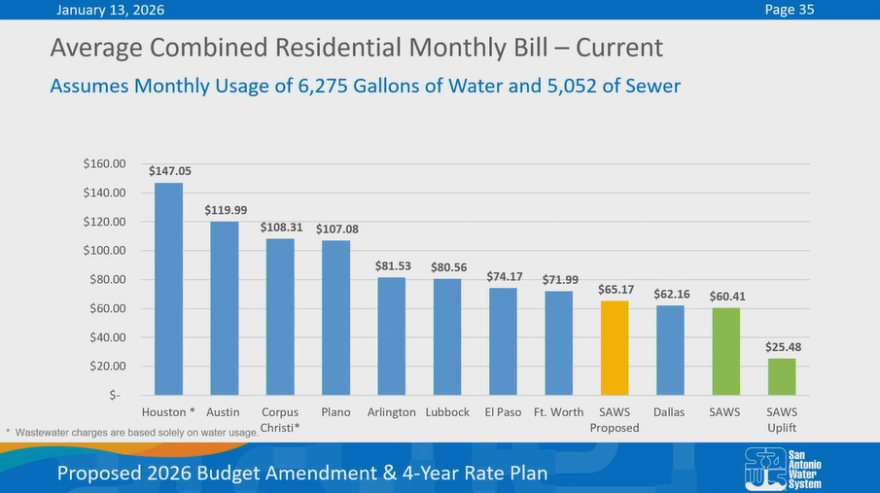
Under the initial proposal, an average SAWS water bill with included fees currently averages $60.41. That same bill would average $79.47 by 2029.

Customers would see just under a $5 increase for this year, with a total average residential bill projected to be around $65.17. Rates would continue to increase anywhere from 6.5% to 7.5% per year after 2026.

Courtesy

/

San Antonio Water System

A presentation slide projects the average monthly residential customer bills if proposed SAWS rate adjustments take effect.

Evanson said the proposed 2026 rate is still lower than what customers were paying in 2020 prior to a rate restructuring in 2023, which lowered water and sewer charges for most residential customers.

He also said SAWS’ current and proposed rates are still lower compared to other areas like Houston, El Paso, and Austin.

“We’re seeing a lot of activity out there and a lot of increases coming through in this space,” said Evanson.

How current and proposed SAWS rates compare to other cities across Texas.

Courtesy

/

San Antonio Water System

How current and proposed SAWS rates compare to other cities across Texas.

The proposed changes would not increase customer bills for residents who participate in the SAWS Uplift program, an initiative that provides financial assistance for those who qualify.

SAWS said several factors are stretching the utility’s budget, including aging infrastructure, ongoing drought conditions, and new legislative requirements.

Officials said a rate adjustment beginning this year could help fund upgrades to wastewater treatment plants and repairs and replacements of aging pipelines.

More than $340 million is needed to rehabilitate the two largest water recycling centers that have been in service since 1965 and 1987, respectively. SAWS said a failure to make improvements could result in permit violations and could trigger additional environmental oversight.

The continuation of SAWS’ water main replacement program is also critical as the city remains in extreme drought with aquifer levels near record lows.

A rate study conducted by the firm Carollo Engineers found the cost of total service for all of SAWS customers — including residential, general, irrigation, and wholesale — totals to over $552 million dollars for 2026.

Total costs of service findings were presented by Carollo Engineers as part of a SAWS rate study

Total costs of service findings were presented by Carollo Engineers as part of a SAWS rate study

The rate adjustment will provide an additional $60.5 million in operating revenue, with $15.6 being available to use for operations and maintenance.

This would be the SAWS’ first rate increase since 2020. Proposed rates are not yet final and could be subject to change following forthcoming discussions.

New rates would need to be approved first by SAWS trustees and then by San Antonio City Council before taking effect.

If approved by city council, SAWS expects the new rates to take effect during the first half of this year.

Great Job Marian Navarro & the Team @ Texas Public Radio for sharing this story.

Robotics software maker Skild AI hits $14B valuation | TechCrunch

Robotics software maker Skild AI hits B valuation | TechCrunch

Skild AI, which makes foundation models for robots, seems to have more than tripled its valuation in just seven months.

The startup has raised a $1.4 billion Series C round that values it at more than $14 billion, Bloomberg reported. The round was led by SoftBank, and Nvidia, Macquarie Group, 1789 Capital and others also invested.

Skild AI last raised a funding at a $4.5 billion valuation this prior summer, Bloomberg reported. The company hasn’t disclosed the exact value of that round — it was rumored to be around $500 million — but Skild AI CEO Deepak Pathak told Bloomberg that the company has now raised more than $2 billion to date.

TechCrunch has reached out to Skild AI for more information on its fundraising history, and we’ll update this piece when we hear more.

Founded in 2023, Skild AI builds general-purpose robotic software and foundation models that can be retrofitted to a variety of different robots and tasks without requiring a ton of additional training. The hope is that these models can also learn from watching humans perform tasks.

There has been a big push recently into this type of learn-as-you-go robotic software alongside the rising hype around humanoids.

One of the biggest hurdles in robot adoption for both personal and industrial use cases is the sheer amount of training required for robots to learn each and every new task. Being able to learn and adapt as they go would clear the path for more robotic adoption.

Techcrunch event

San Francisco
|
October 13-15, 2026

Field AI is another startup looking to build easily-adapted robotic software. 1X, the maker of humanoid Neo, just released a world model in pursuit of the same goal.

Great Job Rebecca Szkutak & the Team @ TechCrunch Source link for sharing this story.

Armed robbery reported near Student Accessibility Center – The Cougar

Armed robbery reported near Student Accessibility Center – The Cougar

Lily Huynh / The Cougar

At approximately 12:30 a.m., an aggravated robbery was reported near the Student Accessibility Center at 4369 Cougar Village Drive. 

The armed suspect coerced the victim to send him money through CashApp before stealing the victim’s phone and wallet and fleeing eastbound on foot. 

In a UH security alert, the suspect is described as a Black male, thin build, approximately 5’6”, wearing a gray Nike sweater, light blue skinny jeans, white Nike sneakers and a black ski mask. The suspect was armed with a gray semi-automatic handgun.

This is a developing story and The Cougar will continue to report on it.

news@thedailycougar.com

Great Job Wendolee T. Garcia Martinez & the Team @ The Cougar for sharing this story.

Secret Link