

Great Job Abigail Stewart & the Team @ Austin Monthly Magazine Source link for sharing this story.

Great Job Abigail Stewart & the Team @ Austin Monthly Magazine Source link for sharing this story.

WASHINGTON – Senate Republicans are facing intense pressure from President Donald Trump to vote down a war powers resolution Wednesday that is aimed at limiting the president’s ability to carry out further military action against Venezuela.
Five GOP senators joined with Democrats to advance the resolution last week, but Trump has lashed out at the defectors as he tries to head off passage of the bill. Democrats are forcing the vote after U.S. troops captured Venezuelan leader Nicolás Maduro in a surprise nighttime raid earlier this month.
“Here we have one of the most successful attacks ever and they find a way to be against it. It’s pretty amazing. And it’s a shame,” Trump said at a speech in Michigan Tuesday. He also hurled insults at several of the Republicans who advanced the legislation, calling Sen. Rand Paul of Kentucky a “stone cold loser” and Sens. Lisa Murkowski of Alaska and Susan Collins of Maine “disasters.”
Trump’s latest comments followed earlier phone calls with the senators, which they described as terse. The fury being directed their way from the president underscored how the war powers vote has taken on new political significance as Trump expands his foreign policy ambitions in the Western Hemisphere.
The legislation, even if passed by the Senate, has virtually no chance of becoming law because it would eventually need to be signed by Trump himself. But it represented both a test of GOP loyalty to the president and a marker for how much leeway the Republican-controlled Senate is willing to give Trump to use the military abroad.
At least one Republican reconsidering
Sen. Josh Hawley, a Missouri Republican who helped advance the war powers resolution last week, has indicated he may change his position.
Hawley said that Trump’s message during a phone call last week was that the legislation “really ties my hands.” The senator said he had a follow-up phone call with Secretary of State Marco Rubio that was “really positive.”
Hawley said that Rubio told him Monday “point blank, we’re not going to do ground troops.” The senator said he also received assurances that the Trump administration will follow constitutional requirements if it becomes necessary to deploy troops again to the South American country.
“I’m in listening-and-receive mode at this time,” said Hawley, adding, “I don’t know how we’re going to proceed next on the floor.”
Sen. Todd Young, an Indiana Republican who also voted to advance the resolution, declined repeatedly to discuss his position but said he was “giving it some thought.” Collins had voted against similar war powers resolutions in previous months before voting last week to advance the one currently before the Senate.
Democratic Sen. Tim Kaine, who has brought a series of war powers resolutions this year, said he wasn’t surprised at Trump’s reaction to Congress asserting its ability to check the president.
“They’re furious at the notion that Congress wants to be Congress,” he said. “But I think people who ran for the Senate, they want to be U.S. senators and they don’t want to just vote their own irrelevance.”
The shifting rationale for military intervention
Trump has used a series of legal rationales for his campaign against Maduro.
As he built up a naval force in the Caribbean and destroyed vessels that were allegedly carrying drugs from Venezuela, the Trump administration tapped wartime powers under the global war on terror by designating drug cartels as terrorist organizations.
The administration has claimed the capture of Maduro himself was actually a law enforcement operation, essentially to extradite the Venezuelan president to stand trial for charges in the U.S. that were filed in 2020.
In a classified briefing Tuesday, senators reviewed the Trump administration’s still undisclosed legal opinion for using the military for the operation. It was described as a lengthy document.
As he exited the classified briefing room at the Capitol, Paul said, “Legal arguments and constitutional arguments should all be public, and it’s a terrible thing that any of this is being kept secret because the arguments aren’t very good.”
Lawmakers, including some Republicans, have been alarmed by Trump’s recent foreign policy talk. In recent weeks, he has pledged that the U.S. will “run” Venezuela for years to come, threatened military action to take possession of Greenland and told Iranians protesting their government that “ help is on its way.”
“It’s amazing. He’s concerned about the protesters in Iran, but not concerned about the damage that ICE is doing to the protesters and Americans in Minnesota and other places,” said Senate Democratic leader Chuck Schumer, referring to the fatal shooting of a woman in Minnesota by an Immigration and Customs Enforcement officer.
How Senate will tackle the war powers resolution
Republican Senate leaders were looking for ways to defuse the conflict between their members and Trump and were eager to move on quickly to other business.
Senate Majority Leader John Thune, R-S.D., questioned whether this war powers resolution should be prioritized under the chamber’s rules.
“We don’t have troops in Venezuela. There is no kinetic action. There are no operations. There are no boots on the ground,” he said, arguing that the legislation “doesn’t reflect what is current reality in Venezuela.”
But even if Republican leaders attempt to dismiss the legislation under those grounds, it would still get a vote.
Schumer said he hoped at least the five Republicans would hold to their position because they “understand how important this is.”
___
Associated Press writers Lisa Mascaro and Joey Cappelletti contributed reporting.
Copyright 2026 The Associated Press. All rights reserved. This material may not be published, broadcast, rewritten or redistributed without permission.
Great Job Stephen Groves, Associated Press & the Team @ KSAT San Antonio for sharing this story.

Analysis: The climate papers most featured in the media in 2025
The year 2025 saw the return to power of Donald Trump, a jewellery heist at the Louvre museum in Paris and an engagement that “broke the internet”.
Amid the biggest stories of the year, climate change research continued to feature prominently in news and social media feeds.
Using data from Altmetric, which scores research papers according to the attention they receive online, Carbon Brief has compiled its annual list of the 25 most talked-about climate-related studies of the past year.
The top 10 – shown in the infographic above and list below – include research into declining butterflies, heat-related deaths, sugar intake and the massive loss of ice from the world’s glaciers:
Later in this article, Carbon Brief looks at the rest of the top 25 and provides analysis of the most featured journals, as well as the gender diversity and country of origin of authors.
New for this year is the inclusion of Altmetric’s new “sentiment analysis”, which scores how positive or negative a paper’s social media attention has been.
(For Carbon Brief’s previous Altmetric articles, see the links for 2024, 2023, 2022, 2021, 2020, 2019, 2018, 2017, 2016 and 2015.)
The top-scoring climate paper of 2025, ranking 24th of any research paper on any topic, is the annual update of the “Indicators of Global Climate Change” (IGCC) report.
The report was established in 2023 to help fill the gap in climate information between assessments of the Intergovernmental Panel on Climate Change (IPCC), which can take up to seven years to complete. It includes the latest data on global temperatures, the remaining carbon budget, greenhouse gas emissions and – for the first time – sea level rise.
The paper, published in Earth System Science Data, has an Altmetric score of 4,099. This makes it the lowest top-scoring climate paper in Carbon Brief’s list since 2017.
(An Altmetric score combines the mentions that published peer-reviewed research has received from online news articles, blogs, Wikipedia and on social media platforms such as Facebook, Reddit, Twitter and Bluesky. See an earlier Carbon Brief article for more on how Altmetric’s scoring system works.)
Previous editions of the IGCC have also appeared in Carbon Brief’s list – the 2024 and 2023 iterations ranked 17th and 18th, respectively.
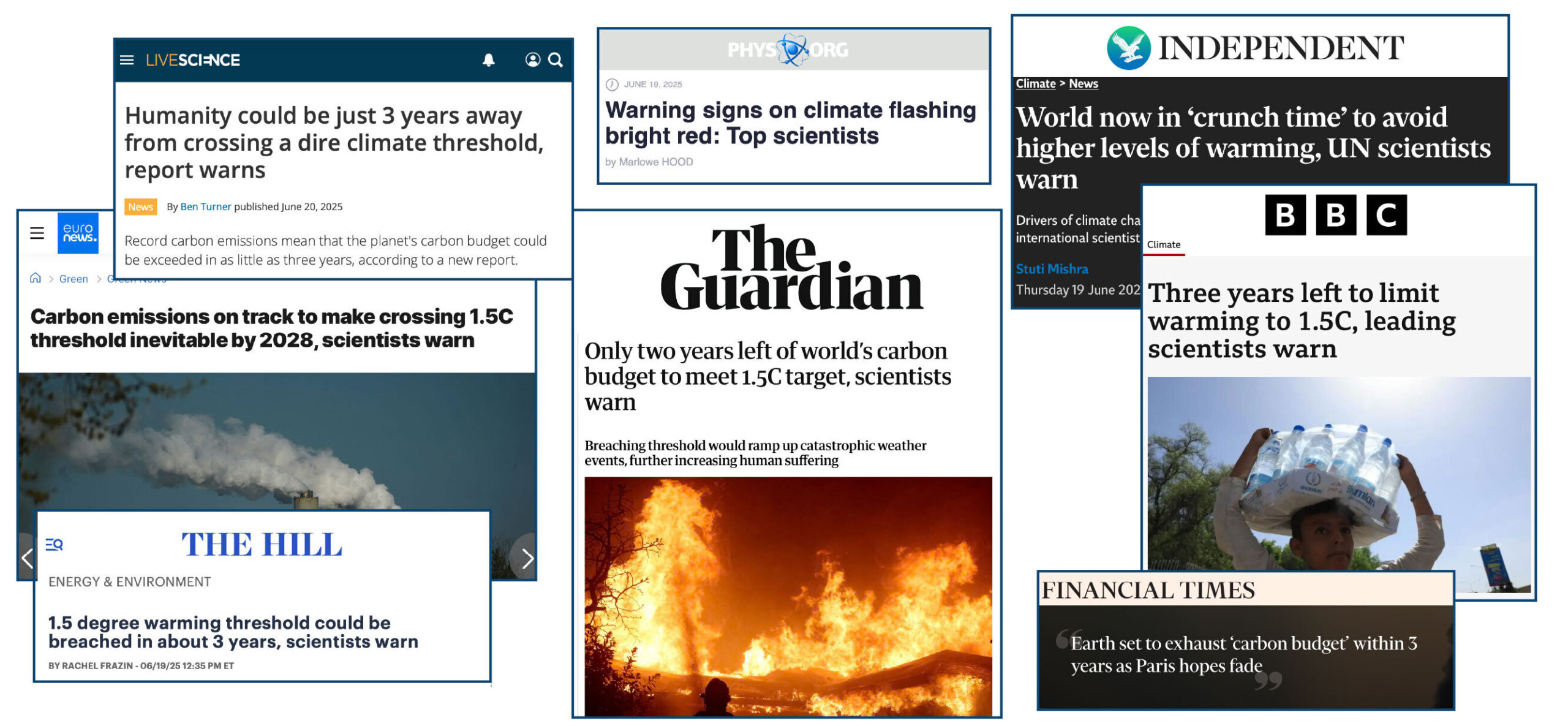
This year’s paper was mentioned 556 times in online news stories, including in the Associated Press, Guardian, Independent, Hill and BBC News.
Many outlets led their coverage with the study’s findings on the global “carbon budget”. This warned that the remaining carbon budget to limit warming to 1.5C will be exhausted in just three years if global emissions continue at their current rate.
In a Carbon Brief guest post about the study, authors Prof Piers Forster and Dr Debbie Rosen from the University of Leeds wrote:
“It is also now inevitable that global temperatures will reach 1.5C of long-term warming in the next few years unless society takes drastic, transformative action…Every year of delay brings reaching 1.5C – or even higher temperatures – closer.”
Forster, who was awarded a CBE in the 2026 new year honours list, tells Carbon Brief that media coverage of the study was “great” at “putting recent extreme weather in the context of rapid long-term rates of global warming”.
However, he adds:
“Climate stories are not getting the coverage they deserve or need at the moment so the community needs to get all the help we can for getting clear consistent messages out there.”
The paper was tweeted more than 300 times and posted on Bluesky more than 950 times. It also appeared in 22 blogs.
Using AI, Altmetric now analyses the “sentiment” of this social media attention. As the summary figure below shows, the posts about this paper were largely positive, with an approximate 3:1 split of positive and negative attention.

With an Altmetric score of 3,828, the second-highest scoring climate paper warns of “widespread” declines in butterfly numbers across the US since the turn of the century.
The paper, titled “Rapid butterfly declines across the US during the 21st century” and published in Science, identifies a 22% fall in butterfly numbers across more than 500 species between 2000 and 2020.
(There is a higher-scoring paper, “The 2025 state of the climate report: a planet on the brink”, in the journal BioScience, but it is a “special report” and was not formally peer reviewed.)

The scale of the decline suggests “multiple and broadly acting threats, including habitat loss, climate change and pesticide use”, the paper says. The authors find that “species generally had stronger declines in more southerly parts of their ranges”, with some of the most negative trends in the driest and “most rapidly warming” US states.
The research was covered in 560 news articles, including the New York Times, Guardian, Associated Press, NPR, El País and BBC News. Much of the news coverage led with the 22% decline figure.
The paper was also mentioned in 13 blogs, more than 750 Bluesky posts and more than 600 tweets.
The sentiment analysis reveals that social media posts about the paper were largely negative. However, closer inspection reveals that this negativity is predominantly towards the findings of the paper, not the research itself.
For example, a Bluesky post on the “distressing” findings by one of the study’s authors is designated as “neutral negative” by Altmetric’s AI analysis.
In a response to a query from Carbon Brief, Altmetric explains that the “goal is to measure how people feel about the research paper itself, not the topic it discusses”. However, in some cases the line can be “blurred” as the AI “sometimes struggles to separate the subject matter from the critique”. The organisation adds that it is “continuously working on improving our models to better distinguish between the post’s content and the research output”.

On the attention that the paper received, lead author Dr Collin Edwards of the Washington Department of Fish & Wildlife says that “first and foremost, people care about butterflies and our results are broad-reaching, unequivocal and, unfortunately, very concerning”.
Edwards tells Carbon Brief he hopes the clarity of the writing made the paper accessible to readers, noting that he and his co-authors “sweat[ed] over every word”.
The resulting news coverage “accurately captured the science”, Edwards says:
“Much as I wish our results were less consistently grim, the consistency and simplicity of our findings mean that even if a news story only provides the highest level summary, it isn’t misleading readers by skipping some key caveat or nuance that changes the interpretation.”
In third place in Carbon Brief’s list for 2025 is the latest scientific paper from veteran climatologist Dr James Hansen, former director of the NASA Goddard Institute for Space Studies and now adjunct professor at Columbia University’s Earth Institute.
The paper, titled “Global warming has accelerated: Are the UN and the public well-informed?” was published in the journal Environment: Science and Policy for Sustainable Development. It generated an Altmetric score of 3,474.

The study estimates that the record-high global temperatures in the last few years were caused by a combination of El Niño and a reduction in air pollution from international shipping.
The findings suggest that the cooling effect of aerosols – tiny, light‑scattering particles produced mainly by burning fossil fuels – has masked more of the warming driven by greenhouse gases than previously estimated by the IPCC.
As efforts to tackle air pollution continue to reduce aerosol emissions, warming will accelerate further – reaching 2C by 2045, according to the research.
The paper was covered by almost 400 news stories – driven, in part, by Hansen’s comments in a press briefing that the Paris Agreement’s 2C warming limit was already “dead”.
Hansen’s analysis received a sceptical response from some scientists. For example, Dr Valerie Masson-Delmotte, an IPCC co-chair for its most recent assessment report on climate science, told Agence France-Presse the research “is not published in a climate science journal and it formulates a certain number of hypotheses that are not consistent with all the available observations”.
In addition, other estimates, including by Carbon Brief, suggest new shipping regulations have made a smaller contribution to warming than estimated by Hansen.
Hansen tells Carbon Brief that the paper “did ok” in terms of media coverage, although notes “it’s on [scientists] to do a better job of making clear what the core issues are in the physics of climate change”.
With more than 1,000 tweets, the paper scored highest in the top 25 for posts on Twitter. It was also mentioned in more than 800 Bluesky posts and on 27 blogs.
The sentiment analysis suggests that these posts were largely positive, with just a small percentage of negative comments.

Ranking fourth in Carbon Brief’s analysis is a Nature paper calculating changes in global glacier mass over 2000-23. The study finds glaciers worldwide lost 273bn tonnes of ice annually over that time – with losses increasing by 36% between 2000-11 and 2012-23.
The study has an Altmetric score of 3,199. It received more news coverage than any other paper in this year’s top 25, amassing 1,187 mentions. with outlets including the Guardian, Associated Press and Economic Times.
At number five, with an Altmetric score of 2,860, is the EAT-Lancet Commission on healthy, sustainable and just food systems.
Carbon Brief’s coverage of the report highlights that “a global shift towards ‘healthier’ diets could cut non-CO2 greenhouse gas emissions, such as methane, from agriculture by 15% by 2050”. It adds:
“The findings build on the widely cited 2019 report from the EAT-Lancet Commission – a group of leading experts in nutrition, climate, economics, health, social sciences and agriculture from around the world.”
Also making the top 10 – ranking sixth and eighth – are a pair of papers published in Nature, which both link extreme heat to the emissions of specific “carbon majors” – large producers of fossil fuels, such as ExxonMobil, Shell and Saudi Aramco,.
The first is a perspective, titled “Carbon majors and the scientific case for climate liability”, published in April. It begins:
“Will it ever be possible to sue anyone for damaging the climate? Twenty years after this question was first posed, we argue that the scientific case for climate liability is closed. Here we detail the scientific and legal implications of an ‘end-to-end’ attribution that links fossil fuel producers to specific damages from warming.”
The authors find “trillions (of US$) in economic losses attributable to the extreme heat caused by emissions from individual companies”.
The paper was mentioned 1,329 times on Bluesky – the highest in this year’s top 25. It was also mentioned in around 270 news stories.
Published four months later, the second paper uses extreme event attribution to assess the impact of climate change on more than 200 heatwaves recorded since the year 2000.
The authors find one-quarter of the heatwaves would have been “virtually impossible” without human-caused global warming. They add that the heatwaves were, on average, 1.7C hotter due to climate change, with half of this increase due to emissions stemming from the operations and production of carbon majors.
This study was mentioned in almost 300 news stories – including by Carbon Brief – as well as 222 tweets and 823 posts on Bluesky.
In seventh place is a Nature Medicine study, which quantifies how heat-related and cold-related deaths will change over the coming century as the climate warms.
A related research briefing explains the main findings of the paper:
“Heat-related deaths are estimated to increase more rapidly than cold-related deaths are estimated to decrease under future climate change scenarios across European cities. An unrealistic degree of adaptation to heat would be required to revert this trend, indicating the need for strong policies to reduce greenhouse gases emissions.”
The paper was mentioned 345 times in the news, including in the Financial Times, New Scientist, Guardian and Bloomberg.
The paper in ninth place also analyses the health impacts of extreme heat. The study, published in Science Advances, finds that extreme heat can speed up biological ageing in older people.
Rounding out the top 10 is a Nature Climate Change study, titled “Rising temperatures increase added sugar intake disproportionately in disadvantaged groups in the US”.
The study finds that at higher temperatures, people in the US consume more sugar – mainly due to “higher consumption of sugar-sweetened beverages and frozen desserts”. The authors project that warming of 5C would drive additional sugar consumption of around 3 grams per day, “with vulnerable groups at an even higher risk”.
The rest of the top 25 includes a wide range of research, from “glacier extinction” and wildfires to Amazon drought and penguin guano.
In 13th place is a Nature Climate Change study that finds the wealthiest 10% of people – defined as those who earn at least €42,980 (£36,605) per year – contributed seven times more to the rise in monthly heat extremes around the world than the global average.
The authors also explore country-level emissions, finding that the wealthiest 10% in the US produced the emissions that caused a doubling in heat extremes across “vulnerable regions” globally.
(See Carbon Brief’s coverage of the paper for more details.)
In 15th place is the annual Lancet Countdown on health and climate change – a lengthy report with more than 120 authors.
The study warns that “climate change is increasingly destabilising the planetary systems and environmental conditions on which human life depends”.
This annual analysis from the Lancet often features in Carbon Brief’s top 25 analysis. After three years in the Carbon Brief’s top 10 over 2020-23, the report landed in 20th place in 2023 and missed out on a spot in the top 25 altogether in 2024.
In 16th place is a Science Advances study, titled “Increasing rat numbers in cities are linked to climate warming, urbanisation and human population”. The study uses public complaint and inspection data from 16 cities around the world to estimate changes in rat populations.
It finds that “warming temperatures and more people living in cities may be expanding the seasonal activity periods and food availability for urban rats”.
The study received 320 new mentions, including in the Washington Post, New Scientist and National Geographic.
In 21st place is a Nature Climate Change paper, titled “Peak glacier extinction in the mid-21st century”. The study authors “project a sharp rise in the number of glaciers disappearing worldwide, peaking between 2041 and 2055 with up to ~4,000 glaciers vanishing annually”.
Completing the top 25 is a Nature study on the “prudent planetary limit for geological carbon storage” – where captured CO2 is injected deep underground, where it can stay trapped for thousands of years.
In a Carbon Brief guest post, study authors Dr Matthew Gidden and Prof Joeri Rogelj explain that carbon dioxide removal will only be effective at limiting global temperature rise if captured CO2 is injected “deep underground, where it can stay trapped for thousands of years”.
The guest post warns that “geological carbon storage is not limitless”. It states that “if all available safe carbon storage capacity were used for CO2 removal, this would contribute to only a 0.7C reduction in global warming”.
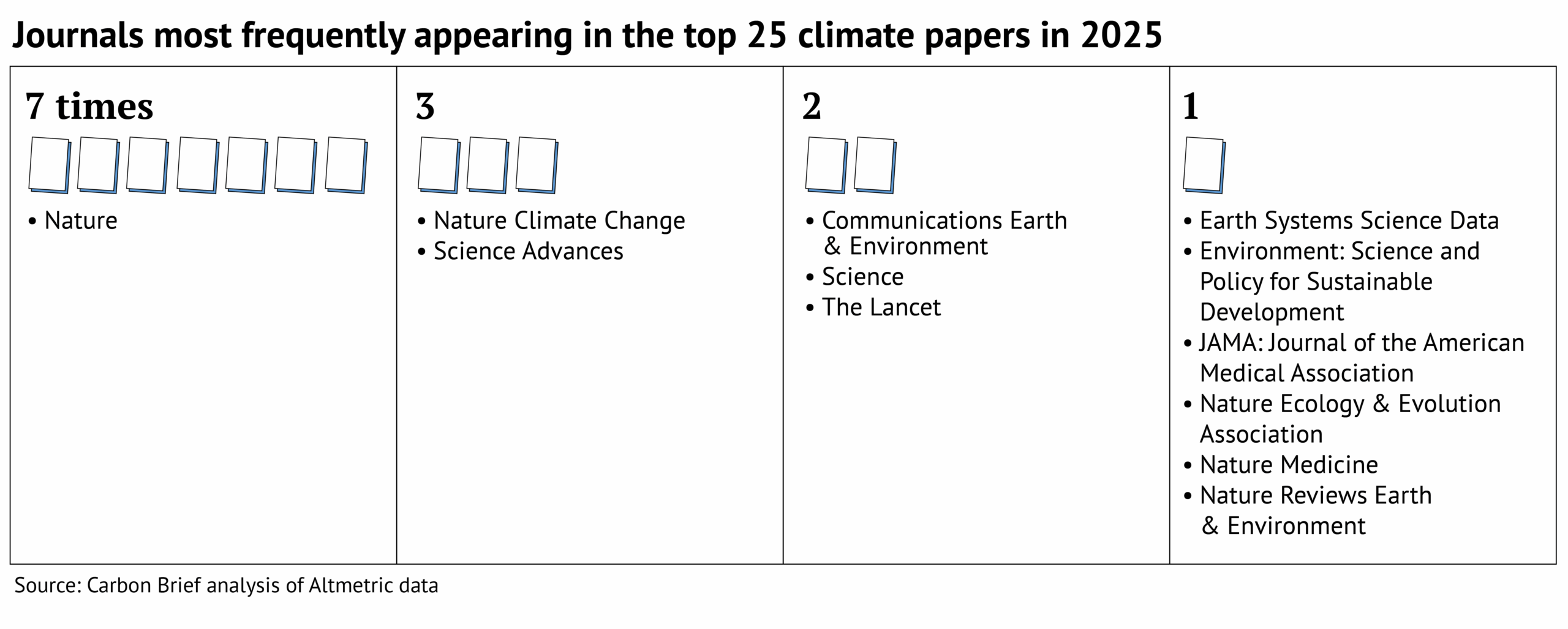
The journal Nature dominates Carbon Brief’s top 25, with seven papers featured.
Many other journals in the Springer Nature stable also feature, including Nature Climate Change (three), Communications Earth & Environment (two), as well as Nature Ecology & Evolution, Nature Medicine and Nature Reviews Earth & Environment (one each).
Also appearing more than once in the top 25 are Science Advances (three), Science (two) and the Lancet (two).
This is shown in the graphic below.
All the final scores for 2025 can be found in this spreadsheet.
The top 25 climate papers of 2025 cover a huge range of topics and scope. However, analysis of their authors reveals a distinct lack of diversity.
In total, the top 25 includes more than 650 authors – the highest number since Carbon Brief began this analysis in 2022.
This is largely due to a few publications with an exceptionally high number of authors. For example, the 2025 report of the Lancet Countdown on health and climate change has almost 130 authors alone, accounting for almost one-fifth of authors in this analysis.
Carbon Brief recorded the gender and country of affiliation for each of these authors. (The methodology used was developed by Carbon Brief for analysis presented in a special 2021 series on climate justice.)
The analysis reveals that 88% of the authors of the climate papers most featured in the media in 2025 are from institutions in the global north.

Carbon Brief defines the global north as North America, Europe, Japan, Australia and New Zealand. It defines the global south as Asia (excluding Japan), Africa, Oceania (excluding Australia and New Zealand), Latin America and the Caribbean.
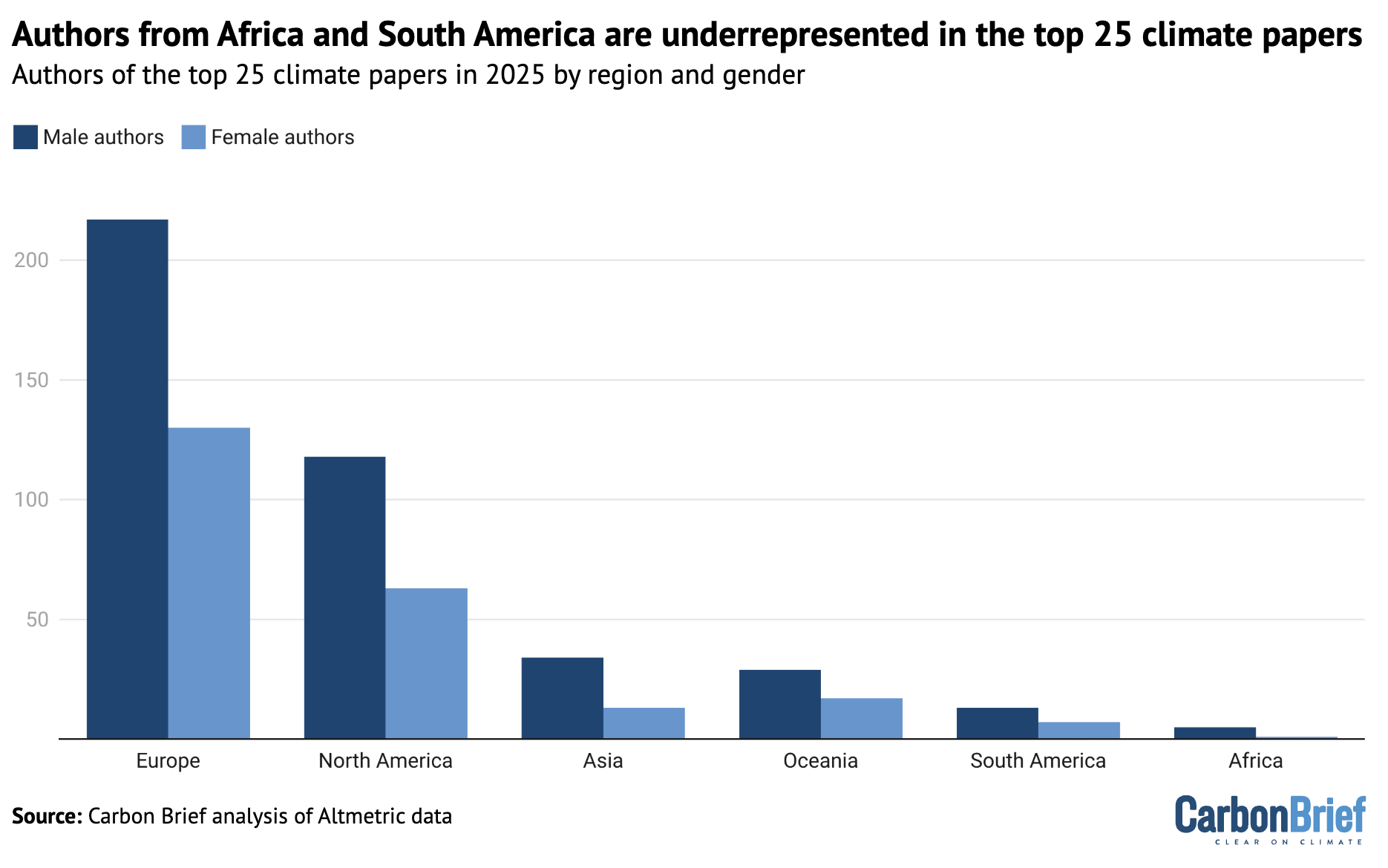
The analysis shows that 53% of authors are from European institutions, while only 1% of authors are from institutions in Africa.
Further data analysis shows that there are also inequalities within continents. The map below shows the percentage of authors from each country, where dark blue indicates a higher percentage. Countries that are not represented by any authors in the analysis are shown in grey.
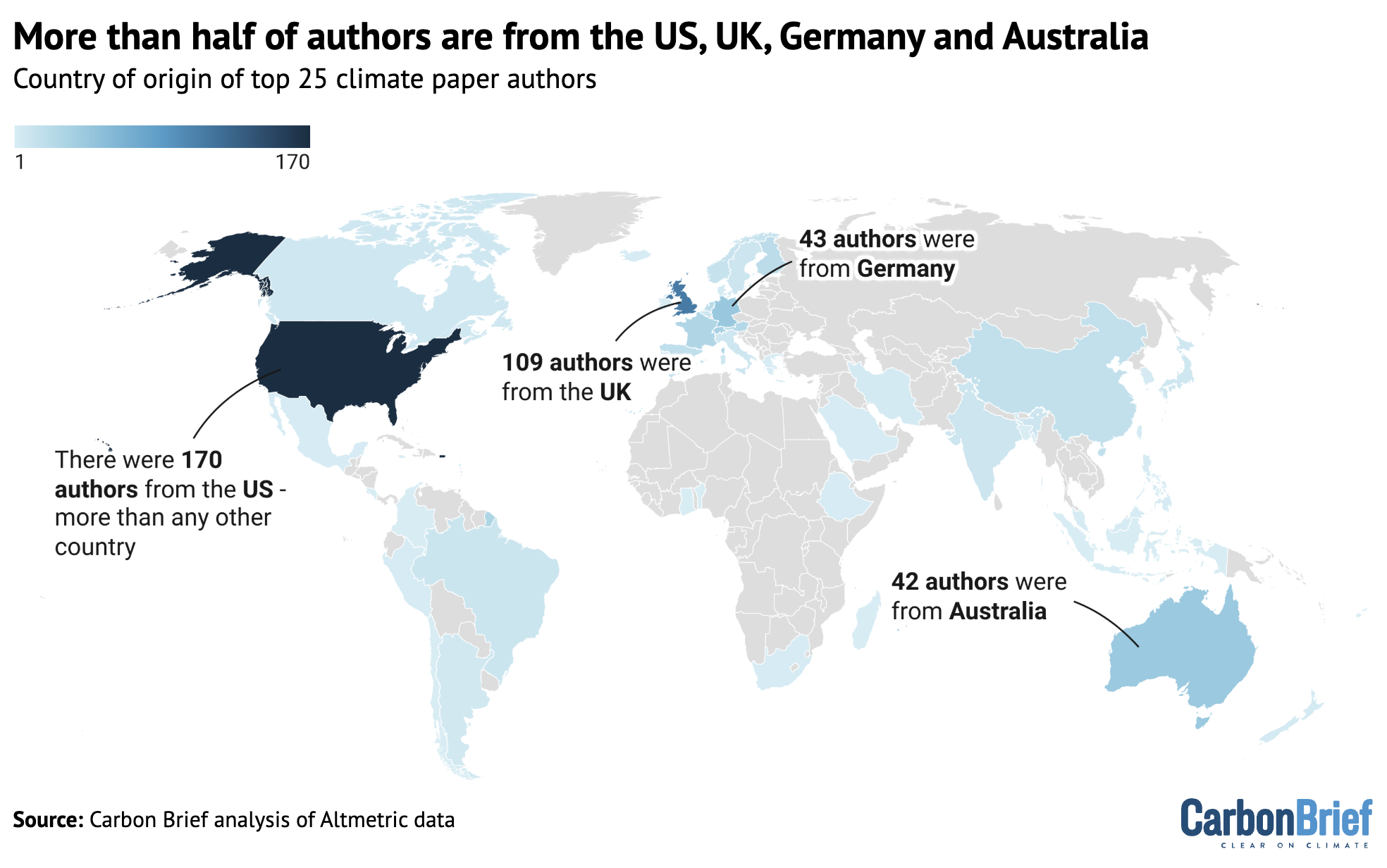
The top-ranking countries on this map are the US and the UK, which account for 26% and 16% of the authors, respectively.
Carbon Brief also analysed the gender of the authors.
Only one-third of authors from the top 25 climate papers of 2025 are women and only five of the 25 papers list a woman as lead author.
The plot below shows the number of authors from each continent, separated into men (dark blue) and women (light blue).
The full spreadsheet showing the results of this data analysis can be found here. For more on the biases in climate publishing, see Carbon Brief’s article on the lack of diversity in climate-science research.
Great Job Carbon Brief Staff & the Team @ Carbon Brief Source link for sharing this story.

Yesterday nearly 15,000 nurses launched a strike at three private sector hospital systems in New York City. Nurses represented by the New York State Nurses Association (NYSNA) have walked out at multiple campuses of Montefiore Einstein Medical Center, Mount Sinai Health System, and New York–Presbyterian Hospital in the largest nurses’ strike in the city’s history and one of the largest in the history of the United States.
Nurses say that the hospitals are stonewalling them on key proposals. Those include demands around safe-staffing ratios; nurses say understaffing is a major issue that leads to burnout of staff and worse patient care. Nurses are also attempting to establish better protections against workplace violence for hospital staff and to resist cuts to their health care benefits, among other demands.
Earlier today, Jacobin contributor Sara Wexler joined nurses on the picket lines at Mount Sinai’s Morningside campus. She spoke to nurses there about their key contract proposals, why bargaining has broken down, and fighting back against their employer’s union-busting efforts.
Great Job Simone Way & the Team @ Jacobin Source link for sharing this story.

HBO’s recent juggernaut, Heated Rivalry, has blasted to the front of seemingly everyone’s consciousness over the last few months. The show, based on the second book in the Game Changers series by Rachel Reid, portrays the secret sexual relationship (turned heart-melting love affair) of the captains of two rival professional hockey teams.
While the press tour of the two lead actors promoting the show is, in a word, delightful, the attention being paid to fictional hockey players’ relationships off-the-ice is, unfortunately, a stark reminder of the reality of the state of gender-based violence in the sport. Countless players for the National Hockey League (NHL), as well as the junior and minor leagues, have been accused of domestic and sexual violence. Yet many of those same players are retained on lucrative professional and semiprofessional contracts, and some have been able to keep playing even while under investigation for criminal sexual and domestic assault.
The NHL remains the only of the four major professional sports leagues (which also includes the NFL, NBA and MLB) that lacks a formal and specific domestic violence policy when players are accused of sexual or domestic violence. Instead, when players are accused of misconduct, assault or otherwise perpetrating harm, cases are adjudicated individually by league leadership. This is despite a number of high-profile allegations against players in professional, semiprofessional and junior leagues.
This kind of opaque process leaves survivors of violence high and dry, especially when their abusers are powerful, wealthy and beloved professional athletes with loyal fanbases. Naming and reporting sexual and domestic assault is incredibly difficult for survivors of violence, especially given how many fear they will be believed when they come forward. But this is even more challenging when the people who perpetrate violence hold social and financial power in their communities.
Despite making up less than 2 percent of college students, Division 1 athletes were named as assailants in over 6 percent of Title IX complaints.
Sexual and domestic violence perpetrated by elite athletes is a problem at all levels of sport. Despite making up less than 2 percent of college students, Division 1 athletes were named as assailants in over 6 percent of Title IX complaints, one study found. While hockey does not receive nearly the air time of a sport like football, over half a million people participate in USA Hockey, including nearly 100,000 women and girls.
Socialization, masculinity and the environments we especially raise young boys in, enable and entrench rape culture. Modern hockey culture exemplifies how these dynamics are reproduced and normalized. Hazing of new players creates cultures of violence, degradation and fear where consent is a non-issue. ‘Chirping’ (the sport’s name for trash talk) frequently includes misogyny, sexual degradation and allows players to weaponize their opponents’ personal lives in a public way. Each team has their own ‘enforcers’—players whose jobs are to (often aggressively) respond to violent play—who often see more ice fighting than skating.
This is further complicated by the brutal, physical nature of a sport like hockey. NHL teams play 82 regular season games (before even accounting for playoff and championship time on the ice) over a grueling seven-month stretch–averaging a game every 2.5 days. With this kind of schedule–and an average of one fight every two to five games–players risk not only repeated concussions but also repeated brain injuries in quick succession, with little if any time to recover and heal.
The science is clear today that high-contact sports (including hockey, rugby, and American football) carry substantial risk of traumatic brain injuries. These kinds of head injuries have been shown to lead to long-term injuries such as chronic traumatic encephalopathy that can cause behavioral changes and increased aggression, creating new risk factors for domestic and sexual violence.
Women deserve to know that the sport they are spending their time and money on cares about violence against women, especially for young girls lacing up their skates for the first time.
A 2024 study of 77 deceased male ice hockey players—the largest study of its kind—found that 27 out of 28 professional players and 13 of 28 college, juniors and semiprofessional players had CTE pathology. Those researchers estimated that for every additional year played, the risk of CTE increased 34 percent.
The movies and TV we watch change our behavior and what we as communities value. Bend it Like Beckham (2002) drove millions of girls into youth soccer teams, and Heated Rivalry could do the same for junior hockey teams. HBO estimated that half of early viewers of the show were women, and women make up the vast majority of romance readers, including of “MM” romance fiction featuring love stories between two men. Women deserve to know that the sport they are spending their time and money on cares about violence against women, especially for young girls lacing up their skates for the first time.
With this influx of new fans to hockey—and especially as women fans join the sport—it is more than time for the NHL to cross the incredibly low bar of standardizing how they respond to allegations of abuse by their players. League leadership has the opportunity to do better in protecting women from violence and holding players accountable when they cause harm.
A formal League policy will not stop violence, especially against women, from being perpetrated by players. But it will stand as a positive assertion that hockey too recognizes the importance of addressing violence against women. And better late than never.

Great Job Kaitlyn Sims & the Team @ Ms. Magazine Source link for sharing this story.

Sign up for TPR Today, Texas Public Radio’s newsletter that brings our top stories to your inbox each morning.
District 8 City Councilwoman Ivalis Meza Gonzalez will rejoin the city council’s Audit, Community Health, and Workforce committees after being removed last year.
In July 2025, about one month after being elected to the council, Meza Gonzalez was arrested for DWI. In September, she was censured by the city council. The censure is a formal reprimand but carries no suspension or removal.
In the last four years, three council members have been arrested for DWI including incumbent District 10 Councilman Marc Whyte and former District 10 Councilman Clayton Perry.
Meza Gonzalez allegedly had a blood alcohol content level of 0.15 which is nearly twice the legal limit in Texas. Her next court appearance is January 27, for a pre-trial hearing.
In a statement, Meza Gonzalez said during her time off of committees, her work for the district did not stop.
“Yesterday, I was reinstated to the Audit, Community Health, and Economic and Workforce Committees,” she said in the statement. “While my work for District 8 never paused, I am glad that my formal committee duties have now resumed. I remain fully committed to advancing the priorities of District 8 and working collaboratively with my council colleagues to deliver meaningful results for our neighborhoods and the City of San Antonio.”
The city’s structure for policy approval includes a committee system where the 10 members of council and the mayor are divided up into different committees. Each one has oversight and initial greenlighting of policies and initiatives to move forward with further development before full council approval.
In addition to the committee reappointments, the councilwoman was also sworn in to serve on the Bexar Central Appraisal District Board of Directors. She was selected by her fellow council members for the role in December. The appraisal district is separate from the city and Bexar County and is responsible for assessing property values in the county.
“This work is essential to maintaining public trust and ensuring fairness and transparency in a process that impacts families and businesses across our city,” she said.
The board of directors does not directly set property appraisals or tax rates, nor does it vote on them. Instead, the board provides oversight to the agency which has its own chief appraiser that’s selected by the board and also appoints the appraisal review board.
Great Job Joey Palacios & the Team @ Texas Public Radio for sharing this story.

If you are caught up with all the festive rush back home, this one’s a lifesaver for you as your beloved ones celebrate Poush Sankranti, heralding the season of harvest with the sweetest delicacies. We have curated 15 AI prompts for you to try something really different with your family and friends.
You can tweak these of course and make the AI generate bespoke results. For those unversed in AI tools, some of the more accessible ones to generate images are Grok, ChatGPT and Google Gemini, among others. However, keep the request minimal as AI prompts contribute to carbon footprint and is very antithetical to the essence of the festival, which is harvest!
See Also: Poush Sankranti 2026: Best AI Prompts To Send Festive Greetings To Your Loved Ones
Cover: ChatGPT
Great Job James Paul & the Team @ Mashable India tech Source link for sharing this story.

Texas Attorney General Ken Paxton has launched a broad campaign of investigations and lawsuits against nonprofit organizations that provide humanitarian aid to migrants, arguing that such efforts enable illegal immigration.

As communities around the country grapple with intense presence from ICE and other agencies targeting immigrants, organizations that aid the undocumented are also being targeted. And in Texas, this includes major nonprofits as well as Catholic Charities.
Texas Attorney General Ken Paxton has launched a broad campaign of investigations and lawsuits against nonprofit organizations that provide humanitarian aid to migrants, arguing that such efforts enable illegal immigration. Officials in the AG’s office cite national security and protection of taxpayer money. But human rights advocates see it as an attack on humanitarian values and community strength.
Paxton has accused these organizations of facilitating illegal immigration, misusing public funds, and in some cases concealing migrants from authorities. One key case involves Catholic Charities of the Rio Grande Valley.
An appeals court temporarily blocked Paxton from questioning its leader under oath. The leader is Sister Norma Pimentel, a nun known internationally for her migrant aid work. Back in December, the Department of Homeland Security paused federal grants to the group over alleged misuse of funds, including inconsistent records and services beyond the allowed 45-day period.
DHS officials have explained that the review aims to ensure federal funds are not used to “encourage illegal immigration, transport illegal aliens, and harbor illegal aliens,” and described the violations as pervasive, with data gaps preventing verification of served individuals. DHS has proposed a six-year ban on federal funding. The organization denies the claims and says it is cooperating fully with authorities. Sister Norma Pimentel has stated that the work “restores human dignity” and that every dollar is taken seriously.
Another major case involves Annunciation House in El Paso. Paxton demanded documents under a 1925 law and accused it of running a stash house, an allegation not upheld by lower courts so far. In May 2025, the case moved forward after higher courts allowed certain procedural steps to proceed, without ruling on the merits of the allegations.
Governor Greg Abbott, a longtime supporter of aggressive immigration enforcement, has previously called for investigations into the role of nonprofits assisting migrants, though he has not commented directly on the current cases. But in September, he banned issuing commercial driver’s licenses to refugees and DACA recipients.
Polls show deep divides in public opinion. A University of Houston and Texas Southern University survey in October 2025 found that 51 percent of Texas voters support the current policy direction. Support drops among Latinos to 42 percent and among African Americans to 23 percent. Overall, 74 percent of Texans see legal migrants as good for the economy.
From 2022 to 2025, undocumented migrants paid about 4.9 billion dollars in state and local taxes each year. Their total contribution comes from work and spending. Tougher controls have mixed effects. The freezing of federal grants has left thousands of migrants in Texas border communities without clear support. A key case is Sister Norma Pimentel’s center in McAllen, which has for years provided food, showers, clothing, and travel assistance to hundreds of thousands of migrants after their release by border officials. Without these services, many families now risk ending up on the streets, while low-income residents in the high-poverty Rio Grande Valley may also lose critical aid.
Advocates from the ACLU and other human rights groups, along with Democratic critics, see Paxton’s actions as an attack on religious freedom and humanitarian values. They argue that such measures harm migrant families and communities while targeting faith-based organizations providing essential aid.
Paxton’s campaign has extended beyond faith-based nonprofits to local governments. In November 2025, he sued Harris County over its allocation of roughly $1.3 million in taxpayer funds to nonprofit organizations providing legal assistance to undocumented immigrants in deportation proceedings. Paxton argued that the program violates the Texas Constitution by improperly granting public funds to private entities without a valid public purpose. Harris County officials defended the Immigrant Legal Services Fund as lawful, emphasizing its role in ensuring due process, and criticized the lawsuit as politically motivated. In December 2025, a district court denied Paxton’s request for a preliminary injunction, allowing the program to continue while the litigation proceeds.
Great Job Artem Kolisnichenko & the Team @ The Texas Signal for sharing this story.

Most players log into a casino like a tourist wandering into a candy shop. They pick a game because it has a cute panda, a cool movie theme, or just because the thumbnail is shiny.
Here is the cold, hard truth: The math does not care about the panda.
I have spent the last 15 years analyzing slot math, and I can tell you that 90% of players are voluntarily handing over more money than they need to. They play games with a 94% Return to Player (RTP) when there are games sitting right next to them offering 99%.
That 5% difference might sound small. But over a thousand spins? That is the difference between an hour of entertainment and five minutes of frustration.
If you are tired of burning your bankroll on “tight” machines, you need to stop looking at the graphics and start looking at the numbers. Here is the lowdown on the highest payout online slots and the reality of playing them.
Why the “House Edge” isn’t the same on every game
Every slot has a built-in advantage for the casino. We call this the House Edge. If a game has a 96% RTP, the casino expects to keep $4 of every $100 bet over the long term.
But some developers release games that push the limits. These are the games the savvy grinders play.
If you are looking for a deep dive into the specific mechanics and where these games are hosted, the First Comics News slots guide breaks down the current market well. But for now, let’s look at the specific titles that offer the best mathematical odds.
The Top 3 High-RTP Games (That You Can Actually Play)
A lot of “high payout” lists are full of games that don’t exist anymore or are blocked in most countries. These three are real, and you can likely find them today.
1. Book of 99 (Relax Gaming)
RTP: 99.0%
This is the current heavyweight champion. Most “Book” style games (like Book of Dead) run at about 96% or sometimes even lower depending on the casino settings. Book of 99 locks it in at 99%.
2. 1429 Uncharted Seas (Thunderkick)
RTP: 98.6%
This is my go-to game when I just want to relax. It has a cool hand-drawn map aesthetic that actually looks good on mobile.
3. Blood Suckers (NetEnt)
RTP: 98.0%
An oldie but a goodie. This game has been around for over a decade, and pros still play it.
The “Catch” You Need to Watch Out For
You might be thinking, “If these games are so good, why would anyone play anything else?”
Good question. Here is the answer.
Volatility is the Silent Killer
RTP is just an average. It is calculated over millions of spins. In the short term, anything can happen. You can play a 99% RTP slot and lose your whole deposit in 20 minutes if luck isn’t on your side. That is called variance, or volatility.
High RTP does not mean guaranteed profit. It just means the “price” of playing is cheaper in the long run.
The Bonus Ban
Casinos aren’t stupid. They know these games give the player a better shot. That is why they often exclude them from wagering requirements. If you take a Welcome Bonus and try to grind it out on 1429 Uncharted Seas, you might void your winnings. I learned this the hard way back in 2014. Don’t be like me. Read the fine print.
Final Verdict: Play Smarter, Not Harder
At the end of the day, slots are negative expectation games. The house always has the edge. You are paying for the thrill, the adrenaline, and the chance of a lucky spike.
By choosing the highest payout online slots, you are simply being a smart consumer. You are getting better value for your money.
So next time you log in, skip the shiny new game with the 94% RTP. Scroll down, search for the high-value titles, and give yourself a fighting chance.
Disclaimer: All gambling involves risk. The stats mentioned above are theoretical and based on long-term play. Never gamble with money you cannot afford to lose. 18+.
Great Job The YBF & the Team @ The YBF Source link for sharing this story.

Apple and Google’s surprise AI partnership announcement on Monday sent shockwaves across the tech industry (and lifted Google’s market cap above $4 trillion). The two tech giants’ deal to infuse Google’s AI technology into Apple’s mobile software, including in an updated version of the Siri digital assistant, has major implications in the high-stakes battle to dominate AI and to own the platform that will define the next generation of computing.
While there are still many unanswered questions about the partnership, including the financial component and the duration of the deal, some key takeaways are already clear. Here’s why the deal is good news for Google, so-so news for Apple, and bad news for OpenAI.
When OpenAI debuted ChatGPT in November 2022, and throughout a good part of the next two years, many industry observers had their doubts about Google’s prospects in the changing landscape. The search giant at times appeared to be floundering as it raced to field models that could be as capable as OpenAI’ s ChatGPT and Anthropic’s Claude. Google endured several embarrassing product debuts, when its Bard chatbot and then its successor Gemini models got facts wrong, recommended glue as a pizza topping, and generated images of historically anachronistic Black Nazis.
But today, Google’s latest Gemini models (Gemini 3) are among the most capable on the market and gaining traction among both consumers and businesses. The company has also been attracting lots of customers to its Google Cloud, in part because of the power of its bespoke AI chips, called tensor processing units (or TPUs), which may offer cost and speed advantages over Nvidia’s graphics processing units (GPUs) for running AI models.
Apple’s statement on Monday that “after careful consideration” it had determined that Google’s AI technology “provides the most capable foundation for Apple Foundation Models” served as Gemini’s ultimate validation—particularly given that until now, OpenAI was Apple’s preferred technology provider for “Apple Intelligence” offerings. Analysts at Bank of America said the deal reinforced “Gemini’s position as a leading LLM for mobile devices” and should also help strengthen investor confidence in the durability of Google’s search distribution and long-term monetization.
Hamza Mudassir, who runs an AI agent startup and teaches strategy and policy at the University of Cambridge’s Judge School of Business, said Apple’s decision is likely about more than just Gemini’s technical capabilities. Apple does not allow partners to train on Apple user data, and Mudassir theorized that Apple may have concluded Google’s control over its ecosystem—such as owning its own cloud—could provide data privacy and intellectual property guarantees that perhaps OpenAI or Anthropic couldn’t match.
The deal also likely translates directly into revenue for Google. Although the financial details of the were not disclosed, a previous report from Bloomberg suggested Apple was paying Google about $1 billion a year for the right to use its tech.
The bigger prize for Google may be the foot-in-the-door the deal provides to Apple’s massive distribution channel: the approximately 1.5 billion iPhone users worldwide. With Gemini powering the new version of Siri, Google may get a share of any revenue those users generate through product discovery and purchases made through a Gemini-powered Siri. Eventually, it might potentially even lead to an arrangement that would see Gemini’s chatbot app pre-installed on iPhones.
David Paul Morris/Bloomberg via Getty Images
The iPhone maker will obviously benefit from giving users a much more capable Siri, as well as other AI features, at an attractive cost and while guaranteeing user privacy. Dan Ives, an equity analyst who covers Apple for Wedbush, said in a note the deal provided Apple with “a stepping stone to accelerate its AI strategy into 2026 and beyond.”
But Apple’s continuing need to rely on partners—first OpenAI and now Google—to deliver these AI features is a worrisome sign, suggesting that Apple, a champion of vertical integration, is still struggling to build its own LLM.
It’s a problem that has dogged the company since the beginning of the generative AI era: For months last year several Apple Intelligence features were delayed, and the long-awaited debut of an updated Siri has been pushed back numerous times. These delays have taken a toll on Apple’s reputation as a tech leader and angered customers, some of whom filed a class action lawsuit against the company after the AI features promoted in ads for the iPhone 16 weren’t initially available on the device.
When Apple CEO Tim Cook promised an updated version of Siri would be released in 2026, many assumed it would be powered by Apple’s own AI models. But apparently those models are not yet ready for prime time and the new Siri will be powered by Google instead.
Daniel Newman, an analyst at the Futurum Group, said that 2026 is a “make-or-break year” for Apple. “We have long said the company has the user base and distribution that allows it to be more patient in chasing new trends like AI, but this is a critical year for Apple,” Newman said.
Cook has shaken up the ranks, installing a new head of AI who previously worked at Google on Gemini. And, if the delays turn out to be related to Apple’s specific requirements around things like privacy, it may ultimately prove to have been worth the wait. Ideally, Apple would want an AI model that matches the capabilities of those from OpenAI, Anthropic, and Google but which is compact enough to run entirely on an iPhone, so that user data does not have to be transmitted to the cloud. It’s possible, said Mudassir, that Apple is grappling with technical limitations involving the amount of power these models consume and how much heat they generate. Partnering with Google buys Apple time to make breakthroughs in compression and architecture while also getting Wall Street “off its back,” he said.
Apple defenders note that the company is rarely a first mover in new technology—it was not the first to create an MP3 player, a smartphone, wireless earphones, or a smart watch, yet it came from behind to dominate many of those product categories with a combination of design innovation and savvy marketing. And Apple has a history of learning from partners for key technology, such as chips, before ultimately bringing these efforts in-house.
Or, in the case of internet search, Apple simply partnered with Google for the long-term, using the Google engine to handle search queries in its Safari browser. The fact that Apple never developed its own search engine has not hurt its growth. Could the same principle hold true for AI?

Florian Gaertner/Photothek via Getty Images
While the Google partnership is not exclusive, meaning that Apple may continue to rely on OpenAI’s models for some of its Apple Intelligence features and OpenAI still has a chance to prove its models’ worth to Cupertino, Apple’s decision to go with Google is definitely a blow. At the very least, it solidifies the narrative that Google has not only caught up with OpenAI, but has now edged past it in having the best AI models in the market.
Deprived of built-in distribution through Apple’s customer base, OpenAI may find it harder to grow its own user base. The company currently boasts more than 800 million weekly users, but recent reports suggest that the rate of usage may be slowing. OpenAI CEO Sam Altman has noted that many people currently see ChatGPT as synonymous with AI. But that perception could fray if Apple users find delight in using Gemini through Siri and come to see Gemini as the better model.
.
Altman told reporters last month that he sees Apple as his company’s primary long-term rival. OpenAI is in the process of developing a new kind of AI device, with help from Apple’s former chief designer Jony Ive, that Altman hopes will rival the phone as the primary way consumers interface with AI assistants. That device may debut this year. As long as Apple was dependent on ChatGPT to power Siri, OpenAI had a good view into the capabilities its new device would be competing against. OpenAI is unlikely to have as much insight into Apple’s AI capabilities going forward, which may make it harder for the upstart to position its new device as an iPhone killer.
OpenAI has to hope its new device is a hit that may enable it to cement users into a closed ecosystem, not dissimilar to the one Apple has built around its hardware device and iOS software. This “walled garden” approach is one way to keep users from switching to rival products when they offer broadly similar capabilities. OpenAI will also have to hope its AI researchers achieve breakthroughs that give it a more decisive and long-lasting edge over Google. That might convince Apple to rely more heavily on OpenAI again in the future. Or, it could obviate the need for OpenAI to have distribution on Apple’s devices at all.
Great Job Jeremy Kahn, Beatrice Nolan & the Team @ Fortune | FORTUNE Source link for sharing this story.
Stay Connected to Independent News in Hill Country

Get the latest stories, events, and updates from FROUSA.org delivered straight to your inbox.