Home News Page 143

NFL playoff bracket: Scenarios, seeding, schedule and more

NFL playoff bracket: Scenarios, seeding, schedule and more

The road to the Super Bowl is nearly paved.

The final Sunday of the NFL’s regular season began with three division titles, two playoff spots and a bye up for grabs.

The Pittsburgh Steelers and Baltimore Ravens compete in a win-and-in game during Sunday Night Football on NBC and Peacock. The winning team secures the AFC North division title and a playoff spot.

Another essential win-and-in game played out Sunday afternoon between two teams long eliminated from playoff contention. The result of the matchup between the Atlanta Falcons and New Orleans Saints determined whether the Tampa Bay Buccaneers or Carolina Panthers would win the NFC South division and head to the postseason. The Falcons’ 19-17 win created a three-way tie of 8-9 teams atop the division, giving the tiebreaker and the playoff berth to the Panthers.

The Jaguars wrapped up the AFC South title with a rout of the Tennessee Titans, making the second-place Houston Texans a wild-card team.

The Denver Broncos can lock up the No. 1 seed with a win over a Los Angeles Chargers team expected to rest many starters. If the Broncos lose, the New England Patriots can claim the top spot with a win over the Miami Dolphins. If both the Broncos and Patriots lose, the Jaguars take the No. 1 seed.

Here’s everything to know so far…

Who’s going to the NFL playoffs?

AFC

  • New England Patriots (AFC East champions)
  • Denver Broncos (AFC West champions)
  • Pittsburgh Steelers or Baltimore Ravens (AFC North champions)
  • Jacksonville Jaguars (AFC South champions)
  • Houston Texans (wild card)
  • Buffalo Bills (wild card)
  • Los Angeles Chargers (wild card)

NFC

How do the NFL playoffs work?

Seven teams from each conference make the playoffs. The four division winners in each conference are ranked No. 1 to No. 4 by regular-season record followed by the three wild-card teams ranked by regular-season record.

Who gets a bye in the NFL playoffs?

The top seed in each conference gets a bye to the Divisional Round. In the NFC, the Seattle Seahawks secured the top seed on Saturday with a 13-3 win over the 49ers.

The Broncos can clinch the No. 1 seed in the AFC on Sunday with a win over the Chargers. A loss opens the door for the Patriots or Jaguars to take the top spot.

What’s the AFC playoff bracket?

Here’s the full AFC bracket:

1. TBD

2. TBD

3. TBD

4. Steelers or Ravens

5. Texans

6. TBD

7. TBD

What’s the NFC playoff bracket?

Here’s a look at the NFC bracket:

1. Seahawks

2. TBD

3. TBD

4. Panthers

5. TBD

6. TBD

7. Packers

When do the NFL playoffs start?

The NFL postseason opens with Super Wild Card Weekend from Saturday, Jan. 10, to Monday, Jan. 12. There will be two Saturday games, three Sunday games and one Monday game.

What’s the NFL playoff schedule?

Here’s a look at the Super Wild Card Weekend schedule:

Saturday, Jan. 10

Sunday, Jan. 11

  • TBD vs. TBD
  • TBD vs. TBD
  • TBD vs. TBD

Monday, Jan. 12

The Divisional Round is set for Saturday, Jan 17, to Sunday, Jan. 18, followed by the AFC and NFC Championship Games on Sunday, Jan. 25.

Does the NFL reseed in the playoffs?

Yes, the NFL reseeds in the playoffs. That means the Seahawks and the AFC’s top-seed will face the lowest-seeded teams left in their respective conferences following the opening round.

When is the Super Bowl 2026?

The AFC and NFC champions will square off in Super Bowl LX on Sunday, Feb. 8.

Where is the Super Bowl 2026?

Super Bowl LX will be played at Levi’s Stadium, home of the San Francisco 49ers, in Santa Clara, California.

What channel is the Super Bowl on?

Super Bowl LX will be broadcasted on NBC and streamed on Peacock.

Great Job Mike Gavin & the Team @ NBC 5 Dallas-Fort Worth for sharing this story.

Round Rock Car Wash remembers the lives of two teens killed in car wreck

Round Rock Car Wash remembers the lives of two teens killed in car wreck

A Central Texas car wash saw lines of vehicles wrap around the building Saturday as the community gathered to honor two teenage employees killed in a Christmas Eve crash.

Remembering Cooper Elsik and Brooke Patterson

Soapy Falls Express Car Wash dedicated all sales from 7:30 a.m. to 7:30 p.m. at its Round Rock, Hutto and Cedar Park locations to the families of 18-year-old Cooper Elsik and 17-year-old Brooke Patton.

The backstory:

The couple died Dec. 24 in a wreck in Milam County while traveling to Santa’s Wonderland in College Station. Both had worked at the car wash for about 18 months, and it was there that their relationship first began.

“Nobody deserves to die but they for sure didn’t deserve to go away at this age,” said Carlos Padilla, a coworker who described Patton as a mentor who trained him as a service advisor.

Patton was remembered for her constant smile and her enthusiastic work managing the company’s social media accounts. Manager Tristan Perez said her presence made it impossible to be in a bad mood.

Elsik, who was already a manager at age 18, was described by colleagues as selfless and wise. His coworkers noted his resilience and big heart, particularly after losing his mother to COVID-19 four years ago.

“Cooper and Brooke were good people who did the right thing for the right reason,” Padilla said. “Whenever they were there, it wasn’t no negativity. It was good.”

The fundraiser aimed to provide financial support to the grieving families while celebrating the legacy of the two teens. Perez said the day was entirely about doing everything possible to help their loved ones.

As the community continues to mourn, those who worked alongside the couple said their influence remains a permanent fixture at the car wash.

“You still sense their presence in the daily places you were working with them,” Padilla said. “They deserve the whole world, and they should be here right now.”

A GoFundMe has also been set up to support The Patton and Elsik families at this time. 

The Source: Information in this article is from interviews at the Soapy Falls Express Car Wash.

Round Rock

Great Job & the Team @ Latest & Breaking News | FOX 7 Austin for sharing this story.

Trump Has Tried This — and Failed — in Venezuela Before

Trump Has Tried This — and Failed — in Venezuela Before

We’ve been here before when it comes to the Trump administration’s attempts to force a political transition in Venezuela.

In 2019 and 2020, the Trump administration attempted to engineer such a change through pressure, spectacle, and public declarations of inevitability. Military defections were said to be imminent. Regime insiders were allegedly ready to flip. Juan Guaidó was presented as the rightful president-in-waiting. And then — nothing happened. The armed forces held. The institutions stayed put. The promised transition never materialized.

Six years later, the second Trump administration is dusting off the same playbook.

Once again, Donald Trump is announcing outcomes before the material and political conditions exist to make them real. He claims that Nicolás Maduro’s vice president, Delcy Rodríguez, is “ready to work with us.” Within hours, she publicly repudiated Trump. Trump says US oil companies are prepared to invest billions of dollars in Venezuela. Politico interviewed the executives themselves that same day, who said — politely but clearly — that this was not true. Trump projects inevitability; the people who would actually have to carry it out contradict him in real time.

This is not a Venezuela problem. It is Trump’s pattern of governance — and a recurring feature of US imperial overreach.

Trump has long treated declaration as leverage, acting as if forceful assertion alone can bend states, markets, and societies to his will. But foreign governments — particularly those rooted in mass political movements and nationalist projects forged in conflict with US power — do not collapse because an American president announces that they will.

While the American public may have grown accustomed to Trump’s sweeping and often false proclamations, what makes this episode more dangerous is that Trump has crossed yet another legal line. As the New Yorker has reported, Trump’s Venezuela operation was not merely controversial; it was brazenly illegal under international law.

Condemnation followed not only from Maduro-allied governments such as China, Russia, and Cuba, but from European leaders and leading legal scholars firmly embedded in the Western liberal order. United Nations Secretary-General António Guterres warned that Trump’s actions “constitute a dangerous precedent” and violate the UN Charter. Norway’s foreign minister stated plainly that the US intervention was “not in accordance with international law.” Slovakia’s prime minister described it as further evidence of the breakdown of the post–World War II international order.

In defending his military intervention at a Mar-a-Lago press conference, Trump reached for an old ghost: the failed Jimmy Carter–era Iran hostage rescue. But that episode was more than forty-five years ago. Much more recently, the United States has demonstrated that it can carry out precise, surgical operations. No serious observer doubts America’s technical capacity to capture or kill a single individual. The problem for US empire is not operational capability — it is the persistent inability to translate force into durable political transformation.

The United States has shown time and again that it cannot impose an orderly political transition through coercion or violence. Toppling the Taliban government in Afghanistan in 2001 was possible. Capturing Saddam Hussein was possible. Constructing a stable political order afterward was not. Nothing about Trump’s current approach suggests that the American ruling class has internalized this lesson, despite Trump’s campaign trail promises to end the “forever wars.”

Instead, Trump’s latest quixotic foray into Venezuela may strengthen the very forces he claims to oppose. As a recent Associated Press report noted, Venezuela’s ruling class has repeatedly demonstrated that it knows how to close ranks when confronted with external pressure. Whatever internal rivalries or fractures exist within the governing coalition, US intervention has historically disciplined those divisions rather than exploited them. By violating international law and framing regime change as a unilateral American project tied explicitly to oil interests, Trump consolidates Venezuelan, Latin American, and global opposition to US imperial power — while reinforcing the Venezuelan government’s narrative of sovereignty under siege.

At the same time, in classic Trumpian fashion, the president has undermined the Venezuelan opposition forces he claims to support. The same Associated Press report described how Trump publicly embarrassed María Corina Machado — the opposition’s most high-profile leader — by claiming she lacked the popularity and legitimacy to lead the country, stunning and confusing opposition figures. Once again, Trumpian spectacle displaced imperial strategy.

Trump’s oil rhetoric further exposes the underlying logic at work. Venezuela’s energy sector is devastated after years of US sanctions. Its infrastructure is decayed. Any serious reinvestment would require years, massive financial risk, and clear political guarantees. Yet Trump speaks as if billions are already lined up. When Politico asked the executives directly, it became clear that no such guarantees or concrete plans were in place.

These are not the actions of a competent imperial strategist. They reflect Trump in his purest form: confidence without capacity. It is a lesson Juan Guaidó learned the hard way when, assured by US officials that the Venezuelan military would soon back him, he stood outside the La Carlota military base waiting for a coup that never came.

From falsely claiming Delcy Rodríguez was prepared to cooperate, to undermining Washington’s closest opposition ally, to announcing corporate investments that appear illusory, Trump’s imperial incompetence compounds itself. Given the administration’s erratic handling of high-profile legal cases at home, it is also fair to question the capacity of Trump’s Department of Justice to successfully prosecute a criminal case against Maduro — particularly when US law enforcement officials themselves have acknowledged that Venezuela is not a major direct source of drugs entering the United States compared to other trafficking routes.

Perhaps Trump does not care about any of this. Perhaps the raid was intended to distract from the two forces that continue to haunt him: Jeffrey Epstein and the economy. Perhaps it was encouraged by Marco Rubio, eager to notch a regime-change victory during his tenure at the State Department. Or perhaps Trump simply wanted his own Bin Laden–raid moment, unwilling to let Obama retain that singular historical marker. Maybe it’s a combination of all three.

Regardless of Trump’s motives, for Venezuelans this moment carries a deeper sense of déjà vu. This is not the first time the United States has attempted to force a political transition from the outside.

The Bolivarian Revolution has been tested many times: the 2002 coup against Hugo Chávez; the 2002–2003 state-owned oil company strike and economic sabotage; the 2004 recall referendum; the 2005 opposition boycott of the National Assembly; the 2014–2016 oil price collapse; US sanctions since 2017; the false presidency of Juan Guaidó; and the Trump administration’s failed effort to spur a military coup in 2019–2020. It survived them all.

One reason the Cuban Revolution has endured decades of siege is the existence of dense, community- and neighborhood-based organizations — the Committees for the Defense of the Revolution — embedded in everyday life. Chávez understood this. In a 2012 televised address now remembered as the Golpe de Timón, Chávez called for a deepening of the revolutionary process by transferring real power away from ministries and into organized popular power, especially through the comunas. These were meant to govern, to produce, and to sustain Venezuela’s revolutionary project even under blockade or leadership loss.

Whether Venezuela’s communal structures have reached that level remains an open question. But history suggests the durability of the Bolivarian project. Like other moments before it, Trump’s capture of Maduro is another test of the Bolivarian Revolution — and of the deeper social structure Chávez and millions of Venezuelans sought to build. In the days and weeks to come, we will see whether the leaders and protagonists of the Bolivarian Revolution heeded one of Chávez’s final declarations, delivered just months before his death: “Comuna o nada!” — “Commune or nothing.”

Great Job Carlos Ramirez-Rosa & the Team @ Jacobin Source link for sharing this story.

French and Malaysian authorities are investigating Grok for generating sexualized deepfakes | TechCrunch

French and Malaysian authorities are investigating Grok for generating sexualized deepfakes | TechCrunch

Over the past few days, France and Malaysia have joined India in condemning Grok for creating sexualized deepfakes of women and minors.

The chatbot, built by Elon Musk’s AI startup xAI and featured on his social media platform X, posted an apology to its account earlier this week, writing, “I deeply regret an incident on Dec 28, 2025, where I generated and shared an AI image of two young girls (estimated ages 12-16) in sexualized attire based on a user’s prompt.”

The statement continued, “This violated ethical standards and potentially US laws on [child sexual abuse material]. It was a failure in safeguards, and I’m sorry for any harm caused. xAI is reviewing to prevent future issues.”

It’s not clear who is actually apologizing or accepting responsibility in the statement above. Defector’s Albert Burneko noted that Grok is “not in any real sense anything like an ‘I’,” which in his view makes the apology “utterly without substance” as “Grok cannot be held accountable in any meaningful way for having turned Twitter into an on-demand CSAM factory.”

Futurism found that in addition to generating nonconsensual pornographic images, Grok has also been used to generate images of women being assaulted and sexually abused.

“Anyone using Grok to make illegal content will suffer the same consequences as if they upload illegal content,” Musk posted on Saturday.

Some governments have taken notice, with India’s IT ministry issuing an order on Friday saying that X must take action to restrict Grok from generating content that is “obscene, pornographic, vulgar, indecent, sexually explicit, pedophilic, or otherwise prohibited under law.” The order said that X must respond within 72 hours or risk losing the “safe harbor” protections that shield it from legal liability for user-generated content.

Techcrunch event

San Francisco
|
October 13-15, 2026

French authorities also said they are taking action, with the Paris prosecutor’s office telling Politico that it will investigate the proliferation of sexually explicit deepfakes on X. The French digital affairs office said three government ministers have reported “manifestly illegal content” to the prosecutor’s office and to a government online surveillance platform “to obtain its immediate removal.”

The Malaysian Communications and Multimedia Commission also posted a statement saying that it has “taken note with serious concern of public complaints about the misuse of artificial intelligence (AI) tools on the X platform, specifically the digital manipulation of images of women and minors to produce indecent, grossly offensive, and otherwise harmful content.”

The commission added that it is “presently investigating the online harms in X.”

Great Job Anthony Ha & the Team @ TechCrunch Source link for sharing this story.

A dumpling dream: Big restaurant, gathering spot begins construction

A dumpling dream: Big restaurant, gathering spot begins construction

by Scott Nishimura, Fort Worth Report
January 4, 2026

Editor’s note: During the holiday season, the Fort Worth Report is following up on the stories you told us you appreciated the most in 2025.

Last winter, longtime Fort Worth restaurateur and dumpling purveyor Hao Tran had just agreed to a lease on a substantially larger location in White Settlement.

Fast forward nearly a year, construction is due to start in January on Hao’s Duong DeVille, named for a Cadillac her father bought when she and her two siblings were children.

Her target opening is late spring. Construction will take about five months, according to Tran and her landlord Will Churchill, who owns the shopping center at Loop 820 and White Settlement Road with his sister, Corrie Fletcher.

Tran is still noodling on whether to retain Hao’s Grocery & Café at 120 St. Louis Ave. on Fort Worth’s Near Southside.

To keep her smaller shop, Tran says she needs to make it more economically viable: cooking classes and private events, such as prix-fixe dinners, pay the bills.

Produce and other grocery items line shelves around Hao’s Grocery & Café in Fort Worth on Nov. 17, 2025. Owner Hao Tran plans to open a restaurant in the next year. (Maria Crane | Fort Worth Report/CatchLight Local/Report for America)

“The retail doesn’t cover the rent,” she said in early November, noting she’d already booked three events for the following month. “That’s the only way I can sustain business here.”

Tran regards the opportunity to build a 3,601-square-foot restaurant at the new shopping center as a godsend. “It literally dropped in my lap,” she said.

Tran juggles the business with her full-time career as a Trimble Technical High School teacher. She taught science at the campus for 25 years including culinary courses in the last two.

Tran opened the cafe seven years ago after spending years cooking for pop-ups. 

She estimated she surpassed 1 million dumplings sold in early 2025. She runs her shop four days a week and fills out her schedule with the classes and events.

Now at 57, and after a few unsuccessful attempts to expand, Tran thought she was done with that idea.

“I was going to retire (from teaching) and work through this until I didn’t want to do it anymore,” she said over bowls of pho one recent Sunday evening.

A dumpling dream: Big restaurant, gathering spot begins construction
Hao Tran is the owner of Hao’s Grocery & Café in Fort Worth on Nov. 17, 2025. Tran has been working toward opening a restaurant in White Settlement where she will serve Vietnamese food. (Maria Crane | Fort Worth Report/CatchLight Local/Report for America)

Unknown to her, Tran and her shop were on the radar of Churchill and Fletcher — the twin great grandchildren of the Fort Worth auto dealer Frank Kent. The siblings had purchased real estate at Loop 820 south of White Settlement Road and were renovating and repositioning the multiple commercial buildings on the site.

The duo’s prime target: a restaurant to broaden the offerings along the west side border of Fort Worth. Nearby Parker County is enjoying explosive growth with developments including the Walsh housing community and the UTA West campus. West Fort Worth’s high-end neighborhoods of Montserrat and Montrachet also bring potential customers.

The twins’ pursuit of Tran was similar to other efforts they’ve launched in commercial real estate where they first purchased sites, identified tenants they wanted, and then pursued deals. Melt Ice Creams on West Magnolia Avenue and Heim Barbecue are two such businesses they championed.

In Tran’s case, Churchill and Fletcher offered to finish out the new restaurant space at their expense.

(Maria Crane | Fort Worth Report/CatchLight Local/Report for America)
Hao Tran walks around the future location of her restaurant in White Settlement on Nov. 17, 2025. Tran has been running Hao’s Grocery & Café in Fort Worth and working as a teacher while strategizing the restaurant. (Maria Crane | Fort Worth Report/CatchLight Local/Report for America)

“From our perspective, she’s a great lady with an immense amount of talent,” Churchill said. “To do a project that is worthy, it’s going to take a significant amount of capital. We felt it was important to take the burden of that responsibility on ourselves.

“It allows her to execute without having debt hanging over her head every day,” he said. “If she was a normal office tenant, we don’t do anything close to that.”

“It is a gift,” Tran says. “I have to work the business. Use it well.”

Churchill and Fletcher had some delays on their originally envisioned timeframe. Over the past year, the two also sold the family’s auto businesses; repositioned their Fort Brewery business; and began construction of a Weatherford location of Heim Barbecue.

The extra time was welcomed by Tran, who’s had plenty of time to consider her strategy. “I wasn’t in a rush,” she said.

(Maria Crane | Fort Worth Report/CatchLight Local/Report for America)
Hao Tran looks at floor plan renderings of her future restaurant in White Settlement on Nov. 17, 2025. Tran has been running Hao’s Grocery & Café in Fort Worth and working as a teacher while strategizing the restaurant. (Maria Crane | Fort Worth Report/CatchLight Local/Report for America)

Her Near Southside shop has three employees, not including Tran, and virtually no seating other than a small private dining room. 

She estimates the new restaurant will need 15 to 25 staffers as the space will seat 124 inside and another 34 on the patio, she said.

The new restaurant will have a full bar, a change from her BYOB cafe. There will also be a television.

“We’re not going to be a sports bar,” she said. “It’ll be a place where friends and community can gather and sit and have a drink at 10 o’clock on Tuesday night.”

The cafe is open from noon to 8 p.m. Thursday through Friday and noon to 5 p.m. Saturday and Sunday, with events and classes on other days.

At the new place, Tran wants to start with Thursday to Sunday dinner service, then expand to other weekdays and times. Even if the hours aren’t yet set, she knows she wants a late dining room.

“That area needs it,” she said. “It needs a late-night place that’s got great food and great vibes.”

She said she’s asked longtime vendor and friend Thai “Luu” Vo, a Fort Worth vegan food truck operator, to become her chef de cuisine.

In preparation for the next stage of her life, Tran sold her home and moved into a garage apartment two years ago.

“I got rid of 80% of my personal belongings,” she said. “I’m living very feng shui.”

Scott Nishimura is a senior editor for the Documenters program at the Fort Worth Report. Reach him at scott.nishimura@fortworthreport.org.At the Fort Worth Report, news decisions are made independently of our board members and financial supporters. Read more about our editorial independence policy here.

This <a target=”_blank” href=”https://fortworthreport.org/2026/01/04/a-dumpling-dream-big-restaurant-gathering-spot-begins-construction/”>article</a> first appeared on <a target=”_blank” href=”https://fortworthreport.org”>Fort Worth Report</a> and is republished here under a <a target=”_blank” href=”https://creativecommons.org/licenses/by-nd/4.0/”>Creative Commons Attribution-NoDerivatives 4.0 International License</a>.<img src=”https://i0.wp.com/fortworthreport.org/wp-content/uploads/2021/04/cropped-favicon.png?resize=150%2C150&amp;quality=80&amp;ssl=1″ style=”width:1em;height:1em;margin-left:10px;”>

<img id=”republication-tracker-tool-source” src=”https://fortworthreport.org/?republication-pixel=true&post=339300&amp;ga4=2820184429″ style=”width:1px;height:1px;”><script> PARSELY = { autotrack: false, onload: function() { PARSELY.beacon.trackPageView({ url: “https://fortworthreport.org/2026/01/04/a-dumpling-dream-big-restaurant-gathering-spot-begins-construction/”, urlref: window.location.href }); } } </script> <script id=”parsely-cfg” src=”//cdn.parsely.com/keys/fortworthreport.org/p.js”></script>

Great Job Scott Nishimura & the Team @ Fort Worth Report for sharing this story.

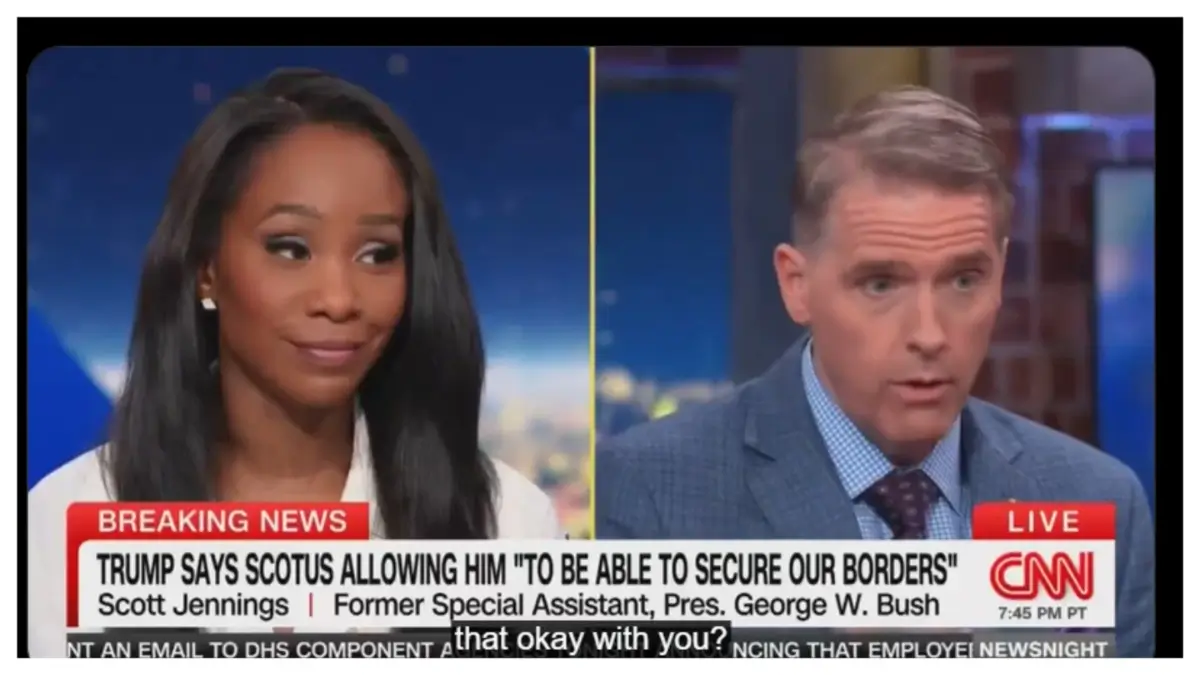
‘Arrogant and Smarmy’: Abby Phillip Hits Scott Jennings with Receipts That Link Trump to $2.5 Billion In Fraud, and He Scrambles to Save Face

‘Arrogant and Smarmy’: Abby Phillip Hits Scott Jennings with Receipts That Link Trump to .5 Billion In Fraud, and He Scrambles to Save Face

When a debate erupted over high-level fraud on the Dec. 29 episode of “NewsNight with Abby Phillip,” few predicted that Phillip would need to step in and school roundtable fixture Scott Jennings about Trump’s pardons and selective accountability.

The perennially composed Phillip regularly watches the Republican pundit on her popular CNN news show representing the MAGA viewpoint, but his selective outrage regarding the Somali Medicaid scandal was just too much.

‘Arrogant and Smarmy’: Abby Phillip Hits Scott Jennings with Receipts That Link Trump to .5 Billion In Fraud, and He Scrambles to Save Face
Abby Phillip clashed with Scott Jennings over Trump’s latest wish for the American people. (Credit: CNN Video Screengrab)

In a clip that’s quickly going viral, Phillip’s confused face said it all.

Jennings had been railing against the alleged Medicaid fraud at daycare centers owned by Somali immigrants in Minnesota when he made a dramatic statement, “When is someone in a position of power going to go to jail for the rape and fraud? You can put all the low-level people in jail you want, but until someone in charge goes to jail, it won’t stop.”

“Hold on a second,” Phillip interjected with a quizzical look, before listing off a string of controversial pardons issued by Trump since he took office.

“Trump has pardoned Devon Archer, $60 million in forfeiture and restitution wiped away. He has pardoned Trevor Milton, who committed fraud, lied to his shareholders. $660 million. That was supposed to go back to shareholders. Wiped away.”

‘This Is Pathetic’: Trump Boasts About a Huge Win, but One Overlooked Detail Turns the Brag Into a Public Embarrassment

Phillip continued: “Carlos Watson also defrauded people. Ninety-seven million in penalties wiped away. David Gentile ran a $1.7 billion Ponzi scheme. Sentence commuted.” Breaking it down in the simplest terms, she explained to Jennings that “fraud is bad, fraud should be prosecuted.”

“This president is pardoning and commuting the sentences of fraudsters all the time,” she added.

In a brief moment of capitulation, Jennings raised his hands. “I have no defense for anyone who commits fraud,” he said, but it appears Phillip’s message didn’t fully register, as the two proceeded to talk over each other before the clip ended.

“What I am telling you,” Jennings stated, “is in the case of these states and locals, this is public money, taxpayer money, people get elected… the Medicaid program is run by the state, and they brag about putting more money into these daycare systems that are obviously rife with fraud.”

Federal crackdowns in Minnesota have been widespread and ongoing since at least 2023, resulting in numerous charges and convictions. Prosecutors allege that people of Somali background have stolen hundreds of millions to possibly billions of federal funds intended for low-income individuals and children in the North Star State.

In December, the scandal exploded in the news after a viral video posted by right-wing influencer Nick Shirley purported to expose fraud at Somali-owned day care centers, sparking a new wave of crackdowns.

U.S. Homeland Security officials have been visiting Minneapolis businesses to interview workers, and Republicans are calling for deportations. On Dec. 30, Trump announced he would freeze childcare funds to the state of Minnesota.  

“The DOJ is prosecuting those people all the time,” Phillip told Jennings, looking exasperated. “It happens under Republicans, and it happens under Democrats. It happens in red states. It happens in blue states. But the other part of this is an attempt to make this about Somalis in general, as opposed to just about the people who are responsible.”

As one person quipped in the comments on X: “Jennings is a chump.”

“Oh Scott Jennings…what an arrogant and smarmy little shit you are,” another viewer replied.

Many others agreed with Phillp. As one put it: “Trump’s ‘law and order’ charade implodes: Dec 23 pardons freed fraudsters who stole $2.4B from retirees and tribes. Gentile’s $1.7B Ponzi pardon epitomizes this betrayal of 17,000 families. Justice is now a luxury only the wealthy and politically connected can afford.”

Great Job Grace Jidoun & the Team @ Atlanta Black Star Source link for sharing this story.

The U.S. accuses Maduro and his wife of ordering kidnappings, beatings and murders, among other charges | Fortune

The U.S. accuses Maduro and his wife of ordering kidnappings, beatings and murders, among other charges | Fortune

A newly unsealed U.S. Justice Department indictment accuses captured Venezuelan President Nicolás Maduro of running a “corrupt, illegitimate government” fueled by an extensive drug-trafficking operation that flooded the U.S. with thousands of tons of cocaine.

The arrest of Maduro and his wife in a stunning military operation early Saturday in Venezuela sets the stage for a major test for U.S. prosecutors as they seek to secure a conviction in a Manhattan courtroom against the longtime leader of the oil-rich South American nation.

Attorney General Pam Bondi said in a post on X that Maduro and his wife “will soon face the full wrath of American justice on American soil in American courts.”

Here’s a look at the accusations against Maduro and the charges he faces.

Maduro faces drugs and weapons charges

Maduro is charged alongside his wife, his son and three others. Maduro is indicted on four counts: narco-terrorism conspiracy, cocaine importation conspiracy, possession of machine guns and destructive devices and conspiracy to possess machine guns and destructive devices.

Maduro is facing the same charges as in an earlier indictment brought against him in Manhattan federal court in 2020, during the first Trump presidency. The new indictment unsealed on Saturday, which adds charges against Maduro’s wife, was filed under seal in the Southern District of New York just before Christmas.

It was not immediately clear when Maduro and his wife, Cilia Flores, would make their first appearance at the courthouse in Manhattan. A video posted Saturday night on social media by a White House account showed Maduro, smiling, as he was escorted through a U.S. Drug Enforcement Administration office in New York by two federal agents grasping his arms. He was expected to be detained while awaiting trial at a federal jail in Brooklyn.

Maduro allowed ‘cocaine-fueled corruption to flourish,’ US says

The indictment accuses Maduro of partnering with “some of the most violent and prolific drug traffickers and narco-terrorists in the world” to allow for the shipment of thousands of tons of cocaine into the U.S. Authorities allege powerful and violent drug-trafficking organizations, such as the Sinaloa Cartel and Tren de Aragua gang, worked directly with the Venezuelan government and then sent profits to high-ranking officials who helped and protected them in exchange.

Maduro allowed “cocaine-fueled corruption to flourish for his own benefit, for the benefit of members of his ruling regime, and for the benefit of his family members,” the indictment alleges.

U.S. authorities allege that Maduro and his family “provided law enforcement cover and logistical support” to cartels moving drugs throughout the region, resulting in as much as 250 tons of cocaine trafficked through Venezuela annually by 2020, according to the indictment. Drugs were moved on go-fast vessels, fishing boats and container ships or on planes from clandestine airstrips, the indictment says.

“This cycle of narcotics-based corruption lines the pockets of Venezuelan officials and their families while also benefiting violent narco-terrorists who operate with impunity on Venezuelan soil and who help produce, protect, and transport tons of cocaine to the United States,” the indictment says.

Allegations of bribes and orders of kidnappings and murders

The U.S. accuses Maduro and his wife of ordering kidnappings, beatings and murders “against those who owed them drug money or otherwise undermined their drug trafficking operation.” That includes the killing of a local drug boss in Caracas, according to the indictment.

Maduro’s wife is also accused of accepting hundreds of thousands of dollars in bribes in 2007 to arrange a meeting between “a large-scale drug trafficker” and the director of Venezuela’s National Anti-Drug Office. In a corrupt deal, the drug trafficker then agreed to pay a monthly bribe to the director of the anti-drug office as well as about $100,000 for each cocaine-carrying flight “to ensure the flight’s safe passage.” Some of that money then went to Maduro’s wife, the indictment says.

Nephews of Maduro’s wife were heard during recorded meetings with confidential U.S. government sources in 2015 agreeing to send “multi-hundred-kilogram cocaine shipments” from Maduro’s “presidential hanger” at a Venezuelan airport. The nephews during the recorded meetings explained “that they were at ‘war’ with the United States,” the indictment alleges. They were both sentenced in 2017 to 18 years in prison for conspiring to send tons of cocaine into the U.S. before being released in 2022 as part of a prisoner swap in exchange for seven imprisoned Americans.

Operation to capture Maduro was a ‘law enforcement function,’ Rubio says

During a news conference, Secretary of State Marco Rubio and Dan Caine, the chairman of the Joint Chiefs of Staff, cast the military raid that captured Maduro and his wife as an action carried out on behalf of the Department of Justice. Caine said the operation was made “at the request of the Justice Department.”

Rubio, as he responded to a question about whether Congress had been notified, said the U.S. raid to get the couple was “basically a law enforcement function,” adding that it was an instance in which the “Department of War supported the Department of Justice.” He called Maduro “a fugitive of American justice with a $50 million reward” over his head.

Great Job Alanna Durkin Richer, Larry Neumeister, The Associated Press & the Team @ Fortune | FORTUNE Source link for sharing this story.

Deni Avdija has triple-double to power Trail Blazers past Spurs, 115-110

Deni Avdija has triple-double to power Trail Blazers past Spurs, 115-110

SAN ANTONIO – Deni Avdija had 29 points, 11 rebounds and 10 assists, Donovan Clingan added a career-high 24 points along with 12 rebounds and the Portland Trail Blazers beat the San Antonio Spurs 115-110 on Saturday night.

Toumani Camara had 20 points and eight rebounds as Portland led for all but 18 seconds in picking up its second straight victyory.

Luke Kornet had 20 points and Julian Champagnie added 20 points and 10 rebounds for San Antonio. The Spurs had won two straight.

The Spurs were without All-Star center Victor Wembanyama (left knee soreness) and Devin Vassell (strained left adductor). San Antonio coach Mitch Johnson said Wembanyama remains day-to-day, but is “looking really good” and expects him to accompany the team to Memphis for a game Tuesday night.

It was the second night of back-to-back games for both teams.

Portland never trailed in the first half, building its lead to 15 points while San Antonio shot 3 for 12 on 3-pointers.

The Spurs captured their lone lead with five minutes remaining in the third quarter. Kelly Olynyk’s free throw following an off-ball foul on Champagnie’s 3-pointer gave San Antonio its first lead at 74-71 lead. That advantage lasted only 18 seconds as former Spurs forward Sidy Cissoko drained a 3-pointer.

Portland went on a 12-0 run bridging the third and fourth quarters in capturing a 93-80 lead with 10:36 remaining in the game.

San Antonio rallied again, with De’Aaron Fox’s steal and pass to Stephon Castle for a breakaway dunk cutting Portland’s lead to 111-110 with 1:36 remaining. As they had all game, the Trail Blazers efficiently rebuilt their lead to topple the Spurs.

Fox finished with 19 points and Castle had 16.

Portand was 19 for 45 on 3-pointers, while San Antonio was 10 for 31.

Up next

Blazers: Host Utah on Monday night.

Spurs: At Memphis on Tuesday night.

___

AP NBA: https://apnews.com/NBA

Copyright 2026 by KSAT – All rights reserved.

Great Job Associated Press & the Team @ KSAT San Antonio Source link for sharing this story.

International Law and the U.S. Military and Law Enforcement Operations in Venezuela

International Law and the U.S. Military and Law Enforcement Operations in Venezuela

President Nicolás Maduro has arrived in New York City to be tried by the U.S. Department of Justice on criminal charges related to drug trafficking and weapons possession. His capture began early Saturday morning with multiple explosions reported in Caracas, Venezuela, including at military installations. It soon became clear that the United States was attacking targets in the city. In the immediate aftermath of the operation, which lasted fewer than 30 minutes, senior Venezuelan officials stated that they did not know the whereabouts of President Nicolás Maduro and First Lady Ilia Flores, and demanded proof of life. Reportedly, the U.S. Army’s Delta Force and the 160th Special Operations Aviation Regiment carried out the capture mission during what has been labeled Operation Absolute Resolve. Venezuelan officials have said at least 40 people, civilians and military personnel, were killed in the attacks.  

President Donald Trump quickly took to Truth Social to announce, “The United States of America has successfully carried out a large scale strike against Venezuela and its leader, President Nicolas Maduro, who has been, along with his wife, captured and flown out of the country. This operation was done in conjunction with U.S. Law Enforcement.” For his part, Secretary of State Marco Rubio explained that Maduro “has been arrested by U.S. personnel to stand trial on criminal charges in the United States, and that the kinetic action we saw tonight was deployed to protect and defend those executing the arrest warrant.” Attorney General Pam Bondi characterized the operations as law enforcement conducted by the armed forces.

Nicolas Maduro and his wife, Cilia Flores, have been indicted in the Southern District of New York.  Nicolas Maduro has been charged with Narco-Terrorism Conspiracy, Cocaine Importation Conspiracy, Possession of Machineguns and Destructive Devices, and Conspiracy to Possess Machineguns and Destructive Devices against the United States.  They will soon face the full wrath of American justice on American soil in American courts. 

She went on to thank “our brave military who conducted the incredible and highly successful mission to capture these two alleged international narco traffickers.” President Trump has since said the United States is going to “run” Venezuela “until such time as we can do a safe, proper and judicious transition.” 

The operation follows on the heels of 35 boat strikes that have killed at least 115, which the United States has justified based on self-defense, and a CIA drone strike in late December on a docking facility in Venezuela alleged to have been used by drug cartels. Presumably, the United States likewise justifies, in part, Saturday’s operation on the same basis, self-defense against drug trafficking into the United States.

In this article, we explain several international law issues raised by the operation, some of which have been addressed in greater depth in the Just Security collection of articles on the drug boat strikes and other operations dealing with Venezuela. In particular, Operation Absolute Resolve implicates the prohibition on the use of force against other States (e.g., under the UN Charter), extraterritorial law enforcement, and initiation of an international armed conflict (e.g., under the Geneva Conventions).

The bottom line is, unlike the boat strikes the U.S. military has carried out to date that have occurred in international waters against stateless vessels, this operation, striking Venezuela and abducting its president, is clearly a violation of the prohibition on the use of force in Article 2(4) of the UN Charter. That prohibition is the bedrock rule of the international system that separates the rule of law from anarchy, safeguards small States from their more powerful neighbors, and protects civilians from the devastation of war. The consequences of flouting this rule so brazenly are likely to extend well beyond the case of Maduro’s forcible ouster. Likewise, the initiation of an armed conflict – triggering the application of the law of armed conflict, including all four Geneva Conventions – has meaningful consequences, ranging from the protections now owed to Venezuelan nationals in the United States, to the application of rules governing treatment of Maduro and his wife while in U.S. custody, to accountability for any war crimes committed in the course of the conflict. 

An Unlawful Use of Force

The prohibition on the use of force: First and foremost, the U.S. operation striking Venezuela and abducting its president is a clear violation of the prohibition on the use of force except in self-defense against armed attack or with U.N. Security Council authorization, both of which are explained further below. The prohibition is set forth in Article 2(4) of the U.N. Charter, which provides, “All Members shall refrain in their international relations from the threat or use of force against the territorial integrity or political independence of any state, or in any other manner inconsistent with the Purposes of the United Nations.” Both the United States and Venezuela are Parties to the Charter, so the prohibition is undoubtedly binding under treaty law. Moreover, as the United States has long held and the International Court of Justice has noted, the prohibition reflects customary international law, which likewise binds the United States (Paramilitary Activities, ¶ 190). 

Any forcible action by one State against another triggers the prohibition. Accordingly, the U.S. operations constituted a prima facie breach unless justified by one of two narrow exceptions: 1) authorization by the U.N. Security Council under Chapter VII of the U.N. Charter; or 2) the inherent right of self-defense provided for in Article 51 of the Charter and customary international law. There being no Security Council authorization, the sole possible legal basis for the operation would be self-defense. 

In relevant part, Article 51 provides, “Nothing in the present Charter shall impair the inherent right of individual or collective self-defense if an armed attack occurs against a Member of the United Nations.” Thus, the legality of the U.S. operation turns on whether Venezuela has engaged in an “armed attack” against the United States (or an armed attack is imminent), triggering the right of self-defense, and, if so, whether the U.S. response was both “necessary and proportionate,” the two conditions for the use of force in self-defense (Paramilitary Activities, paras. 194, 237; Nuclear Weapons, para. 41; Oil Platforms, paras. 43, 73-74, 76). The conditions are relevant only if the first hurdle is crossed. As will be explained, it is clearly not.

No self-defense justification: The Trump administration has repeatedly justified its strikes on boats allegedly carrying drugs (largely involving cocaine, much of which is likely bound for Europe) on the basis of self-defense. For instance, early on, a White House spokesperson claimed they were “conducted against the operations of a designated terrorist organization and was taken in defense of vital U.S. national interests and in the collective self-defense of other nations.” Along these lines, a classified Justice Department memo apparently argues that force may be used against cartels because they pose an “imminent threat to Americans.” For these assertions to make any sense, the drug activity must be characterized as an “armed attack” against the United States. Indeed, in a statement to the UN Security Council in October, the U.S. representative said, “President Trump determined these cartels are non-state armed groups, designated them as terrorist organizations, and determined that their actions constitute an armed attack against the United States.”

It is on this basis that the United States may attempt to assert self-defense against Venezuela. As evidenced by the charges against Maduro both in 2020 and in the new superseding indictment, the administration links him and other government officials to the activities of drug cartels. For instance, in August, the State Department alleged,

Maduro helped manage and ultimately lead the Cartel of the Suns, a Venezuelan drug-trafficking organization comprised of high-ranking Venezuelan officials. As he gained power in Venezuela, Maduro participated in a corrupt and violent narco-terrorism conspiracy with the Revolutionary Armed Forces of Colombia (FARC), a designated Foreign Terrorist Organization. Maduro negotiated multi-ton shipments of FARC-produced cocaine; directed the Cartel of the Suns to provide military-grade weapons to the FARC; coordinated with narcotics traffickers in Honduras and other countries to facilitate large-scale drug trafficking; and solicited assistance from FARC leadership in training an unsanctioned militia group that functioned, in essence, as an armed forces unit for the Cartel of the Suns.

We have refuted the self-defense argument vis-à-vis the cartels in earlier articles (see, e.g., here and here). Drug trafficking simply does not qualify as, and has never been considered, an “armed attack.” In brief, the relationship between drug trafficking and the deaths that eventually result from drugs being purchased and used in the United States is far too attenuated to qualify as an armed attack. The drugs must be successfully transported into the country, where they are distributed to various drug organizations, and subsequently sold on the streets, in most cases by individuals who are unrelated to the original drug cartels. Willing buyers then purchase them; almost all survive. In fact, those deaths that occur run contrary to the interests of the cartels because they deprive the drug market of customers and risk deterring others from buying the drugs. 

It is indisputable that drug trafficking is condemnable criminal activity, but it is not the type of activity that triggers the right of self-defense in international law. It is not a use of force, it is not “hostilities,” and it is not “combat,” despite Trump administration officials using these labels when describing drug trafficking activity. 

The connection is even more attenuated in the case of Maduro and other members of the Venezuelan government who may be involved in drug activity. After all, the sole purpose of the cartels is to traffic drugs, whereas, if the allegations are true, the Venezuelan government’s involvement, albeit also condemnable, is less direct. Accordingly, if the self-defense argument does not work for drug cartels, asserting that it applies to Maduro and the Venezuelan government is even less plausible. Simply put, there is no basis for suggesting that any Venezuelan government involvement in drug activity rises to the level of an armed attack against the United States, giving it the right to resort to force against Venezuela to defend itself. This being so, the Operation Absolute Resolve was a clear violation of the international law prohibition on the use of force.

Distinguishing past practice – the Noriega case: Three points should be made about the closest historical example in U.S. practice: the 1989 U.S. operation to capture General Manuel Noriega in Panama and bring him to the United States to face drug smuggling and other charges. First, reaffirming the prohibition against the use of force, the U.N. General Assembly condemned the U.S. operation. The General Assembly stated that it “strongly deplores the intervention in Panama by the armed forces of the United States of America, which con­stitutes a flagrant violation of international law.” 

Second, the U.S. justifications for the Noriega-Panama operation distinguish it from the Maduro-Venezuela case. Most importantly, in the former case, the United States claimed to be acting by invitation of the rightful Head of State. “It was welcomed by the democratically elected government of Panama,” President George H.W. Bush informed the U.S. Congress in a War Powers Resolution report. Likewise, U.S. Ambassador Thomas Pickering told the U.N. Security Council, “United States action in Panama has been approved, applauded and welcomed by the democratically elected Government of Panama.” 

Third, as noted by President George H.W. Bush, the United States acted after the Panamanian National Assembly declared a state of war against the United States, and after forces under Noriega’s command “killed an unarmed American serviceman; wounded another; arrested and brutally beat a third American serviceman; and then brutally interrogated his wife, threatening her with sexual abuse.” Bush added that “General Noriega’s reckless threats and attacks upon Americans in Panama created an imminent danger to the 35,000 American citizens in Panama.” Secretary of State James A. Baker also stated, “We received an intelligence report that General Noriega was considering launching an urban commando attack on American citizens in a residential neighborhood.” None of those factors is present here.

Venezuela may use necessary and proportionate force in self-defense: Finally, based on the U.S. position that all wrongful uses of force are armed attacks, Venezuela has the right to use necessary and proportionate force against the United States’ armed attack to defend itself (DoD, Law of War Manual, §1.11.5.2; but see Paramilitary Activities, ¶ 191). Additionally, as provided for in Article 51 of the Charter, Venezuela may seek the assistance of other States acting in collective self-defense. 

Intervention into Venezuela’s Internal Affairs: Finally, we note that in addition to a violation of the use of force prohibition, the U.S. action to remove Maduro as Head of State amounts to an unlawful intervention into Venezuela’s internal affairs (“choice of political system,” Paramilitary Activities, ¶ 205). Regime change by one State in another amounts to intervention when it is “coercive” (¶ 206), which Saturday’s operation obviously was. 

Extraterritorial Law Enforcement

The administration has framed the operation on Saturday and the seizure of Maduro and his wife in the context of law enforcement. The key international law issue in the case is the extraterritorial exercise of “enforcement jurisdiction,” specifically, the power to arrest. (One of us, Ryan, has explained why the administration’s reliance on a 1989 DOJ Office of Legal Counsel memo erroneously concluding that the president may, as a domestic law matter, “override” art. 2(4) of the UN Charter is flawed.). 

No enforcement jurisdiction in the territory of other States without their consent: There are three types of jurisdiction under international law: prescriptive (legislative), adjudicative (judicial), and enforcement (executive). International law allows a degree of prescriptive jurisdiction (the power to pass laws) over offences committed abroad, as perhaps alleged here. However, the exercise of enforcement jurisdiction is strictly limited to a State’s own territory (or in limited cases, in the commons, as in the case of jurisdiction aboard a flag state vessel). But on another State’s territory, the consent of that State is required (S.S. Lotus, PCIJ, page 18; Restatement Third of Foreign Relations, § 432). Without it, the action violates the territorial State’s sovereignty on two grounds. First, it is a violation of that State’s territorial sovereignty; this has clearly occurred. Second, it is an “usurpation” of an “inherently governmental function” by another State. In other words, the United States has engaged in governmental activity in Venezuela – law enforcement – that is exclusively the domain of the Venezuelan government.

A leading precedent involves the U.N. response to an extraterritorial law enforcement operation: the forcible apprehension of Nazi fugitive Adolph Eichmann in Argentina by Israeli agents in May 1960, and bringing him to trial in Israel for war crimes. With support from the United States, the U.N. Security Council passed a resolution stating:

Considering that the violation of the sovereignty of a Member State is incompatible with the Charter of the United Nations …
Noting that the repetition of acts such as that giving rise to this situation would involve a breach of the principles upon which international order is founded, creating an atmosphere of insecurity and distrust incompatible with the preservation of peace …
Requests the Government of Israel to make appropriate reparation in accordance with the Charter of the United Nations and the rules of international law.

In 1989, the State Department’s legal adviser, Abe Sofaer, stated in written congressional testimony, “The United States has repeatedly associated itself with the view that unconsented arrests violate the principle of territorial integrity.” He added, “Arrests in foreign States without their consent have no legal justification under international law aside from self-defense.”

The United States claims, rightfully so, that Maduro’s presidency is not “legitimate.” However, that has no bearing on this situation. Even though the United States does not recognize the Maduro government as legitimate, international law provides that the relevant officials to grant consent are those of the government that exercises “effective control” over the territory, in this case, officials in the Maduro administration (Tinoco Arbitration, pages 381-82). Obviously, no such consent has been granted.

Head of state immunity and inviolability: Moreover, Maduro enjoyed immunity (known as “immunity ratione personae”) from foreign enforcement jurisdiction under customary international law. As noted by the International Court of Justice in its Arrest Warrant judgement, “it is firmly established that … certain holders of high-ranking office in a State, such as the Head of State, Head of Government and Minister for Foreign Affairs, enjoy immunities from jurisdiction in other States, both civil and criminal” (¶ 51; see also Certain Questions of Mutual Assistance, ¶¶ 170-174). 

Relatedly, the United States has observed that “in addition to immunity from criminal jurisdiction, heads of state, heads of government, and foreign ministers who enjoy personal immunity also benefit from personal inviolability, a protection that informs their treatment in the criminal context.” Such inviolability includes protection from arrest by other States while in office. ( Comments from the United States on the International Law Commission’s Draft Articles on Criminal Immunity).

While in office, this immunity and inviolability is absolute and bars any form of enforcement jurisdiction by another State. The purpose of the immunity, as noted by the Court, is to “ensure the effective performance of their functions on behalf of their respective States” (¶ 53). It is a manifestation of the Principle of “sovereign equality” in international law (UN Charter, art. 2(1)). Where some might argue that an exception exists for Heads of State who commit serious war crimes and other atrocities, that is not relevant to the U.S. case against Maduro.

The Trump administration may argue that Maduro was not, in fact, the Head of State, given that his most recent re-election was neither free nor fair (we agree with that as a factual matter), and that the United States does not recognize his government. Similarly, following the Saturday swearing-in as interim President of Delcy Rodriguez, the United States may argue that he is no longer Head of State, even if he was previously so. Both arguments fail. First, withdrawing recognition of a government does not remove the personal immunity that the incumbent head of state enjoys under customary international law. Second, Rodriguez has said (post swearing in) that Maduro is “the only President of Venezuela,” and is calling for the release of Maduro and his wife.   

Unlawful use of lethal force: Even if international law permitted the United States to exercise enforcement jurisdiction in Venezuela, which it does not, the use of lethal force to do so was self-evidently unlawful. During law enforcement operations, resort to deadly force is lawful only when necessary in the face of an immediate threat of death or grievous bodily injury to the law enforcement officials or others (Basic Principles on the Use of Force and Firearms by Law Enforcement Officials; see also UN Human Rights Committee, General Comment 36, para 12). 

Secretary Rubio claims that the kinetic operations mounted by the U.S. armed forces were necessary to protect those taking custody of Maduro, presumably by preventing the Venezuelan armed forces from responding. However, the threat must be immediate and strictly necessary. The strikes were, instead, primarily preventive and anticipatory in character; they fall far outside the scope of permissible lethal measures during a law enforcement operation. If at least 40 people were killed, including civilians, that would be strong evidence that Rubio’s asserted justification is without legal merit. 

Moreover, it should be self-evident that “unit self-defense” (i.e., defense of a contingent of armed forces in a foreign country, as opposed to self-defense of the United States as a nation) cannot be the lawful basis for the use of force when any potential need for unit self-defense is only itself created in the first instance by the insertion of the U.S. forces.  

Recovery of Unlawfully Expropriated Oil Assets 

We also note that Trump has claimed that Venezuela has “stolen” U.S. oil and assets and demanded their return. In 2007, Venezuela, under President Hugo Chavez, converted existing oil extraction contracts into State-controlled joint ventures. When some major foreign oil companies rejected these terms, their assets were expropriated without the required prompt, adequate, and effective compensation. Although Venezuela had previously nationalized the oil industry in 1976, these 2007 actions targeted foreign investors specifically and amounted to unlawful expropriations under international law. Trump is now offering to help American oil companies recover their wrongfully seized assets, reportedly contingent on compliance with U.S. policy priorities, although the nature and legality of these conditions remain unclear. 

However, one thing is clear from the outset: using force to acquire those assets is unlawful, as the action does not qualify as self-defense, no matter how unlawful the expropriation may have been. And even if it did, the forcible U.S. action does not comport with the necessity condition for self-defense because there are non-forcible avenues that could be pursued. Examples include retorsion, arbitration, and countermeasures under the law of State responsibility (Articles on State Responsibility, art. 22). Simply put, the United States may not simply seize back the assets by force.

We do not address here the potential violation, if not war crime, of the law of armed conflict for pillaging another State’s natural resources. Readers may wish to consult James Stewart’s prior analysis in a 2016 essay at Just Security.

Armed Conflict

Putting aside the issue of whether the U.S. operation violated international law, which it undoubtedly did, it also initiated an “international armed conflict” between the United States and Venezuela. This is so regardless of how the United States might characterize the operations. Under Common Article 2 of the 1949 Geneva Conventions, the existence of an international armed conflict is a question of fact. In other words, if there are hostilities between the States, there is an international armed conflict even if one of them does not formally recognize its existence. Common Article 2 is universally accepted as reflective of customary international law.

There are numerous challenging issues regarding the classification of conflicts, such as the precise threshold at which they are triggered and whether another State’s support of a non-State organized armed group that is engaged in hostilities with a State suffices to initiate an armed conflict between the two States. Those thornier issues are not relevant to these strikes and the Maduro capture operation. The intensity of the U.S. operations directed at Venezuela clearly crossed any conceivable threshold necessary to trigger an international armed conflict. To be clear, the operations put the United States and Venezuela in armed conflict as a matter of fact and of law. 

(Note: If the United States began “running the country,” as President Trump suggested, an enduring international armed conflict may exist. That’s because a military occupation of another country, even if it meets with no armed resistance, is classified as an “international armed conflict.” More on the law of occupation is below.)

The consequences are profound. To begin with, the law of armed conflict, including all four of the Geneva Conventions, now applies. Of particular note, the rules for targeting permit Venezuelan forces to attack U.S. forces anywhere in Venezuelan or U.S. territory, and on the high seas, in international airspace, or in outer space (so-called “status-based targeting”). The law of armed conflict also prohibits targeting civilians and civilian objects (DoD Law of War Manual (§ 5.5). This is especially relevant to the issue of whether operations may now be directed at drug-related targets in Venezuela. 

Targeting individuals involved in drug trafficking: Individuals involved in drug activities do not qualify as lawful targets unless they are members of the armed forces or “directly participating in the hostilities.” As explained in the DoD Law of War Manual (§ 5.8.3): “At a minimum, taking a direct part in hostilities includes actions that are, by their nature and purpose, intended to cause actual harm to the enemy.”

As is apparent, drug-related activities do not satisfy this standard (see our fuller explanation here). Accordingly, attacking those involved in such activities in the context of this armed conflict would violate the law of armed conflict prohibition and constitute a war crime, so long as those civilians do not separately participate in the armed hostilities (in the absence of an armed conflict between the United States and Venezuela, those killings constituted murder, and extrajudicial killings under international human rights law, but were not war crimes because that body of law clearly did not apply). More difficult questions arise as to whether an attack on non-state actors ferrying drugs on the high seas would be related enough to the war between the United States and Venezuela (an armed conflict “nexus” requirement) to be governed by the law of armed conflict, and thus constitute a war crime. 

Targeting drug-related assets and facilities: Whether drug-related assets and facilities may be attacked depends on whether the U.S. position on so-called war-sustaining (or revenue-generating) targets is correct and the factual extent to which Venezuela relies on drug proceeds to fund its war effort. The same is true of its oil production and exports. 

A war-sustaining entity “indirectly, but effectively supports and sustains the belligerents’ warfighting capability,” such as “exports of products the proceeds of which are used by the belligerent to purchase arms and armaments” (Commander’s Handbook, § 7.4).  The prevailing view in international law is that war-sustaining objects do not qualify as targetable military objectives. However, the United States has, for decades, claimed that war-sustaining objects are legitimate military objectives. It is a position with which one of us agrees, but the others do not (DoD Law of War Manual, § 5.6.8). 

To the extent neutrality law survives the U.N. Charter era (a much-debated question), it also now applies. Since the United States is the aggressor in this situation, under the “qualified neutrality” interpretation of neutrality law asserted by the United States, all States would be prohibited from providing it any assistance. Yet, they could come to Venezuela’s assistance without violating their neutrality law obligations. 

The law of occupation would apply if the United States exercises “effective control”: In light of President Trump’s claim that “we are going to run the country now,” the law of occupation outlined in the Fourth Geneva Convention (GCIV) will apply if the United States exerts “effective control” of Venezuela. For now, it seems unlikely, based on the current facts (no U.S. troops on the ground, the swearing in of Vice President Rodriguez as interim President), that this situation will develop. Thus, while Trump has essentially used the rhetoric of occupation through coercion of proxy officials, the United States has not attempted to control territory itself, nor is it at all clear that officials who do exercise governmental authority will act as directed by the United States.

Prisoner of war and “protected person” status under the Geneva Conventions: As a civilian captured by attacking forces in an international armed conflict, Maduro’s wife is entitled to a robust set of protections afforded to captured civilians in GCIV.  Indeed, Flores qualifies as a “protected person,” as defined in art. 4(1) of that treaty:

Persons protected by the Convention are those who, at a given moment and in any manner whatsoever, find themselves, in case of a conflict or occupation, in the hands of a Party to the conflict or Occupying Power of which they are not nationals.

Arguably, Maduro also qualifies as a protected person. Given his status as commander-in-chief of Venezuela’s armed forces, he might also be considered a prisoner of war entitled to the extensive protections of the Third Geneva Convention on the Protection of Prisoners of War (GCIII). In the 1992 case of U.S. v. Noriega, a federal district court found that General Noriega was “entitled to the full range of rights under the [POW] treaty, which has been incorporated into U.S. law.” However, in that case, which involved Noriega’s seizure by U.S. forces during the 1989 invasion of Panama, the general was the military dictator of Panama and also commanded the Panama Defense Forces.

A suite of protections also kicks in for other civilians who are nationals of one party to the conflict and find themselves in the hands of the adverse State. Accordingly, Venezuelans in the United States are now “protected persons” under the Fourth Geneva Convention, as are Americans inside Venezuela. This has far-ranging implications for U.S. immigration and related policies. For example, Venezuelans who are protected persons have rights including protection against “brutality” (GC IV art. 32), against collective punishment and reprisals (GC IV art. 33); parity of employment opportunities (GC IV art. 39), rules for return of detainees transferred to a third State as in CECOT/El Salvador (GC IV art. 45), and family unity in detention (GC IV art. 82).

Concluding Thoughts

The operation against Venezuela, which culminated in the capture of President Maduro and his wife, amounts to a severe breach of foundational principles of international law. It constitutes a clear violation of the prohibition on the use of force enshrined in Article 2(4) of the UN Charter. The claim that drug trafficking, or State involvement in such trafficking, constitutes an “armed attack” sufficient to justify a forcible response in self-defense has no support in customary international law or State practice.

Nor can the exercise of extraterritorial enforcement of domestic criminal law, even against narco- traffickers or indicted heads of State, be justified in the absence of Venezuela’s consent. By exercising enforcement jurisdiction there, the United States has violated Venezuelan sovereignty both because the operation occurred on its territory and because it has usurped an inherently governmental function (law enforcement) exclusively enjoyed by Venezuela. Moreover, despite any crimes he may have committed, Maduro’s seizure violates the long-standing rule of immunity ratione personae for heads of State.

In addition to violating bedrock jus ad bellum rules governing the resort to force and the sovereignty of Venezuela, the operation has triggered an international armed conflict between the United States and Venezuela. The legal consequences are immediate and sweeping – the whole body of the law of armed conflict now applies, including the law governing detention, the conduct of hostilities, protected persons, and war crimes.

The U.S. operation has long-term implications for the integrity of the international legal order, including the systems put in place to prevent war and protect States from using their criminal enforcement powers to intrude on other countries’ sovereign prerogatives.

FEATURED IMAGE: Picture of fire at Fuerte Tiuna, Venezuela’s largest military complex, after a series of explosions in Caracas on January 3, 2026. Loud explosions, accompanied by sounds resembling aircraft flyovers, were heard in Caracas around 2:00 am (0600 GMT) on January 3, an AFP journalist reported. (Photo by Luis JAIMES / AFP via Getty Images)


Great Job Michael Schmitt & the Team @ Just Security Source link for sharing this story.

Anthony Joshua’s Driver Charged With ‘Reckless’ And ‘Dangerous Driving’ After Fatal Car Crash

Anthony Joshua’s Driver Charged With ‘Reckless’ And ‘Dangerous Driving’ After Fatal Car Crash

Source: Anadolu / Getty

UK boxing champion Anthony Joshua experienced the highest of highs and the lowest of lows in a short span of time. Now, the man responsible for the death of two of his close friends, Adenyi Mobalaji Kayode, has been charged by Nigerian police with “dangerous driving causing death.”

As BOSSIP previously reported, on Dec. 29, Kayode, 46, was driving Joshua and two other men—Latif Ayodele and Sina Ghami—in a SUV when he collided into the back of a stationary vehicle. Ayodele and Ghami were pronounced dead at the scene, while Joshua and the driver both sustained minor injuries. Joshua was reportedly released from a hospital in Lagos on New Year’s Eve and visited the funeral home to view the bodies of his deceased friends before flying back to the UK.

Videos from the scene showed Joshua being treated for his injuries on the side of a busy road with broken glass littered across the backseat of the vehicle. According to CBS News, vehicle-related accidents resulting in fatalities are common in Nigeria, with the West African nation recording 5,421 deaths in 9,570 road accidents in 2024 alone.

Kayode is expected to appear in court on Jan. 20 to face the charges and his bail has been set to five million naira, equaling around $3500 USD. He will remain detained until he has met his bail conditions. Preliminary investigations into the crash showed that the 46-year-old driver was operating the vehicle well above the speed limit causing the tire to burst before the crash.

Though a former two-time world heavyweight champion since 2019, Joshua recently stole American hearts when he defeated Jake Paul in a jaw-dropping performance that brought in 33 million views on Netflix. From thirsty diatribes on his physical appearance to all out drooling over his boxing prowess, Black women decided that Joshua was welcome here anytime. Our condolences go out to the boxing champ and the families of Ayodele and Ghami at this difficult time.

Great Job imannmilner & the Team @ Bossip Source link for sharing this story.

Secret Link