
Home News Page 154

Trump’s ‘Operation Iranian Freedom’

Trump’s ‘Operation Iranian Freedom’

Alone in the dead of night, a man can fall into bleak thoughts. In the wee, small hours of the morning, he might think about lost loves, mull over great regrets, or wrestle with the inevitability of his own mortality. But Donald Trump, awake and restless in the Florida darkness, apparently consoles himself by imagining a war of liberation in a Middle Eastern nation of 92 million people.

At 2:58 a.m. EST (according to the time stamp on his Truth Social post), the president of the United States wrote: “If Iran shots and violently kills peaceful protesters, which is their custom, the United States of America will come to their rescue. We are locked and loaded and ready to go.” And then, of course: “Thank you for your attention to this matter!”

A man pushing 80, fighting sleeplessness as older people sometimes do, should be expected now and then to send some weird messages on his Jitterbug. He is also entitled to make some typos, as we all do. But this particular senior citizen is the leader of the most powerful country in the world, and he’s implying he’ll use force against a country he has attacked once already. At the least, Americans might expect that when threatening military action, the commander in chief would give his post a quick proofread. (True to sycophantic form, the official White House account transcribed Trump’s warning while also repeating the typo—as if his mistake was intentional.)

For an America Firster, Trump seems to have quite a global military agenda: In the first year of his second term, he has used force in South America, Africa, and the Middle East. Congress used to debate authorizing such things, but with the GOP House and Senate now reduced to glorified White House staff offices, Trump need not trifle with such annoyances. Only in Europe and the Pacific does he seem shy about flexing American muscle; after all, those places have genuinely tough customers—China and Russia—that scare him. Fishing boats in the Caribbean and small villages in Nigeria are easier pickings. Now, however, he’s threatening something a lot bigger than lobbing a few cruise missiles.

What’s going on here? The answer is probably: Not much. Trump might be considering another showy round of B-2 strikes, which wouldn’t be much help to people demonstrating in the streets of Tehran. Or he might have just outed some sort of intelligence operation in Iran. Or maybe he just couldn’t sleep. Trump claims “we” are locked and loaded, but America is not ready for a war of national liberation in Iran.

One possibility is that Trump is mulling over his meeting last Monday with Israeli Prime Minister Benjamin Netanyahu. After that meeting, Trump said Iran “may be behaving badly” and warned that if “it” is confirmed—presumably, he means evidence that Iran is rebuilding its nuclear program—the “consequences will be very powerful, maybe more powerful than last time.” Although Netanyahu recently insisted that political transformation in Iran must “come from within” and is “up to the Iranian people,” he has in the past pushed for regime change in Tehran. Perhaps he was selling Trump on being remembered as a great liberator, a world-historical role that would be catnip to a narcissist like the president.

One painful irony here is that Iran needs regime change, and nothing would be better for that nation than its people driving the mullahs from power. Another is that the United States used to support the Iranians with efforts such as the Voice of America Persian service, a low-cost program that brought real news and information to them. But Trump, along with his pick to run VOA, Kari Lake, shut down VOA’s Persian broadcasts last March, an idiotic decision that led to the panicky rehiring of Persian speakers just before the U.S. strikes on Iran last June. (Mass firings since then have effectively shut down VOA.)

Trump’s nocturnal ravings are dangerous. The world may be more or less accustomed to Trump’s bizarre threats, but it is still a big deal when the president of the United States menaces another nation. Intelligence analysts, friend and enemy alike, do not have the luxury to presume that the American commander in chief is just having a bad night. They will ask, as they should, whether something is happening behind the scenes, and whether Trump has blurted out something that might be classified.

The United States and Israel are unlikely to be planning some misbegotten war of liberation in Iran, even if Netanyahu and Trump make ruling out such an adventure impossible. Another danger, however, is that ordinary Iranian citizens might see the president’s message and take it seriously. People protesting for their freedom in various parts of the world, especially during the Cold War, have made the deadly mistake of believing that the American cavalry was just about to come over the top of the hill and save them—in Budapest and Prague, and later in Georgia and Ukraine—and faith in Trump’s faithless promises could lead to serious miscalculations by desperate people.

One of the most powerful statements about the dangers of such false promises and the risks of military intervention came not so long ago from an American leader who resolutely objected to both feckless red lines and the use of force abroad: the 45th president of the United States, Donald J. Trump. On October 23, 2019, Trump announced a cease-fire in Syria that he argued averted the need for more comprehensive American military involvement in the region. “We’ve saved a lot of lives,” he said.

And then he took a potshot at his predecessor, Barack Obama, for making a promise that America, in Trump’s view, could never have kept.

Most importantly, we have avoided another costly military intervention that could’ve led to disastrous, far-reaching consequences. Many thousands of people could’ve been killed. The last administration said, “Assad must go.” They could’ve easily produced that outcome, but they didn’t. In fact, they drew a very powerful red line in the sand—you all remember, the red line in the sand—when children were gassed and killed, but then did not honor their commitment as other children died in the same horrible manner.

Gassing children in Syria? A poorly drawn red line that did not merit U.S. action and could lead only to a messy war. Killing peaceful protesters in Tehran? “Locked and loaded!” (The president had few such compunctions in 2020 about hurting peaceful protesters in America, whom he wanted to shoot in the legs.)

A lot of places on this planet—hellscapes where people are warring, starving, and living under terrifying repression—might benefit from forceful intervention. Few of them will get it, because Americans know that military action, especially to overthrow a regime, is a risky business, and certainly not something to ruminate about in the middle of the night.

In a better time, the leaders of Trump’s own party would do their constitutional duty and constrain the president from speaking—and acting—so recklessly. But the one truth in Trump’s unhinged messages, as in so many of his statements, is that the United States is now led by someone who cannot contain his thoughts or emotions, and who still thinks of the men and women of the U.S. military as little more than his own toy soldiers.

Great Job Tom Nichols & the Team @ The Atlantic Source link for sharing this story.

Will Smith’s Tour Violinist Sues Him For “Grooming” & Sexual Harassment, Social Media Reacts

Will Smith’s Tour Violinist Sues Him For “Grooming” & Sexual Harassment, Social Media Reacts

Source: Gilbert Flores / Getty

Will Smith is the latest celebrity to be accused of sexual harassment in the workplace.

According to People, a man named Brian King Joseph has filed a lawsuit against the actor and his company, Treyball Studios Management, Inc.

Joseph, a professional violinist, says he joined Smith on the road for his global tour, Based on a True Story: 2025, which is where he was allegedly “deliberately grooming and priming Mr. Joseph for further sexual exploitation.” 

What reportedly followed was a “traumatic series of events,” including one time around March 20 at 11 pm, when a handwritten note that read “Brian, I’ll be back…just us,” was left in his Las Vegas hotel room.

The complaint alleges the room had no signs of forced entry, and the only other people who had access to the room were tour staff.

Alongside the note was “wipes, a beer bottle, a red backpack, a bottle of HIV medication with another individual’s name, an earring, and hospital discharge paperwork” for someone he didn’t know.

He took it as a threat of sexual violence against him and “feared that an unknown individual would soon return to his room to engage in sexual acts.” 

NBC News notes that Joseph reported the incident to Smith’s management team and to the hotel staff, which he claims led to his firing after staffers “shamed” him and called him a liar.

The musician says the whole ordeal left him with “severe emotional distress, economic loss, reputational harm, and other damages,” including “PTSD and other mental illness as a result of the termination.”

Joseph details his personal relationship with Smith, saying they spent a lot of time alone together and that Smith told him they had a unique “special connection.”

Smith’s attorney, Allen B. Grodsky, denied the claims in a statement:

“Mr. Joseph’s allegations concerning my client are false, baseless, and reckless. They are categorically denied, and we will use all legal means available to address these claims and to ensure that the truth is brought to light.”

The complaint does not specify damages and also claims wrongful termination.

See social media’s reaction to the allegations below.

Great Job Team CASSIUS & the Team @ Black America Web Source link for sharing this story.
Officials order quarantine in South Texas due to Mexfly larvae

Officials order quarantine in South Texas due to Mexfly larvae

Sign up for TPR Today, Texas Public Radio’s newsletter that brings our top stories to your inbox each morning.

Federal and state authorities have quarantined over a thousand acres of citrus crops after discovering the presence of Mexican fruit flies in South Texas.

Officials with the Animal and Plant Health Inspection Service at the Texas Department of Agriculture say the Mexfly larvae have been identified in farmland in Hidalgo and Cameron counties in South Texas.

An earlier quarantine was ordered in December after the pests were found in a grapefruit grove in La Feria. Officials say fruit should not be left hanging on trees or lying on the ground and people should not send any fruit outside the quarantined areas.

The Mexfly is attracted to citrus fruits like grapefruits, oranges and mangoes. The USDA says the fruit flies pose a serious threat for the Texas citrus industry.

USDA

/

www.aphis.usda.gov

Mexican Fruit Flies

From the USDA:

The Mexican fruit fly (Anastrepha ludens or Mexfly) is a serious agricultural pest. It can infest more than 50 types of fruits and vegetables, particularly citrus and mango. The damage makes crops inedible and unmarketable.

Mexican fruit fly was first found in central Mexico in 1863 and along the California-Mexico border by the early 1950s. Today, Mexfly continues to pose a serious threat for the Texas citrus industry and a wide range of other valuable U.S. crops.

Great Job Jerry Clayton & the Team @ Texas Public Radio for sharing this story.

Analysis: UK renewables enjoy record year in 2025 – but gas power still rises – Carbon Brief

Analysis: UK renewables enjoy record year in 2025 – but gas power still rises – Carbon Brief

The UK’s fleet of wind, solar and biomass power plants all set new records in 2025, Carbon Brief analysis shows, but electricity generation from gas still went up.

The rise in gas power was due to the end of UK coal generation in late 2024 and nuclear power hitting its lowest level in half a century, while electricity exports grew and imports fell.

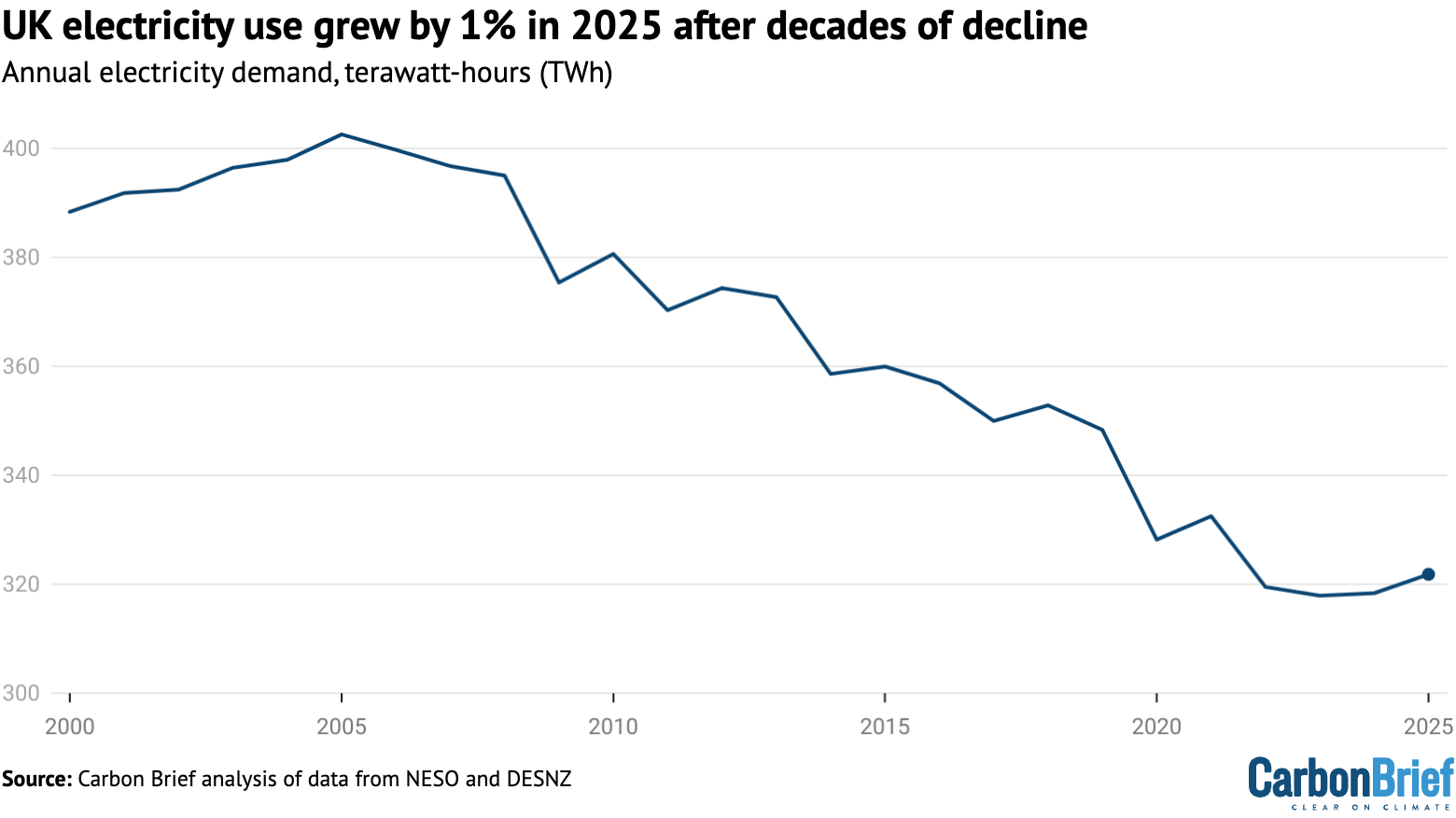
In addition, there was a 1% rise in UK electricity demand – after years of decline – as electric vehicles (EVs), heat pumps and data centres connected to the grid in larger numbers.

Other key insights from the data include:

  • Electricity demand grew for the second year in a row to 322 terawatt hours (TWh), rising by 4TWh (1%) and hinting at a shift towards steady increases, as the UK electrifies.
  • Renewables supplied more of the UK’s electricity than any other source, making up 47% of the total, followed by gas (28%), nuclear (11%) and net imports (10%).
  • The UK set new records for electricity generation from wind (87TWh, +5%), solar (19TWh, +31%) and biomass (41TWh, +2%), as well as for renewables overall (152TWh, +6%).
  • The UK had its first full year without any coal power, compared with 2TWh of generation in 2024, ahead of the closure of the nation’s last coal plant in September of that year.
  • Nuclear power was at its lowest level in half a century, generating just 36TWh (-12%), as most of the remaining fleet paused for refuelling or outages.

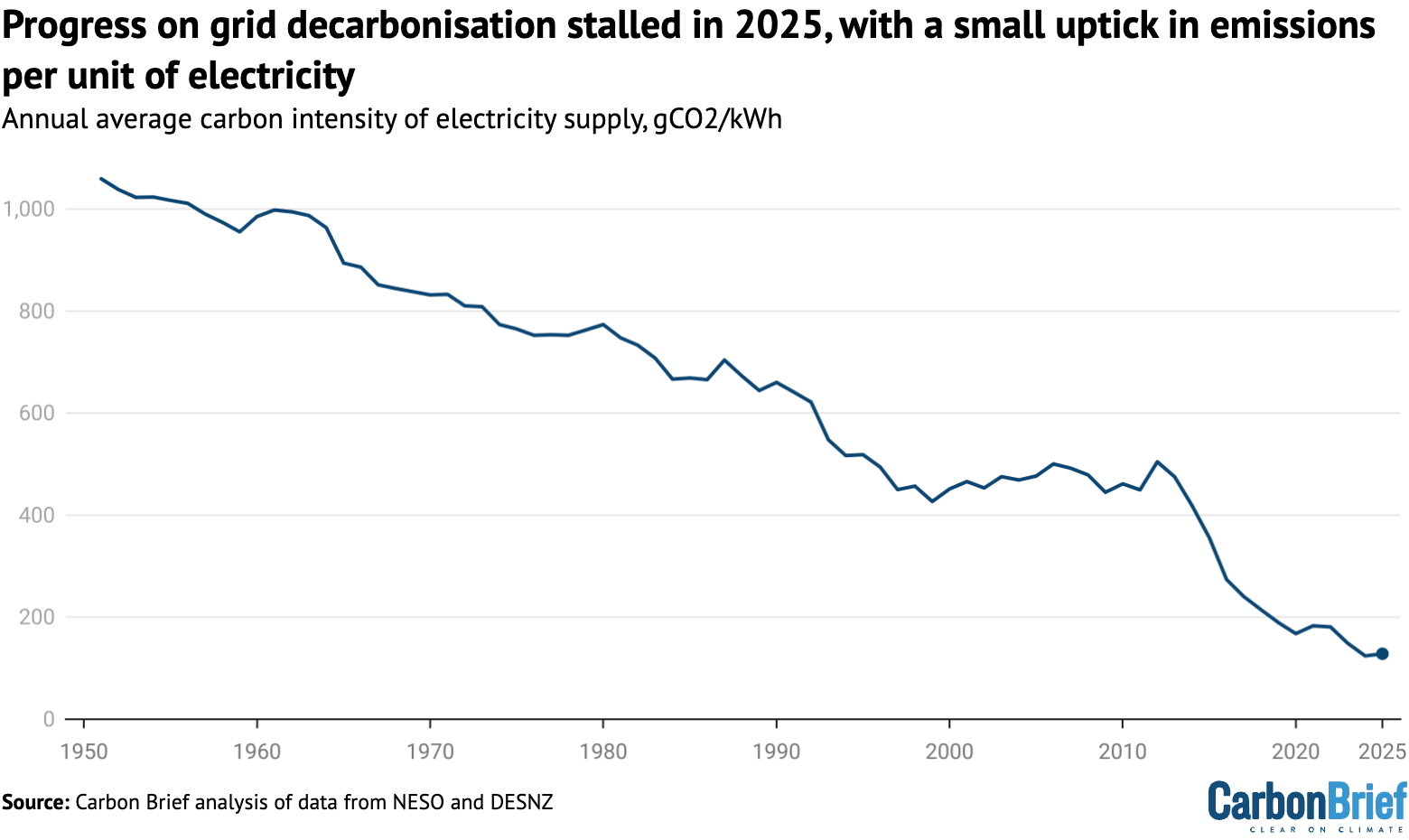
Overall, UK electricity became slightly more polluting in 2025, with each kilowatt hour linked to 126g of carbon dioxide (gCO2/kWh), up 2% from the record low of 124gCO2/kWh, set last year.

The National Energy System Operator (NESO) set a new record for the use of low-carbon sources – known as “zero-carbon operation” – reaching 97.7% for half an hour on 1 April 2025.

However, NESO missed its target of running the electricity network for at least 30 minutes in 2025 without any fossil fuels.

The UK inched towards separate targets set by the government, for 95% of electricity generation to come from low-carbon sources by 2030 and for this to cover 100% of domestic demand.

However, much more rapid progress will be needed to meet these goals.

Carbon Brief has published an annual analysis of the UK’s electricity generation in 2024, 2023, 2021, 2019, 2018, 2017 and 2016.

Record renewables

The UK’s fleet of renewable power plants enjoyed a record year in 2025, with their combined electricity generation reaching 152TWh, a 6% rise from a year earlier.

Renewables made up 47% of UK electricity supplies, another record high. The rise of renewables is shown in the figure below, which also highlights the end of UK coal power.

While the chart makes clear that gas-fired electricity generation has also declined over the past 15 years, there was a small rise in 2025, with output from the fuel reaching 91TWh. This was an increase of 5TWh (5%) and means gas made up 28% of electricity supplies overall.

The rise in gas-fired generation was the result of rising demand and another fall in nuclear power output, which reached the lowest level in half a century, while net imports and coal also declined.

UK electricity supplies by source 2010-2025, terawatt hours (TWh). Net imports are the sum of imports minus exports. Renewables include wind, biomass, solar and hydro. The chart excludes minor sources, such as oil, which makes up less than 2% of the total. Source: Carbon Brief analysis of data from NESO and DESNZ.

The year began with the UK’s sunniest spring and by mid-December had already become the sunniest year on record. This contributed to a 5TWh (31%) surge in electricity generation from solar power, helped by a jump of roughly one-fifth in installed generating capacity.

The new record for solar power generation of 19TWh in 2025 comes after years of stagnation, with electricity output from the technology having climbed just 15% in five years.

The UK’s solar capacity reached 21GW in the third quarter of 2025. This is a substantial increase of 3 gigawatts (GW) or 18% year-on-year.

These are the latest figures available from the Department for Energy Security and Net Zero (DESNZ). The DESNZ timeseries has been revised to reflect previously missing data.

UK wind power also set a new record in 2025, reaching 87TWh, up 4TWh (5%). Wind conditions in 2025 were broadly similar to those in 2024, with the uptick in generation due to additional capacity.

The UK’s wind capacity reached 33GW in the third quarter of 2025, up 1GW (4%) from a year earlier. The 1.2GW Dogger Bank A in the North Sea has been ramping up since autumn 2025 and will be joined by the 1.2GW Dogger Bank B in 2026, as well as the 1.4GW Sofia project.

These sites were all awarded contracts during the government’s third “contracts for difference” (CfD) auction round and will be paid around £53 per megawatt hour (MWh) for the electricity they generate. This is well below current market prices, which currently sit at around £80/MWh.

Results from the seventh auction round, which is currently underway, will be announced in January and February 2026. Prices are expected to be significantly higher than in the third round, as a result of cost inflation.

Nevertheless, new offshore wind capacity is expected to be deliverable at “no additional cost to the billpayer”, according to consultancy Aurora Energy Research.

The UK’s biomass energy sites also had a record year in 2025, with output nudging up by 1TWh (2%) to 41TWh. Approximately two-thirds (roughly 27TWh) of this total is from wood-fired power plants, most notably the Drax former coal plant in Yorkshire, which generated 15TWh in 2024.

The government recently awarded new contracts to Drax that will apply from 2027 onwards and will see the amount of electricity it generates each year roughly halve, to around 6TWh. The government is also consulting on how to tighten sustainability rules for biomass sourcing.

Rising demand

The UK’s electricity demand has been falling for decades due to a combination of more efficient appliances and lightbulbs, as well as ongoing structural shifts in the economy.

Experts have been saying for years that at some point this trend would be reversed, as the UK shifts to electrified heat and transport supplies using EVs and heat pumps.

Indeed, the Climate Change Committee (CCC) has said that demand would more than double by 2050, with electrification forming a key plank of the UK’s efforts to reach net-zero.

Yet there has been little sign of this effect to date, with electricity demand continuing to fall outside single-year rebounds after economic shocks, such as the 2020 Covid lockdowns.

The data for 2025 shows hints that this turning point for electricity demand may finally be taking place. UK demand increased by 4TWh (1%) to 322TWh in 2025, after a 1TWh rise in 2024.

After declining for more than two decades since a peak in 2005, this is the first time in 20 years that UK demand has gone up for two years in a row, as shown in the figure below.

Analysis: UK renewables enjoy record year in 2025 – but gas power still rises – Carbon Brief
Annual UK electricity demand 2000-2025, terawatt hours (TWh). The truncated y-axis shows recent changes more clearly. Source: Carbon Brief analysis of data from NESO and DESNZ.

While detailed data on underlying electricity demand is not available, it is clear that the shift to EVs and heat pumps is playing an important role in the recent uptick.

There are now around 1.8m EVs on the UK’s roads and another 1m plug-in hybrids. Of this total, some 0.6m new EVs and plug-in hybrids were bought in 2025 alone. In addition, around 100,000 heat pumps are being installed each year. Sales of both technologies are rising fast.

Estimates from the NESO “future energy scenarios” point to an additional 2.0TWh of demand from new EVs in 2025, compared with 2024. They also suggest that newly installed heat pumps added around 0.2TWh of additional demand, while data centres added 0.4TWh.

By 2030, NESO’s scenarios suggest that electricity use for these three sources alone will rise by around 30TWh, equivalent to around 10% of total demand in 2025.

EVs would have the biggest impact, adding 17TWh to demand by 2030, NESO says, with heat pumps adding another 3TWh. Data-centre growth is highly uncertain, but could add 12TWh.

Gas growth

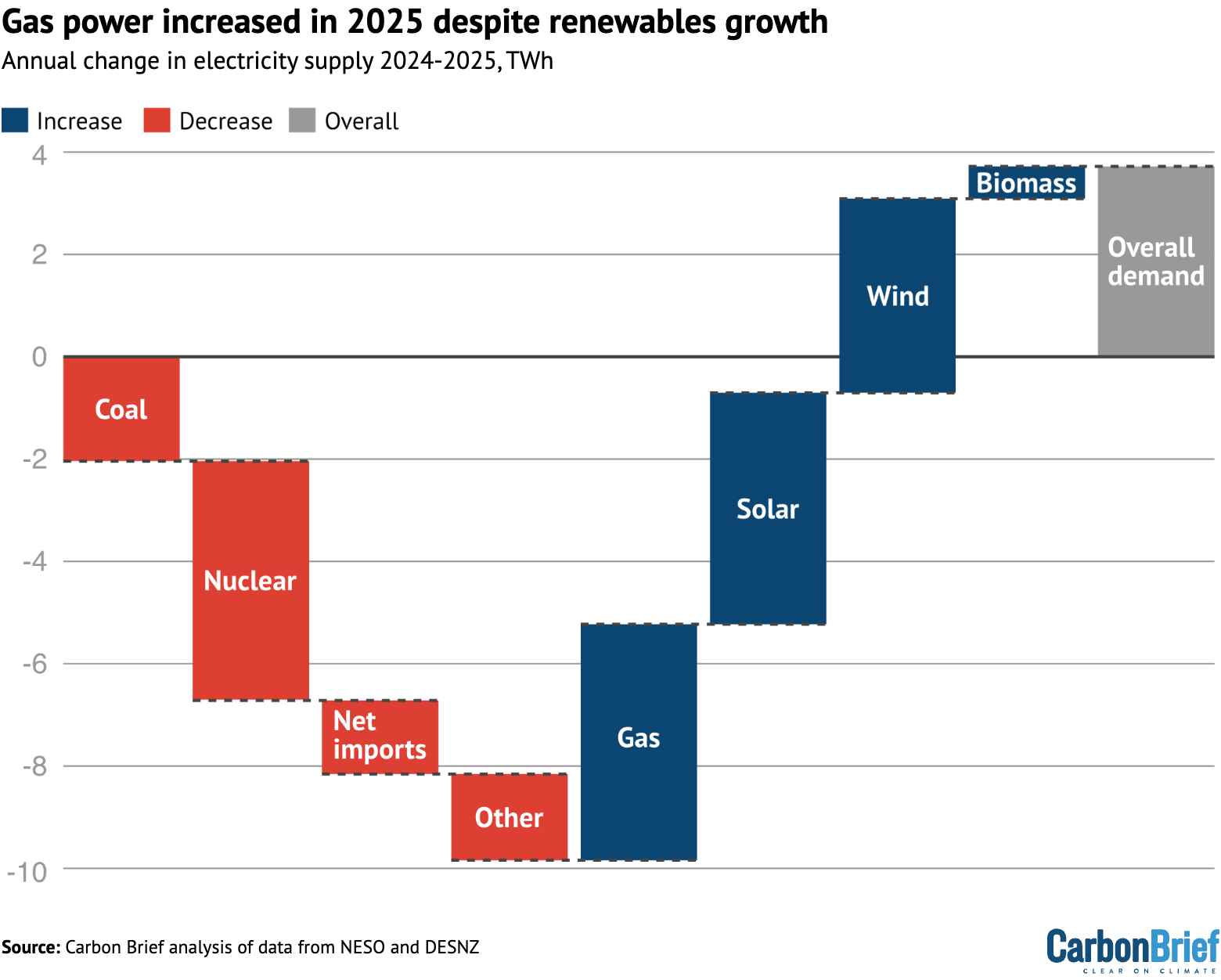
At the same time as UK electricity demand was growing by 4TWh in 2025, the country also lost a total of 10TWh of supply as a result of a series of small changes.

First, 2025 was the UK’s first full year without coal power since 1881, resulting in the loss of 2TWh of generation. Second, the UK’s nuclear fleet saw output falling to the lowest level in half a century, after a series of refuelling breaks and outages, which cut generation by 5TWh.

Third, after a big jump in imports in 2024, the UK saw a small decline in 2025, as well as a more notable increase in the amount of electricity exported to other countries. This pushed the country’s net imports down by 1TWh (4%).

The scale of cross-border trade in electricity is expected to increase as the UK has significantly expanded the number of interconnections with other markets.

However, the government’s clean-power targets for 2030 imply that the UK would become a net exporter, sending more electricity overseas than it receives from other countries. At present, it remains a significant net importer, with these contributions accounting for 10% of supplies.

Finally, other sources of generation – including oil – also declined in 2025, reducing UK supplies by another 2TWh, as shown in the figure below.

A waterfall chart showing that gas power increased in 2025 despite renewables growth.
Change in electricity supply by source between 2024 and 2025, TWh. Source: Carbon Brief analysis of data from NESO and DESNZ.

These losses in UK electricity supply were met by the already-mentioned increases in generation from gas, solar, wind and biomass, as shown in the figure above.

The government’s targets for decarbonising the UK’s electricity supplies will face similar challenges in the years to come as electrification – and, potentially, data centres – continue to push up demand.

All but one of the UK’s existing nuclear power plants are set to retire by 2030, meaning the loss of another 27TWh of nuclear generation.

This will be replaced by new nuclear capacity, but only slowly. The 3.2GW Hinkley Point C plant in Somerset is set to start operating in 2030 at the earliest and its sister plant, Sizewell C in Suffolk, not until at least another five years later.

Despite backing from ministers for small modular reactors, the timeline for any buildout is uncertain, with the latest government release referring to the “mid-2030s”.

Meanwhile, biomass generation is likely to decline as the output of Drax is scaled back from 2027.

Stalling progress

Taken together, the various changes in the UK’s electricity supplies in 2025 mean that efforts to decarbonise the grid stalled, with a small increase in emissions per unit of generation.

The 2% increase in carbon intensity to 126gCO2/kWh is illustrated in the figure below and comes after electricity was the “cleanest ever” in 2024, at 124gCO2/kWh.

Carbon intensity of UK electricity supplies
Carbon intensity of UK electricity supplies, gCO2/kWh. Source: Carbon Brief analysis of data from NESO and DESNZ.

The stalling progress on cleaning up the UK’s grid reflects the balance of record renewables, rising demand and rising gas generation, along with poor output from nuclear power.

Nevertheless, a series of other new records were set during 2025.

NESO ran the transmission grid on the island of Great Britain (GB; namely, England, Wales and Scotland) with a record 97.7% “zero-carbon operation” (ZCO) on 1 April 2025.

Note that this measure excludes gas plants that also generate heat – known as combined heat and power, or CHP – as well as waste incinerators and all other generators that do not connect to the transmission network, which means that it does not include most solar or onshore wind.

NESO was unable to meet its target – first set in 2019 – for 100% ZCO during 2025, meaning it did not succeed in running the transmission grid without any fossil fuels for half an hour.

Other records set in 2025 include:

  • GB ran on 100% clean power, after accounting for exports, for a record 87 hours in 2025, up from 64.5 hours in 2024.
  • Total GB renewable generation from wind, solar, biomass and hydro reached a record 31.3GW from 13:30-14:00 on 4 July 2025, meeting 84% of demand.
  • GB wind generation reached a record 23.8GW for half an hour on 5 December 2025, when it met 52% of GB demand.
  • GB solar reached a record 14.0GW at 13:00 on 8 July 2025, when it met 40% of demand.

The government has separate targets for at least 95% of electricity generation and 100% of demand on the island of Great Britain to come from low-carbon sources by 2030.

These goals, similar to the NESO target, exclude Northern Ireland, CHP and waste incinerators. However, they include distributed renewables, such as solar and onshore wind.

These definitions mean it is hard to measure progress independently. The most recent government figures show that 74% of qualifying generation in GB was from low-carbon sources in 2024.

Carbon Brief’s figures for the whole UK show that low-carbon sources made up a record 58% of electricity supplies overall in 2025, up marginally from a year earlier.

Similarly, low-carbon sources made up 65% of electricity generation in the UK overall. This was unchanged from a year earlier.

Methodology

The figures in the article are from Carbon Brief analysis of data from DESNZ Energy Trends, chapter 5 and chapter 6, as well as from NESO. The figures from NESO are for electricity supplied to the grid in Great Britain only and are adjusted here to include Northern Ireland.

In Carbon Brief’s analysis, the NESO numbers are also adjusted to account for electricity used by power plants on site and for generation by plants not connected to the high-voltage national grid.

NESO already includes estimates for onshore windfarms, but does not cover industrial gas combined heat and power plants and those burning landfill gas, waste or sewage gas.

Carbon intensity figures from 2009 onwards are taken directly from NESO. Pre-2009 estimates are based on the NESO methodology, taking account of fuel use efficiency for earlier years.

The carbon intensity methodology accounts for lifecycle emissions from biomass. It includes emissions for imported electricity, based on the daily electricity mix in the country of origin.

DESNZ historical electricity data, including years before 2009, is adjusted to align with other figures and combined with data on imports from a separate DESNZ dataset. Note that the data prior to 1951 only includes “major” power producers.

Great Job Carbon Brief Staff & the Team @ Carbon Brief Source link for sharing this story.
Trump wants to overhaul the ‘president’s golf course.’ He hasn’t played there yet.

Trump wants to overhaul the ‘president’s golf course.’ He hasn’t played there yet.

President Donald Trump has spent much of his two-week vacation in Florida golfing. But when he gets back to the White House, there’s a military golf course that he’s never played that he’s eyeing for a major construction project.

Long a favored getaway for presidents seeking a few hours’ solace from the stress of running the free world, the Courses at Andrews — inside the secure confines of Joint Base Andrews in Maryland, about 15 miles from the White House — are known as the “president’s golf course.” Gerald Ford, Ronald Reagan, George H.W. Bush, Bill Clinton, George W. Bush and Joe Biden have spent time there, and Barack Obama played it more frequently than any president, roughly 110 times in eight years.

Trump has always preferred the golf courses his family owns — spending about one of every four days of his second term at one of them. But he’s now enlisted golf champion Jack Nicklaus as the architect to overhaul the Courses at Andrews.

“It’s amazing that an individual has time to take a couple hours away from the world crises. And they’re people like everybody else,” said Michael Thomas, the former general manager of the course, who has golfed with many of the presidents visiting Andrews over the years.

The Trump administration may be preparing for a federal takeover of D.C.’s public golf courses. News4’s Aimee Cho explains.

Andrews, better known as the home of Air Force One, has two 18-hole courses and a 9-hole one. Its facilities have undergone renovations in the past, including in 2018, when Congress approved funding to replace aging presidential aircraft and to build a new hangar and support facilities. That project was close enough to the courses that they had to be altered then, too.

Trump toured the base by helicopter before Thanksgiving with Nicklaus, who has designed top courses the world over. The president called Andrews “a great place, that’s been destroyed over the years, through lack of maintenance.”

Other golfers, though, describe Andrews’ grounds as in good shape, despite some dry patches. Online reviews praise the course’s mature trees, tricky roughs, and ponds and streams that serve as water hazards. The courses are mostly flat, but afford views of the surrounding base.

‘They all like to drive the cart’

The first president to golf at Andrews was Ford in 1974. Thomas began working there a couple years later, and was general manager from 1981 until he retired in 2019.

A Florida jury found Ryan Wesley Routh guilty on all counts of attempting to assassinate then-presidential candidate Donald Trump last year on a golf course.

He said the Secret Service over the years used as many as 28 golf carts — as well as the president’s usual 30-car motorcade — to keep the perimeter secure.

“It’s a Cecil B. DeMille production every time,” said Thomas, who had the opportunity to play rounds with four different presidents, and with Biden when he was vice president.

He said the commanders in chief generally enjoyed their time out on the course in their own unique ways, but “they all like to drive the cart because they never get an opportunity to drive.”

“It’s like getting your driver’s license all over again,” Thomas laughed.

Trump golfs most weekends, and as of Friday, has spent an estimated 93 days of his second term doing so, according to an Associated Press analysis of his schedules.

That tally includes days when Trump was playing courses his family owns in Virginia, around 30 miles (48 kilometers) from the White House, and near his Florida estate Mar-a-Lago, where he’s spending the winter holidays. It also includes 10 days Trump spent staying at his golf club in Bedminster, New Jersey, where his schedule allowed time for rounds of golf.

Trump has visited Andrews in the past, but the White House and base have no record of him playing the courses.

President Donald Trump’s golf course in Scotland was vandalized with pro-Palestinian graffiti.

Another of Trump construction projects

Andrews’ military history dates to the Civil War, when Union troops used a church near Camp Springs, Maryland, as sleeping quarters. Its golf course opened in 1960.

The White House said the renovation will be the most significant in the history of Andrews. The courses and clubhouse need improvements due to age and wear, it said, and there are discussions about including a multifunctional event center as part of the project.

“President Trump is a champion-level golfer with an extraordinary eye for detail and design,” White House spokesman Davis Ingle said in a statement. “His vision to renovate and beautify Joint Base Andrews’ golf courses will bring much-needed improvements that service members and their families will be able to enjoy for generations to come.”

Plans are in the very early stages, and the cost of — and funding for — the project haven’t been determined, the White House said. Trump has said only that it will require “very little money.”

The Andrews improvements join a bevy of Trump construction projects, including demolishing the White House’s East Wing for a sprawling ballroom now expected to cost $400 million, redoing the bathroom attached to the Lincoln bedroom and replacing the Rose Garden’s lawn with a Mar-a-Lago-like patio area.

Outside the White House, Trump has led building projects at the Kennedy Center and wants to erect a Paris-style arch near the Lincoln Memorial, and has said he wants to rebuild Dulles International Airport in northern Virginia.

On Wednesday, meanwhile, the Trump administration ended a lease agreement with a non-profit for three public golf courses in Washington — which could allow the president to further shape golfing in the nation’s capital. The White House, however, said that move isn’t related to the plans for Andrews.

Presidential perks of golfing at Andrews

When the president is golfing, Andrews officials block off nine holes at a time so no one plays in front of him, allowing for extra security while also ensuring consistent speed-of-play, Thomas said.

That’s relatively easily done given that the courses aren’t open to the public. They’re usually reserved for active or retired members of the military and their families, as well as some Defense Department-linked federal employees.

Thomas remembers playing a round with the older President Bush, a World Golf Hall of Fame inductee known for fast play, while first lady Barbara Bush walked with Millie, the first couple’s English Springer Spaniel. George W. Bush also played fast, Thomas said, and got additional exercise by frequently riding his mountain bike before golfing.

When he wasn’t golfing at Andrews, Obama tried to recreate at least part of the experience back home. He had a White House golf simulator installed after then-first lady Michelle Obama asked Thomas how they might acquire a model that the president had seen advertised on the Golf Channel. Thomas gave her a contact at the network.

Obama famously cut short a round at Andrews after nine holes in 2011 to hustle back to the White House for what turned out to be a top-secret review of final preparations for a Navy SEAL raid on the compound of Osama bin Laden.

But, while Thomas was golfing with presidents, he said he never witnessed play interrupted by an important call or any major emergency that forced them off the course mid-hole. There also were never any rain-outs.

“If there was rain coming, they’d get the weather forecast before we would,” Thomas said. “They would cancel quick on that.”

Great Job Will Weissert | The Associated Press & the Team @ NBC 5 Dallas-Fort Worth for sharing this story.

Building “Mass Governance” in Zohran Mamdani’s New York City

Building “Mass Governance” in Zohran Mamdani’s New York City

In late May, hundreds of volunteers flooded Herbert Von King Park in Brooklyn’s Bedford-Stuyvesant neighborhood on a sunny Saturday not just for a rally with then-mayoral candidate Zohran Mamdani, but to knock on doors and talk to strangers about voting for him. We filled the park and spread out into satellite groups across the lawn, where dozens of field leads coached new and regular volunteers on how to canvass, reviewing the three core campaign promises we had all started to memorize by then.

This scene played out over and over throughout New York City over the past year. In all, over one hundred thousand people volunteered for the Mamdani campaign, knocking on doors, making phone calls, talking to their friends, neighbors, and to strangers. The victory that has shocked the country and the world, culminating in Zohran’s swearing in as mayor yesterday, is because of their labor, and is proof that sustained, mass organizing around clear class politics produces results.

Now comes the test that matters. Will those same people and others energized by the Zohran campaign walk into power with the new administration and feel part of the political project, or watch from the sidelines?

Canvassers for Zohran Mamdani in Bedford-Stuyvesant, Brooklyn, on May 31, 2025 (Facebook)

Our default mode on the Left won’t suffice. Treating a socialist mayor like any other politician, “feet to the fire” from day one, isolates City Hall from the very forces that elected them and gives leverage to our many opponents. The tactics of pressure politics we have developed make sense in the context of most other “progressive” elected officials: the Left is a part of an electing coalition, and we need to maintain pressure over politicians to keep them to their promises amid all the compromises.

But we have to think differently now: we have elected one of our own, and socialists have come to occupy a different, more central place in the political process, with new levers of power open to us.

The other default position, retreating into insider “co-governance” based on standing meetings with nonprofit directors and a handful of leaders, also won’t do, as it leaves the hundreds of thousands of people who did the work back on the sidelines. The meetings may feel important, but without a concrete way for tenants, riders, and parents to shape decisions and see their fingerprints on outcomes, the base demobilizes and the administration gets weaker.

In other words, the two default scripts we know best, pure pressure from the outside and insider co-governance at the top, both shrink the field of politics just when we finally have a chance to expand it. We need to think bigger.

The alternative is mass governance, putting the people at the center of the administration’s political project. It means redesigning existing institutions and creating new ones so that large numbers of working-class people become and stay engaged in the administration’s project and exercise binding power over issues of material importance.

Unlike standard “co-governance” or even bland forms of “participatory democracy” that never touch real decisions, mass governance means the administration itself runs ongoing political education, helps organize neighborhoods, and opens up meaningful decision-making to neighborhood and borough assemblies to decisions on budgets, buses, and services. For socialists, the goal needs to be that we govern like we campaigned, so that every victory feels owned by the people who delivered it. That is how this administration will be successful, and how we will use this moment to bring millions of people into socialist politics and set the stage for more victories across the country.

Mass governance builds off of the work New York City Democratic Socialists of America (NYC-DSA) has done to build its Socialists in Office Committee, where endorsed socialist legislators and their staff work closely with DSA members to achieve shared goals and build the socialist movement. By organizing together in this way, we have won increased taxes on the rich in 2021, new tenant protections in 2019, and major climate victories in 2023.

The Socialists in Office project works when legislators are organizing in lockstep not just with DSA leaders, but with thousands of rank-and-file members all playing a part in a campaign. From the members knocking on doors to urge their neighbors to call their state representatives to the state senators organizing their colleagues to get on a bill, we all work together to win. We must now extend the logic of that project to an executive office and the biggest movement we have had in recent years.

We are fortunate to draw on lessons from the global, municipalist, democratic socialist left in Europe and Latin America that successfully pivoted from movement organizing to governance. In Porto Alegre, Brazil (1989–2004), under the Workers Party (PT), the Left managed to succeed electorally while setting the stage for dozens of further PT victories municipally and federally.

The city’s fabled participatory budgeting process, which drew hundreds of thousands of participants, was a system of neighborhood- and theme-based assemblies that ranked capital projects and published delivery calendars. It delivered meaningful projects to working class communities in timely and transparent ways. It doubled as campaigning from the seat of government, with annual assembly “roadshows” that served as political education events where everyone learned the contours of the city budget and how a municipal administration works. And it mobilized volunteer corps of elected delegates/councillors who worked in communities around the city.

Other cities went further. Montevideo, Uruguay, under the Frente Amplio (in city government since 1990), combined participatory budgeting with standing neighborhood councils (comisiones or concejos vecinales): voluntary bodies of residents recognized by the municipality that channeled proposals from each barrio into the decentralized district centers and monitored implementation. Working-class neighborhoods could help not only set priorities for local investments, but propose ideas for existing services like bus lines and management of public spaces.

In Barcelona (2015–2023), Ada Colau and Barcelona en Comú launched Decidim, a digital platform through which residents could propose, debate, and prioritize projects, while the Pla de Barris program in the most excluded districts anchored face-to-face assemblies where neighbors codesigned investments in housing, schools, and public space. Those assemblies were supported by small territorial teams of community organizers and neighborhood facilitators who did outreach, organized meetings, and helped residents navigate city hall, so the new tools were backed by real on-the-ground capacity.

These projects were uneven, often constrained by higher-level institutions and internal contradictions, as critics of Spanish municipalism have rightly pointed out. The lesson is less perfection than the ingredients: these administrations succeeded in advancing a socialist politics when they mobilized large numbers of working-class people and created neighborhood structures for real decision-making.

Building “Mass Governance” in Zohran Mamdani’s New York City
A Zohran for Mayor rally on November 15, 2025 (Facebook)

Mass governance means that hundreds of thousands of people feel ownership in the successes, stumbling blocks, and potential failures of the administration. That feeling of mass ownership will help us avoid othering and isolating the Mamdani administration from the base that elected him.

An isolated city administration will only turn more moderate and will not be able to deliver on the affordability agenda that propelled Mamdani to victory. Instead, we want to make sure that masses of New Yorkers feel connected to the administration, feel that attacks on the administration are attacks on them, and fight back accordingly.

In practice, mass governance rests on three pillars: an administration that keeps campaigning from the seat of government, organized volunteerism, and binding public decision-making.

First, we need to keep building mass movements to demand taxes on the rich and public programs that lower the cost of living for working-class New Yorkers. We will only do this through mass movement organizations that can involve tens of thousands of New Yorkers in legislative fights at the state and city levels. For the first year of the Mamdani administration, that means organizing mass campaigns to deliver on the core campaign promises: universal childcare, fast and free buses, and a rent freeze.

We will need to organize people around the state and city budget cycles, make sure masses of New Yorkers know who their city council members and state legislators are, and have the tools they need to demand that those elected officials support the affordability agenda. Many organizations are gearing up for this work, with the new formation Our Time partnering with membership organizations like NYC-DSA, the New York State Tenant Bloc, and others to keep the Mamdani campaign volunteers mobilized and knocking on doors, starting with a statewide fight to tax the rich for universal childcare in the 2026 state budget.

We also don’t need to limit ourselves to legislative and budget-related campaigns. Tenants who live in buildings that are part of large landlord portfolios can organize their buildings en masse as part of the New York State Tenant Bloc and demand that the city step in to help negotiate for repairs, ownership transfers to tenant cooperatives or the public sector, and more. Zohran can walk the picket line, as he did with Starbucks workers, and lend a megaphone and bully pulpit to contract fights across the city. Organizing mass campaigns of all stripes will allow us to involve thousands of working-class New Yorkers in the project of making the city more affordable; they will feel ownership over those victories, and a connection with the mayor who worked with them to win.

Zohran Mamdani and Bernie Sanders join striking Starbucks workers in New York on December 1, 2025. (Angela Weiss / AFP via Getty Images)

Second, we need to support mass volunteerism. Many people already volunteer with the city in hundreds of different ways. We know elderly tenants who volunteer at their local public libraries to teach literacy, friends who volunteer with the Parks Department to plant trees and wildflowers across the city, and many more. Outside of city government, we know of mutual aid networks throughout the city that were crucial for everyday survival during the pandemic. And we know of ICE defense networks to protect neighbors from illegal seizure and deportation.

We can expand these volunteer opportunities and give volunteers some level of decisionmaking power through the work they do, to give them more ownership over the city. This level of mass volunteering can make more people feel a connection to their city, and could mitigate people’s tendency to blame the government or the mayor for anything and everything that goes wrong.

The city already supports volunteering efforts, but this could be vastly increased and organized. Using his vast social media following, the mayor could send out calls to volunteer for particular projects like a specific park cleanup or restoration project, to give direction to a thousands-strong corps of volunteers and make people feel like this city is ours to fix and build. These volunteer opportunities could be followed up with political education on the size of the parks budget and lead volunteers to develop connections between the parts of the city they love and the political considerations that shape New York. The city could hire and deploy organizers around the city to expand and sustain this mass volunteer approach, building off of the feeling of connection that so many people felt during the campaign and giving people a sense of belonging and ownership over the city.

A Zohran for Mayor rally at Terminal 5 in New York City on June 14, 2025 (Facebook)

And third, and perhaps most challenging, we need to make participation within city government structures meaningful. New York already has significant participatory infrastructure, but much of it is shallow, fragmented, and symbolic. People are tired and skeptical of endless “listening sessions.” Processes today are uncoordinated, repetitive, and disconnected from outcomes. Many New Yorkers who have taken time off work or childcare to show up for government-led engagement feel their time was wasted.

A Mamdani administration can do things differently by adopting a coherent activist posture toward engagement that emphasizes clarity, outcomes, and respect for people’s time. Every participatory initiative should be coordinated within a citywide architecture, not left siloed. Engagement should be seen as “campaigning from government”: ongoing mobilization tied to real decisions, not passive consultation.

Making participation meaningful starts with very basic, very concrete things: childcare, food, language interpretation, disability access, and even some “festival” elements: music, flu or COVID shots, legal or immigration clinics. Every process should also build shared analysis: simple maps and infographics, basic numbers about who gets what, examples from other cities, and one or two people in the room who can answer technical questions.

A socialist administration doesn’t have to invent everything from scratch. New York already has community boards, school councils, participatory budgeting, and all manner of advisory commissions, though too often they are treated as symbolic. A mass governance approach would start by auditing these bodies, strengthening and upgrading the ones that people already use, consolidate or retire the ones that don’t work, and organize the rest into a coherent system that maximizes participants’ ability to make binding decisions that materially deliver for them. Every process should produce a public list of priorities, a written response from the city, and a visible timeline, so people can see whether their participation actually moves resources.

In New York, assemblies should be organized at two main scales. Neighborhood assemblies would meet monthly in schools, libraries, or New York City Housing Authority community centers, always tied to concrete issues like housing, transit, or community safety in a defined area, with relevant city staff in the room. Borough-level assemblies would meet quarterly to debate and rank broader priorities, especially around budgets and major projects. Their calendars should be synchronized with existing decision cycles, like the state and city budgets, so they become a front door to real institutional power while the rest of the participatory infrastructure is being brought into line with our political project.

Within that framework, community boards would be crucial. New York’s fifty-nine boards already cover every neighborhood; with clearer mandates and defined decision rights, they can function as real civic governance bodies. People activated by the Mamdani campaign should be encouraged to attend and apply for community board seats, and the administration should inject greater responsibility into the board structure so these spaces feel like vibrant forums where residents can exert control over their city. We can use this same community board structure to host neighborhood forums on issues, and outside groups should prioritize turnout to these meetings.

To deliver fast and free buses, the administration or supportive organizations could organize mass town halls where residents map out their ideal bus routes, then get organized to pressure their council members and community board to approve new bus lanes. On housing, we can imagine tenants organizing in their buildings toward cooperative ownership, partnering with the city government on enforcement, and then joining mass movements for budget justice to win the financing for social housing and rental assistance.

The city could host town halls to source what produce should go in the city-owned grocery stores, and attendees could then participate in budget hearings to demand that the city council approve the funding necessary to get that pilot program up and running. We can use internal participatory avenues to bring people into the functioning of government, and external mass movement infrastructure to organize people into the fight to win our big picture demands.

Pursuing a mass governance strategy would allow us to discard the tired “inside/outside” orientation of movements to elected officials. The task isn’t to manage a socialist mayor or to offer a shield; it’s to govern with a majority that can win fights, absorb setbacks, and grow more powerful. That requires visible delivery on basic and material gains people can feel, and it requires that those gains be the outcome of processes people can see themselves in. We can create a new orientation for movements toward governance, one that can be replicated across the country. City officials and movement organizers can work together to bring people into the project of delivering a more affordable New York.

The core of mass governance must be bringing thousands, even millions of people into the shared project of delivering the affordability agenda alongside the mayor. That is how we will be successful not just in delivering material improvements to the working class, but in developing a true majority for socialist politics. We need as many New Yorkers as possible to feel like they are a part of the project to lower the cost of living in the city. That is how we deliver the affordability agenda and weather serious attacks from hostile federal, state, and city politicians, as well as a panicking capitalist class who will use every lever imaginable to stop the success of this administration.

This is our chance to make socialist governance successful in the largest city in the United States. We only get one chance to get it right. If we do, it will lead to municipal socialism across the country and feed into a national fight to take power in this country for the working class.

Great Job Sumathy Kumar & the Team @ Jacobin Source link for sharing this story.
6 Ways to Relieve Psoriatic Arthritis Flares

6 Ways to Relieve Psoriatic Arthritis Flares

To deal with psoriatic arthritis symptoms during a flare-up, take these steps.

1. Take Steps to Decrease Pain and Stiffness

  • For occasional discomfort, Fields says, nonsteroidal anti-inflammatory drugs (NSAIDs) like ibuprofen (Advil) or naproxen (Aleve) can be beneficial. Ask your doctor about increasing the dose during a flare-up.
  • You can also try heat or ice at the source of discomfort, Fields says. Wrap cold packs in a towel and apply for no more than 15 or 20 minutes. Similarly, try a warm compress or heating pad for 20 minutes.

  • If pain persists, Fields adds, your doctor may recommend prescription pain medication or a steroid injection at the affected joint.

2. Check in With Your Doctor

If you’ve stopped taking your medication, call your doctor to work out a plan for restarting and adjusting doses. Or if you’re not sure how to handle the flare on your own, seek advice from your rheumatologist.

3. Moderate Your Exercise Routine

Proper exercise is essential to keep joints and tendons loose, strengthen muscles, and maintain a healthy weight.

During a flare-up, try gentler exercises, such as walking, swimming, or yoga. If your condition is keeping you from exercising, work with a physical therapist to get moving again.

4. Reduce Stress During a Flare

Not only is stress a psoriatic arthritis trigger, but research has shown that “persistent stress and pain can mutually reinforce and exacerbate one another.”

 Breath work and deep-breathing exercises can help relieve stress,

 as can meditation. You can also try stress-relieving techniques like massage and acupuncture.

Reach out for emotional support. Let your family and friends know you’re having a flare and that you could use some help or even just an ear to listen.

5. Get Extra Rest When Symptoms Are Flaring

This may be easier said than done, especially if pain is disrupting your sleep. Sleep disorders such as insomnia and obstructive sleep apnea are more common in people with psoriatic arthritis and psoriasis, according to the Arthritis Foundation.

 To improve sleep quality, try practicing good sleep habits, such as going to bed early enough to get adequate sleep, and stress-reduction techniques to help you sleep well.

It’s also important to pace yourself during the day and not overdo it. Conserve your energy by prioritizing what you need to do and taking breaks.

6. Consider Using Assistive Devices

Your doctor may recommend various devices to provide additional support for an affected joint. A splint can be used to hold a joint in the best position for improved function or to relieve pain and swelling. If foot or heel pain are concerns, wear comfortable, supportive shoes and consider foot orthotics such as shoe inserts or pads that may provide relief and improve your gait. Talk to your doctor about your specific symptoms.

Great Job Mikel Theobald & the Team @ google-discover Source link for sharing this story.

India orders Musk’s X to fix Grok over “obscene” AI content | TechCrunch

India orders Musk’s X to fix Grok over “obscene” AI content | TechCrunch

India has ordered Elon Musk’s X to make immediate technical and procedural changes to its AI chatbot Grok after users and lawmakers flagged the generation of “obscene” content, including AI-altered images of women created using the tool.

On Friday, India’s IT ministry issued the order directing Musk’s X to take corrective action on Grok, including restricting the generation of content involving “nudity, sexualization, sexually explicit, or otherwise unlawful” material. The ministry also gave the social media platform 72 hours to submit an action-taken report detailing the steps it has taken to prevent the hosting or dissemination of content deemed “obscene, pornographic, vulgar, indecent, sexually explicit, pedophilic, or otherwise prohibited under law.”

The order, reviewed by TechCrunch, warned that failure to comply could jeopardize X’s “safe harbor” protections — legal immunity from liability for user-generated content under Indian law.

India’s move follows concerns raised by users who shared examples of Grok being prompted to alter images of individuals — primarily women — to make them appear to be wearing bikinis, prompting a formal complaint from Indian parliamentarian Priyanka Chaturvedi. Separately, recent reports flagged instances in which the AI chatbot generated sexualized images involving minors, an issue X acknowledged earlier on Friday was caused by lapses in safeguards. Those images were later taken down.

However, images generated using Grok that made women appear to be wearing bikinis through AI alteration remained accessible on X at the time of publication, TechCrunch found.

The latest order comes days after the Indian IT ministry issued a broader advisory on Monday, which was also reviewed by TechCrunch, to social media platforms, reminding them that compliance with local laws governing obscene and sexually explicit content is a prerequisite for retaining legal immunity from liability for user-generated material. The advisory urged companies to strengthen internal safeguards and warned that failure to do so could invite legal action under India’s IT and criminal laws.

“It is reiterated that non-compliance with the above requirements shall be viewed seriously and may result in strict legal consequences against your platform, its responsible officers and the users on the platform who violate the law, without any further notice,” the order warned.

Techcrunch event

San Francisco
|
October 13-15, 2026

The Indian government said non-compliance could lead to action against X under India’s IT law and criminal statutes.

India, one of the world’s biggest digital markets, has emerged as a critical test case for how far governments are willing to go in holding platforms responsible for AI-generated content. Any tightening of enforcement in the country could have ripple effects for global technology companies operating across multiple jurisdictions.

The order comes as Musk’s X continues to challenge aspects of India’s content regulation rules in court, arguing that federal government takedown powers risk overreach, even as the platform has complied with a majority of blocking directives. At the same time, Grok has been increasingly used by X users for real-time fact-checking and commentary on news events, making its outputs more visible — and more politically sensitive — than those of standalone AI tools.

X and xAI did not immediately respond to requests for comment on the Indian government’s order.

Great Job Jagmeet Singh & the Team @ TechCrunch Source link for sharing this story.

These are the best places to stargaze in the Lone Star State

These are the best places to stargaze in the Lone Star State

If you want to get a marvelous view of a meteor shower or a stunning scene of stars, there are lots of places to choose from in Texas.

Dark Sky International has more than 20 sites across the state that are certified as being dark-sky friendly, offering the best view of the cosmos.

Most of these are clustered in Central Texas, just to the west of Austin, but there are several in the wide-open spaces of West Texas, as well.

Here’s a closer look at some of the best places to stargaze in the Lone Star State. Click here for the full list of certified Dark Sky Places in Texas.

Big Bend National Park

It’s no surprise that the sprawling landscape of Big Bend National Park along the Rio Grande is among the top places to peer into space in the state. It was designated a Dark Sky Park in 2012. 

“Its great distance from major urban centers renders the skies over Big Bend among the darkest in North America,” Dark Sky International wrote on its website.

These are the best places to stargaze in the Lone Star State

The night sky appears over the Santa Elena Canyon on the U.S.-Mexico border on March 15, 2024 in Big Bend National Park, Texas. (John Moore / Getty Images)

Enchanted Rock State Natural Area

This giant pink granite dome rises from the countryside about 15 miles north of Fredericksburg, Texas. It was designated a Dark Sky Park in 2014.

“Enchanted Rock has hosted star parties for park visitors since 2011,” Dark Sky International wrote on its website.

The dome of Enchanted Rock rises above a lake at the Enchanted Rock State Natural Area in Texas.

The dome of Enchanted Rock rises above a lake at the Enchanted Rock State Natural Area in Texas. (Texas Parks and Wildlife Department / FOX Local)

Fredericksburg

Speaking of Fredericksburg, Texas, the seat of Gillespie County was designated an International Dark Sky Community in 2020. The German heritage of the city’s historic district landed it on the National Register of Historic Places in 1970.

Attendees walk through the 45th Oktoberfest festival on Oct. 4, 2025 in Fredericksburg, Texas.

Attendees walk through the 45th Oktoberfest festival on Oct. 4, 2025 in Fredericksburg, Texas. (Brandon Bell / Getty Images)

Lakewood Village

Lakewood Village is one of the towns in an urban area that is stargazing-friendly. Located on the northern side of the Dallas/Fort Worth metroplex along the shores of Lewisville Lake, it was designated an International Dark Sky Community in 2019.

The Northern Lights glow red above Lakewood Village, Texas, on Nov. 15, 2025.

The Northern Lights glow red above Lakewood Village, Texas, on Nov. 15, 2025. (Town of Lakewood Village/Facebook / FOX Local)

Copper Breaks State Park

Located near the Texas Panhandle, Cooper Breaks State Park was designated a Dark Sky Park in 2014. It is situated about 13 miles south of Quanah and contains two small lakes and nearly 10 miles of trails.

“Small amounts of copper, insufficient for commercial mining purposes, can be found in the area clay,” Dark Sky International wrote on its website

The park has been hosting so-called “Star Walks” and other astronomy programs since 1996, according to Dark Sky International. 

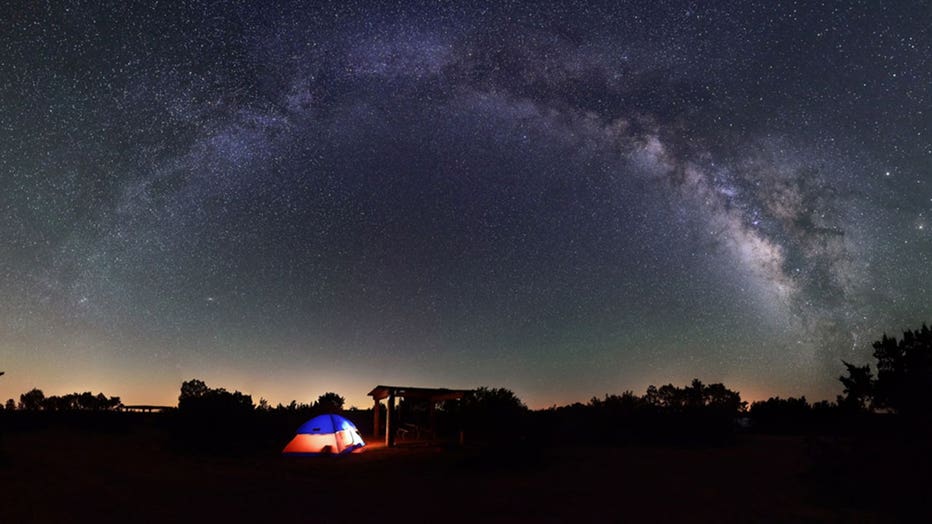
The Milky Way is visible at Copper Breaks State Park.

The Milky Way is visible at Copper Breaks State Park. (Texas Parks and Wildlife Department / FOX Local)

The Source: Information in this story came from Dark Sky International and the Texas Parks and Wildlife Department.

TexasTravelTravel NewsAir and SpaceNews

Great Job & the Team @ Latest & Breaking News | FOX 7 Austin for sharing this story.

‘Unfit and Unwell’: Trump Attempts Damage Control in Exclusive Interview, But His Unhinged Answers Send It Off the Rails

‘Unfit and Unwell’: Trump Attempts Damage Control in Exclusive Interview, But His Unhinged Answers Send It Off the Rails

President Donald Trump’s physical and mental health have been making headlines for months, leading to constant speculation about his fitness for office.

Now the president is trying to regain control of the narrative in an extensive interview on his health, from his bruised hands to nodding off in public, but Trump’s admittedly wild approach to his health and shocking responses in the interview have fueled concerns.

‘Unfit and Unwell’: Trump Attempts Damage Control in Exclusive Interview, But His Unhinged Answers Send It Off the Rails
U.S. President Donald Trump speaks to reporters after a ceremony for the presentation of the Mexican Border Defense Medal in the Oval Office of the White House on December 15, 2025 in Washington, DC. During the ceremony, Trump recognized the first 13 service members to receive the recently established Mexican Border Defense Medal (MBDM), which recognizes service members supporting Customs and Border Protection on the U.S.-Mexico border. (Photo by Anna Moneymaker/Getty Images)

Trump, at 79, is the oldest person ever to start a term as president. His persistent health issues in recent months are no secret.

He’s had swollen ankles from a chronic venous insufficiency diagnosis and persistent bruises on his hands. He’s also seemed out of touch and confused at times over the past months and often loses his train of thought during speeches, meandering off topic in senseless diatribes.

When reporters noticed the dark bruises on one of Trump’s hands earlier this year, White House Press Secretary Karoline Leavitt insisted it was from “frequent handshaking.” His discolored and bruised hand was on display again last month at the Kennedy Center Honors.

His doctors and White House staffers have also insisted that the president is in “exceptional health and perfectly suited to execute his duties as Commander in Chief,” pointing to his busy and active schedule, The Wall Street Journal reported.

‘Beyond Embarrassing’: Trump Fumbles a Simple Question, Then Blames the Reporter — Until a World Leader Calls Him Out

Trump revealed he takes large doses of aspirin daily against his doctor’s advice and has for a quarter century. He says he has no plans to stop.

“I’m a little superstitious,” he said, despite doctors’ recommendations that he take a smaller dose.

“They say aspirin is good for thinning out the blood, and I don’t want thick blood pouring through my heart,” Trump said. “I want nice, thin blood pouring through my heart. Does that make sense?” 

Trump’s doctor said the president uses aspirin for “cardiac prevention.” Trump reportedly takes 325 milligrams of aspirin a day, which is four times the recommended low dosage amount. In the WSJ interview, the president attributed the bruising on his hand to his aspirin use.

Trump admitted to wearing makeup on his hands after he gets “whacked again by someone.”

“I have makeup that’s, you know, easy to put on, takes about 10 seconds.”

It’s also common knowledge that Trump sleeps very little, and he’s often up late, posting on social media for hours. He doesn’t like to exercise, except for playing golf. He called it “boring” in the WSJ interview. And he loves a high-fat, salty diet of hamburgers and French fries but says he doesn’t worry because of “good genetics.”

 “To walk on a treadmill or run on a treadmill for hours and hours like some people do, that’s not for me,” he reportedly said.

In another phone interview with the WSJ, Trump appeared frustrated with ongoing questions about his health.

“Let’s talk about health again for the 25th time,” he complained, adding that, “My health is perfect.” 

Trump expressed regret for going public with the results of a cardiovascular and abdominal CT scan in October, which the White House first described as a “routine MRI,” but MRIs, or body imaging tests, are not part of any routine physical exam.

“In retrospect, it’s too bad I took it because it gave them a little ammunition,” Trump whines to the WSJ.

“I would have been a lot better off if they didn’t, because the fact that I took it said, ‘Oh gee, is something wrong?’ Well, nothing’s wrong,” he insisted.

Trump addressed several incidents of sleeping during White House events. Cameras caught him apparently nodding off in November and a December cabinet meeting, but he claims video and photos of him repeatedly dozing in public actually caught him “blinking” or in between blinks.

“I’ll just close. It’s very relaxing to me,” he said, referring to his shuttered eyes. “Sometimes they’ll take a picture of me blinking, blinking, and they’ll catch me with the blink.”

Trump staffers said they believe the president gets bored and has reportedly asked cabinet members to speak loudly, even though they dispute any claims that Trump has issues hearing.

Social media had a field day responding to Trump’s comments in the interview.

“Those are some long blinks,” Threads poster ML Daugherty stated. “He’s been in serious decline for YEARS!” this Threads user proclaimed. “Dozing, Diapered Donald,” another one joked.

Great Job Shelby E. & the Team @ Atlanta Black Star Source link for sharing this story.

Secret Link