Home News Page 2516

Diamondbacks Activate Star Outfielder Corbin Carroll From Injured List

Diamondbacks Activate Star Outfielder Corbin Carroll From Injured List

The Arizona Diamondbacks activated outfielder Corbin Carroll from the 10-day injured list before Saturday’s game against the Kansas City Royals.

Carroll, sidelined since June 18 with a chip fracture in his left wrist, returned to his customary leadoff spot and was starting in right field against the Royals. He was injured when he was hit by a pitch thrown by Toronto’s Justin Bruhl.

Carroll said before Saturday’s game that his wrist felt better the last couple of days, and he played in a minor-league game on Friday in the Arizona Complex League to test it out.

The 2023 National League Rookie of the Year has 20 home runs, a major league-leading nine triples and a .255 batting average this season. To make room for Carroll on the roster, the Diamondbacks optioned utilityman Tim Tawa to Triple-A Reno.

Reporting by The Associated Press.

Want great stories delivered right to your inbox? Create or log in to your FOX Sports account, and follow leagues, teams and players to receive a personalized newsletter daily!

FOLLOW Follow your favorites to personalize your FOX Sports experience

Major League Baseball

Arizona Diamondbacks

Kansas City Royals


Get more from Major League Baseball Follow your favorites to get information about games, news and more


Great Job & the Team @ FOX Sports Digital Source link for sharing this story.

How to Watch Real Madrid vs. Borussia Dortmund From Anywhere Free: Stream FIFA Club World Cup Soccer

How to Watch Real Madrid vs. Borussia Dortmund From Anywhere Free: Stream FIFA Club World Cup Soccer

See at DAZN

Watch the FIFA Club World Cup for free

DAZN

61% off with 2yr plan (+4 free months)


See more details

It’s another all-European FIFA Club World Cup quarterfinal, as Xabi Alonso’s Real Madrid take on Niko Kovač’s Borrusia Dortmund

Below, we’ll outline the best live TV streaming services to watch every match of the tournament as it happens, wherever you are in the world. We’ll also explain how to use a VPN if the match isn’t available where you are, along with a full match list. 

Spanish behemoths Real Madrid are unbeaten in their last five games against Dortmund, claiming 4 wins and 1 draw, including their 5-2 triumph in the 2024 Champions League at Wembley.

The promise of an all-Bellingham quarter-final is sadly not to be, with recent Dortmund signing Jobe unable to face off against his brother Jude due to suspension.

Real Madrid takes on Borussia Dortmund on Saturday, July 5, at metlife stadium in East Rutherford, New Jersey. Kickoff is set for 4 p.m. ET or 1 p.m. PT. That makes it a 9 p.m. BST start in the UK and an 6 a.m. AEST kickoff in Australia on Sunday morning. 

Gonzalo Garcia of Real Madrid, celebrating, jumping in the air.

Gonzalo Garcia scored the only goal in Real Madrid’s Round of 16 victory over Juventus. 

Carmen Mandato/FIFA/FIFA via Getty Images

Livestream the FIFA Club World Cup 2025 free

The great news for footy fans is that sports streaming platform DAZN is set to broadcast all 63 matches of the FIFA Club World Cup free in almost every country, with coverage available in multiple languages.

DAZN

Existing DAZN subscribers or Freemium members can watch every game of the tournament as part of their current membership.

If you’re not a member, it’s easy to sign up for a free DAZN Freemium account using your email address to watch all the action at no cost through the DAZN app.

As well as dedicated apps for iOS and Android, DAZN offers a wide range of support for set-top boxes and smart TVs.

How to watch Real Madrid vs. Borussia Dortmund online from anywhere using a VPN

If you’re traveling abroad and want to keep up with all the FIFA Club World Cup soccer action while away from home, a VPN can help enhance your privacy and security when streaming. 

It encrypts your traffic and prevents your internet service provider from throttling your speeds. It can also be helpful when connecting to public Wi-Fi networks while traveling, adding an extra layer of protection for your devices and logins. VPNs are legal in many countries, including the US and Canada, and can be used for legitimate purposes such as improving online privacy and security. 

However, some streaming services may have policies restricting VPN use to access region-specific content. If you’re considering a VPN for streaming, check the platform’s terms of service to ensure compliance. 

If you choose to use a VPN, follow the provider’s installation instructions, ensuring you’re connected securely and in compliance with applicable laws and service agreements. Some streaming platforms may block access when a VPN is detected, so verifying if your streaming subscription allows VPN use is crucial.

James Martin/CNET

Price $13 per month, $100 for the first 15 months (then $117 per year) or $140 for the first 28 months (then $150 per year)Latest Tests No DNS leaks detected, 18% speed loss in 2025 testsNetwork 3,000 plus servers in 105 countriesJurisdiction British Virgin Islands

ExpressVPN is our current best VPN pick for people who want a reliable and safe VPN that works on a variety of devices. It’s normally $13 a month but if you sign up for an annual subscription for $100, you’ll get three months free and save 49%. That’s the equivalent of $6.67 a month.

Note that ExpressVPN offers a 30-day money-back guarantee.

61% off with 2yr plan (+4 free months)

Livestream Real Madrid vs. Borussia Dortmund free in the UK

Footy fans in the UK have a second, free option for watching FIFA Club World Cup matches, in addition to DAZN.

Free-to-air broadcaster Channel 5 is set to show 23 select matches live during the tournament, including this game. 

That also means this match can be live-streamed via the network’s My5 online service. Coverage begins at 8 p.m. BST on Saturday evening. 

Channel 5 is available through Freeview, Freesat, Freely, Sky or Virgin Media. 

If you want to stream the network’s coverage from the tournament, you can head to channel5.com or download the dedicated My5 app for iOS, Android and smart TVs 

Livestream Real Madrid vs. Borussia Dortmund in Australia

Like the UK, Australia also has a second option for watching the tournament live. Alongside DAZN’s free coverage, pay TV broadcaster Foxtel and its sister streaming service Kayo will also be showing all 63 games. 

Kayo Sports

A Kayo Sports subscription starts at AU$25 a month and lets you stream on one screen, while its Premium tier costs AU$40 a month for simultaneous viewing on up to three devices.

The service gives you access to a range of sports, including F1, NRL, NFL, NHL and MLB, and there are no lock-in contracts. 

Better still, if you’re a new customer, you can take advantage of a one-week Kayo Sports free trial.

Quick tips for streaming the FIFA Club World Cup 2025 soccer using a VPN 

  • With four variables at play — your ISP, browser, video streaming provider and VPN — your experience and success when streaming soccer may vary.
  • If you don’t see your desired location as a default option for ExpressVPN, try using the “search for city or country” option.
  • If you’re having trouble getting the game after you’ve turned on your VPN and set it to the correct viewing area, there are two things you can try for a quick fix. First, log in to your streaming service subscription account and make sure the address registered for the account is an address in the correct viewing area. If not, you may need to change the physical address on file with your account. Second, some smart TVs — like Roku — don’t have VPN apps you can install directly on the device itself. Instead, you’ll have to install the VPN on your router or the mobile hotspot you’re using (like your phone) so that any device on its Wi-Fi network now appears in the correct viewing location.
  • All of the VPN providers we recommend have helpful instructions on their main site for quickly installing the VPN on your router. In some cases with smart TV services, after you install a cable network’s sports app, you’ll be asked to verify a numeric code or click a link sent to your email address on file for your smart TV. This is where having a VPN on your router will also help, because both devices will appear to be in the correct location. 
  • And remember, browsers can often give away a location despite using a VPN, so be sure you’re using a privacy-first browser to log into your services. We normally recommend Brave.

Great Job Kevin Lynch & the Team @ CNET Source link for sharing this story.

Heavy rain in Central Texas leaves 2 dead, 10 missing in Travis County

Heavy rain in Central Texas leaves 2 dead, 10 missing in Travis County

A teenage girl who was witnessed being washed away is among those missing, the chief of Travis County Emergency Services District 1 confirmed to KVUE.

AUSTIN, Texas — Two people are confirmed dead and at least 10 people are missing in Travis County – including a teenage girl who was witnessed being washed away – as heavy rain continues to fall throughout Central Texas on Saturday.

According to Chief Donnie Norman with Travis County Emergency Services District 1, crews have responded to dozens of rescues in northwest Travis County, mostly along Big Sandy Creek and Cow Creek. No other details are available at this time.

It comes as first responders across Central Texas spent Saturday scrambling to rescue dozens of people from rising floodwaters, including in Burnet County and Williamson counties.

Emergency Management Coordinator for Burnet County Derek Marchio told KVUE first responders had conducted 25 water rescues all before 8 a.m. Saturday.

Emergency officials in Burnet County are also searching for a fire official who appears to have been swept away by floodwaters early Saturday. The man was responding to a call when he drove into water and his vehicle was washed away.

The emergency vehicle was since recovered but the man was not inside.

Williamson County has issued a disaster declaration in response to the flooding on Saturday.

The Office of Emergency Management activated its Emergency Operations Center at 5 a.m. on Saturday in order to coordinate resources and request assistance from the state. Additional personnel have been called in to respond to the flooding.

Up to 25 people have been rescued in the county, the majority from homes.

Austin-Travis County EMS officials also reported dozens of water rescues, many of which were along Cow Creek, west of Lago Vista. Crews have found remnants of mobile homes that appear to have been carried downstream, but they are uncertain whether the homes were occupied when they were swept away.

The flash flood threat will continue through the day Saturday as rain continues to fall over Central Texas.

Great Job & the Team @ WFAA RSS Feed: news Source link for sharing this story.

Doué and Dembélé score for PSG in 2-0 quarterfinal win over Bayern Munich at Club World Cup

Doué and Dembélé score for PSG in 2-0 quarterfinal win over Bayern Munich at Club World Cup

ATLANTADésiré Doué scored in the 78th minute, and Paris Saint-Germain moved a step closer to another trophy with a 2-0 victory over Bayern Munich in the quarterfinals of the Club World Cup on Saturday, a game marred by a gruesome injury to young German star Jamal Musiala.

With PSG two men down after a pair of late red cards and Bayern throwing everyone forward, Ousmane Dembélé added an insurance goal deep into stoppage time to send the French powerhouse on to the semifinals Wednesday against either Real Madrid or Borussia Dortmund at East Rutherford, New Jersey.

PSG, which claimed its first Champions League title with a 5-0 rout of Inter Milan five weeks ago, broke a scoreless deadlock when João Neves stole the ball from Harry Kane near the halfway line to send the French team sprinting toward the Bayern goal.

Neves got the ball back off a give-and-go and found Doué lurking just outside the top of the area. His left-footed shot caught Bayern goalkeeper Manuel Neuer flat-footed as it skidded inside the right post.

But PSG had to hold on for dear life to preserve the win after Willian Pacho and Lucas Hernández were both sent off with red cards. Pacho was called for a reckless challenge and Hernandez earned red for doling out an elbow.

Bayern had two apparent goals flagged for offside, including a header by Kane. In the waning seconds, the German club was awarded a penalty kick, only to have it waved off after a video review.

Key moment

Musiala’s sickening injury marred the outcome.

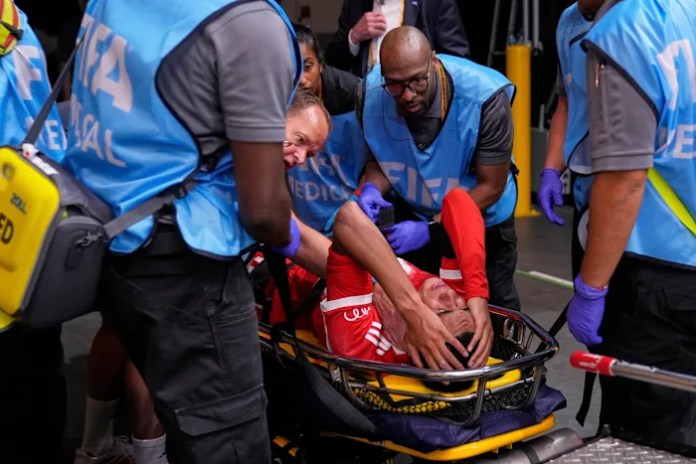
As he chased a loose ball near the end line in first-half stoppage time, PSG keeper Gianluigi Donnarumma darted off his spot and dived for it — only to crash into the left ankle of the 22-year-old German. As Musiala rolled over, his foot dangled awkwardly, the ankle appearing to be cleanly broken.

Donnarumma walked away with the ball, but kneeled down in horror when he looked back and realized the seriousness of the injury. A stretcher was immediately summoned to take Musiala off the field.

Both teams walked toward the locker rooms in stunned silence, with the PSG keeper appearing to be close to tears. He was booed throughout the second half by Bayern fans each time he touched the ball.

Takeaways

The last of six games at Mercedes-Benz Stadium in Atlanta drew a crowd of 66,937, nearly filling the retractable-roof facility.

It was the largest turnout in Atlanta, one of 11 U.S. cities that will host games at next year’s World Cup.

___

AP soccer: https://apnews.com/hub/soccer

Copyright 2025 The Associated Press. All rights reserved. This material may not be published, broadcast, rewritten or redistributed without permission.

Great Job Paul Newberry, Associated Press & the Team @ KSAT San Antonio Source link for sharing this story.

Five Ways the GOP Is Quietly Paving the Road to a National Abortion Ban

Five Ways the GOP Is Quietly Paving the Road to a National Abortion Ban

The fight continues to closely track Project 2025’s plan to eviscerate the right to bodily autonomy across the nation.

Abortion rights protesters, including Kori Ricketts, demonstrate outside the U.S. Supreme Court during oral arguments for Medina v. Planned Parenthood South Atlantic on April 2, 2025. (Kayla Bartkowski / Getty Images)

Originally published by The Contrarian as “Don’t Be Fooled: A National Abortion Ban Is Still the GOP Goal.”

To mark the third anniversary of the Supreme Court’s decision in Dobbs v. Jackson Women’s Health Organization, last week The Contrarian covered several of the statistics and stories that sum up the state of abortion rights in America in 2025.

This week, I’ve joined with Jennifer Klein, who served as director of the White House Gender Policy Council under President Joe Biden and helped lead the administration’s response to Dobbs. In addition to beating back five attempts by Congress to pass a national abortion ban, the White House leveraged executive power to protect access to medication abortion and emergency caresafeguard travel for abortionexpand contraception access, and fight for patient privacy and safety.

Of course, most of these safeguards have been rolled back by the current administration. As President Donald Trump tries to convince the public that abortion is now a state issue, the grim reality is that the fight continues to closely track Project 2025’s plan to eviscerate the right to bodily autonomy across the nation.

Federal funding for abortion providers remains under attack in the “Big Beautiful Bill,” which passed the House and Senate by close margins. The ability of 1.1 million patients nationwide to obtain vital healthcare at a Planned Parenthood facility is now at grave risk—mostly in states where abortion is legal. Make no mistake, this is a steady, coordinated attempt to ban abortion in every state by any means.

Last week, the Supreme Court issued yet another consequential abortion ruling, Medina v. Planned Parenthood South Atlantic, which enables states to exclude health care providers from Medicaid, thereby limiting patients’ ability to select a trusted provider and further restricting access to reproductive and other health care.

The vast majority of Americans support abortion and reproductive freedom, yet state lawmakers continue to introduce and pass laws stripping citizens of these rights. Providers face confusing, punitive rules that might lead them to delay or deny care. Planned Parenthood and other providers face budget cuts that threaten to restrict healthcare access for millions of Americans.

These are not isolated outcomes. Rather, they reveal a coordinated national strategy.

Here are five myths we believe need to be dispelled to counter the challenges that lie ahead.

Myth #1: After Dobbs, abortion is a state issue.

The battle has continued in force at the federal level, where abortion remains under attack through litigation and policy rollbacks. There’s a salami-slicing strategy underway, one lawsuit or regulation at a time, designed to fly under the radar.

We’ve seen a federal judge strike down a rule guaranteeing privacy protections for abortion data—and lawsuits filed to restrict access to medication abortion in a court in Texas where plaintiffs explicitly sought out a judge likely to issue a nationwide ban. The Trump administration rescinded guidance put in place during the Biden administration to require hospitals to provide emergency abortions, sowing unnecessary confusion. Federal funding for abortion providers remains under attack in the “big, beautiful bill.” Far from a states’ rights matter, this is a steady, coordinated attempt to ban abortion in every state by other means.

Myth #2: People can just travel to “abortion states” to get care.

That’s becoming harder, even beyond the financial costs that have long made travel prohibitive for some patients. Five states introduced bills that would criminalize those who help minors get abortions across state lines; Idaho and Tennessee already passed such laws. In Texas—the state with the highest number of patients fleeing for care—a sheriff’s office used license plate cameras to track a woman suspected of self-managing her abortion. For immigrants and communities of color already under surveillance, these bans add another layer of potential criminalization. The goal is to isolate people, punish helpers, and make travel legally and logistically risky.

Myth #3: Medication abortion will remain available.

Mifepristone, a drug used in medication abortion, is extremely safe and used in over 60 percent of U.S. abortions. Precisely because it’s so effective and accessible, it’s under fierce attack. Antiabortion lawmakers are spreading absurd claims, like medication contaminating water supplies or causing infertility. Groups are pressing the Food and Drug Administration to revoke its longstanding approval of mifepristone, and the FDA has launched a review. Confusion and disinformation are powerful tools, and they are working. Many people don’t even know medication abortion is still legal in their state.

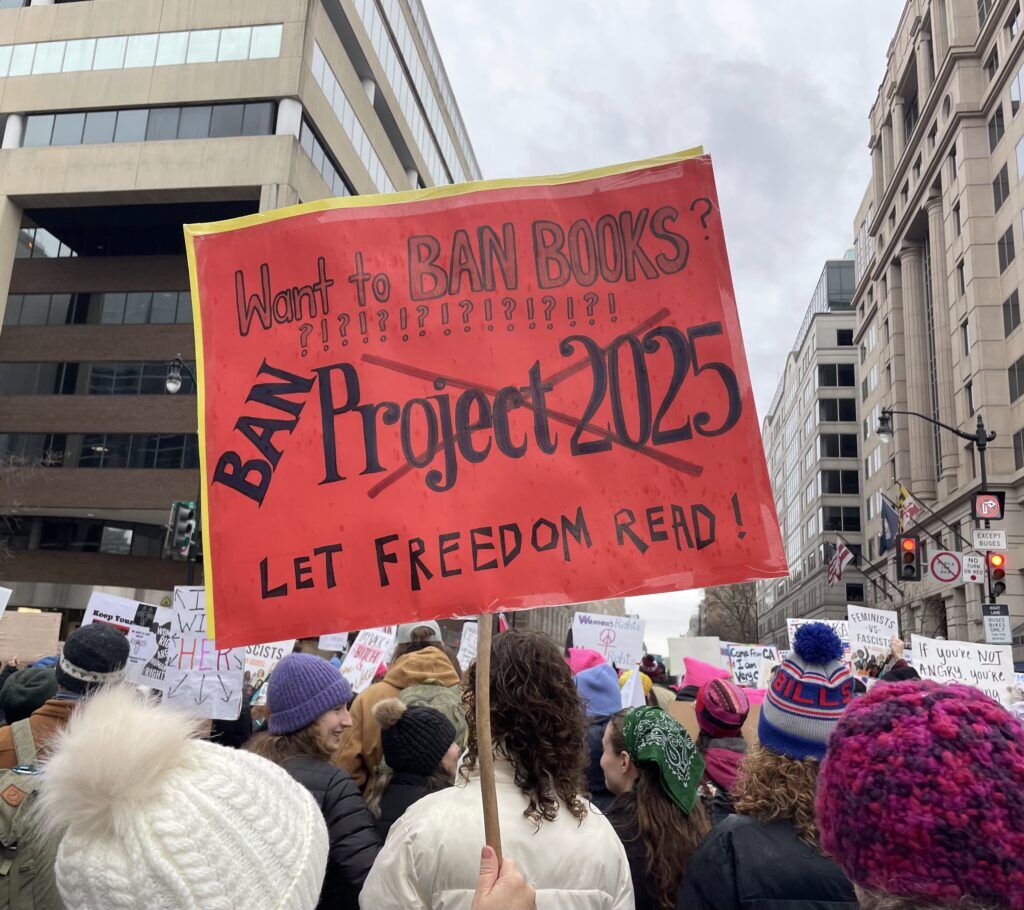
Thousands of people rallied in Washington, D.C., on Jan. 18, 2025, for the People’s March just days before President Donald Trump’s inauguration. (Livia Follet)

And though many believe that blue states are safe havens, that is not entirely true either. So far in 2025, over 25 states introduced bills to restrict medication abortion, even in states where abortion is legal. These include bans on telehealth and mailed pills or imposing unnecessary requirements like in-person visits or ultrasounds. Some won’t pass, but they flood the system with misinformation and create confusion. Again, the chaos is the point: this is a deliberate and coordinated national effort; even in supportive states, access is being chipped away.

Myth #4: Emergency abortions are still always available.

The federal Emergency Medical Treatment and Labor Act, or EMTALA, requires hospitals in certain emergency circumstances to provide life-saving care, including abortion. The Biden administration issued guidance to clarify what is covered under the law and vigorously enforced it, but the Trump administration has rescinded that guidance. Though EMTALA is still in effect, in states with vague laws or extreme abortion bans, doctors hesitate, patients suffer, and care is delayed, even in life-threatening situations.

Myth #5: This isn’t about IVF, it’s just about abortion.

Those opposed to abortion have long had a strategy in place to establish legal rights for fetuses and embryos, which not only lays the foundation for a national abortion ban but also has far other, far-reaching implications. Since Dobbs, states have introduced dozens of bills defining life at conception, threatening miscarriage care and in vitro fertilization. Despite Trump’s assertions he is the “fertility president,” he has yet to deliver on the proposals in his executive order (which are long overdue, by the way). And there are judges chomping at the bit to leverage state laws—like in Alabama, where the state Supreme Court ruled last year that embryos are “children,” causing IVF clinics to stop services and the legislature to scramble.

***

Don’t buy the narrative that there is anything benign about eviscerating a federal right—or that states are a destination for guaranteed democratic outcomes, especially when it comes to abortion. We are in the throes of a full-on nationwide assault that requires our utmost and sustained attention, vigilance, outrage and response.

Great Job Jennifer Weiss-Wolf & the Team @ Ms. Magazine Source link for sharing this story.

Elon Musk lays out America Party's look

Elon Musk lays out America Party's look

Elon Musk floated more ideas for his proposed America Party as he continues his breakup with President Trump.

Great Job Mallory Wilson & the Team @ The Washington Times stories: News Source link for sharing this story.

As Trump pushes Apple to make iPhones in the U.S., Google’s brief effort building smartphones in Texas 12 years ago offer critical lessons

As Trump pushes Apple to make iPhones in the U.S., Google’s brief effort building smartphones in Texas 12 years ago offer critical lessons

The executives were well aware of the difficulties they would face in manufacturing a smartphone in the U.S. As with any great tech industry moonshot, the challenge was part of the appeal—and they embraced it.

“Conventional wisdom said it wasn’t possible,” the company crowed defiantly in a blog post announcing the new America-made smartphone. “Experts said that costs are too high in the US; that the US has lost its manufacturing capability; and that the US labor force is too inflexible.”

Soon, tens of thousands of shiny, new touchscreen phones began rolling off the assembly line at a plant in Fort Worth, Texas every day, and what seemed like a risky endeavor began to look like it could be a milestone—a bold bet on American manufacturing at a time when smartphone giant Apple relied on factories in China, home to cheap labor and legions of suppliers eager to produce electronic components.

That was 2013. And the company behind the bet was Google, which had acquired legacy phone maker Motorola Mobility and was leveraging its modern tech prowess and vast resources to make the Moto X smartphone a success.

Just a year later, it was all over. Google sold the Motorola phone business and pulled the plug on the U.S. manufacturing effort. It was the last time a major company tried to produce a U.S. made smartphone.  

The story of Google’s short-lived on-shorting experiment has been largely forgotten, a footnote in the internet search giant’s nearly three-decade history of business initiatives and projects. But Google’s experience, particularly where it succeeded, where it discovered unexpected benefits, and where it stumbled, are newly relevant amid President Trump’s campaign to pressure Apple, and other tech companies, to build their gadgets on U.S. soil. 

In just the past few weeks, the President has demanded that Apple reshore a big part of its iPhone production from Asia or face tariffs of at least 25%. 

Equivalent in size to nearly eight football fields, the plant began producing the Google Motorola phones in the summer of 2013.

Mike Fuentes/Bloomberg via Getty Images

The Google Motorola case study provides critical lessons about U.S. smartphone manufacturing that are still applicable today, as well as numerous intriguing what ifs. Was the project doomed by the economic realities of globalization, the competitive landscape in the smartphone business, or were Google’s shifting corporate priorities ultimately to blame?  Could more time, or more effective marketing, have made a difference?

To piece together the history, Fortune spoke with five former Motorola employees who were directly involved in the company’s U.S. assembly push, as well as numerous industry experts and analysts. “We felt scrappy and felt we could carve out a niche for ourselves,” recalled Steve Mills, who was Motorola Mobility’s chief information officer at the time and who is now chief operating officer at Foresite Cybersecurity. 

Many of the former Google insiders described starting the effort with high hopes but quickly realized that some of the assumptions they went in with were flawed and that, for all the focus on manufacturing, sales simply weren’t strong enough to meet the company’s ambitious goals laid out by leadership.

Looking for an edge 

The phone at the center of the plan, the Moto X, stood out from the pack not just because of where it would be produced. Motorola would offer consumers who purchased the phone directly on its website the option to customize the device, with dozens of colors and materials, eventually including bamboo and walnut backs, as well as special touches like personalized engraving. 

The company hoped that offering customized phones would give it an edge over rivals Apple and Samsung, which sold only standardized lineups. And the customization was well-suited to the on-shoring plan: By making phones in the U.S., Motorola would be able to deliver them to domestic customers within four days, instead of making them wait, while also saving on shipping costs. 

In its marketing, Motorola played up the device’s pedigree as a patriotic alternative to the foreign-produced competition. The plant’s opening celebration was such a big deal that then-Texas Gov. Rick Perry and billionaire Shark Tank investor Mark Cuban showed up.

The Moto X phone could be customized in different colors and materials, including backs made out of wood

Mike Fuentes/Bloomberg via Getty Images

The factory in Fort Worth, about an hour’s drive from Dallas, was operated by Flextronics, a contract manufacturer now known as Flex. To save on costs, workers at the plant handled only final assembly, using components that were imported from Asia.

The cost of labor was of course higher than in China – workers were paid an hourly wage that was about three times more than in China, company executives said at the time. But it was an acceptable trade-off, given the other advantages. Dennis Woodside, who was then the CEO of Motorola Mobility, said in an interview at the time that the customized phones were being sold at a profit. 

In addition to the customized models, Motorola sold standardized versions of the Moto X to wireless carriers – an arrangement that helped ensure a base level of demand and production at the factory. 

Apple vs. Trump 

While Apple does not produce customized versions of its iPhone, the company would likely face many of the same complications, plus new ones, if it quickly shifted iPhone manufacturing to the U.S. as Trump has called for. Higher labor costs are still a reality. And domestic suppliers are limited, with most based in China.

As a result, Apple would have to raise iPhone prices astronomically—at least initially—to make a profit, experts said. Instead of $1,000, U.S.-made phones would have to retail for as much as $3,500, Wedbush Securities analyst Dan Ives estimated in a recent research note, concluding that Apple ever producing the devices domestically is a “fairy tale.”

Over the past six months, to reduce its exposure to Trump’s tariffs, Apple has accelerated a years-long shift in its sourcing of iPhones. Rather than China, its main manufacturing hub and initially the target of Trump’s highest import taxes, the company now ships most of its U.S.-bound phones from India, where tariffs are lower.

President Trump visited a factory in 2019 where Apple Mac Pro PCs are assembled.

MANDEL NGAN/AFP via Getty Images

How the trade war will ultimately play out is still in flux. Trump has delayed some of his import taxes and is still negotiating others.

But his comments in May on conservative social network Truth Social show he opposes Apple’s current workaround. In his message, he insisted Apple’s iPhones ‘must be built in the United States, not India, or anyplace else.”

Apple CEO Tim Cook has described Asia as better for manufacturing than the U.S. The reason has nothing to do with the difference in wages, he insisted in an interview at a Fortune conference in 2017. China stopped being a low-cost labor destination years ago, according to Cook. Rather, the country’s advantage is the far greater availability of skilled workers, such as the tooling engineers who create designs and molds for components, and who he praised for their precision.

“In the U.S., you could have a meeting of tooling engineers and I’m not sure we could fill the room,” Cook said on stage. “In China you could fill multiple football fields.”

In an effort to appease Trump, Apple this year promised to spend $500 billion in the U.S. over the next four years. Some of that money, the company said, will go to producing servers in Houston for its data centers. But Apple hasn’t mentioned anything about bringing iPhone manufacturing back home to the U.S.

Imported workers and equipment

When it came to the Moto X, Flextronics, from the outset, anticipated a shortage of skilled engineers in the U.S. To get around the problem, it drafted engineering talent from its factories across the globe, including from Hungary, Israel, Malaysia, Brazil, and China, and splurged on moving them to Fort Worth just to get the operation running as quickly as possible.  

“We had to bring in a very cultural cast of characters,” said Mark Randall, who led Motorola’s supply chain and operations.

Rank and file assembly line workers, along with supervisors and managers, were easier to recruit locally because of the area’s status as a telecom manufacturing corridor, he added. Of the nearly 3,800 staffing the facility at its peak, most didn’t require intensive training. 

Production at the plant, equivalent in size to nearly eight football fields, started in the summer of 2013. The operation was in a former Nokia phone factory, in an industrial park designated as a foreign trade zone and with its own airport for cargo. The location meant that Motorola would pay lower tariffs on certain components it imported from Asia. The savings would only kick in, however, if the company decided to export some of the phones it produced there to other countries. 

Randall, who is now a supply chain consultant and startup board member, described Texas as a friendly home for manufacturing. In just one example of the warm welcome, the state gave Motorola a tax break for worker training, he said.

Former Texas Governor Rick Perry spoke at an event at Motorola’s factory in 2013.

Mike Fuentes/Bloomberg via Getty Images

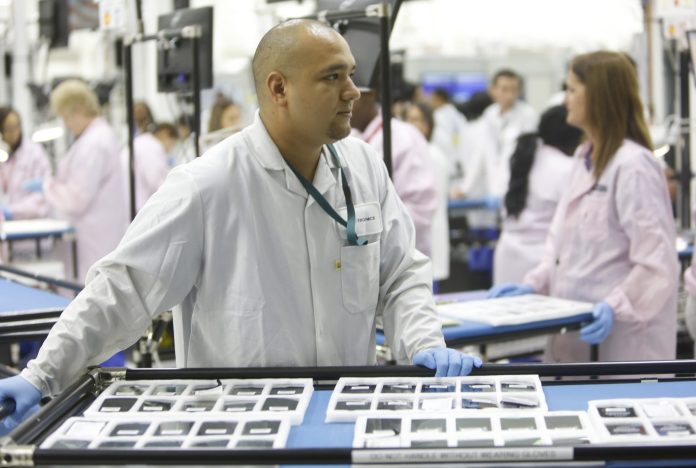
Setting up the Moto X plant required installing a massive amount of equipment, including conveyor belts and other machinery. Some, like certain testing machines, were shipped from China. Workers wearing smocks and gloves to protect the electronics from dirt and lint stood at blue tables set in neat rows while they went through the many steps required to finish a phone. Computer screens glowed above each station. 

Fitting plastic parts, like the phone’s back cover, tended to be done by hand. Robotics was used for adding components like touch screens and for testing certain parts during assembly to make sure they worked properly.

As production ramped up, process engineers, who sometimes patrolled the assembly line with stopwatches, looked for bottlenecks and rejiggered the assembly line. Like with any plant, the effort to squeeze out more efficiency was a constant focus. 

As the first Motorola phone designed under Google, Moto X generated considerable buzz. The Android device, which was priced at $579 for the unlocked entry version, had a rounded backside and pioneering voice control feature. Users merely had to say “Okay, Google now” to activate the feature, to set up reminders and get driving directions 

“It was a cool sexy phone,” said Mills, the CIO. “I got it for my kids.”

The mobile network carriers were also excited by the Moto X, though at least partly for self-serving reasons, according to Randall, the supply chain guru. If the device sold well, it would provide the carriers more leverage over Apple in negotiating the wholesale prices they paid for future iPhones. 

But ultimately, critics gave the Moto X mixed reviews. While they praised the ability to customize the device and its overall design, they dinged it for having underwhelming storage in the basic model (16GB) and inferior screen quality compared to the competition.

Made in America “wasn’t resonating

As the Fort Worth plant revved up, workers quickly started pumping out up to 100,000 phones weekly. Initially, the plant’s staff was overwhelmed, forcing Motorola to briefly backtrack on its promise to deliver phones to customers within four days. But over time, the volume dipped considerably. In the first quarter of 2014, Motorola sold 900,000 Moto X handsets worldwide compared to Apple selling 26 million of its new iPhone 5s during the same period, according to Strategy Analytics.  

Five months after Moto X debuted, Motorola slashed its price to $399. After nine months, the factory was down to 700 workers, or less than one-fifth of what it had earlier.  

Within the first few weeks, Randall said it was clear to leadership that the Moto X was underperforming. The team had to ramp down production. 

While not a complete failure in terms of sales, the phone wasn’t a huge success either. Employees said they expected future models to do better, after improving the phone’s design. Many blamed a limited marketing budget compared to the big money that Samsung and Apple spent on print ads and TV commercials. Because Moto X was a brand new model, they argued it needed a splashier ad campaign to get the word out or a more convincing message.

One of the company’s big assumptions about the phone had turned out to be wrong. After betting big on U.S. assembly, and waving the red, white, and blue in its marketing, the company realized that most consumers didn’t care where the phone was made.

“One of the learnings was that assembled in America wasn’t resonating,” said Mark Rose, a senior director of product management with Motorola at the time who now coaches product managers as a consultant.

Apple wouldn’t necessarily face the same challenges as Motorola, if it opened a U.S. smartphone plant. Their vast difference in size could make a big difference.

Because of sluggish demand, Motorola struggled to achieve the cost savings from making Moto X in huge numbers. Apple, on the other hand, with annual U.S. iPhone sales in the tens of millions, could more easily cash in on the economies of scale.

For Motorola, the challenge it faced was compounded by its decision to let shoppers customize their phones when ordering them online. Fully assembling those devices ahead of time, which would have helped make the plant run more smoothly, was impossible. It also led to higher return rates, an expensive problem for any company, because customers were more likely to be disappointed with the color scheme they chose. Apple, with its standardized lineup, doesn’t have the same worries.

Thanks to its successful track record, Apple also has significant control and leverage over its suppliers to negotiate lower prices for its iPhone components. Motorola, with its back-in-the-pack position and the uncertainty about whether its new Moto X phone would be a hit, had little sway in comparison.

Meanwhile, Motorola, along with most other Android phone makers, operate in an environment of intense competition that translates into low profit margins. Any extra costs, such as is the case  with U.S. manufacturing from higher wages, can be financially painful. Apple’s iPhone, however, is a premium product that sells at a high margin. As a result, the company could more easily absorb the additional expense of producing it in the U.S.

12 years later…

Ultimately, Google’s changing priorities played a major role in its decision in January 2014 to sell Motorola to China-based Lenovo for $2.9 billion. A few months later, with the sale of the phone maker still pending, Google announced it would shut down its Moto X assembly line in Fort Worth and shift production entirely to China and Brazil, where production costs were lower. Instead of trying to compete with Apple, Motorola, under Lenovo, would focus on making cheaper phones aimed at customers in developing countries. “What we found was that the North American market was exceptionally tough,” Motorola president Rick Osterloh told the Wall Street Journal after announcing that the Fort Worth plant would close. 

Selling would eliminate another problem for Google: Griping by phone makers that used Android software in their devices. They complained that Google, after buying Motorola, competed directly against them. Google had to take the rebellion seriously. If those partners bailed on Android, it would be a huge blow to Google because it would make it more difficult for handset users to access its services.

Another factor in the sale was Google’s rationale for acquiring Motorola in the first place. In addition to buying a phone business, Google had gotten Motorola’s huge patent portfolio that it hoped would help it fend off a growing number of lawsuits over Android. Apple, Microsoft, and other competitors had targeted Google and its phone making partners with claims that the operating system infringed on their intellectual property. In selling Motorola to Lenovo, Google kept most of the patents, tacitly acknowledging that they were more valuable to it than a handset business with disappointing sales.

In the end, Motorola’s failed U.S. adventure had little to do with where the Moto X was assembled, by all accounts. The phone simply didn’t sell well enough to justify a U.S. assembly line.

“If it had sold better off the jump, the whole story would have been different,” said Gabe Madway, who worked in Motorola’s public relations at the time and is now at online investment management service Wealthsimple.

artphone. Photographer:

Randall, meanwhile, put it even more bluntly, saying the phone’s failure “had very much zero” to do with U.S. manufacturing and everything to do with the iPhone being a better device with bigger brand recognition than the Moto X. 

Of course, a lot has changed in 12 years that could make or break a new U.S. manufacturing push by a company like Apple. Factory automation, for example, has greatly improved, opening the door to more cost savings in any U.S. smartphone factory now compared to before.

But some things haven’t changed. Adding thousands of workers on short notice to speed up production of a device getting more sales than anticipated would be next to impossible to do in the U.S. In China, it’s routine. 

“If there was a ramp that went super well, the ability to flex that workforce is insane” Randall said about China. “The ability to scale down that work workforce is insane.” 

Also, there are relatively few U.S.-based suppliers that could produce enough electronic components for millions of phones. And expanding the pool would likely take years. Meanwhile, importing parts, the obvious alternative, may be prohibitively expensive if Trump’s “Liberation Day” tariffs, proposed in April, fully kick in. It doesn’t help that the president frequently changes his mind about the levies, making it difficult for companies to plan ahead for big investments like phone assembly plants.

Mills, the former Motorola CIO, said Trump giving phone makers like Apple some wiggle room would make it easier for them to set up U.S. manufacturing. Instead of producing their phones entirely in the U.S, they could avoid tariffs by doing merely final assembly domestically, like Motorola tried. 

“A big thing comes down to what Trump means by Made in America,” said Mills. 

Another idea is for Apple to set up a small operation domestically to produce a “prestige or limited edition” iPhone, said Ross Rubin, an analyst with Reticle Research. It could charge a premium for the device, say $2,000, he said, and let Trump declare victory, letting Apple avoid the much more expensive alternative to onshoring a huge chunk of its iPhone production. 

What is clear is this: Motorola’s Made in America experiment lasted just over a year, and in more than a decade since, no other major smartphone maker has dared to try something similar again.


Great Job Verne Kopytoff & the Team @ Fortune | FORTUNE Source link for sharing this story.

Google faces EU antitrust complaint over AI Overviews | TechCrunch | FROUSA Media

Google faces EU antitrust complaint over AI Overviews | TechCrunch | FROUSA Media

A group known as the Independent Publishers Alliance has filed an antitrust complaint with the European Commission over Google’s AI Overviews, according to Reuters.

The complaint accuses Google of “misusing web content for Google’s AI Overviews in Google Search, which have caused, and continue to cause, significant harm to publishers, including news publishers in the form of traffic, readership and revenue loss.”

It also says that unless they’re willing to disappear from Google search results entirely, publishers “do not have the option to opt out” of their material being used in AI summaries.

It’s been a little over a year since Google began adding AI-generated summaries at the top of some web search results, and despite some early answers that were spectacularly off-base, the feature continues to expand, to the point where it’s reportedly causing major traffic declines for news publishers.

Google told Reuters that “new AI experiences in Search enable people to ask even more questions, which creates new opportunities for content and businesses to be discovered.” The company also argued that claims about web traffic are often based on incomplete data, and that “sites can gain and lose traffic for a variety of reasons.”

#FROUSA #HillCountryNews #NewBraunfels #ComalCounty #LocalVoices #IndependentMedia

Great Job Felicia Ray Owens & the Team @ FROUSA Media Source link for sharing this story.

#FeliciaRayOwens #TheFeliciaFiles #FROUSA #LocalVoices #IndependentMedia #HerSheSquad

Great Job Felicia Ray Owens & the Team @ Felicia Ray Owens Source link for sharing this story.

Devastating flash floods slam Texas Hill Country; Tropical Storm Chantal heads for Carolinas » Yale Climate Connections

Devastating flash floods slam Texas Hill Country; Tropical Storm Chantal heads for Carolinas » Yale Climate Connections

One of the nation’s deadliest flash floods in years struck one of Texas’ prime holiday recreation areas, the Guadeloupe River, early on Friday, July 4. A wall of water swept away vehicles and campers and cascaded through packed campgrounds in the hours near sunrise on Friday, producing heart-wrenching tragedy. As of noon CDT Saturday, at least 27 deaths were confirmed, including 9 children, the Associated Press reported. Many others remained missing, including 27 people from Camp Mystic, a summer camp with nearly a century of operations along and near the Guadeloupe River.

The floods were fueled by torrential rains from a thunderstorm complex that developed overnight near and west of the hardest-hit areas, across western parts of the Texas Hill Country. The region is notorious for devastating flash floods, as tropical moisture can easily surge from the Gulf of Mexico across the rugged topography. The Hill Country is just west of the Austin and San Antonio metro areas.

Remnant moisture from Tropical Storm Barry, which had moved onto the northeast coast of Mexico as a tropical depression on Sunday, drifted northward into southwest Texas over several days. The weak remnant circulation continued to pull ample low-level moisture from the western Gulf of Mexico onshore into southern Texas. By Thursday night, this appears to have been overlaid by ample higher-level moisture from the Eastern Pacific. The balloon-borne radiosonde sounding launched from Del Rio, TX, at 7 a.m. CDT Friday showed that the amount of moisture in the atmosphere (precipitable water) was the fourth highest on record across more than 70 years of twice-daily soundings.

Many studies have confirmed that human-caused climate change is making the heaviest short-term rainfall events more intense, largely by warming the world’s oceans and thus sending more water vapor into the atmosphere that can fuel heavy rain events. Sea surface temperatures this week have been as much as 1°F below the 1981-2010 average for early July in the western Gulf and Caribbean, but up to 1°F above average in the central Gulf. Long-term human-caused warming made the latter up to 10 times more likely, according to the Climate Shift Index from Climate Central.

There have been claims that NOAA/NWS did not foresee catastrophic TX floods–but that’s simply not true. This was undoubtedly an extreme event, but messaging rapidly escalated beginning ~12 hrs prior. Flood Watch mid PM, “heads up” outlook late PM, flash flood warnings ~1am.

Daniel Swain (@weatherwest.bsky.social) 2025-07-05T15:50:32.896Z

The threat of heavy overnight rain in the western Hill Country was well anticipated by the National Weather Service, even though pinpointing exactly where such intense localized storms will form hours in advance can be difficult to impossible.

  • A Flood Watch was issued at 1:18 p.m. Thursday, more than 15 hours ahead of the disaster, by the National Weather Service in New Braunfels, TX, for parts of eight counties, including hard-hit Kerr County.
  • A Flood Warning went into effect for parts of Bandera and Kerr counties at 1:14 a.m. Friday.
  • A Flash Flood Emergency was issued for locations along the Guadeloupe River at 5:34 a.m. Friday, with the note that “Automated rain gauges indicate a large and deadly flood wave is moving down the Guadalupe River. Flash flooding is already occurring.”
  • It remains unclear whether or how the overnight warnings made it to the people most at risk – a classic “last-mile problem.”

Radar-indicated rainfall amounts in the heart of the storms were on the order of ten inches, which is on par with generation-scale 24-hour rainfall events in the Hill Country. (For instance, the town of Kerrville, near the worst flood damage, received 11.60 inches on August 2, 1978.) However, the heaviest rains in this case fell within just a few hours. Moreover, the storms appear to have been almost ideally situated to send destructive flood crests down the north and south forks of the Guadeloupe River, which converge at the town of Hunt. Camp Mystic Guadeloupe River is located on the south fork of the Guadeloupe, just upstream of that convergence point.

The Friday-morning storms left behind a weak but well-defined circulation at upper levels, known as a mesoscale convective vortex, or MCVs. Such vortexes can persist and trigger additional storms the next night, and that’s exactly what happened: widespread rains of 8-12 inches were reported northwest of Austin (roughly 50 miles north of the Friday flood disaster). Flash flood emergencies were again issued early Saturday, and at least two deaths had been confirmed by late Saturday morning, according to local authorities cited by KXAN-TV.

Devastating flash floods slam Texas Hill Country; Tropical Storm Chantal heads for Carolinas » Yale Climate Connections
Figure 1. Infrared satellite image of Tropical Storm Chantal at 1726Z (1:26 p.m. EDT) Saturday, July 5, 2025. (Image credit: NOAA Satellites)

Chantal becomes the Atlantic’s third named storm of 2025

Tropical Storm watches and warnings were flying for much of the South Carolina and North Carolina coast on Saturday as Tropical Storm Chantal crawled northward toward an expected Sunday-morning landfall. Chantal formed a few hundred miles south of the South Carolina coast at 8 a.m. EDT Saturday, July 5. Chantal’s formation date of July 5 comes almost two months before the typical August 3 appearance of the season’s third named storm (based on 1991-2020 climatology). The usual date of the Atlantic’s first hurricane is August 11. Chantal’s formation was aided by warm sea surface temperatures around 29 degrees Celsius (84°F), which is about one degree Fahrenheit above average for this time of year.

At 2 p.m. EDT Saturday, July 5, Chantal was located about 180 miles (300 km) south-southwest of Wilmington, North Carolina, with top sustained winds of 45 mph (75 km/h), a central pressure of 1006 mb, headed north at 3 mph.

Forecast for Chantal

Moderate wind shear of 10-20 knots from strong upper-level winds out of the southwest should keep Chantal from becoming very strong, as will the storm’s limited amount of time over water before landfall on Sunday morning. NHC predicts that Chantal’s winds will peak at 50 mph (80 km/h) at the time of landfall.

Chantal’s main impact will be from heavy rains of two to four inches and storm surge flooding of one to three feet, which will likely cause minor flooding in North Carolina. Dangerous rip currents will also be a threat along the Carolina coast.

An exceptionally weak one-two-three punch from the season’s first three named storms

Chantal is destined to be the season’s third-straight short lived named storm. Chantal follows on the heels of two other underachieving tropical storms: Andrea, which formed on June 24 in the remote central Atlantic between Bermuda and the Azores Islands, and Barry, which formed off the coast near Tampico, Mexico, on June 29. Andrea and Barry both lasted about 12 hours as named storms; Chantal will likely last less than 36 hours. According to hurricane scientist Michael Lowry, Andrea and Barry jointly produced an anemic 0.6 on the Accumulated Cyclone Energy or ACE scale, and “never in the modern record (since at least 1950) have the first two storms of the season produced so little activity as measured by the Accumulated Cyclone Energy or ACE.” Now that’s a record we like to see continue!

Creative Commons LicenseCreative Commons License

Republish our articles for free, online or in print, under a Creative Commons license.

Great Job Jeff Masters and Bob Henson & the Team @ Yale Climate Connections Source link for sharing this story.

Blac Chyna’s Break Up With Derrick Milano Confirmed Less Than A Year After Engagement

Blac Chyna’s Break Up With Derrick Milano Confirmed Less Than A Year After Engagement

Angela White, known to many as Blac Chyna, and Derrick Milano have ended their engagement. Blac Chyna’s breakup journey comes less than a year after he proposed in front of fans.

Source: Paul Archuleta / Getty

White’s romantic history has often been under scrutiny. As BOSSIP has previously reported, her past relationships have been highly publicized. She shares son King Cairo, 12, with rapper Tyga, and daughter Dream, 8, with Rob Kardashian from a high-profile, often tumultuous engagement. In recent years, the TV personality embarked on a highly publicized spiritual journey, changed her name from “Blac Chyna” to Angela White, reversed cosmetic surgeries, and publicly embraced sobriety and Christianity. This shift led many to observe a focus on peace and a different direction for her personal life.

Derrick Milano, a Grammy-winning songwriter known for co-writing hits such as Megan Thee Stallion and Beyoncé‘s “Savage Remix,” became publicly involved with White in May 2023. By October 2024, Milano proposed to White in front of a crowd at Howard University’s homecoming event, Yardfest. Beaming with pride, White accepted the proposal, which came as no surprise, being the mother of two, was beginning to question whether a ring was coming a couple of months prior.

Blac Chyna’s Break Up: “Prayer & Reflection” Cited for Ending Engagement

Blac Chyna’s break up with Derrick Milano was confirmed via Instagram stories. Both White and Milano announced the news on Thursday, July 3. Their statements framed the decision as an amicable one, guided by faith and personal reflection.

According to TMZ, Angela White’s statement read: “After much prayer and reflection, Derrick and I have decided to call off the engagement. We love each other deeply and are good friends, but we both believe that God’s guidance has shown us that this is the right path for both of us, as we each continue our journeys.” Her statement concluded, “May we find peace and fulfillment in His divine will, trusting that His plan is greater than our own.” Milano released a nearly identical statement, confirming the mutual decision to end the engagement.

We wish them both the best on their new paths.

Great Job Kerbi Lynn & the Team @ Bossip Source link for sharing this story.

Secret Link