The jury’s partial verdict remains under wraps for now.
NEW YORK — The jury in Sean “Diddy” Combs’ sex trafficking trial is set to resume deliberations Wednesday after reaching a yet-to-be-disclosed verdict on all but one of the five charges the hip-hop mogul faces.
U.S. District Judge Arun Subramanian ordered the jury to continue its closed-door discussions for a third day after the panel of eight men and four women said Tuesday that it was unable to reach consensus on the top count: racketeering conspiracy.
The judge agreed with prosecutors and Combs’ defense team that less than 13 hours of deliberations was too soon to give up on reaching a verdict on all counts.
The jury’s decision on the other charges — two counts of sex trafficking and two counts of transportation to engage in prostitution — remains under wraps for now.
In a note to the court late Tuesday, the jury said “unpersuadable opinions on both sides” among some jurors had prevented the group from reaching a unanimous verdict on the racketeering conspiracy charge.
Racketeering conspiracy is the most complicated charge in the trial and carries a potential maximum sentence of life in prison.
The sex trafficking charge carries a mandatory minimum sentence of 15 years in prison and a maximum sentence of life. Transportation to engage in prostitution carries a maximum sentence of 10 years in prison.
The disclosure of the jury note about the partial verdict seemed to put defense attorneys and their client in a dour mood even before it was read in open court by the judge.
Eight defense lawyers formed a half-circle behind Combs as the smiles and lighthearted mood that accompanied the arrival of other jury notes over two days seemed absent as the attorneys contemplated the possibility that jurors had reached agreement on counts that carry the heaviest sentencing penalties.
Combs, 55, appeared morose as his lawyers spoke with him. At one point, the hip-hop mogul solemnly read a piece of paper that attorney Marc Agnifilo handed to him.
After the jury came in for instructions and then exited the room, a subdued Combs sat in his chair for a few minutes. As he stood to leave, he faced his relatives and supporters in the audience, blew a kiss and tapped his heart, as he frequently has done at the start and end of each day.
Then he paused before his mother and exchanged a few words, telling her, “Love you” and “I’ll be all right.”
Marshals then led him from the room.
Earlier in their deliberations the jury asked to review testimony from Cassie, the R&B singer who was Diddy’s former longtime girlfriend, as well as from Daniel Phillip, a male stripper Diddy is accused of paying to have sex with Cassie.
Prosecutors say Combs coerced two girlfriends into drug-fueled sex marathons with male sex workers.
Lawyers for the Bad Boy Records founder contend prosecutors are trying to criminalize Combs’ swinger lifestyle. They say his conduct, if anything, amounted to domestic violence, not federal felonies.
As powerful monsoon winds buffeted the Taiwan Strait, British captain Richard Boghurst braced himself for a demanding shift laying undersea power cables to carry wind energy to Taiwan’s semiconductor factories.
“The currents were so strong that during a 12-hour window, we’d only get about three to four hours to actually work,” he recalled about his recent stint on the cable-laying vessel, the Orient Adventurer, to Rest of World.
The visibility dropped so low that surveying the seabed was nearly impossible, Razvan Serbanel, a Romanian captain on the ship, told Rest of World. “Timing and planning were everything,” he said.
The Taiwan Strait is arguably the world’s most contested sea, at the heart of China’s claim to Taiwan. Its geopolitical importance stems in part from two types of marine cables that crisscross the sea floor: communication lines, about the width of a garden hose, carry data as pulses of light from internet cable landing stations elsewhere into Taiwan; and power lines transmit electricity from offshore wind farms to the island’s energy-hungry semiconductor sector.
Captain Richard Boghurst leads cable-laying operations in the Taiwan Strait, where strong currents limit crews to a few workable hours each shift.
Captain Razvan Serbanel oversees seabed surveys where careful planning is key to completing offshore cable work.
Both types of cables are known to break, including due to sabotage by Chinese ships. In February, the internet on the remote island of Matsu abruptly went dark after a Chinese sea captain deliberately damaged a cable. This month, a Taiwanese judge sentenced him to three years of imprisonment. China has denied any involvement. Further increasing tensions, China recently announced it has developed an undersea cable cutting device.
For the global tech industry, which is heavily reliant on Taiwan’s semiconductor sector, the stakes are particularly high. Taiwanese chips underpin much of the world’s electronics and artificial intelligence models, and making them requires substantial energy. TSMC alone consumed more energy in 2024 than Iceland did the whole year. The sector’s energy needs are expected to grow eightfold by 2028, especially due to AI demands, according to government projections. At present, about 97% of its energy comes from imports, but the government has aggressively pursued offshore wind, carried onshore by thick, armoured undersea cables.
The Taiwan Strait is arguably the world’s most contested sea.
Making, installing, and maintaining these cables is vital to Taiwan’s national security, and the government has pushed for a domestic wind industry that owns its cable ecosystem.
The Orient Adventurer docked at Taichung Port in Taiwan in May 2025.
“Taiwan can not only increase energy self-sufficiency, but also enter the green power supply chain that Apple, Microsoft, Amazon, and Facebook all value,” then-President Tsai Ing-wen had said while inaugurating a wind turbine parts factory in 2019. The sector would create over 20,000 jobs by 2025, she said.
The push has opened a rare new career path in Taiwan’s industrial job market and people with engineering skills are suddenly in demand in the niche wind-energy cables sector. Undersea cable installers sail for weeks at a time, handling massive weights: 50 kilograms (over 110 pounds) per meter, which quickly adds up to positioning 2.5 metric tons of polymer-and-metal cables in a roiling ocean. They have to unspool the cables from giant carousels by maintaining precise tension and rotation so it doesn’t tangle.
“It’s like constructing a building in a place that is constantly shaking and completely unpredictable,” Tai-Wen Hsu, a professor in National Taiwan Ocean University’s department of harbor and river engineering, told Rest of World. “Conditions are harsh and can change rapidly.”
Crew members handle routine supply runs that keep offshore cable missions running smoothly.
The first Taiwan-owned submarine cable factory, operated by Walsin Energy Cable System, will launch later this year. The sector produced goods worth more than 188 billion New Taiwan dollars ($5.77 billion) last year, a 51% increase over production in the years before the pandemic.
“Electrical engineers often head into tech or semiconductor firms. But this new industry has opened doors for those with civil and mechanical engineering backgrounds to step into offshore energy work,” Hsu said.
Even entry-level jobs in offshore wind are highly paid, at double the average salary seen in other industrial sectors. More experienced engineers earn twice as much.
Wind turbines at the offshore wind farm off the coast of Zhunan Township in Taiwan.
The nation got its first cable-laying vessel in 2022, when Taichung-based Dong Fang Offshore launched the Orient Adventurer. It can lay 5,000 tons of lines and is equipped with deep-sea remotely operated vehicles (ROVs) that can plunge to depths of 3,000 meters, far beyond the reach of human divers. The Adventurer’s crew has since laid cables for offshore wind farms and installed a domestic communications cable for Taiwan’s largest telecom company, Chunghwa Telecom.
We had shifting sand waves, which are underwater dunes that move. What we surveyed five years ago might be different now.
The first time Weichun Hung, a Taiwanese cable lay equipment trainee for Singaporean company SAL Shipping, stepped aboard a cable-laying vessel, he was 50 and had just left a long but stagnant career in Taiwan’s telecom sector. It was March 2021, and the ship, the Seaway Phoenix, was preparing to depart from Taichung Port to a wind farm off Taiwan’s western coast.
The Orient Adventurer is equipped with deep-sea remotely operated vehicles that can plunge to depths of 3,000 meters to lay cables and conduct seabed surveys for windfarm projects.
Taiwan’s wind power ambitions were just beginning to gather momentum. Massive wind turbine foundations had been hammered into the seabed, and vessels laden with heavy equipment roared day and night as the workers rushed to meet construction deadlines.
The Phoenix was unlike anything Hung had seen before. Its deck was dominated by two carousels, each more than three stories high and wound with kilometers of thick undersea cable, ready to be carefully placed onto the seabed.
Hung had no offshore experience, but the industry needed local workers, and fast.
“Around 2020, when some of the earlier wind farms in Taiwan were being built, we saw … foreign firms build [the farms], then leave, and the critical know-how never stays,” Daniel Shih, chief financial officer of Shinfox Far East Company, the offshore wind arm of Taiwan’s Shinfox Energy, told Rest of World.
Then domestic firms like Shinfox and Dong Fang started up, buying cable-laying vessels worth billions of dollars and competing with foreign players, Polin Chen, CEO of Dong Fang Offshore, told Rest of World. Taiwan’s government allegedly favors local suppliers in offshore wind tenders, according to a Word Trade Organization complaint filed this year by the European Union.
“We couldn’t enter the communication cable business from scratch — it’s a competitive, mature field. But offshore wind gave us a foothold and the infrastructure and scale to spill over into that market,” he said.
Taiwan is expected to become the second-largest offshore wind market in Asia by 2030, according to GWEC Market Intelligence. “Taiwan is going to build a dozen wind farms in the next decade. The scale demands that we own this knowledge,” Chen said.
Polin Chen, CEO of Dong Fang Offshore, led one of the first local firms to enter Taiwan’s cable-laying industry through offshore wind.
One year after becoming a seaman, Hung shifted to the rigging team, helping hoist tons of cable and equipment using precision cranes. Later, he was promoted to the control room, where he now works as a cable lay tensioner, overseeing the heavy-duty tracks that guide cables off the carousels and release it at the right speed and pressure to the seabed.
This career path is typical as experienced marine engineers are difficult to come by in Taiwan, Shih said. Companies tend to recruit from adjacent industries, such as small-vessel operators, and upskill them to handle the complex logistics of cable-laying vessels. Shinfox also partners with universities to recruit talent, Shih said.
“We mostly hire people from Asia because there’s more potential to train them long-term. We also hope to get more young people in Taiwan involved in this industry, the business is going global, and they should be part of it,” he said.
Bass Lu, a marine operations manager in Taipei for Vestas APAC, graduated with a master’s in civil engineering in 2016, but detoured into the wind sector. “When I just graduated, many international companies were investing in Taiwan’s offshore wind industry. I figured this was a field with no ceiling,” the 32-year-old told Rest of World.
He learned on the job at Northland Power’s Hai Long project, where he saw just how complicated submarine cable-laying can be.
As Taiwan races to power its chip industry with clean energy, investors are sizing up the high-stakes world of offshore wind.
The process starts with planning through surveys and assessments of the seabed and the project. During construction, crews carry out tasks like piloting ships, operating ROVs, and trenching the seabed. Project engineers oversee it all, from monitoring the tides to coordinating connections between various stations.
The Taiwan Strait’s unpredictable seabed makes planning harder, Lu said.
“At Hai Long, we had shifting sand waves, which are underwater dunes that move. What we surveyed five years ago might be different now,” he said.
Yi-teng Chia, a Taiwanese cable installation engineer based in Taipei at Van Oord, said his job has given him opportunities to travel internationally and grow. He works at Taichung Port, managing cable transfers between ships and coordinating offshore deployments. He recently flew to Greece to help pick up and load out cables.
“There are so many opportunities. Taiwan is just getting started, and demand for cable engineers is only growing,” he said.
Great Job Hsiuwen Liu & the Team @ Rest of World – Source link for sharing this story.
In the lead-up to Friday’s (July 4) kick-off of their much-anticipated reunion tour Oasis announced the details for an upcoming 30th anniversary edition of their landmark sophomore album, (What’s the Story) Morning Glory?
The collection, due out on Oct. 3 via Big Brother Recordings, will feature new unplugged versions of five of the album’s classic tracks: “Cast No Shadow,” “Morning Glory,” “Wonderwall,” “Champagne Supernova” and “Acquiesce,” with the latter available today (July 2). The re-issue follows up on last summer’s 30th anniversary expanded edition of the band’s 1994 debut album, Definitely Maybe and will be issued in 2-CD, 3-LP and digital formats.
The five new unplugged versions were produced and mixed by band songwriter/guitarist and sometime singer Noel Gallagher and Callum Marinho from the original master recordings at Gallagher’s London Lone Star Sound studio, according to a release announcing the project. The deluxe album — which will come in a variety of vinyl formats — will feature new artwork shot by original sleeve designer Brian Cannon as well as new sleeve notes; all formats will also include the 2014 remastered version of the album alongside the new bonus unplugged tracks.
What’s the Story was released in Oct. 1995, 14 months after the band’s debut album and has sold 22 million copies to date, including more than 5.5 million in the U.S., according to a release, which notes that it stands as the U.K.’s third best-selling album of all time.
In the wind-up to the reunion tour some fans never thought would happen Oasis recently announced a series of pop-up stories for fans to purchase merch for the tour that kicks off on Friday with the first of two gigs at Principality Stadium in Cardiff, Wales. The first in a series of Oasis Live ‘25 Fan Stores launched nationwide last month in the U.K. and Ireland — in Manchester and Cardiff, with shops in London and Birmingham opening on July 8, followed by Edinburgh and Dublin on Aug. 4 — giving fans the chance to purchase merchandise ahead of the shows.
In addition, Big Brother Recordings has launched the Oasis Live ’25 Map Experience, a Google Maps-based immersive, interactive location-based platform that allows fans to explore each city on the U.K./Ireland tour through curated hotspots tied to the band’s history, including bars and venues they’ve played in and links to official merch outlets and AR experiences with exclusive content throughout the tour.
The London map, for instance, chronicles the photo shoot locations for the “Cigarettes & Alcohol” single, the Creation Records HQ, Abbey Road studio and favorite pubs, including The Good Mixer.
Following the run of shows in Cardiff, Manchester, London, Edinburgh and Dublin, the band will jump the North America in late August for gigs in Toronto, Chicago, New Jersey and Los Angeles before moving on to Mexico City, South Korea, Japan, Australia and South America. The outing is currently slated to wrap up with a Nov. 23 show at Estádio MorumBIS in Sao Paulo, Brazil.
Listen to the new unplugged “Acquiesce” below.
Great Job Gil Kaufman & the Team @ Billboard Source link for sharing this story.
Meg Oliver reports on a partial verdict in the trial of Sean “Diddy” Combs, the narrow Senate passage of President Trump’s tax and spending bill, and the environmental concerns surrounding a new immigration detention facility.
Be the first to know
Get browser notifications for breaking news, live events, and exclusive reporting.
Great Job & the Team @ Home – CBSNews.com Source link for sharing this story.
Anne Chow, former CEO of AT&T Business, is lead director on FranklinCovey’s board of directors, a director of 3M and CSX, and author of Lead Bigger: The Transformative Power of Inclusion.
In my years leading at AT&T, I witnessed a curious phenomenon. When a crisis hit our communications networks, our teams, regardless of function and hierarchy, would leap into action to restore the critical and essential services we provided to our customers. Whether a hurricane, a trans-Pacific cable cut, or cyberattack, purpose crystalized. Silos disappeared. People dropped politics, their own agendas, and rallied toward a common mission. The result? Execution and performance soared.
These powerful moments of clarity amid chaos have always stayed with me. I often found myself wondering: Why can’t we bottle this? Why does it take a disaster for our clearest alignment and best execution to surface?
Today, I find myself revisiting those questions, not from the C-suite of a telecom giant, but through my work in boardrooms and university lecture halls and, most personally, as a mother of two Gen Z daughters entering the workforce. What I see is a business environment defined not by one crisis or even by periodic crises, but by what PwC is calling permacrisis. Trade wars, generative AI disruption, political polarization, supply chain shocks, rising geopolitical risk: It’s a hurricane in every direction.
And here’s the trap: In this endless storm of instability, I see the opposite of my AT&T experience: Many leaders lose focus, fixating on issues and events within their circle of concern but beyond their real purview. At the same time, they may neglect matters that are squarely within their control and influence.
A prime example is how much time you spend with your emerging workforce. I’m talking about your front line, their managers, and your newest hires. Collectively I’ll call them your “freshman line.” These employees aren’t just your future; they are your present. In a world where everything feels fragile, shoring up this group is a point of leverage for greater resilience across your organization.
Yet, as a cohort, this group gets much less attention and training than senior staff.
The hurricane inside the building
It’s easy to recognize disruption when it comes from the outside: supply chain breakdowns, regulatory whiplash, or technological upheaval. But increasingly, the storm is also coming from within. Generational shifts, flatter hierarchies, and declining corporate loyalty have made it harder to develop and retain talent. Younger employees are hired and let go more quickly, and they’re more likely to change jobs on their own. Even senior team members are staying for shorter stints. As a result, institutional knowledge is disappearing. Technology is replacing the need for many middle management functions and threatens to replace whole categories of jobs.
In this shift, the front line—the people who are face-to-face every day with your customers, your suppliers, your code base—bears the weight. In the past, layers of management above the front line absorbed all this complexity and translated it for those serving customers, directly interacting with the market every single day. Now? That complexity lands directly in the laps of your newest hires and their managers, who are also largely unsupported. Traditionally, leadership development has been lavished on senior executives and those deemed “high-potential talent.”
We’re asking these early-career professionals to step into roles that require decision-making, critical thinking, and rapid analysis at speeds previously reserved for more experienced players. Are we preparing them for this? Are we even present enough to notice what they need?
Your freshman line: the untapped force
I use the term freshman line purposefully. These aren’t just your young employees, they are your newest team members across all demographics. The skills and mindsets they bring, as well as the kind of leadership they respond to, are dramatically different from a generation ago.
They are native to the newest technologies our organizations require. Many lack traditional business etiquette but show up with a more subtle social intelligence that can be winning and persuasive. They are purpose-driven and skeptical of the blind, loyalty-based tradeoffs that my generation accepted as a matter of course.
Some managers may not like their tendency to push back on “the way leadership has always been done.” But in a business environment that demands innovation, that’s an asset, not a liability.
Here’s the critical thing to know about your freshman line: They’re soaking up the impact of our collective uncertainty just like everyone else, but with less context, less patience, and less experience. If you want to build resilience in your company, this is the cohort to invest in. Not just because it’s the right thing to do, but because it’s your best chance at agility, especially in times of transformation.
Reallocating your leadership energy
Today’s leaders are exhausting themselves worrying about global economic policy, AI existential risk, and tariff policy that shifts week to week. But while those dynamics surely matter, and contribute to your situational awareness, they are not where your highest-leverage leadership lies in 2025.
Ask yourself: When was the last time you sat down with a group of frontline managers, not to assess them or for a quick introduction, but to listen? When did you last walk the floor, not to check that they were present and working, but to ask them what’s working and what’s not? To hear their worries and their ideas while also showing them that you care?
These are the conversations that convey your culture. This is how you identify the blockers to execution, innovation, and morale. This is where your next generation of leadership is incubated, not in corporate strategy off-sites, but in the field, on the ground, and on the factory floor.
Many may think they do enough of this. But one recent survey found that nearly half of frontline employees don’t know who their CEO is. There is a certain gap here.
From boss to builder
The flattening of hierarchies means your frontline team has moved from the periphery to the center of your organization. The front line is absorbing complexity, interfacing with AI, representing your brand, and, increasingly, influencing and driving internal change. For instance, their prioritization of authenticity and well-being is driving a workplace evolution that is here to stay and is changing the way we must lead.
In this environment, leaders need to show up differently. When we lean in, we must do so by coaching and advising more, rather than managing more. We need to actively help the freshman line cultivate business acumen, including decision confidence, stakeholder awareness, relationship building, and a mindset for calculated, smart risk. That growth doesn’t happen by accident but through intention and support. We can’t just assume they’ll “figure it out.”
These are your changemakers. But only if you invest in them as such.
A call to leaders
Forgive me for stating the obvious: Today’s business world doesn’t reward analysis-paralysis. It rewards focus, courage, action, and results. And if there’s one place every business leader can focus amid the uncertainty—the permacrisis, the hurricane everywhere—it’s on attracting and developing the talent with the most potential to shape what comes next. Who, let’s not forget, are most often the face of your business to your customers and partners alike. Spend time with your new hires. Develop and flex your own communications style to better connect with them. Understand their perspectives. Build their confidence and support their ideas. In an era of constant change, these early-career employees will shape how your organization adapts across technology, culture, and growth. If you’re not standing alongside your freshman line and serving as an active coach, you’re already behind.
The opinions expressed in Fortune.com commentary pieces are solely the views of their authors and do not necessarily reflect the opinions and beliefs of Fortune.
Great Job Anne Chow & the Team @ Fortune | FORTUNE Source link for sharing this story.
At Martin Luther King Park’s splash pad, Victor Orozco loves to play with his friends. He even had a birthday party there.
“We just bring our water guns and our balls so we can play around, run around, use our bikes, our scooters,” Orozco said. “The only thing is like just having fun.”
Fun — and safety — are at the top of his mom, Samantha Silva’s mind.
KSAT asked Silva if she ever worries about what’s in the water her son plays in.
“I do, but like we’ve been coming here for like a year now and nothing has happened to my kids,” Silva replied. “So everything at the moment seems okay.”
While he’s been lucky enough to avoid getting sick, Orosco has seen some things.
“Like a lot of kids, like just walk around, but when they get in the dirt and get the balls, they come back in and there’s dirt and then maybe the water comes back with the dirt, and kids drink it,” he said.
And it’s not just little kids taking sips.
“I even sometimes drink the water,” admitted Clara Morin, laughing.
She spent years bringing her kids to the splash pads at Elmendorf Lake Park.
A technician incubated the samples to test for two different types of bacteria.
Coliforms – If the count is high, the CDC said it’s likely harmful germs, like certain viruses, bacteria, and parasites are in the water.
E. coli – A type of coliform that could indicate feces or other harmful germs are in the water. People can get infected after swallowing it, according to the CDC.
All seven samples had virtually no bacteria, according to the lab’s quality assurance manager, Sean Galicki.
“Public safety-wise, based off of these results, it’s safe,” he said. “You wouldn’t have to worry about any bacteria.”
A technician at the Eurofins Environment testing lab organizes water samples. (Copyright 2025 by KSAT – All rights reserved.)
We showed the results to both moms.
“That’s good,“ said Silva. ”That gives us a peace of mind. You know, make sure that the playground or the splash pad is safe for the kids.
Morin joked that it made her feel more comfortable taking a drink from the splash pad.
“Okay, awesome, that’s great,” she said. “That’s wonderful to know, to know that our kids can be out here enjoying it.”
KSAT Investigates asked the city’s Parks and Recreation Department to demonstrate their testing process four different times over the last month, but they did not make anyone available before the publication of this story.
In an email, Connie Swann, marketing manager for the Parks and Recreation department, told KSAT Investigates that the splash pad’s pH level fluctuates for several reasons, including the weather or after an especially busy day.
Swann said the city has several safeguards in place to ensure splash pad safety, including:
Automatically regulating for chlorine and pH levels
Monitoring splash pad system’s readings daily, including manual readings
Shutting down splash pads if pH levels are too high or low
Swann said the department’s plumbers all have aquatic facility operator certifications.
Parents like Silva said they were glad to see KSAT test the water and show the results.
Gov. Pamela Baricuatro of Cebu Province pledges workforce development and job growth as key priorities of her administration. CDN Digital File Photo
CEBU CITY, Philippines – Cebu Governor Pamela “Pam” Baricuatro has pledged to address unemployment in Cebu by expanding job opportunities and investing in skills training for the province’s youth and workforce, despite persistent economic challenges.
During her inauguration on Tuesday, July 1, 2025, the new Capitol administration announced that aside from healthcare, it will prioritize labor and employment opportunities, particularly for the youth.
With the theme “Bag-ong Sugbo: Governed by Purpose, Grounded in Service,” Baricuatro emphasized the need to invest in training and development to prepare Cebuanos for the demands of the modern job market.
“To our youth, we will invest in training and upskilling in Information Technology and Business Process Management (IT-BPM), as well as in vocational programs,” she said.
“We are also exploring scholarships in healthcare-related fields to ensure a continuous stream of dedicated professionals serving our hospitals and clinics,” she added.
Meanwhile, the provincial government is actively collaborating with local industries and educational institutions to align training programs with actual labor market needs. The goal is to create meaningful and sustainable employment opportunities for Cebuanos across all municipalities.
Despite the challenges posed by the current economic climate, Baricuatro remains confident that these targeted efforts will bring lasting improvements in employment and economic growth.
“Our administration is governed by purpose, grounded in service, and committed to uplifting the lives of every Sugboanon,” she said.
Your subscription could not be saved. Please try again.
Your subscription has been successful.
Read Next
Disclaimer: The comments uploaded on this site do not necessarily represent or reflect the views of management and owner of Cebudailynews. We reserve the right to exclude comments that we deem to be inconsistent with our editorial standards.
Great Job & the Team @ INQUIRER.net Source link for sharing this story.
Writes Ruiz in a letter to WFAA viewers: ‘This deeply personal news is difficult to talk about, but it’s important to share.’
DALLAS — Hey, North Texas:
I have some tough news to share with you.
I know. I’m still in shock, too.
About one month after my 33rd birthday, I was diagnosed with triple-negative breast cancer.
I’m grateful for my team of doctors. We have a treatment plan in place, and the outlook is positive — but the road ahead will be a challenging one.
This deeply personal news is difficult to talk about, but it’s important to share.
I found the lump myself during a routine self-exam. That moment changed my life. I want to remind you that early detection is why my outlook is positive. Trust your instincts — because cancer doesn’t discriminate. Before my diagnosis, I was the healthiest and fittest I’ve ever been. I have no family history of breast cancer, and I didn’t feel any other symptoms.
This type of cancer grows quickly. After my diagnosis, it felt like a sprint to get to my first treatment. I underwent fertility preservation, port installation surgery, endless oncology consultations, and finally started chemotherapy 18 days after my official diagnosis.
I’m still trying to catch my breath.
Over the next few months, you may notice some changes. There may be days I’m not on the air. There will be physical changes too.
I want you to know that behind the scenes, I’m fighting so hard and staying hopeful.
Sharing the forecast with you — the community that raised me — has been one of the greatest honors of my life. Your support, your kindness and your encouragement mean more than you know. And if you see me out and about, and I look a little different, please just know: I’m still me. Still Mariel.
I’m just facing a different kind of storm right now.
Great Job & the Team @ WFAA RSS Feed: news Source link for sharing this story.
ProPublica is a nonprofit newsroom that investigates abuses of power. Sign up to receive our biggest stories as soon as they’re published.
One summer day in 2017, a front-page story in the StarNews of Wilmington, North Carolina, shook up the lives of hundreds of thousands of people. The drinking water system, it said, was polluted with a contaminant commonly known as GenX, part of the family of “forever” PFAS chemicals.
It came from a Chemours plant in Fayetteville, near the winding Cape Fear River. Few knew about the contaminated water until the article described the discoveries of scientists from the Environmental Protection Agency and a state university. Given that certain types of PFAS have been linked to cancer, there was widespread anxiety over its potential danger.
In the onslaught of legal action and activism that followed, the EPA during President Donald Trump’s first term took an assertive stance, vowing to combat the spread of PFAS nationwide.
In its big-picture PFAS action plan from 2019, the agency said it would attack this complex problem on multiple fronts. It would, for example, consider limiting the presence of two of the best-known compounds — PFOA and PFOS — in drinking water. And, it said, it would find out more about the potential harm of GenX, which was virtually unregulated.
By the time Trump was sworn in for his second term, many of the plan’s suggestions had been put in place. After his first administration said PFOA and PFOS in drinking water should be regulated, standards were finalized under President Joe Biden. Four other types of PFAS, including GenX, were also tagged with limits.
But now, the second Trump administration is pulling back. The EPA said in May that it will delay enforcement on the drinking water limits for PFOA and PFOS until 2031, and it will rescind and reconsider the limits on the other four. Among those who challenged the standards in court is Chemours, which has argued that the EPA, under Biden, “used flawed science and didn’t follow proper rulemaking procedures” for GenX.
These EPA decisions under Trump are part of a slew of delays and course changes to PFAS policies that had been supported in his first term. Even though his earlier EPA pursued a measure that would help hold polluters accountable for cleaning up PFAS, the EPA of his second term has not yet committed to it. The agency also slowed down a process for finding out how industries have used the chemicals, a step prompted by a law signed by Trump in 2019.
At the same time, the EPA is hampering its ability to research pollutants — the kind of research that made it possible for its own scientists to investigate GenX. As the Trump administration seeks severe reductions in the EPA’s budget, the agency has terminated grants for PFAS studies and paralyzed its scientists with spending restrictions.
Pointing to earlier announcements on its approach to the chemicals, the EPA told ProPublica that it’s “committed to addressing PFAS in drinking water and ensuring that regulations issued under the Safe Drinking Water Act follow the law, follow the science, and can be implemented by water systems to strengthen public health protections.”
“If anything,” the agency added, “the Trump administration’s historic PFAS plan in 2019 laid the groundwork for the first steps to comprehensively address this contamination across media and we will continue to do so this term.”
In public appearances, EPA Administrator Lee Zeldin has pushed back on the suggestion that his agency weakened the drinking water limits on GenX and similar compounds. Future regulations imposed by his agency, he said, could be more or less stringent.
“What we want to do is follow the science, period,” he has said.
That sentiment perplexes scientists and environmental advocates, who say there is already persuasive evidence on the dangers of these chemicals that linger in the environment. The EPA reviewed GenX, for example, during both the first Trump and Biden administrations. In both 2018 and 2021, the agency pointed to animal studies linking it to cancer, as well as problems with kidneys, immune systems and, especially, livers. (Chemours has argued that certain animal studies have limited relevance to humans.)
Scientists and advocates also said it’s unclear what it means for the EPA to follow the science while diminishing its own ability to conduct research.
“I don’t understand why we would want to hamstring the agency that is designed to make sure we have clean air and clean water,” said Jamie DeWitt, a toxicologist in Oregon who worked with other scientists on Cape Fear River research. “I don’t understand it.”
The Cape Fear River runs near the Chemours plant in Fayetteville, North Carolina.
Credit:
Ed Kashi/The New York Times/Redux Images
Delays, Confusion Over PFAS
Favored for their nonstick and liquid-resistant qualities, synthetic PFAS chemicals are widely used in products like raincoats, cookware and fast food wrappers. Manufacturers made the chemicals for decades without disclosing how certain types are toxic at extremely low levels, can accumulate in the body and will scarcely break down over time — hence the nickname “forever chemicals.”
The chemicals persist in soil and water too, making them complicated and costly to clean up, leading to a yearslong push to get such sites covered by the EPA’s Superfund program, which is designed to handle toxic swaths of land. During the first Trump administration, the EPA said it was taking steps toward designating the two legacy compounds, PFOA and PFOS, as “hazardous substances” under the Superfund program. Its liability provisions would help hold polluters responsible for the cost of cleaning up.
Moving forward with this designation process was a priority, according to the PFAS plan from Trump’s first term. Zeldin’s EPA describes that plan as “historic.” And, when he represented a Long Island district with PFAS problems in Congress, Zeldin voted for a bill that would have directed the EPA to take this step.
The designation became official under Biden. But business groups, including the U.S. Chamber of Commerce, and organizations representing the construction, recycling and chemical industries, sued. Project 2025, The Heritage Foundation’s playbook for the new administration, also questioned it.
Zeldin has said repeatedly that he wants to hold polluters accountable for PFAS, but his EPA requested three delays in the court case challenging the Superfund designation that helps make it possible.
The agency said in a recent motion it needed the latest pause because new leadership is still reviewing the issues and evaluating the designation in context of its “comprehensive strategy to address PFOA and PFOS.”
The EPA also delayed a rule requiring manufacturers and importers to report details about their PFAS use between 2011 and 2022. An annual bill that sets defense policy and spending, signed by Trump in his first term, had charged the EPA with developing such a process.
When Biden’s EPA finalized it, the agency said the rule would provide the largest-ever dataset of PFAS manufactured and used in the United States. It would help authorities understand their spread and determine what protections might be warranted.
Businesses were supposed to start reporting this month. But in a May 2 letter, a coalition of chemical companies petitioned the EPA to withdraw the deadline, reconsider the rule and issue a revised one with narrowed scope.
When the EPA delayed the rule less than two weeks later, it said it needed time to prepare for data collection and to consider changes to aspects of the rule.
In an email to ProPublica, the agency said it will address PFAS in many ways. Its approach, the agency said, is to give more time for compliance and to work with water systems to reduce PFAS exposure as quickly as feasible, “rather than issue violations and collect fees that don’t benefit public health.”
The court expects an update from the EPA in the Superfund designation case by Wednesday, and in the legal challenges to the drinking water standards by July 21. The EPA could continue defending the rules. It could ask the court for permission to reverse its position or to send the rules back to the agency for reconsideration. Or it could also ask for further pauses.
“It’s just a big unanswered question whether this administration and this EPA is going to be serious about enforcing anything,” said Robert Sussman, a former EPA official from the administrations of Presidents Bill Clinton and Barack Obama. As a lawyer, he now represents environmental groups that filed an amicus brief in PFAS cases.
Back in North Carolina, problems caused by the chemicals continue to play out.
A consent order between the state and Chemours required the manufacturer to drastically reduce the release of GenX and other PFAS into the environment. (The chemicals commonly called GenX refer to HFPO-DA and its ammonium salt, which are involved in the GenX processing aid technology owned by Chemours.)
Chemours told ProPublica that it invested more than $400 million to remediate and reduce PFAS emissions. It also noted that there are hundreds of PFAS users in North Carolina, “as evidenced by PFAS seen upstream and hundreds of miles away” from its Fayetteville plant “that cannot be traced back to the site.”
PFAS-riddled sea foam continues to wash up on the coastal beaches. Chemours and water utilities, meanwhile, are battling in court about who should cover the cost of upgrades to remove the chemicals from drinking water.
Community forums about PFAS draw triple-digit crowds, even when they’re held on a weeknight, said Emily Donovan, co-founder of the volunteer group Clean Cape Fear, which has intervened in federal litigation. In the fast-growing region, new residents are just learning about the chemicals, she said, and they’re angry.
“I feel like we’re walking backwards,” Donovan said. Pulling back from the drinking water standards, in particular, is “disrespectful to this community.”
“It’s one thing to say you’re going to focus on PFAS,” she added. “It’s another thing to never let it cross the finish line and become any meaningful regulation.”
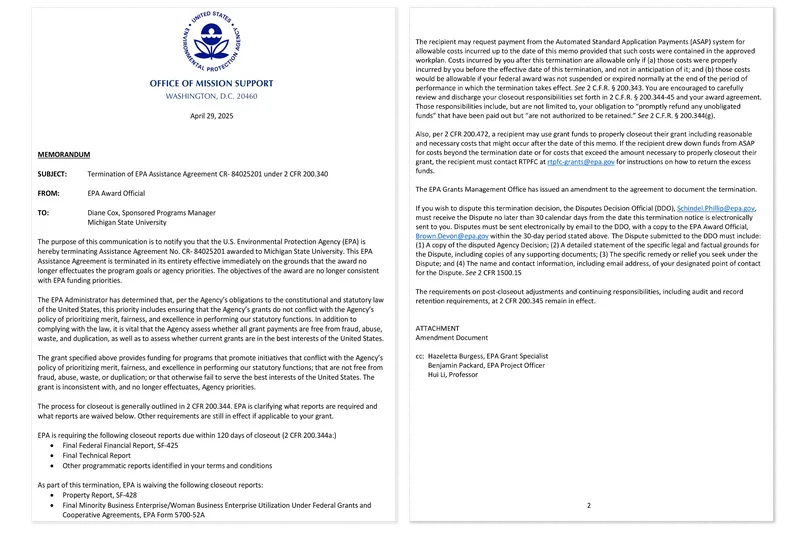
A letter dated April 29, 2025, notifying Michigan State University about the termination of a grant for research into PFAS, one day after the EPA said in a press release that it was committed to combating PFAS contamination by, in part, “strengthening the science.”
Credit:
Obtained by ProPublica
Research Under Fire
The EPA of Trump’s first term didn’t just call for more regulation of PFAS, it also stressed the importance of better understanding the forever chemicals through research and testing.
In a 2020 update to its PFAS action plan, the EPA highlighted its support for North Carolina’s investigation of GenX in the Cape Fear River. And it described its efforts to develop the science on PFAS issues affecting rural economies with “first-of-its-kind funding for the agriculture sector.”
Zeldin, too, has boasted about advancing PFAS research in an April news release. “This is just a start of the work we will do on PFAS to ensure Americans have the cleanest air, land, and water,” he said.
At about the same time, though, the agency terminated a host of congressionally appropriated grants for PFAS research, including over $15 million for projects focused on food and farmlands in places like Utah, Texas and Illinois.
Scientists at Michigan State University, for example, were investigating how PFAS interacts with water, soil, crops, livestock and biosolids, which are used for fertilizer. They timed their latest study to this year’s growing season, hired staff and partnered with a farm. Then the EPA canceled two grants.
In virtually identical letters, the agency said that each grant “no longer effectuates the program goals or agency priorities. The objectives of the award are no longer consistent with EPA funding priorities.”
The contrast between the agency’s words and actions raises questions about the process behind its decisions, said Cheryl Murphy, head of Michigan State’s Center for PFAS Research and co-lead of one of the projects.
“If you halt it right now,” she said, “what we’re doing is we’re undermining our ability to translate the science that we’re developing into some policy and guidance to help people minimize their exposure to PFAS.”
At least some of the researchers are appealing the terminations.
About a month after PFAS grants to research teams in Maine and Virginia were terminated for not being aligned with agency priorities, the agency reinstated them. The EPA told ProPublica that “there will be more updates on research-related grants in the future.”
Even if the Michigan State grants are reinstated, there could be lasting consequences, said Hui Li, the soil scientist who led both projects. “We will miss the season for this year,” he said in an email, “and could lose the livestock on the farm for the research.”
Federal researchers are also in limbo. Uncertainty, lost capacity and spending restrictions have stunted the work at an EPA lab in Duluth, Minnesota, that investigates PFAS and other potential hazards, according to several sources connected to it. As one source who works at the lab put it, “We don’t know how much longer we will be operating as is.”
The EPA told ProPublica that it’s “continuing to invest in research and labs, including Duluth, to advance the mission of protecting human health and the environment.”
Meanwhile, the agency is asking Congress to eliminate more than half of its own budget. That includes massive staffing cuts, and it would slash nearly all the money for two major programs that help states fund water and wastewater infrastructure. One dates back to President Ronald Reagan’s administration. The other was spotlighted in a paper by Trump’s first-term EPA, which said communities could use these funds to protect public health from PFAS. It trumpeted examples from places like Michigan and New Jersey.
The EPA lost 727 employees in voluntary separations between Jan. 1 and late June, according to numbers the agency provided to ProPublica. It said it received more than 2,600 applications for the second round of deferred resignations and voluntary early retirements.
“These are really technical, difficult jobs,” said Melanie Benesh, vice president for government affairs at the nonprofit Environmental Working Group. “And the EPA, by encouraging so many employees to leave, is also losing a lot of institutional knowledge and a lot of technical expertise.”
The shake-up also worries DeWitt, who was one of the scientists who helped investigate the Cape Fear River contamination and who has served on an EPA science advisory board. Her voice shook as she reflected on the EPA’s workforce, “some of the finest scientists I know,” and what their loss means for public well-being.
“Taking away this talent from our federal sector,” she said, will have “profound effects on the agency’s ability to protect people in the United States from hazardous chemicals in air, in water, in soil and potentially in food.”
Great Job by Anna Clark & the Team @ ProPublica Source link for sharing this story.




CEOs are obsessing over ‘permacrisis’ problems but not leading frontline employees, warns former AT&T leader
Anne Chow, former CEO of AT&T Business, is lead director on FranklinCovey’s board of directors, a director of 3M and CSX, and author of Lead Bigger: The Transformative Power of Inclusion.
In my years leading at AT&T, I witnessed a curious phenomenon. When a crisis hit our communications networks, our teams, regardless of function and hierarchy, would leap into action to restore the critical and essential services we provided to our customers. Whether a hurricane, a trans-Pacific cable cut, or cyberattack, purpose crystalized. Silos disappeared. People dropped politics, their own agendas, and rallied toward a common mission. The result? Execution and performance soared.
These powerful moments of clarity amid chaos have always stayed with me. I often found myself wondering: Why can’t we bottle this? Why does it take a disaster for our clearest alignment and best execution to surface?
Today, I find myself revisiting those questions, not from the C-suite of a telecom giant, but through my work in boardrooms and university lecture halls and, most personally, as a mother of two Gen Z daughters entering the workforce. What I see is a business environment defined not by one crisis or even by periodic crises, but by what PwC is calling permacrisis. Trade wars, generative AI disruption, political polarization, supply chain shocks, rising geopolitical risk: It’s a hurricane in every direction.
And here’s the trap: In this endless storm of instability, I see the opposite of my AT&T experience: Many leaders lose focus, fixating on issues and events within their circle of concern but beyond their real purview. At the same time, they may neglect matters that are squarely within their control and influence.
A prime example is how much time you spend with your emerging workforce. I’m talking about your front line, their managers, and your newest hires. Collectively I’ll call them your “freshman line.” These employees aren’t just your future; they are your present. In a world where everything feels fragile, shoring up this group is a point of leverage for greater resilience across your organization.
Yet, as a cohort, this group gets much less attention and training than senior staff.
The hurricane inside the building
It’s easy to recognize disruption when it comes from the outside: supply chain breakdowns, regulatory whiplash, or technological upheaval. But increasingly, the storm is also coming from within. Generational shifts, flatter hierarchies, and declining corporate loyalty have made it harder to develop and retain talent. Younger employees are hired and let go more quickly, and they’re more likely to change jobs on their own. Even senior team members are staying for shorter stints. As a result, institutional knowledge is disappearing. Technology is replacing the need for many middle management functions and threatens to replace whole categories of jobs.
In this shift, the front line—the people who are face-to-face every day with your customers, your suppliers, your code base—bears the weight. In the past, layers of management above the front line absorbed all this complexity and translated it for those serving customers, directly interacting with the market every single day. Now? That complexity lands directly in the laps of your newest hires and their managers, who are also largely unsupported. Traditionally, leadership development has been lavished on senior executives and those deemed “high-potential talent.”
We’re asking these early-career professionals to step into roles that require decision-making, critical thinking, and rapid analysis at speeds previously reserved for more experienced players. Are we preparing them for this? Are we even present enough to notice what they need?
Your freshman line: the untapped force
I use the term freshman line purposefully. These aren’t just your young employees, they are your newest team members across all demographics. The skills and mindsets they bring, as well as the kind of leadership they respond to, are dramatically different from a generation ago.
They are native to the newest technologies our organizations require. Many lack traditional business etiquette but show up with a more subtle social intelligence that can be winning and persuasive. They are purpose-driven and skeptical of the blind, loyalty-based tradeoffs that my generation accepted as a matter of course.
Some managers may not like their tendency to push back on “the way leadership has always been done.” But in a business environment that demands innovation, that’s an asset, not a liability.
Here’s the critical thing to know about your freshman line: They’re soaking up the impact of our collective uncertainty just like everyone else, but with less context, less patience, and less experience. If you want to build resilience in your company, this is the cohort to invest in. Not just because it’s the right thing to do, but because it’s your best chance at agility, especially in times of transformation.
Reallocating your leadership energy
Today’s leaders are exhausting themselves worrying about global economic policy, AI existential risk, and tariff policy that shifts week to week. But while those dynamics surely matter, and contribute to your situational awareness, they are not where your highest-leverage leadership lies in 2025.
Ask yourself: When was the last time you sat down with a group of frontline managers, not to assess them or for a quick introduction, but to listen? When did you last walk the floor, not to check that they were present and working, but to ask them what’s working and what’s not? To hear their worries and their ideas while also showing them that you care?
These are the conversations that convey your culture. This is how you identify the blockers to execution, innovation, and morale. This is where your next generation of leadership is incubated, not in corporate strategy off-sites, but in the field, on the ground, and on the factory floor.
Many may think they do enough of this. But one recent survey found that nearly half of frontline employees don’t know who their CEO is. There is a certain gap here.
From boss to builder
The flattening of hierarchies means your frontline team has moved from the periphery to the center of your organization. The front line is absorbing complexity, interfacing with AI, representing your brand, and, increasingly, influencing and driving internal change. For instance, their prioritization of authenticity and well-being is driving a workplace evolution that is here to stay and is changing the way we must lead.
In this environment, leaders need to show up differently. When we lean in, we must do so by coaching and advising more, rather than managing more. We need to actively help the freshman line cultivate business acumen, including decision confidence, stakeholder awareness, relationship building, and a mindset for calculated, smart risk. That growth doesn’t happen by accident but through intention and support. We can’t just assume they’ll “figure it out.”
These are your changemakers. But only if you invest in them as such.
A call to leaders
Forgive me for stating the obvious: Today’s business world doesn’t reward analysis-paralysis. It rewards focus, courage, action, and results. And if there’s one place every business leader can focus amid the uncertainty—the permacrisis, the hurricane everywhere—it’s on attracting and developing the talent with the most potential to shape what comes next. Who, let’s not forget, are most often the face of your business to your customers and partners alike. Spend time with your new hires. Develop and flex your own communications style to better connect with them. Understand their perspectives. Build their confidence and support their ideas. In an era of constant change, these early-career employees will shape how your organization adapts across technology, culture, and growth. If you’re not standing alongside your freshman line and serving as an active coach, you’re already behind.
The opinions expressed in Fortune.com commentary pieces are solely the views of their authors and do not necessarily reflect the opinions and beliefs of Fortune.
Great Job Anne Chow & the Team @ Fortune | FORTUNE Source link for sharing this story.