Home News Page 47

Thinking Machines Cofounder’s Office Relationship Preceded His Termination

Thinking Machines Cofounder’s Office Relationship Preceded His Termination

Leaders at Mira Murati’s Thinking Machines Lab confronted the startup’s cofounder and former CTO, Barret Zoph, over an alleged relationship with another employee last summer, WIRED has learned.

That relationship was likely the alleged “misconduct” that has been mentioned in prior reporting, including by WIRED.

To protect the privacy of the individuals involved, WIRED is not naming the employee in question. The individual, who worked in a different department than Zoph and was in a leadership role, is no longer at the lab.

Murati approached Zoph to discuss the relationship, sources say. The cofounders’ working relationship broke down in the months following that conversation, according to multiple sources, and Zoph started speaking to competitors about other opportunities.

Before Zoph left the company, he was in conversation with leaders from Meta Superintelligence Labs, according to a source familiar with the matter. Zoph was ultimately hired by OpenAI. OpenAI’s CEO of applications, Fidji Simo, said the hiring had been in the works for weeks. Simo also noted that she did not share Thinking Machines’ concerns over Zoph’s ethics.

Zoph and OpenAI declined to comment for this story.

This week, a third Thinking Machines cofounder, Luke Metz, and at least three other researchers from Murati’s startup also departed for OpenAI. In October, the startup’s cofounder Andrew Tulloch left for Meta.

While tensions between Murati and Zoph came to a head in recent days, they do not entirely explain the broader exodus of Thinking Machines employees.

WIRED previously reported that there was misalignment within Thinking Machines about what the startup should build.

In November, Murati’s startup was reportedly looking to raise capital at a $50 billion valuation, up from its current valuation of $12 billion.

Thinking Machines Lab declined to comment for this story.

Great Job Maxwell Zeff & the Team @ WIRED Source link for sharing this story.

Judge Allows a Third Offshore Wind Project to Resume Construction as the Industry Challenges Trump

Judge Allows a Third Offshore Wind Project to Resume Construction as the Industry Challenges Trump

Posted on January 16, 2026

A federal judge has ruled that work on a Virginia offshore wind project could resume. It’s the third project this week to successfully challenge the Trump administration in court. The administration announced last month it was suspending leases for at least 90 days on five East Coast offshore wind projects because of national security concerns. Dominion Energy Virginia, which is developing Coastal Virginia Offshore Wind, was the first to sue. In federal court in Virginia on Friday, a judge granted its request for a preliminary injunction, allowing construction to resume while the lawsuit proceeds. Federal judges ruled this week that construction could also resume on a wind farm for New York and another for Rhode Island and Connecticut.

(Copyright 2026 The Associated Press. All Rights Reserved.)

Great Job & the Team @ News Talk WBAP-AM for sharing this story.

Trump’s plan to make data centers pay for power plants has big flaws

Trump’s plan to make data centers pay for power plants has big flaws

The principle of new large loads paying their fair share is gaining consensus across states, industry groups, and political parties,” Gramlich said. The rules that have been in place for years did not ensure that.”

But Gramlich highlighted that Friday’s plan will run into the same state-vs.-federal jurisdictional conflicts that have stymied PJM’s efforts to reform data-center interconnection to date.

First off, PJM’s capacity auctions operate by allowing power plants, battery projects, demand-response providers, and other supply-side” providers to bid their capacity into the system. Those capacity costs are then passed along to utilities, he noted. Utility customers themselves — including data centers — are not part of that equation.

Even if the large loads voluntarily participate, there’s no mechanism currently for direct participation of a retail customer in a wholesale auction,” Gramlich said. 

What’s more, data centers remain customers of utilities regulated at the state level. It might require changes in state law in any PJM state” to alter those facts, he said.

Even if such state policies were put in place, there’s no guarantee that the prospective data centers would play ball, he said. It’s easy to hold an auction, but the hard part is compelling anyone to participate.”

The new agreement faces other fundamental challenges, too.

While the text doesn’t specify the exact type of power plants it wants PJM to build, its call for reliable baseload power generation” is code for fossil fuels or nuclear power. That will pose problems. Demand for gas turbines has pushed delivery orders for new power plants out to 2028 or later. Almost all of the new gas-fired power plants secured in PJM’s fast-track procurement last year aren’t set to come online until 2030 or later. And nuclear power plants usually take about a decade to build.

Meanwhile, more than 100 gigawatts of potential new grid resources, the vast majority of which are solar, wind, and batteries, remain stuck in PJM’s badly congested interconnection queue. PJM is still working on efforts to fast-track these resources by, for example, pairing batteries with existing solar and wind farms.

Ultimately, an auction of the kind the White House plan envisions could drive investment in more power plants, according to Julia Hoos, head of USA East at Aurora Energy Research — but it could also exacerbate some other elements of PJM’s challenges.”

Everyone agrees that PJM is struggling to bring online new generation fast enough, and that some sort of intervention is required,” Hoos wrote in a Friday email. But she added that PJM already has several ongoing reform processes to address these issues — and it’s pretty unprecedented for this sort of top-down intervention to direct PJM’s efforts.” 

{
if ($event.target.classList.contains(‘hs-richtext’)) {
if ($event.target.textContent === ‘+ more options’) {
$event.target.remove();
open = true;
}
}
}”
>

Great Job Jeff St. John & the Team @ Canary Media Source link for sharing this story.

Laura Ingraham praises DOJ investigations of Walz and Frey, suggests it could get “a lot spicier for them”

Laura Ingraham praises DOJ investigations of Walz and Frey, suggests it could get “a lot spicier for them”

LAURA INGRAHAM (HOST): And when we talk about using language and words, and let’s go to Mike on this, it’s really language and words that lead to action on the part of the agitators on the ground. When you’re telling them to film, to track, and calling this an invasion, Mike, that comes pretty close to incitement and one would think you get text messages and you get emails the story might get a lot spicier for them.

MIKE DAVIS (GUEST): Yeah. Under the Constitution, our US Congress writes our immigration laws on behalf of the American people. Congress decides who gets to come and who has to go and the president has a constitutional duty to enforce those federal immigration laws. That is the supreme law of the lands. And these local governors, these local mayors, cannot interfere with federal immigration enforcement. Not only is it an assault on federal law enforcement, you’re looking at insurrection and seditious conspiracy, along with harboring, conspiracy, and many other serious federal felonies when you are inciting people to commit violent acts, to physically obstruct federal law enforcement.

So I would say to Governor Walz and to Mayor Frey, you better back down or you’re going to end up in federal prison.

Great Job Media Matters for America & the Team @ Media Matters for America Source link for sharing this story.

Republican candidate Marty Lancton leads in Harris County Judge campaign funds, Parker trails behind | Houston Public Media

Republican candidate Marty Lancton leads in Harris County Judge campaign funds, Parker trails behind | Houston Public Media

Sarah Grunau/ Houston Public Media

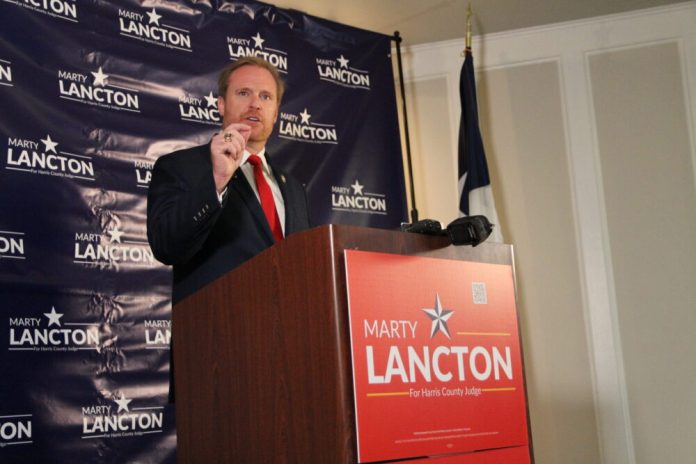
Houston firefighters union leader Marty Lancton confirms his bid for the Harris County Judge’s seat on Thursday, August 20, 2025.

Local firefighters union president Marty Lancton, a top Republican candidate for Harris County Judge, has raised more than $500,000 in his upcoming bid for the seat outpacing the leading Democratic candidate, former Houston Mayor Annise Parker.

But while Lancton received several high-dollar donations from some business owners and real estate moguls, Parker, who drew in roughly $416,000, received about 115 more donations than Lancton, according to recent campaign finance reports filed this week.

His lead in campaign funds comes weeks after Texas Gov. Greg Abbott announced his endorsement of Lancton in the county judge’s race, vowing to devote a significant part of his war chest to Lancton’s campaign and a consolidated effort to turn elected Harris County seats red. Lancton’s campaign finance report did not include any direct donations from Abbott.

A 2025 University of Houston Hobby School of Public Affairs survey which was conducted before Lancton threw his hat in the ring showed Harris County voters slightly favored Parker in this year’s county judge election. Other candidates trailed behind Parker, like Democratic Houston City Council member Letitia Plummer, who received a 2% net favorability for the position.

Plummer did not file a campaign finance report through the Harris County Clerk’s Office by the Jan. 15 reporting period deadline. Her campaign made a July 8 filing appointing a treasurer, and a Jan. 12 filing giving her authorization to file financial reports. A spokesperson for Plummer’s campaign did not immediately return a message seeking comment Friday.

Harris County Judge Lina Hidalgo announced last year she would not seek reelection for her seat. Her recent campaign finance report shows she pulled in about $1,800 in the latest reporting period and spent more than $280,000. Many of those expenditures went towards her Japan trade mission, which was aimed at garnering more business for the county.

Republican candidate Aliza Dutt, the mayor of Houston suburb Piney Point Village, brought in $42,000 in donations. Republican Warren Howell raised just under $4,500.

Oscar Gonzalez, a retired Harris County Sheriff’s Office deputy and Republican, raised about $2,200 in donations in his bid for the seat.

Some of Lancton’s heftiest campaign donations include a $50,000 gift from a Washington D.C.-based firefighters association political action committee, another $50,000 from his own union’s political action committee and various top-dollar donations from some local business owners.

Parker’s top donations include $20,000 from Gilbert Garcia, a managing partner of a Houston-based asset management firm. She also received $10,000 from Ken Bohan, treasurer of the LGBTQ+ Victory Fund, a political action committee founded by Parker, and another $10,000 donation from former Port Houston Commissioner Theldon Branch III.

Great Job & the Team @ Houston Public Media for sharing this story.

Find Your Next Workout With These Routines That Keep You Moving

Find Your Next Workout With These Routines That Keep You Moving

Our reporters have teamed up with fitness experts to design dozens of routines. Try something new — and build an exercise habit that sticks.

Great Job & the Team @ NYT > Well Source link for sharing this story.

AI cloud startup Runpod hits $120M in ARR — and it started with a Reddit post   | TechCrunch

AI cloud startup Runpod hits 0M in ARR — and it started with a Reddit post   | TechCrunch

Runpod, an AI app hosting platform that launched four years ago, has hit a $120 million annual revenue run rate, founders Zhen Lu and Pardeep Singh tell TechCrunch.  

Their startup journey is a wild example of how if you build it well and the timing is lucky, they will definitely come.

The story includes bootstrapping their way to over $1 million in revenue; landing a $20 million seed round after VC Radhika Malik, a partner at Dell Technologies Capital, saw some Reddit posts; and gaining another key angel investor, Hugging Face co-founder Julien Chaumond, because he was using the product and reached out over the support chat, the founders tell TechCrunch. 

It all began in late 2021 when the two friends, who worked together as corporate developers for Comcast, decided the hobby they were doing wasn’t fun anymore. 

They had built setups of specialized computers used to generate Ethereum in their respective New Jersey basements. While they did successfully mine a bit of the cryptocurrency, it wasn’t enough to pay back their investment, they said. Plus, mining was going to end after the much-ballyhooed network upgrade called “The Merge.” 

On top of that, it was “boring” after a couple of months, Lu said. 

But they had talked their wives into letting them spend a good $50,000 on the hobby between them, they estimated. Lu and Singh knew that home harmony depended on finding a way to use those GPUs. 

Techcrunch event

San Francisco
|
October 13-15, 2026

The devs had been engaged in machine learning projects at work, so they opted to convert their mining rigs into AI servers. This was before ChatGPT, even before DALL-E 2. 

As they repurposed the rigs, “We were seeing how really god-awful the software stack was for dealing with these GPUs,” Lu said. As developers, they found a problem they wanted to solve.  

Runpod was born “because we felt that the actual experience of developing software on top of GPUs was just hot garbage,” Lu described. 

A few months later in early 2022, they were ready to share what they had built. Runpod is a platform for hosting AI apps, emphasizing speed, easily configured hardware (including a serverless option that automates configuration), and dev tools like APIs, command-line interfaces, and other integrations.  

Back in 2021, they only had a few such integrations (like support for popular web app tool Jupyter notebooks). The next problem: finding beta testers. 

“As first-time founders, we didn’t really know how to market or how to do anything,” Lu recalled. “So I’m like, all right, let’s just post on Reddit.” 

So, they posted in a couple of AI-oriented subreddits. The offer was simple: free access to their AI servers in exchange for feedback. It worked. They landed beta customers, which led to paying customers. Within nine months, they had quit their jobs and hit $1 million in revenue, they said. 

Bootstrapping growth

But that led to another problem. “Six months in, business users were like, ‘Hey, I want to actually run real business stuff on your platform. But I cannot run it on servers that are in people’s basements,” Lu said. 

It had not occurred to the New Jersey founders to raise capital from VCs. Instead they formed revenue-share partnerships with data centers to grow capacity. But it was stressful. The founders needed to stay three steps ahead. 

“If we don’t have the GPUs, the market sentiment, the user sentiment changes. Because when they don’t see capacity from you, they go somewhere else,” Singh described. 

Meanwhile, their user base was growing on Reddit and Discord, especially after ChatGPT launched.

VCs were also on the prowl for investments. Malik saw them on Reddit and reached out, their first VC call. But Lu didn’t know how to pitch to an investor. “Radhika was super helpful, even at the first conversation,” he said. She basically explained to him how a VC thinks and told him she’d stay in touch.  

Meanwhile, Lu had a business to run that had to pay for itself. “It was almost two years where we really didn’t have any funding,” he said. So Runpod never offered a free tier. It had to at least pay for itself, even if it wasn’t throwing off much profit. Unlike other AI cloud services that began as crypto miners, these founders refused to take on debt, they said. 

By May 2024, with AI app fever spreading, their lucky decision to launch AI hosting for devs two years earlier was paying off. Their business had grown to 100,000 developers, and they landed a $20 million seed deal co-led by the VC arms of both Dell and Intel, with participation from big names like Nat Friedman and Chaumond.  

They haven’t raised more money since but are now planning to, armed with a business that, they believe, should command a healthy Series A. 

Today, Runpod counts 500,000 developers as customers, ranging from individuals to Fortune 500 enterprise teams with multimillion-dollar annual spend, the founders said. 

Their cloud spans 31 regions globally and counts customers like Replit, Cursor, OpenAI, Perplexity, Wix, and Zillow as users.

Competition is also fierce. Devs have all the major clouds to choose from (AWS, Microsoft, Google), plus plenty of industry-specific choices like CoreWeave and Core Scientific. 

But they also see their place in the world a bit differently — as a dev-centric platform. They don’t see coding ever going away but changing. Programmers will become AI agent creators and operators. 

“Our goal is to be what this next generation of software developers grows up on,” Lu said.  

Great Job Julie Bort & the Team @ TechCrunch Source link for sharing this story.

‘Diarrhea Can be Very Painful’: Trump Rushes Out of Briefing Claiming Meetings, but Cameras Catch Him Speaking to Reporters Shortly After

‘Diarrhea Can be Very Painful’: Trump Rushes Out of Briefing Claiming Meetings, but Cameras Catch Him Speaking to Reporters Shortly After

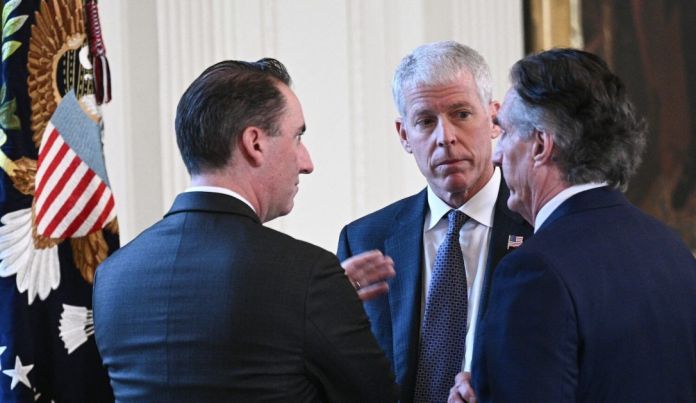
President Donald Trump abruptly ended a White House briefing and declined to take questions before making a swift exit.

The president gathered executives and officials in the White House’s East Room for what was billed as a serious roundtable on his administration’s “Great Healthcare Plan.” The meeting was supposed to be about rural healthcare, but instead, thanks to his immediate rush out of the room, it ended like a fire drill.

‘Diarrhea Can be Very Painful’: Trump Rushes Out of Briefing Claiming Meetings, but Cameras Catch Him Speaking to Reporters Shortly After
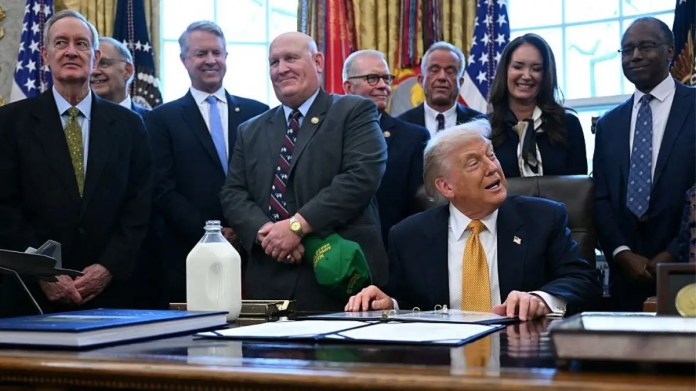
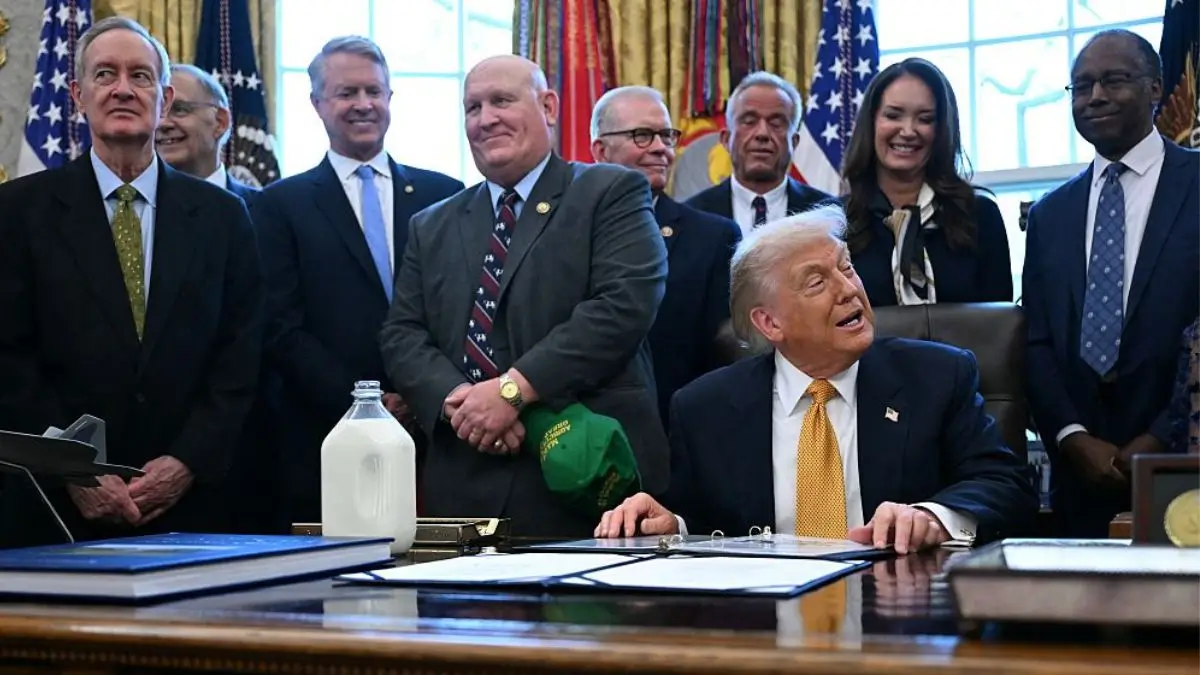
Donald Trump’s White House exit turned a health care roundtable into a viral spectacle on some corners of a social media. ( (Photo by Brendan SMIALOWSKI / AFP via Getty Images)

‘Personal Diaper Changer’: Trump Appears Lifeless as Ally Is Forced to Help Him Fix His Clothes During Trip That Has Viewers Baffled

The roundtable took place on Friday, Jan. 16, around 11:30 a.m. and was packed with his team to unveil his broad framework pitched as a way to lower healthcare costs while Congress continues to argue over the future of Affordable Care Act subsidies.

The setup was familiar: long tables, folded hands, attentive faces, and the quiet expectation that the president would speak, take questions, and linger just long enough to look engaged. That is not how it went.

Video from C-SPAN shows Trump suddenly standing up at the end of the hour-long event, shaking hands with U.S. Secretary of Health and Human Services Robert F. Kennedy Jr. and CMS Administrator Mehmet Oz, and then moving briskly toward the exit.

As he made his getaway, staff cued up “God Bless America,” which played loudly as he left the room without taking a single question from the press.

He was out, and on Threads, the theories came fast and merciless.

One user wrote, “Holding back diarrhea, can be very painful, and scary. Lol.”

Another quipped, “The runs is something he gets, not something he does.”

A third added, “Must’ve consumed whole milk with a W, time for [the toilet bowl emoji].”

The jokes quickly escalated.

“He s—t his diaper and neeeded Don jr to change it,” one person claimed.

Someone else asked, “He didn’t run away, he stumbled away.”

The real reason why the former reality star was in a hurry was that he needed to get to Florida. Trump was headed to Palm Beach for a ceremony renaming a four-mile stretch of Southern Boulevard — the road connecting Palm Beach International Airport to Mar-a-Lago — in his honor. Still, the speed of the exit sparked immediate speculation, according to the Post.

Those comments about how he smells are not new, nor are his those about his overall wellness.

Trump’s health has become the recurring point of fixation online, particularly as critics note that he is the oldest person to assume the presidency.

One pointed rumor about his aging has been amplified for years by former “Celebrity Apprentice” crew members, particularly comedian and ex-staffer Noel Casler.

Casler has repeatedly claimed that Trump suffered from incontinence during the filming of the show, alleging that decades of stimulant abuse and a poor diet compromised his bodily functions, even as Trump projected an image of perfect health. He reiterated those claims publicly in 2020, and they continue to resurface whenever Trump’s physical condition becomes a topic of discussion.

By Friday afternoon around 3 p.m., Trump landed back in Palm Beach for his fifth consecutive weekend at Mar-a-Lago. After his arrival, he spoke with reporters, who asked about receiving the Nobel Peace Prize from the 2025 winner Maria Corina Machado.

“She offered it to me. I thought it was a very nice gesture,” Trump stated, later adding, “And by the way, I think she’s a very fine woman, and we’ll be talking again.”

He returned for a street-naming ceremony, which will include Palm Beach County Mayor Sara Baxter, Florida Rep. Meg Weinberger, former county commissioner Dave Kerner, County Commissioner Maria Sachs, and right-wing provocateur Laura Loomer.

In the end, the health care plan barely registered online. What people talked about everything else: the speed, the music, the frozen smiles, the swirl of jokes about age, health, and smell. In Trump’s universe, even a policy roundtable can turn into a sprint for the exit, leaving the internet to narrate the rest.

Great Job Nicole Duncan-Smith & the Team @ Atlanta Black Star Source link for sharing this story.

ChatGPT tests ads as a new era of AI begins | Fortune

ChatGPT tests ads as a new era of AI begins | Fortune

Two days after Google insisted there are no current plans for ads in its Gemini AI app, OpenAI announced Friday that it is starting to test ads in ChatGPT.

OpenAI CEO of applications Fidji Simo said in a blog post that ads will begin appearing at the bottom of the chatbot’s answers for free users and for Go subscribers (who pay $8 a month) in the U.S. in the coming weeks, opening an important new source of revenue for the high-flying startup which has been valued by investors at $500 billion.

It’s a moment many in tech have long viewed as inevitable: Running frontier AI models is brutally expensive, burning through staggering amounts of computing power, electricity, and GPUs. Advertising’s revenue stream is hard to resist. OpenAI expects to generate “low billions” of dollars in revenue this year, and more each year thereafter, the FT reported on Friday citing an unnamed person “close to the company.”

While Google has so far held back from putting ads in its standalone Gemini chatbot app, the company has incorporated ads into the AI Overviews that appear in its online search results, a move viewed as essential as the company seeks to extend its $265 billion a year advertising business into the AI age.

OpenAI said in its blog post that the forthcoming ads will be clearly labeled, and that users’ conversations with ChatGPT would be kept private. “You need to know that your data and conversations are protected and never sold to advertisers,” the company said. “We need to keep a high bar and give you control over your experience so you see truly relevant, high-quality ads—and can turn off personalization if you want.” In addition, it said that ads will not influence ChatGPT’s answers, which it said “are optimized based on what’s most helpful to you.”

OpenAI emphasized that subscriptions remain its long-term priority, and said that the $20 per month Plus and $200 per month Pro subscriptions, as well as the Business Enterprise version of the product, will remain ad-free. “Our enterprise and subscription businesses are already strong, and we believe in having a diverse revenue model where ads can play a part in making intelligence more accessible to everyone,” the company wrote.

Still, the company doubled down on tying the introduction of ads with its overall mission to ensure that advanced general intelligence, or AGI, “benefits all of humanity,” Simo wrote.

In a separate blog post on Friday, OpenAI said that “ads support our commitment to making AI accessible to everyone by helping us keep ChatGPT available at free and affordable price points.”

Great Job Sharon Goldman & the Team @ Fortune | FORTUNE Source link for sharing this story.

ACC more than survived, it thrived. Miami in the College Football Playoff final is proof

ACC more than survived, it thrived. Miami in the College Football Playoff final is proof

MIAMI – The Power 4 conference that didn’t get its champion into the College Football Playoff has a team that tied for second playing in the CFP’s national title game.

So much for the demise of the Atlantic Coast Conference.

The league that looked most vulnerable a few short years ago when the latest round of realignment shook up college sports is doing just fine.

The best proof comes out of Miami, a second-place finisher in the ACC that plays Indiana in the title game Monday. It’s a turn of events that, at least for now, has left in the rearview mirror the playoff rejection of ACC champion Duke.

“It’s been about creativity and innovation on the business side of sports, as well as in the area that has connections with competition,” commissioner Jim Phillips said in explaining what has worked over the past few tumultuous years.

To reset, Duke won a convoluted tiebreaker to emerge from a five-way tie for second and make the ACC title game, then beat Virginia there. But because the Blue Devils had five losses and were unranked, they got passed over by 24th-ranked Sun Belt champion James Madison for the fifth and final automatic-qualifying spot in the 12-team bracket.

It was something of a black eye for a conference that was, for decades, known for basketball, but through expansion moves of its own along with the steady success of either Florida State or Clemson, has cultivated a more-than-respectable resume as a football conference.

In this case, it was Miami — once a big, brash name in college football that hadn’t been quite that since it joined the league in 2004 — that came to the rescue.

The furor over the Duke snub was erased when the playoff selection committee gave the Hurricanes the last at-large spot over Notre Dame despite ranking them lower than the Fighting Irish all season.

Miami making the final might have validated that decision.

“I believe the ACC is like 9-4 in postseason play this year, and I think a lot of the reasons we have progressed is (thanks to) some of the teams that we have faced throughout the course of the season in our conference,” Miami coach Mario Cristobal said.

Seven of those nine wins have come against other Power Four teams. The ACC also points to solid scheduling — 35 games against Power Four teams overall this season — and 14 wins against those teams and Notre Dame; both numbers were the highest among the P4 conferences.

Another story line that emerged from Miami’s wins is the $20 million playoff share that will all go to the Hurricanes, instead of being divided among all the conference members, which is the traditional way of doing it.

That arrangement strikes to the heart of the ACC’s dilemma and how it solved it when Florida State and Clemson sued the conference and threatened to leave, concerned about being left behind as the Big Ten and SEC kept expanding.

Phillips and the lawyers came up with a “success incentives” initiative in which programs would keep all their postseason money. They crafted a similar deal that placed 60% of their media revenue up for grabs, with teams that generate more viewership (think FSU, Clemson, Duke in hoops) getting more of the dough.

“For us, it was an innovative approach of how to handle our revenue,” Phillips said. “You put everyone at the same level, then compete for a portion of those resources. We thought about it, talked about it, and said, listen this is the evolution of college sports.”

Also evolving — the CFP. Under the arrangement in place for the playoff, the Big Ten and SEC have the power to decide what comes next. The ESPN-mandated deadline for that decision is next Friday and the two conferences head into negotiations this weekend with very different views of what should happen.

Phillips and Big 12 commissioner Brett Yormark will also be sitting at the negotiating table. Time will tell if sitting there as the commissioner of a league that put a team in this year’s final gives Phillips any more say in these conversations.

___

AP college football: https://apnews.com/hub/ap-top-25-college-football-poll and https://apnews.com/hub/college-football. Sign up for the AP’s college football newsletter: https://apnews.com/cfbtop25

Copyright 2026 The Associated Press. All rights reserved. This material may not be published, broadcast, rewritten or redistributed without permission.

Great Job Eddie Pells, Associated Press & the Team @ KSAT San Antonio Source link for sharing this story.

Secret Link