Home News Page 96

Run Away Season 2: Cast, Rumours & Release Date – Our Culture

Run Away Season 2: Cast, Rumours & Release Date – Our Culture

Netflix has turned Harlan Coben adaptations into New Year Day staples. In 2024, we had Fool Me Once. 2025 brought us Missing You. Now, along came Run Away.

TV fans seem to dig the tradition. With 12.7 million views this week, Run Away is the second most-popular show globally and the #1 show in seven countries. Does that mean we’re getting season 2?

Run Away Season 2 Release Date

Run Away is based on the 2019 novel of the same name, which doesn’t have a sequel. Also, if previous Coben adaptations are any indication, they are meant to be standalone stories.

In other words, Run Away season 2 is unlikely. Add in the fact that the title is listed as a limited series on Netflix, and this is probably all we get.

Still, you never know. If the show proves incredibly popular, a follow-up is never out of the question. In that case, a second installment could arrive in 2027.

Run Away Cast

  • James Nesbitt as Simon Greene
  • Ruth Jones as Elena Ravenscroft
  • Minnie Driver as Ingrid Greene
  • Alfred Enoch as Isaac Fagbenle
  • Lucian Msamati as Cornelius Faber
  • Jon Pointing as Ash
  • Ellie de Lange as Paige Greene
  • Adrian Greensmith as Sam Greene

What Is Run Away About?

Run Away revolves around Simon, whose life unravels when his eldest daughter, Paige, runs away.

Simon tracks Paige to a park, where she appears under the influence, accompanied by a troubled young man named Aaron. A heated confrontation between Simon and Aaron is caught on camera and goes viral. Soon after, Aaron is found murdered, and Simon becomes a prime suspect. With Paige still unaccounted for, the father is pulled into an investigation that exposes criminal underworlds and connections to a dangerous cult.

In other words, what begins as a frantic search for his missing child spirals into a dark mystery brimming with twists. The show consists of eight episodes, so it’s a quick and riveting watch.

By the time the finale wraps up, viewers get answers to their most pressing questions. Without going into spoiler territory, we learn Paige’s fate and find out who was Aaron’s killer. The show ends on a pretty definite note, which is why Run Away season 2 seems unlikely. Thankfully, there are many other Colben shows available to stream.

Are There Other Shows Like Run Away?

If you liked Run Away, check out the other Harlan Colben adaptations on Netflix. The list includes The Stranger, Stay Close, Gone for Good, The Innocent, Safe, Hold Tight, and The Woods.

Alternatively, catch up with everything else trending on the platform. We recommend Stranger Things, Younger, The Accident, Man vs. Baby, and Emily in Paris.

Great Job Alexandra Pleșa & the Team @ Our Culture Source link for sharing this story.

The War on Drugs: A Pretext for Regime Change in Venezuela

The War on Drugs: A Pretext for Regime Change in Venezuela

The recent kidnapping of Venezuelan president Nicolás Maduro was not a “counter-narcotics” initiative: it was the culmination of a long-running hybrid warfare strategy aimed at regime change in Caracas.

US strategic planners are pursuing regime change while seeking to avoid the political costs of open war. Instead of relying on direct military occupation, they prefer to blend methods such as economic strangulation, lawfare, diplomatic isolation, covert action, and media management into what is known as hybrid warfare — a strategy designed to achieve regime change while preserving the appearance of legality and restraint.

The attempt to oust Venezuela’s government is not itself new. Ever since the Bolivarian Revolution came to power in 1999 with the election of Hugo Chávez, Venezuela has been subjected to hybrid forms of destabilization. The “War on Drugs” and casting of Maduro as a narco-terrorism chief has, however, gained a central role as a pretext for a long-yearned-for power-grab in Caracas.

WikiLeaks cables show that regime change has long been US strategy. A 2006 US Embassy document set out a strategy to “strengthen democratic institutions, penetrate and divide Chavismo, and build independent society”. The legal groundwork for escalation was established in 2015 when Barack Obama’s administration declared Venezuela a “national security threat,” allowing more coercive pressure.

Since at least 2002, the United States has worked to cultivate an opposition-aligned “civil society.” By working with Venezuelan opposition groups behind the scenes and by financing a dense ecosystem of NGOs through agencies such as USAID and the National Endowment for Democracy, Washington has worked to reengineer Venezuela’s political terrain and bring about a government favorable to US interests. What is labeled “democracy promotion” serves a core function of hybrid warfare: it provides plausible deniability for a real project of foreign intervention.

The most visible expression of this political warfare was Washington’s recognition of Juan Guaidó in 2019 as Venezuela’s “interim president.” This became the centerpiece of an international effort to construct a parallel state apparatus abroad, presenting Guaidó as the legitimate head of government. This fiction provided the political foundation for the seizure of Venezuelan assets, massively stepped-up economic strangulation, and the channeling of diplomatic and financial support to a US-backed opposition. Nearly sixty countries were enlisted in this coordinated attempt to isolate Maduro. It was about manufacturing the conditions for regime change behind the language of constitutional legitimacy.

Yet, this hybrid-warfare campaign didn’t work. Despite mounting pressure — political warfare, economic strangulation, lawfare, diplomatic siege, and constant behind-the-scenes efforts to fracture the Bolivarian Revolution — this strategy failed to deliver. Donald Trump even dismissed Guaidó as the “Beto O’Rourke of Venezuela,” with reference to the failed US presidential candidate — a fitting epitaph for the collapse of this particular initiative.

As the Guaidó project fell apart, Washington leaned on a tried-and-tested script for intervention in Latin America — the War on Drugs — using indictments, rewards, and narco-terrorism allegations to rebrand regime change as law enforcement.

Journalists across mainstream media amplified a cartel narrative that recast Maduro as a drug kingpin — the alleged head of the so-called Cartel de los Soles. What had once been framed as a struggle over “democracy” was now described as a criminal manhunt for a leader of a narco-terrorist organization.

The weaponization of War on Drugs narratives to justify foreign intervention in Latin America has been a central pillar of US geopolitical strategy for decades. It has functioned as a key pretext through which Washington has exerted political leverage, tying access to trade, financial markets, security cooperation, and diplomatic legitimacy to compliance with US strategic priorities. Governments that fall out of favor, even as they announce record drug seizures, are branded as “drug leaders” and “narco-regimes” — a label that serves to delegitimize them internationally and open the door to sanctions and more overt forms of coercion. Through the strategic initiative of Plan Colombia from 2000 onward, billions of dollars in military assistance were poured into Colombia to combat leftist insurgents, even as wide sections of political society actively collaborated with drug-funded right-wing paramilitaries.

Under the second Trump administration, this logic was fully operationalized. The bounty on Maduro’s head was raised from $15 million to $50 million by the US Department of State in a move designed to intensify pressure. An aggressive campaign portrayed Venezuela — not the far more central producers and trafficking hubs in Colombia or Mexico — as the epicenter of the global drugs trade. Even the DEA’s own 2025 National Threat Assessment didn’t list Venezuela as a major producer or a trafficking hub, instead singling out Colombia, Peru, Bolivia, and Mexico.

A whole procedural storyline, facilitated by the US court system — indictments, warrants, and state-sanctioned reward programs — was deployed to present escalation as “due process” and generate the illusion of plausible deniability for regime change. This was “statecraft by indictment” — the criminalization of the Bolivarian leadership, as the new spearhead of Washington’s hybrid war.

Efforts to manufacture consent were paired with a massive intensification of coercive operations against Venezuela, supposedly to stop drugs from reaching US shores. This military build-up took concrete form in a major US naval deployment to the Caribbean, backed by extensive sea and air power. The United States sought to economically strangle Venezuela by targeting its primary export, oil, enforcing a “total and complete blockade,” seizing tankers in international waters, and as of January 7, claiming they were going to control sales.

In the months leading up to Maduro’s kidnapping, counter-narcotics claims were used to justify military “strikes” against sea and land targets in and around Venezuela. At least 110 people were extrajudicially executed on boats by the start of this month, with Trump baselessly claiming that “every one of those boats . . . kills 25,000 Americans” — and insisting that “Maduro’s days were numbered.” At the same time, strategic planners such as Marco Rubio and Pete Hegseth, working with their friends in the media, constantly repeated that the unprecedented escalation was law-enforcement rather than a hybrid regime change operation. This was the political purpose of the drug-war framing: to provide moral cover for a geostrategic offensive as part of the wider project to restore US dominance in Latin America.

Operation “Absolute Resolve,” as it was dubbed by US strategic planners, was a hybrid operation par excellence. It brought overt and covert methods of warfare together to achieve a key objective: the kidnapping of President Maduro and First Lady Cilia Flores.

The raid began with overwhelming air dominance and military action that served as a “shock and awe” strategy designed to spread fear and disorientation across an entire city. Power outages and blackouts were reported across Caracas, with Trump boasting that the “lights of Caracas largely turned off due to a certain expertise that we have; it was dark, and it was deadly.” The operation drew directly from the repertoire of hybrid warfare, fusing military force, intelligence operations, and the law enforcement framing into a single, tightly choreographed act of coercion.

The special-forces assault on Maduro’s residence benefited from speed and surprise: far from any recognizable arrest or judicial process, it was a capture by force. The night-time kidnapping brutally executed the lawfare strategy.


What followed over the next hours and days was an avalanche of propaganda as Maduro’s kidnapping was legitimated with constant references to legality and “judicial processing” by mainstream media. The “law enforcement” narrative was placed front and center on networks like CNN and Fox News, as cameras and commentary fixated on “indictments” and the “processing” of the “captured” and “arrested” Maduro. Leaked emails show that the BBC directly instructed its staff to refer to the kidnapping in these terms — thus presenting Maduro as a wanted man, running from the law.

The framing was perverse but central to the operation: it chose to launder a naked act of state terror, recasting it as the legitimate execution of a court order. With hollow references to “law and order,” the victims, including civilians, were reduced to disposable figures in a grand performance of imperial legality.

Yet the operation and media fanfare that accompanied it were about more than Maduro himself. They were a form of geostrategic communication: a moment of spectacle and intimidation that also provided an opportunity to warn others. Reading from a carefully prepared script on January 3, Trump declared that the “extremely successful operation should serve as warning to anyone who would threaten American sovereignty or endanger American lives.”

In this new phase of hybrid warfare, the United States’ Venezuela policy is no longer contested through election disputes or self-proclaimed presidents, but a more open form of coercion and submission to empire. Indeed, Venezuela occupies a critical position in the architecture of contemporary imperialism, where struggles over strategic resources, the US-China rivalry, Latin American autonomy, and the survival of the Cuban Revolution converge.

As Trump openly admitted, Venezuela is one of the few Latin American states that has maintained a long-term refusal to fall into line with US strategic priorities. It has redirected oil, finance, and security cooperation away from Washington and toward strategic rivals of the United States, building close alliances with China, Russia, Iran, and others. This makes Venezuela not just an economic prize for a few US multinational corporations, but a strategic hinge in the quest for regional and global dominance.

The broader ambitions were clearly spelled out in the US National Security Strategy, unveiled in November: “the United States will reassert and enforce the Monroe Doctrine to restore American preeminence in the Western Hemisphere, and to protect our homeland and our access to key geographies throughout the region. We will deny non-Hemispheric competitors the ability to position forces or other threatening capabilities, or to own or control strategically vital assets, in our Hemisphere.”

Venezuela possesses the largest oil reserves in the world, a commodity foundational to military projection and the stability of the international political economy. The scale of Venezuela’s reserves is such that they can shape the viability of long-term geopolitical objectives even in a context of low prices and production decline.

Control of energy resources is intimately intertwined with the dollar system and strategic-alliance politics. When a major oil producer like Venezuela aligns with powers seeking to structurally reform the Western-led world order, it threatens to erode the pillars of US power – which explains why the United States treats Venezuelan oil as a strategic asset worth breaking international law for, and why the kidnapping is about more than War on Drugs rhetoric.

In its struggle to survive economic warfare, Maduro’s government has been pushed toward using yuan pricing, oil-backed debt resettlement, experimentation with cryptocurrencies, intermediary trading, and relabeling Venezuelan crude. In other words, sanctions had the unintended effect of incentivizing Caracas to develop alternative mechanisms that reduced its dependence on dollar-cleared markets and made Venezuelan oil a vehicle for challenging the very financial levers the United States relies on to enforce its hegemony.

There are also other geopolitical issues at stake. Washington has long viewed the Bolivarian Revolution as a center of gravity for political resistance in the region — not least because of its crucial solidarity with the Cuban Revolution. Far from being “just another left-wing government,” the Bolivarian Revolution has sought to build an alternative political-economic project by reorganizing key state institutions — including a civil–military alliance — toward sovereignty and redistribution, moving away from the liberal “democratic” forms of governance that so effectively allow US interests and dominant class forces to penetrate civil and political society.

Unlike other electoral left-leaning governments that proved fragile in the face of coups, lawfare, economic attack, and elite sabotage, the Venezuelan project has endured prolonged internal and external pressure, making it a qualitatively different form of state project — and therefore a uniquely high-value target for regime change. Together with its strategic assets, commitment to a multipolar world order, and political resistance to the United States within Latin America, Venezuela represents not simply a local nuisance but a challenge to the global hierarchy of imperialism.

Ultimately, the kidnapping was the violent escalation of a hybrid strategy designed to bring a strategically positioned nonaligned state back under US control. The narrative of the War on Drugs and the media fixation on Maduro’s courtroom processing are not incidental: they are the ideological cover that converts a kidnapping into a fraudulent exercise in due process. This is how consent is manufactured for a power play aimed at restoring US dominance in the western hemisphere and warning others who may dare to defy the Empire.

Great Job Oliver Dodd & the Team @ Jacobin Source link for sharing this story.

Maximize Your Gains With These New Year’s Resolution Deals

Maximize Your Gains With These New Year’s Resolution Deals

New Year’s resolution season is in full swing, and you’ve officially made it past Quitter’s Day (the second Friday in January, when many people have given up on their resolutions). Maybe you want to exercise more often, or keep better track of your schedule, or hit a certain step goal, or drink more water. Whatever the habit you’re making or breaking, we’ve found some deals on WIRED-tested gear that can help you on your journey.

For more recommendations, check out our many buying guides, like the Best Reusable Water Bottles, the Best Fitness Trackers, and the Best Paper Planners.

WIRED Featured Deals:

Beats Powerbeats Pro 2 for $200 ($50 off)

The Beats Powerbeats Pro 2 are the best workout earbuds you can buy. This price matches the best deal we’ve seen, and every color (orange, lavender, black, and beige) is discounted. The design is supremely comfortable, they have great noise canceling and a transparency mode, and they last up to 10 hours depending on your noise-cancellation settings. There’s also a built-in heart rate monitor. These sleek buds have punchy sound and are compatible with iOS and Android devices.

BlueAnt

Pump X

Our favorite over-ears for the gym have cooling ear pads and great active noise cancellation.

Garmin Vivoactive 6 for $250 ($50 off)

Image may contain: Electronics, Screen, Computer Hardware, Hardware, Monitor, Wristwatch, Arm, Body Part, Person, and Baby

The Garmin Vivoactive 6 recently earned the top spot in our fitness tracker buying guide. It looks great on your wrist, and it plays well with both Android and iOS devices. Moreover, it’s accurate, and it has onboard satellite connectivity and a bright, easy-to-read AMOLED display. You’ll get a spate of fitness features, including blood oxygen monitoring, sleep tracking, heart rate and step counts, and fall detection. There’s an optional Connect+ subscription that costs $70 per year, but we don’t think you need it.

Fitbit

Ace LTE

We like this smartwatch for kids, and most important, our kids like it too.

Apple Watch Series 11 for $300 ($100 off)

The Apple Watch Series 11 finally has a full 24 hours of battery life, which makes it worth consideration if you’ve been in the market for an upgrade. It is both an excellent fitness tracker and smartwatch. It can track all sorts of stats, from the basics like steps and workouts to sleep, hypertension, and blood oxygen. It has been on sale at this price since the holiday shopping season, but it does tend to fluctuate back and forth, and we haven’t seen it sell for less than it is right now. For more recommendations, check out our Apple Watch Buying Guide.

Google

Pixel Watch 4

The best smartwatch for Android owners is repairable, sleek, and at a match of its lowest price.

Apple

Watch SE 3

This budget-friendly Apple Watch is still excellent for those that don’t need the latest and greatest features.

Optimum Nutrition Gold Standard 100 Percent Whey Protein Powder for $32 ($18 off)

  • Photograph: Boutayna Chokrane

  • Photograph: Boutayna Chokrane

Optimum Nutrition

Gold Standard 100 Percent Whey Protein Powder

Optimum Nutrition was having a “Quitter’s Day” sale this week, but the powder is also on sale at Amazon. This is the best protein powder overall. It delivers 24 grams of protein per serving, and it’s available in more than 20 flavors, so you should be able to find one that you like. (My favorite is Banana Cream, which tastes like a yellow Laffy Taffy, and WIRED editor Kat Merck’s favorite is Delicious Strawberry, but there are less adventurous options as well.) If you’re working on your gains this year, this is a solid deal worth considering.

Hydro Flask

Standard Mouth Water Bottle

This durable, double-insulated, and affordable water bottle is our top pick.

Hyperice

Hypervolt 2

This massage gun offers excellent value, especially with the discount.

Day Designer Daily Planner for $57 ($21 off)

Day Designer

Daily Planner

This planner has space for a typical calendar and a daily to-do list. Half of each page has blocks of time from 5 am to 9 pm, and you’ll also get a to-do list section and a “three most important things” section. It’s a bulky planner, but if you’re looking for space to fine-tune the minutiae of your day-to-day life, there’s room.

Amazon

Kindle Scribe (2nd Gen, 2024)

Want to read more in 2026? This digital notebook is a hybrid with e-reader functionality and a neat smart pen.

Dreamegg

Sunrise 1

Get better sleep this year with this affordable sunrise alarm, which can help you wake up feeling refreshed.


Power up with unlimited access to WIRED. Get best-in-class reporting and exclusive subscriber content that’s too important to ignore. Subscribe Today.

Great Job Louryn Strampe & the Team @ WIRED Source link for sharing this story.

Texas set to ban smokeable cannabis as soon as Jan. 25 | Houston Public Media

Texas set to ban smokeable cannabis as soon as Jan. 25 | Houston Public Media

Jars of hemp flower on sale at South Austin’s ATX Organics. Such cannabis, sold as “THCA flower,” would be effectively banned by new state rules that could take effect by the end of the month. (Michael Minasi | KUT News)

Smokeable cannabis products sold legally across Texas could disappear by the end of the month under proposed state rules that would redefine how THC is measured and dramatically raise costs for hemp businesses.

The Texas Department of State Health Services has drafted sweeping new regulations for the hemp industry, including child-resistant packaging, stronger warning labels, expanded testing, recall procedures and fee increases of roughly 10,000% for manufacturers and retailers.

Under the proposal, posted online for public comment the day after Christmas, annual fees for hemp manufacturers would jump from $250 to $25,000 per facility. Retailers would be required to pay $20,000 per location each year, up from the current $150 registration fee.

The proposed rules would still allow for edible hemp products, like gummies and drinks containing Delta-9, Delta-8 and potent cannabinoids such as THCP.

Those products would be required to carry warning labels, clear dosing instructions and web links to independent lab tests showing the concentration of active ingredients and the presence of any heavy metals, pesticides or microbial contamination.

More than 9,100 retail locations in Texas are registered to sell consumable hemp products, according to state health records. An emergency rule adopted in September prohibited sales of hemp products to people under 21, even though many, if not most, stores already carded customers.

Texas set to ban smokeable cannabis as soon as Jan. 25 | Houston Public Media
Ty Scott stocks hemp products at Smoke ATX on Slaughter Lane in Austin. (Michael Minasi | KUT News)

State health officials drafted the new regulations in response to an executive order issued by Gov. Greg Abbott on Sept. 10 directing state agencies to develop new rules governing what Texas calls “consumable hemp products.”

The order followed a stalemate in the Legislature, where lawmakers failed to agree on whether to regulate mind-altering hemp compounds or attempt another outright ban. In June, Abbott vetoed an initial bill prohibiting THC products that had been championed by Lt. Gov. Dan Patrick.

Under Texas law, hemp is defined as cannabis containing no more than 0.3% Delta-9 THC, the primary psychoactive compound in marijuana. That definition was adopted by state lawmakers in 2019 and closely mirrored federal legislation passed the year before.

Neither state nor federal law explicitly banned THCA, a naturally occurring cannabis compound that converts into Delta-9 THC when heated or smoked. Even in states where marijuana is legal, most of the Delta-9 THC in smokable cannabis starts as THCA.

The proposed rules would include THCA amounts in the calculation of Delta-9 THC levels, a change that would effectively outlaw most smokable hemp products.

Members of the Texas Health and Human Services Commission Executive Council heard testimony Friday on the proposed hemp rules.
Members of the Texas Health and Human Services Commission Executive Council heard testimony Friday on the proposed hemp rules. (Nathan Bernier | KUT News)

During a public hearing Friday morning, DSHS commissioners heard from dozens of small hemp business owners and cannabis users. Many said they supported stricter packaging rules and age limits, but objected to the effective ban on smokable products and the sharp increase in licensing and registration fees.

“These proposed fees don’t regulate small businesses, they eliminate them,” Estella Castro, owner of Austinite Cannabis Co., told commissioners. “This proposal would force me to close, despite doing everything right.”

Several speakers accused the health department of exceeding its authority by attempting to redefine THCA as Delta-9.

“Changing Delta-9 to total THC is a legislative function, not administrative,” said Jesse Mason, owner of the San Antonio hemp store Reggie & Dro. “By counting THCA prior to heat, you are banning products the legislature legalized.”

A handful of speakers testified in full support of the regulations and called on the state health department to go even further.

“Thank you for increasing license fees. The more difficult it is for the industry to addict users, the better. Age limits should be higher than 25,” said Christine Scruggs, an anti-THC activist who said her son had developed psychosis from cannabis use and required medical treatment to recover.

Dr. Lindy McGee, a Houston pediatrician who spoke to commissioners on behalf of the Texas Medical Association and the Texas Pediatric Society, called for stricter labeling requirements, including statements that THC can be habit forming and take more than two hours to kick in.

“[Label warnings] should be easily recognizable and large enough for a grandparent who is babysitting to be able to tell that the gummies are edibles and not something they should be giving their grandkids,” she said. “That’s another thing we see in the emergency department.”

State health officials can still revise the rules based on public feedback. The regulations could take effect as soon as Jan. 25, or the department could delay or phase in enforcement.

The drafted rules would not affect the state’s medical marijuana program, which was expanded in 2025 to allow for 15 dispensaries statewide, up from three.

Great Job & the Team @ Houston Public Media for sharing this story.

Tarrant County GOP chair challenges 7 Democratic candidates, removes Republican House candidate

Tarrant County GOP chair challenges 7 Democratic candidates, removes Republican House candidate

by Drew Shaw, Fort Worth Report
January 9, 2026

Tarrant County Republican Chairman Tim Davis wants seven Democratic judicial candidates running in the March 3 primary election removed from the ballot, saying their candidate filings had several errors. 

Davis formally challenged the ballot applications and petition filings on Wednesday, asking the Tarrant County Democratic Party to review the candidates and declare them ineligible to run. 

Davis also deemed Republican candidate Zee Wilcox ineligible to run for the Texas House. Late Friday, she filed a lawsuit challenging his decision.

Under state law, local parties are responsible for reviewing applications for compliance. They have the authority to reject filings that do not meet procedural requirements.

All seven judicial candidates are running unopposed in the Democratic primary, meaning if they are not removed from the ballot, they will be on the ballot in the November general elections.

However, if they are removed, the judicial seat likely will go to the Republican nominee by default.

“We are committed to reviewing (Davis’) concerns carefully and in accordance with the Texas Election Code,” read a statement from the Tarrant County Democratic Party. “Additionally, we question many of the assertions made, and in those cases, we will be standing strong to keep our candidates on the ballot.”

Davis said he challenged the Democratic candidates’ applications because the Republican Party has judges in important positions across Tarrant County. Protecting their positions is important to preserve “the rule of law,” he said.

“We really protect our judges in this party because it’s important to our community,” Davis said.

The candidates are all seeking judicial seats currently held by Republicans. Five would be up against incumbents in November.

Davis’ challenges allege that the candidates’ applications and petitions are missing the required number of signatures and information, including professional courtroom experience. 

If the candidates are deemed ineligible, they couldn’t refile for election as the deadline was Dec. 8. The deadline to challenge candidates’ place on the ballot is Jan. 12.

The candidates are among 17 Democrats running for the 39 judicial and justice of the peace positions in Tarrant County up for grabs in November — all but three of which are held by Republican incumbents.

Democratic Party officials said in the statement they’ve assembled a “near-record, deeply qualified slate of candidates” this year, so they weren’t surprised by the challenges from the GOP.

Allison Campolo, the Tarrant County Democratic chair, said they will soon submit a challenge letter to some Republican candidates’ positions. At the time of publishing, those challenges had not been publicly filed.

Early voting for the primary begins Feb. 17.

Davis removes Republican from ballot

Earlier this week, Davis notified Republican candidate Zee Wilcox that she was ineligible to appear on the ballot in the race for Texas House District 98. That district includes Keller, Grapevine and parts of Southlake and is currently represented by Giovanni Capriglione, who isn’t seeking reelection.

Two other Republicans are also vying for the GOP nomination — Keller Mayor Armin Mizani and Colleyville businessman Fred Tate.

Wilcox has also asked the Secretary of State’s office to provide an opinion on her eligibility. Her lawsuit against Davis accuses him of making false and damaging statements about her campaign, she said. 

When Wilcox filed for election on Dec. 8, the day of the filing deadline, she filled out the form for federal office instead of for a Texas office. Wilcox, who has never run for public office, said she trusted the Tarrant County Elections Office to tell her if the form was wrong or if anything was filed incorrectly.

“I drove down to the office and spoke to the lady who was accepting my application, and I said, ‘Hey, I’ve never done this before. I want to make sure everything is correct. Can you please guide me with this?’” Wilcox said. 

Her $750 filing fee went through. On Dec. 16, she received an email from Davis saying the Texas Secretary of State flagged her application as incorrectly filed. 

She attempted to correct the issue but heard no response, she said. On Dec. 18, she was given a place on the HD 98 ballot, and she assumed the issue was resolved, she said. 

Then, on Jan. 7, a few hours after she appeared on her first candidate forum, she received an email from Davis saying she’d been removed from the ballot, according to emails reviewed by the Report.

Wilcox said she didn’t understand why she couldn’t correct the issue in December. She feels the action amounts to retaliation from Davis for running against his candidate of choice and for not falling in line with the local GOP, she said. 

“I’ve ordered campaign material. I’ve collected money from donors. I’ve been running a campaign,” Wilcox said. “Then, after my first forum, all of a sudden, I struck a note. And they decided to go back on something the state already certified.”

Davis acknowledged Wilcox’s removal in a Facebook post but did not respond to requests for comment on her filing. 

“This was not the result of some vast conspiracy, despite whatever Mrs. Wilcox wants to allege. Instead, it’s the outcome of choices she made with her filing,” Davis wrote. “The rule of law matters in the TCGOP, and we believe election integrity begins with the very first step in the process: when our candidates file for office.”

Davis, a lawyer who was tapped to be GOP chair in November, responded to Wilcox’s initial cease and desist letter in an email saying he hadn’t made any false statements and that her demands were baseless, according to copies of the emails reviewed by the Report.

Drew Shaw is a government accountability reporter for the Fort Worth Report. Contact him at drew.shaw@fortworthreport.org or @shawlings601

At the Fort Worth Report, news decisions are made independently of our board members and financial supporters. Read more about our editorial independence policy here.

This <a target=”_blank” href=”https://fortworthreport.org/2026/01/09/tarrant-county-gop-chair-challenges-7-democratic-candidates-removes-republican-house-candidate/”>article</a> first appeared on <a target=”_blank” href=”https://fortworthreport.org”>Fort Worth Report</a> and is republished here under a <a target=”_blank” href=”https://creativecommons.org/licenses/by-nd/4.0/”>Creative Commons Attribution-NoDerivatives 4.0 International License</a>.<img src=”https://i0.wp.com/fortworthreport.org/wp-content/uploads/2021/04/cropped-favicon.png?resize=150%2C150&amp;quality=80&amp;ssl=1″ style=”width:1em;height:1em;margin-left:10px;”>

<img id=”republication-tracker-tool-source” src=”https://fortworthreport.org/?republication-pixel=true&post=359853&amp;ga4=2820184429″ style=”width:1px;height:1px;”><script> PARSELY = { autotrack: false, onload: function() { PARSELY.beacon.trackPageView({ url: “https://fortworthreport.org/2026/01/09/tarrant-county-gop-chair-challenges-7-democratic-candidates-removes-republican-house-candidate/”, urlref: window.location.href }); } } </script> <script id=”parsely-cfg” src=”//cdn.parsely.com/keys/fortworthreport.org/p.js”></script>

Great Job Drew Shaw & the Team @ Fort Worth Report for sharing this story.

Climate Cooperation Will Suffer as the U.S. Disengages From International Commitments – Inside Climate News

Climate Cooperation Will Suffer as the U.S. Disengages From International Commitments – Inside Climate News

The U.S. government’s announcement that it will seek to withdraw from more than 60 international organizations, many linked to the United Nations, will inflict lasting geopolitical self-harm and suggests the current administration is deeply insecure in the face of a rapidly changing world, political scientists said this week. 

The new directive from the White House seems to undermine America’s own influence in global systems, said Federica Genovese, a political scientist at the University of Oxford. 

“We are seeing a superpower confronted with the fact that its position may be threatened, and how superpowers react when they need to change,” she said. More fundamentally, she added, “the return of Trump is a symptom of Americans themselves being unsure how they want to position themselves in the world.”

Genovese said the global consequences of U.S. policy shifts are already taking shape. As the U.S. disengages, for example by pulling out of the Paris Agreement, climate cooperation is mutating.

“We are moving into a much more fragmented world,” she said, where cooperation becomes “more cynical, more hierarchical and more forceful,” increasingly driven by power and self-interest rather than shared responsibility. 

In that world, she said, the European Union is becoming an institutional anchor for climate governance and data sharing, not because it is perfect, but because it continues to treat scientific coordination and rule-based cooperation as public goods, she added.

In a statement reacting to the new withdrawal decree, German Environment Minister Carsten Schneider said the U.S. exit from the United Nations climate framework was expected, but disappointing nonetheless.

“During the climate conference at the end of last year it became apparent the U.S. is alone with its stance on climate change,” he said. “A number of new alliances were forged in Belém to address international carbon markets, accelerate the phase-out of fossil fuels and, most notably, combat fake news on climate issues.”

Some European leaders increasingly see the United States as a threat to global stability. In separate statements this week, French President Emmanuel Macron and German President Frank-Walter Steinmeier both warned that U.S. actions and statements are hastening the disintegration of post-WWII rule-based governance.

As reported by The Guardian, Macron said multilateral institutions are becoming less effective in a world with great powers tempted to try dividing up the world.

Speaking in Berlin Wednesday, Steinmeier said global democracy is at risk, and that smaller states and entire regions could be “treated as the property of a few great powers.”

No Simple Answers to Complex Issues

By leaving the United Nations Framework Convention on Climate Change, the U.S. forfeits having seats on any of the organization’s climate finance boards, losing any influence over how U.S. dollars already in the fund will be spent, which appears to be a “dereliction of the administration’s duty to American taxpayers,” according to a statement from Joe Thwaites, director of the Natural Resources Defense Council’s international climate finance program.

The Jan. 7 memorandum from the White House instructs federal departments and agencies to take “immediate steps” to cease funding for, and participation in, organizations ranging from child-abuse prevention programs, online freedom coalitions and public-health working groups, to cyber-crime forums, human-rights commissions and cultural heritage bodies.

The list reads like it was compiled by grabbing documents from a filing cabinet that tumbled down a flight of stairs. But the loud clatter is not just accidental noise, especially in the context of other global events, including an apparent U.S. takeover of Venezuela’s fossil resources, said Marc Hudson, a visiting science policy research fellow at the University of Sussex who traces the history of climate policy on the All Our Yesterdays website.

The din distracts from a systematic effort to dismantle the administrative and scientific scaffolding of the post-WWII international order that has enabled at least some level of international cooperation and accountability on climate action and a wide range of other issues, Hudson said.

“What you’re seeing here is a refusal to engage with the irreducible complexity of the world,” he said. The people driving the efforts to further isolate the United States see many of the institutions on the list as “woke job-creation programs for liberal, hippie scum who can’t get a job in the real world,” he said.

One of the consequences, he added, is “that a whole bunch of clever people lose their jobs and their influence within the state, and the state becomes much more blind to various threats.”

This story is funded by readers like you.

Our nonprofit newsroom provides award-winning climate coverage free of charge and advertising. We rely on donations from readers like you to keep going. Please donate now to support our work.

Donate Now

The White House memo says a Department of State review identified organizations whose work runs counter to U.S. interests. The White House did not respond to questions about the memorandum.

Some legal experts said it could take months or years to determine whether a series of executive actions can legally sever all these international ties

The U.S. is connected to those international groups through various legal mechanisms, but the new memo seeks to nullify decades of layered international law with a single action, like a new homeowners’ association president trying to dissolve the group by posting a note on the front door. The intent is clear, but the authority is not.

More “Flooding the Zone” Tactics

Political analysts say the cascade of confusion isn’t purely chaotic. There’s a documented pattern of using information overload to overwhelm institutions and public attention. Torrents of proclamations, directives and policies that sometimes contradict each other are issued so rapidly that the media, civil society and legal systems can’t keep up. 

This “flooding the zone” strategy, identified by political communications researchers, exploits the limited attention span of modern societies. Too much information makes it hard to process, verify or contest substantive changes before they take hold.

Analyses of authoritarian playbooks show that this is a deliberate governance tactic designed to exhaust opponents and weaken oversight by increasing the speed and volume of rulings, policies and decrees. 

On top of the exhaustion and loss of institutional knowledge, confusing decrees generate uncertainty, all of which make it harder for societies to respond coherently to long-term threats like climate change, said Rachel Santarsiero, a National Security Archive researcher who studies the history of international climate governance.

With public attention constantly shifting to the new crisis of the day, long-term climate and environmental governance fade into the background, she added.

From Genovese’s perspective, the U.S. might have to confront the internal threat of rising authoritarianism before it degenerates into something even worse, as a prerequisite to reengaging with the world on climate action and other issues. 

The latest steps to isolate the U.S. are part of an authoritarian far-right agenda that has been part of the American political spectrum for a “very, very long time,” she said. “What is new is that people are finally being forced to talk about fascism in America and about whether they know their own history, or want to know their past for what it is.”

She said she’s heard friends and colleagues in the U.S. argue that this is the moment to focus on restoring democracy in public institutions. 

“Yes, climate change cannot wait, but you are not going to do anything about climate change if you have a petro-autocracy,” she said, referring to a national government that aligns its policies with fossil fuel interests. “There is a sequence to this,” she added. “Democracy has to come first.”

About This Story

Perhaps you noticed: This story, like all the news we publish, is free to read. That’s because Inside Climate News is a 501c3 nonprofit organization. We do not charge a subscription fee, lock our news behind a paywall, or clutter our website with ads. We make our news on climate and the environment freely available to you and anyone who wants it.

That’s not all. We also share our news for free with scores of other media organizations around the country. Many of them can’t afford to do environmental journalism of their own. We’ve built bureaus from coast to coast to report local stories, collaborate with local newsrooms and co-publish articles so that this vital work is shared as widely as possible.

Two of us launched ICN in 2007. Six years later we earned a Pulitzer Prize for National Reporting, and now we run the oldest and largest dedicated climate newsroom in the nation. We tell the story in all its complexity. We hold polluters accountable. We expose environmental injustice. We debunk misinformation. We scrutinize solutions and inspire action.

Donations from readers like you fund every aspect of what we do. If you don’t already, will you support our ongoing work, our reporting on the biggest crisis facing our planet, and help us reach even more readers in more places?

Please take a moment to make a tax-deductible donation. Every one of them makes a difference.

Thank you,

Great Job By Bob Berwyn & the Team @ Inside Climate News Source link for sharing this story.

Social Services Cuts Will Mean More Women Stop Working—and Maybe That’s the Point

Social Services Cuts Will Mean More Women Stop Working—and Maybe That’s the Point

Freezing childcare and social-services funding exposes how the administration’s “pro-family” agenda relies on pushing women out of the workforce and back into unpaid caregiving.

Rep. Robert Garcia (D-Calif.) speaks during a House Oversight and Government Reform Committee hearing about the Trump administration’s decision to freeze $10 billion in childcare funds for families with low incomes in California, Colorado, Illinois, Minnesota and New York at the U.S. Capitol on Jan. 7, 2026. (Chip Somodevilla / Getty Images)

The current federal administration is very pro-family—they tell us that all the time. One of JD Vance’s first public appearances as vice president was his speech at the antiabortion March for Life rally in January 2025, where he called for more births in the U.S. and framed his agenda as both “pro-life” and “pro-family.” Trump reaffirmed that position in March, where he reiterated that this was a pro-family administration.

But at the start of this year, on Jan. 6, 2026, alleging concerns about fraud in state-run social services programs (even though the only concerns that have been raised—not proven—are in Minnesota), the Trump-Vance administration’s U.S. Department of Health and Human Services suspended three programs that provide support to children—not only in Minnesota, but also in California, Colorado, New York and Illinois. Those states, all led by Democrats, will lose access to billions in funding through the Temporary Assistance for Needy Families (TANF) program, the Child Care and Development Fund, and the Social Services Block Grant program. To be clear, these funds are the backbone of services-provision for families living in poverty in most communities, Republicans and Democrats alike.

This announcement comes days after the administration moved to eliminate a rule that had capped childcare copayments for low‑income families at 7 percent of their income.

It also comes after last year’s efforts to eliminate support for Head Start, quality and affordable education and other services for young children living in poverty.

…. All this from the pro-family party. 

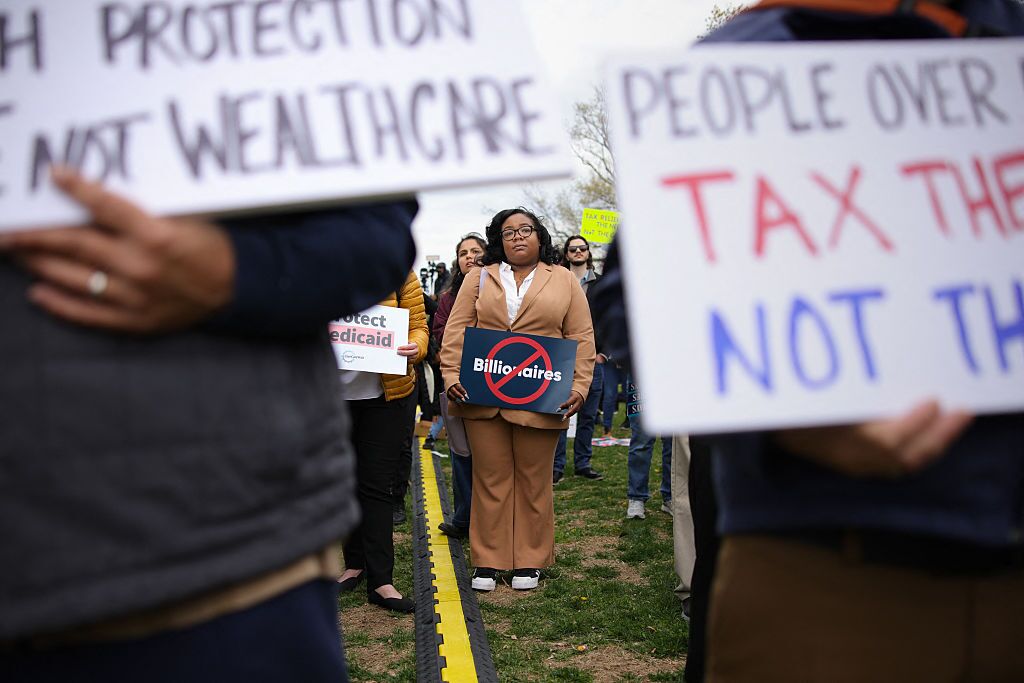
A press conference and rally in support of fair taxation near the U.S. Capitol on April 10, 2025. Tax justice advocates spoke out against President Trump’s tax cuts for the wealthy, and urged members of Congress to intervene. (Bryan Dozier / Middle East Images via AFP and Getty Images)

TANF is the best known of the menu of social services support, but the Child Care and Development Fund (CCDF) explicitly provides financial relief for families needing childcare. Childcare is a key support for working parents. And while 2025 was the weakest year for job growth since 2003, key everyday costs like food, rent and energy are still rising. Even worse, the cost of childcare remains astronomical in many communities. For single parents it can represent up to 35 percent of what they earn, causing some people with children to quit jobs because they literally cannot afford to work. Cuts, or freezes, on the CCDF will make childcare costs shoot up even higher.

So how is eliminating government funding for childcare pro-family you ask? It depends what kind of family you want to support. Because if the cost of childcare rises, one of two things has to happen: Either a parent needs to get a better paying job—quickly—or quit their job to stay home with the kids.

And given that women on average make about 76 cents per dollar paid to men (for Black women, it’s 65 cents; for Latinas, it’s 58 cents), that’s a lot of women who are going to be staying home. 

When childcare is disrupted, full-time employees can miss significant amounts of work. Those work interruptions fall disproportionately on women, as well as Black and multiracial parents.

Women make up 82 percent of those who miss work for childcare reasons, and bBack and multiracial parents have had to quit a job or turn down a job at twice the rate of white parents.

Many of the families that benefit from childcare services are those with only one parent, as well as same-sex parents. The impact on them will be different, but just as harmful.

Either way, we’re pushing people out of the workforce and into the home. And disproportionately, it’s women being pushed.

It is hard not to see that such as result is unlikely to worry the current administration much. On May 3, 2021, JD Vance co-authored an opinion piece for The Wall Street Journal declaring, “Young children are clearly happier and healthier when they spend the day at home with a parent.” 

The Heritage Foundation clearly agrees, because their hot-off-the-presses report, “Saving America by Saving the Family,” restates their belief that children do best when raised by the married couple that created them—a premise it then uses to advance policies including tax incentives for larger families and shifts in childcare funding that would steer public support away from external childcare programs and toward parental, at-home care.

And who do we think is expected to choose home over career? As Acting Assistant Secretary Andrew Gradison of the Administration for Children and Families said recently, “In a healthy America, fathers lead, protect and provide for their families.”  

Great Job Amy Barasch & the Team @ Ms. Magazine Source link for sharing this story.

These Open Earbuds Offer Active Noise Canceling

These Open Earbuds Offer Active Noise Canceling

Like all open-ear earbuds, the OpenFit Pro have an airy and open soundstage that delivers a more natural listening experience than regular earbuds — it’s closer to the experience of listening to speakers. You can make them sound even more immersive by activating the confusingly named Optimized for Dolby Atmos mode. I say confusing because this mode is neither a replacement for Dolby Atmos nor is it strictly for use with existing Dolby Atmos content. It is essentially Dolby’s best earbud-based audio software, which combines spatial audio processing (for a wider and deeper soundstage) with optional head tracking. Both of these features will work with any content; however, Dolby claims it works best when you’re listening to Dolby Atmos content.

It’s the first time Dolby’s tech has been employed on a set of open-ear earbuds, and it’s a great match. It boosts the perceived width and height of the space, and does so without negatively affecting dynamic range or loudness, something that often plagues similar systems. And yes, the effect is more pronounced when listening to Atmos than when playing stereo content. I’ve used Dolby’s spatial tech on several products, including the LG Tone Free T90Q, Jabra Elite 10, and Technics EAH-Z100, and this is the first time I’ve enjoyed it enough to leave it enabled for music listening.

Still, it’s not as effective as Bose’s Immersive Audio on the Bose Ultra Open Earbuds. Bose’s head tracking is smoother—particularly noticeable when watching movies—and its spatial processing is more convincing and immersive for both music and movies.

Where Shokz enjoys a big leg up on Bose is the OpenFit Pro’s call quality. The OpenFit Pro’s mics do a great job of eliminating noises on your end of the call. You could be walking down a busy street, hanging out in a full coffee shop, or even passing by an active construction site, and your callers probably won’t have a clue you aren’t sitting on a quiet park bench. As with all open-ear earbuds, being able to hear your own voice naturally (without the use of a transparency mode) eliminates the fatigue normally associated with long calls on regular earbuds.

Comfortable Design

Photograph: Simon Cohen

Comfort is a key benefit of Shokz’s OpenFit series, and the OpenFit Pro, with ear hooks that are wrapped in soft silicone, are no exception. Unlike previous OpenFit models, which position speakers just outside your ear’s concha, the Pro’s speaker pods project directly into your ears, and in my case, they make contact with the inner part of that cavity. This significantly increases stability, but over time, I became aware of that contact point.

They never became uncomfortable, but it’s not quite the forget-you’re-even-wearing-them experience of the OpenFit/OpenFit 2/+ models. As someone who wears glasses, I tend to prefer clip-style earbuds like the Shokz OpenDots One, and yet the OpenFit Pro’s ear hook shape was never an issue. Shokz includes a set of optional silicone support loops, presumably for folks with smaller ears or who need a more stable fit. They didn’t improve my fit, but then again, I’ve got pretty big ears.

As with all hook-style earbuds, the OpenFit Pro charging case is on the big side. It’s got great build quality thanks to the use of an aluminum frame, and you get wireless charging (not a given with many open-ear models), but it’s still way less pocketable than a set of AirPods Pro.

Easy to Use

Image may contain Electrical Device Microphone Car Transportation Vehicle Electronics and Speaker

Photograph: Simon Cohen

For the OpenFit Pro, Shokz has finally abandoned its hybrid touch/button controls in favor of just physical buttons, and I think it’s the right call. You can now decide exactly which button press combos control actions like play/pause, track skipping, volume, and voice assistant access, a level of freedom that wasn’t available on previous versions.

Great Job Simon Cohen & the Team @ WIRED Source link for sharing this story.

Trump promises oil executives ‘total safety’ if they invest in Venezuela after Maduro ouster | Houston Public Media

Trump promises oil executives ‘total safety’ if they invest in Venezuela after Maduro ouster | Houston Public Media

Julia Reihs | KUT News

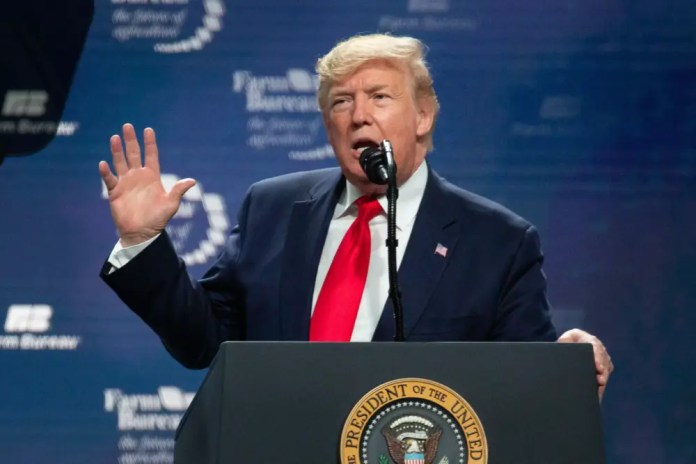
President Trump addressed farmers and ranchers at the American Farm Bureau Federation’s convention in Austin in 2020.

WASHINGTON (AP) — President Donald Trump on Friday called on oil executives to rush back into Venezuela as the White House looks to quickly secure $100 billion in investments to revive the country’s ability to fully tap into its expansive reserves of petroleum.

Since the U.S. military raid to capture former Venezuelan leader Nicolás Maduro on Saturday, Trump has quickly pivoted to portraying the move as a newfound economic opportunity for the U.S., seizing tankers carrying Venezuelan oil, and saying the U.S. is taking over the sales of 30 million to 50 million barrels of previously sanctioned Venezuelan oil and will be controlling sales worldwide indefinitely.

Trump used the meeting with oil industry executives to publicly assure them that they need not be skeptical of quickly investing in and, in some cases, returning to the South American country with a history of state asset seizures as well as ongoing U.S. sanctions and decades of political uncertainty.

“You have total safety,” Trump told the executives. “You’re dealing with us directly and not dealing with Venezuela at all. We don’t want you to deal with Venezuela.”

Trump added: “Our giant oil companies will be spending at least $100 billion of their money, not the government’s money. They don’t need government money. But they need government protection.”

The president said the security guarantee would come from working with Venezuelan leaders and their people, instead of deploying U.S. forces. He also said the companies would “bring over some security.”

Trump played up the potential for major oil companies to strike big, while acknowledging that the oil executives were sharp people who were in the business of taking risk, a quiet nod to the reality that he’s asking for big investment in Venezuela at moment when the country is teetering and economic collapse is not out of the question.

Trump welcomed the oil executives to the White House after U.S. forces earlier Friday seized their fifth tanker over the past month that has been linked to Venezuelan oil. The action reflected the determination of the U.S. to fully control the exporting, refining and production of Venezuelan petroleum, a sign of the Trump administration’s plans for ongoing involvement in the sector as it seeks commitments from private companies.

It’s all part of a broader push by Trump to keep gasoline prices low. At a time when many Americans are concerned about affordability, the incursion in Venezuela melds Trump’s assertive use of presidential powers with an optical spectacle meant to convince Americans that he can bring down energy prices.

Trump urges Big Oil to take the plunge

The White House said it invited oil executives from 17 companies, including Chevron, which still operates in Venezuela, as well as ExxonMobil and ConocoPhillips, which both had oil projects in the country that were lost as part of a 2007 nationalization of private businesses under Maduro’s predecessor, Hugo Chávez. Chevron, ExxonMobil and ConocoPhillips are each headquartered in the Houston area.

“If we look at the commercial constructs and frameworks in place today in Venezuela, today it’s un-investable,” said Darren Woods, the ExxonMobil CEO. “And so significant changes have to be made to those commercial frameworks, the legal system, there has to be durable investment protections and there has to be change to the hydrocarbon laws in the country.”

Other companies invited included Halliburton, Valero, Marathon, Shell, Singapore-based Trafigura, Italy-based Eni and Spain-based Repsol as well as a vast swath of domestic and international companies with interests ranging from construction to the commodity markets.

Large U.S. oil companies have so far largely refrained from affirming investments in Venezuela as contracts and guarantees need to be in place. Trump has suggested that the U.S. would help to backstop any investments.

Venezuela’s oil production has slumped below one million barrels a day. At the heart of Trump’s challenge to turning that around is convincing oil companies that his administration has a stable relationship with Venezuela’s interim President Delcy Rodríguez, and can provide protections for companies entering the market.

Trump, however, is confident that Big Oil is ready to take the plunge, but allowed that it’s not without risk.

“You know, these are not babies,” Trump said of the oil industry executives. “These are people that drill oil in some pretty rough places. I can say a couple of those places make Venezuela look like a picnic.”

The president also offered a new rationale for ousting Maduro and demanding the U.S. maintain oversight of its Venezuelan oil industry, saying, “One thing I think everyone has to know is that if we didn’t do this, China or Russia would have done it.”

While Rodriguez has publicly denounced Trump and the ouster of Maduro, the U.S. president has said that to date Venezuela’s interim leader has been cooperating behind the scenes with his administration.

Tyson Slocum, director of the consumer advocacy group Public Citizen’s energy program, criticized the gathering and called the U.S. military’s removal of Maduro “violent imperialism.” Slocum added that Trump’s goal appears to be to “hand billionaires control over Venezuela’s oil.”

Trying to restore diplomatic ties

Meanwhile, the United States and Venezuelan governments said Friday they were exploring the possibility of restoring diplomatic relations between the two countries, and a delegation from the Trump administration arrived in the South American nation Friday.

The small team of U.S. diplomats and diplomatic security officials traveled to Venezuela to make a preliminary assessment about the potential reopening of the U.S. Embassy in Caracas, the State Department said in a statement.

Trump also announced Friday he’d meet next week, either Tuesday or Wednesday, with Maria Corina Machado, the leader of Venezuela’s opposition party, as well as with Colombian President Gustavo Petro in early February.

Trump has declined to back Machado, even as the U.S. and most observers determined her opposition movement defeated Maduro in Venezuela’s last election. Trump said following Maduro’s ouster that Machado “doesn’t have the support within, or the respect within, the country” to lead.

Trump called on the Colombian leader to make quick progress on stemming flow of cocaine into the U.S.

Trump, following the ouster of Maduro, had made vague threats to take similar action against Petro, describing the Colombia leader as a “sick man who likes making cocaine and selling it to the United States”

Trump abruptly changed his tone Wednesday about his Colombian counterpart after a friendly phone call in which he invited Petro to visit the White House.

The seeming détente between Petro, a leftist, and Trump, a conservative, appears to reflect that their shared interests override their deep differences.

For Colombia, the U.S. remains key to the military’s fight against leftist guerrillas and drug traffickers. Washington has provided Bogotá with roughly $14 billion in the last two decades.

For the U.S., Colombia, the world’s biggest cocaine producer, remains the cornerstone of its counternarcotics strategy abroad, providing crucial intelligence used to interdict drugs in the Caribbean. —

Associated Press writers Matthew Daly and Seung Min Kim contributed to this report.

Great Job & the Team @ Houston Public Media for sharing this story.

Seeing Double?! Social Media Goes WILD After Erykah Badu’s Daughter Puma Flexes Their Twin-Like Resemblance (PHOTOS)

Seeing Double?! Social Media Goes WILD After Erykah Badu’s Daughter Puma Flexes Their Twin-Like Resemblance (PHOTOS)

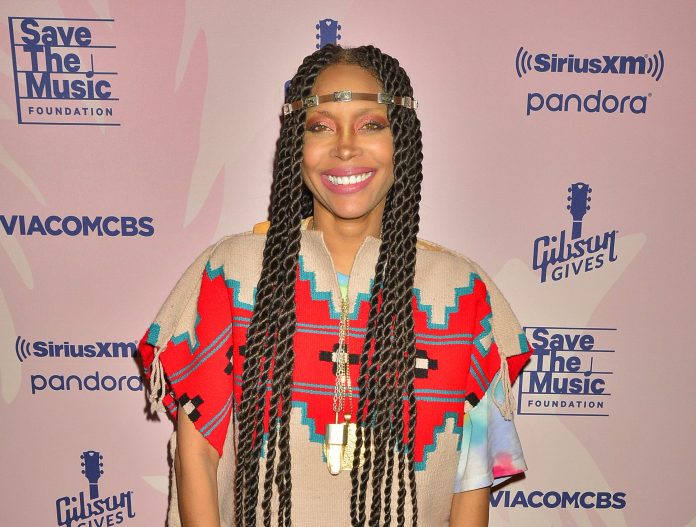
Roommates, Erykah Badu and her daughter Puma have the internet seeing double after Puma dropped some pics of them on Instagram. The photos have folks saying their copy-paste energy is next level, making them practically look like twins.

RELATED: Aht! Aht! Erykah Badu Ain’t Playing About Her “Child Support” From Andre 3000 In New Interview (VIDEO)

Erykah Badu & Puma Have The Internet Doing Double Takes

The internet is calling Erykah Badu and her daughter Puma goals after the 21-year-old dropped some cute pics of them on Instagram. In the photos, their eyes practically match, and in another one they’re even rocking similar style outfits with stocking caps on their heads.

Puma gave her mom mad props in the caption, letting everyone know her mom has always been top two and not two! “It’s uncanny she’s literally the blueprint ” Erykah slid in her comment section with the sweetest compliment adding, “ She’s the improvement ”

Internet Goes Crazy After Seeing Erykah & Puma Side By Side

After The Shade Room dropped the pics of Erykah and Puma, the comment section went wild! Some fans said they look like identical twins, while others think Puma looks like Erykah and her dad D.O.C.

Instagram user @raven_thick wrote, That’s a beautiful copy & paste situation ” 

Instagram user @dominiquechinn wrote, “Mommy said copy/paste ” 

While Instagram user @kimmymar wrote,Beauty like her Mama . And can sing too ” 

Then Instagram user @worldstarfanny_ wrote, “Crazy part is she looks just like her father as well.” 

Another Instagram user @kweenmocha wrote,Doc and Erykah went half on a baby since Puma looks like whoever she’s with ” 

Instagram user @beccahanna6 wrote, “So she just gonna clone herself and think we not gonna notice?” 

Then another Instagram user @saucybanks wrote, Identical twins bro ” 

While another Instagram user @t.leshaye_ wrote, They so pretty” 

Finally, Instagram user @reed.toni58 wrote, “Wow she gave birth to herself.”

Is Puma Her Mom’s Twin, Dad’s Mini, Or Both?

This isn’t the first time Puma had folks flooding her comment section with heart-eye emojis. Back in October 2025, she went viral after sharing pics posing with her mom and dad, D.O.C. While some debated over her genes, others gave her parents made props for being super dope.


RELATED: Erykah Badu Sparks BBL Shade After Poppin’ Out At Billboard Women In Music Awards With THIS Curvy Fit (VIDEO)

What Do You Think Roomies?

Great Job Ashley Rushford & the Team @ The Shade Room Source link for sharing this story.

Secret Link