Sign up for TPR Today, Texas Public Radio’s newsletter that brings our top stories to your inbox each morning.
San Antonio City Council is preparing to hold a public discussion Jan. 22 about how the San Antonio Police Department coordinates with state and federal immigration authorities, amid rising tensions over federal enforcement actions and community protests.
District 1 Councilmember Sukh Kaur announced the planned meeting in a social media video, saying council members want to be transparent about how SAPD works with outside agencies and federal immigration enforcement. Residents will be invited to speak during the public comment period, which is expected to begin at 1 p.m. An official agenda has not yet been released.
“We hope that we can all have a good conversation about what we’re required to do, but making sure we’re still keeping all members of our community safe,” Kaur said.
The protests here and across the United States were held in the wake of the fatal shooting of Renée Nicole Good by a U.S. Immigration and Customs Enforcement agent in Minneapolis.
The announcement comes as San Antonio has seen several demonstrations tied to federal immigration activity.
On Saturday, hundreds marched through downtown’s Main Plaza in protest of actions by U.S. Immigration and Customs Enforcement, calling for accountability and expressing fear about enforcement tactics following a widely publicized fatal shooting of Renée Nicole Good by an ICE agent in Minneapolis.
Over 100 people came out to protest Monday evening on the corner of San Pedro Avenue and Basse Road. That was the location of a multi-agency law-enforcement operation involving Texas Department of Public Safety troopers, San Antonio police, and federal immigration authorities early Sunday morning.
In November, more than 100 residents also gathered near San Pedro and Basse after a large-scale federal immigration enforcement operation in the area, decrying the raids and demanding community protections.
Under Texas law, San Antonio police are required to cooperate with federal immigration authorities in certain situations, even though department policy limits officers from enforcing immigration law or detaining people based solely on their status.
In a statement following President Donald Trump’s 2025 inauguration, the city of San Antonio said that SAPD will cooperate with the federal government on immigration as long as Trump’s plans follow the law.
Great Job TPR Staff & the Team @ Texas Public Radio for sharing this story.
When Justin Kim, co-founder and CEO of Hupo, first launched his company about four years ago, it wasn’t selling AI-powered sales coaching to banks, finance services, or insurance companies. The company originally began as Ami, a mental wellness platform focused on how people manage pressure, form habits, and change behavior over time.
“I’ve always been a big sports fan – basketball, football, Formula One, MMA – and what draws me to all of them is performance. In my free time, I’ve spent a lot of time thinking about what actually drives human performance. People are very different, but across sports, there are clear patterns in how performance shows up,” Kim said in an interview with TechCrunch.
His curiosity eventually shaped his professional focus. Kim started exploring what drives performance at work, and one theme kept surfacing: mental resilience. That idea led him to found a startup in 2022.
Early work with Meta, which backed this startup in the seed round, helped sharpen some hard-earned lessons: software only works when it fits into daily behavior like how people already live and work, and tools designed to help people “improve” often fail if they are judgmental, abstract, or disconnected from real work, Kim told TechCrunch.
Those ideas followed the startup through its pivot, and today they shape Hupo’s approach to sales coaching; less about replacing human judgment and more about helping people in the moments that really matter in banking, insurance, and financial services.
Kim said the shift wasn’t as dramatic as it might seem. “The core problem in both cases is performance at scale. In banking and insurance, results vary, not because of motivation, but because training, feedback, and confidence differ. Traditional coaching can’t reach everyone, and managers can’t sit in on every conversation.”
AI that understands conversations in real-time now allows teams to receive consistent coaching, even in the highly regulated, complex industry, Kim noted.
Techcrunch event
San Francisco | October 13-15, 2026
image credits: Hupo
Hupo has raised a $10 million Series A led by DST Global Partners, with participation from Collaborative Fund, Goodwater Capital, January Capital, and Strong Ventures. In addition, the Singapore-headquartered startup now serves dozens of customers in APAC and Europe, including Prudential, AXA, Manulife, HSBC, Bank of Ireland, and Grab.
“BFSI [Banking, Financial Services and Insurance] is a notoriously difficult vertical for early-stage companies, but our customers typically expand contracts 3–8x within the first six months,” the founder said. “We’ll be expanding into the US in the first half of this year, where distribution-heavy financial models create a strong need for scalable coaching.”
Kim started his career at Bloomberg, selling enterprise software to banks, asset managers, and insurers, where he saw how complex regulated sales could be. He later worked on product development at South Korean fintech Viva Republica, the company behind Toss, learning how technology built around real user behavior could reshape traditional financial services.
“Hupo sits at the intersection of those experiences. I understood the buyer, the end user, and the operational reality of selling financial products,” Kim said. “Once AI became capable of understanding context and coaching in real time, it became obvious to me that sales coaching—especially in banking and insurance—was the right place to apply it.”
Many AI sales coaching tools start with the technology first, Kim said, but Hupo took a different approach, building its platform around how banks and insurers operate. “One of the biggest lessons I’ve learned is that, especially with large enterprises, you have to understand their business and industry in detail,” he added, noting that Hupo’s models were trained from the start on real financial products, common objections, client types, and regulatory requirements.
The latest round brings total funding to $15 million since the company was founded in 2022. The new capital will go toward expanding its product, including real-time coaching features, scaling enterprise-grade deployments, growing go-to-market efforts in banking, financial services, and insurance, and building out the team.
In five years, Kim says he wants Hupo to go beyond sales coaching and help large teams perform at scale, giving managers and employees clearer insights and practical guidance, even across tens of thousands of people.
Great Job Kate Park & the Team @ TechCrunch Source link for sharing this story.
A man accused of killing his ex-wife and her husband in Ohio is facing upgraded murder charges as he’s expected to be moved from Illinois to face prosecution across the state line.
Michael David McKee, 39, is now facing two charges of premeditated aggravated murder, according to Franklin County court records. McKee was arrested in Illinois on Saturday in connection to the deaths of his ex-wife, Monique Tepe, 39, and her husband, Spencer Tepe, 37, in Columbus, Ohio.
Spencer Tepe’s brother-in-law, Rob Misleh, told NBC News on Monday that the couple’s death was shocking but their family “quickly believed” McKee had something to do with it.
“He was an emotionally abusive person when they were together, that is all I know,” Misleh said.
He previously told NBC News that Mckee’s arrest represents “an important step toward justice” for the slain couple, though nothing can undo the loss.
A Chicago man was arrested in connection to the murder of his ex-wife and her husband in Ohio.
McKee stood up straight as he appeared in court Monday in a yellow Winnebago County jail suit, wearing glasses with his hands and feet chained. He was represented by Winnebago County Public Defender Carie Poirier.
He plans to plead not guilty to the charges and is hoping for a speedy transfer to Ohio by waiving extradition, Poirier said.
McKee stayed silent during the quick hearing, only addressing the court when giving the judge his name.
Monique and Spencer Tepe were married in January 2021 in Columbus, according to their wedding video. During her vows, Monique Tepe said that she knew from the first day that she had found someone special.
“I had quite a journey to get to you, countless bad Bumble dates, wrong relationships and waterfalls of tears, but it was worth every cringing second because it led me to you,” she said.
The couple was found dead in their home on Dec. 30 from apparent gunshot wounds, according to a police report.The county coroner’s report said their cause of death appears to be a homicide, but cautioned that the case was not yet finalized.
Their two young children were found in the home unharmed.
McKee and Monique Tepe divorced in 2017 after two years of marriage. Investigators have not yet identified a motive in the attack.
Monique Tepe and her husband are believed to have been killed between 2 a.m. and 5 a.m. on the morning of Dec. 30. They were found later that day, after friends and co-workers were concerned that Spencer Tepe, a dentist, had not shown up to work. Around 10 a.m., a man called 911 and said he could see a body and blood in the home.
Columbus police previously released a video of a person of interest wearing a hooded jacket walking in an alley near the Tepes’ home on the night of the killings. Officials declined to answer whether they believed McKee was the man in the video, saying they did not want to make remarks that could compromise the case.
McKee is a medical doctor specializing in vascular surgery with licensing in both California and Illinois, according to online records. He graduated from the Ohio State University College of Medicine in 2014, the records show.
He was also previously licensed in Nevada, but that license expired in June. There are no reports of medical malpractice or disciplinary history marked in his licensing records.
OSF Saint Anthony Medical Center, where McKee is listed as a vascular surgeon, said it was working with authorities. The hospital is located in Rockford, Illinois, a city more than 400 miles northwest of Columbus, Ohio.
McKee is currently being held in Winnebago County Jail in Illinois. It’s unclear when he will be transferred to Ohio.
Great Job Selina Guevara, Doha Madani and Jake Lubbehusen | NBC News & the Team @ NBC 5 Dallas-Fort Worth for sharing this story.
In 2022, the Natural Resource Conservation Service began sampling soils in San Antonio and Bexar County, Texas to measure soil organic carbon. This project was started in conjunction with the Greater Edwards Aquifer Alliance and the City of San Antonio Parks and Recreation Department. Travis Waiser will cover the sampling technique, where samples were taken, and summarize the data collected from the project. At the end of the talk Travis will cover some management strategies that can be implemented to build soil carbon in your soils.
Coal power generation fell in both China and India in 2025, the first simultaneous drop in half a century, after each nation added record amounts of clean energy.
The new analysis for Carbon Brief shows that electricity generation from coal in India fell by 3.0% year-on-year (57 terawatt hours, TWh) and in China by 1.6% (58TWh).
The last time both countries registered a drop in coal power output was in 1973.
The fall in 2025 is a sign of things to come, as both countries added a record amount of new clean-power generation last year, which was more than sufficient to meet rising demand.
Both countries now have the preconditions in place for peaking coal-fired power, if China is able to sustain clean-energy growth and India meets its renewable energy targets.
These shifts have international implications, as the power sectors of these two countries drove 93% of the rise in global carbon dioxide (CO2) emissions from 2015-2024.
While many challenges remain, the decline in their coal-power output marks a historic moment, which could help lead to a peak in global emissions.
Double drop
The new analysis shows that power generation from coal fell by 1.6% in China and by 3.0% in India in 2025, as non-fossil energy sources grew quickly enough in both countries to cover electricity consumption growth. This is illustrated in the figure below.
Growth in coal-fired power generation in China and India by year, %, 1972-2025. Source: Analysis by Lauri Myllyvirta for Carbon Brief. Further details below.
China achieved this feat even as electricity demand growth remained rapid at 5% year-on-year. In India, the drop in coal was due to record clean-energy growth combined with slower demand growth, resulting from mild weather and a longer-term slowdown.
The simultaneous drop for coal power in both countries in 2025 is the first since 1973, when much of the world was rocked by the oil crisis. Both China and India saw weak power demand growth that year, combined with increases in power generation from other sources – hydro and nuclear in the case of India and oil in the case of China.
China’s recent clean-energy generation growth, if sustained, is already sufficient to secure a peak in coal power. Similarly, India’s clean-energy targets, if they are met, will enable a peak in coal before 2030, even if electricity demand growth accelerates again.
In 2025, China will likely have added more than 300 gigawatts (GW) of solar and 100GW of wind power, both clear new records for China and, therefore, for any country ever.
Power generation from solar and wind increased by 450TWh in the first 11 months of the year and nuclear power delivering another 35TWh. This put the growth of non-fossil power generation, excluding hydropower, squarely above the 460TWh increase in demand.
Growth in clean-power generation has kept ahead of demand growth and, as a result, power-sector coal use and CO2 emissions have been falling since early 2024.
Coal use outside the power sector is falling, too, mostly driven by falling output of steel, cement and other construction materials, the largest coal-consuming sectors after power.
In India’s case, the fall in coal-fired power in 2025 was a result of accelerated clean-energy growth, a longer-term slowdown in power demand growth and milder weather, which resulted in a reduction in power demand for air conditioning.
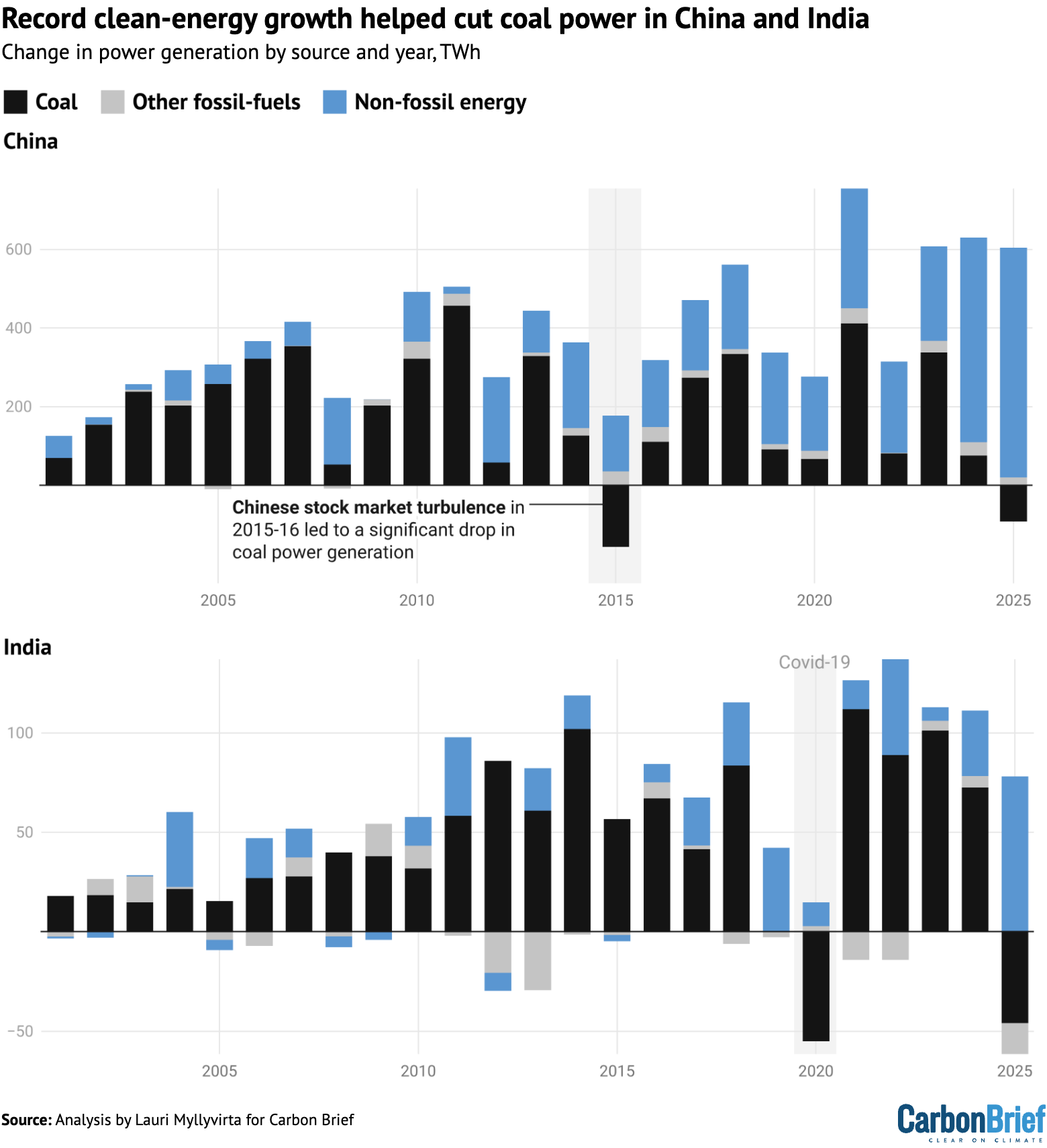
Faster clean-energy growth contributed 44% of the reduction in coal and gas, compared to the trend in 2019-24, while 36% was contributed by milder weather and 20% by slower underlying demand growth. This is the first time that clean-energy growth has played a significant role in driving down India’s coal-fired power generation, as shown below.
Change in power generation in China and India by source and year, terawatt hours 2000-2025. Source: Analysis by Lauri Myllyvirta for Carbon Brief. Further details below.
India added 35GW of solar, 6GW wind and 3.5GW hydropower in the first 11 months of 2025, with renewable energy capacity additions picking up 44% year-on-year.
Power generation from non-fossil sources grew 71TWh, led by solar at 33TWh, while total generation increased 21TWh, similarly pushing down power generation from coal and gas.
The increase in clean power is, however, below the average demand growth recorded from 2019 to 2024, at 85TWh per year, as well as below the projection for 2026-30.
This means that clean-energy growth would need to accelerate in order for coal power to see a structural peak and decline in output, rather than a short-term blip.
Meeting the government’s target for 500GW of non-fossil power capacity by 2030, set by India’s prime minister Narendra Modi in 2021, requires just such an acceleration.
Historic moment
While the accelerated clean-energy growth in China and India has upended the outlook for their coal use, locking in declines would depend on meeting a series of challenges.
First, the power grids would need to be operated much more flexibly to accommodate increasing renewable shares. This would mean updating old power market structures – built to serve coal-fired power plants – both in China and India.
Second, both countries have continued to add new coal-fired power capacity. In the short term, this is leading to a fall in capacity utilisation – the number of hours each coal unit is able to operate – as power generation from coal falls.
(Both China and India have been adding new coal-power capacity in response to increases in peak electricity demand. This includes rising demand for air conditioning, in part resulting from extreme heat driven by the historical emissions that have caused climate change.)
If under-construction and permitted coal-power projects are completed, they would increase coal-power capacity by 28% in China and 23% in India. Without marked growth in power generation from coal, the utilisation of this capacity would fall significantly, causing financial distress for generators and adding costs for power users.
In the longer term, new coal-power capacity additions would have to be slowed down substantially and retirements accelerated, to make space for further expansion of clean energy in the power system.
Despite these challenges ahead, the drop in coal power and record increase in clean energy in China and India marks a historic moment.
Power generation in these two countries drove more than 90% of the increase in global CO2 emissions from all sources between 2015-2024 – with 78% from China and 16% from India – making their power sectors the key to peaking global emissions.
About the data
China’s coal-fired power generation until November 2025 is calculated from monthly data on the capacity and utilisation of coal-fired power plants from China Electricity Council (CEC), accessed through Wind Financial Terminal.
For December, year-on-year growth is based on a weekly survey of power generation at China’s coal plants by CEC, with data up to 25 December. This data closely predicts CEC numbers for the full month.
Other power generation and capacity data is derived from CEC and National Bureau of Statistics data, following the methodology of CREA’s monthly snapshot of energy and emissions trends in China.
For India, the analysis uses daily power generation data and monthly capacity data from the Central Electricity Authority, accessed through a dashboard published by government thinktank Niti Aayog.
The role of coal-fired power in China and India in driving global CO2 emissions is calculated from the International Energy Agency (IEA) World Energy Balances until 2023, applying default CO2 emission factors from the Intergovernmental Panel on Climate Change.
To extend the calculation to 2024, the year-on-year growth of coal-fired power generation in China and India is taken from the sources above, and the growth of global fossil-fuel CO2 emissions was taken from the Energy Institute’s Statistical Review of World Energy.
The time series of coal-fired power generation since 1971, used to establish the fact that the previous time there was a drop in both countries was 1973, was taken from the IEA World Energy Balances. This dataset uses fiscal years ending in March for India. Calendar-year data was available starting from 2000 from Ember’s yearly electricity data.
Great Job Lauri Myllyvirta & the Team @ Carbon Brief Source link for sharing this story.
WILL CAIN (HOST): The department is surging hundreds of additional agents into Minneapolis to support the ongoing ICE operations there in the wake of last week’s shooting. This comes — in this press conference today — comes as we’re getting new witness video of Renee Good before the shooting. She can be seen in her vehicle blocking agents for several minutes, even dancing to the tune of her own car horn. You know, all the behavior of a legal observer.
There’s a weird kind of smugness, by the way, in the way that some of these liberal white women interact with authority. Most guys learn early in life that every confrontation has a sort of escalation chain. A joke, a push, an argument can eventually turn to violence. We spend a lifetime reading the signs, knowing when we’re getting close, knowing when to pull back, knowing when we’re on the edge of violence. These protesters? They seem completely oblivious, or they think they have a hall pass to the possibility that blocking cops or using their cars as barricades could end violently — tragically, but violently.
Great Job Media Matters for America & the Team @ Media Matters for America Source link for sharing this story.
Living with chronic inflammatory demyelinating polyneuropathy (CIDP) means managing symptoms that can range from frustrating to debilitating. Depending on the severity of your CIDP, you may experience tingling in your hands and feet, numbness, coordination problems, and impaired mobility that requires a wheelchair or walker.
In addition to working with your neurologist to establish a treatment plan, you can implement a few strategies into your daily or weekly routine to make every day life with CIDP a bit easier. Here are some things you can do now to raise your CIDP symptom-management game.
1. Work With a Physical or Occupational Therapist
Many people with CIDP experience muscle weakness, balance problems, and diminished reflexes. Physical therapy can help you improve muscle strength and coordination, maintain mobility, and reduce neuropathic pain, and occupational therapy can help you work on fine motor skills and teach you new ways to perform daily tasks so you can maintain your independence.
“I think it’s very helpful to work with physical and occupational therapists — they can guide you in what exercises to do or not to do,” says Michal Vytopil, MD, PhD, vice chair of neurology at Beth Israel Lahey Health’s Lahey Hospital and Medical Center, in Burlington, Massachusetts. Dr. Vytopil generally recommends low-impact aerobic exercise, like walking, swimming, or stationary cycling, which are less likely to cause musculoskeletal damage.
When choosing a therapist, be sure they have experience working with people who have conditions involving nerve damage. Also, be sure to get the all-clear from your doctor before starting new physical activity — and better yet, ensure your physical therapist and your doctor are coordinating and communicating about your care plan.
2. Focus on Good Nutrition
A healthy diet is an important part of managing CIDP, and should focus on a Mediterranean-style diet that includes anti-inflammatory, nutrient-dense foods such as fresh fruits and vegetables, whole grains, nuts, and fish. For people with a peripheral neuropathy condition such as CIDP, it’s particularly important to steer clear of foods high in saturated fats and processed foods, as well limit or avoid high-sugar foods and alcohol, which have been found to put your nerve health at risk.
It’s also important to stay hydrated if you’re undergoing intravenous immunoglobulin therapy to prevent side effects ranging from headaches to kidney damage.
3. Seek Mental Health Support
Some research suggests people living with CIDP have a higher risk of developing mental health symptoms and disorders. Many people admit feeling sadness when thinking about life before symptoms began, a time with fewer limitations. Self-image may also be impacted; perhaps you now see yourself primarily as someone who has CIDP, rather than recognizing your condition as only a part of who you are and something you can learn to manage.
You may find it healing to work with a mental health professional who can help you process complicated feelings about living with CIDP and develop coping strategies to feel more content and in control in your daily life. You could also consider joining a chronic pain support group. There, you’ll meet people who understand what you’re experiencing and may share details on the latest treatments and strategies that are working for them.
4. Find Balance and Learn to Prioritize
It’s not just physical balance you’ll want to maintain — you’ll have to listen to your body and find a rhythm of activity and rest that feels good to you. By prioritizing and accepting help from friends and family, you can focus on what’s most important and protect your overall health.
5. Use Assistive Devices
Whether it’s a brace, walker, or small tool to make it easier for you to do things around the house, assistive devices can make a big difference by reducing pain, adjusting for muscle weakness, and preventing injury. They can also help you stay independent and safe. “Things like bracing will help not only manage symptoms, but reduce flares and improve quality of life when you have CIDP,” says Lewis.
Some other examples of assistive devices include:
Handrails and grab bars in the bathroom
Bathtub and shower thermometer to help you check the water temperature
Gloves to prevent cuts or scrapes when doing housework
Jar openers
Zipper pulls
Button hook
Long-handled shoe horn
Managing CIDP goes beyond medications. It also requires collaboration between you, your neurologist, and other specialists working together to minimize symptoms and help you maintain your quality of life.
The Takeaway
Living with CIDP can involve a wide range of symptoms, from mild tingling to significant weakness and mobility challenges, making daily life difficult for some people.
Alongside medical interventions, lifestyle measures — such as working with physical and occupational therapists, eating a healthy diet, and using assistive devices — can help you manage symptoms and maintain independence.
A holistic, team-based approach that combines medical care with personalized lifestyle strategies and mental health help can improve quality of life and allow you to feel more in control of your condition.
Great Job Katherine Lee & the Team @ google-discover Source link for sharing this story.
Tarrant County GOP officials promised to continue exploring hand-counting ballots for future primary elections, despite determining that the move would be too logistically challenging for the March 3 primaries.
Some local Republican Party officials argue that hand-counting paper ballots would better protect voters’ information and ward off potential security gaps in electronic voting machines.
“We’re not doing the ballot hand-count right now, not because of any lack of effort, or because we didn’t consider it serious. Trust me, we did,” John O’Shea, a Republican precinct chair, told members of the Republican Party during a Jan. 8 executive meeting.
“But we’re going to get there, I promise you,” O’Shea said.
John O’Shea, a Tarrant County Republican Party precinct chair, talks to members of the party during an executive committee meeting on Jan. 8, 2026, in Fort Worth. (Drew Shaw | Fort Worth Report)
Democratic Chair Allison Campolo decried the Republicans’ exploration of hand-counting, calling it slower, more expensive and “significantly less accurate and less secure” than the county’s current machines.
“They are chasing a conspiracy theory to guide them to make poorer choices, and if they do, it will negatively affect all Tarrant voters regardless of party,” she said.
Hand-counting ballots would be a switch from the county’s current system of using the Hart Intercivic voting machines. These machines, while electronic, don’t connect to the internet and store voters’ information on external hard drives.
Republicans can make such a change to their March partisan primaries unilaterally, as such elections are run by the local Republican and Democratic parties. This differs from May and November elections, which Tarrant County administers.
GOP officials considered hand-counting ballots over the fall as a team of precinct chairs explored what funding, staffing and systemic changes would be needed. Their efforts included hosting “speed tests” to assess how fast volunteers could accurately tally ballots.
Tarrant County GOP chair Tim Davis declined to comment on how the local party intends to continue exploring hand-counting ballots.
Republican officials on the team looking at hand-counting ballots told GOP precinct chairs that, while the team feels the effort is important, the party doesn’t have the time, resources, funding or logistics to make the change by this March.
However, officials added that the party is still working to take “every measure possible” to ensure “free and fair” elections.
Her sentiments were similar to those of the Dallas County GOP that abandoned its plan to switch to hand-counting, citing logistical cost and staffing issues. However, both Dallas and Williamson County Republicans plan to employ precinct-level voting, meaning voters would have to vote in the specific precinct determined by their home address.
Hand-counting ballots would notably require the Tarrant County GOP to also switch to precinct-level voting. Tarrant voters can cast ballots anywhere in the county currently.
While the Democratic Party wouldn’t be required to hand-count ballots, it would have to switch to precinct-level voting, under a state law that aims to prevent partisan disenfranchisement.
That would mean both parties would need hundreds of new voting locations unless they considerably consolidate precincts. Tarrant County has about 700 precincts — significantly more than the 200 voting locations available in the 2024 primary elections.
Those opposing such a move said these challenges would disenfranchise voters and make counting ballots too expensive.
“I am absolutely stunned that any faction of the (GOP) is still attempting to conduct hand-counting in a county of over 1 million eligible voters,” Campolo said.
Typically, Texas partially reimburses the parties for election-related costs for primaries. In 2023, the state warned county party chairs that it wouldn’t absorb higher-than-normal costs for the primary compared with previous years.
Hand-counting ballots poses a challenge for poll workers and election judges in ensuring thousands of ballots are accurately tabulated within 24 hours. State law does not require hand-counted results to be audited, as it does for machine-tabulated ones, and it severely limits public observation of the counting process.
In March 2024, about 69,000 Republicans cast votes in Tarrant County on Election Day as did about 36,000 Democrats. The 2022 primary saw about 61,000 Republicans cast ballots on Election Day and almost 36,000 Democrats.
Tarrant County elections hold up to past scrutiny
Calls to hand-count ballots have grown louder since 2020 amid skepticism and misinformation campaigns about machines used for voting and tabulating ballots.
Then-election administrator Heider Garcia repeatedly defended Tarrant County’s elections over his tenure as being secure and reliable. No evidence of widespread or coordinated election fraud has been found under Tarrant County’s current system.
In 2022, following Trump’s persistent denial of his loss in 2020, Republican Tarrant County Judge Tim O’Hare ran on the promise to increase election security. He repeated throughout his campaign unsubstantiated allegations that Tarrant County saw significant “mail ballot harvesting” and “Democrats cheating.”
O’Hare launched multiple initiatives to tighten election security, including creating an election integrity unit in 2023 to investigate any reports of fraud or security gaps. The unit’s investigations have not resulted in any criminal charges.
In recent interviews, Trump has suggested that an executive order regarding election security and interference is on the horizon before November’s midterm elections.
Abandoning countywide voting would reduce the use of the county’s electronic system used to check in and verify voters at polling sites — a system some Republicans argued is insecure because the systems connect to the internet. The e-pollbooks are different from voting machines, which do not connect to the internet.
At the Fort Worth Report, news decisions are made independently of our board members and financial supporters. Read more about our editorial independence policy here.
This <a target=”_blank” href=”https://fortworthreport.org/2026/01/12/tarrant-county-gop-promises-to-explore-hand-counting-ballots-in-future-elections-but-not-this-years/”>article</a> first appeared on <a target=”_blank” href=”https://fortworthreport.org”>Fort Worth Report</a> and is republished here under a <a target=”_blank” href=”https://creativecommons.org/licenses/by-nd/4.0/”>Creative Commons Attribution-NoDerivatives 4.0 International License</a>.<img src=”https://i0.wp.com/fortworthreport.org/wp-content/uploads/2021/04/cropped-favicon.png?resize=150%2C150&quality=80&ssl=1″ style=”width:1em;height:1em;margin-left:10px;”>
OpenAI announced it has acquired a tiny startup called Torch for an undisclosed sum. An unnamed sourced told the Information that OpenAI paid $100 million worth of equity for the startup. Torch’s four-person team is joining OpenAI, both companies said.
Torch was working on an app that combined all of a person’s medical information for AI use from a range sources such as doctor visits, lab tests, wearables and other portals, including consumer wellness tests and the like. The Torch team called their tech “a medical memory for AI, unifying scattered records into a context engine.”
This acqui-hire means a different fate. The team and its tech will be part of OpenAI’s newly announced ChatGPT Health, a service for people using the chatbot to analyze and manage their health.
Great Job Julie Bort & the Team @ TechCrunch Source link for sharing this story.
Gayle King knows how to command a room, but sometimes the room decides what it wants to talk about instead. The veteran broadcaster has spent decades shaping conversations and showing up exactly as she is.
However, after being spotted at a Hollywood awards show with a new look, the energy around the Maryland native quickly went from admiration to nitpicking over what she tried to hide in photos.
Gayle King’s red carpet moment shifted from celebration to critique as online attention zeroed in on old pictures of her feet instead of her overall look. (Photo: Dia Dipasupil/Getty Images)
Over the past year, King has appeared increasingly confident and visibly slimmer, a shift she has never hidden or dramatized. She has been open about her wellness journey for years. Still, with every high-profile appearance, speculation tends to follow, with people weighing in on her shedded pounds, wondering if she used the weight loss drugs her bestie, Oprah Winfrey, has used.
The same conversation resurfaced after King stepped onto the Golden Globes red carpet in a plunging, figure-hugging gown that highlighted her transformed silhouette. Her feet were covered with heels to match the dress, likely to prevent further ridicule about her toes.
While the look initially drew praise, the focus didn’t stay there for long when the Daily Mail started to dig in deeper on her public journey to getting smaller.
As photos from 2020 recirculated on the site, attention veered away from the dress and landed somewhere far more specific: her feet.
What might have been a fleeting observation quickly took on a life of its own online. Instead of lingering on the gown or King’s overall presentation, Daily Mail readers zeroed in on close-up images and began dissecting details that had little to do with the event itself.
One person wrote, “The pic of her hideous feet is embarrassing.”
Another asked, “All that money she has and she can’t get a pedicure?”
Others went further, with one comment reading, “Gayle and Shaq have the worst looking feet. All that money she has she can get them things fixed.”
Another added, “What is up with those nasty feet? Like some kind of evil demon creature’s hooves.”
One more commenter piled on, saying, “Does she ever get a fresh pedicure??? I would never take a photo of my feet looking like that…much less post it to social media! She still looks like a big girl.”
The reactions illustrated how quickly social media can turn a full red carpet moment into a single-point critique.
This wasn’t the first time King found herself under that kind of microscope.
Last summer, a yacht day photo featuring King alongside Oprah Winfrey and Kris Jenner went viral, prompting a similar cycle of scrutiny. While many admired the image of the longtime friends enjoying a luxurious day together, others focused on King’s wig, then zeroed in on her feet. Even amid wealth, friendship, and ease, the internet found details to debate.
At the same time, King continues to be celebrated for far more than viral moments. She has remained candid about her life, her confidence, and her desire for companionship, speaking openly about wanting love without turning it into a performance.
She has also embraced visibility on her own terms, including posing in swimwear for Sports Illustrated, a move that underscored her comfort with her body and her refusal to fade quietly into the background.
Gayle King is a man
1) blatantly flashing devil horns in a Sports Illustrated Swimsuit issue…a smiling satanist with black hole eyes 2) touching the masonry, big chin, long arms 3) huge mastoids, huge hand with male digits 4) with another dude with a gigantic head, Tyra Banks pic.twitter.com/SLpVy7T4Kj
While the Daily Mail had people talking about her feet, this magazine cover had people talking about her booty.
While critics fixate on what they see as imperfections, others point to King’s consistency, warmth, and willingness to live visibly and honestly. At 71, she remains present, engaged, and unapologetic about occupying space exactly as she is.
And if her toes aren’t polished enough for the world, perhaps the issue is theirs and not hers. People will hate as she enjoys rubbing elbows and tiptoeing on the red carpet with people they only read about.
Great Job Nicole Duncan-Smith & the Team @ Atlanta Black Star Source link for sharing this story.